The Apollo Quartet is hard sf, but it’s also alternate history. And the books of the quartet themselves have their own alternate history too. They say a plan never survives contact with the enemy and, in pretty much the same way, a synopsis never survives unscathed once you actually get into writing a novel, novella or story.
I can’t remember at what point in the writing of Adrift on the Sea of Rains I decided it would be the first of the quartet… but once I’d made the decision I obviously needed to come up with three more stories. I had one sitting in my “ideas book” (actually, it’s just a Google doc) that I thought would be suitable. It was only when I started writing the second book of the quartet that I realised it didn’t quite fit. So I kept one narrative thread, left the other as implied, added a new narrative about the mission to Mars, set the story decades earlier… and changed the title to The Eye With Which The Universe Beholds Itself.
The original Apollo Quartet 3 and 4 bear no resemblance to the ones that have been/will be published. The original synopsis for Apollo Quartet 3 just simply didn’t fit in with how the quartet was shaping up. And I’d decided I really wanted to write about the Mercury 13 and the bathyscaphe Trieste. So I did.
With the Mercury 13 as the subject of Then Will The Great Ocean Wash Deep Above, another theme was rising to the forefront of the four novellas… and so I needed a new story for the final book. I’d already “borrowed” the title of my favourite film, but the link to Sirk’s masterpiece was too thin. That wasn’t going to work. But with a little sleight of hand, I had myself a new plot which provided a suitable end to the quartet, and then the title – with a little tweaking – would suit it perfectly. Instead of an Avro engineer, my protagonist would be an astronaut’s wife. And rather than just a fan of science fiction, she’d be a writer…
So here, for your delight and delectation, are the original synopses for Apollo Quartets 2 to 4, which I recently discovered in a Google doc created back in September 2011.
2. Wave Fronts The Earth has a single interstellar colony – administered by NASA, ESA and JASA – on SuperEarth2 at Gleise 581, twenty light years from Earth, and which has been in existence for twenty years. By now radio waves from the colony should have reached Earth, but there has been nothing. So Shepard has been sent to find out what’s happened. He travels to Gleise 581 by bubble-ship, and when he arrives at SuperEarth2, he discovers that the colony has completely vanished. Using one of the bubble-ship’s re-entry capsules, he lands on the surface and treks across the land to the settlement’s location. But it is as if it had never existed. And now he stuck there as there is no way for him to get into orbit. A second narrative depicts the dismantling of a colony and its preparations to leave its world before the light front reaches Earth. The colonists move onto another planetary system… where they meet an alien race, engaged in the same method of colonisation as themselves.
3. The Shores of Earth Earth is now home only to the empress of the Healing Empire, her family and staff, who all live in a vast palace. The rest of humanity lives off-Earth, scattered throughout the Solar System. The protagonist travels to Earth and lands in capsule which can reconfigure itself into lifting-body/glider. He is immediately arrested by the empress’s personal guard, and subsequently interrogated by a captain of the guard. The protagonist has come to report the arrival of a vessel from an interstellar colony populated centuries before by a generation ship, but its arrival is too soon – there’s not been enough time to get to the exoplanet, and then build the necessary infrastructure to send the ship back. Perhaps the visiting ship is alien? Except no evidence of aliens has ever been found…
4. All That The Stars Allow It is the late 1950s, and a British electronics engineer is offered a job in Houston with NASA, which entails moving from his current job in Canada where he works for Avro. (A lot of Mission Control was designed and built by British engineers, many of which had previously worked for Avro in Canada.) He packs up and drives south, anticipating the future of manned spaceflight given what he knows of NASA’s plans. The engineer is an avid reader of science fiction, and the second narrative is the text of a story of the period of an engineer in a future in which humanity has colonised the Solar System.
Perhaps one day these stories may appear, no doubt in somewhat changed form. But when all’s said and done, I think the Apollo Quartet as it now exists is a much better piece of work than it would have been had I used the above plots.
A couple of times while reading books to review on SF Mistressworks, I’ve wondered why a book is no longer in print, especially given that many inferior ones still are. A recent such review – it will appear tomorrow – had me thinking about which out-of-print books I’d like to see available once again, books that only saw one or two editions a decade or more ago. It proved a harder list – even limited to five – than I expected. For one thing, the SF Gateway has been doing an admirable job in bringing a number of books back into “print” as ebooks; some of my favourite sf novels have appeared over the last few years in the SF Masterworks series; and many authors have made their back list available as print-on-demand books or on Kindle, such as Marta Randall or Gwyneth Jones. But there are still some books that I think should be re-introduced to a twenty-first century audience:
The Wall Around Eden, Joan Sloczewski (1989). I reviewed this for SF Mistressworks (see here) and thought the book a masterclass in science fiction writing. The last edition in print was from The Women’s Press in 1991. It really deserves to be made available once more.
The Complete Short Stories of Joanna Russ, Joanna Russ. This is a cheat – there’s no such book. But if assorted male authors have had their collected short fiction published, then why not Russ? Her last collection was in 1988, and by my count she had almost seventy pieces of short fiction published. It’s long past time for a collected works.
Coelestis, Paul Park (1993). Okay, so it’s one of my favourite sf novels and I also happen to think it’s one of the best sf novels ever written… But it saw only a single hardback and paperback release in the UK and US and has been out of print ever since.
The Steerswoman’s Road, Rosemary Kirstein (2003). This was an omnibus of two earlier novels, published in 1989 and 1992 (neither of which were then reprinted), but the omnibus appeared only in a single edition and has never been reprinted since. It should be – the books are excellent. See my reviews on SF Mistressworks here and here.
The Grail of Hearts, Susan Shwartz (1992). This is a superior fantasy which has apparently never been reprinted since its paperback edition in 1993.
Anyone else have any genre books they’d like to see back in print?
ETA: By my count Russ had 56 stories published, plus six Alyx stories and two set in the Cthulhu mythos. All but fourteen have been collected.
My first thought was that it’s a surprisingly safe shortlist. But then it struck me that with three debuts, “safe” is probably not the right word to use. And yet, in genre terms, in regards to the definition of science fiction with which this year’s jury were apparently working… it is sort of safe. Thankfully, there’s no talking horses (just perambulatory trees), but neither is there the usual left-field literary-fiction-dabbling-in-sf pick.
Unusually, I’ve read four of the books already – and one of them, the Priest, I’d planned to read. Nexus I’d ignored after seeing two negative reviews of it – in Vector and Strange Horizons. But of the books I have read… I thought both the Leckie and the Hurley good, and have written about them – see here and here. It’s also hard not to see Ancillary Justice as the sf book of 2013, given the buzz that’s surrounded it and its appearance so far on the BSFA and Nebula shortlists (and I’ll be very surprised if it doesn’t make the Hugo shortlist as well). Smythe’s The Machine is also very good. And as a literary fiction pick is hardly a contentious choice – while Blue Door describes itself as a publisher of “commercial literary fiction” (an oxymoron, surely?), Smythe has also been published by Harper Voyager, a sf imprint. And The Machine is pleasingly Ballardian.
Then there’s the Mann… I’m a fan of Mann’s sf and I have copies of all his books (see here). But The Disestablishment of Paradise is his first novel since 1996, and a lot has changed since then. Which, sadly, means that The Disestablishment of Paradise feels very old-fashioned. The writing is assured, the structure is handled well, the world-building is clever… but the pace drags, the dialogue is stilted, and the interactions between the characters read like they come from a book written fifty years ago. I’ve not read The Adjacent, although I was planning to as part of my Hugo reading. But Priest is pretty much the Grand Old Man of British literary sf (from the inside, that is), a previous Clarke winner, and a four-time BSFA novel winner (the last in 2012). While The Adjacent‘s presence was by no means a certainty, the odds must have been good it would be there. Finally, all I know about Nexus is what I’ve read in a pair of not-very-complimentary reviews. Which makes its appearance on the list a surprise – but we’ll see what’s said about it now that it’s a finalist.
The Clarke Award has a history of generating odd shortlists. This year’s is perhaps the least contentious for a number of years. But it’s also quite a strong list, with some excellent books on it. Three speak to the future of the genre, two are by old hands, and one updates a 20th Century mode of sf for the 21st Century. That’s a pretty good spread. Who the eventual winner will be, however, is anybody’s guess…
I have spent much of the past half a dozen weeks or so catching up on my Hugo reading so I could round out the draft Hugo ballot I posted back in early February. Obviously, this didn’t mean reading every piece of fiction published in 2013, I had to choose what to read. And I made my choices according to a number of factors – authors I’d read before and appreciated, word of mouth, recommendations from friends and acquaintances, even other people’s posted Hugo ballots… Some novellas and short stories I wanted to read, but didn’t have access to copies since I don’t subscribe to the Big Three and I haven’t bought every original anthology published in 2013.
So there are some things to bear in mind about my choices. First, they’re limited by what I had access to. Second, I’ve nominated some of my my own works because a) I’m allowed to, and b) it’s not like they’ll get hundreds of votes anyway, and c) I wouldn’t have written the damn things if I didn’t think they were good. (And it’s not like I was massively prolific in 2013 anyway – only two novellas and two short stories.)
I should also point out that I don’t actually have much time for the Hugo Awards as awards. The results – or even the shortlists – almost never reflect my tastes, and its winners are by no means the “best” of the year in their categories (and that’s not just a “taste” thing). The Hugos are a popularity contest and I’m not in tune with the electorate in any meaningful way. (Although, to be honest, I’ve been somewhat surprised – and scared – that I noted Sofia Samatar’s ‘Selkie Stories are for Losers’ as a story worth nominating when I first read it back in January 2013, and I seem to be in agreement in that regard with a lot of people as it’s appeared on several award shortlists and Hugo ballots. On the other hand, it does demonstrate my belief that fiction can be objectively good, if so many people with different tastes have recognised Samatar’s story as award-worthy.)
Given my continual dissatisfaction with the Hugos – its categories, its rules, its shortlists and winners throughout the decades and years… – you’d have thought I’d refrain from nominating or voting in this year’s awards. Certainly I see no point in buying a worldcon supporting membership simply for the “privilege” of voting. But I will be attending Loncon 3, and I bought a membership to be at the convention not to vote in the awards. It’s a side… er, well, not “-benefit”; not really a “bonus” either. It’s something I can do because I’ll be attending the worldcon. And, since there are a few points I’d like to make about the Hugo Awards, I decided to make those points this year by nominating works.
There are several books I didn’t manage to read in time which were possible contenders: Shaman, Kim Stanley Robinson; Strange Bodies, Marcel Theroux; The Adjacent, Christopher Priest… And plenty I did read that didn’t make the cut (see here and here). But looking at other people’s posted ballots, I don’t think there are any other books I’ve missed I might consider award-worthy. (Although Larry Nolen did suggest some translated books which looked interesting – can’t find the damn titles now, though…)
I like novellas, I think it’s an interesting length – both to write and to read. But I think it’s best-suited to book format. In other words, it takes up too much real-estate in a magazine, and is too long to read online. But not many small presses publish original novellas in hardback or paperback, and of those that do few of them are the sort of genre fiction that I like. In other words, I read very few novellas published in 2013. So I spent last weekend hunting around online for suitable candidates… without success. I bought only two novellas published last year, and both made my ballot.
Yes, I am ignoring the novelette category. Novelettes should die. There is no need for a category for “medium-length stories”. There is more difference between a 17,500-word novella and a 39,000-word novella than there is between a 1,000-word short story and a 17,400-word short story.
The first test of a good story is: did I make it through to the end? Most I give up on after only a handful of paragraphs. Of the stories I did finish, the above are the ones I thought the best. I note that another story from The Lowest Heaven has proven a more popular pick than mine; and the same is also true for We See a Different Frontier. Both are excellent anthologies, incidentally; and proof that there really needs to be a Best Original Anthology Hugo.
Ah, I hear you cry, your choices make no sense! Red Doc> is fiction, Beyond Apollo is a fanzine, The Five(ish) Doctors Reboot is a dramatic presentation! Except… there is no category for poetry, so I’m putting Red Doc> here. Beyond Apollo is not about science fiction or fantasy or even fandom, it is about science and engineering, so I’m putting it here. The Five(ish) Doctors Reboot is not science fiction, it is about a science fiction programme and set very much in the real world… so I’m putting it here. Paul Graham Raven’s excellent review is about the most traditional item on my ballot. And I’ve given my last slot to the list of 100 Great Science Fiction Stories by Women I published – but which was contributed to by many – because it was an important project.
fan writer 1 Liz Bourke 2 Jonathan McCalmont 3 Abigail Nussbaum 4 Jared Shurin 5 Nina Allan
Yes, I have ignored some of the categories. I will not be voting for them either. Yes, some of my choices are not obvious fits for the categories in which I’ve put them. But I profoundly disagree with the definitions of some of the categories – I mean, “semiprozine”? Who the fuck thinks its definition is even remotely sensible or workable? – and I have chosen to express this disagreement by nominating things where I think they should go.
I expect to be thoroughly disappointed by the eventual shortlists. Perhaps one or two of my fiction choices will make it onto the final ballot – Ancillary Justice is, I think, a shoo-in; likewise the Samatar short story. Nina Allan’s Spin is a possibility. But I’ll be bloody surprised if any of the others make the cut. As for the not-fiction categories… if every nominee for fanzine is a paper fanzine, or every nominee for fan writer is someone who writes for paper fanzines… then I’ll consider fandom officially dead.
Finally, Loncon 3 will also be awarding Retro Hugos, for works published 75 years ago in 1938. So not only are voters expected to be familiar with every piece of genre fiction published last year, but also for a year decades before they were born? Fuck off. Loncon 3 has provided a handy list of what was published in 1938, for those of you daft enough to take the whole thing seriously. I will say only this: I have read only one of the eligible novels, Galactic Patrol by EE ‘Doc’ Smith, and it was unutterably shit… and yet it and its sequels, the Lensman series, are still celebrated today as “classic” science fiction…
I spent much of February catching up with 2013 novels for my Hugo ballot. While this included a number of books by authors I usually read and enjoy, I also chose a number of edge cases that had looked interesting. I also didn’t have a computer at home during two weeks of February, which is why I was uncharacteristically quiet during the latter half of the month… It also meant I got a lot of reading done – nine books in four days at one point – so I’ll keep my comments on each book short as there’s more than the usual number of them. Incidentally, I’m still sticking to alternating genders in my fiction reading.
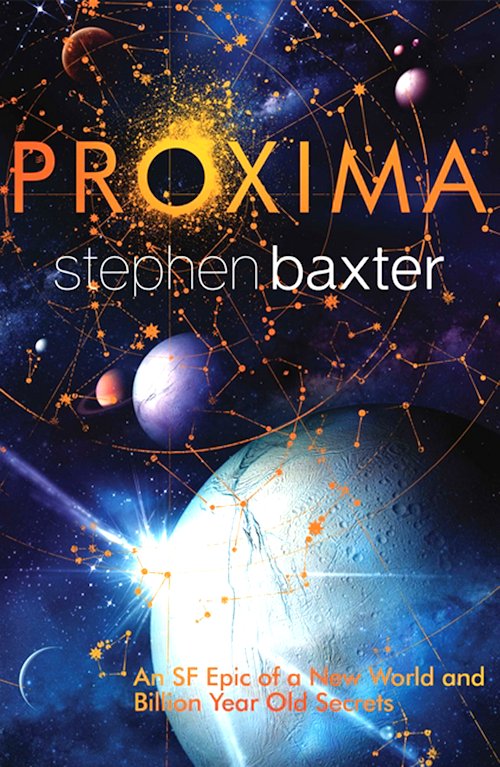
Proxima, Stephen Baxter (2013). Not sure what I was expecting this to be like – the publicity suggested I might like it… but I found it more like Exultant (see here) than Coalescent (see here). In other words, I thought it juvenile and thick with indigestible lumps of exposition; and while there was plenty of invention on display, no single idea was neat enough to make the book stand out. Criminals are transported to an inhabitable exoplanet in the titular star system, and what a surprise they prove completely unsuitable as pioneer colonist material. We’ve got rape and violence and warlordism in a century that has settlements throughout the Solar System and can even send spacecraft to another planetary system. But those criminal types do stumble across an enigmatic alien device which links the exoplanet with Mercury. This novel won’t be going on my Hugo ballot.
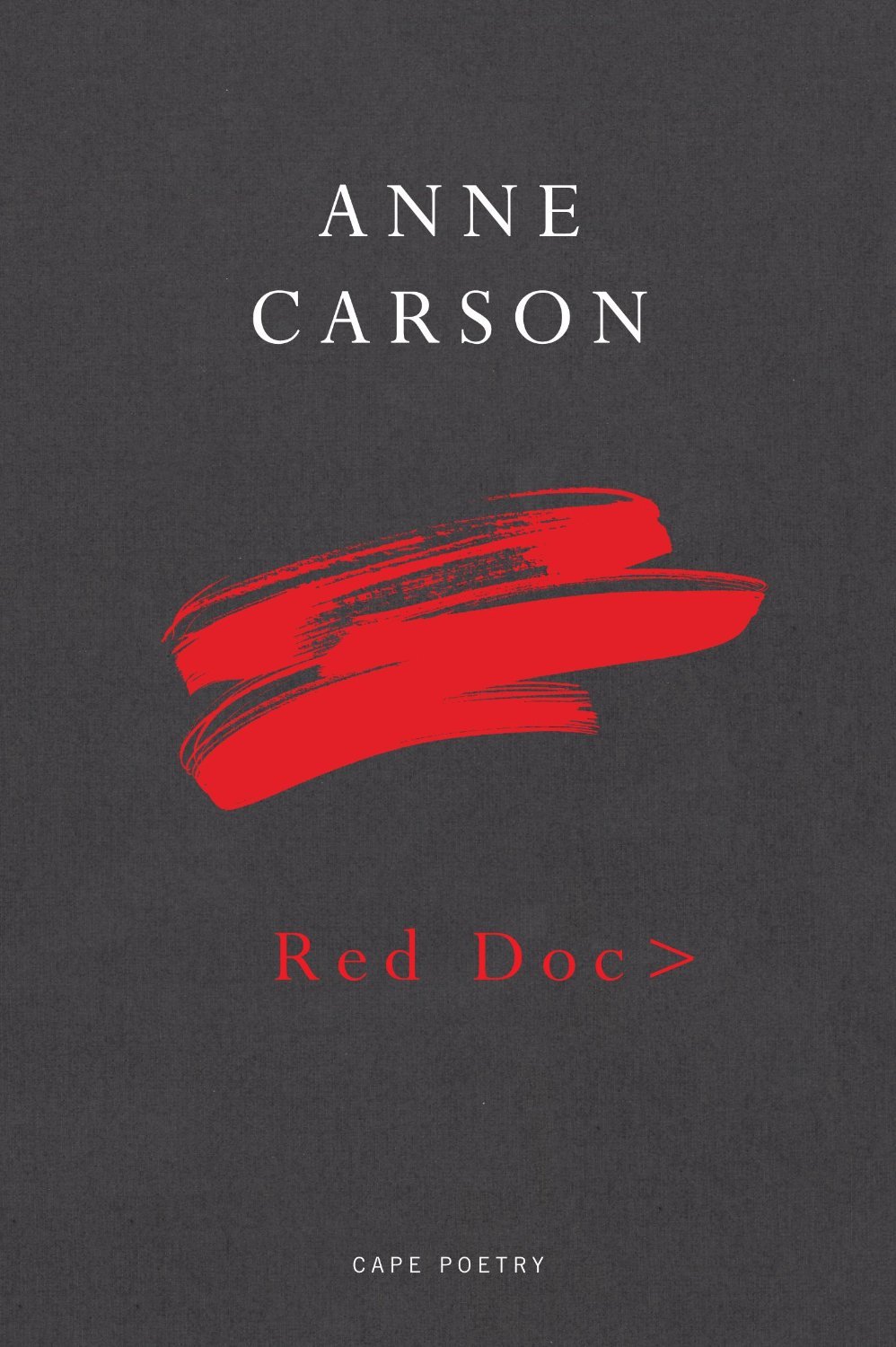
Red Doc>, Anne Carson (2013). This was shortlisted for the Kitschies earlier this year, which is why I bought a copy and read it. It’s a poem, told in a mix of styles, and I’m still not entirely sure what to make of it. While I find its genre aspects all a bit wishy-washy, there are moments of great beauty in it, and the dialogue in the told sections reads truer than anything you might find in a category genre novel. Since it’s not a novel, novella or short story, but a poem, I’m going to put it on my Hugo ballot as a related work. As far as I know, there’s nothing in the rules which says a related work has to be non-fiction.
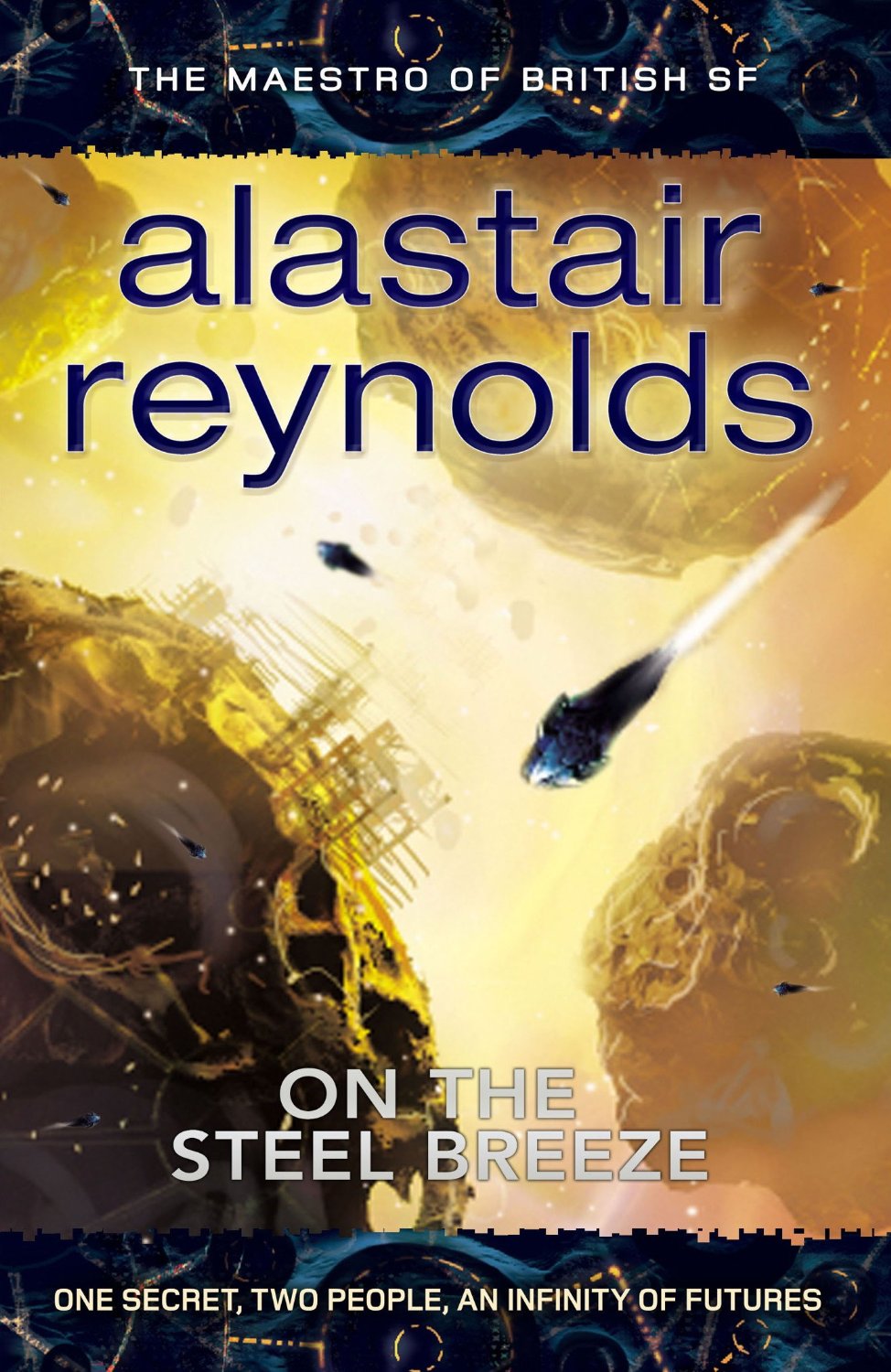
On the Steel Breeze, Alastair Reynolds (2013). This is the sequel to Blue Remembered Earth and the middle book of the Poseidon’s Children trilogy. Much of it concerns a covert war prosecuted by Arachne, an AI built to monitor a huge space-based telescopic array, because of course all machine intelligences are completely fixated on destroying non-machine life. There’s also a convoy of “holoships” – hollowed-out asteroids – en route to an exoplanet, on whose surface is an enormous enigmatic alien feature, the Mandala. The story focuses on three “clones” of Chiku Akinya, labelled Red, Yellow and Green – it’s a bit more complicated than cloning, something called “Quorum Binding”, which allows them to update each other’s memories, as is helpfully explained to one of the Chikus early in the novel by another character, even though, of course, she already knows how it works. One of the Chikus stayed on Earth; one set off in pursuit of Eunice Akinya’s space craft, Winter Queen (from Blue Remembered Earth); and one joined the fleet of holoships heading for the exoplanet Crucible. There are some nice set-pieces – I liked, for example, the one set on the surface of Venus, even if it didn’t seem to add much to the plot. The societies in the holoships turn totalitarian because, of course, totalitarianism is the default setting of any society in a science fiction novel – much as I disagree that hard sf is inherently right wing, the preponderance of right-wing societies in it is tiresome. There are also some uplifted elephants, a genius scientist who has a set of pronouns all of “vir” own, more about the mer people from the first book, and even some giant enigmatic alien machines orbiting Crucible, the presence of which had been hidden from humanity by Arachne. It’s certainly a polished novel,and what Reynolds does he does well, but it doesn’t quite meet the promise suggested by the first book of the trilogy. Of course, there’s still a final book to come, so perhaps that will do the trick. This book is not going on my Hugo ballot.
Life After Life, Kate Atkinson (2013). I’d never heard of Atkinson until her Jackson Brody books were adapted for television – even though her debut novel won the Whitbread Book of the Year in 1995 and she’s a pretty big-selling author in the UK. However, it was hard not to be aware of Life After Life, her latest book, as it’s already won the Costa Novel Award, is arguably genre, and has been talked about by a number of my online friends and acquaintances. A young woman born in 1910 dies at various times during her life, each time being reborn back in 1910 and somehow – sometimes only through some subconscious prompting – each time managing to avoid her fate from the previous time around. I thoroughly enjoyed this book – a pleasantly engaging protagonist, nicely witty prose, and a very smooth read without being as bland as commercial fiction. Recommended. I’ll be putting this one on my Hugo ballot.
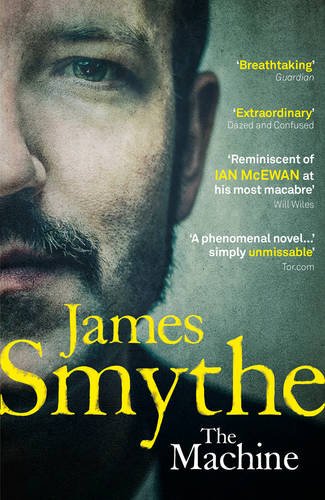
The Machine, James Smythe (2013). Smythe is banging out books like they’re an endangered species, but if the two I’ve read are any indication he’s no hack. The machine of the title of this novel is used to remove troublesome memories, but it’s later discovered that prolonged use puts the patients into a persistent vegetative state. Like Vic, Beth’s husband, a soldier who returned from the war with severe PTSD, turned increasingly violent and so opted for treatment with the Machine, but is now in a nursing hostel, oblivious to everything. So Beth buys a black market Machine, “kidnaps” her husband, and uses her Machine to restore his memories and so restore him. The name “Ballard” has been thrown around a lot in reference to The Machine, and certainly the setting – a sink estate on a post-global-warming Isle of Wight – feels very Ballardian, although the story itself doesn’t feel much like a Ballardian commentary on society. The prose is good, written in present tense with no quotation marks – which, obviously, is a style I’m all for… but why does it feel like everyone is doing it these days, eh? The ending may not come as much of a surprise, although perhaps reading Smythe’s The Explorer I’d been primed to expect a twist. Good stuff – and I have one spot left on my Hugo novel ballot and this is the current front-runner for it.
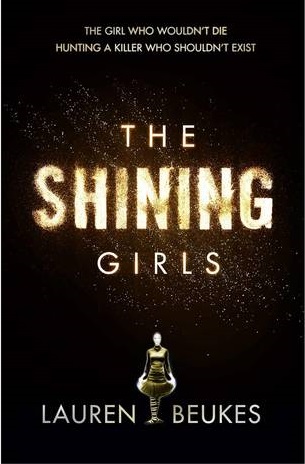
The Shining Girls, Lauren Beukes (2013). After Beukes’ Clarke Award-winning Zoo City, we have a high-concept commercial thriller, though the concept is enough to make it genre: a time-travelling serial killer. There’s a house in Chicago, and the killer can use it to access any time from the 1930s, when he discovers the house, to the 1990s. He jumps back and forth through the decades, stalking and killing young women, often ones he has previously visited while they were kids. They are the “shining girls”, so called by him because they have some quality which would have led them to live remarkable lives had he not murdered them. The Shining Girls is a fast, pacey read with a good sense of time and place, but the plot feels a bit too choppy to gel in places and the whole never feels quite complete somehow. This one will not be going on my Hugo ballot.
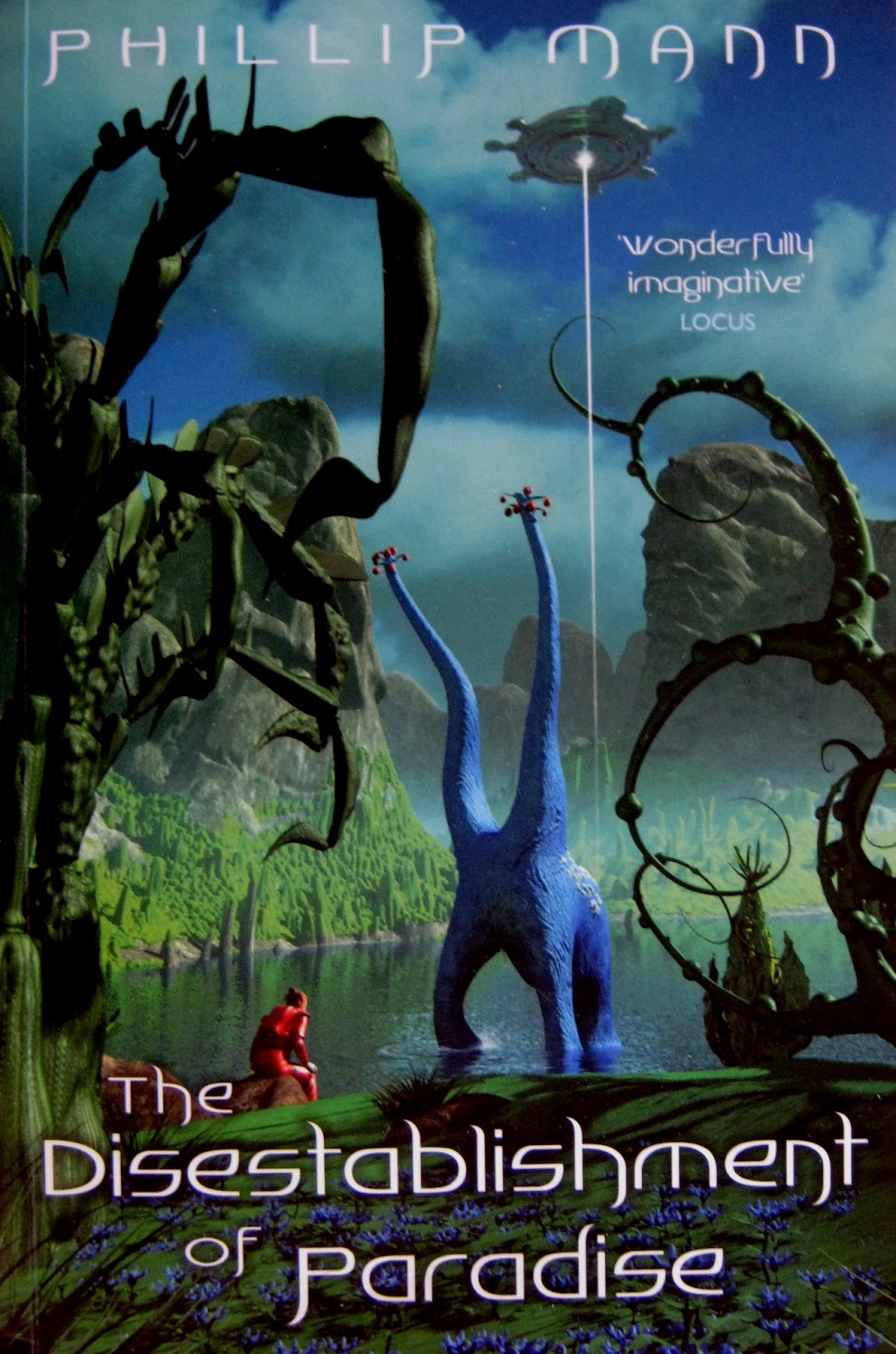
The Disestablishment of Paradise, Phillip Mann (2013). I’m a fan of Mann’s science fiction – I have all of his novels in hardback. So I was particularly happy to discover he had something new out, seventeen years after his last novel, 1996’s The Burning Forest. But, oh dear. The Disestablishment of Paradise refers to the final months of the Earth colony on the exoplanet called Paradise – this is what disestablishment is, the removal of a colony from a world – and the scientist, and her “assistant”, who remain behind and learn something more about the planet and its flora (it has no fauna). Particularly the Peripatetic Dendron, which is a sort of giant animated three-legged tree, and the Michelangelo-Reaper, which is a plant with psychic powers of some sort. There’s no denying that Paradise is a fascinating place, and that Mann draws a beguiling picture of it; but the human dynamics in The Disestablishment of Paradise are woefully old-fashioned (especially in regard to the female characters) and the dialogue is stilted at best. The story is framed as the novelisation of the reminiscences of the scientist, as told to a writer best-known for dark and edgy children’s books; and I’m not entirely sure what that conceit adds. There are occasional asides to the reader – and several appendices of supplementary material, which are referenced in the narrative – but it’s not enough to jolly along the somewhat plodding pace. One of the longest set-pieces is the “saving of the Dendron”, which seems to go on and on and on, with an excess of detail into Dendron physiology. After reading The Disestablishment of Paradise, I’m going to have to reread Mann’s earlier novels, as I don’t remember them being as dull or stodgy as this one. The Disestablishment of Paradise will not be appearing on my Hugo ballot.
The Children of Anthi, Jay D Blakeney (1985) I read this for review on SF Mistressworks.
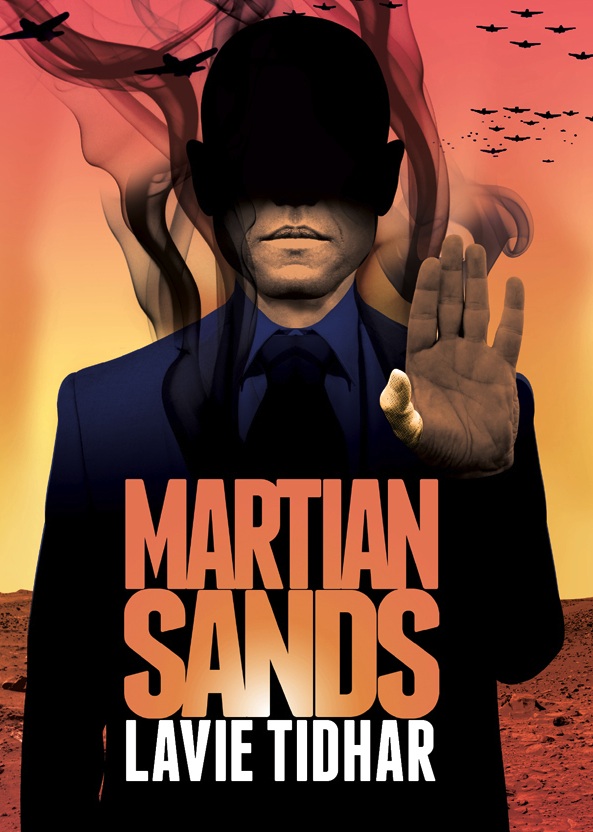
Martian Sands, Lavie Tidhar (2013). Or Tidhar does Dick. Again. I am not much of a fan of Philip K Dick’s work – there are a couple I like, but the only reason I own so many of his damn books is because almost half of the SF Masterworks series consisted of works by him. Martian Sands reads like a pastiche of Dick – and for me, that’s its biggest problem. It’s as if the plots and settings of a dozen of PKD’s novels were glommed together, and then roughly stitched into a single narrative using a magic chest full of sf references and in-jokes. I know some preferred this to The Violent Century, but I thought the other book much the better of the two. I won’t be putting Martian Sands on my Hugo ballot
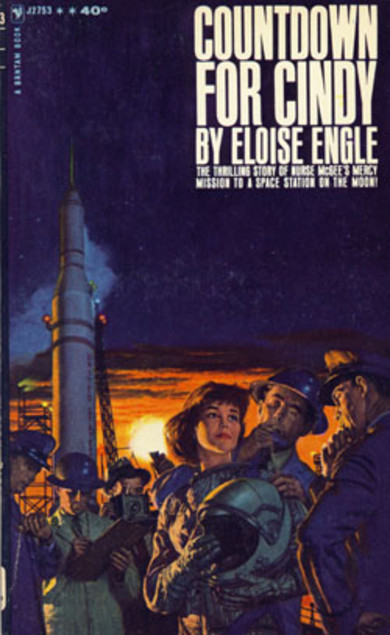
Countdown For Cindy, Eloise Engle (1962). I couldn’t resist this when I saw it on eBay, chiefly because it offered a 1960s take on women in space – which is something I’d covered in Apollo Quartet 3, Then Will The Great Ocean Wash Deep Above. The “MOON NURSE!” on the back was just a bonus. Interestingly, according to a foreword the author interviewed both Jackie Cochran and Jerrie Cobb, both of whom appear in Then Will The Great Ocean Wash Deep Above (actually, Cobb is one of my novella’s two protagonists). I’m working on a full review of Countdown For Cindy, to be posted here soon-ish.
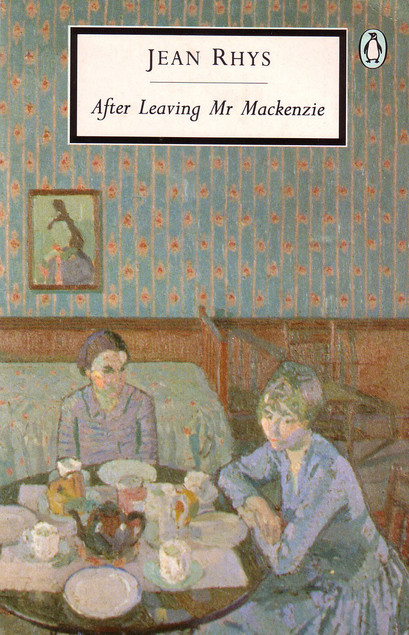
After Leaving Mr Mackenzie, Jean Rhys (1930). It was M John Harrison who recommended Jean Rhys on Twitter – some time last year, I seem to recall – during a conversation about women writers. Shortly afterwards, I stumbled across this book in a charity shop, and decided to give it a go. Julia has left her husband after the death of their baby, and is now living hand-to-mouth in a Parisian fleapit hotel. Desperate for money, she returns to London, hoping to sponge off relatives and/or past lovers. There’s a distant tone to this short novel, a weird lack of affect, as if Julia didn’t quite fully inhabit her life or the story – and, as a consequence, it’s hard to really care if Julia is successful or not. There’s an admirable clarity to the prose, and some nice turns of phrases in the descriptions – like “Behind the curtains was a green and optimistic sun-blind, faintly irritating, like a stupid joke” – and it all adds up to a curiously timeless prose-style. The sensibilities and lifestyles being described might be from the Thirties, but the language feels like it could belong to any decade of the Twentieth Century. That’s pretty impressive. If I see any more books by Rhys in charity shops, I’ll probably take a punt on them, but this one feels a little too languid for my tastes so I’ll not be in any rush to track down her work.
The Man from Charisma, Ted Mark (1970). I’ve no idea what possessed me to buy this book, or one of its sequels, Rip It Off, Relevant!. Perhaps I read something somewhere that suggested it might be amusing. It wasn’t. Jonathan Relevant is discovered naked on an iceberg after test missiles launched by a US and a Soviet nuclear submarine accidentally collide and explode above it. Relevant appears different to different people – to Soviet scientist Dr Ludmilla Skivar, he’s a studly Gagarin; to US Paper Clipped scientist Professor Von Schweindrek, he’s a model of Aryan masculinity; to African-American student activist G-for-George Pullman Porter, he’s Black Panther Eldridge Cleaver… The Soviets lay claim to Relevant, but the CIA steals him from them, and hides him in a CIA-sponsored research institute at Hartnell University… whose admin building has just been occupied by radical students protesting a number of different things. Relevant gets dropped into the middle of this, and tries to resolve it – which shouldn’t be that difficult given how everyone sees him as what they want to see. But this is the late 1960s, so… “Every man sees him as his hero. Every woman sees him as her lustful dream.” Sigh. We’re strictly in right-on “comedy” territory from the Swinging Sixties, with all the bad and borderline offensive jokes that entails – not to mention some outright offensive characterisations of various groups of people. I’ve no idea what possessed me to buy this book, and now I’ve read it I wished I hadn’t bought it. We’ll have to see if the sequel is any better – but I’m not holding my breath….
I was reading a blog post recently which described YA fiction containing spaceships and other overt science fiction tropes as “hardcore” – as a means to distinguish it from other science fiction YA. Of course, in YA “dystopian” is a genre rather than a description of a setting; and now it seems “science fiction” is a setting rather than a genre…
And it occurred to me – not so much that this was not what science fiction is, but more that it was a different way of looking at science fiction.
It’s an established fact that science fiction fandom is greying. Where once enough people joined each year for sf fandom to grow, that’s no longer true. And yet science fiction as a genre has become ubiquitous. Obviously a proportion of consumers of sf probably think of themselves as fans – but they’re not in fandom. Either because they’re not invested enough in science fiction to do more than passively consume it, or… they have their own fandom. After all, “sf fandom” as we commonly use the phrase refers to a specific group of people, it’s not just a generic term for all active consumers of the genre. It’s a community which traces its beginnings back to the early part of the twentieth century, when groups of like-minded people met up in various cities around the globe to celebrate a specific mode of literature. Over the years and decades, the community and its activities have formalised – resulting in conventions, fanzines, jargon, an entire support infrastructure for the category sf publishing industry, but also support for those who offer first-line support to the publishing industry…
But there are other sf-related fandoms now. And some of them are doing very well indeed – as Worldcon attendances have declined, so Dragon*Con attendances have risen. Which is why that blog post about “hardcore” YA sf put me in mind of China Miéville’s novel about two cities which occupy the same space but refuse to acknowledge that relationship.
This is not to say there are no crossover points – NineWorlds is a good example of one. (I’ve never been, it clashes with a music festival I’d sooner attend; and yes, I’d rather camp in a field and listen to lots of metal bands than spend a night in that awful hotel in Heathrow.) There are also a number of blogs which transit freely through various forms of genre fandom. But if there are those who do not restrict themselves, there are also those who police the border. The fandom & the fandom has its very own Breach: the Hugo Awards. To be fair, the Hugos were created as a celebratory tool by those original sf fans, but now it seems the awards do little more than help provide a structure badly needed by a decaying community which refuses to acknowledge its time is past. The Hugo rules have fossilised practices which haven’t been true for decades, but no one wants to change those rules. Or rather, those in the best position to effect change are too busy fighting against change.
It seems foolish in the extreme for sf fandom to ignore YA genre fiction. The biggest-selling genre authors of the past couple of decades are YA authors – JK Rowling, Stephenie Meyer and Suzanne Collins. And each of their series has gone on to become highly-successful film franchises. It’s not as if YA sf is some strange new never-seen-before creature. Back in the day, they called the books “juveniles” and both Heinlein and Asimov, much-lauded writers in traditional sf fandom, openly wrote them. But past attempts to create a Best YA Novel Hugo have all foundered. Some say YA fiction should be treated like other fiction – if it’s good enough, it’ll be nominated for best novel; and JK Rowling did win the Hugo in 2001. But that doesn’t hold water. YA, as noted above, looks at science fiction differently; it is shelved in its own separate section in book shops; it has its own separate fandom… And it’s that latter point where the problem lies. YA sf fandom cannot be subsumed into traditional sf fandom. That’s never going to happen. Nor do fans get “promoted” from YA sf fandom to sf fandom – that’s not how it works. Plus, there are plenty of career sf authors currently writing YA fiction, so to continue to ignore it just looks like sheer spite.
Personally, I’ve no interest in reading or writing YA sf. But that doesn’t mean I think sf fandom should exclude it. I’d say sf fandom, and the Hugo Awards, are in danger of making themselves irrelevant, but that horse has long since bolted. This year’s Hugos have prompted a conversation online about change, about what needs to be done in order to halt their decline. The sort of major changes that are needed will never happen – the system is designed to prevent it – but two indicators of the need for a change I do expect to be reflected in the 2014 shortlists…
If the best fan writer and best fanzine shortlists are comprised entirely of candidates from paper fanzines, then the old guard have won and the Hugos are dead. If they comprise only bloggers and blogs, then that’s a step forward and there’s a possibility the Hugos can save themselves. But I think I’d go a little further: if a YA novel makes it onto the best novel shortlist, then there may be real change in the air…
There’s an excellent post here by Adam Roberts, written with his characteristic perspicacity and wit, on awards and self-pimping. Now I must hang my head in shame, as I did post a little something of that sort back in December, but in my defence I’m just farting in a thunderstorm. (And Adam himself admits he’d thought The Eye With Which The Universe Beholds Itself was published in 2012, and I wanted to make people aware that it was actually out in 2013. Note to self: do not publish anything in January.) However, I was intending to post something here about what I’d myself nominated for the BSFA (and I will likely do the same for the Hugo), just as soon as I’d figured out what I was going to choose…
Each year, I tell myself I will read more short fiction, or I will read more books during their year of publication. Each year, I fail to do so. So it’s a rare year when I get to actually cobble together a list of nominations in all four BSFA categories – novel, short fiction, non-fiction, artwork – of reasonable length. This year, sadly, is no exception. So, for what it’s worth, these are what I’ve nominated so far…
Novel
Checking back over my records, I see I’ve read nineteen books published in 2013, but only six of them are genre novels. Which doesn’t give me much of a pool to nominate from – but the following are easily the best of those six, and I’d be happy to nominate them even if I’d read ninety books published in 2013.
Short Story
At the start of the year, I made an effort to keep abreast of new genre short fiction as it was published – not just in the various online venues I regularly visit, but also the genre print magazines to which I subscribe – which would be, er, Interzone. Sadly, that effort didn’t last long. I did, however, read two genre anthologies published in 2013, and both contained some very good fiction.
As for the non-fiction and artwork categories… I’ll be spending this weekend trying to cobble together a short list of each to nominate (nominations close on Tuesday 14 January). And I have until 31 March to decide what I’m going to nominate for the 2013 Hugo Awards…
December
I wrote a guest post on Iain Banks for Fantástica – Ficción – they were kind enough to translate it into Spanish. The post includes a never-seen-before photograph of Banks I took at the 1990 Eastercon in the Adelphi Hotel in Liverpool.
And I guest-edited issue 61 of Focus, “the British Science Fiction Association’s magazine for writers”, on the topics of self-publishing and social media. Contributions were provided by Geoff Nelder, Gary Gibson, William King, Tony Ballantyne, Colin Tate, Keith Brooke, Vaughan Stanger, Darren Nash, Joyce Chng, RB Harkness, Berit Ellingsen, Jonathan McCalmont, Del Lakin-Smith, Donna Scott, Danie Ware and Helen Arney.
Apollo Quartet 3: Then Will The Great Ocean Wash Deep Above is now available from Amazon. It’s been available as an ebook for several days – on Kindle (UK | US), Kobo, and as both epub and mobi from the Whippleshield Books website.
Since MPG Biddles went into administration back in June, I’ve had to find a different printer for Whippleshield’s books, and I decided to try Amazon’s CreateSpace for the paperback edition of Then Will The Great Ocean Wash Deep Above. Which means a book of the Apollo Quartet is now available in paperback in the US for the first time. You can buy it here (UK | US).
The limited hardback edition will be delayed a week or two as I’m using a different printer, but it’s available for pre-order here.
I’ve also decided to move forward the fourth book of the Apollo Quartet, All That Outer Space Allows, and will try to get it out for the first half of 2014. Perhaps even in time for the Eastercon in Glasgow. I’ve always had a clear vision of the story – unlike books 2 and 3 when I started them – so it shouldn’t be that difficult. But we shall see what the new year brings…
ETA: Those of you have already pre-ordered the limited hardback edition, or are thinking of doing so, I’m happy to provide an ebook version – in pdf, epub or mobi – free of charge immediately to ease the wait…
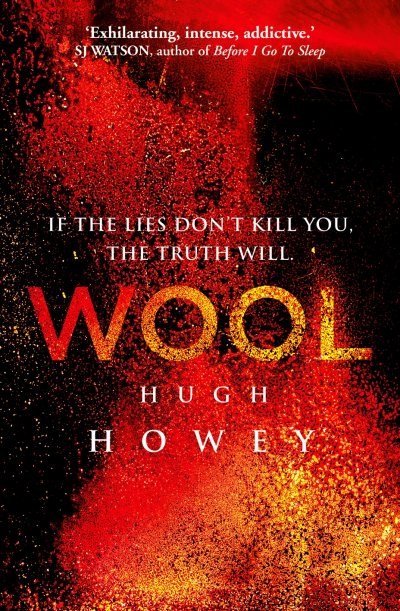
In the world of twenty-first century publishing, the story of the book is often more interesting than the story in the book. And so it is with best-selling science fiction novel, Wool. Originally self-published as a novelette on Amazon’s Kindle, its popularity prompted Howey to write further stories in the same setting. These were then fixed up into a novel. Which promptly sold in huge numbers. Howey earned enough money to quit his job. Publishers came knocking at his door and he sold the film rights to Ridley Scott. Hugh Howey has become the latest poster boy for self-publishing success.
Given all this, it seems churlish to complain that Wool doesn’t deserve the praise lavished upon it. Its quality is immaterial; it is a success. That is the narrative of Wool.
The narrative in the book, however, is not so happy. There is an underground silo of 144 storeys in a world that is toxic and uninhabitable. The silo’s only contact with outside is via screens, the view on which degrades over time as dirt gathers on the external lenses. At intervals, people are sent outside as punishment–and the chief crime deserving this sentence appears to be… wanting to go outside. Clad in protective gear which gives these “cleaners” around half an hour of life, they leave the silo and clean the lenses. Then they walk off into the ruined city, but fall and die before leaving sight of the lenses. Why do they always clean the lenses? Why not simply walk off and see how far they get before their suit degrades? It is this first section which formed the original novella, and the puzzle at its heart makes no sense as motivation for cleaning the lenses. It also requires the “cleaners” to be wilfully stupid and ignore what they know…
The remainder of Wool’s 576 pages build on this opening section. Since the last “cleaner” was the sheriff, a new one is required. The deputy recommends Juliette, a mechanic from the lowest levels of the silo. The mayor seconds the choice. Bernard, the head of IT, disagrees, and also seems to think he actually runs the silo. Which, it transpires, he does. Nevertheless, Juliette is made sheriff, but her appointment has set the mayor at odds with IT and Bernard soon gets his way. Juliette is arrested on a trumped-up charge and sentenced to “cleaning”. Her friends in Mechanical, however, secretly ensure she is a given a suit which will last more than thirty minutes. Juliette has also figured out the suit’s secret – this is the premise of the opening novella – and this allows her to find her way to… another silo.
The setting of Wool is science-fictional, the opening section is written in a science fiction mode; but once Juliette, who is not only a naturally-gifted mechanic and highly intelligent but also beautiful, is introduced, Wool turns into a small town soap opera. Unfortunately, this only emphasises the fact the novel’s setting does not stand up to scrutiny. The silo has a single metal spiral staircase to link its 144 levels, but such a design is impractical. The metal of the staircase would also collapse under its own weight. IT manages a server farm, but the servers do nothing. They don’t run the systems of the silo, because there are no such systems. The silos are sealed environments and possess hydroponic gardens, a mine and a well, but they could not be self-sufficient for the many generations the story implies. Wool also gives little indication of their size or population. They are deep – 144 levels must make the lowest level 450 to 500 metres below ground – but the area covered by each level is never mentioned.
Howey’s prose is readable, if very baggy, and his frequent flights of fancy fail more often than they succeed. His plotting, however, is driven by escalating jeopardy, but it is inconsistently applied, often implausible, and poorly paced. One character discovers something and is killed; another learns something different, and is arrested and sentenced to “cleaning”. Howey keeps his cast under constant pressure, and yet his writing is leisurely paced. His characterisation is typical of commercial fiction: Juliette is super-competent, and Bernard is a pantomime villain. He is, for example, the only fat person in the entire silo.
There’s an interesting story somewhere in Wool – now the first of a trilogy, to be followed next year by Shift, and then by Dust – but Howey’s writing is neither brisk, economic nor subtle enough to tell it, and his technique of applying constant jeopardy to his central cast annoys more often than it propels the reader forward.
Still, it is useless to complain. Wool is a self-publishing success story. The narrative of the book has already been written, and it says that Wool is good.
This review originally appeared in Interzone #246, May-June 2013.


 It Doesn't Have To Be Right...