It Doesn't Have To Be Right…

… it just has to sound plausible


4 Comments

Science fiction under pressure

As a species, we have little experience with naturally hostile environments, a century’s worth perhaps. By “hostile”, I don’t mean environments such as the Arctic, which are uncomfortable, or could prove fatal without basic survival tools. I mean environments which are pretty much instantly lethal without complex technological assistance. Human beings have to date visited two: space (including the lunar surface) and the sea deeper than 200 metres below the surface (it’s actually shallower than that, but the depth record for free diving currently stands at 214 m).
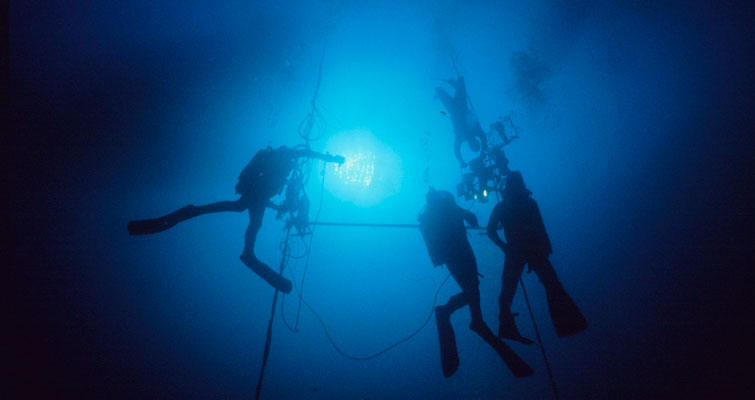
A scene from Luc Besson's The Big Blue

A scene from Luc Besson’s The Big Blue

Science fiction has covered the first of these in countless stories and novels, with varying degrees of accuracy. But no reader of sf doubts the hazardous nature of outer space. While all too many science fictions present magical technology allowing human beings to live and work and make war in space, there’s still a background of ever-present danger. In fact, it’s almost become a cliché.

But what of the opposite extreme? High atmospheric pressure rather than vacuum? Certainly the former have been covered in science fictions, though the genre tends to treat it as much the same as the latter – ie, both are survivable when wearing a spacesuit. But spacesuits are actually just personal spacecraft, designed for the same environment as spacecraft – ie, space. (If that’s not belabouring the point a bit much.) They provide a self-contained atmosphere and protection from radiation. A spacesuit wouldn’t work on a planetary surface with a datum pressure of, say, 50 atmospheres. It would be unwearable, constricted by the gas pressing against every square centimetre, its joints locked since they are designed to maintain a constant internal volume. When submarines get squished when they sink too deep in the sea? That’s what would happen to a spacesuit… and the person inside it.
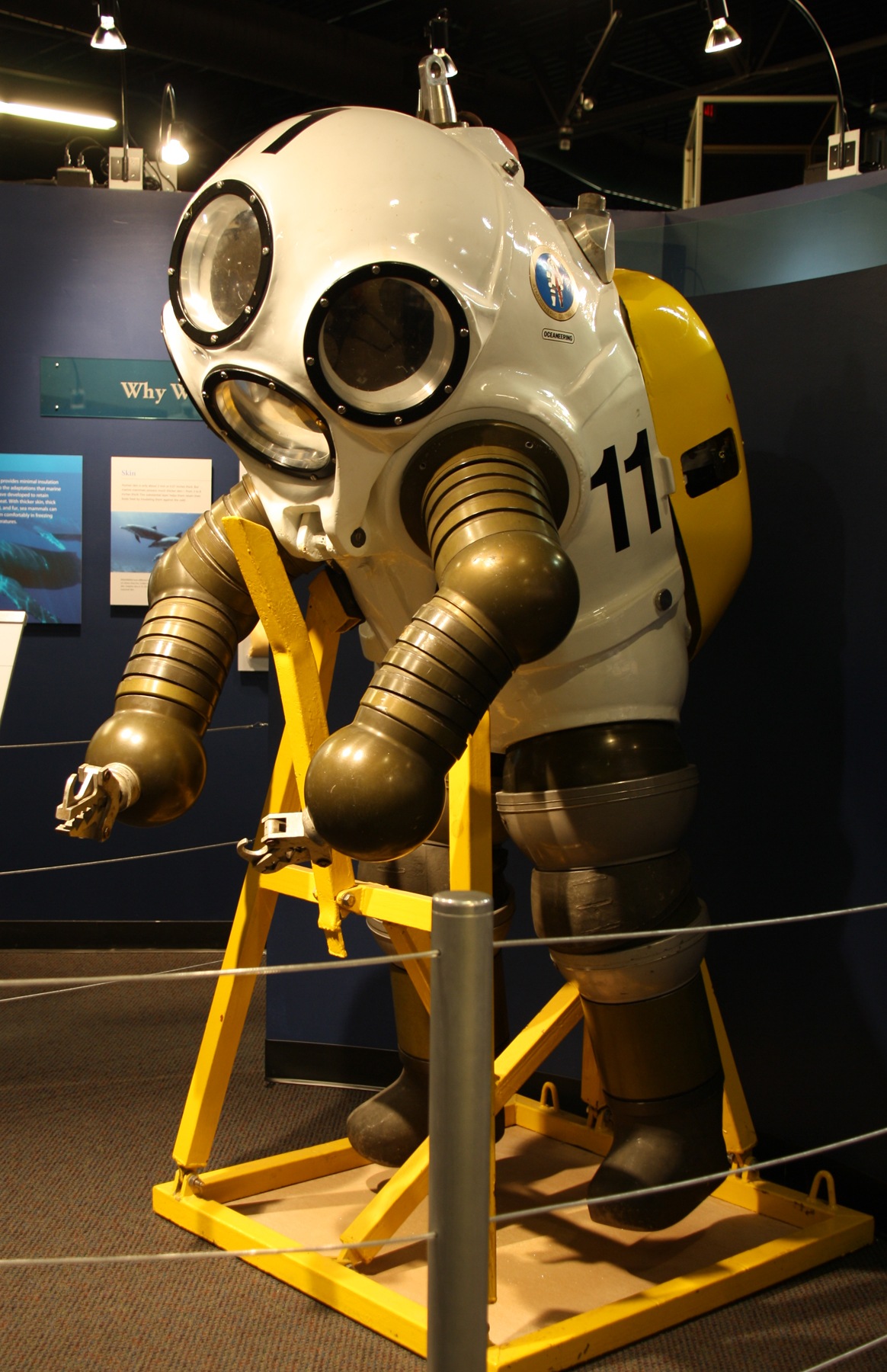
A JIM suit

A JIM suit

Which doesn’t mean hyperbaric environments would necessarily be out of reach. One solution would be to use an Atmospheric Diving Suit, which is much like a spacesuit but designed to keep pressure out rather than in. The current depth record in an ADS is 610 m (2000 ft), which is 61 atmospheres. Perhaps with the advent of new and stronger materials, or some sort of force-field, environments with much higher pressures would be accessible to someone in an ADS.
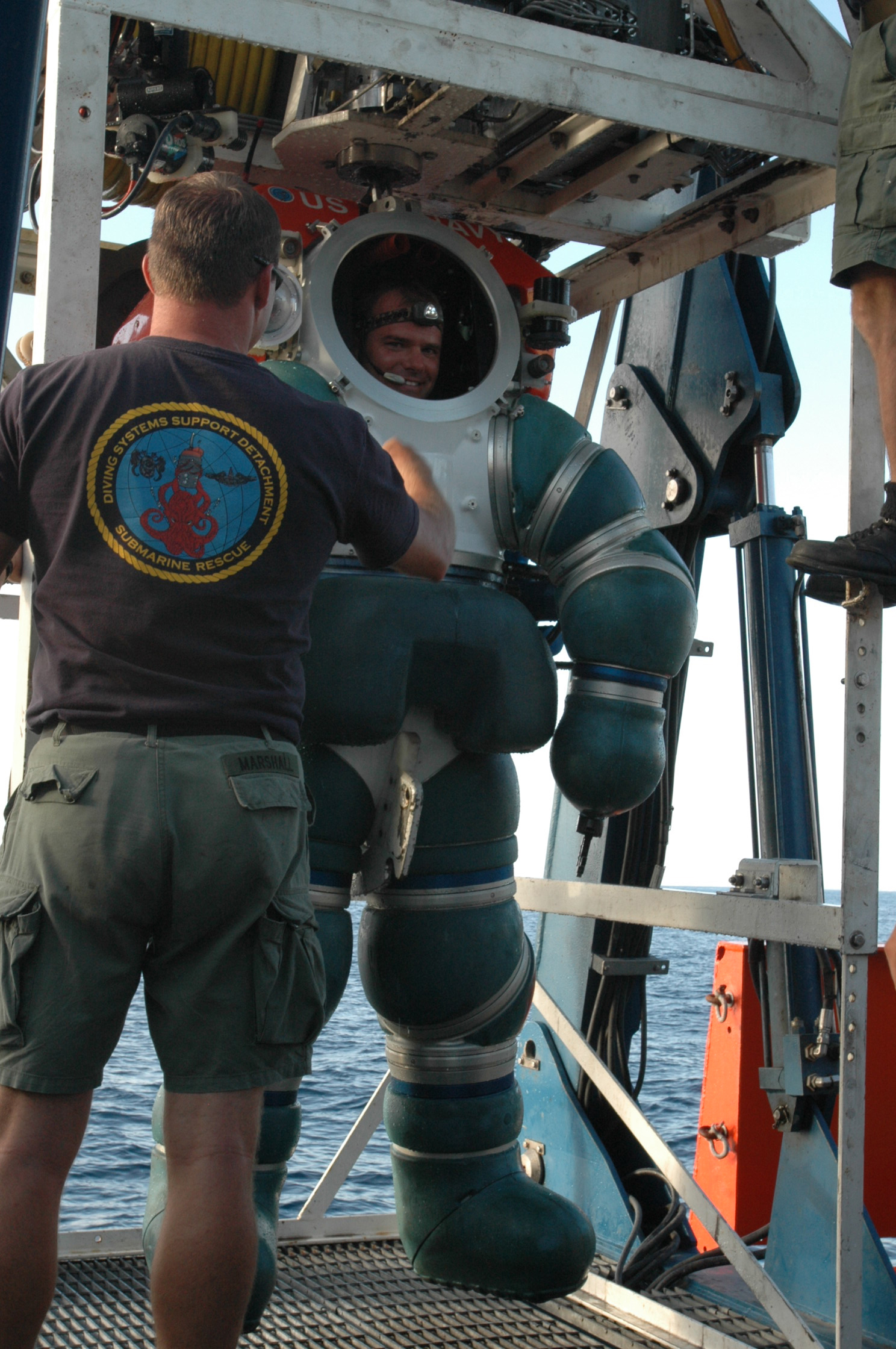
Chief Navy Diver Daniel P Jackson in the Hardsuit 2000

Record holder Chief Navy Diver Daniel P Jackson in the Hardsuit 2000

The only recent example that comes to mind of a sf novel set (partly) on a world with a hyperbaric environment is Alastair Reynolds’ On the Steel Breeze (2013), the second book of his Poseidon’s Children trilogy. Several chapters take place on the surface of Venus, which, as well as a mean surface temperature of 462° C, has a surface pressure of 92 to 95 atmospheres. In the novel, some of the characters go EVA on the surface, an apparently not uncommon pasttime, in “surface suits”:

The suits were essentially ambulatory tanks. They were glossy white, like lobsters dipped in milk. They had no faceplates, just camera apertures. Instead of hands, they had claws. Their cooling systems were multiply redundant. That was the critical safety measure, Chiku learned in the briefing. Death by pressure was so rare that it had only happened a few times in the entire history of Venus exploration. (p 128)

Clearly – refrigeration aside – Reynolds’ surface suit is much like a beefed-up ADS, and in no way resembles a spacesuit. Which is as it should be.

But what if a closer interaction with the environment is required? Perhaps there’s a need for something more dextrous than “claws”? Or human beings must be as unencumbered as possible in order to live and work in this hyperbaric environment. Obviously not the surface of Venus, but perhaps somewhere less extreme…
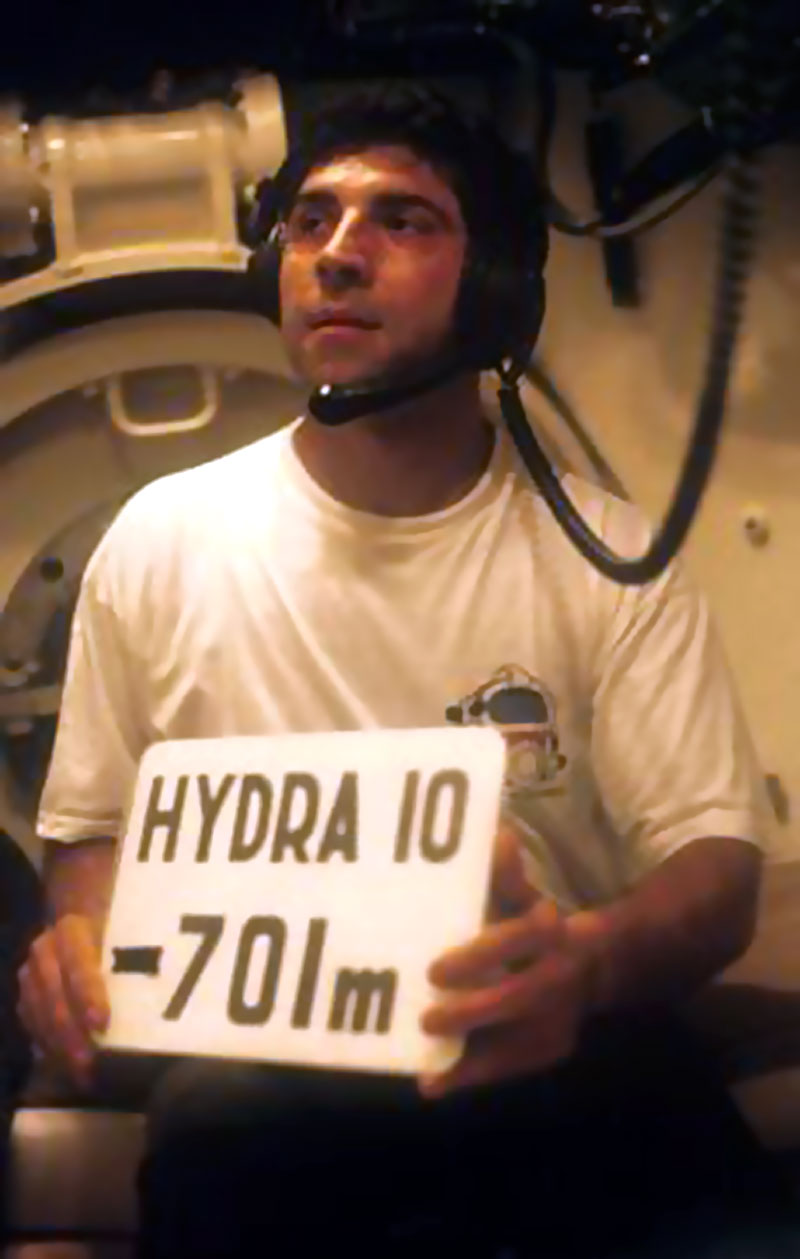
Theo Mavrostomos at a simulated depth of 701 m

Theo Mavrostomos at a simulated depth of 701 m

You can saturate a human body up to pressures around 70 atmospheres – that’s the current record, set during a simulated saturation dive by Theo Mavrostomos in 1992. He spent two hours at a depth equivalent to 701 metres (2300 feet). The term “saturation” means the person’s tissues have absorbed the maximum possible partial pressure of gas. A sudden return to normal atmospheric pressure would result in explosive decompression. A too-quick return would cause the absorbed gas to bubble out of the person’s tissues – the “bends”, or decompression sickness, which can be fatal. There are other hazards associated with hyperbaric environments. At pressures above 5 atmospheres, nitrogen causes nitrogen narcosis, or “the rapture of the deep”; and at pressures higher than 15 atmospheres High Pressure Nervous Syndrome can affect people breathing helium-oxygen mixtures.
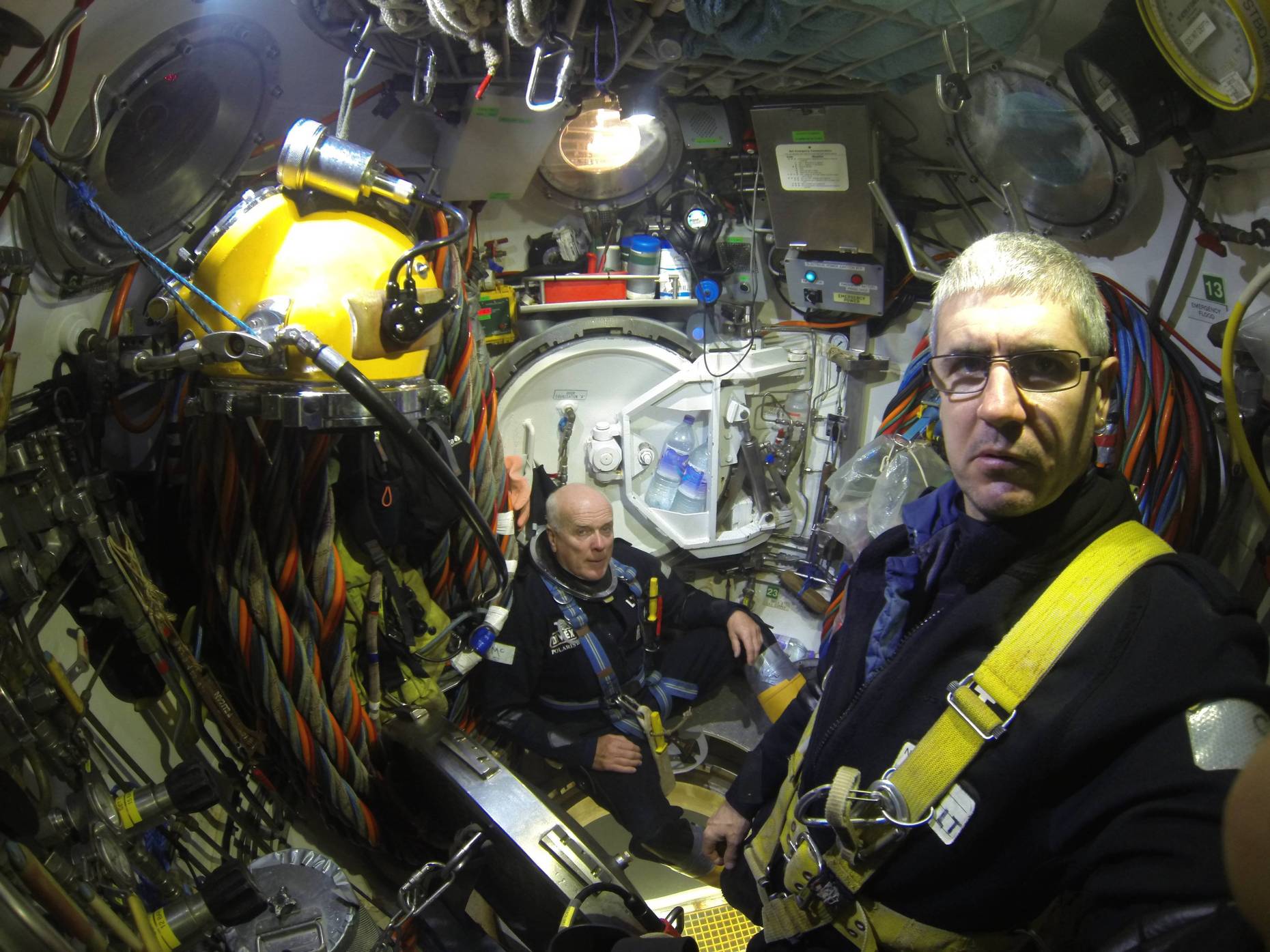
A pair of North Sea saturation divers

A pair of North Sea saturation divers

High pressure air is extremely difficult to breathe – not just the physical act of drawing it into the lungs, but also the lungs diffusing it into the blood. By using a less dense gas, such as helium, to maintain the correct partial pressure of oxygen (too much oxygen is poisonous), the human body can handle greater pressures. But this also presents its own set of problems – there’s HPNS, but also helium’s excellent conductivity of heat, not to mention the shortening of sound wavelengths resulting in the infamous “Donald Duck” voice (at the limit of saturation diving, this can make divers pretty much unintelligible). HPNS can be mitigated by adding some nitrogen back into the mix, and “unscramblers” are used on the radio links to divers but these are not wholly effective. There is no solution to helium’s conductivity other than bloody great heaters scattered throughout the saturation system.

At present, we’ve about reached the limit possible with saturation diving. In the oil industry, working at depths of 100 to 250 metres (320 to 820 ft) is routine. Deeper than 450 metres (1500 ft), ROVs are used. Greater pressures than 70 atmospheres may be possible – perhaps by using hydrogen, which has half the atomic weight of helium. Unfortunately, hydrogen is extremely flammable, although some helium could be added to render it safe. French diving company Comex consider it possible to reach depths of 1000 metres (3281 ft), or 100 atmospheres, using a hydrogen mix, but no one has tried and there’s currently no impetus to do so.
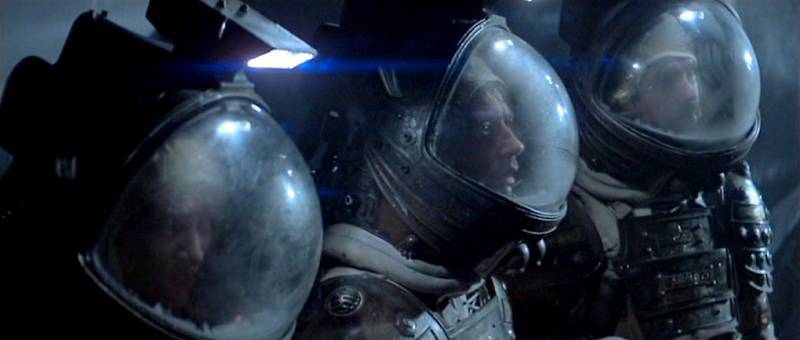
A still from Ridley Scott's Alien

A still from Ridley Scott’s Alien

Where this gets interesting is that, as far as I know, no one has used this in science fiction. While hyperbaric environments, or dense atmospheres on high-gravity planets, perhaps even gas giants, have undoubtedly been used, it’s either been with some science-fictional equivalent of a ROV, or magical spacesuits which operate as well in 100 atmospheres as they do in a vacuum, or perhaps even a kind of armoured suit capable of withstanding great pressure like a souped-up ADS. Dense atmospheres seem mostly to appear in science fiction only as settings for winged aliens or humans, such as in Vonda N McIntyre’s ‘Fireflood’ (1979) or Wings’ (1973; see here). Gas giants are quite common in sf, though mostly the action takes place in their upper atmosphere. One that doesn’t is Poul Anderson ‘Call Me Joe’ (1957), in which a disabled operator “drives” a ROV on Jupiter’s surface – James Cameron used a similar idea in Avatar (2009).

But sf typically treats alien worlds – what we now call exoplanets – as either extensions of space, or Earth-like, or near enough Earth-like not to make any difference. Those hardy explorers of countless science fictions often have little more to deal with than inclement weather, although perhaps one or two might need a breathing mask… No one has ever thought of the Earth’s surface as remotely like space – it’s an environment entirely distinct, and although it covers a wide range of conditions they’re all survivable. So why no variety in alien worlds? Ignorance initially, almost certainly; but then it becomes about the story, about some “alien” aspect of the exoplanet which drives the plot, as in Marion Zimmer Bradley’s Endless Voyage (1975; see here). Yet, allegedly, science fiction is about science and technology, and how we use it…
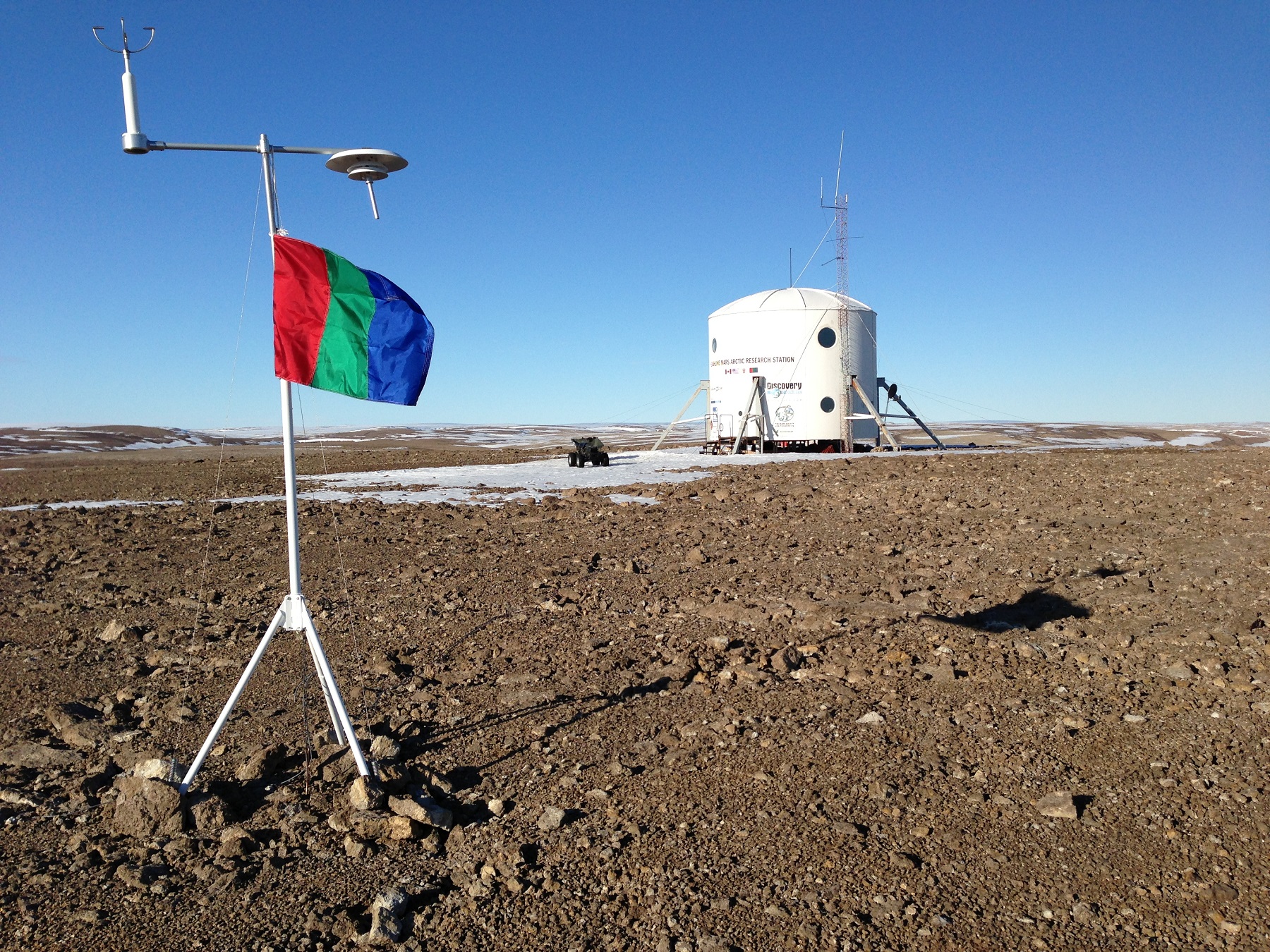
Mars Arctic Research Station

Mars Arctic Research Station

Surely it would be more interesting to explore the techniques and technology that might be used to explore, or perhaps even colonise, an environment that is neither Earth-like nor vacuum? A saturation system strikes me as a perfectly suitable method to use in a hyperbaric environment; and one that is filled with dramatic possibilities. Just think, you could murder someone by knocking them out and them putting them in a balloon’s gondola… Too much science fiction, to my mind, fails to get across the true experience of the strange environments in which it takes place. It’s passed off as “setting” using a few incidental details, but in all other respects treated as if it were, say, middle America, or the Wild West. A more rigorous approach to such things would be far more interesting.

Of course, it’s not just exoplanetary environments. There’s certainly science fiction set underwater at great depth (see my earlier blog post on the topic here), but most such sf imagines that human beings have been physiologically engineered to survive in that environment. But, as far as I’m aware, no one in sf has made the mental leap from deep sea to hyperbaric planetary surface.

8 Comments

Writing, creativity and the internet

So apparently George RR Martin writes his novels using some 1980s software running on a computer that has no internet connection. Because obviously Game of Thrones needed to be mentioned again in the national press and this seemed like a good excuse. But seriously, I don’t see what’s news-worthy or admirable in someone who continues to use thirty-year-old technology when far more sophisticated and useful wordprocessors exist today. It has nothing to do with “creativity”.

As for the internet being a “distraction”. Well, okay, Martin doesn’t exactly have to check his facts or look things up because he’s writing big fat commercial fantasy and where do you research that sort of stuff? (Other than the history the author is ripping off, of course.) But some of us do a lot of research, and the internet is pretty damn useful for that. Sometimes it’s just a first port of call, before moving onto more detailed books on the topic; other times, the internet provides more than enough information for the purpose.

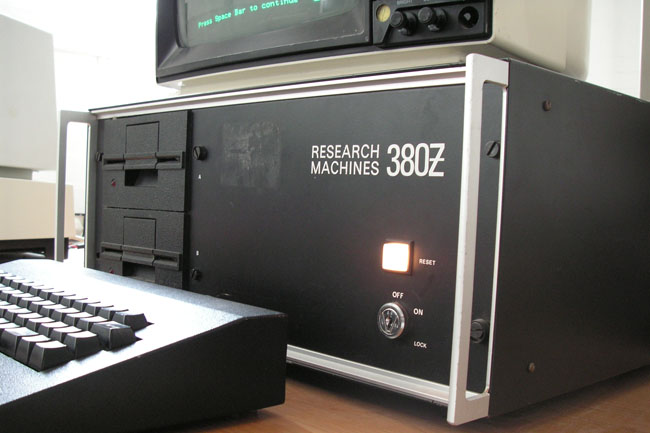
380z_1

I’ve often wondered how writers – especially science fiction writers – managed before the invention of the Web. I remember James P Hogan on a panel at the 2005 Worldcon talking about the various contacts he had made during his career – he admitted he was quite shameless at approaching people he thought might prove useful and blagging their contact details – and how he’d telephone them if he needed their expertise. So that was one method. And, of course, there are libraries. But reading some Golden Age science fiction, it’s plain a lot of sf authors didn’t even bother – they just made it up and assumed no one would catch them out. Nowadays, given that readers have access to exactly the same tools as writers, getting caught out is almost a certainty. (And it’s not like authors before the Web weren’t pulled up on their mistakes either – cf Larry Niven having the Earth rotate the wrong way in Ringworld; or indeed the design of the ringworld itself.)

There’s no such thing as too much research, although it’s certainly possible to put too much of the research into the narrative. Unlike Kim Stanley Robinson, I don’t consider the info-dump just another narrative tool in the sf writer’s toolbox – so no, I don’t think it can be used freely without embarrassment. Exposition is a speedbump, or a pothole, in the reader’s journey through a story. However, I do think a writer can make a virtue of the research. Some, in fact. do. But there are those, on the other hand, who do it really badly – like this one:

“Ready, Barn,” the lunar commander replied.

“Okay. TIG 142034700 NOUN 67 5530000370 plus 0002, need A 47 in plus 37364 plus 05607 plus 58642 plus 56955, needle 465 is plus 00370, needle 546 is NA. Ignition 1 Rev late is 1440209, toug weight 10789. Over.”

“Roger. Copy 142034700 55350000370 plus 0002 plus 37364 plus 05607 plus 58642 plus 56955 plus 00370, NA 1440209, tug weight 10789. Over.”

“That’s affirmative, Kathy. P32 CSI PAD follows. NOUN 11 143015060 NOUN 37 14438 all zips NOUN 81 0492 all zips. Need A 473 is 01818, 275 is 02780, AGS DELTA Vs plus 0492 all zips plus 0010. Over.”

No, that’s not from Adrift on the Sea of Rains. It’s actually from Space Station Friendship by Dick Lattimer, published in 1988.

Of course, not all science fictions require research. A style that has become quite common over the last few years – I’ve seen it labelled with the horrible term “sci fi strange” – seems almost completely made-up. Nothing requiring research there (unless you include the frequent references to other science fictions, that is). Still, it’s not for me  – don’t like reading it, have no intention of writing it. I like my research, it’s often what motivates me to write a story. And finding a way to use it in a narrative that works is, for me, part of the fun of writing.

Also, the shit that I look up is usually just plain interesting.

(Incidentally, the picture is, as the front of the machine states, a Research Machines 380Z, the first computer I ever used. The school I attended had two of them. These days, most of my colleagues at work are younger than that computer…)


11 Comments

Apollo Quartet review copies

It’s been two years since Adrift on the Sea of Rains was published, and reviews of it continue to appear online. Which is very gratifying. But for some reason books two and three of the Apollo Quartet, The Eye With Which The Universe Beholds Itself and Then Will The Great Ocean Wash Deep Above, published sixteen and six months ago respectively, haven’t been reviewed to the same extent. So this is just a note to say ebook review copies of The Eye With Which The Universe Beholds Itself and Then Will The Great Ocean Wash Deep Above are still available. If you fancy one, either leave a comment or tweet me at @ian_sales. I can do epub, mobi or pdf. At a pinch, I can even do paperback.

Meanwhile, of course, work continues on All That Outer Space Allows. I’m at that stage where I’m reading research materials to get a feel for the period and place and cast, and getting some early words down on paper. The story opens in 1965 at Edwards Air Force Base and ends in Florida on the evening of 16 April 1972. It will be about astronauts and it will be about science fiction.

E-USAF-X-15-2

Here’s the opening paragraph. As you can see, it’s going to be a bit different to the preceding three novellas…

Ginny is at the table on the patio, in slacks and her favourite plaid shirt, hammering away on her Hermes Baby typewriter, a glass of iced tea to one side, a stack of typescript to the other. Something, a sixth sense, she’s developed it during her ten years as an Air Force wife, a presentiment, of what she can’t say, causes her to glance over at the gate to the yard. And there’s Bob, Lieutenant Colonel Robert Lincoln Hollenbeck, cap in hand, his movie-star profile noble with concern. Ginny immediately looks over to her right, across to the Air Force Base and the dry lake. Her hand goes to her mouth. Oh my God my God my God. There’s a line of dark smoke chalked up the endless sky. My God my God my God. She pushes back her chair and lurches to her feet.

The above may change as I get further into the story and things start to come together. But for the time-being at least it gives a good idea of what I have planned.


1 Comment

My reviews on SF Mistressworks

It occurred to me that while most of the reviews on SF Mistressworks are reprints, all of mine are original – which means that unless you follow that blog, you won’t have seen them. So here’s a list of the sf books by women authors I’ve reviewed so far this year on SF Mistressworks:

The New Women of Wonder, Pamela Sargent, ed. (1978) The third and final all-women sf anthology edited by Sargent, at least until the two reboots in 1995. Probably the best of the three. Review here.

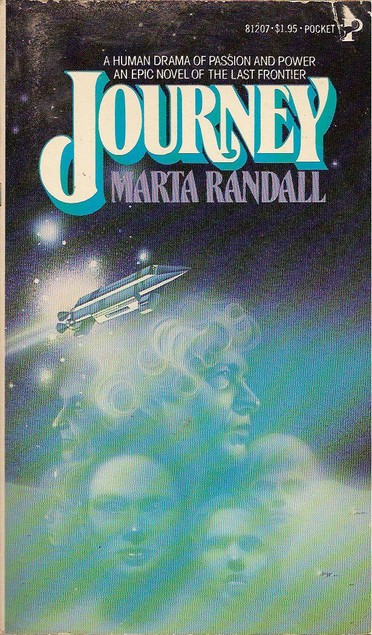
Journey, Marta Randall (1978) The first of a duology about the Kennerin family and their trials and tribulations colonising the world of Aerie. I wasn’t entirely convinced. Review here.

journey

Fireflood and Other Stories, Vonda N McIntyre (1979) McIntyre’s only collection, which is a shame as judging by the stories in this she deserves to be much better known. Review here.

The Children of Anthi, Jay D Blakeney (1985) The first of duology about the semi-feudal world of Ruantl and the adventures of galactic rogue Blaise Omari after he crashlands there. Solid core genre, although it didn’t survive this most recent read quite as well as I’d expected. Review here.

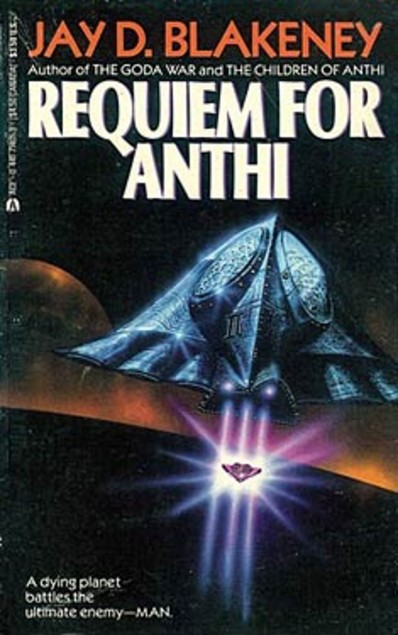
Requiem for Anthi, Jay D Blakeney (1990) The sequel to The Children of Anthi, which probably makes a better fist of the background even if the protagonists do prove to be infeasibly special. Review here.

anthi

Extra(Ordinary) People, Joanna Russ (1984) Excellent collection, containing Russ’s only Hugo win, ‘Souls’, as well as ‘The Mystery of the Young Gentleman’, which immediately became a favourite piece of short sf. Review here.

Countdown For Cindy, Eloise Engle (1962) Early Sixties tosh about the first American woman in space, a nurse sent to the Moon to look after a pair of injured scientists at the Moonbase. Very much a book of its time – its titular heroine is not going to be seen as much of a role model these days. Review here.

Still to come over the next couple of months: reviews of Ark Baby by Liz Jensen, Busy About the Tree of Life by Pamela Zoline, We Who Are About To… by Joanna Russ and Queen of the States by Josephine Saxton. I have many more eligible books than those, of course – they’re just the ones I’ve actually read and am working on reviews of at this moment.


3 Comments

Eastercon is over

So that’s Satellite 4, the 2014 Eastercon, over and done with. It was a con of ups and downs. On the one hand, it’s always good to spend time with friends, especially ones you don’t see IRL all that often. On the other… I didn’t reckon much to the programme, the dealers’ room was disappointingly small, and the hotel isn’t all that well-suited to conventions – the main bar and function space are separated by two staircases… or a shortcut through the main restaurant.

The train journey to Glasgow didn’t start too well, but proved mostly painless. British railways are still an embarrassment, however. The ROSCOs seriously need to be nationalised, they’re robbing us all blind. I hadn’t managed to get a room in the con hotel, the Crowne Plaza, but was instead staying in the Hilton Garden Hotel about five minutes’ walk away. It proved to be the better hotel – while the rooms were small, and the en suite bathrooms tiny, they did contain a fridge, a safe and an… iMac. The hotel breakfast was nothing special, although unfortunately I managed to poison myself on the Saturday – I suspect the mushrooms. I think they must have been cooked in butter, because I spent most of the day feeling like I’d been kicked in the stomach. Lactose intolerance will do that to you.

In fact, I didn’t eat well all weekend. It was either bar food or the hotel restaurant, and there wasn’t a fat lot on the bar food menu I could eat. So I pretty much had chips. Just chips. Every day. Including a trip to Strathbungo with the Steels and Dougal. (Which happened during the Hugo Award announcement, so I watched the shortlists appear on Twitter on my phone with mounting disbelief, sitting in a car in Strathbungo, eating chips.) Bizarrely, the con ended with Hal Duncan and myself eating in the hotel restaurant on the Monday night… which is what happened the last time the Eastercon was in that hotel, back in 2006.

Other “downs” – being glass-fronted, the hotel was uncomfortably hot throughout the weekend. What is it about the UK and its inability to air-condition buildings effectively? And on one night, someone turned off the lights in the gents while I was in one of the cubicles. I was not happy.

I only managed to make three programme items, though I’d promised myself I’d be more diligent. First was the NewCon Press / PS Publishing launch. It occurred to me during it that it’s only small presses who launch books at Eastercon now. It must be several years since I last saw one of the big imprints do so. Then there was Neil Williamson’s talk about how he uses music in his writing – which managed to put one member of the audience to sleep (the second time that person has done so during one of Neil’s readings). And finally I attended the BSFA Award ceremony. It’s gratifying to see the BSFA can still be resolutely amateur – with the slideshow not always working, at least one of the list of nominees given to a presenter proving incorrect, and a plain lack of script. Still, I guess it’s an improvement on (some) previous years… I correctly called the winners in three of the categories, but I thought Christopher Priest might take the Best Novel. I certainly wasn’t expecting a tie, and while Ancillary Justice was my second favourite to win, I hadn’t thought Ack-Ack Macaque stood much chance. I’d not reckoned on the effect being on-site has, however. Anyway, congratulations to all the winners.

I spent much of Satellite 4 in the hotel’s main bar, talking to friends and meeting new people. In that respect, the convention was much like any other. I can remember the topics of only a handful of the conversations, nor can I remember everyone I spoke to. But it was nice to speak to you if I did speak to you. I do sort of recall one conversation about Apollo Quartet 4 All That Outer Space Allows, and discussing a dinner scene from something that I fancied taking off in the novella… But when I got home on the Tuesday, I’d completely forgotten in what it was the dinner scene had originally appeared. Which was bloody annoying. But then – and this is apparently how my brain works – last Sunday I was reading a short story by Margaret Atwood and it mentioned in passing Walden Pond and I remembered I had a copy of Thoreau’s book, Walden, which I wanted to read for All That Outer Space Allows because in Sirk’s film All That Heaven Allows it’s Rock Hudson’s favourite book and he shows it to Jane Wyman just before… the dinner party. Aha! After all that, it proved the most obvious answer – the dinner scene is in the movie which partly inspired the novella and which its title references. Doh.

Anyway, I digress. I enjoyed Satellite 4 for the socialising, but after the 4 am finish on the Saturday, I was definitely wondering if I was getting too old for this shit… Except one of the other people who stayed up until that ungodly hour was Jim Burns. And he has a couple of decades on me. So clearly I must be doing it wrong. Ah well.

No con report would be complete without a catalogue of book purchases. So here it is…

2014-04-27 10.45.52

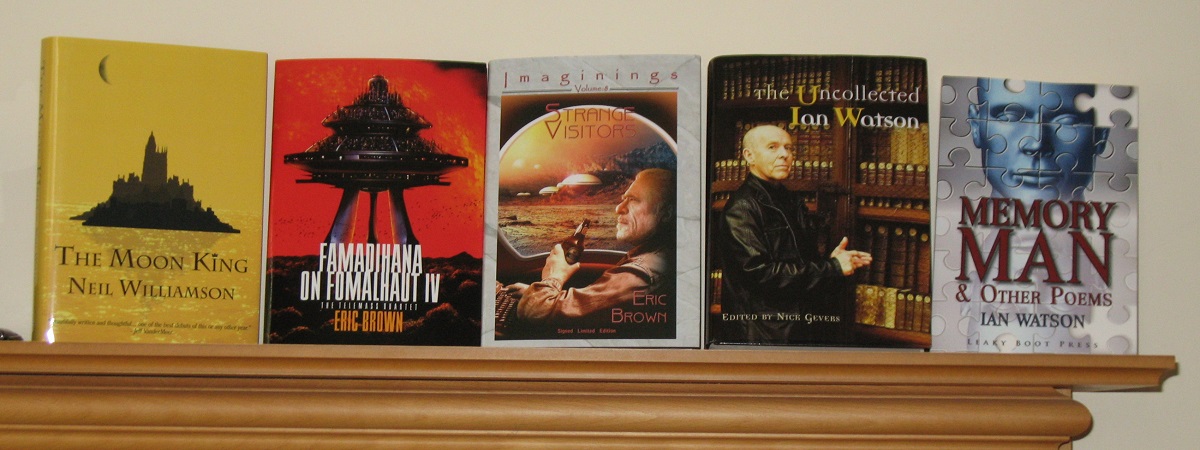
My haul from the New Con Press / PS Publishing book launch: Neil Williamson’s debut novel, The Moon King; the first in the Telemass Quartet by Eric Brown, Famadihana on Fomalhaut IV; his latest collection, Strange Visitors, part of NewCon’s Imaginings series of collections; The Uncollected Ian Watson is precisely that; and Memory Man & Other Poems is Ian’s first poetry collection. (The NewCon Press titles have yet to appear on their website, so the titles link to the site’s front page.)

2014-04-27 10.47.31

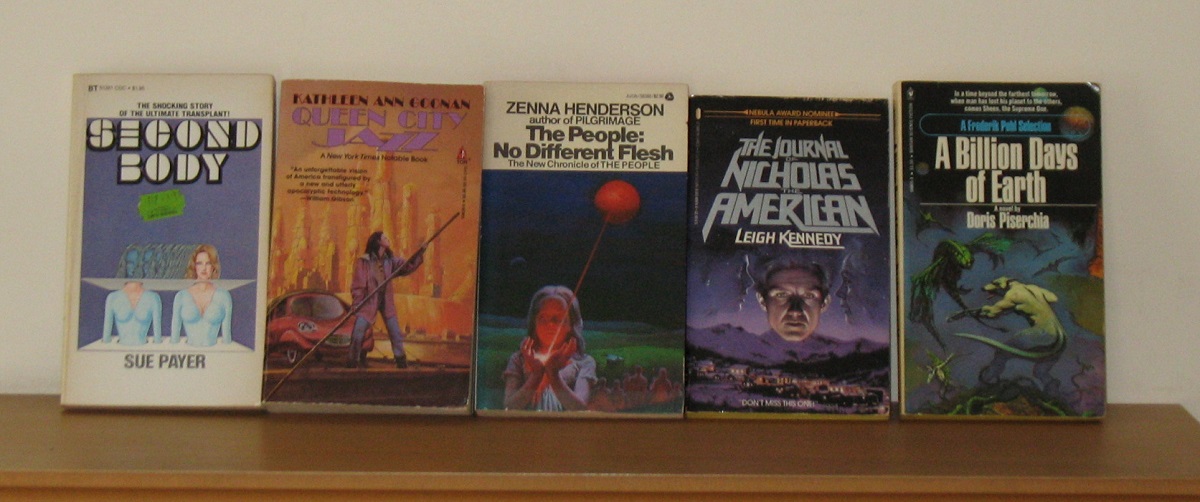
Some books for SF Mistressworks: Second Body by Sue Payer I just couldn’t resist after reading the blurb – “Five hours later, Wendy’s head was fused to Jennifer’s tall, voluptuous body, and her life would never be the same!”. Queen City Jazz by Kathleen Ann Goonan, The People: No Different Flesh by Zenna Henderson, The Journal of Nicholas the American by Leigh Kennedy and A Billion Days of Earth by Doris Piserchia are all books I’ve heard of – in fact, they’ve all been reviewed once already on SF Mistressworks.

2014-04-27 10.48.23

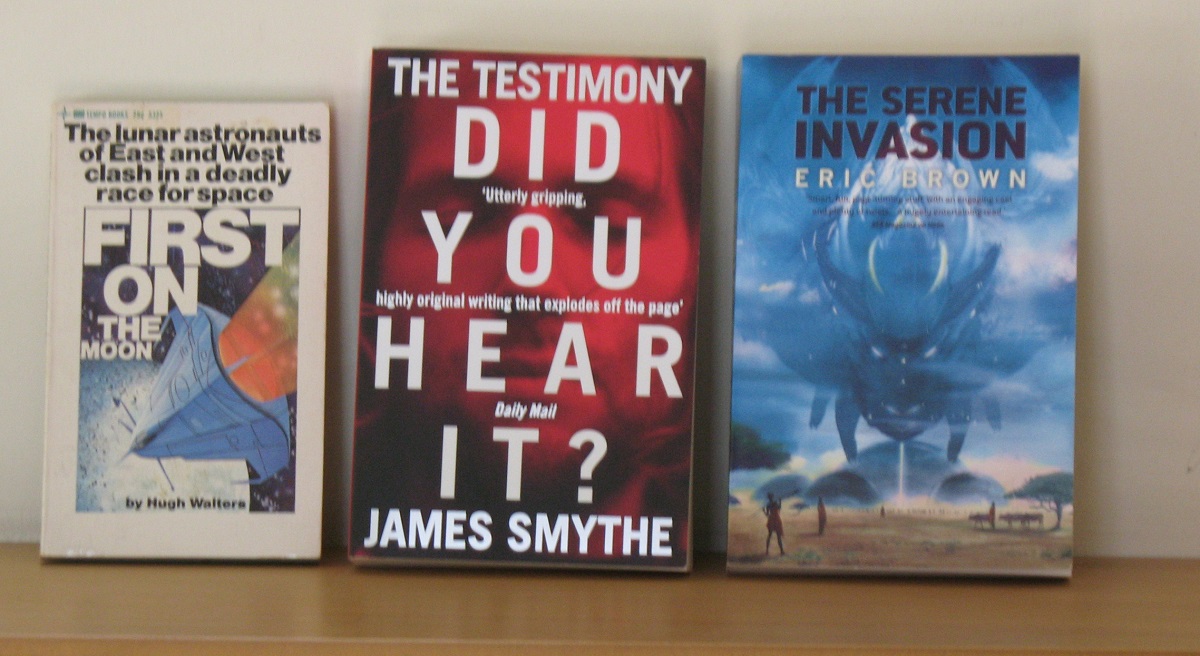
I also collect fictional treatments of first landings on the Moon published before Apollo 11 – First on the Moon by Hugh Walters from 1960 is one such novel. The Testimony by James Smythe and The Serene Invasion by Eric Brown are both books I didn’t have and want to read.

2014-04-27 10.49.12

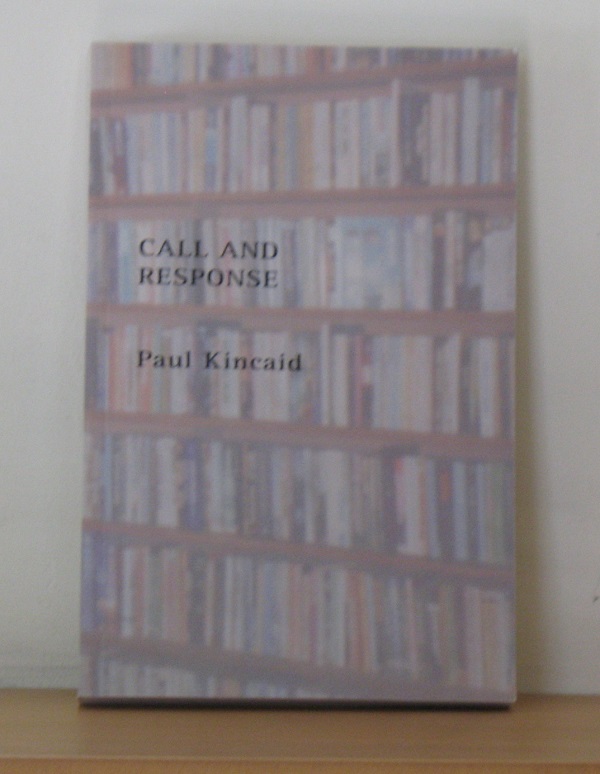
Finally, Paul Kincaid’s latest critical work, Call and Response.

As for Whippleshield Books… All three books of the Apollo Quartet were available in the dealers’ room throughout the con on the TTA Press table. I even sat behind the table for an hour with Jim Steel, so Roy could attend a programme item. We were not exactly mobbed. Over the entire weekend, I managed to sell around two dozen books, which was slightly better than I’d expected. I still had a 1.5 boxes of books to ship back home, however.

Next year’s Eastercon is in Heathrow, with Jim Butcher and Seanan McGuire as Guests of Honour. I doubt I’ll be going. I don’t like the site, and I’m not a fan of urban fantasy. I shall stay home and write something instead…


17 Comments

Women-only science fiction anthologies

Men-only sf anthologies are hardly rare, and anthologies where the male writers hugely outnumber the female writers on the table of contents are sadly commonplace. But there have been attempts in the past to redress this. As far as I can discover, there have been thirteen women-only sf anthologies published since the 1970s, and one that describes itself as a feminist anthology and has mostly female contributors. Late this year, of course, we get Alex Dally MacFarlane’s The Mammoth Book of SF Stories by Women, and I’m very much looking forward to seeing what stories she has chosen. But for the time-being, there are…

venusThe Venus Factor, Vic Ghidalia & Roger Elwood, eds. (1972) This is the earliest women-only sf anthology of which I’m aware. It appears to have been sold on the fact it contains “Agatha Christie’s only science fiction story”, ‘The Last Séance’. The remaining stories are by Cynthia Asquith, Gertrude Atherton, Miriam Allen deFord, and the more familiar Zenna Henderson, Anne McCaffrey, Judith Merril and CL Moore. It covers most of the decades from sf’s beginnings to the book’s publication, with Christie’s story from the 1920s, three from the 1930s, one from the 1950s and three from the 1960s.

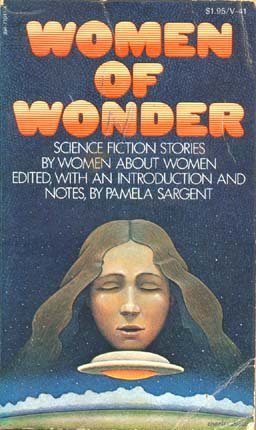
wowWomen of Wonder, Pamela Sargent, ed. (1975) Perhaps the most celebrated of the women-only sf anthologies – or rather, the trilogy which this book begins is perhaps the most celebrated. Sargent lays out her agenda in an excellent introduction (in fact, all three Women of Wonder anthologies are worth getting for Sargent’s introductions) – this is more than just science fiction “by women about women”, it’s about women’s place in the genre, and in the history of the genre, as both protagonists and writers. There are no obscure names in the table of contents, and one story even won a Nebula Award. The stories are by Sonya Dorman, Judith Merril, Katherine McLean, Marion Zimmer Bradley, Anne McCaffrey, Kit Reed, Kate Wilhelm, Carol Emshwiller, Ursula K Le Guin, Chelsea Quinn Yarbro, Joanna Russ and Vonda N McIntyre, and date from 1948 to 1973. I reviewed it on SF Mistressworks here.

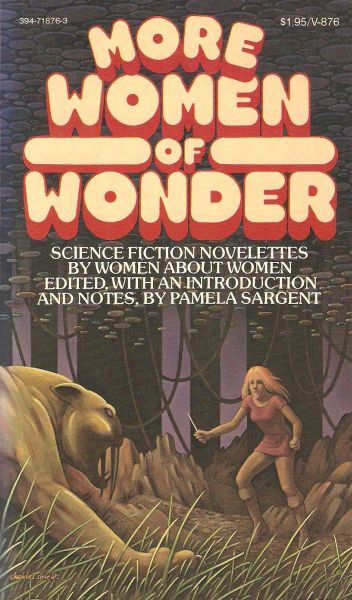
mwowMore Women Of Wonder, Pamela Sargent, ed. (1976) Although the Women of Wonder anthologies were plainly intended to demonstrate that, “Look! Women write science fiction too!”, Sargent does seem to draw her contributions from a relatively small pool. Admittedly, she explains that the anthologies are as much about sf stories about women as they are sf stories by women. Appearing in this volume are CL Moore, Leigh Brackett, Joanna Russ, Josephine Saxton, Kate Wilhelm, Joan D Vinge and Ursula K Le Guin, three of whom appeared in the earlier volume. I reviewed the anthology on SF Mistressworks here.

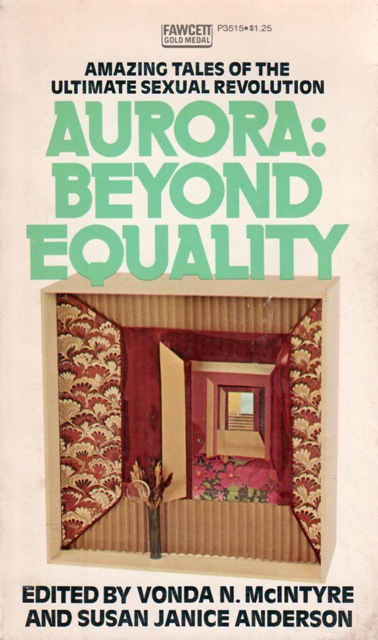
auroroaAurora: Beyond Equality, Vonda N McIntyre & Susan Janice Anderson, eds. (1976) This billed itself as a “feminist science fiction anthology” because its contents were not contributed wholly by women – three of the stories in the anthology were by men, David J Skal, PJ Plauger and Craig Strete. The remaining stories were provided by James Tiptree Jr (twice), Mildred Downey Broxon, Ursula K Le Guin, Joanna Russ and Marge Piercy. The stories are all original to the anthology.

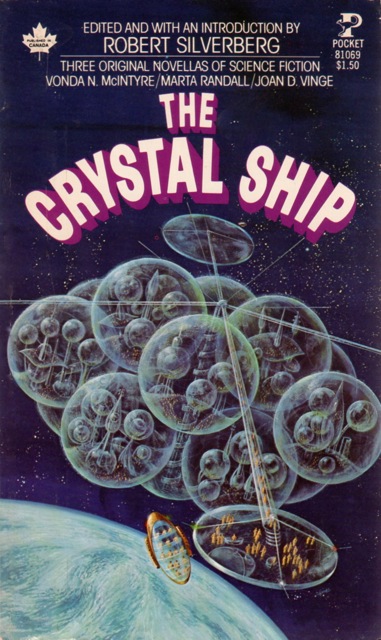
crystalThe Crystal Ship, Robert Silverberg, ed. (1976) Although a male sf writer’s name appears prominently on the cover of this book, it actually contains three original novellas by women: ”The Crystal Ship’ by Joan D Vinge, ‘Megan’s World’ by Marta Randall and ‘Screwtop’ by Vonda N McIntyre. The last also appeared in The New Women of Wonder (see SF Mistressworks review here), and was published in 1989 as one half of a Tor double with James Tiptree Jr’s ‘The Girl Who Was Plugged In’.

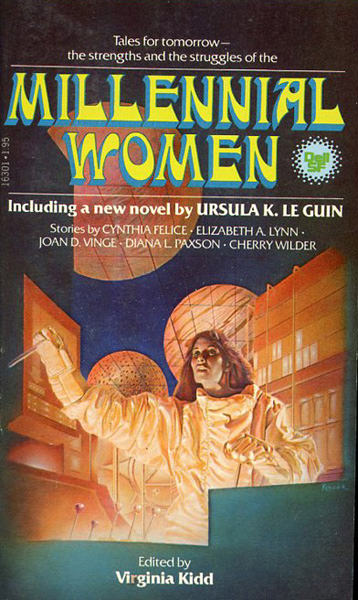
millennialMillennial Women, Virginia Kidd, ed. (1978) Kidd was a member of the Futurians and an influential editor. While this anthology is perhaps not as strong as any of the Women of Wonder anthologies, it does present a wide variety of sf stories – provided by Cynthia Felice, Marilyn Hacker, Diana L Paxson, Elizabeth A Lynn, Cherry Wilder, Joan D Vinge and Ursula K Le Guin. Some editions of the book were sold as Le Guin’s short novel, “Eye of the Heron and other stories”, with Le Guin’s name most prominent on the cover. I reviewed it on SF Mistressworks here.

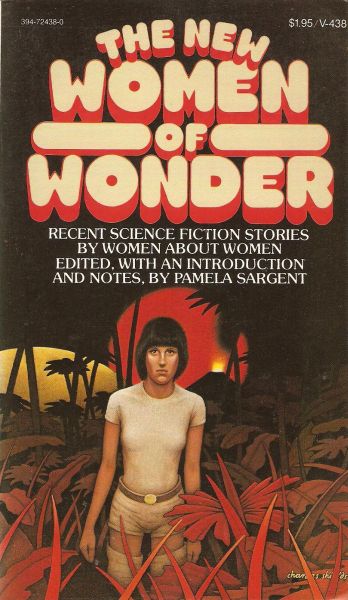
nwowThe New Women of Wonder, Pamela Sargent, ed. (1978) The third and final Women of Wonder anthologies until their 1995 reboot. Sargent once again turns mainly to women writers she has previously published – only Eleanor Arnason, Pamela Zoline and James Triptree Jr are new in this volume. Mind you, their three stories are pretty much stone-cold classics of the genre. Also inside are stories by Sonya Dorman, Vonda N McIntyre, Josephine Saxton, Kit Reed, Carol Emshwiller, Joanna Russ, Chelsea Quinn Yarbro and Joan D Vinge. This volume is the strongest of the three. I reviewed it on SF Mistressworks here.

cassandraCassandra Rising, Alice Laurance, ed. (1978) Not an easy book to find, this anthology contains nineteen original stories by Ursula K Le Guin, Kay Rogers, Joan Bernott, Zenna Henderson, Katherine MacLean, Kathleen Sky, Rachel Cosgrove Payes, Josephine Saxton, Grania Davis, Raylyn Moore, Alice Laurance, Anne McCaffrey, Steve Barnes, Barbara Paul, Sydney J Van Scyoc, Beverly Goldberg, Miriam Allen deFord & Juanita Coulson, Jacqueline Lichtenberg and Chelsea Quinn Yarbro. Steve Barnes, incidentally, is not male writer Steven Barnes but the pen-name of Margaret L Barnes (an introductory note explains she used the name “as a way of preserving her family name, Stephenson, lost in marriage”). Judging by some of the introductory comments to the stories made by Laurance, this was an open submission anthology, which may explain the presence of the more unfamiliar names. There is also a foreword by Andre Norton.

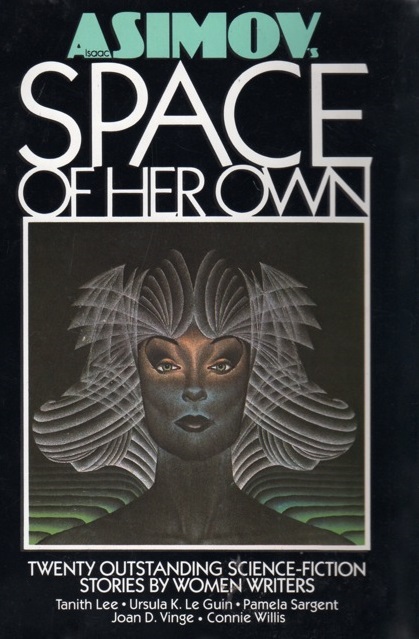
spaceAsimov’s Space of Her Own, Shawna McCarthy, ed. (1983) As the title indicates, this anthology contains women-authored stories originally published in Isaac Asimov’s Science Fiction Magazine. Asimov’s regularly published themed anthologies of contents drawn from the magazine – McCarthy herself edited four of thirty such anthologies. The contents date entirely from 1981 to 1983, and are provided by Connie Willis, Mary Gentle, Leigh Kennedy, Sydney J Van Scyoc, Ursula K Le Guin, Pamela Sargent, Joan D Vinge, Julie Stevens, Mildred Downey Broxon, Cyn Mason, PA Kagan, Sharon Webb, Pat Cadigan, Lee Killough, PJ MacQuarrie, Tanith Lee, Stephanie A Smith, Cherie Wilkerson, Janet Asimov, Beverly Grant and Hope Athearn. None of the stories are especially well-known.

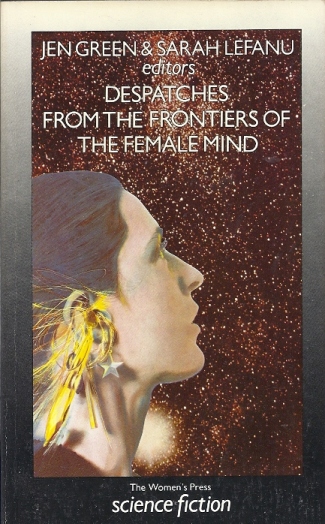
despatchesDespatches from the Frontiers of the Female Mind, Sarah LeFanu & Jen Green, eds. (1985) During the 1980s, The Women’s Press published a number of science fiction paperbacks by women writers, all in similar grey livery. This was the only anthology. It contains original stories by Josephine Saxton, Margaret Elphinstone, Joanna Russ, Gwyneth Jones, Beverley Ireland, Tanith Lee, Lannah Battley, Pamela Zoline, Mary Gentle, Frances Gapper, Lisa Tuttle, Pearlie McNeill, Naomi Mitchison, Zoe Fairbairns, Penny Casdagli, Raccoona Sheldon (AKA James Tiptree Jr) and Sue Thomason. Many of the authors also had novels published by The Women’s Press, reprints and original. The Zoline is a coup – she has only ever written five stories… and one of those was original to her collection, Busy About the Tree of Life. Jack Deighton reviewed Despatches from the Frontiers of the Female Mind on SF Mistressworks here.

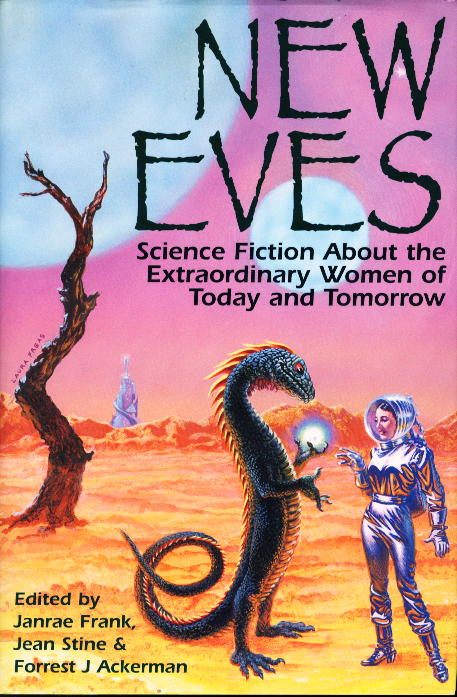
newevesNew Eves: Science Fiction About the Extraordinary Women of Today and Tomorrow, Forrest J Ackerman, Janrae Frank & Jean Marie Stine, eds. (1994) An excellent introduction to science fiction by women from the genre’s beginnings through to the year of publication of the anthology – indeed, the anthology is organised by decade. The editors’ introduction is mostly good, but sabotages itself with a final section which undermines the quite sensible argument presented in the preceding pages – no doubt the lone male editor insisted on this. The stories are organised into sections by decade: ‘The 20s & 30s’, ‘The 40s’, ‘The 50s’, ‘The 60s & 70s’ and ‘The 80s – and Beyond’. Not all of the older stories work for modern readers, but it’s good that they’re documented – works by Francis Stevens (AKA Gertrude Barrows Bennett), Leslie F Stone and Hazel Heald, for example. Later authors may be better known but there are still many who have been unfairly forgotten. I reviewed the anthology on SF Mistressworks here and here.

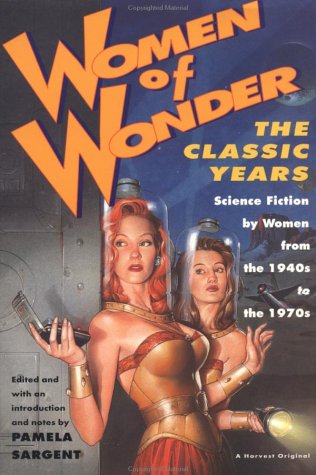
wowcalssicsWomen of Wonder: the Classic Years, Pamela Sargent, ed. (1995) The first of a pair of reboots of the Women of Wonder series, it actually contains more stories than the the original three volumes – and, in fact, contains many of the stories from those anthologies. Zenna Henderson, Margaret St Clair and Lisa Tuttle are new to the volume, and CL Moore, Leigh Brackett, Marion Zimmer Bradley and Joan D Vinge are all represented by different stories than those in the Women of Wonder trilogy. As for the rest… The stories by Judith Merril, Katherine McLean, Anne McCaffrey, Sonya Dorman, Kit Reed, Chelsea Quinn Yarbro, Joanna Russ and Vonda N McIntyre all originally appeared in Women of Wonder; those by Josephine Saxton, Kate Wilhelm and Ursula K Le Guin were in More Women Of Wonder; and the stories by Pamela Zoline, James Tiptree Jr and Eleanor Arnason were in The New Women of Wonder. There is enough of a difference to consider buying this book if you own the original trilogy, but perhaps less of a reason to track down the three Women of Wonder anthologies if you have this one.

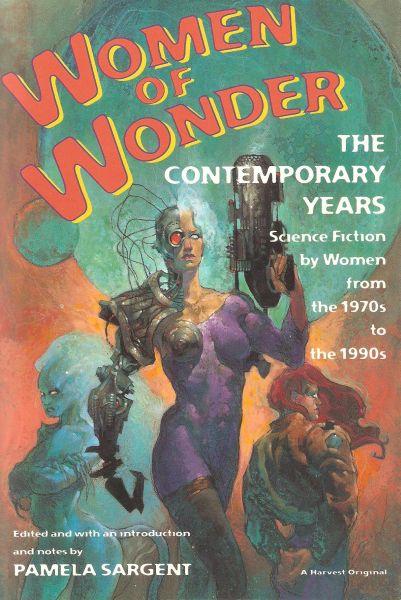
wowconWomen of Wonder: the Contemporary Years, Pamela Sargent, ed. (1995) While the “classic” volume covered the years 1948 to 1977, the same years covered by Sargent’s original trilogy, this one covers the following two decades – with stories from 1978 to 1993. Contributions are provided by CJ Cherryh, Tanith Lee, Suzy McKee Charnas, Carol Emshwiller, Sydney J Van Scyoc, Angela Carter, Mary Gentle, Octavia E Butler, Jayge Carr, Rosaleen Love, Sheila Finch, Pat Cadigan, Pat Murphy, Karen Joy Fowler, Judith Moffett, Connie Willis, Lisa Goldstein, Nancy Kress, Storm Constantine and Rebecca Ore. Although there are names in common with New Eves: Science Fiction About the Extraordinary Women of Today and Tomorrow, there is very little overlap – only the Van Scyoc story, in fact, appears in both. I reviewed this anthology for SF Mistressworks here and here.

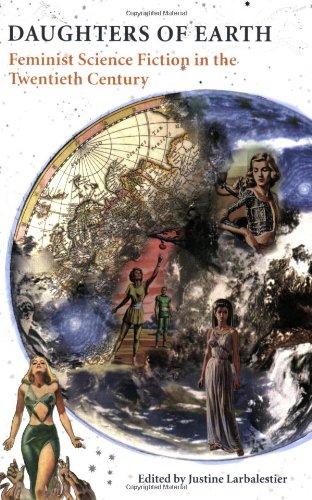
doeDaughters of Earth, Justine Larbalestier, ed. (2006) Unlike the other anthologies in this post, Daughters of Earth is a mix of fiction and non-fiction, as each of the stories is followed by an essay discussing that story and/or its author. Daughters of Earth also covers the widest spread of time of all the anthologies named above – the earliest story is from 1927 and the latest from 2002. The fiction is provided by Clare Winger Harris, Leslie F Stone, Alice Eleanor Jones, Kate Wilhelm, Pamela Zoline, James Tiptree Jr, Lisa Tuttle, Pat Murphy, Octavia E Butler, Gwyneth Jones and Karen Joy Fowler. Some of these stories have appeared in other anthologies mentioned in this post; one or two of them I consider personal favourite sf stories. The non-fiction is provided by Jane L Donawerth, Brian Attebery, Lisa Yaszek, Josh Lukin, Mary E Papke, Wendy Pearson, Cathy Hawkins, Joan Haran, Andrea Hairston, Veronica Hollinger and L Timmel Duchamp. If this anthology has a fault, it’s that it could do with being much larger – it contains eleven pieces of fiction, but I can think of at least another dozen I think deserve the same treatment.

I’ve mentioned throughout this post where reviews of the anthologies on SF Mistressworks exist, and I’ve linked to those reviews. The ones that have yet to be reviewed… will be done some time during this year as I own copies of them all. For those interested in reading more on the subject, there is Partners in Wonder by Eric Leif Davin, The Battle of the Sexes in Science Fiction by Justine Larbalestier, Decoding Gender in Science Fiction and, if you can find a copy, Future Females: A Critical Anthology by Marleen S Barr. There are probably many other books on feminist science fiction, as well as books on, or by, individual feminist writers – for example, Joanna Russ: On Joanna Russ by Farah Mendlesohn or The Country You Have Never Seen by Russ herself. And, of course, everyone should own a copy of Russ’s How to Suppress Women’s Writing

ETA: Despite owning copies of them, I managed to miss out both Despatches from the Frontiers of the Female Mind and Cassandra Rising, as noted in the comments below. I have now added them. Other people have pointed me in the direction of themed all-women anthologies from major publishers and small presses, many of which include both science fiction and fantasy. Those, I think, are a post for another day. The above are explicitly science fiction anthologies, covering the historical spread of the genre and demonstrating that women have been writing sf since its beginnings.


Leave a comment

8-question meme from SF Signal

John DeNardo posts these regularly on SF Signal and I usually have a go at them. This week it’s the following eight questions:

1. The first science fiction, fantasy or horror book I ever read was:
Technically, it would be Doctor Who and the Zarbi by Bill Strutton, a novelisation of the TV series, which my parents gave me as a Christmas present in, I think, 1974. But the first category sf novel I read was Starman Jones by Robert Heinlein, which was lent to me by a classmate in my first year at prep school – so that would be either late 1976 or early 1977.

Doctor_Who_and_the_Zarbi

2. The last science fiction, fantasy or horror book I read that I’d put in my “Top 20″ list is:
I guard my Top 20 jealously and, sadly, it’s mostly not sf, fantasy or horror. No genre book has made it into the list during the last couple of years. However, if I were to run a category genre-only Top 20, then the last book I read which might make the grade would probably be… Extra(Ordinary) People, a 1984 collection by Joanna Russ, if only because it contains a story, ‘The Mystery of the Young Gentleman’, which immediately became a new favourite. I reviewed it on SF Mistressworks here. If I were to restrict myself to novels, the last three genre reads with the most stars from me on GoodReads were, in no particular order: Europe in Autumn, The Violent Century, Rapture and Ancillary Justice.

3. The last science fiction, fantasy or horror book I couldn’t finish was:
That would be Palimpsest by Cathrynne M Valente. I’d heard a lot of positive things about it, and was quite chuffed to stumble across a copy in a charity shop. But the reading didn’t go very well at all. I baled around page 100, unable to put up any longer with the over-writing. I think it was something about a character being able to taste a snail’s foot in his mouth or something.

4. A science fiction, fantasy or horror author whose work I cannot get enough of is:
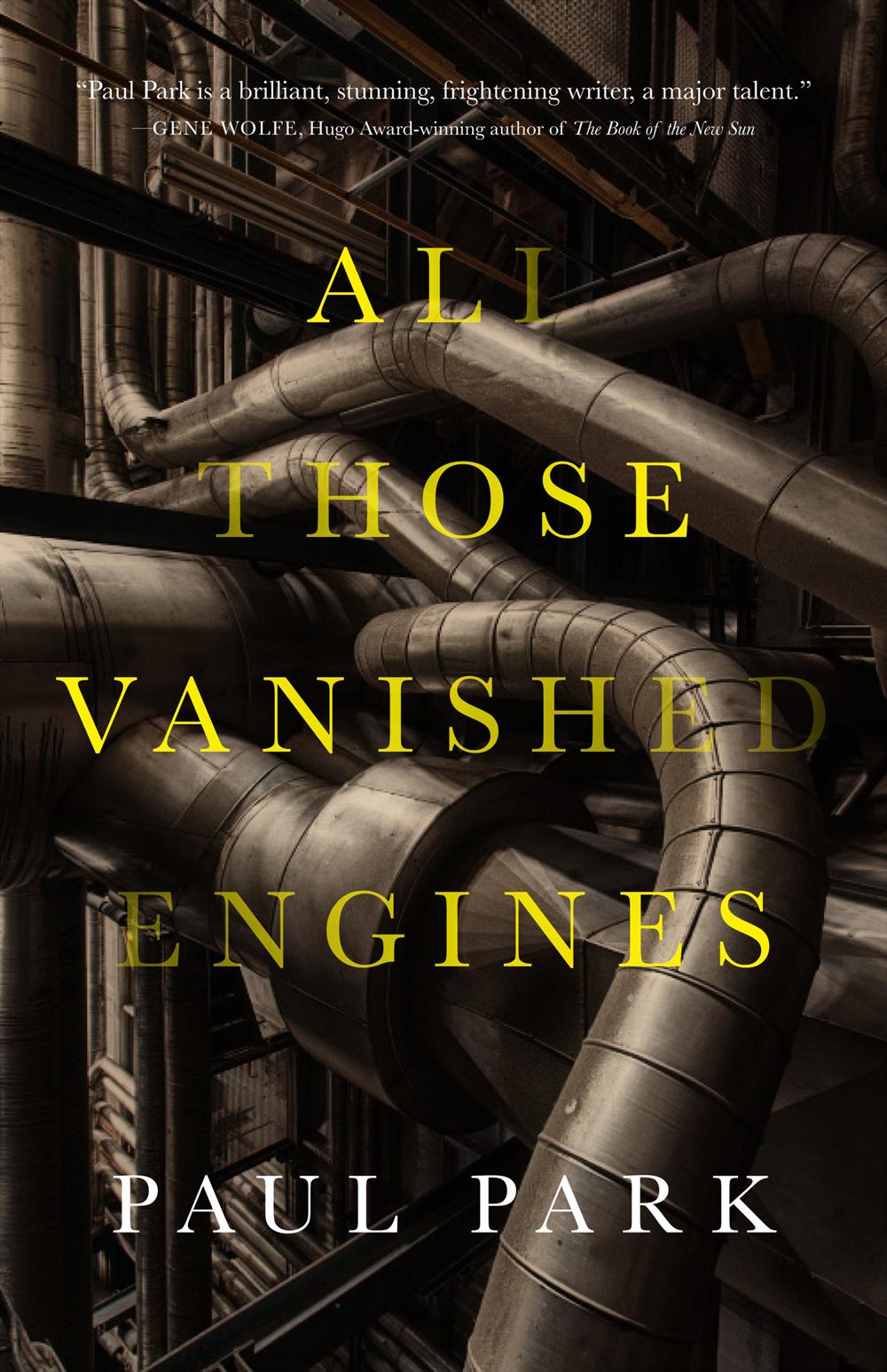
I have my favourites – who doesn’t? Paul Park has a new novel and a collection coming out this year, which has made me very happy – doubly so, in fact. Sadly, Gwyneth Jones doesn’t seem to have anything due out in the foreseeable future. A couple of years ago, I’d heard a US publisher had contracted for a sequel to Dr Franklin’s Island (as by Ann Halam), but I’ve yet to see it mentioned anywhere online. I’m also eagerly awaiting David Herter’s new sf novels/novellas from PS Publishing.

all-those-vanished-engines-paul-park-base-art-co

5. A science fiction, fantasy or horror author I’m ashamed to admit I haven’t read yet is:
But I’ve read everyone! Ahem. Of course, I haven’t really, just rather a lot of them – but many of those I’ve not read have been a matter of choice. I don’t think there’s anyone I’m ashamed I’ve not read – because if I was, I’d have read them; or at the very least I’d have one of their books on my humungous TBR pile. PC Hodgell, for example; or Michael Cisco… I own books by both but have yet to read them. Which reminds me, I really must get around to purchasing a copy of Laurie J Marks’ Fire Logic, as I really want to read it. Um, in fact, now I think about it, there’s a whole bunch of authors I want to read but have yet to buy anything by…

6. A science fiction, fantasy or horror book I would recommend to someone who hasn’t read sf/f/h is:
Easy. The Wall Around Eden by Joan Slonczewski. I reviewed it on SF Mistressworks here, and have been singing its praises ever since. Sadly, it’s currently out of print; but it really needs to be introduced to a new audience.

7. A science fiction, fantasy or horror book that’s terribly underrated is:
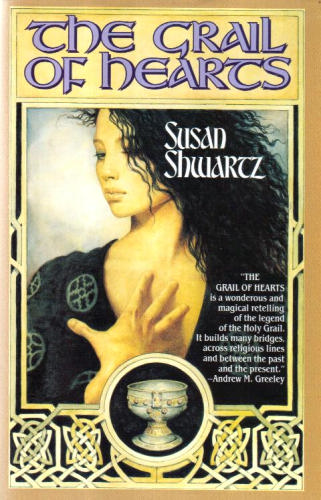
Where do I start? Many of my favourite genre novels were highly regarded when they were published, but they’ve never been reprinted since. One or two are now in the SF Masterworks series… so I can hardly claim they’re still under-rated. Instead, I will chose something completely out of my comfort zone – a fantasy novel: The Grail of Hearts by Susan Shwartz (1991). It was never published in the UK, had two reviews on publication (in Locus and amazing Stories), has zero reviews on GoodReads and two on Amazon (including a 5-star one by Katherine Kerr!), Kirkus called it a “formless hodgepodge of a book”, and the first five pages of Google are links to places to buy the book rather than online reviews… I think it qualifies as under-rated.

grailfohearts

8. A science fiction, fantasy or horror book that’s terribly overrated is:
There’s a lot of recent sf I think is horribly over-rated – just look at the Hugo Award and Nebula Award shortlists for the past few years. But many of those books I’ve not actually read myself, so my opinion is chiefly the result of other stuff written by those authors. However, I have read Leviathan Wakes by James SA Corey, and it was shortlisted for the Hugo Award for 2012, and made it into the top 5 on the Locus Poll for that year. I thought it was terrible, and I refused to read its sequels. I now hear it’s been optioned for television. Sigh.


8 Comments

The apples and oranges of genre

Apples and oranges are fruit, and you’ll find them in fruit bowls and packed lunches around the world. They’re sold in supermarkets and greengrocers, but not in fishmongers and betting shops. Some people prefer apples to oranges. They like the appleness of apples more than the orangeness of oranges. Or vice versa. Some people like both equally. But the fact you can find apples and oranges in a fruit bowl doesn’t make an apple an orange or an orange an apple.

Comparing_Apples_to_Oranges

Just like science fiction and fantasy.

Everyone knows what apples and oranges are, and they could give any number of reasons why one is not the other. Yet when it comes to science fiction and fantasy, most people can only say, “they’re fruit”. As if that’s all that matters. Of course it isn’t. Otherwise everyone would like the two genres equally – and fantasy wouldn’t outsell sf by five or seven to one.

But because sf and fantasy stories both take place in invented worlds, people lump them together. But not every sf/fantasy story has an invented setting; and not every story which takes place in an invented world is sf or fantasy. So that’s a piss-poor definition. And where do we stop with the invented elements? Robots. Dragons. FTL. Magic. What about an invented organisation? Like… SPECTRE? Are Fleming’s Bond books science fiction? Maybe it’s the degree of invention in the story, then. Like that’s not a movable bar…

The point is, when you start looking at what science fiction and fantasy have in common you soon find yourself tied in knots. However, when you consider why they’re different… then things begin to make sense. Which, logically, implies they must be different things.

So they share a “fruit bowl”, and have done since fruit bowls were invented – but they still exhibit more readily-definable differences than they do similarities. Please stop trying to insist apples are oranges, and vice versa. Accept that they are each their own thing, no matter how many fruit salads you make.


19 Comments

The SF Mistresswork list, revised

Who remembers the SF Mistressworks meme, a list of science fiction by women writers from the twentieth century (and earlier)? I originally posted it in March 2011 (see here), and it then inspired me to create the SF Mistressworks website. Which is still going strong.

But that original list had a few problems. A couple of the titles I’d proposed turned out to be fantasy and not science fiction… The list also contained only 91 books, as I’d not managed to think of 100 suitable titles.

But three years later, I’ve read a lot more sf by women writers, and I’ve done more research on the topic. So I felt it was time for a new version of the list. Also, many more of the books are now available once again – either published by small presses, or made available on Kindle by the SF Gateway or the authors themselves self-publishing their back-catalogue.

The list below mostly unchanged from the original – I’ve simply expanded it to 100, removed the fantasy novels, made a few alternative selections for a couple of writers, and added some more writers I’d unfairly missed off first time around. It now looks like this:

  1. Frankenstein*, Mary Shelley (1818)
  2. Herland†, Charlotte Perkins Gilman (1915)
  3. Orlando, Virginia Woolf (1928)
  4. Lest Ye Die, Cicely Hamilton (1928)
  5. Swastika Night, Katharine Burdekin (1937)
  6. Shadow on the Hearth, Judith Merril (1950)
  7. Judgment Night, CL Moore (1952)
  8. The Sword of Rhiannon, Leigh Brackett (1953)
  9. Agent of the Unknown, Margaret St Clair (1956)
  10. Pilgrimage: The Book of the People, Zenna Henderson (1961)
  11. Catseye, Andre Norton (1961)
  12. Memoirs of a Spacewoman†, Naomi Mitchison (1962)
  13. Sunburst, Phyllis Gotlieb (1964)
  14. Heroes and Villains, Angela Carter (1969)
  15. Armed Camps, Kit Reed (1969)
  16. Darkover Landfall, Marion Zimmer Bradley (1972)
  17. Ten Thousand Light-years from Home, James Tiptree Jr (1973)
  18. The Dispossessed*, Ursula K LeGuin (1974)
  19. Walk to the End of the World†, Suzy McKee Charnas (1974)
  20. Star Rider†, Doris Piserchia (1974)
  21. The Female Man*†, Joanna Russ (1975
  22. Missing Man, Katherine MacLean (1975)
  23. Arslan*, MJ Engh (1976)
  24. Don’t Bite the Sun, Tanith Lee (1976)
  25. Floating Worlds*, Cecelia Holland (1976)
  26. Where Late The Sweet Birds Sang*, Kate Wilhelm (1976)
  27. Islands, Marta Randall (1976)
  28. Dreamsnake, Vonda N McIntyre (1978)
  29. False Dawn, Chelsea Quinn Yarbro (1978)
  30. Shikasta, Doris Lessing (1979)
  31. Kindred†, Octavia Butler (1979)
  32. Benefits, Zoe Fairbairns (1979)
  33. Leviathan’s Deep, Jayge Carr (1979)
  34. A Voice Out of Ramah, Lee Killough (1979)
  35. The Snow Queen, Joan D Vinge (1980)
  36. The Silent City†, Élisabeth Vonarburg (1981)
  37. The Many-Coloured Land, Julian May (1981)
  38. Darkchild, Sydney J Van Scyoc (1982)
  39. The Crystal Singer, Anne McCaffery (1982)
  40. Native Tongue†, Suzette Haden Elgin (1984)
  41. The Handmaid’s Tale, Margaret Atwood (1985)
  42. Jerusalem Fire, RM Meluch (1985)
  43. The Children of Anthi, Jay D Blakeney (1985)
  44. The Dream Years, Lisa Goldstein (1985)
  45. Last Letters from Hav, Jan Morris (1985)
  46. Queen of the States†, Josephine Saxton (1986)
  47. The Wave and the Flame, Marjorie Bradley Kellogg (1986)
  48. The Journal of Nicholas the American, Leigh Kennedy (1986)
  49. A Door into Ocean†, Joan Slonczewski (1986)
  50. Angel At Apogee, SN Lewitt (1987)
  51. In Conquest Born, CS Friedman (1987)
  52. Pennterra, Judith Moffett (1987)
  53. Kairos, Gwyneth Jones (1988)
  54. Cyteen, CJ Cherryh (1988)
  55. Unquenchable Fire*, Rachel Pollack (1988)
  56. The City, Not Long After, Pat Murphy (1988)
  57. Carmen Dog†, Carol Emshwiller (1988)
  58. The Steerswoman, Rosemary Kirstein (1989)
  59. The Third Eagle, RA MacAvoy (1989)
  60. Grass*, Sheri S Tepper (1989)
  61. Heritage of Flight, Susan Shwartz (1989)
  62. Falcon, Emma Bull (1989)
  63. The Archivist, Gill Alderman (1989)
  64. Winterlong, Elizabeth Hand (1990)
  65. A Gift Upon the Shore, MK Wren (1990)
  66. Red Spider, White Web, Misha (1990)
  67. Polar City Blues, Katherine Kerr (1990)
  68. He, She and It (AKA Body of Glass), Marge Piercy (1991)
  69. Sarah Canary*, Karen Joy Fowler (1991)
  70. Beggars in Spain, Nancy Kress (1991)
  71. A Woman of the Iron People, Eleanor Arnason (1991)
  72. Hermetech, Storm Constantine (1991)
  73. Synners, Pat Cadigan (1991)
  74. China Mountain Zhang, Maureen F McHugh (1992)
  75. Correspondence†, Sue Thomas (1992)
  76. Lost Futures, Lisa Tuttle (1992)
  77. Doomsday Book*, Connie Willis (1992)
  78. Ammonite*, Nicola Griffith (1993)
  79. The Holder of the World†, Bharati Mukherjee (1993)
  80. Dancing on the Volcano, Anne Gay (1993)
  81. Queen City Jazz, Kathleen Ann Goonan (1994)
  82. Happy Policeman, Patricia Anthony (1994)
  83. Shadow Man, Melissa Scott (1995)
  84. Legacies, Alison Sinclair (1995)
  85. Primary Inversion, Catherine Asaro (1995)
  86. Alien Influences, Kristine Kathryn Rusch (1995)
  87. The Sparrow, Mary Doria Russell (1996)
  88. Memory, Lois McMaster Bujold (1996)
  89. Remnant Population, Elizabeth Moon (1996)
  90. Looking For The Mahdi, N Lee Wood (1996)
  91. An Exchange of Hostages, Susan R Matthews (1997)
  92. Fool’s War, Sarah Zettel (1997)
  93. Black Wine, Candas Jane Dorsey (1997)
  94. A Thousand Words for Stranger, Julie E Czernada (1997)
  95. Halfway Human, Carolyn Ives Gilman (1998)
  96. Vast, Linda Nagata (1998)
  97. Hand of Prophecy, Severna Park (1998)
  98. Brown Girl In The Ring, Nalo Hopkinson (1998)
  99. Dreaming In Smoke, Tricia Sullivan (1999)
  100. Ash: A Secret History, Mary Gentle (2000)

Although there were around sixty women actively writing science fiction or fantasy in the 1940s, I can’t find a sf novel written by any of them which was published in that decade. Several of the writers on the list are better known as writers of fantasy, but they have written science fiction and that’s what I’ve listed. Books in Gollancz’s SF Masterworks series I’ve marked with an asterisk (*) – many of these were added to the series after I posted the original list three years ago. Books that were published by The Women’s Press back in the 1980s/1990s I’ve marked with a dagger (†).

Myself, I’ve read 49 of the books, and have a further eight on the TBR. Forty-eight of the books have also been reviewed on SF Mistressworks, some of them several times.

Finally, are there any writers I’ve missed who really belong on the list? Don’t forget it’s books published up until 2000. Perhaps some of the books on the list are not the author’s best work, perhaps another title would better. One or two were, I admit, judgement calls – for example, Marge Piercy’s He, She and It (as Body of Glass) won the Clarke Award in 1992 but is no longer in print; her Woman on the Edge of Time, however, is (but it was also first published in 1976, and I felt I had more than enough books from that year). There are, as far as I’m aware, only two cheats on the list – Tiptree is represented by a collection rather than a novel; and Despatches from the Frontiers of the Female Mind is an anthology  – and, to be honest, there are a good number of women-only sf anthologies which might be better choices.

ETA: removed Despatches from the Frontiers of the Female Mind as it’s an anthology, and added Joachim Boaz’s suggestion of Kit Reed’s Armed Camps. I’ll be posting a list of women-only sf anthologies shortly.


1 Comment

Title story

PS Publishing have released details of the next Postscripts anthology, Far Voyager Postscripts #32/33. The TOC looks like this:

  • ‘Far Voyager’ — Ian Sales
  • ‘3 A.M. in the Mesozoic Bar’ — Michael Swanwick
  • ‘Dear Miss Monroe’ — Andrew Jury
  • ‘The Case of the Barking Man’ — Mel Waldman
  • ‘One Hundred Thousand Demons and the Cherub of Desire’ — Andrew Drummond
  • ‘An American Story’ — Darrell Schweitzer
  • ‘Irezumi’ — John Langan
  • ‘Sister Free’ — Rio Youers
  • ‘A Little Off the Top’ — Tom Alexander
  • ‘Sweetheart, I Love You’ — Mel Waldman
  • ‘Winter Children’ — Angela Slatter
  • ‘A Girl of Feather and Music’ — Lisa L. Hannett
  • ‘Thirty Three Tears to a Teaspoon’ — Alan Baxter
  • ‘The Rusalka Salon for Girls Who Like to Get Their Hair Wet’ — Angie Rega
  • ‘The Psychometrist’ — Suzanne J. Willis
  • ‘Sea Angels’ — Quentin S. Crisp
  • ‘Plink’ — Kurt Dinan
  • ‘Xaro’ — Darren Speegle
  • ‘We Are Not Alone’ — Richard Calder
  • ‘The Curtain’ — Thana Niveau
  • ‘Playground’ — Gio Clairval
  • ‘What Once Was Bone’ — Gary A. Braunbeck
  • ‘Darkscapes: Three Journeys to the Night Side’ — Mel Waldman
  • ‘Services Rendered’ — Bruce Golden
  • ‘GW in the Afterlife’ — Robert Reed
  • ‘Eskimo’ — Andrew Hook
  • ‘With Friends Like These’ — Gary Fry
  • ‘An Inspector Calls’ — Ian Watson
  • ‘Confessions’ — Mel Waldman
  • ‘A Legion of Echoes’ — Alison Littlewood
  • ‘Talk in Riddles’ — Mark Reece
  • ‘The Mermaid and the Fisherman’ — Paul Park

Yup. My story is the title story. Cool, or what? There’s some good stuff in that TOC too, including a few favourite authors. No publication date as yet, but it’ll be sometime this year, I imagine.