It Doesn't Have To Be Right…

… it just has to sound plausible


2 Comments

2013 and me

I don’t normally bother with these sorts of posts, as usually it’s hardly worth it. However, while I can’t hope to match the prolificity of some authors I know, and I’m still a small fry in the genre ocean, I decided it might be worth mentioning that I did have one or two pieces published this year… Well, all right, four. Two short stories: ‘The Incurable Irony of the Man Who Rode The Rocket Sled’, which appeared in The Orphan here; and ‘The Last Men in the Moon’, which appeared in the literary anthology Because of What Happened from the Fiction Desk. And, of course, two books of the Apollo Quartet – The Eye With Which The Universe Beholds Itself, which was published in January this year and not in 2012, even though it feels like it; and Then Will The Great Ocean Wash Deep Above, which was published only a week ago…

From the above, it looks like I’ve not done much during the past 11 months. True, 2013 doesn’t feel like my most productive year ever, but I’m sure I did a few other things… I reviewed three books for Interzone, two for Vector and nineteen for SF Mistressworks. I contributed some guest blog posts here and there, wrote the introduction to Set it in Space and Shovel Coal into it, an anthology by the Sheffield SF and Fantasy Writers Group, and gave talks at both the National Space Centre and the University of Sheffield Natural History Society. I spent a weekend in Berlin with family, and another weekend in Stockholm at this year’s Swecon, two cities I’d never visited before – and I had an excellent time in both. I saw 41 bands perform live, most of those at Bloodstock. I attended four conventions, including the one in Sweden. I also read a metric ton of books as research for my two novellas above…

Oh, and I won an award and was a finalist for another.

Shit, I thought I’d done more than that. It certainly feels like I should have done. I must make more of an effort next year. As it is, I suspect I may be the one buying the curry in 2014…


4 Comments

Apollo Quartet 3 published

Apollo Quartet 3: Then Will The Great Ocean Wash Deep Above is now available from Amazon. It’s been available as an ebook for several days – on Kindle (UK | US), Kobo, and as both epub and mobi from the Whippleshield Books website.

Since MPG Biddles went into administration back in June, I’ve had to find a different printer for Whippleshield’s books, and I decided to try Amazon’s CreateSpace for the paperback edition of Then Will The Great Ocean Wash Deep Above. Which means a book of the Apollo Quartet is now available in paperback in the US for the first time. You can buy it here (UK | US).

The limited hardback edition will be delayed a week or two as I’m using a different printer, but it’s available for pre-order here.

I’ve also decided to move forward the fourth book of the Apollo Quartet, All That Outer Space Allows, and will try to get it out for the first half of 2014. Perhaps even in time for the Eastercon in Glasgow. I’ve always had a clear vision of the story – unlike books 2 and 3 when I started them – so it shouldn’t be that difficult. But we shall see what the new year brings…

In the meantime, there’s always Then Will The Great Ocean Wash Deep Above to read, in either ebook or paperback…

ETA: Those of you have already pre-ordered the limited hardback edition, or are thinking of doing so, I’m happy to provide an ebook version – in pdf, epub or mobi – free of charge immediately to ease the wait…


8 Comments

Apollo Quartet 3 is here… nearly

There’s only a fortnight to go until Apollo Quartet 3 Then Will The Great Ocean Wash Deep Above is officially published, so I’m now making e-ARCs available for review. I have them in PDF, EPUB or MOBI format. Leave a comment if you’d like one.

I will, of course, be publishing the book in paperback and in a signed hardback edition limited to 75 copies, just as I did for Adrift on the Sea of Rains and The Eye With Which The Universe Beholds Itself. If you’re a collector-y type person, I’m afraid the hardback edition of Adrift on the Sea of Rains is sold out but there are still copies available of The Eye With Which The Universe Beholds Itself. Get one while you can. You never know, one day it might be worth something…


4 Comments

Goings on and off

Last weekend saw numerous awards handed out in science fiction and fantasy. Sadly, Adrift on the Sea of Rains didn’t win the 2012 Sidewise Award for Short-Form Alternate History. That went to Rick Wilber’s ‘Something Real’, first published in Asimov’s and apparently about a baseball player who turns spy during an alternate WWII. Still, I was surprised, and very pleased, to be shortlisted – and while The Eye With Which The Universe Beholds Itself may be predominantly hard sf, Then Will The Great Wash Deep Above is pretty much pure alternate history… So maybe next year.

Of course, the best-known award handed out over the weekend was the Hugo Award. In sixteen separate categories. The Hugo is a popular vote award, and its results reflect that. The winner was John Scalzi’s Redshirts, a book I will admit appeals to me not one bit, nor from the reviews I’ve read would it seem to qualify as the best science fiction novel published in 2012. But that’s the way the award works. Good to see Pat Cadigan win a long-deserved Hugo for best novelette, though I think it’s long past time the category was hurled into the outer darkness. The short story ballot contained only three stories and I was disappointed Aliette’s ‘Immersion’ didn’t win, but Ken Liu’s brand of sentimentality seems to be serving him well – this is his second Hugo win in two years. I’m not much interested in the other categories, especially those which cling to old modes of fandom for dear life and are being badly distorted by recent years’ results.

Other big sf news includes the death of Frederik Pohl at the age of 93. He wrote a huge number of books, and I think I’ve read around a dozen of them. Some of them I remember as pretty good, possibly even genre classics – like Gateway and Man Plus – but others seemed very forgettable, such as Narabedla Ltd, Mining the Oort or Homegoing. But that’s an occupational hazard of being so prolific, or having so long a career. However, Pohl was also an influential editor and like a lot of sf authors and editors of his generation helped shape the genre of science fiction as we now know it – for good or ill. Pohl is the second author of his generation to die this year. The other was Jack Vance, who was also very prolific. I think I’ve read about two-thirds of Vance’s sf output. He died back in May. Vance’s fiction had a very distinctive voice, and while his novels were of variable quality they were also very recognisable. He wrote pulp, but it was better-than-average pulp, and occasionally it transcended its pulpish origins. While it’s always sad when writers whose fiction has brought you pleasure die, the books of the late Iain Banks meant far more to me than those of Vance or Pohl.

On a personal note, I recently dropped the price of the paperback edition of The Eye With Which The Universe Beholds Itself for UK buyers by £1 on the Whippleshield Books online shop, so order your copy now. I’ve dropped the ebook price as well – across all platforms and sites. Also, you can now listen to the audio version of Adrift on the Sea of Rains on Starship Sofa (part one is currently up, I assume part 2 will appear this week). Rather than have narrator Logan Waterman read out the glossary, we agreed I would post it online – you can find it here.

I also decided a couple of weeks ago that Whippleshield Books is going to publish a series of mini-anthologies in paperback and ebook, each one containing no more than four or five stories. The submission period doesn’t open until 1 November, and I’ll post more about it then, but here’s the original announcement. I’m also playing around with an idea for a non-genre-specific ebook-only mini-anthology series, but we’ll see how Aphrodite Terra goes. Meanwhile, Apollo Quartet 3 Then Will The Great Wash Deep Above is taking shape nicely. I hope to be able to post the cover art and the back-cover blurb soon.

SF Mistressworks has had to go to a fortnightly schedule. I’ve been providing every other review for the last twelve months, and writing a book review once a fortnight was affecting all the other things I have – or would like – to do. Every other review will still be by me – at least until I build up a bigger backlog of reviews – but now I only have to write one a month. I’d been hoping to get more short fiction done this year but had been finding it difficult. This should help. Incidentally, I have no plans to let SF Mistressworks lapse or close. It’s been going now for over two years, and I plan to keep it running until there are no more eligible books to review – although given its policy of allowing multiple reviews of books, that might never happen…

My list of 100 Great Science Fiction Stories by Women continues to get hits every day – in fact, it’s the most popular post on this blog by quite a margin. I never managed to figure out how many times it was reblogged on Tumblr, but I think it was in triple figures; and it was also linked to by a number of blogs and other sites. Perhaps it’s time to start working on a 100 Great Science Fiction Novels by Women list… though I’d expect that to prove a lot more contentious (“where’s x?! How dare you miss out y?!). We shall see.

Meanwhile on this blog, I shall continue to write about the books I’ve read, post photographs of the books I’ve bought, try and define science fiction, post pictures of cool aircraft, ships, submersibles, cars, Brutalist buildings and futurist fashions… and write posts on any other topic which takes my fancy at the time. Blogging is allegedly on its way out – why generate original content when you can just reblog someone else’s content? why comment on something when you can just click “like”? – but I think I’ll carry on doing it for a while yet…


3 Comments

Adrift on the Sea of Rains: the podcast

An audio version of Adrift on the Sea of Rains has just been published by Starship Sofa – see here. I didn’t really believe the story would work as a podcast but, with some careful editing by Adam Pracht and myself, I think we managed it. Go and check it out and you’ll see what I mean.

However, we couldn’t really have the narrator read out the glossary, and since that’s part of the whole Adrift on the Sea of Rains reading experience, I’ve published it on the Whippleshield Books blog, both as a blog post and a downloadable PDF. See here.


2 Comments

The cost of doing business

During the Bank Holiday weekend, while working on Apollo Quartet 3: Then Will The Great Ocean Wash Deep Above, I stumbled across a book I’d not known about and which would prove very useful for research. So I promptly tracked down a copy on abebooks.co.uk and ordered it. As I added it to the bibliography, it occurred to me that I’d spent more on research books for Then Will The Great Ocean Wash Deep Above than I had for the previous two novellas of the quartet.

It’s a somewhat unfair observation as both Adrift on the Sea of Rains and The Eye With Which The Universe Beholds Itself were written chiefly using books I already owned – books I’d collected for my A Space About Books About Space blog over a number of years. But because Apollo Quartet 3 is partly based on something about which I don’t already own reference books… I had to buy them. But exactly how much had I spent?

Totaling up the cost of all the books, and DVDs, mentioned in each of the Apollo Quartet books’ bibliography proved a bit of an eye-opener. It looked like this:

AQ1 £480.02
AQ2 £452.81
AQ3 £477.77
Grand Total £1410.60

That’s a hidden cost of writing, that is. Yes, I write science fiction, so I could just make it all up. And it would cost me nothing. Or I could just rip off ideas from other science fiction novels (I have quite a few of them too). On the other hand, maybe I could borrow books I need from the library – although I suspect at least 80% of the ones I used wouldn’t be available, even through inter-library loans. However, if I include only the books I bought specifically as research for the three novellas, then the figures are considerably reduced:

AQ1 £9.86
AQ2 £62.52
AQ3 £262.93
Grand Total £335.31

That’s not to say that reading all those books for research has been a chore. Having said that, don’t read about the Mercury 13 unless you need more anger in your life. But, on the whole, everything I’ve read for research has proven very interesting. Who knows; I’ve read books on women aviators before – such as Diana Barnato Walker’s Spreading My Wings – and so I might well have sooner or later ended up reading about the Mercury 13 anyway. I’ll certainly be hanging onto the books, and perhaps even re-using some of the research in later fiction… So it’s not like they were a waste of money.

Besides… books.


Leave a comment

The fastest man on earth

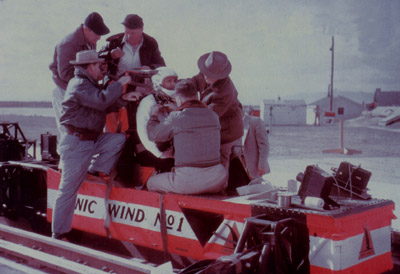
No, not me. Though I suppose if you strapped enough rocket bottles to me, I could probably qualify. Which is what happens – to someone else, I hasten to add – in my story ‘The Incurable Irony of the Man who Rode the Rocket Sled’. It was published yesterday in the The Orphan #5. You can find my story here.

sonicwind

‘The Incurable Irony of the Man who Rode the Rocket Sled’ was inspired by some of the research I did for the Apollo Quartet. I’d come across mention of the rocket sleds that were used in the 1950s to test how many Gs a human body could safely withstand, and I thought it would be pretty cool to write about that. So I did. The end result, however, isn’t exactly typical – as science fiction, my fiction, or even fiction per se: The Orphan itself describes it as possessing “footnotes, no plot, and genre content visible, yet near microscopic”. So, no launching rocket sleds into space to fight aliens or anything. Just a man, the rocket sleds, and the world around him.

They were bonkers, the volunteers on the rocket sled programme – especially the man who created it, John Paul Stapp. But what they achieved did prove useful and ultimately saved many lives. Here’s a USAF information film about rocket sleds, which gives you some idea of what it was all about.

Enjoy.


8 Comments

England 3 Scotland 0

Last month, Neil Williamson was bemoaning his lack of productivity in short fiction on his blog, so I proposed a friendly competition to motivate him and myself. For each story we completed and submitted we would score one point. (Resubmissions didn’t count.) And for each story we sold or placed, we would earn another point. The one with the least points at the end of the year would buy the winner a slap-up meal in Glasgow at the 2014 Eastercon.

At the moment, I’m in the lead. With three points. I finished and submitted a story, ‘The Incurable Irony of the Man who Rode the Rocket Sled’, to Rustblind and Silverbright, an anthology of railway-themed genre stories edited by David Rix and to be published by Eibonvale Press, but… Rocket sleds ran on rails, yes, but I knew the link to the theme was tenuous. And so it proved. Which proved a bit of a problem, as I didn’t think the story was really sellable. It’s a mixture of fiction and non-fiction, has no plot, is only really genre if seen in a certain light, and is far more literary than most genre venues are comfortable with. Happily, The Orphan has taken it for their next issue. And I see from the contents of previous issues that it’s in excellent company.

‘The Last Men in the Moon’, however, is more overtly science fiction, but it’s also quite literary. I really must get that t-shirt printed up: “too literary for genre fiction, too genre for literary fiction”. (Joke.) Happily, literary serial anthology The Fiction Desk has taken it – my second sale to them after ‘Faith’ in The Maginot Line last year. ‘The Last Men in the Moon’ is a bit of a piss-take of sf, and it’s a bit of a deconstruction of the hoary old alien invasion / conquest of the earth trope, and I also get to flatten Sheffield in it.

I describe myself as a science fiction writer, but I’m starting to wonder if what I write really qualifies as sf. But the Apollo Quartet!, you cry. Except, as someone said to me recently, “I’m just waiting for someone to twig that the Apollo Quartet is not hard SF”. And it’s sort of true. The novellas are set in the past, they’re about real space hardware, and the central tropes to date are handwavy things like the Bell and a FTL drive I don’t bother to explain. And then I look at my last few stories to see print and… ‘Faith’ features real named astronauts but inexplicable irrational woo-woo things happen to them (it’s available free here). ‘The Way The World Works’ is set in an alternate 1984 and the ending is in no way science fiction. ‘Wunderwaffe’ is a Nazi / Metropolis / alternate history / time travel mashup, and probably deserves a genre all its own. ‘Dancing the Skies’ is just pure fantasy, with flying monsters and Spitfires. On the other hand, ‘Words Beyond the Veil’ is heartland hard sf, even if it does quote from the lyrics of a death metal album (you can read it here).

I think I write with a sf sensibility, even if what I write isn’t always science fiction. What I read is reflected in my writing, and I read a mix of science fiction and literary fiction. But I admire the prose of the latter more, and so try to emulate that. However, when I try to write straight-down-the-middle sf, I find I can’t do it. It feels… too arbitrary, too ungrounded. It’s not anchored to the real world. Even my fantasies have to be grounded in the real world – Spitfires and Wellingtons and the ATA in ‘Dancing the Skies’, for example.

Or perhaps I write with a literary fiction sensibility, which is why my sf usually turns out to be weak sf. It has been mooted that some of the most interesting science fiction being written these days is being written outside the genre. There are certainly literary fiction novels which use genre tropes that I consider better than most genre novels, like The Road or Girl Reading or Never Let Me Go. I used to think such books felt old-fashioned because their writers didn’t know how to deploy their tropes, didn’t have the experience of practiced sf authors in doing so, but what those literary authors have actually done is make the tropes more accessible.

And that I think is a problem with a lot of modern sf – it’s too abstruse, too much the product of, and for, a private members’ club. I complained, for example, that Leviathan Wakes was regressive, a throwback to the hegemonic space operas of the 1970s, but how many people actually care about that, or know enough about sf and its history to realise it? A small group within the small group that is the readers and fans of science fiction. Which makes me wonder what a space opera written by a literary fiction writer would look like. Not one of Banks’ Culture novels, there’s far too much pure genre in them. Is such a story possible? It would be a wonderful experiment, I think.

I’ve a feeling science fiction as a genre is no longer as willing to experiment as it once was. It’s settled into a happy rut, a happy series of ruts, in which expectation plays a large part – as it does in so much of twenty-first century life. This is a century defined by the management of expectation. Yes, there is stuff that challenges those expectations, but it’s way out on the long tail. And we’re happy with that because it can’t destabilise the centre from there. And yet everything that has destabilised science fiction in the past has made it a stronger, better genre – the New Wave, Cyberpunk, New Space Opera. Even if it did eventually get co-opted by the establishment as it became a core fixture.

It is time, I think, to repudiate science fiction’s core values. We need a New New Wave.


1 Comment

My trip into space

Well, into the National Space Centre, that is…

I may have been involved in science fiction for 25 years, but I’m relatively new to this “author” thing. I’ve done plenty of panels at conventions, but I’ve never given a reading, and I’ve certainly never spoken about something I’ve written to a bunch of complete strangers who may or may not have come to hear me talk or indeed have any clue who the hell I am.

But that’s what I did last Sunday.

The National Space Centre in Leicester had organised a two-week celebration of “Space Fiction”, beginning on 9 February and lasting until 24 February. I was asked if I’d like to contribute on one of those days as one of the clients of the John Jarrold Literary Agency. Since Adrift on the Sea of Rains and The Eye With Which The Universe Beholds Itself are proper hardcore realistic space fiction books it struck me they’d be well-suited to a reading in the National Space Centre… And so it was arranged: Philip Palmer, Chris Beckett and myself would each give a 30-minute talk/reading on Sunday 17 February.

As you approach the National Space Centre, the first thing you see is a giant pupa pointing up into the sky above Leicester. That’s the Rocket Tower. The rest of the building looks more like something you’d find on a university campus or science park. I’m not sure what I was expecting – something like a museum, I suspect – but it’s far more resolutely modern than my dim memories of visits to museums as a child suggested. I was immediately taken with the Soyuz on display in the main foyer. And it really is a tiny spacecraft. I’d known that, of course – I’ve researched this stuff, after all. But you have to see it in the flesh, so to speak, to realise quite how small and makeshift and fragile it is. The Soyuz is apparently only one of two on permanent display in the West.

I was collected from the foyer by Charlie, who was wrangling the three of us that day. She did an excellent job of looking after us, so much thanks. The actual venue for the talk proved to be a small lecture area just off the main concourse, with rows of benches facing a small stage backed by a large screen. There was another screen above the stage. Most of the National Space Centre is one big open space, partitioned into display areas by walls no more than three metres high, so there was a lot of background noise. But we had microphones.

Phil Palmer’s talk began at 12:15. He talked about science fiction and extrapolation, and it was obviously something he had spoken about before. He then read from both Debatable Space and Hell Ship. The audience was mostly families with small children – about twelve to fifteen people in total. Chris Beckett arrived during Phil’s talk.

Afterwards, we had a thirty-minute gap before Chris’ session started at 13:15, so we went to get a bite to eat from Boosters Restaurant. It was sandwiches and soup, so my face fell when I saw it. I asked one of the staff if they had anything that was dairy-free. He told me they’d make me any sandwich I wanted in a dairy-free version. That level of service and helpfulness still impresses me – it shouldn’t do, not in the twenty-first century; but it’s still unusual enough in the UK to be a pleasant surprise.

Chris’s talk was not as well attended as Phil’s had been. He spoke about rogue planets and how they’d been scientifically proven about he’d written Dark Eden. He also described the inspiration for the novel, and then read one of the chapters.

There was then another thirty-minute gap until my talk at 14:15. Phil had booked a ticket for the planetarium show, so he shot off to that while Chris, his wife Maggie, and myself went for a wander round. We headed for the Rocket Tower, though I was a little worried about suffering from vertigo on the top deck. But I was fine as long as I didn’t get too close to the railing. The LM simulator looked more like a computer game than an actual copy, but the 1960s living-room was good. The three of us recognised several items in it from our own childhoods. There was a piece of moon rock in a globe of the Moon, and one wall gave an illustrated timeline of the Space Race. The next deck down celebrated Soviet achievements, though from what I could see the Soyuz simulator was just a little room with a plastic seat in it. I didn’t linger as I needed to get back to lecture area.

Then it was time for my talk. I’ve not done public speaking since I left school decades ago, and I knew this was going to be nothing like being on a panel at a convention. For one thing, my audience would be just walk-ins, who had likely wandered across to see what was going on. My name will have meant completely nothing to them. (In the event, beside Phil and Chris, at least two members of the audience knew me – Will Ellwood, who I know via Twitter, and Dave Caldwell, who was a member of an APA I was in back in the 1990s.)

As soon as I was ready to begin, I hit my first snag. I only had two hands. I was using a PowerPoint presentation, so I needed to hold the clicker to advance the slides. I also needed to hold a microphone. And then there was the script of my talk, which I hadn’t learned off by heart. Damn. I’d need three hands. Charlie happily lent me her hands-free mike. She then introduced me and I started babbling…

I thought it went quite well. I managed not to speak unintelligibly fast, and I clicked through the slides in mostly the right places. I spoke about realistic space travel and science fiction’s poor record in depicting it, using ocean liners as spaceships rather than actual real spacecraft (such as the Soyuz in the foyer), and how I came to write the Apollo Quartet. I cut down the excerpts from Adrift on the Sea of Rains and The Eye With Which The Universe Beholds Itself I’d planned to read, and that proved to be a wise decision. I finished it pretty much exactly in thirty minutes. And the entire audience stayed throughout the entire talk. Afterwards, a couple of people came up and thanked me and said they had found it interesting.

Phil, Chris and myself then moved across to a table in the main concourse, where people could buy copies of our books and we would sign them. We were actually approached by more people asking for directions than we were people who wanted to purchase our books. But never mind.

It was a fun day. I’d liked to have taken the time to explore the National Space Centre more fully, and I certainly think it’s an interesting place to take children. Personally, perhaps, I’d have preferred more hardware and less science, but that’s what fascinates me. All the same, I could happily spend a day there.

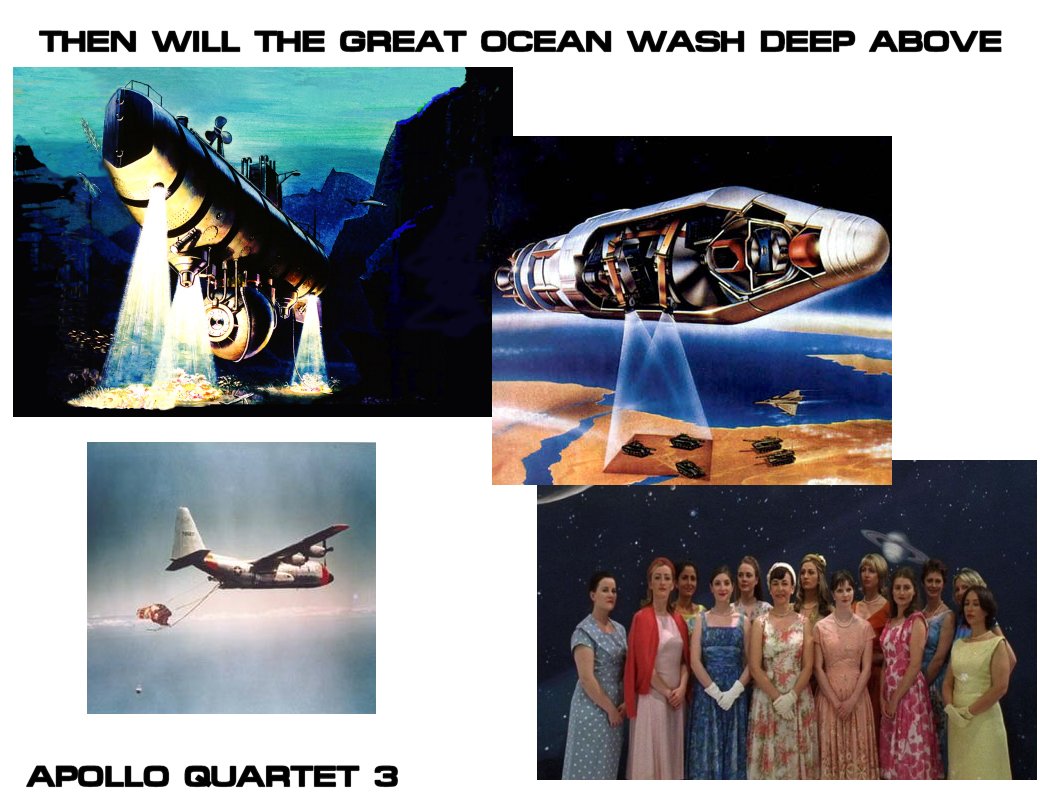
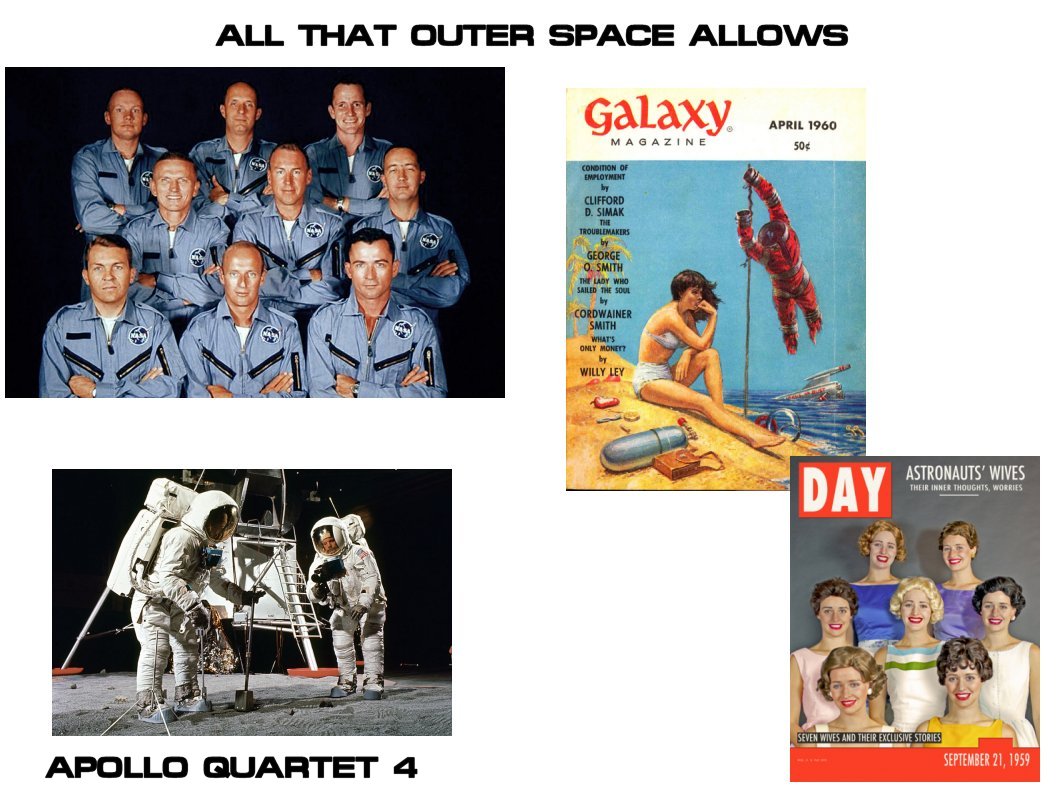
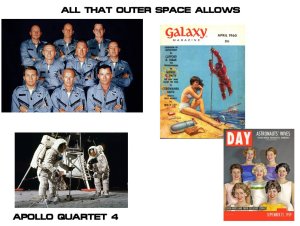
Finally, the last two slides of my presentation were hints to the stories of the final two books of the Apollo Quartet. And here they are…
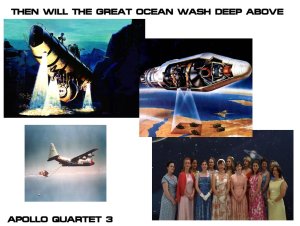
aq3

aq4


3 Comments

Going into space

Well, the National Space Centre in Leicester. Which, for a fortnight in February, is putting on a “Space Fiction” special event. Between 9 February and 24 February, a number of authors will be giving talks at the National Space Centre. The full schedule is here.

I’ll be there on Sunday 17 February, with fellow John Jarrold Literary Agency clients Chris Beckett and Philip Palmer. Since Adrift on the Sea of Rains and The Eye With Which The Universe Beholds Itself are your actual bona fide proper hardcore space fiction, I’ll be talking about, and reading from, them. There’ll also be copies available to buy.

I guess I’d better start making notes on what I’m going to say…