
My story ‘Disambiguation’ is now up on the website of Alt Hist, the magazine of historical fiction and alternate history. It was originally published here on my blog a couple of months ago, but now it’s found a better home. It’s something of an experimental piece since it’s constructed from a series of real and fake Wikipedia articles. It also has flying boats in it. Go read it. Please.
Category Archives: my fiction
Anatomy of a Story: Killing the Dead
The author tells us that he’d had the title in his head for years, but no real plot to go with it. “Later the idea of setting the story on a generation starship occurred to me,” he says. “And then I decided it should be about terrorism, which fit perfectly with the setting – the sealed environment of a generation starship is especially vulnerable to terrorists. The rest of the story came out of a conversation with Eric Brown as we travelled north from a convention on a much-delayed train.”
So reads part of the introduction to my story ‘Killing the Dead’ by the editors of the Postscripts magazine/anthology . It appeared in ‘Edison’s Frankenstein’, issue 20/21, dated December 2009. According to my records, I finished ‘Killing the Dead’ in June of 2008, tried it at two magazines, before it was bought by Pete Crowther and Nick Gevers of Postscripts at the end of July. It was another 18 months before it eventually saw print.
I had indeed had the title knocking around for years – the earliest version of the story I can find was written on an Amstrad PCW, and I owned that I when I was at university in the early 1990s. In the 500 or so words which are all I completed of that draft, the story is set on an alien world and in a city which, like in ancient Egypt, sits on one side of a river with a necropolis on the other. But that’s as far as I got with it. Some fifteen years later, I decided to have another go. I kept the necropolis, but moved it onto a generation starship – which then gave me a reason for preserving the bodies of the dead. And indeed for their destruction to be a major felony, with ramifications for all those aboard. It also gave me the opening image of the dark spreading across the sky.
‘Killing the Dead’ is one of the few stories I’ve written where I actually did make it up as I went along. I had a fairly clear idea of the cast and plot: members of the starship’s crew are preserved after death in necropolises with the intention of resurrecting them, and their valuable skill-sets, once the starship reaches its destination. But someone is destroying the tombs, and so jeopardising the crew’s ability to build a functioning colony when they arrive. These crimes would be under investigation by a detective, who previously has had little beyond the occasional theft or assault to look into.
The logic behind all this was hashed out in the conversation with Eric Brown mentioned above. We were on our way to our respective homes from Novacon in Wallsall in November 2007. He told me I should write the story, so I did. I finished it in less than a week. But it wasn’t very good, and needed more work. So I fiddled with it over the next six months.
I did some research, of course: I picked a suitable destination and worked out how long the journey would reasonably take. At some point I decided that I wanted the story to reference Dante’s Divine Comedy. I’d already described the necropolises as low hills of seven levels in reference to Purgatorio, but I wanted to include more. So I split the story into seven sections – including a dream sequence – and buried in each section an image derived from one of the seven terraces of Purgatory. These are:
1 The Proud, who carry huge stones on their back
2 The Envious have their eyes sewn shut
3 The Wrathful walk around in acrid smoke
4 The Slothful are engaged in a ceaseless activity of some sort
5 The Covetous lay face down on the ground
6 The Gluttonous are forever tempted by fruit out of reach (although I think the source I used mentioning running water, so I went with that instead)
7 The Lustful must pass through a wall of flame
I leave it to the reader to find the relevant sentences in the story.
Despite all this, I don’t think I’d actually figured out the end when I started the story. I didn’t know who the terrorists were. So when I did work it out, it came as a surprise – but one of those good ones, one of those ones where you realise the answer has already been set up in the story right from the start.
The same was true of the final few sentences. I’d been hiding references to purgatory throughout the story, so it seemed only natural that the journey aboard the generation starship should be cast as a form of limbo. It also occurred to me that a fear the journey’s end might leave them in hell rather than heaven could be a valid motivation for the terrorism.
Incidentally, all the named characters in the story are named for various mythologies’ gods of the dead: Arawn (Welsh), Supay (Inca), Flins (Wendish), and Jabru (Elamite).
Those few venues which did review the issue of Postscripts were positive about ‘Killing the Dead’. It didn’t set the genre on fire, although I’d have been surprised if it did. Tangent Online described the story as “Highly recommended”, and Gav at NextRead was also nice about it. And, er, that’s about it.
For those of you who want to make up your own mind, here it is (PDF).
A portrait of the writer as a young man
I have always been a science fiction writer. I remember filling an exercise book with deck-plans for a starship when I was twelve years old. I wish I could find that book, but it has long since vanished. During my teens I played RPGs, and wrote up the sessions as fiction. After joining the British Science Fiction Association in the late 1980s, I turned my hand to writing your actual original science fiction. Not entirely successfully, it has to be admitted. And this despite the fact there seemed to be new sf small press magazines appearing every five minutes in the UK. Some of the titles I remember, and still have copies of, are: BBR, Dream Magazine, New Moon Quarterly, Works, REM, Exuberance, Critical Wave, Territories, The Lyre, Nova SF, Auguries, Strange Attractor, Opus Quarterly, Sweet Dreams Baby!, New Visions, The Edge, The Scanner, Sierra Heaven…
I submitted fiction to several of the above, but my first ever published short story was a space opera parody which appeared in The Scanner #8 in 1990. It wasn’t very good. Shortly after graduating from university, I left the UK. And spent ten years working in the United Arab Emirates. While there, I started submitting fiction to the pro magazines, with even less success. Occasionally, I tried stories at small press mags… Which is how Sierra Heaven ended up with my second piece of published fiction in their Summer 1997 issue.
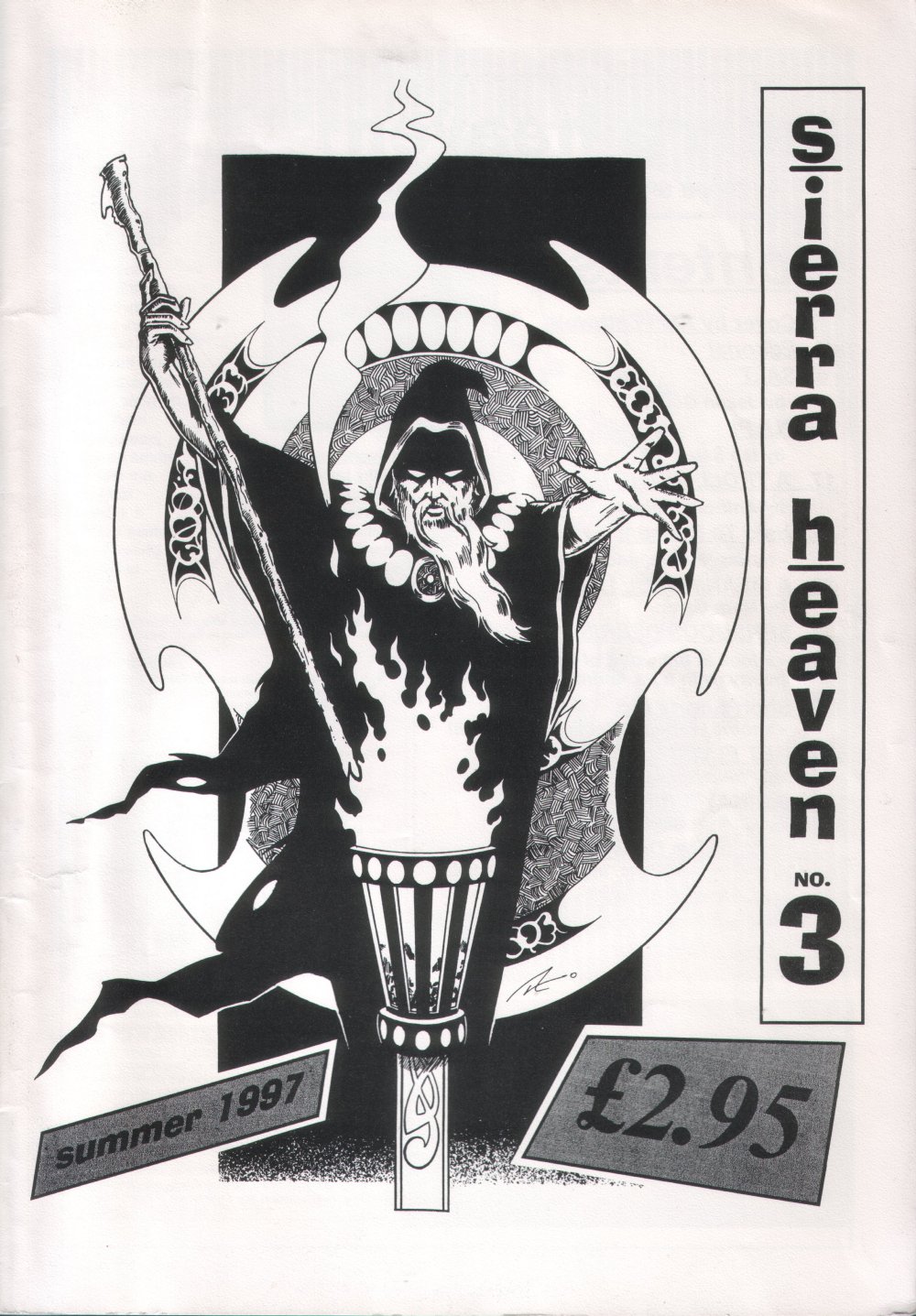
Here, for your delight and delectation, your edification and edumacation, is that story. It’s a space opera metafictional story, titled ‘Pulp!’, that probably owes far too much to certain film by Quentin Tarantino. Apologies for the poor quality of the scan.
Click here: Pulp!
The door of perception
Yesterday, a review of Alt Hist 1 was posted on The Portal here. The reviewer said of my story in the issue, ‘Travelling by Air’, that the “story really embraces what, for me, is so entrancing with alternate history”. Which makes me happy.
Incidentally, the second issue of Alt Hist should be out in the next few weeks. I’m looking forward to seeing it.
A veritable bargain… or two
Old stories never die, they either sit and moulder in old magazines, or they get republished again and again. But not anymore. Thanks to the magic of modern technology, they can live again. Just reformat that Standard Manuscript Format, slap on some cover-art, and publish it for the Kindle.
Which is precisely what I’ve done for two of my stories. These are the Euripidean Space ones – ‘Thicker Than Water’ and ‘A Cold Dish’ – and were originally published in Jupiter magazine. They’ve been described as “fun, pure sf”, are set on the moons of Saturn, and are hard science fiction based upon / inspired by Ancient Greek mythology sort of. They’re available on both amazon.co.uk and amazon.com, for much cheapness.
Go on, Kindle-folk, you know you want them…

Available on Amazon UK here and Amazon US here.

Available on Amazon UK here and Amazon US here.
(Apologies for the cover-art: I’m better at the words than I am the pictures.)
A science fiction story – with flying boats!
A week or so ago I set myself a challenge: to write a science fiction story in which a flying boat featured prominently. I was hoping to come up with some heartland sf story, something with spaceships and aliens and such. And flying boats, of course. But I couldn’t think of a plot in which a flying boat, especially a historical one, might plausibly appear in the distant future or on another planet.

I could have just invented some futuristic flying boat, but I was determined it’d be a known type – and I had in mind one of those flying boats from the 1930s which carried passengers to Australia or across the Atlantic. So I dreamt up and considered a number of ideas, and promptly discarded them… and then realised there was only one way I could justifiably have a Short Empire flying boat, for example, in a sf story. But I didn’t really want to write alternate history. I wanted something more sfnal than that.
And I think I’ve sort of done it.
It’s a somewhat experimental story – in both structure and the fact that the plot is only implied. I shouldn’t think it’s the first story, science fiction or mainstream, to ever be written in this fashion, but it’s the first time I’ve tried it. It was fun to research, and I had fun “writing” it. I hope it proves as much fun to read.
Here it is (PDF): Disambiguation
Enjoy.
Not a failure of the imagination
I love research. I take a nerdish delight in it. When I’m writing, I want everything in my story to be right. If that means digging through books, or searching the Internet, to find the information I need, then I’m more than willing to do so. I should be writing, of course. Except I can’t write if I don’t know what I need to know, if I can’t make sure it’s absolutely spot-on.
I don’t think I’m capable of writing a story in which I can “make it up as I go along”. I have come to accept that. The nearest I managed, ‘Killing the Dead’ in Postscripts 20/21 Edison’s Frankenstein, was set on an entirely invented generation starship. But I couldn’t let it go there. I had to pick a real destination for the ship, and calculate the length of time the journey would take. But even that didn’t do the trick. So I structured the story according to Dante’s Inferno
I have in the past bought a copy of a long-out-of-print and scarce book – see here – so I could read up on something that appeared in a story I was writing. My story ‘Barker’ (see here) required a lot of research into the history and personalities of the early decades of the Space Race. Because everyone in the story except the title character was a real historical person. Fortunately the subject fascinates me and I already own a large number of books on it. See my Space Books blog. And yes, the flash fiction I posted there, ‘The Old Man of the Sea of Dreams’, also required a great deal of research too.
The story I’m currently working on – ironically, a fantasy – has had me researching Supermarine Spitfires and Vickers Wellington bombers. The protagonist is a RAF pilot during World War II, and I wanted to make sure I had all the details of flying those aircraft correct. I could have finessed it, I suppose – a few general piloting terms, perhaps, and then on with the story. But that would be cheating. It wouldn’t convince me.
And, without that research, how else would I have learnt that the the first item in the Vickers Wellington Pilot’s Notes Check list before landing is “Auto-pilot.. .. .. cock–OUT”? I kid you not. See page 25 here.
Another story, as yet unpublished, has one section featuring an Alvis Scorpion Combat Vehicle Reconnaissance (Tracked), so I hunted around until I found a copy of a book about the vehicle. Because I needed to get the terminology right.
Amanda Rutter of Floor to Ceiling Books asked on Twitter today “What book do you wish you had written?” She gave The Last Unicorn

As a reader I want to know what it’s like, what it feels like, to be there. I want details. I am, after all, reading these books to explore other places, people and times – real or invented. And the last thing I want is glib one-line descriptions, or the distracting blur of authorial hand-waving. I feel novels should have bibliographies – and many novels do include a page of “Further Reading”. I have a work-in-progress which currently has twenty-five titles in its bibliography. It has, I admit, taken a long time to write. I hope it’ll be worth the effort.
I’ve wittered on about this subject before, but that’s because it’s something dear to me. True, fiction is not non-fiction. Nor should it try to be. But neither is it a failure of the imagination to research something heavily before writing about it.
Anatomy of a Story: A Cold Dish
Back in October 2009, I wrote a piece on my first Euripidean Space story, ‘Thicker than Water’ – you can find it here. ‘A Cold Dish’ was the second of my stories set in that universe, and it too was published in Jupiter magazine – in Jupiter 28, April 2010.
‘A Cold Dish’ is based on the play The Suppliants by Euripides. The play recounts how Theseus approaches the king of Thebes in order to ask for the bodies of the Seven Against Thebes, the seven leaders of an army which failed to invade the city-state. In Ancient Greece, burial rites were very important, and wars fought over dead bodies were not uncommon in the literature of the time. Unfortunately, this plot didn’t translate well to my Euripidean Space universe. It wasn’t really dramatic enough. Further, the need to bury dead heroes is not a cultural urge which translates to modern Western European culture.
In the universe of my Euripidean Space stories, the Earth has locked itself off behind a firewall for reasons unknown. This has left a number of off-planet settlements – on Mars, in the Asteroid Belt, among the moons of Jupiter and Saturn – struggling to survive. Patrolling the Solar System is an alien sentinel, origin unknown, which appears to exist solely to protect a number of alien artefacts. Unfortunately, these artefacts are not obvious – some of them could be somewhat unusual natural phenomena. In ‘Thicker Than Water’, for example, the artefact was a sea of buckminsterfullerenes on the moon of Tethys.
I’d already decided what the alien artefact would be in this, my second Euripidean Space story, and that dictated its setting. The Saturnian moon Mimas is sometimes known as the “Deathstar moon” because it features an enormous crater, Herschel, which covers a third of its face – as is obvious from the photo below. Herschel resembles a huge radio-dish, like Arecibo or Jodrell Bank. Identifying the artefact gave me part of the story’s plot – the “seven” would attack Mimas to prevent the Mimanteans from experimenting with the artefact. Herschel Crater also gave me the story’s title: ‘A Cold Dish’.

Image credit: NASA/JPL/SSI
But it still wasn’t enough. Happily, the title of the story – it was originally only a working title – provided the answer: revenge. Theseus’s mission to Mimas would be partly to retrieve the bodies of the dead heroes, but would also be driven by revenge. My Theseus analogue I named Spiro Maris – the Spiro, I suppose, from his adventures in the Labyrinth on Crete. I don’t recall why I gave him the family name Maris. The other characters in ‘A Cold Dish’ also bear names derived from their Greek counterparts. The Seven of Euripides play were Amphiaraus, Capaneus, Hippomedon, Parthenopeus, Polynices, Eteocles and Tydeus. Not all are named in ‘A Cold Dish’, but of those that are… Capaneus was known for his immense strength, so I called him Armstrong. Amphiarus means “twice-cursed”, which became Bimalison. Hippomedon… well, “hippo” is horse, so I named him Steed. The two Foote brothers are so named because their father was Oedipus, or “swollen-footed”.
As an example of “just enough information”: in ‘Thicker Than Water’, I’d named the settlement Torus for its carousel living-quarters. This phonetically aped Tauris, the name of the city where the Euripides’ play I’d based the story on had taken place. I felt I needed something similar for ‘A Cold Dish’. The Suppliants takes place in Thebes, but I couldn’t find any reference to the name’s meaning. So I decided to use the name as is for the Mimantean settlement. But I called it The BES, without actually bothering to work out what the acronym meant. The Built Environment System? It didn’t really matter.
As for “too much information”. I realised I didn’t know how large Saturn would appear in the Mimantean sky. The moon orbits at a mean distance of 185,520 kilometres, so I suppose I could work it out. Or I could finesse it, of course, and simply not mention it. But it felt like a useful detail. Instead, I went hunting on the internet, and on the JPL-NASA website found this:

Courtesy NASA/JPL-Caltech
The webpage here contains a number of artist’s impressions of the surfaces of the moons of Saturn and Jupiter.
I had a plot, a cast and a location. Now I needed an opening. I had this image in my head of figures in spacesuits encrusted with ice, so that’s what I used. Maris is inspecting the frozen bodies of the Seven, and then returns to the BES to negotiate with the Mimanteans. The rest of the story more or less wrote itself. I needed a Greek chorus. In ‘Thicker Than Water’, I’d used Saturn’s radio noise, but I wanted something different. So I decided to have all voice communication in the BES broadcast throughout the settlement. That allowed me to insert the grieving mothers, who provide the chorus in Euripides’ play, into the story and, as a bonus, gave me some pointers to the character of the Mimanteans. I also managed to include a reference to Theseus’s boat (also known as Granny’s broom).
The more I read up on the Ancient Greek characters on whom I was basing my cast, the more information I could insert into the story regarding their backgrounds. For each of the Greek city-states, I picked a moon: Athens became Rhea, Troy is Iapetus, Sparta is Hyperion, for example. Likewise with the personalities from the myths: Oedipus I renamed Rex Foote, Agamemnon is Stanovsky, Helen of Troy is, er, Helen Bright, Paris is Alexander Lek… Some of these may well make appearances in other Euripidean Space stories.
Some might say I’ve put far too much into ‘A Cold Dish’. All the references to Euripides’ play and Greek myths, which most readers won’t actually spot, some might consider those irrelevant in “a fun pure SF piece” (as Rich Horton described it on sfsite.com). But I believe stories should be more than just “fun”. I’d like to think there’s plenty to unpack in my stories, not just what appears on the surface. I feel that enriches the reading experience.
woof!
Des Lewis has started a “Real Time Review” of the Winter 2010 BFS Journal (see my photos of it here). So far, he’s read the first eight stories from New Horizon. Which includes mine, ‘Barker’ – about which he writes:
“A claustrophobic vision, this time in a punch-drunk comic-strip rocket. Real history and real names in retrocausality. To my hindsight surprise, I enjoyed it thoroughly as a lighter part of these movements in a dark symphony.”
I’m not entirely sure what the “dark symphony” is in reference to, but I’ll take my compliments where I find them.
Full review here. You’ll need to scroll down to see Des’s comments on ‘Barker’.
Cor. Swag.
Today, postie brought me the amalgamated British Fantasy Society Journal. The three magazines – Prism, Dark Horizons and New Horizons – are now a single hardback book. And very smart it looks too. See:


And what’s this on page 22? Why, it’s a story by Yours Truly: ‘Barker’, an alt history about the Space Race.

And while I’m at it: M-Brane SF Quarterly #1 is also now available in the UK:

With two of my stories in it: ‘Through the Eye of a Needle’ and ‘Human Resources’.
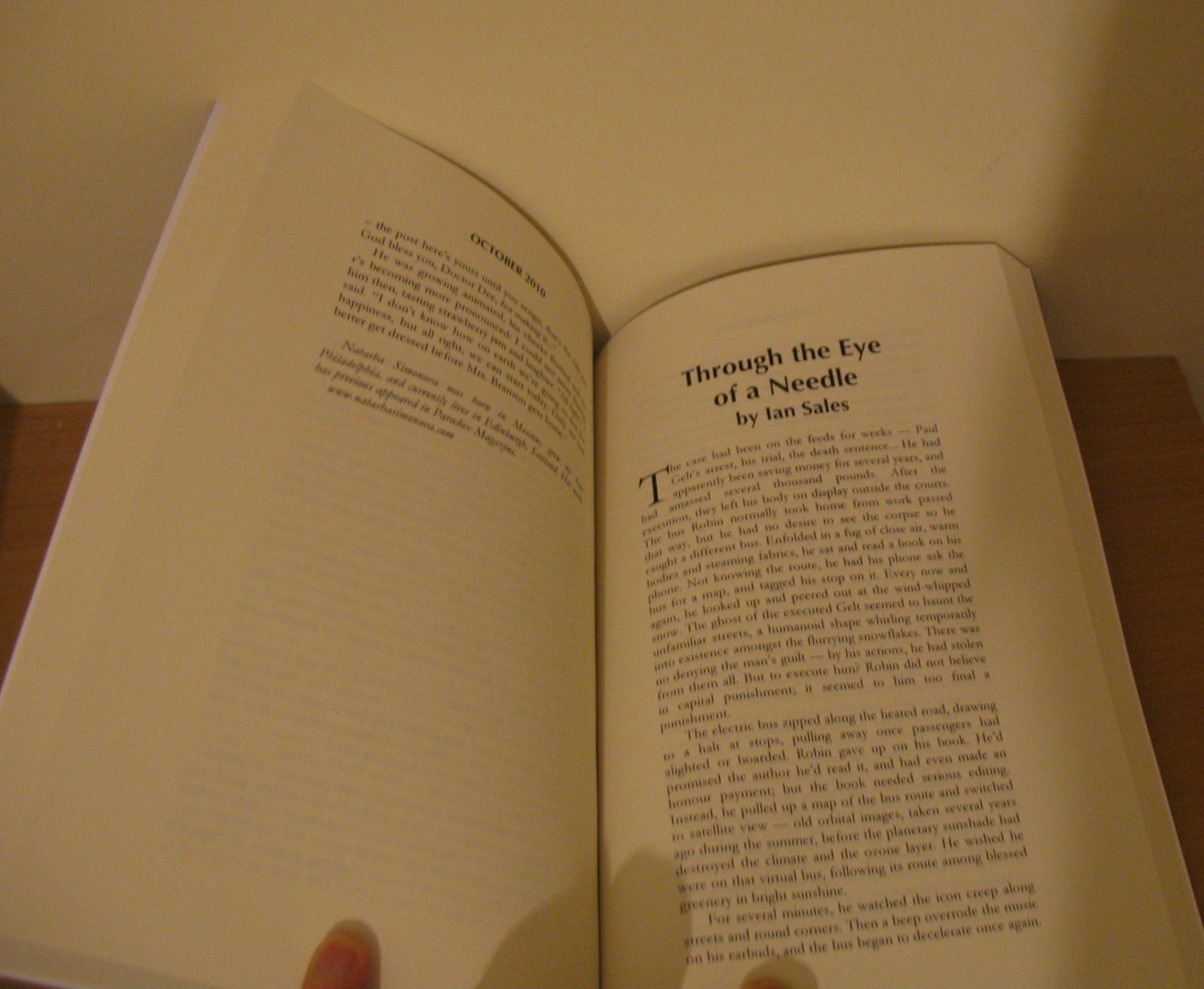

Go on, you know you want a copy…
 It Doesn't Have To Be Right...