It’s time to retire this blog. All I’m doing is posting mini-rants-masquerading-as-reviews of books and movies, and that at increasingly longer intervals. Plus, WordPress have gone and fucked up a perfectly good product, and their new “Gutenberg” block editor is shit. It now takes ten times longer to format a blog post, and I had to trash the one I’d planned to post before this one because I couldn’t get the editor to let me format it how I wanted. If I want to use the old editor, I have to pay extra money. I’ve no desire to support a business that blackmails its customers by removing functionality and then demanding money to return it. So, fuck them.
I could, I suppose, move to another platform. Not Blogger. I was on that originally. But they kept on randomly blocking my blog because their AI had decided it was spam… and Blogger made it increasingly difficult to get it unblocked. “Customer support” is not a phrase that seems to be in Google’s vocabulary. I’ve also heard their current version is even worse than WordPress.
Other blogging platforms seem more in the nature of website-building platforms for complete idiots. All drag and drop and fixed templates and zero actual control on the part of the user. And yes, I do still use the CLI in $dayjob.
Anyway, blogs are dead, social media is a cesspool of stupidity and tribalism, fandom is a pitched battle between various groups determined to police and/or gatekeep everyone else, and who knows when physical conventions will be a thing again? (I refer, of course, to English-language genre culture.)
Anyway, for this ultimate post, I shall finish much as I’ve been going on these last few years. With sort of reviews of half a dozen books.
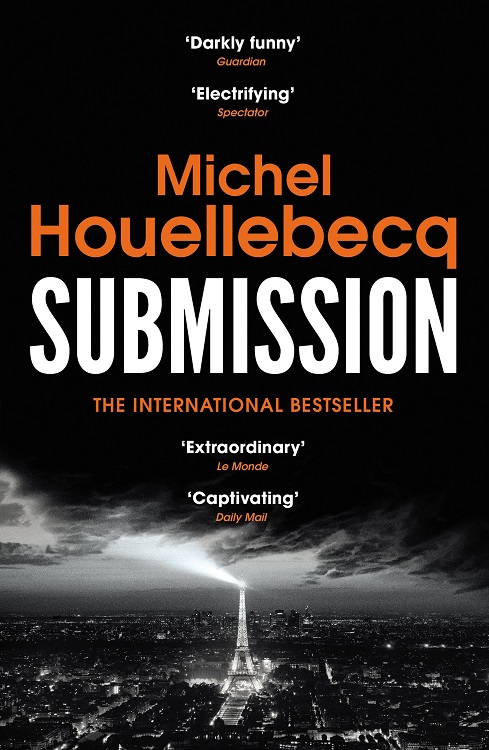 Submission, Michel Houellebecq (2015, France). I can’t decide if this novel is irresponsible race-baiting or a clever commentary on the culture war. It’s probably both. In Submission‘s 2022, a moderate Muslim candidate becomes president of France and remakes French society along moderate Islamic lines – which are not all that moderate. In a word, the patriarchy is back. Women can no longer work. The narrator is a professor at a Parisian university, who is forced to retire when the new regime takes over. While the new government greatly reduces crime, it is at the cost of women’s freedoms. Professors are “bribed” back into their positions by finding them biddable female students as wives. Which, to be fair, is not how Islam works. It is, however, how patriarchy works. And that’s definitely one of the unacknowledged planks of the right-wing adherents of the “culture war”. They hate Muslims. But they want women back in the kitchen and no brown people in sight. But I’m not sure this novel is commenting on them, and I don’t think Islam is a good vehicle to make that point. But then France has a different reaction to its Muslim citizens than the UK, and I grew up in the Middle East so I’ve lived in actual Islamic countries, and Houellebecq’s presentation of Islam is hopelessly simplified, even though he provides a character to actually explain the religion. There’s also an unacknowledged issue here. I’ve seen it in the real world. In Houellebecq’s France, women can still study, but they cannot work. So their studies are worthless. But those women don’t want their daughters to suffer the same fate, so they agitate for jobs. It’s what’s been happing in the Gulf states for the past 30 years. Houllebecq’s interpretation of an Islamic Europe is unsustainable. You can’t disenfranchise half of the population and expect that to continue unopposed. Houellebecq is a controversial figure, but much of the controversy he has manufactured himself. Submission is the sort of novel that will upset people, but it’s not really a thought experiment. it’s a piss-take. Houellebecq is upsetting the people he’s taking the piss out of. Seems fair to me.
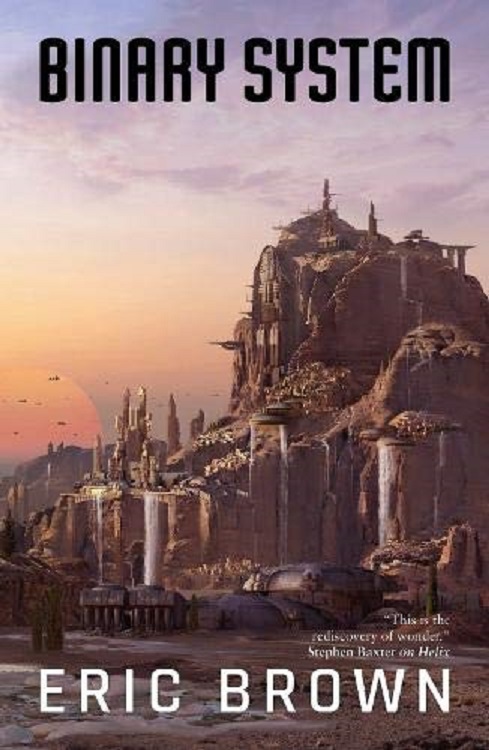 Binary System, Eric Brown (2017, UK). This was originally published as two ebooks in 2016 and 2017, but that seems an odd decision since neither seem to stand on their own. It is good old-fashioned – where “old-fashioned” means 1990s – science fiction, but with updated sensibilities. To be fair, UK sf of the 1990s and English-language sf of today doesn’t require much in the way of “re-alignment”. Female protagonists were common in male-authored sf by UK writers in the 1990s; the fact it took an additional decade for female protagonists to begin appearing in US male-authored sf is another matter. And, to be fair, throughout the 1980s and 1990s, the US published a great deal more women genre writers than the UK did. Anyway. In Binary System, Delia Kemp is the sole survivor of an explosion as a ship is translating through a wormhole type thing, and finds herself marooned on a world thousands of light years away. It is inhabited by several alien races – and Earth has yet to encounter any aliens. She is taken prisoner by insectoid aliens, but then broken free by gibbon-like alien, and with him she agrees to travel south to witness the ten-yearly appearance of his god. They’re helped by a “spider-crab” alien. The insectoid aliens, she learns, are invaders, devolved ones, it’s true; but the other races, native to the planet, would be happy to be rid of them, and Kemp is worried they might at some point reach Earth. Not that she expects to ever reach Earth herself as she’s marooned so far away. It’s all very trad sf, and there are few real surprises – other than wondering how they story could have been split into two – but it’s well-crafted stuff. And if some of the tropes are a little shiny around the edges, they’re at least used by someone who knows what he’s doing. This is not Brown’s best book, but it’s emblematic of the solid, heartland, unassuming science fiction that he writes when he’s writing moderate to good sf. He’s actually written some excellent sf, but has never been popular enough for it to be noticed. Which is a shame.
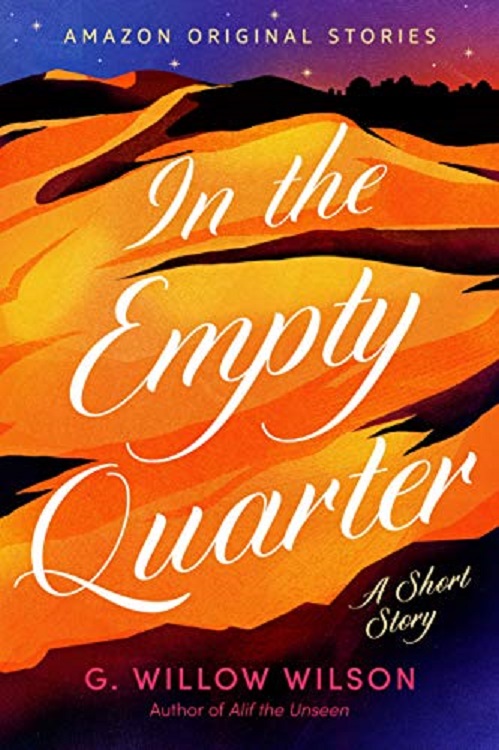 In the Empty Quarter, G Willow Wilson (2021, USA). This was actually free, and I don’t think I’ve read anything by Wilson before – although I do remember she was flavour of the month some ten years ago, but has been writing comics the last few years. An American couple are in an invented city in Saudi Arabia in the 1950s, as the husband is part of a team prospecting for oil. The wife, Jean, has been shown about town – as much as she can be – by a local contact of her husband, Mahmoud, and while she’s starting to harbour romantic thoughts toward him, she’s also bored. So she persuades her husband to allow her to accompany him on a trip into the Empty Quarter, the Rub Al-Khali. But she finds herself even more bored, standing around while he works, so she explores a cave she finds in a sabkha, gets trapped, and is rescued by a djinn. I’ve actually camped in the Empty Quarter, so I know what it’s like, and I’m not really convinced by Willow’s description (which does not mean she has never visited it, of course). For one thing, she doesn’t use the term sabkha, and her description of one doesn’t quite ring true. Despite all that, the entire novella feels like packaging for a single line, “You’ve been treating me like a guest, but I’m here without an invitation”. Which is, of course, true – of the Brits and French in the first half of the twentieth century, and the Americans in the second half of the twentieth century. But the novella’s story isn’t really a commentary on that one line, just its delivery vehicle. And that, I think, is where it fails. Jean sees Saudi Arabia as “exotic”, which fits her character, but Willow seems more interested in commenting on the US’s exploitation of the Arabian peninsula than US, or indeed Western, attitudes to the cultures of the region. Having said that, this is a novella. If it disappoints, it’s because it implies a wider remit than it actually delivers on.
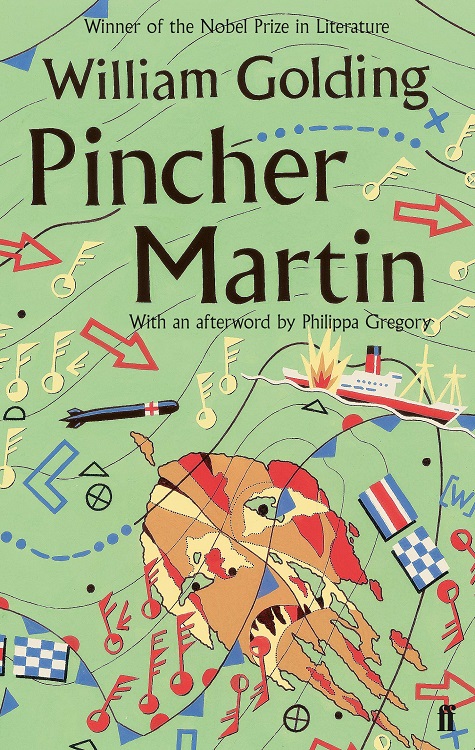 Pincher Martin, William Golding (1957, UK). Some friends of mine have recently been writing about William Golding, although they initially encountered him many decades ago. I did too, in a fashion, as I read Lord of the Flies at school – at least, I’m pretty sure I did – but I didn’t try another Golding novel until only a couple of years ago. So I’ve not had that long an appreciation of his books, and the few that I’ve read so far have been somewhat variable: Rites of Passage is amazing, The Inheritors is very good, but The Pyramid and The Paper Men are only mildly amusing. Pincher Martin is a remarkable book, and I think if it had been one of the first books by Golding I’d read I might perhaps hold him in as high esteem as the aforementioned friends. The title refers to a RNVR lieutenant in a destroyer in a trans-Atlantic WW2 convoy. The ship is sunk – probably by a U-Boat – and Martin finds himself on his own floating in mid-Atlantic. He manages to land himself on a tiny rock island, and has to subsist on rain water and mussels until he is rescued. As he waits, and suffers from exposure and malnutrition, flashbacks, some of which are more or less stream-of-consciousness, tell something of his past. And he was not a nice man. Much of the novel recounts, in excruciating detail, Martin’s situation and efforts to keep himself alive. It’s hard reading. And then there’s the final chapter… I’ll say there’s a twist, but I won’t spoil it. Recommended.
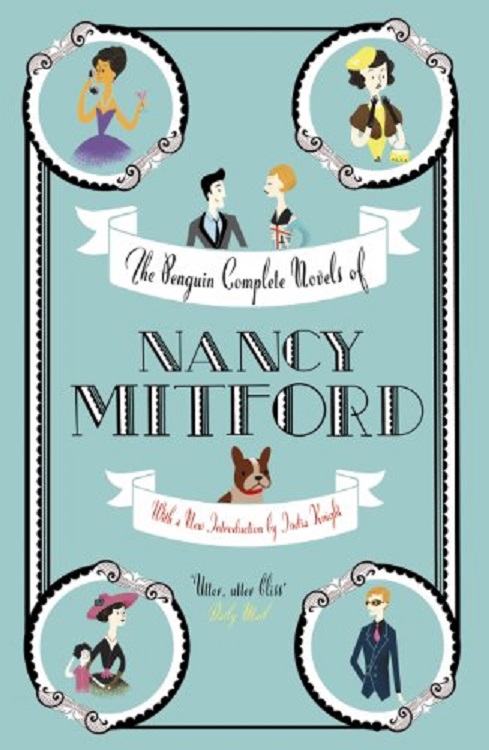 Christmas Pudding, Nancy Mitford (1932, UK). The second of The Penguin Complete Novels of Nancy Mitford, and it’s more of the same as the first. But much funnier. Some of the characters featured in Highland Fling (like Waugh, Mitford seems to have a stable of characters for her books), but this time they’re spending Christmas in the country. Amabelle Fortescue, rich widow and ex-sex worker, has hired a cottage in Gloucestershire. She invites the Monteaths to join her. Meanwhile, novelist Paul Fotheringay, a friend of Amabelle’s, whose tragic debut novel has been hailed as a comic masterpiece, deeply hurting him, has decided a biography of his favourite Victorian poet is what is needed to convince people of his serious literary nature. So he wangles a post, under a false name, as tutor to the poet’s descendant, a teenage baronet, whose home is near the country cottage rented by Amabelle. Some of the poet’s verse is reproduced, and it’s brilliant – “Think only, love, upon our wedding day / The lilies and the sunshine and the bells / Of how, the service o’er, we drove away / To our blest honeymoon at Tunbridge Wells.” The cast are grotesques, even when presented as relatively normal for the milieu, and it’s Mitford has a sharp tongue when poking fun at them and their world. But this is no social commentary – nor was Waugh’s, to be fair – and if Mitford’s humour is at the expense of her characters, it’s at least it’s not Waugh’s contemptuous cynicism. They’re well put-together these novels. Recommended.
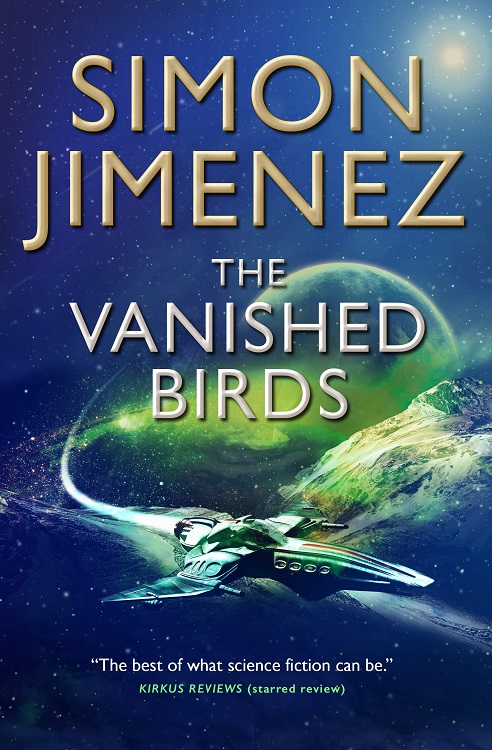 The Vanished Birds, Simon Jimenez (2020, USA). I’d given up on reading US genre debuts, but then I go and pick one up and read it. To be fair, I’d heard good things of The Vanished Birds from people whose opinion I trust, and I’ve not seen it mentioned often on social media, which means it probably doesn’t appeal to the sort of people who champion books I’ve found I definitely don’t like. (And it hasn’t made any award shortlists this year.) But, oh dear. Tricked again. On the plus side, it’s better written than is usually the case – but given it was apparently a thesis for a Creative Writing MFA, that’s hardly a surprise. Unfortunately, it fails pretty much everywhere else. It opens with a section set on a world which is visited by twelve spaceships every fifteen years, there to collect… a fruit which apparently stays fresh for up to fifteen years after harvesting. The economics make no sense – there are other villages, and hence more spaceships, on different schedules, so demand for this fruit must be huge. Except… the ships only appear every fifteen years, but for them the trip takes days, and they’re away from their destination for only months. (This time discrepancy in FTL applies nowhere else in the novel.) All this has little to do with the story, which is all about a mysterious boy one such ship picks up on a trip to the planet. There are a series of spacestations, in a universe that borrows most of its visuals from media sf, especially Star Wars, and which are shaped like birds because… because why? Their architect is treated more or less like an empress, for no discernible reason. She goes into cold sleep at regular intervals and has now lived for over a thousand years. She has determined the mysterious boy has the ability to “jaunt”, ie, travel from planet to planet without a spaceship. This ability could, understandably, upset the standard corporatist US-imagined space opera bollocks universe, with its serfs and one-percenters and child abuse and slavery, all of which exist because. For all its praise, The Vanished Birds is a creative writing exercise that strives more for effect than rigour, has a plot that makes little sense, and a universe cobbled together from a dozen ro so properties and overlaid with the usual US science fiction fascist nonsense. (In one scene, 2,500 innocent men, women and children are herded into a room and shot dead by corporate soldiers in order to “punish” the aforementioned architect who had created the secret complex where they lived and worked. Seriously, this fascist shit needs to stop. It’s a failure of imagination, and says more about US culture than it does English-language science fiction. And The Vanished Birds will definitely be the last twenty-first century US genre debut novel I ever read – at least until those authors have several more novels under their belt.
So, that’s it. The end of a blog. It had a good run – November 2006 to April 2021. I’ll keep it up, as there are one or two posts that still get visitors, like 100 Great Science Fiction Stories by Women. But I’ll no longer be adding new content. And the URL may change as I no longer see the point in paying to redirect to my own domain.

 It Doesn't Have To Be Right...