It Doesn't Have To Be Right…

… it just has to sound plausible


Leave a comment

Warm below the storm, part 1

This was going to be another of my The future we used to have posts because, after all, the days of serious research into sustained living underwater, or seeing how deep human beings can survive, are long since past. These days, it’s all ROVs and atmospheric diving suits – James Cameron’s descent to Challenger Deep last year notwithstanding. But commercial saturation diving is still common in the oil industry, and a number of companies still send divers down to 200 or 300 metres. So, it’s not quite a future of the past just yet.

However, “inner space” – or at least the watery version of it – has been a reasonably popular locale for science fiction stories and novels. In my post on Sealab (see here), I mentioned some of them. This post, however, will be the real world. Next week, I’ll follow up with a part 2 on fictional submersibles, underwater habitats, deep sea diving, etc. For now…

submersibles

19_Trieste2_DSV1_1

DSV 1 Trieste II
max depth: 6100 m

19_alvin

DSV 2 Alvin
max depth: 4500 m

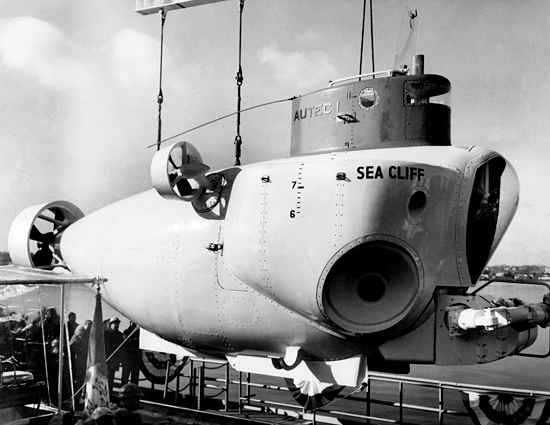
19_seacliff-4_54172

DSV 4 Sea Cliff
max depth: 6000 m

19_Ben_Franklin_Sub_446

Grumman/Piccard PX-15 Ben Franklin
max depth: 1200 m

19_int_Franklin

Interior of Ben Franklin

underwater habitats

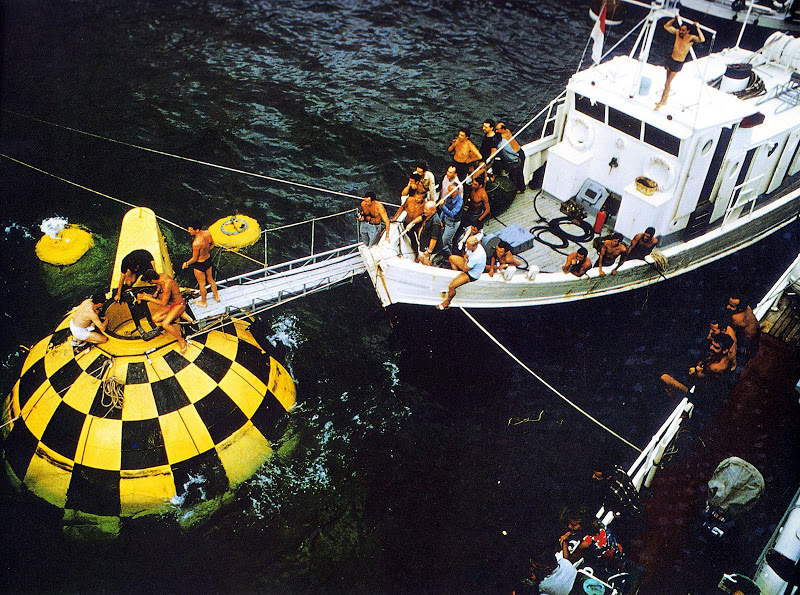
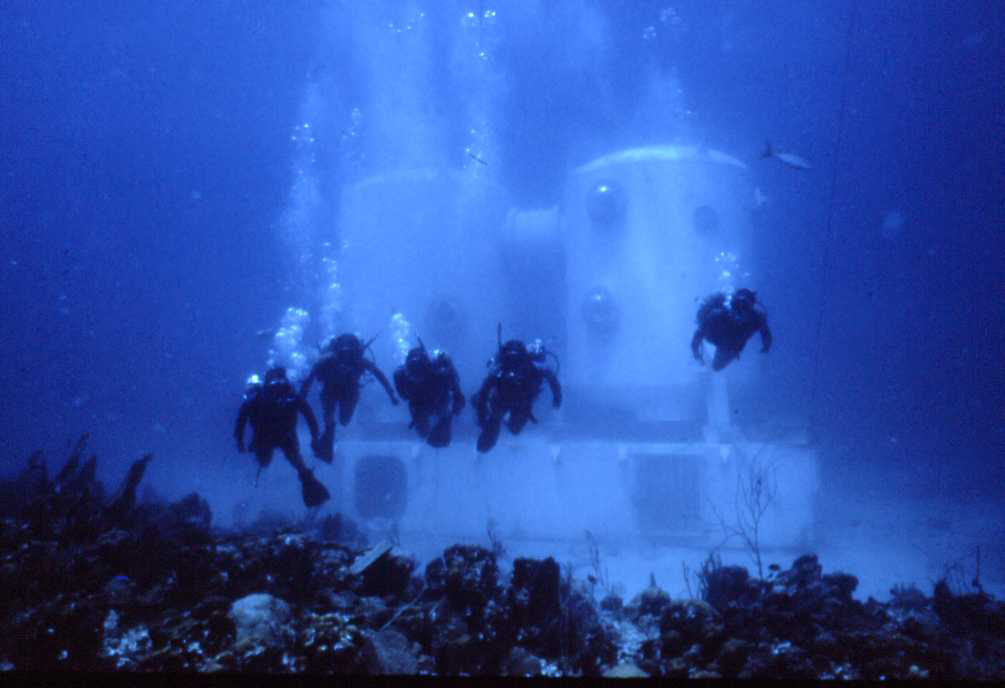
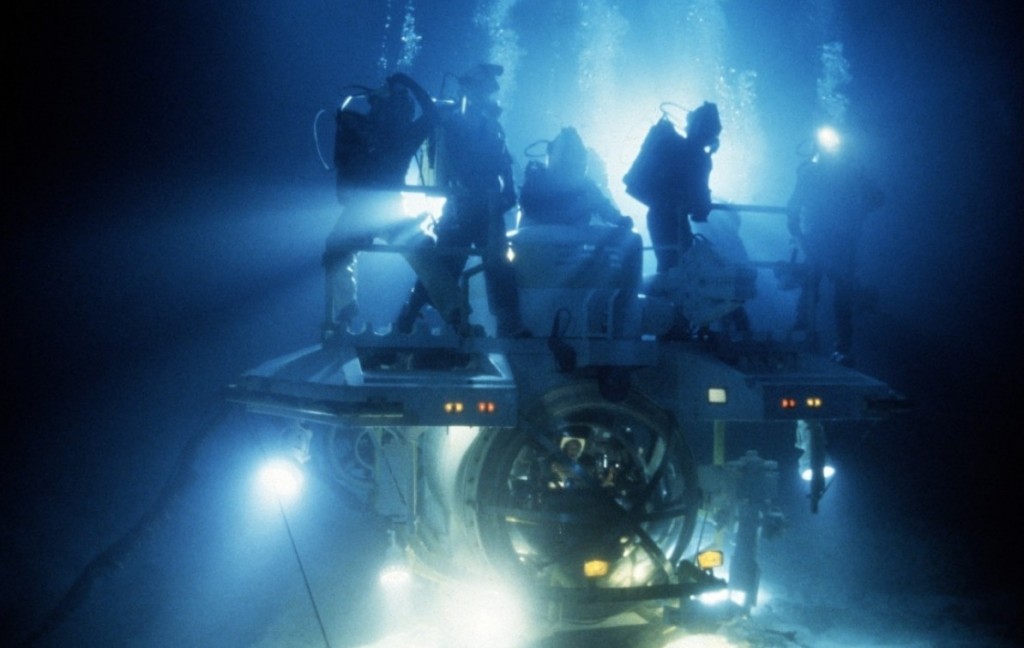
19_sealabI

Sealab I (1964)
depth: 58 m

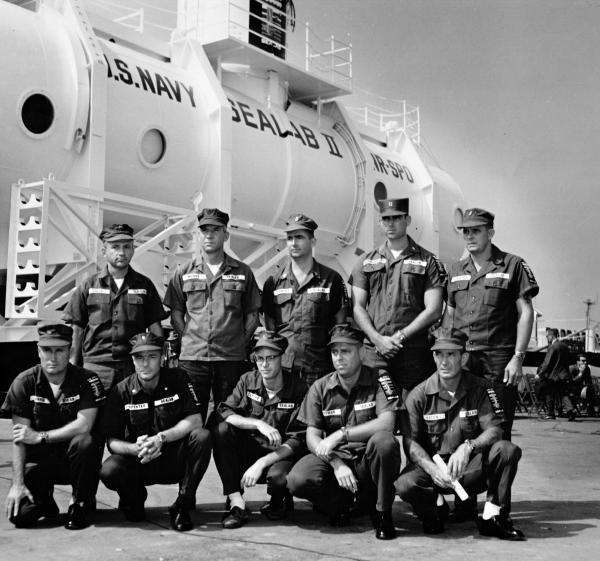
19_14S2Team1

Sealab II (1965)
depth: 62 m

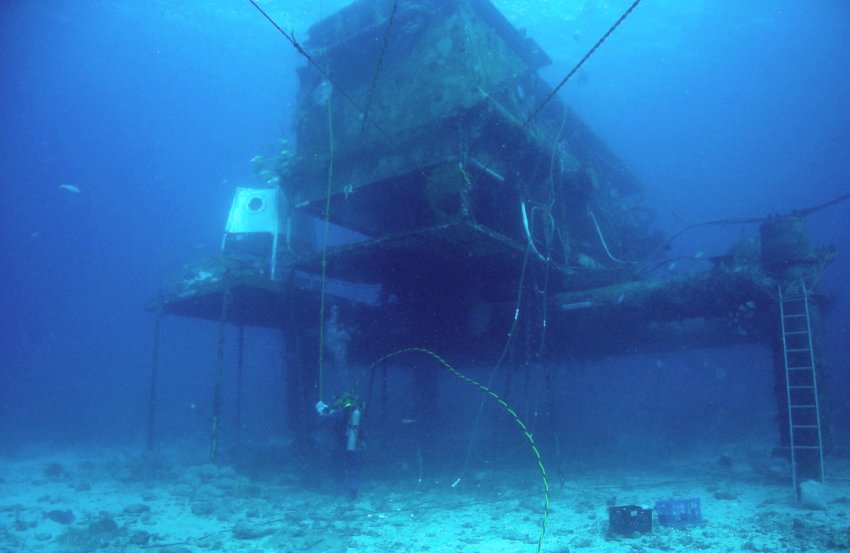
19_sealab_iii

Artist’s impression of Sealab III (1969)
depth: 185 m

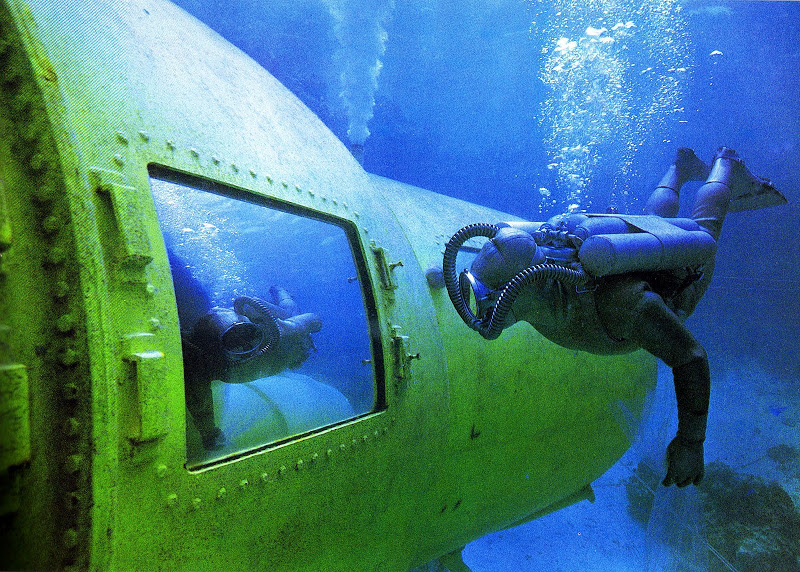
19_Conshelf-II-Diver

Conshelf II (1963)
depth: 10 m

19_Conshelf-III

Conshelf III (1965)
depth: 102.4 m

19_Helgoland

Helgoland II (1971 – 1977)
depth: 31 m

19_t-tektite

Tekite (1969 – 1970)
depth: 13.1 m

US-SPACE-NEEMO

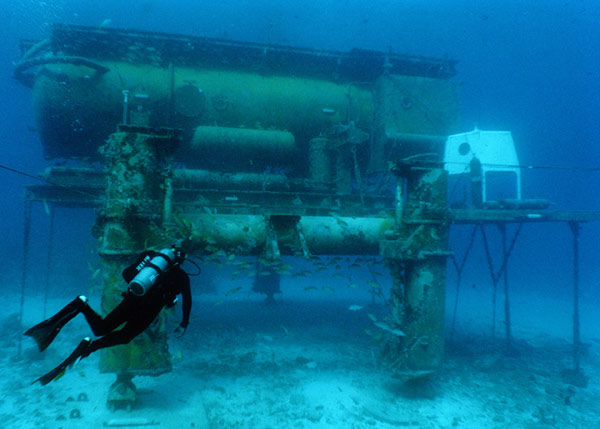
Aquarius (1986 – present)
depth: 20 m

saturation divers

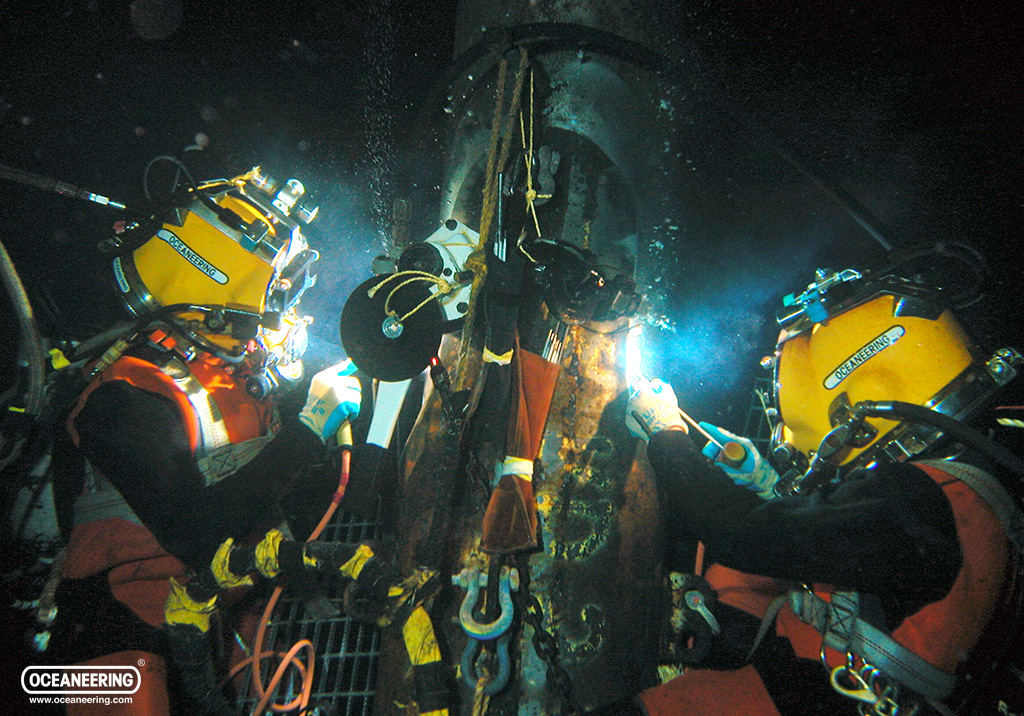
19_20111101-divers-wet-welding

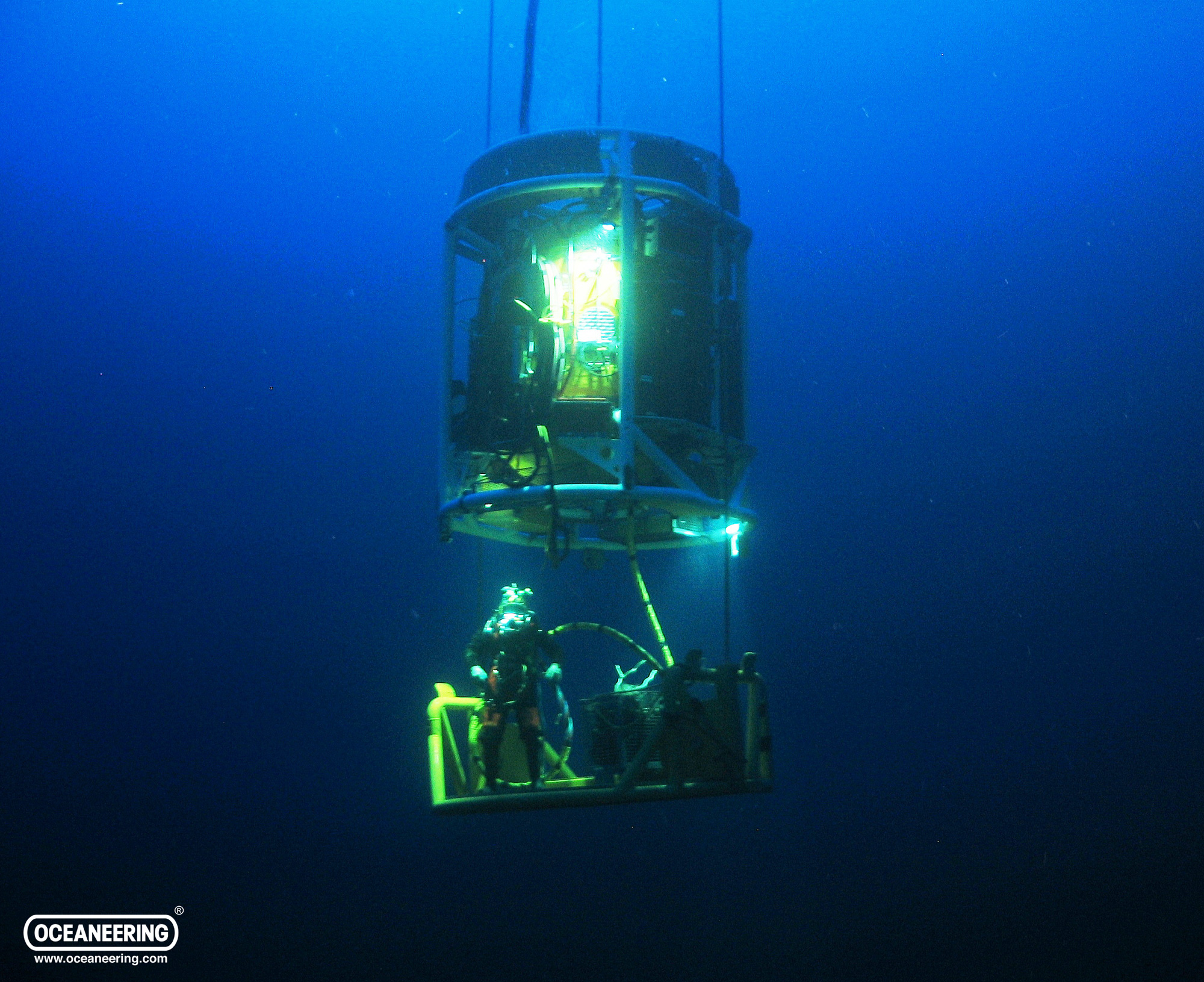
Oceaneering saturation divers

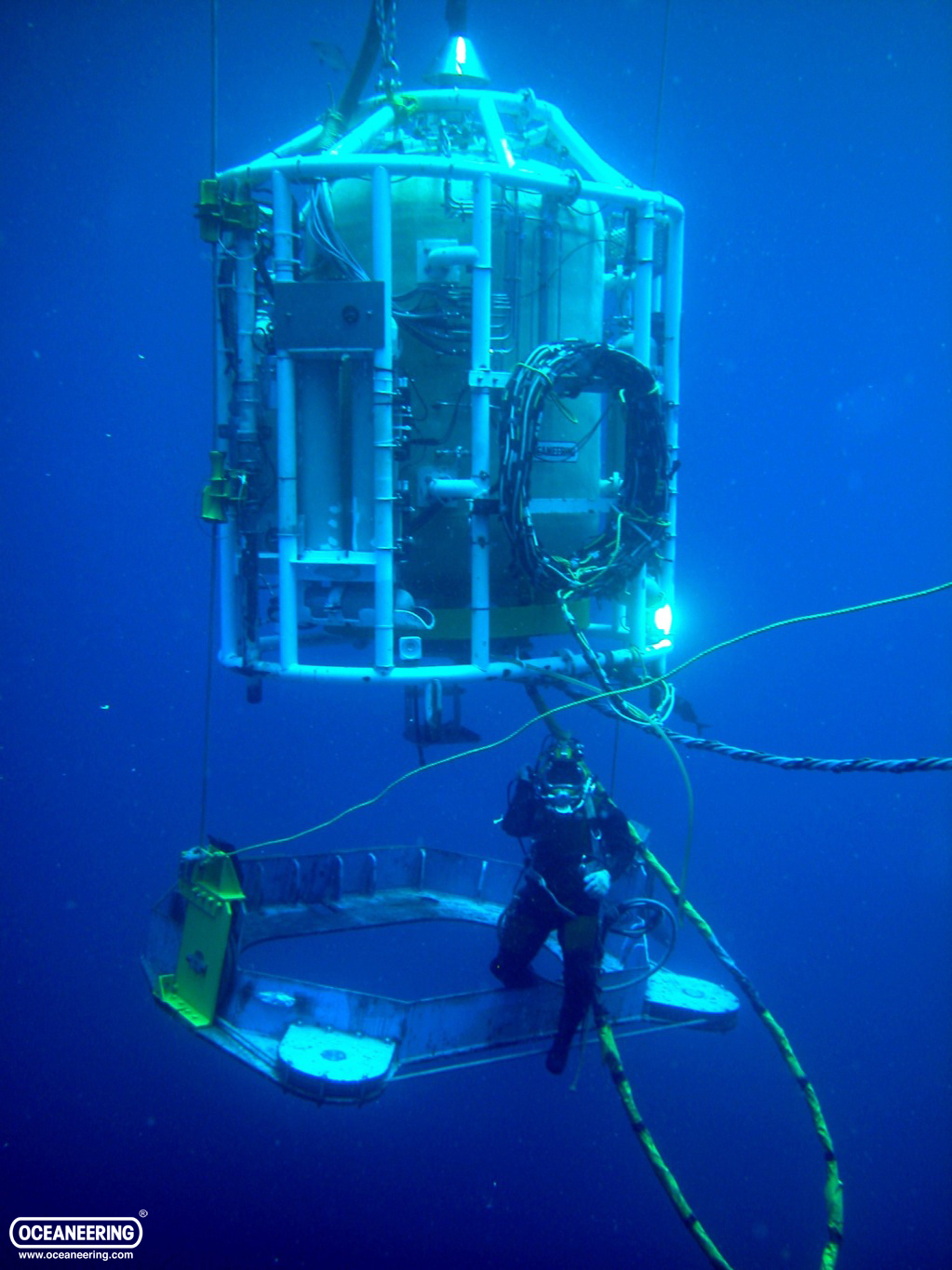
19_oceaneering-nautilus-bell-locking-out

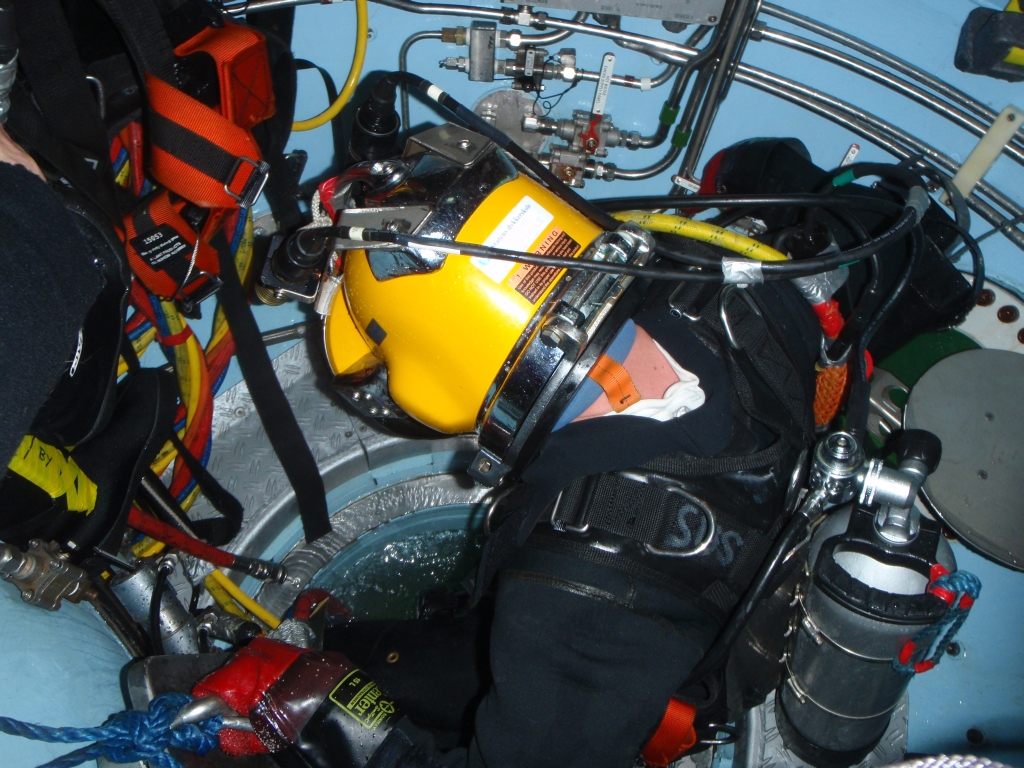
Oceaneering Nautilus diving bell

OLYMPUS DIGITAL CAMERA

Saturation diver preparing to leave diving bell


7 Comments

New look

Today I decided the blog was looking all a bit noughties, so it was time for a fresh coat of paint. It’s just one of the free WordPress themes, so it’s nothing fancy. I’ve kept the widgets the same, so there’s the two book of the Apollo Quartet, but now on the right-hand side of the page. Plus the cover art for the various places I’ve so far appeared in print.

The header photo is Apollo 15 sitting somewhat lopsidedly on the Sea of Rains. I was actually planning to use something completely different, but I stumbled across that one on my hard-drive and it seemed the right one to use. Also in the header… it’s the return of the subtitle! Yes, all these years and this blog has actually been called “It Doesn’t Have To Be Right… It Just Has To Sound Plausible”. The previous theme I used chopped off the second part of the phrase. And now, it has now been reinstated.

All I need to do now is post more regularly… And write more interesting posts…


3 Comments

Songs of the Dying Earth

sdelgSongs of the Dying Earth, edited by George RR Martin and Gardner Dozois
(Harper Voyager, 660pp, £8.99 pbk)

Few of us would disagree that Jack Vance is a man whose career deserves respect; and since imitation is the sincerest form of flattery, then an anthology of stories which ape one of his creations must seem like a fine and commercial tribute. And yet… The Dying Earth first appeared in 1950. It is over sixty years old. The average age of the contributors to Songs of the Dying Earth is no younger. This anthology, then, is an exercise in nostalgia. Though its cover proclaims it contains “stories in honour of Jack Vance”, it is not a homage: its contents are not inspired by Vance’s creation, they pastiche it. Each of the twenty-two stories uses places and characters invented by Vance. Further, while some directly reference stories written by Vance; one, by Liz Williams, bases its plot directly on one by Vance.

The original The Dying Earth was a short story collection of 176 pages. Songs of the Dying Earth is nearly four times larger. This means those factors which lent the original its charm soon overstay their welcome: the ornate, archaic language; the amusing names of people, places and spells; the science-fictional tone in service to fantastical magic; the constant references to the dying sun. Over 660 pages, these conceits lend every story a similar affect, making each of the stories blend and merge into the one following. Songs of the Dying Earth reads like a novel without a plot and an interchangeable cast. It is, then, a book to be dipped into, not to be read from cover to cover.

While the anthology may provide a varied read only in small doses, the quality – and flavour – of the contents is equally variable. A handful stand out. Kage Baker, who appears to be the only contributor who remembered that many of Vance’s Dying Earth stories were very funny. Lucius Shepard, who shows more invention than most (with footnotes), though a thorny moral discussion in the middle jars somewhat. Elizabeth Hand, whose story is the only one to feature female protagonists (she should also be rewarded for the invention of “Punctilious Trousers”). And Jeff Vandermeer, who brings a foreign, but welcome, note of the surreal; his is perhaps the least accurate imitation, but it is better for it.

However, John C Wright’s and Elizabeth Moon’s stories are completely tone-deaf; unlike Terry Dowling and Walter Jon Williams, who both manage to catch the flavour of Vance’s originals. Neil Gaiman’s story bizarrely opens in present-day Florida. Matthew Hughes, given his career to date, provides an oddly disappointing tale. Robert Silverberg’s opening story is dull, as is Mike Resnick’s. Liz William’s is memorable chiefly for being so miserable. Dan Simmons provides a novella, the longest story in Songs of the Dying Earth. The remainder – Paula Volsky, Phyllis Eisenstein, Tad Williams, Glen Cook, Byron Tetrick, Tanith Lee, Howard Waldrop and co-editor George RR Martin – are somewhere in between.

Each story features an afterword in which the writer explains how they first discovered Vance’s The Dying Earth, and what it now means to them. In almost all cases, they discovered the book at an impressionable age during the 1960s or early 1970s. These afterwords suggest that Songs of the Dying Earth is indeed a celebration of Vance’s creation. Certainly, it seems poorly-designed to introduce a new generation of readers to Vance’s oeuvre – most of which is out of print, anyway. And purely as an anthology, the sameness of its contents works against it.

Overall, it’s hard to not suspect the writers had more fun writing the stories in Songs of the Dying Earth than readers will have reading them.

This review originally appeared in Interzone, #238, January-February 2012.


Leave a comment

The future we used to have, part 18

As well as the USSR, USA and UK, many other nations were involved in the Cold War. However, none, it seems, built quite as many aircraft as those three countries. As a result, this “rest of the world” post proved really difficult to put together. The USA and USSR were in a military pissing contest, so it’s no real surprise they manufactured hundreds of different types of aircraft. Britain’s large inventory was a result of the role the country played in World War 2… But few other nations invested quite so much in their own military-industrial complexes, and seemed mostly happy to purchase their military aircraft from the USSR, USA or UK. The following aircraft, however, were all the products of their nation’s aerospace companies. Not all of them ever saw service.

fighters

18_Avro_Arrow_3

Avro Arrow
Interceptor prototype
(Canada)

18_MirageG8

Dassault Mirage G
Swing-wing interceptor prototype
(France)

18_SO9000_Trident

SNCASO SO.9000 Trident
Interceptor prototype
(France)

18_vj101c

EWR VJ-101
Experimental VTOL fighter
(Germany)

SONY DSC

Soko/Avioane Craiova JR-22 Orao
Fighter
(Yugoslavia/Romania)

fighter/bombers

18_JH-7JH-7A

Xian JH-7 FBC-1 Flying Leopard
Fighter/bomber
(China)

18_mirage_iv_mv

Dassault Mirage IV
Supersonic strategic bomber
(France)

18_hal-hf-24-marut

Hindustan Aeronautics HF-24 Marut
Fighter/bomber
(India)

18_Fiat-G-91-R3

Fiat G.91
Fighter/bomber
(Italy)

18_saab_a-36_195

Saab 36
Proposed supersonic bomber
(Sweden)


3 Comments

12-question book meme

“For a lazy Saturday”, says SF Signal (see here). It’s Saturday, I’m feeling lazy, so why not? Twelve SF/F/H-related questions on which to do the meme thing:

1. The last sf/f/h book I read and enjoyed was:
I just reread Eric Brown’s four Starship Seasons novellas – Starship Summer, Starship Fall, Starship Winter and Starship Spring – and enjoyed them. The last genre book I read that really impressed me was M John Harrison’s Empty Space.

2. The last sf/f/h book I read and did not enjoy was:
Moonstar Odyssey, David Gerrold. A palimpsest novel in which Gerrold uses various stories and testimonies to build up a picture of the terraformed world of Satlik and its inhabitants, who chose their gender at puberty or “blush”. Unfortunately, somewhere along the way Gerrold forgot about his plot – three-quarters of the book is scene-setting before an actual plot is squeezed in at the end. I now have a copy for sale.

3. A sf/f/h book that I would recommend to new sf/f/h readers is:
Dark Eden, Chris Beckett. Yes, it won the Clarke Award this year, but as sf texts go it’s quite low-level. By that I mean, despite being set on a rogue planet between galaxies, which features an entirely invented ecosystem, the story itself is as old as the Bible and even readers unfamiliar with the genre and its tropes should have little trouble sympathising with the book’s cast.

The same is also true of Joan Slonczewski’s The Wall Around Eden. It’s set in a small community protected from a post-apocalyptic Earth by a mysterious alien forcefield. The characters are beautifully drawn, the plot works like a well-oiled engine, and there’s nothing in the book at which a non-genre reader might balk.

Um, the Eden references in the titles are purely coincidental…

4. A sf/f/h book that I would recommend to seasoned sf/f/h readers is:
Obviously, I would recommend all the sf novels I most admire. But perhaps I should instead recommend a non-genre book that I think genre readers would enjoy – such as Girl Reading by Katie Ward, or The Explorer by James Smythe. Both were marketed as literary fiction but use sf tropes, and both are considerably better-written than is the norm for genre fiction. Girl Reading is, to my mind, the better of the two, but both are certainly worth reading.

For someone looking for fiction in smaller bites, the sf collection that comes to mind is The Universe of Things by Gwyneth Jones.

5. The sf/f/h book I most want to read next is:
I am so bad at deciding what to read that I have to make a list. Some of my reading is dictated by SF Mistressworks – I have to read and review books to keep to its one-a-week schedule – but that’s no real hardship. Genre books on the list to read some time in the near-future include Principles of Angels, Slow Apocalypse, Rapture, Cyclonopedia, Never at Home and Watermind. Plus a lot of non-genre, such as Under the Volcano, Stonemouth, The Cleft, Killer in the Rain and The Sweetheart Season.

6. My favorite sf/f/h book series includes:
Tricky. I love the Dune series, but I don’t think the individual books in it are especially good. And the whole thing has been poisoned by the McDune books churned out by Kevin J Anderson and Brian Herbert. L Timmel Duchamp’s Marq’ssan Cycle is a series I really want to reread; the same is true of Kim Stanley Robinson’s Mars trilogy. But there’s no actual series, in which one novel follows directly on from another for more than three, four or five books, that I’d call a favourite. There are series that contain books I like a great deal and/or admire – the Culture, Eight Worlds, Hainish Cycle, Jurisdiction, Alliance-Union, Dumarest saga… But despite the many seemingly endless series currently being published, there’s none that I eagerly buy each installment the moment it is published.

7. I will read anything by this sf/f/h author:
Easy. Gwyneth Jones.

8. The first sf/f/h book I read was:
It was a Dr Who novelisation: Doctor Who and the Zarbi. Then, at school, a classmate introduced me to proper science fiction when he lent me Heinlein’s Starman Jones. After that it was EE ‘Doc’ Smith and I was hooked. Now, I can no longer read those books.

9. The sf/f/h book I’m most surprised that more people don’t like is:
Probably Coelestis by Paul Park, which I feel deserves to be in the SF Masterworks series. In the past, I’ve championed both Take Back Plenty and The Continuous Katherine Mortenhoe, and they’re now in the series so I live in hope.

10 .The sf/f/h book I’m surprised so many people do like is:
Basically, anything by Asimov. Especially the Foundation series. More recently, I’ve been baffled by the acclaim given to, among others, Wool, The Windup Girl, Leviathan Wakes, or A Song of Ice and Fire. And while I’ve read and enjoyed books by China Miéville, I still can’t see why he’s the poster boy for British genre fiction.

11. The most expensive sf/f/h book I own is:
A hardback first edition of The Dune Encyclopedia. Paperback copies are rare and not cheap, but I was lucky enough to find a hardback copy. It was very expensive, but it was worth it.

12. The number of sf/f/h books I own and have yet to read is:
Not sure; somewhere around the 300 mark, I expect. I did try reading a book on speed reading once, but it took me ages to finish it… But seriously, I typically read three to four books a week. Even so, it’s going to take me years to whittle down the TBR. Especially given that I continue to buy new books all the time…


1 Comment

The future we used to have, part 17

Back in the day, the UK used to have a massive aircraft industry. It was because of the Second World War, of course. We churned out huge numbers of bombers and fighters during those years, but even in the two decades following, there were dozens of aircraft manufacturers in Britain, all bidding on government contracts. Over the years, the various companies merged, amalgamated, or went under, until pretty much all we were left with was British Aerospace. But back in the 1950s and 1960s, when names like Avro, Vickers, Handley Page, de Havilland, Gloster, Supermarine, still meant something, the UK built some iconic military aircraft. Not just the V-Bombers, but also the English Electric Lightning interceptor, the sadly-cancelled TSR.2, or the Canberra – which became the B-57 under licence in the US…

fighters

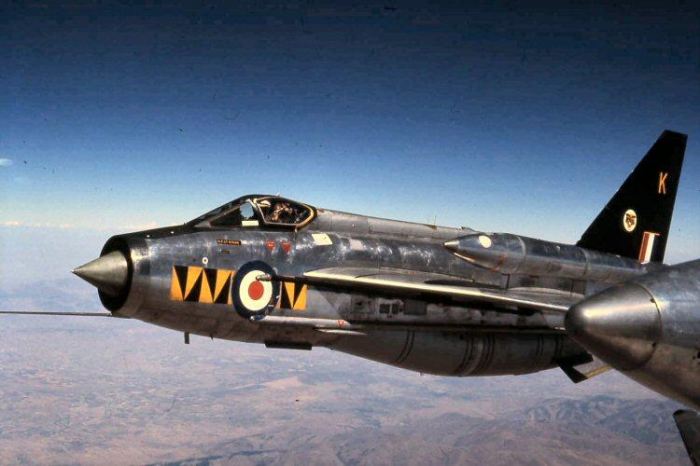
17_74-sqn-bac-lightning-f6-raf-tengah

English Electric Lightning

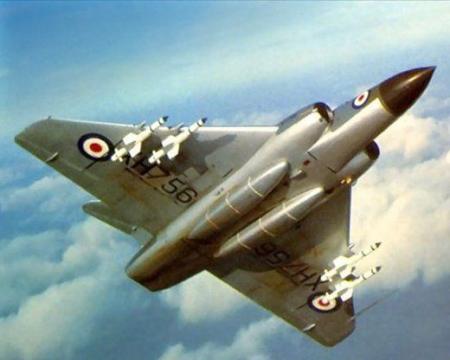
17_Gloster_Javelin_XH756_firestreak

Gloster Javelin

17_Sea_vixen_xp924_g-cvix_kemble_arp

De Havilland Sea Vixen

17_sr53

Saunders-Roe SR.53

17_Vickers508

Supermarine Type 508

bombers

17_Victor-K2-XM715

Handley Page Victor

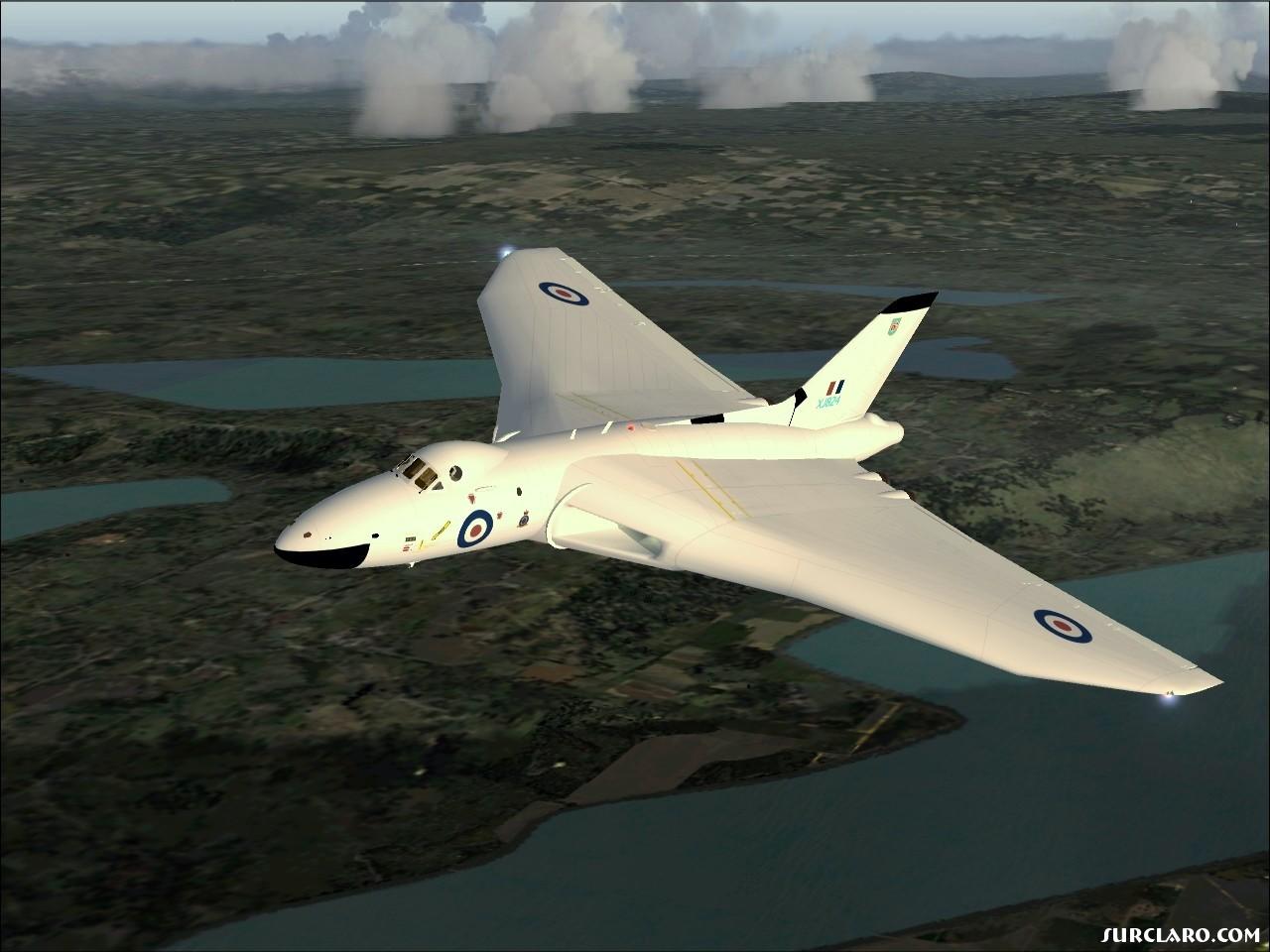
17_Avro_Vulcan_Bomber

Avro Vulcan

17_Canberra-4

English Electric Canberra

17_tsr2

BAC TSR.2

17_valiant-vickers

Vickers Valiant

The SR.53 was a prototype rocket- and jet-propelled interceptor; only two were built. The Type 508 was also a prototype, and a later version of it, without the butterfly tail, went on to enter service as the Supermarine Scimitar.


2 Comments

In an octopus’s garden

Back in the 1930s, Swiss scientist August Piccard held records for both the highest altitude ever reached and the deepest ocean descent. In the last couple of years I’ve found myself retracing a similar journey, and while I may have travelled higher and deeper, I’ve done it from the comfort of my armchair. In books.

I was three when Neil Armstrong set foot on the Moon, so the Space Race was a part of the world in which I grew up. I had a childish interest in it, but in my late thirties that interest was rekindled after reading Andrew Smith’s Moondust. I’ve since used my fascination with the topic in my writing – not just the Apollo Quartet, but also in published and soon-to-be-published short stories. And I plan to continue doing so.

In 2010, I learnt it was the fiftieth anniversary of the first descent by human beings to Challenger Deep, the deepest part of the ocean on the planet, some 11,000 metres below the surface of the Pacific. In January 1960, Lieutenant Don Walsh, USN, and Jacques Piccard, son of Auguste Piccard, had reached the ocean-bottom in the bathyscaphe Trieste (which had also been designed and built by Auguste Piccard). I was surprised to discover that very little had been made of the two men’s achievement – in fact, I could find only a single book on the topic, Seven Miles Down, which I wrote about here. Contrast this with the huge numbers of books published in 2009 to celebrate the fortieth anniversary of the Apollo 11 Moon landing (such as these).

archives-trieste-6_62313

Space exploration has been in the public eye since 1957 and the launch of Sputnik. Underwater exploration – especially deep sea exploration – has not. Yet it’s actually just as fascinating a topic. While the “commute” is a great deal simpler and less expensive – you just sink – the environment at the bottom of the ocean is every bit as dangerous, if not more so, than space. It is an area in which great strides were made during the middle decades of the twentieth century, and in which all the various problems were solved by brute-force engineering… only for interest to fade away as it proved too difficult to keep human beings alive in that environment. Just like space exploration.

Recently, I’ve been reading about underwater exploration – partly as a result of my ongoing interest in the Trieste, but also because I’ve felt it’s a good subject for short fiction. Earlier this week, I finished Sealab by Ben Hellwarth, which is about the US Navy’s programme during the 1960s to build an underwater habitat. I also have a copy of Living and Working in the Sea by James W Miller and Ian G Koblick (recommended by Gavin Smith). And, of course, there’s plenty of material on the internet. Even so, underwater exploration is not as well documented as space exploration.

The idea of living at the bottom of the sea is not a new one. The best-known fictional example is likely Captain Nemo from Jules Verne’s Twenty Thousand Leagues Under the Sea, and that’s from 1870. There are, of course, plenty of difficulties to overcome – and not just the fact that human beings can’t breathe water. The deeper you go, the higher the pressure – one atmosphere for every ten metres of water. So at 610 m (2000 ft), that’s 61 atmospheres, or 61 kg per square centimetre. At such pressures, ordinary air is too dangerous to breathe. Not only is the partial pressure of oxygen increased to levels which can be toxic, but the nitrogen causes nitrogen narcosis, which presents as a form of debilitating drunkenness. Nitrogen also dissolves in the cells of the body, and returning to normal atmospheric pressure causes the gas to bubble out, often with fatal consequences – the bends. As a result, divers visiting below 60 m use a helium-oxygen mix. They must also decompress slowly to normal atmospheric pressure, a process that often takes longer than the period spent underwater.

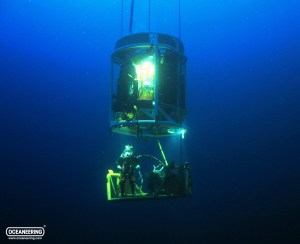
One technique that has allowed greater depths to be reached is “saturation diving”. In this, the diver spends time before the dive in a sealed chamber in which the pressure is slowly increased – often over days – to the required level. If, for example, the diver will be operating at 200 m (650 ft), by the time they’ve completed compression, they will be breathing a helium-oxygen mix at 20 atmospheres, and the cells of their body will also be at that pressure. A sudden return to normal atmospheric pressure would be quite literally explosive.
20120207-Neptunes-1st-Sat-Job-390

Saturation diving is frighteningly dangerous. In 1962, Swiss physicist and diver Hannes Keller announced he would dive to the hitherto considered impossible depth of 305 m (1000 ft) using a secret mixture of breathing gases. In a diving bell, Atlantis, he and a British journalist, Peter Small, were lowered to the seabed off the coast of Santa Catalina Island, California. The plan was for Keller to place a Swiss and US flag on the seabed. Somehow, he managed to get his umbilical tangled in the flags as he returned to the bell, and once inside he passed out as the gas mixture had gone bad. Small had already blacked out. The bell was raised, and at 60 m (200 ft) support divers were sent down to assist. One of them never returned. Once the bell was on the ship, Keller revived, followed by Small two hours later; but Small then passed out again. Several hours later, Keller noticed that Small had stopped breathing. He tried to resuscitate him, to no avail. Once the bell’s atmosphere had reached two atmospheres – eight hours after it was originally sealed – it was opened and Small rushed to hospital, where he was pronounced dead. Keller had broken the deep-diving record, but at the cost of two lives.

Underwater exploration, and living, has been more successful in shallower waters, typically no more than 10 or 20 metres – depths at which it’s safe for a diver to head immediately for the surface. Jacques Cousteau operated his three Conshelf habitats in the Mediterranean between 1962 and 1965, before interest waned in the idea. US industrial Edwin Link, inventor of the flight simulator, experimented with his SPID, Submersible Portable Inflatable Dwelling, in which diver Robert Sténuit set a series of records, including spending 24 hours at 62 m (200 ft) in 1962. The biggest such project, though it was initially run on a shoestring budget, was the US Navy’s Sealab, the brainchild of Commander George F Bond, who before joining the Navy had worked as a country doctor in an Appalachian village called, amazingly, Bat Cave. The Sealab programme comprised three habitats, each one larger and better-equipped than the preceding one, placed in progressively deeper water. Mercury astronaut Scott Carpenter joined the project on loan from NASA and spent thirty days in Sealab II. Sealab III, however, was plagued by technical problems, and ended in tragedy when a diver from the first team sent down to open up and then live in the habitat died of carbon dioxide poisoning on the ocean bottom at 185 m (610 ft).

sealab

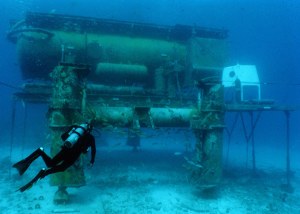
The US Navy subsequently shut down the Sealab programme, but research into saturation diving continued in the private sector as oil companies began offshore drilling at deeper depths. They needed divers for seabed maintenance and repairs. A few other attempts were made at underwater habitats, but the idea of sustained underwater living, especially at depths of 200 m or more, was soon dropped. These days there are only a handful of underwater habitats in operation, and they all sit in shallow water – such Aquarius, which is in 20 m of water in the Florida Keys National Marine Sanctuary. Even commercial divers found it more efficient to stay aboard a ship in a sealed chamber at the required pressure, and travel to the seabed in a diving bell to work. These days, of course, much of the work done by saturation divers is instead done by remotely-operated vehicles, ROVs, which can operate much deeper and don’t require decompression.
neemo9_aquarius

While the US Navy may have canned Sealab, it didn’t abandon saturation diving. Instead, it mounted a secret mission to retrieve debris from Soviet missile tests from the floor of the Sea of Okhotsk. The US Navy then realised it could use saturation divers to place taps on Soviet military submarine cables some 120 m (400 ft) down in the same region. Operation Ivy Bells provided a lot of useful intelligence throughout the 1970s, before it was compromised by a traitor within the CIA in 1980.

During the 1970s, commercial diving companies and some navies had tried to extend the depth at which saturation divers could operate. Somewhere around the 310 m mark, however, divers begin to suffer from a variety of symptoms, even when using a helium-oxygen mix: lethargy, dizziness, shakes, vomiting, delusion and hallucinations. This was dubbed High Pressure Nervous Syndrome, HPNS, and it seemed like a natural limit had finally been reached. Eventually, it was discovered that by adding hydrogen, or a small amount of nitrogen, to the gas mix, HPNS could be avoided. Commercial saturation diving to 300 m became routine, and depths of around 600 m were found to be possible – in fact, to date the deepest dive ever recorded by human beings was to 534 m (1752 ft) by a team of commercial saturation divers in 1988. The deepest simulated dive – ie, in a compression chamber on land – was to 701 m (2300 ft) as part of a scientific exercise by a commercial diving company. The diver spent three hours at 70 atmospheres, and experienced only minor HPNS symptoms, a slight tremor. At present, it is believed human beings cannot survive deeper than 750 m to 1000 m.

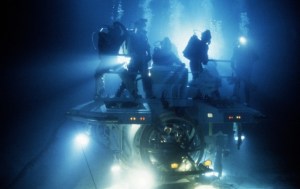
Much like space exploration, science fiction typically glosses over the difficulties associated with living and working underwater – especially at depth. There have been numerous novels, films and even television series featuring underwater cities, but most seemed to take as given that some element of humanity has been engineered to survive underwater – even at depth. James Blish and Norman L Knight’s A Torrent of Faces features aquatic humans, as do, more recently, Alastair Reynolds’ Blue Remembered Earth and Peter Watts’ Rifters Trilogy. Actual diving, or realistic underwater habitats, seems more the province of techno-thrillers – much like accurate space exploration has been. Michael Crichton’s Sphere, for example, has all the elements of a good story – saturation diving, underwater habitat, and a mysterious alien spacecraft on the ocean bottom… but still manages to be a bad film. The Abyss is perhaps one of the best cinematic representations of deep sea diving, but the fluid-breathing diving suit is pure invention. Given the actual achievements made last century in saturation diving and underwater habitats, it seems a shame the topic is not more commonly used in science fiction.
Abyss_2C-The-1074184-1024x648

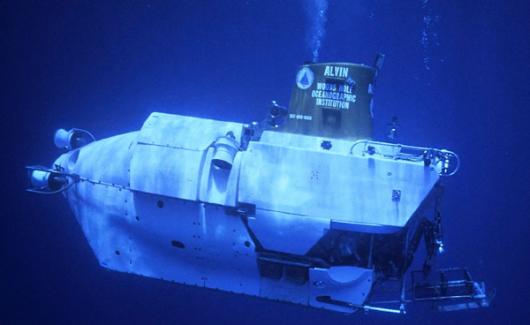
Having said all that, depth is no obstacle when people remain in a one-atmosphere environment, as they do in a submarines, submersibles or atmospheric diving suits. Sf representations of these are far more common – from Frank Herbert’s The Dragon in the Sea to the seaQuest DSV television series. But that’s a topic for another post…


Leave a comment

Double stacked

I promised a book haul post and here it is. Unusually, this month’s haul consists chiefly of research books, and first editions for various collections. Which actually probably makes it a little more expensive than is typical… Oh well.

20130506a

I bought these for research for Apollo Quartet books 3 and 4 – so yes, as promised, the role of women is much increased in the second half of the quartet. These four books – Women with Wings, Right Stuff, Wrong Sex, Integrating Women into the Astronaut Corps and Women Astronauts – only apply to part of the planned stories for the two novellas, however. I guess you’ll have to buy Then Will The Great Ocean Wash Deep Above and All That Outer Space Allows when they’re published to find out precisely how…

20130506b

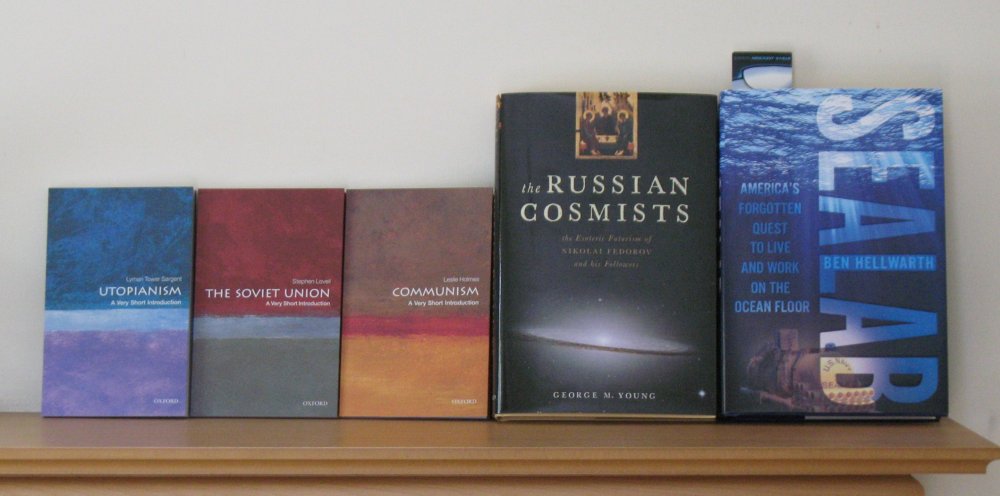
More research. Sort of. Sealab I bought just because it looked interesting. And as the bookmark indicates, I’m about a third of the way into it and it is interesting. Fascinating, even. I may well post about it later. The Very Short Introductions – Utopianism, Communism and The Soviet Union – are quite useful research tools, though they’re obviously only starting points. The Russian Cosmists is for a novel I’m working on. I started the novel the year before last when I had a bash at NaNoWriMo. I managed 15,000 words before giving up, but I recently realised that if I restructured it and took the plot in a different direction, I could end up with something quite interesting.

20130506c

A bunch of genre works. The Dog Stars was shortlisted for the Clark Award this year. I found that copy in a charity shop. The Lowest Heaven is an ARC of the latest anthology from Anne Perry and Jared Shurin. This ARC is just the stories, but the finished product will apparently contain a number of astronomical photographs. It’s due out next month. Seoul Survivors I have to review for Interzone. And The Maker’s Mask is a self-published work I stumbled across on Amazon. From what I’ve read of it so far, it seems quite fun.

20130506d

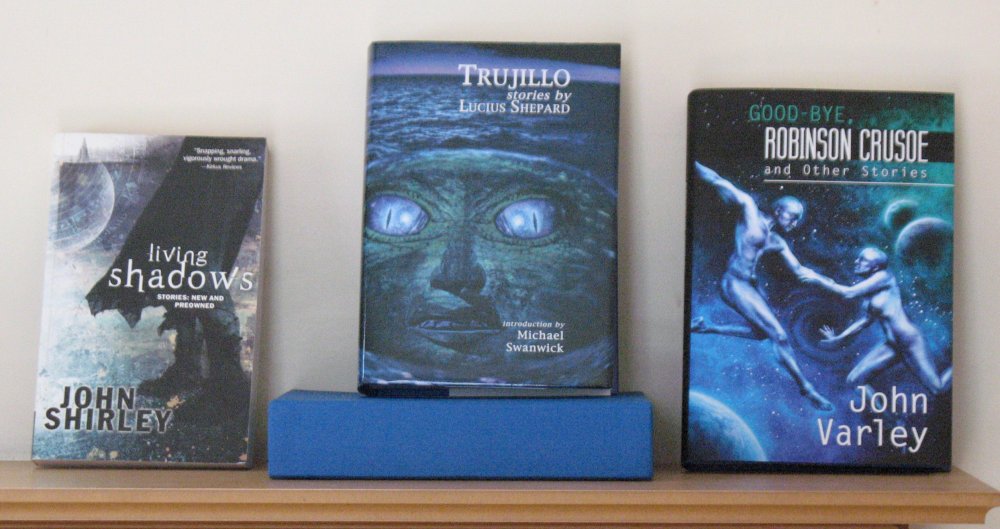
Some signed genre collections. I’ve been a fan of Varley’s fiction since the early 1980’s, so there was no way I was going to miss buying Good-Bye, Robinson Crusoe, even if I have most of its contents in other collections. Trujillo I picked up cheap on eBay. It’s out of print and difficult to find – especially the slipcased edition. I also have the Night Shade Books edition, although this PS Publishing one includes the title novel and some additional short stories. Living Shadows was another cheap eBay purchase.

20130506e

These, er, weren’t cheap. The Alien Sky and A Male Child are first editions of Scott’s first and third novel, from 1953 and 1956. Despite the enduring popularity of The Raj Quartet, Scott’s other works are really difficult to find – especially the early ones. Happily, a Cambridge-based bookshop put some of his books up on eBay recently. So I bought them. Hear Us O Lord from Heaven Thy Dwelling Place is a 1962 first edition of Lowry’s first posthumous collection. It contains ‘Through the Panama’, which is currently one of my favourite pieces of novella-length fiction. It was sold by the same shop as the Scott novels.

20130506f

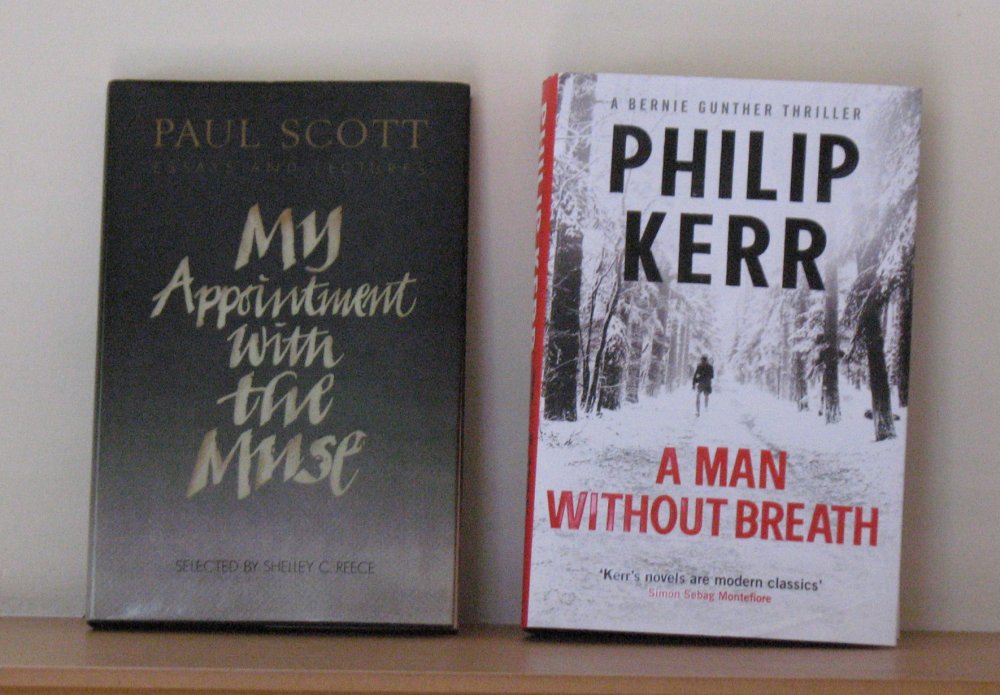
Finally, My Appointment with the Muse is a posthumous collection of Scott’s essays and talks. A Man Without Breath is the ninth and latest in Kerr’s Bernie Gunther series. I only have to read the novel prior to this one, Prague Fatale, and this one and I’m up to date.


2 Comments

The future we used to have, part 16

I did the USSR last week, but now it’s the USA’s turn. The amount of money spent on these aircraft is staggering – far more in total than it cost to put twelve men on the Moon. And yet few of them saw service and even fewer actually saw combat. Despite their capabilities, the technology was far from sophisticated. They pushed the science and engineering of the time as far as it would go, just so they could intercept Soviet bombers before they began dropping bombs, or drop bombs themselves on the enemy without being intercepted. And the only way to do either was to go… higher, faster…

fighters

16_F-101B_kevsaviationpics-com

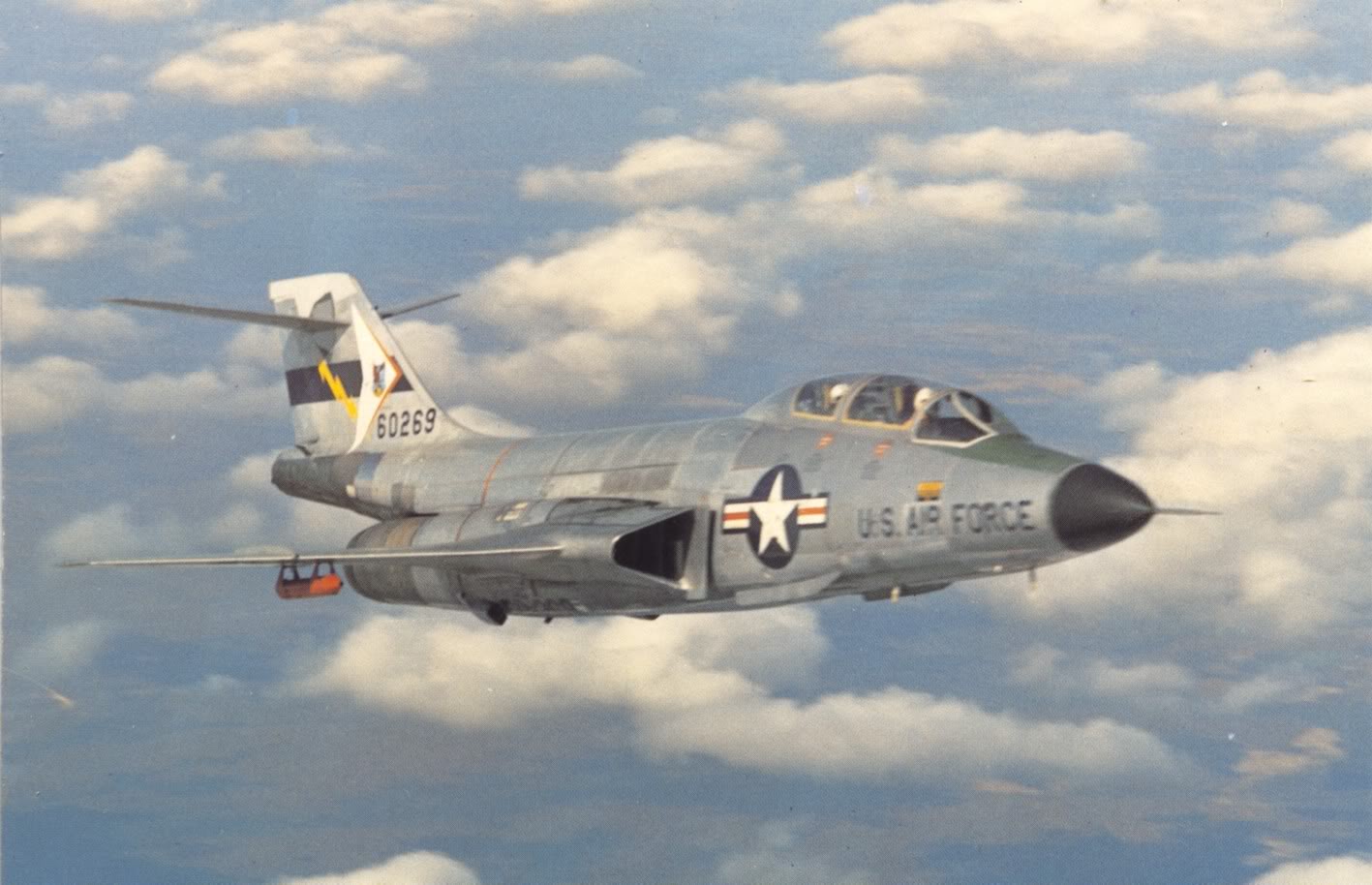
McDonnell F-101 Voodoo

16_F-106 Delta Dart(4)

Convair F-106 Delta Dart

16_F-108MockupGlamourAlternate

North American XF-108 Rapier

16_f2y-1

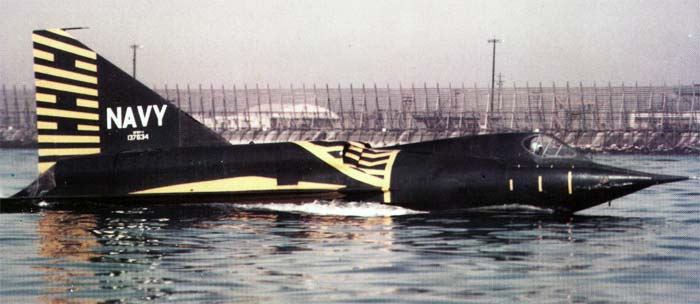
Convair F2Y Sea Dart

16_lockheed-cl-1200-lancer

Lockheed CL-1200 Lancer

bombers

16_a-5_foto27

North American A-5 Vigilante

16_xb43_13

Douglas XB-43 Jetmaster

16_xb-46-photo

Convair XB-46

16_xb51_15

Martin XB-51

16_ConvairYB-60LOW

Convair YB-60

Of the fighters, only the F-101 and F-106 ever flew with USAF. The F-101 was also flown by the Royal Canadian Air Force. The North American A-5 Vigilante was based on the cancelled XF-108, but rather than a Mach 3 interceptor it was a carrier-based Mach 2 bomber. The Convair XB-46 was built for a medium jet bomber competition, but lost out to the Boeing B-47 Stratojet. The Martin XB-51 was built for a low-level bomber competition, but lost out to the Martin B-57, a license-built version of the English Electric Canberra. The Convair YB-60 was an attempt to extend the operational life of Convair B-36 Peacemakers by giving them swept wings and all-jet propulsion. USAF instead chose to use the Boeing B-52 Stratofortress.


Leave a comment

Come what May

A new month, a Bank Holiday weekend, and various doings of recentness in the weird and wacky world of science fiction. First up, of course, is Chris Beckett winning the Arthur C Clarke Award with Dark Eden. A win we can happy with, I think; though it was not my actual favourite on the shortlist. But congratulations to Chris, a genuinely nice guy and an excellent writer. Still, likely there will be much discussion on the win and what it means for science fiction in the UK over the next few weeks. Or perhaps not.

On the topic of not winning, right-wing nutjob Theodore Beale failed to conquer the SFWA and polled only a tenth of the votes of new SFWA president Stephen Gould. I’m not a member of the Science Fiction Writers of America, and have no desire to ever be one but, you know, it’s good to mock fascists, even if their politics are completely risible anyway. Speaking of which, a large number of plainly very stupid people in the UK gave a bunch of seats in local elections to UKIP. This is the party whose candidates believe exercise prevents homosexuality, claim the Jews were responsible for the Holocaust, think it’s funny to photoshop their head onto a photograph of Hitler and some Nazi bigwigs, and give “imitating a pot plant” as a defence for throwing a Nazi salute… One of their candidates has apparently gone to live in Thailand for six months, leaving his (Thai) wife and kids in the UK; and another was forced to resign as a police officer after being caught working as a male escort in full uniform. The clowns are taking over the circus.

Earlier this week, Nook dropped the price of its Simple Touch ereader from £79 to £29. Since I’d spent £130 on four hardback books a couple days before, I decided £29 was cheap enough to order one. Which is where it all went horribly wrong. I placed an order… and moments after getting an email acknowledgement I received a second email saying my credit card had been declined. Because I hadn’t created an account on the website, there was no way I could view or amend my order. I tried contacting Nook support, but they were completely snowed under with, it seemed, queries from other people with the same problem. So I created an account, and ordered another Simple Touch, this time using a debit card. It went through fine. The next day, I get an email saying they’ve fixed the credit card problem, so I can re-order if I want. I don’t want. I already have one heading my way – or so an email tells me. And then I get yet another email, saying it’s out of stock so my order has been cancelled. But the website still says the order’s in progress. So, Nook: big fail there. You win this week’s award for Most Useless Business on the Planet.

Meanwhile, Adam Roberts has been working his way backwards through Banks’ Culture novels. Not reading them back-to-front, obviously, just in reverse order of publication. It perhaps comes as no great surprise to learn that the later novels are not as good as those that preceded it. That is the Way of Commercial Fiction. Go read the reviews – they are insightful and amusing. And they sort of make me want to reread the Culture novels, too. If only the TBR weren’t so damn big…

Fantasy Café’s Women in SF&F month hit a bump in the road recently with a bonkers post about sexism in fantasy – or rather, the poster’s claim that it does not exist. Read the post here, then read an excellent rebuttal here. And on the same topic, here’s a piece from 1982 which demonstrates that thirty years later not a fat lot has changed. Susan Shwartz, incidentally, is the author of one of the few heartland fantasy novels I’m happy to recommend to people, The Grail of Hearts.

One author I constantly recommend people read is Gwyneth Jones. She’s offering her Escape Plans free on Kindle on Monday 6 May and Tuesday 7 May. Go buy it. Best use the link under the title, rather than search for it on Amazon, as their search engine seems to be completely fucked. Here’s my review of it on SF Mistressworks, written back in 2001.

Despite reading for SF Mistressworks, so far this year women writers only account for around 36% of my reading. Which is not to say that reading for SF Mistressworks is a hardship. While Margaret St Clair’s collection might not have been very good, Marta Randall’s novels are certainly much better than most of her contemporaries. And I’ve also had the opportunity to revisit some books I remember with great fondness, such as those by Shariann Lewitt or Susan R Matthews. Perhaps they’ve not always fared especially well on reread, but I’m glad I took the time to do it.

Speaking of books, over the last few days I’ve tweeted photos of some recent arrivals of a bookish nature. I’ll do a proper book haul post in a few days, but let’s just say I now have more research material for Apollo Quartet books three and four, and the Paul Scott and Malcolm Lowry first edition collections have expanded somewhat (which is the £130 of books mentioned earlier). So, of course, I’ve been spending my time reading about… underwater habitats and saturation diving. For another writing project. Current read is Sealab by Ben Hellwarth, which is proving fascinating. The whole idea of living and working on the sea bed appears to have been driven by one man, Captain George F Bond, USN; and who reminds me much of Colonel John Paul Stapp, USAF, of rocket sled fame, and who I wrote about in my story, ‘The Incurable Irony of the Man Who Rode the Rocket Sled’, which should be appearing on The Orphan some time soonish.