It Doesn't Have To Be Right…

… it just has to sound plausible


Leave a comment

Let’s do the meme

I seem to have been strangely busy the past week or so, and, I have to admit, somewhat short on inspiration for a subject to write about here. So here’s some cheap content: a meme. This was originally put together by Charles Tan. As usual: bold it if you’ve read it, italicise it if you own it but haven’t read it.

1. The Monkey’s Wedding and Other Stories by Joan Aiken
2. Rashomon and Seventeen Other Stories by Ryunosuke Akutagawa
3. The Kite of Stars and Other Stories by Dean Francis Alfar
4. I, Robot by Isaac Asimov
5. Black Projects, White Knights by Kage Baker
6. The Best of J. G. Ballard by J.G. Ballard – well, I have volume one of the Complete Stories, so I assume that counts.
7. Perpetuity Blues and Other Stories by Neal Barrett, Jr.
8. The Imago Sequence and Other Stories by Laird Barron
9. Occultation by Laird Barron
10. Mirror Kingdoms: The Best of Peter S. Beagle
11. The Collected Stories of Greg Bear by Greg Bear
12. The Chains That You Refuse by Elizabeth Bear
13. The Girl With The Flammable Skirt by Aimee Bender
14. Lord Stink & Other Stories by Judith Berman
15. Trysts: A Triskaidecollection of Queer and Weird Stories by Steve Berman
16. A Book of Endings by Deborah Biancotti
17. Blooded on Arachne by Michael Bishop
18. One Winter in Eden by Michael Bishop
19. The Poison Eaters & Other Stories by Holly Black
20. Labyrinths: Selected Stories and Other Writings by Jorge Luis Borges
21. From the Files of the Time Rangers by Richard Bowes
22. Streetcar Dreams by Richard Bowes
23. The Stories of Ray Bradbury by Ray Bradbury
24. Graveyard People: The Collected Cedar Hill Stories by Gary Braunbeck
25. Home before Dark: The Collected Cedar Hill Stories by Gary Braunbeck
26. Particle Theory by Edward Bryant
27. Tides from the New Worlds by Tobias S. Buckell
28. Bloodchild and Other Stories By Octavia E. Butler
29. Dirty Work: Stories by Pat Cadigan
30. The Night We Buried Road Dog by Jack Cady
31. The Panic Hand by Jonathan Carroll
32. Burning Your Boats: The Collected Short Stories by Angela Carter
33. Fireworks: Nine Stories in Various Disguises by Angela Carter
34. The Bloody Chamber: And Other Stories by Angela Carter – er, why the “collected stories” and then two more collections?
35. Stories of Your Life and Others by Ted Chiang
36. The Collected Stories of Arthur C. Clarke by Arthur C. Clarke – I’ve read half a dozen or so Clarke collections so I must have read the contents of this,
37. The Ladies of Grace Adieu and Other Stories by Susanna Clarke
38. Novelties & Souvenirs, Collected Short Fiction by John Crowley
39. The Avram Davidson Treasury by Avram Davidson
40. The Enquiries of Dr. Eszterhazy by Avram Davidson
41. Driftglass: Ten Tales of Speculative Fiction by Samuel R. Delany
42. We Can Remember It for You Wholesale by Philip K. Dick
43. Strange Days: Fabulous Journeys with Gardner Dozois by Gardner Dozois
44. Beluthahatchie by Andy Duncan
45. What Will Come After by Scott Edelman
46. Axiomatic by Greg Egan
47. I Have No Mouth, and I Must Scream by Harlan Ellison
48. The Beast that Shouted Love at the Heart of the World by Harlan Ellison
49. Deathbird Stories by Harlan Ellison
50. The Collected Stories of Carol Emshwiller by Carol Emshwiller
51. Dangerous Space by Kelley Eskridge
52. Fugue State by Brian Evenson
53. Harsh Oases by Paul Di Filippo
54. The Fantasy Writer’s Assistant and Other Stories by Jeffrey Ford
55. The Empire of Ice Cream by Jeffrey Ford
56. The Drowned Life by Jeffrey Ford
57. Returning My Sister’s Face and Other Far Eastern Tales of Whimsy and Malice by Eugie Foster
58. Artificial Things by Karen Joy Fowler
59. What I Didn’t See and Other Stories by Karen Joy Fowler
60. Smoke and Mirrors by Neil Gaiman
61. Fragile Things by Neil Gaiman
62. Burning Chrome by William Gibson
63. In the Forest of Forgetting by Theodora Goss
64. Take No Prisoners by John Grant
65. A Separate War and Other Stories by Joe Haldeman
66. Last Summer at Mars Hill by Elizabeth Hand
67. Saffron & Brimstone: Strange Stories by Elizabeth Hand
68. Things That Never Happen by M. John Harrison
69. The Past Through Tomorrow by Robert Heinlein
70. 20th Century Ghosts by Joe Hill
71. Skin Folk by Nalo Hopkinson
72. The Coming of Conan the Cimmerian by Robert E. Howard
73. The Lottery and Other Stories by Shirley Jackson
74. Unexpected Magics: Collected Stories by Diana Wynne Jones
75. Minor Arcana by Diana Wynne Jones
76. Grazing the Long Acre by Gwyneth Jones – though I have read all of Jones’ other collections.
77. The Wreck of the Godspeed and Other Stories by James Patrick Kelly
78. The Baum Plan for Financial Independence and Other Stories by John Kessel
79. Night Shift by Stephen King
80. Different Seasons by Stephen King
81. Hearts in Atlantis by Stephen King
82. Portable Childhoods by Ellen Klages
83. Scenting the Dark and Other Stories by Mary Robinette Kowal
84. Nano Comes to Clifford Falls and Other Stories by Nancy Kress
85. Nine Hundred Grandmothers by R.A. Lafferty
86. Objects of Worship by Claude Lalumiere
87. Black Juice by Margo Lanagan
88. Red Spikes by Margo Lanagan
89. Yellowcake by Margo Lanagan
90. Mr. Gaunt and Other Uneasy Encounters by John Langan
91. The Best of Joe R. Lansdale by Joe R. Lansdale
92. The Wind’s Twelve Quarters by Ursula K. Le Guin
93. The Compass Rose by Ursula K. Le Guin
94. The Birthday of the World and Other Stories by Ursula K. Le Guin
95. Red as Blood, or Tales from the Sisters Grimmer by Tanith Lee
96. The First Book of Lankhmar by Fritz Leiber
97. The Second Book of Lankhmar by Fritz Leiber
98. The Nightmare Factory by Thomas Ligotti
99. Stranger Things Happen by Kelly Link
100. Magic for Beginners by Kelly Link
101. Engines of Desire: Tales of Love & Other Horrors by Livia Llewellyn
102. H. P. Lovecraft: Tales by H.P. Lovecraft
103. Breathmoss and other Exhalations by Ian R. MacLeod
104. You Might Sleep by Nick Mamatas
105. Dreamsongs: A RRetrospective by George R. R. Martin
106. Invisible Country by Paul McAuley
107. Harrowing the Dragon by Patricia McKillip
108. The Bone Key by Sarah Monette
109. The Best of Michael Moorcock by Michael Moorcock
110. Black God’s Kiss by C.L. Moore
111. The Cat’s Pajamas and Other Stories by James Morrow
112. Dreams of the Compass Rose by Vera Nazarian
113. Unforgivable Stories by Kim Newman
114. The Secret Files of the Diogenes Club by Kim Newman
115. The Original Dr. Shade and Other Stories by Kim Newman
116. Monstrous Affections by David Nickle
117. The Best of Larry Niven by Larry Niven
118. I Am No One You Know: Stories by Joyce Carol Oates
119. The Complete Stories by Flannery O’Connor
120. Zoo by Otsuichi
121. Lesser Demons by Norman Partridge
122. Mr. Fox and Other Feral Tales by Norman Partridge
123. Night Moves and Other Stories by Tim Powers
124. Little Gods by Tim Pratt
125. Map of Dreams by M. Rickert
126. Holiday by M. Rickert
127. The Best of Kim Stanley Robinson by Kim Stanley Robinson
128. The Ant King and Other Stories by Benjamin Rosenbaum
129. Unacceptable Behaviour by Penelope Rowe
130. The Adventures of Alyx by Joanna Russ
131. Long Walks, Last Flights, and Other Journeys by Ken Scholes
132. Filter House by Nisi Shawl
133. Love Songs for the Shy and Cynical by Rob Shearman
134. The Jaguar Hunter by Lucius Shepard
135. Trujillo and Other Stories by Lucius Shepard
136. Phases of the Moon: Stories from Six Decades by Robert Silverberg
137. Are You There and Other Stories by Jack Skillingstead
138. The Girl With No Hands and Other Tales by Angela Slatter
139. Crystal Express by Bruce Sterling
140. Ascendancies: The Best of Bruce Sterling
141. Houses Without Doors by Peter Straub
142. Magic Terror: 7 Tales by Peter Straub
143. Absolute Uncertainty by Lucy Sussex
144. The Best of Michael Swanwick by Michael Swanwick
145. Gravity’s Angels: 13 Stories by Michael Swanwick
146. Monterra’s Deliciosa & Other Tales & by Anna Tambour
147. The Ice Downstream by Melanie Tem
148. The Far Side of the Lake by Steve Rasnic Tem
149. Her Smoke Rose Up Forever by James Tiptree, Jr.
150. Ten Thousand Light-Years from Home by James Tiptree, Jr.
151. In the Mean Time by Paul Tremblay
152. My Pathology by Lisa Tuttle
153. Ventriloquism by Catherynne M. Valente
154. The Jack Vance Reader by Jack Vance – have read half a dozen of his collections, so have probably read the contents of this.
155. City of Saints and Madmen by Jeff VanderMeer
156. The Third Bear by Jeff VanderMeer
157. Strange Things in Close-up; the Nearly Complete Howard Waldrop
158. Dead Sea Fruit by Kaaron Warren
159. Everland and Other Stories by Paul Witcover
160. The Island of Doctor Death and Other Stories and Other Stories by Gene Wolfe
161. The Very Best of Gene Wolfe by Gene Wolfe – have read three or four Wolfe collections, so have probably read contents of this.
162. Impossible Things by Connie Willis
163. Fire Watch by Connie Willis
164. The Doors of His Face, The Lamps of His Mouth and Other Stories by Roger Zelazny
165. Impossible Stories by Zoran Zivkovic
166. The Writer, The Book, The Reader by Zoran Zivkovic

Not a good list for me: too many writers I have no desire to read. I also suspect there’s a lot of overlap for those authors who have more than one collection listed, especially where one of them is a “best of” or “collected stories”. Many of the authors I’ve probably read the contents of their “collected stories” volumes as I’ve read so many of their short stories.

If I were to put a list of collections together, I suspect it would look very different from this one.
Leave a comment

Alternate reading material

My story ‘Disambiguation’ is now up on the website of Alt Hist, the magazine of historical fiction and alternate history. It was originally published here on my blog a couple of months ago, but now it’s found a better home. It’s something of an experimental piece since it’s constructed from a series of real and fake Wikipedia articles. It also has flying boats in it. Go read it. Please.


6 Comments

So you think you know good sf?

So the Guardian wants to know what are our favourite sf novels. And up pop the usual suspects. Sigh. I can’t be bothered to post yet another rant on the topic. Instead, I will point you at these previous posts of mine:

The Ten Best Science Fiction Books… Ever
The Best Science Fiction Series
The Best SF Novels Since 1990

And for all you Foundation and Lensman fans:

The Worst Science Fiction Series


Leave a comment

readings & watchings 2011 #4

Here we go again – we know a song about that – it’s time for more scrapings from the petri-dish of popular and unpopular culture, as studied under the microscope by Your Scientifically-Minded Correspondent.

Books
Satan Wants Me, Robert Irwin (1999). Irwin’s The Arabian Nightmare is one of the best fantasies of the 1980s, and his Night and Horses and the Desert (re-issued as The Penguin Anthology of Classical Arabic Literature) is a highly-entertaining and informative study of, well, classical Arabic literature. Satan Wants Me – god knows what people thought when they saw me reading this on the tram during my commute to work – is presented as the journal of a hippie sociology doctoral student in early 1970s London. He has recently joined an occult group spun off from Aleister Crowley’s Order of the Golden Dawn. He’s also taking a lot of drugs. And he has some very weird friends. There are some very funny laugh-out-loud bits in this novel – which probably got me even stranger looks on the tram – and it’s sharply-observed throughout. Then it goes completely batshit weird towards the end. While not the classic The Arabian Nightmare is, it certainly confirms my belief that Irwin is a writer very much worth reading.

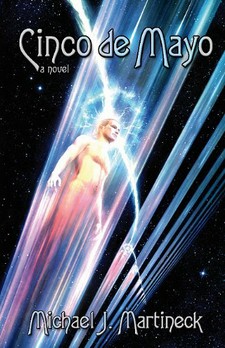
Cinco de Mayo, Michael Martineck (2010), I reviewed for SFF Chronicles here. I’ve known Michael for a long time, though we’ve never actually met in person. We’re both members of an informal critting group, with a couple of other people – i.e., we email each other stories, novel extracts, etc., for comments. So I saw bits of Cinco de Mayo several years ago. But I’d never seen the finished product. I have now, and I enjoyed it very much. And thought it a happily diverse and intelligently put-together story. Definitely worth a read.

Twenty Thousand Leagues Under the Sea, Jules Verne (1870). This 1973 edition of Verne’s classic has my name and old school number written on the ffep, which means I’ve owned this book for just over thirty years. So I must have read it at some point. I know the story – everyone does – but is that from actually reading the book, or just from some form of cultural osmosis? This (re)read did demonstrate that there’s much about the story I’d forgotten / not known. It’s very dull, for one thing. There are endless pages listing ocean flora and fauna. Very little actually happens. Aronnax et al go hunting a mysterious sea monster which has been sinking ships. In an encounter with it, they are swept overboard and then rescued by the monster… which proves to be a submarine: Captain Nemo’s Nautilus. The Nautilus sails around the world, and they do things every now and again. Eventually, Aronnax and his two companions manage to escape, and witness the Nautilus being sucked into a giant maelstrom. That’s pretty much it. Some of the science is impressively detailed; in other places it is impressively wrong – the quoted ocean depths, for instance, are out by quite a margin, claiming the deepest part of the Pacific is something like 15,000 fathoms deep – that’s 90,000 feet! Challenger Deep is actually almost 36,000 feet deep – I know this because of this. Still, despite Twenty Thousand Leagues Under the Sea being a bit of a slog to read, I actually fancy trying a bit more Verne. Perhaps I’ve been unduly influenced by David Herter’s Evening’s Empire

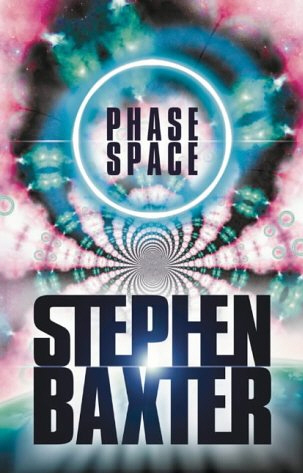
Phase Space, Stephen Baxter (2002), is a collection of short stories, many of which are off-cuts from Baxter’s Manifold trilogy. I read those three books back in 1999, 2000 and 2001 – when they were published, in other words. But not Phase Space. I have a lot of time for Baxter’s fiction, both short and long; but this collection was a bit of a disappointment. There’s some good stuff in it – ‘War Birds’, for example, which won the BSFA Award for Best Short Story in 1998 (and unfortunately resembles something I’ve been working on myself; damn); ‘Tracks’, based on an interview Baxter conducted with Apollo 16 astronaut Charlie Duke; ‘Moon-Calf’, about a retired astronaut on holiday in south-west England; ‘Barrier’, which is the sort of sf I’d be happy to have in Rocket Science. Unfortunately, many of the other stories follow a similar pattern – the narrative is interspersed with italicised first-person infodumps – and so they tend to blur together. And one or two, well, I was surprised to see they’d originally been published by Asimov’s and Interzone… Phase Space is not Baxter’s strongest collection by any means, but there’s some good stuff in it.

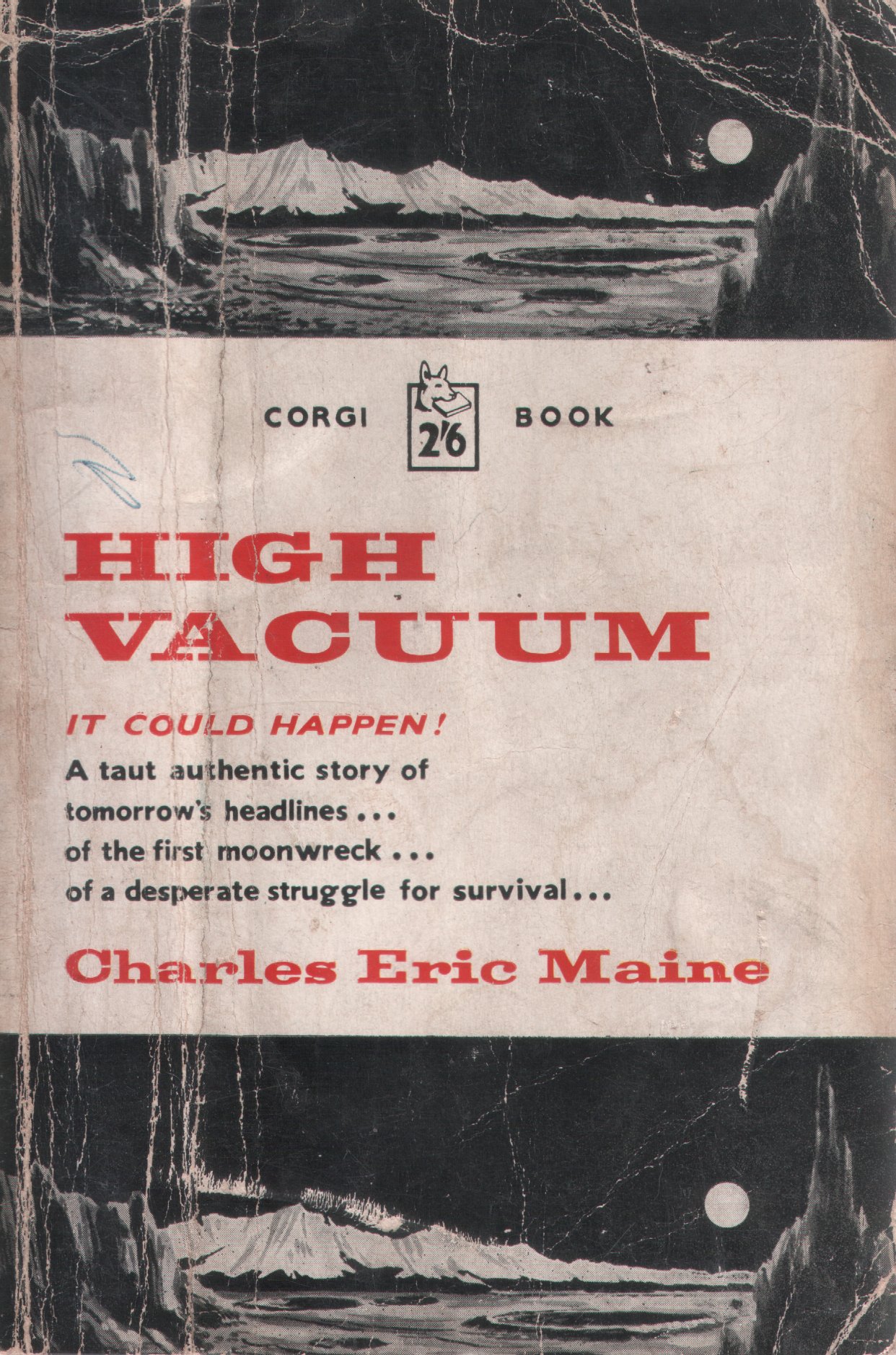
High Vacuum, Charles Eric Maine (1957). I’m currently working on a two-hander review of this and Jeff Sutton’s First on the Moon for my Space Books blog. I thought it might be an interesting exercise to contrast two novels about Moon landings written before the Apollo programme with the real world lunar landings. While I would have said there was plenty of drama in actually trying to get to the Moon, both Sutton and Maine clearly felt what was need for real drama was… a crash-landing.

Icehenge, Kim Stanley Robinson (1984). I have planned a “cage-fight” – which I will write up on this blog – between this book and Robert Heinlein’s The Moon is a Harsh Mistress (which I will have to read first; sigh). Because Icehenge is a much better candidate for the SF Masterwork series. Some of the world-building is a little quaint now – USA vs USSR – but I’ll be completely unsurprised if I find that Icehenge shits all over the Heinlein.

Winterlong, Elizabeth Hand (1990), was April’s book for my reading challenge and I wrote about it here.

The Silver Chair, CS Lewis (1953), is the fourth book of the Chronicles of Narnia by publication date, but the sixth book by internal chronology. Useless Eustace and new-found friend Jill Pole escape from bullies at “modern” school Experiment House (dear god, but Lewis shows his reactionary side with his description of the school), because Aslan wants them to find Prince Rilian of Narnia, who was abducted ten years before. Aslan gives Jill four clues, which she manages to screw up, but it all works out in the end. And everyone gets lashings of buttered scones and hot chocolate at the end, or something. These books are a bit like your old Daily Mail-reading grandad telling a bedtime story – the only bits missing are rants against immigration and falling house prices…

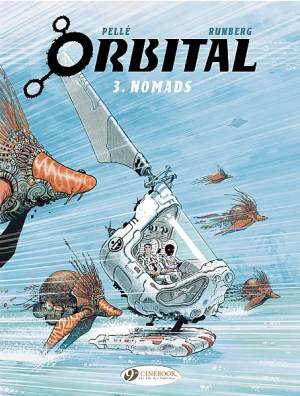
Orbital Vol 3: Nomads, Sylvain Runberg & Serge Pellé (2011), is the third book of a bande desinée series published in English by Cinebook. It’s heartland sf, but far more adult than you’d expect of a science fiction “comic.” Earth is a reluctant new member of a galactic federation, after a war with the alien Sandjarr. A pair of special agents, one human and one Sandjarr, must ensure the celebrations in Kuala Lumpur to mark the end of the war, to which a Sandjarr delegation has been invited, goes without a hitch. But a nomadic alien race has settled nearby, and something is killing all the fish and the fisherman are not happy about it… Good stuff.

Films
Barbarossa – Siege Lord, Renzo Martinelli (2009), I reviewed for VideoVista – see here.

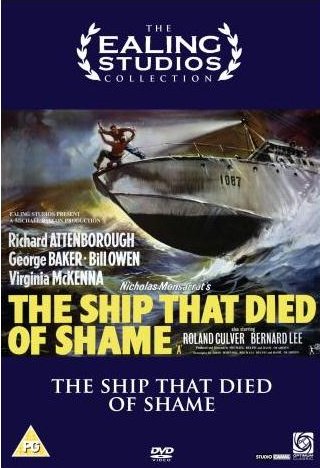
The Ship That Died of Shame, Basil Deardon (1955), is an adaptation of a Nicholas Monsarrat short story of the same title. The crew of a wartime MGB are re-united when they find their old boat – stripped of her weapons, of course – for sale. So they buy her, make her seaworthy, and use her to run contraband across the Channel into post-war austerity Britain. But it all goes horribly wrong when they accept a job to smuggle a murderer to France. Good solid British film-making from the Fifties.

Tin Man (2007), is a mini-series “re-imagining” of The Wizard of Oz, in which Oz becomes the Outer Zone or “Oh Zee”. DG, not Dorothy Gale, finds herself embroiled in a plot by her evil sister to bring endless darkness to the OZ. DG hadn’t known she had a sister, or that the OZ even existed. But when the Midwest farmhouse where she lives with her parents is attacked by strange men in black uniforms, she escapes through a tornado – discovering as she does so that her parents are actually robots. Because she’s really a princess from the OZ. With the help of a heartless ex-law officer (i.e., a “tin man”), the queen’s old advisor who has had his brain removed, and a cowardly lion-like humanoid – oh, and her old tutor, who can transform into a small terrier – DG must find the Emerald of the Eclipse in order to defeat her sister. An interesting spin on a children’s classic which, to be honest, has never appealed to me; but it all felt a bit meh in places. Though it reminded me a lot of the Sci Fi Channel Flash Gordon telly series – which was cheap and a bit silly, but which I quite liked – it didn’t have that programme’s charm.

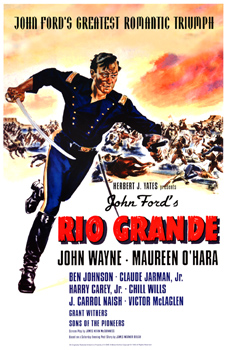
Rio Grande, John Ford (1950). I am not, I admit, a big fan of Westerns. In fact, the only one in my DVD collection is Howard Hawk’s Rio Bravo – which is actually an alternative name for the Rio Grande, the river forming part of the border between the US and Mexico. Rio Grande the film is the third in Ford’s cavalry trilogy, following on from Fort Apache and She Wore a Yellow Ribbon, neither of which I’ve seen. It’s John Wayne doing manly men stuff in the Wild West as injuns run rampant and hide out in Mexico where Wayne’s cavalry can’t follow them. Except he does, even though it might provoke a diplomatic incident. Then he learns that the injuns have captured a wagonload of white kids, which only makes the mission more righteous. The US Cavalry must have been the biggest bunch of war criminals in uniform until the formation of the SS, and their portrayal in films such as Rio Grande has only romanticised their crimes. It’s unlikely a John Wayne film would be “warts and all”, given that there’s always been a strong element of fantasy to the depiction of the Wild West in Hollywood cinema. Wayne’s character may be a racist, but he’s still the hero…

The Spy Who Came In From The Cold, Martin Ritt (1965), is a curiously flat adaptation of Le Carré’s novel of the same name. Richard Burton, who always sounds as though he’s declaiming rather than acting, plays the head of the Berlin office who comes under a cloud when a defection from East Berlin is bungled. He is demoted to a lowly position in London, eventually leaves the “Circus”, and turns to drink and a succession of low-paid jobs. At which point he is approached by East German agents, and reluctantly defects to them. But, of course, it’s all a cunning plot. They’re a bit bloody convoluted these Le Carré films. I have the novel on the TBR; I shall have to read it.

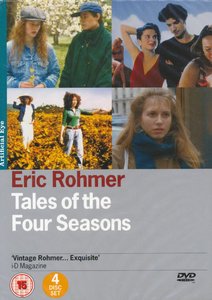
An Autumn Tale, Éric Rohmer (1998). That’s it, all four of Rohmer’s Contes des quatre saisons now watched. In this one, a forty-something woman attempts to matchmake for a winemaker friend of the same age. As does the winemaker’s son’s ex-girlfriend, who has just split up with her university professor lover and who she thinks is an ideal candidate. Unfortunately, most of the characters in An Autumn Tale aren’t especially likable. They prattle and pontificate too much. The ex-girlfriend is particularly annoying – she spouts off lots of arrogant drivel about love and people, but doesn’t actually display much insight. Some poor bloke who gets dragged in as a prospective suitor is horribly mistreated but still hangs in there, though he and the winemaker don’t appear all that well-suited to each other… I first came to Rohmer’s films after watching Triple Agent, and enjoyed its slow-burning drama very much. These Four Seasons films have been… mixed. A Summer’s Tale was easily the best one, with A Winter’s Tale a middling second. A Tale Of Springtime and An Autumn Tale both suffered from unlikable casts. All the same, I’ll be bunging Rohmer’s six Comédies et Proverbes films on the Lovefilm rental list.

Frau im Mond, Fritz Lang (1929), I will be reviewing in more depth on my Space Books blog. For the time-being, I’ll just say that it’s badly-paced, with far too much silliness up-front and not enough screen-time devoted to the mission to the Moon.

The Objective, Daniel Myrick (2008), is advertised as being by the director of The Blair Witch Project, which I’ve never actually seen. A Special Forces team of walking clichés, led by a tight-lipped CIA agent, infiltrate the mountains of Afghanistan where satellites have spotted something very strange indeed. If you like films in which US military stereotypes spout manly men bullshit, and then shoot at things, you might find The Objective interesting inasmuch as it’s not wholly a war film: the eponymous, er, objective, is – keep this to yourselves – not of this world. The film felt a bit amateur in places, and probably would have benefitted from a couple of beers inside the viewer.

I Come With The Rain, Anh Hung Tran (2008), I reviewed for VideoVista – see here.

Aliens From Outer Space, Bill Knell (2009), I reviewed for VideoVista – see here.

The Small Back Room, The Archers (1949). Those back room boys… Without them, we’d never have won the war, you know. Though they don’t actually appear to do much in this film. Sammy Rice is one such back room boy. He has an artificial foot, which pains him; and a dependency on pills and alcohol. He’s also in a strange relationship with his boss’s secretary. When a new type of booby-trapped explosive device, dropped by Jerry planes, starts killing children, Rice is brought in to puzzle out how it works. Meanwhile, he’s crawling further into a bottle, politics at the office is causing major problems, and his increasing bitterness is jeopardising his relationship with his girlfriend. Despite some clever photography, the tension and drama in The Small Back Room never quite works, but as a study of a man succumbing to despair during wartime – including a bizarre drunken dream sequence – the film is very effective. The Archers – Powell and Pressburger – were bloody clever filmmakers, and it certainly shows in this. In lesser hands, The Small Back Room could have been just another anodyne WWII home-front melodrama. We need directors like the Archers in the twenty-first century.

Le Refuge, François Ozon (2009), was surprisingly ordinary and a bit dull for an Ozon film. Could it really have been directed by the same person who made 8 Women, Angel or Water Drops On Burning Rocks? Two junkies score some smack, but one dies of an overdose. The other, the dead man’s girlfriend, only just survives. And then discovers that she’s pregnant. The dead junkie’s family, who are wealthy, don’t want her to keep the baby. But she chooses to have it, so runs away to a friend’s house on the coast. A few months later, the dead junkie’s gay brother comes to visit, and ends up staying a week or so. And, er, that’s about it. There are a number of scenes filmed on a beach, in which the woman’s pregnant belly is plainly visible. I was quite impressed by the prostheses and make-up used for this effect, only to learn in a featurette on the DVD that the actress, Isabelle Carré, really was pregnant during the making of the film. You have to wonder if she was cast because she was pregnant; or did Ozon completely rewrite the script on learning she was pregnant? Le Refuge is a likable drama, but Ozon has made much more interesting films.

Norwegian Ninja, Thomas Cappelan Malling (2010), I will be reviewing for VideoVista, but I decided to give it an early mention because it’s a pitch-perfect spoof of low-budget action/spy movies, and might well end up on my Best of the Year top five films.


1 Comment

I saw this meme and…

I spotted this on David Hebblethwaite’s blog and, while something similar went round on World Book Day (see here), I decided to have a bash at it. Besides, I’ve not posted much this week, and I don’t want all my fans (ha!) to think I’m slacking…

1. The book I’m currently reading

A Confederacy of Dunces, John Kennedy Toole

Many people have recommended this to me, but I can’t see what all the fuss is about. The main character, Ignatius J Reilly, is an over-educated idiot, and the novel is asking us to laugh at him. That’s cheap humour. Some of the slapstick, on the other hand, is quite amusing; and there is some wit in the black characters’ dialogue. But this is no American classic.

2. The last book I finished

The Silver Chair, CS Lewis.

I’m about thirty-five years too old to enjoy the Chronicles of Narnia, but I’m ploughing my way through the books nonetheless. I suspect if I had read them when I was a kid I would have found them just as patronising and dated. Oh well, only three more to go…

3. The next book I want to read

Blood Meridian, Cormac McCarthy

The TBR pile is frighteningly large and, of course, I want to read every book on it. But some sooner rather than later. I’ve had Blood Meridian for a while, and have been meaning to read it for just as long. I think I shall tackle it next. Honest.

4. The last book I bought

The Atrocity Exhibition, JG Ballard

I made a few bob on Amazon affiliates recently and was sent a voucher. Which I promptly spent. Chiefly on graphic novels. But I also included a SF Masterwork, and this, the nicely-packaged Fourth Estate edition of The Atrocity Exhibition. I read a lot of Ballard’s later “mainstream” novels when I was living in Abu Dhabi, and enjoyed them; but as I get older I find myself appreciating his writing more and more.

5. The last book I was given

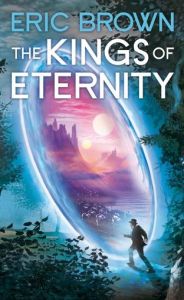
The Kings of Eternity, Eric Brown

I’ve known Eric for nearly two decades, and liked his fiction for a couple of years longer than that. He sends me copies of his novels now when they’re published. Some day I hope to be able to return the favour. The Kings of Eternity is, by all accounts (including Eric’s), the best novel he’s written to date. So I really need to read it before the end of the year as it may well appear on a few shortlists in 2012.


2 Comments

Women in sf reading challenge #4: Winterlong, Elizabeth Hand

You’d have thought that with two four-day weekends in April, I’d have had plenty of time to read that month’s book from my reading challenge. Unfortunately not. However, during April I did manage to pick up copies of China Mountain Zhang, Maureen F McHugh; The Year of Our War, Steph Swainston; and Zoo City, Lauren Beukes (which I’m going to read instead of the planned Moxyland) – so I’m all set for the next three months at least.

Which is just as well, as April’s book was the last from my list I could just pick off my shelves: Winterlong by Elizabeth Hand. I’ve no idea how long I’ve had the book – but the “£2.00” scribbled in pencil inside the cover suggests I bought it at a convention, probably during the early 1990s. This can’t have been all that long after it was published – Winterlong, Hand’s debut novel, first appeared as a Spectra Special Edition paperback in late 1990, and as a paperback original in the UK a year later. It’s the latter edition I own. I also own the sequel, Æstival Tide, but not the third book of the trilogy, Icarus Descending – which apparently was never actually published in the UK (don’t you hate that? when UK publishers only publish the first two books of a US trilogy, but not the third?).

This year’s reading challenge has given me a welcome excuse to finally read Winterlong (and perhaps its sequel), something I’d been meaning to do for a while. It has always been my impression that I would enjoy Hand’s writing. I’ve read some of her short stories, and around this time last year I read her novella Illyria, and I’ve always thought her writing very good. She writes with a very literary style, closer perhaps to fantasy than science fiction, low on rigour, but with lovely prose – much like a writer I admire very much, Paul Park. So I had expected to like Winterlong

Sadly, I didn’t. There is lush prose – and I like lush prose; I’m a fan of Lawrence Durrell’s writing, after all. But often it seems to tip into florid prose, and, unfortunately, in Winterlong it’s florid prose which dominates. As I read the novel, I couldn’t help thinking that if Hand had applied the writer’s phrase “kill your darlings”, the book would have been half its 440 pages in length. I mean, a sentence like “The black domino of a Persian malefeants with her whip pied the pastel train of a score of moth-winged children trying very hard to perform the steps of a salacious maxixe” (p 171) shouldn’t have made it through the editing process. Which is not say that Winterlong is a bad book or doesn’t have anything interesting to say. It simply reads like a first novel written by someone whose reach exceeded their grasp, who had yet to gain control over their style, whose focus lay too much on the individual word-choices and not enough on the cumulative effect of those choices.

Wendy Wanders is a subject at the Human Engineering Laboratory, a “neurologically augmented empath approved for emotive engram therapy”. She can “tap” patients’ memories and emotional states, ostensibly for therapeutic reasons. But she was autistic as a child, and though her neurological augmentations have “fixed” her – as well as making her empathic – she is still not entirely cured. The HEL is located just outside the City of Trees, which was destroyed hundreds of years in the past, left for nature to run riot over, and is now inhabited by remnant peoples unrelated to the mainstream Ascendant population of the country. From hints and clues in the text, I’m guessing the City is Washington DC.

Things go horribly wrong at the HEL and, during an attack by those for whom the HEL scientists were working, Wendy escapes with the help of a lab assistant, Justice Saint-Alaban, an inhabitant of the City. Once in the City, she disguises herself as a man and joins a troupe of actors. This troupe mostly performs Shakespeare’s plays and Wendy, as Aidan Arent, takes the female roles – yes, that’s a woman pretending to be a man who plays women on stage who, in many of Shakespeare’s plays, disguise themselves as men… (Hand studied drama and anthropology at university.)

Meanwhile, Raphael Miramar, a male prostitute, and one of the most beautiful and desired in the City, has chosen to go and live with his lover, leader of the Natural Historians, hoping to trade commitment for an education. The City is run by the Curators, descendants of various museum staff – the Natural Historians, the Botanists, the Zoologists, etc. There are also Houses of prostitutes, both male and female, who cater to the Curators, and seem to do little else except arrange sumptuous balls.

Raphael’s lover, however, is not so committed to the relationship,  now that Raphael no longer lives the pampered lifestyle of his House, and so is losing his looks. Raphael makes friends with a junior Natural Historian, but inadvertently kills her, and is forced to flee. He falls in with a group of lazars, children infected with diseases spread by viral rains dropped during “air raids” by Ascendant airships, is identified as their god, the Gaping One, and taken to meet their leader, the man who attacked the HEL – who has been resurrected after being tortured to death by the aardmen, genetically-engineered dog-humans, and is now quite mad.

Winterlong is structured as a series of nine parts, each written in the first-person from either Wendy’s or Raphael’s point of view. The opening part, ‘The Boy in the Tree’, was also published separately as a novella in Full Spectrum 2 a year before Winterlong‘s publication. Neither Wendy nor Raphael, it has to be admitted, are especially sympathetic characters. The novel hints at a greater world, with its references to “Ascensions” and a war with the “Balkhash Commonwealth”. However, the story is focused tightly on events within the City of Trees, which has something of the flavour of Delany’s Bellona, something of New Orleans, and something of a Shakespearean Venice or Forest of Arden.

In fact, it’s all very fin de siècle and decadent, perhaps even Gothic; which perhaps explains the prose style. It’s also strangely reluctant to engage too much with the world it describes. Everywhere is dirty, there is sex and death, but it all feels a little sanitised and innocent, perhaps because the prose focuses so much on the appearance and odours of things. It gives the environs of many of the scenes the feel of a set-dressing, rather than a vital, living place within which a story is occurring. When, for instance, Raphael rapes the assistant Curator he has just inadvertently murdered, it’s over and done with in a bland sentence: “Then I ravished her.”

Yet the City is unnatural. It’s not simply the life-style of those in the Houses. Much of the flora and fauna has also been altered – and are known by the term “geneslaves”. There are the aforementioned aardmen, but also willow trees which kill, and an intelligent talking chimpanzee (one of the Players in the troupe Wendy joins). It’s the sort of world which appeared quite often in science fiction during the late 1980s and early 1990s – I’m thinking of Geoff Ryman’s The Child Garden (1989), or Michael Swanwick’s Stations of the Tide (1991) – although Hand’s version is more dystopian and post-apocalyptic than most. The City is an interesting place, but the prose often works against the story, confusing what shouldn’t be difficult to parse.

In her review of the full trilogy in SF Eye #13 (reprinted in Deconstructing the Starships), Gwyneth Jones writes that Hand is “a writer who embraces gender difference – whether or not she notices where this embrace is leading her”. Certainly it’s true that there’s much that’s traditional in the gender roles played by the characters in Winterlong. Wendy becomes Aidan and discovers empowerment; Raphael stops being a sex toy and learns evil. The Shakespearean confusions and mistaken identities only work if you accept traditional gender roles. Given the world of Winterlong, it would not be unreasonable to expect some fluidity in this area – Wendy’s masquerade at least hints at the intent – but Hand fails to question the underlying assumptions with which she writes. And the opportunity is lost.

This review almost sounds as if I’m characterising Winterlong as a complete failure. Which is not the case. I thought it interesting, but overwritten. I have the sequel, but Winterlong has not really inspired me to read it, as Rosemary Kirstein’s The Steerswoman made me keen to seek out its sequels. But perhaps one day I will get round to reading Æstival Tide and, perhaps also, if I spot a paperback copy of Icarus Descending in a dealers’ room at a convention I might well buy it.


41 Comments

“I am stupid and proud of it.”

Isn’t that what they’re saying, all those people who insist that science fiction doesn’t have to be literature? They don’t understand anything more complex than the graceless idiot-prose of, say, Asimov, so they insist that’s what sf should be. Because it’s not their fault, of course; it’s everybody else that’s wrong. Other people may look down on science fiction, but they don’t care – in fact, they’re glad people look down on the genre. They take it as validation. Those other people, they claim, only sneer at sf because they don’t know anything, they think they’re better than us sf fans.

Bollocks. You’re the one practising snobbery – reverse snobbery. And it makes you look very, very foolish.

A lot of science fiction is rubbish. But that’s okay, it’s a wide genre, with room for many things in it. What you should not do is claim that the rubbish is the good stuff. You should not redefine sf so it privileges the bad over the good. And you certainly shouldn’t use that upside-down measure of quality to sneer at other genres of fiction.

That may be your science fiction, but it’s not mine.

My science fiction is the literature of ideas. It’s the one that has the widest remit of any mode of literature, the one that’s capable of so much more than any other… I don’t want it to be kept in the gutter by talentless hacks and moronic fans. I don’t want its highest ambition to be that it is “entertaining”. All fiction should have ambition; it should strive to better itself. It should struggle to document the human condition as closely as possible. It should provoke thought, discussion, commentary. It should redefine. Science fiction is no exception. I want it to change the way I think about the world, about myself, about the future. My science fiction includes people like the late Joanna Russ, who used the genre to fight for equality. It includes writers like JG Ballard who made us question the world around us. It includes writers who use science fiction as commentary, as a tool to examine life and the world.

That is science fiction.

And all those people who prefer the term “speculative fiction” – in effect, you’re saying it’s okay to limit science fiction to ham-fisted space adventure stories. That’s just as wrong. Renaming the genre is not the way to gain respectability. What you have to do is acknowledge the genre’s variety – the good and the bad – and then you have to up your game. What you’re practising is just another form of snobbery. Between the two of you, you’re doing the genre no favours, and yourselves even less.

So, please, if you’re happy in this “gutter” you’ve created, don’t call it “science fiction”. Be honest. Call it “space pulp fiction” or something, give it a name that sounds stupid so we know who you are. And if you call it “speculative fiction”, then you’re just as guilty of keeping sf in that so-called gutter. Acknowledge that real science fiction has breadth and variety. The fact that you’re only capable of paddling in the shallows doesn’t invalidate the rest of the genre pool.

Defend your own tastes, by all means; but never think to tell me or anyone else what is and what is not science fiction.


2 Comments

Read this book!

The first programme item I was on at Illustrious, the 2010 Eastercon last weekend, was “Read This Book”. It was, however, cancelled, perhaps because it was scheduled against the BSFA Awards. I can’t say I’m too upset about the cancellation – and the Award Ceremony is one of the few Eastercon programme items I make a point of attending. Also worth noting is that even by Saturday afternoon, right up to the point where I learnt the panel was cancelled, I had no real idea which novel I was going to urge the audience to read…

But right now, on this day of this year, with the benefit of hindsight and more thought than I was capable of during Illustrious, I am going to imagine that the novel I would have chosen for the panel, that the novel I would have chosen until another one comes along and completely blows me away, is actually, er, two novels. And, given what I have written about science fiction on this blog over the past couple of years, they are choices that may surprise people. (Having said that, people who know me also know how much I love these two novels.)

The first one is…

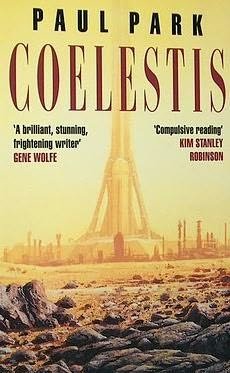
My absolute favourite science fiction novel is Coelestis by Paul Park. I demand rigour in my science fiction. If you can change the background, and the story remains unchanged, then it isn’t sf. Yet Coelestis is completely unconvincing as sf. It is defiantly not-sf science fiction. And that is one reason why it is so brilliant. It is also beautifully written, and extremely unsettling.

Simon Mayaram, a junior consular official, has recently arrived on a tide-locked colony world distant from Earth. At the orders of his boss, he reluctantly takes the consul’s place at a party thrown by the local colonial movers and shakers at Goldstone Lodge. Also present is Junius Styreme and his beautiful daughter, Katharine. The Styremes are aliens, members of one of the two races native to the planet. Prior to the arrival of humanity, they were enslaved by the planet’s other race, the Demons. The humans wiped out the Demons and freed the aliens. Now the aliens show their gratitude – the rich ones, at least – by using drugs and surgery to become human. But not everyone feels the same way. A group of rebels attacks Goldstone Lodge, killing all those present. Except Simon and Katharine. They escape but are quickly captured. The rebels take them across to the planet’s dark side, where they discover a surviving Demon holds the rebels in thrall. The Demon, and the loss of her drugs, slowly returns Katharine to her alien nature. As Simon, who loves her, watches in horror…

John Clute has described Coelestis as a “Third World” novel, but to me it is very definitely post-colonial sf. It is also anti-colonial. The world of the novel doesn’t map exactly onto India – or any other ex-Empire colony – but the parallels are clear. The life-style enjoyed by the humans is very like that of the British in the Raj. The desire of the aliens to mimic their masters bears some similarities with the way India has subsumed elements of British culture – such as the language (which remains the nearest the country has to an official language). Park makes these likenesses even starker by refusing to invent a society for his world. It is the twentieth century in all but name – although there are intriguing hints of a future Earth beyond the characters’ understanding. But for the aliens, the first section of Coelestis could be set in Mayapore.

But once Simon and Katharine find themselves on the dark side, the nature of the story changes. Whereas Park had initially used the colonials-in-situ, and their struggle to remain inappropriate, as commentary, he uses Katharine and Simon in captivity to first deconstruct the identity of the aliens, and then to deconstruct Simon’s identity. It makes for an discomfiting read. Coelestis uses its limited toolbox of science-fictional conceits to address only those areas Park wants to study. The rest is immaterial, and so no attempt at rigorous or plausible world-building is made. It’s not there because it doesn’t matter, because not having it there points up all the more the difference between the aliens and the humans, and humanity’s actions.

Coelestis is not a comfortable read. But it is one of those science fiction novels which can change the way you look at the world. And there are remarkably few of them.

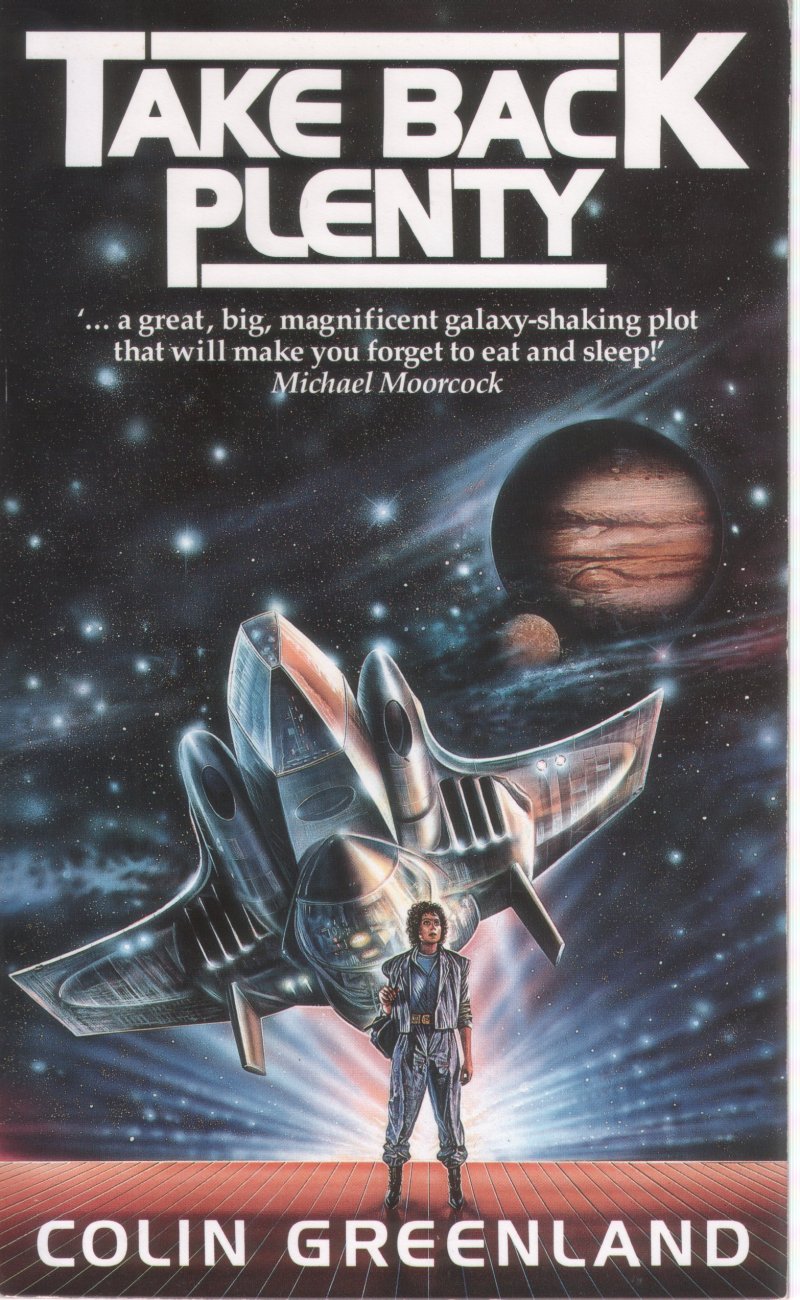
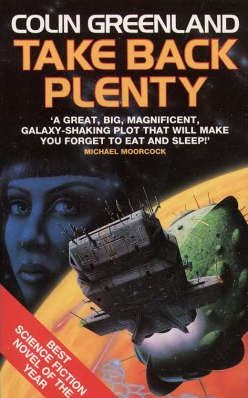
My second choice could only be science fiction. Unlike Coelestis, it has rigour. But I also demand authenticity in my sf. Take Back Plenty by Colin Greenland is proudly inauthentic, it glories in its lack of authenticity. Its story takes place in a Solar system that only ever existed in wildly unscientific pulp science fiction. It features canals on Mars, a Venus of impenetrable jungles, and a cast of colourful aliens. It is a clever postmodern space opera and a rollicking good read.


Tabitha Jute is captain of the space barge Alice Liddell. While on Mars, Tabitha inadvertently causes a near-riot, and is subsequently fined by the authorities. But she doesn’t have the money to pay the fine. Fortunately, she meets up with Marco Metz, leader of the cabaret act Contraband, and he contracts her to take him and his band to Titan. First, they stop off at Plenty, an alien artefact orbiting Earth. It had been built by the alien Frasque, but they’d been booted out of the Solar System by the Capellans – highly advanced aliens who’d bootstrapped humanity into space, but now kept everyone sealed within the orbit of Pluto.

Of course, Contraband isn’t really a cabaret act and Tabitha is forced to flee Plenty with the members of the band. They crash-land on Venus, are rescued by pirates, and then delivered to the Capellans.

To say anymore would give away the novel’s climax.

The story of Take Back Plenty is told by a mysterious, and not entirely reliable, narrator – complete with authorial interventions. Sections of the book are also interspersed with conversations between Tabitha and Alice, the space barge’s AI persona. These conversations round out Tabitha’s background and character. They also help explain the Solar system of the story. Tabitha Jute is one of the great female characters of science fiction. She is not feisty, she is not kick-ass. She is not strong because she was raped as a young woman; she is no one’s Perfect Girlfriend. In a book which revels in its inauthenticity, she is stunningly real.

When Take Back Plenty was published in 1990, I remember there being a lot of talk about it. It went onto win both the BSFA and Arthur C Clarke Awards. I’ve argued in the past that it kicked off the British New Space Opera movement. But the more I think about it, the more I think that’s not the case. Take Back Plenty re-appropriated the tropes of pulp space opera, but it used them in a knowing and postmodern way. It didn’t add hard science or “grit” to space opera. It added realness, yes, and dirt under science fiction’s fingernails; but its tropes were still the candy-coloured conceits of early space opera. By doing this, the novel privileged story, not setting –  yet another difference to New Space Opera. So much so, in fact, that Take Back Plenty even aped those old serials by giving poor Tabitha no actual control over the plot.

On its publication, Take Back Plenty promised a new and exciting trend in British science fiction. Sadly, that never materialised. Greenland’s novel was a one-off. He followed it with a pair of sequels, Seasons of Plenty and Mother of Plenty; but the vision had soured and neither matched the joy of Take Back Plenty. Greenland wrote one other sf novel, Harm’s Way, a steampunk space opera, but has written no novel-length science fiction since. Which is a shame.

So there you have it. Two science fiction novels I love and admire. (Science fiction novels I love but don’t admire would be a much longer list.) Sadly, both are currently out of print. Obviously I think they should be on the SF Masterworks list – assuming rights are available and all that. I urge everyone to seek out second-hand copies of these two books and read them. Or perhaps an enterprising ebook publisher might like to consider editions on Kindle (providing the authors are willing, of course).

Coelestis and Take Back Plenty are a pair of novels I am happy to champion. And I can even do that without feeling embarrassed they’re science fiction.


6 Comments

Helium Boobs, Coconut Cows and Flying Eyes

So that was the 2011 Eastercon, Illustrious. It might very well have been a train-wreck – hotel in the middle of nowhere, military sf theme, disorganised programme… – but it actually turned out to be a blast. In a good way, of course.

The train journey there took me less time than I’d expected, so I arrived feeling quite cheered. Registration was a bit of a faff, but never mind. I dumped my bag in my room – which was very nice – and then went looking for friendly faces in the bar. Of which there were many.

And that is where I spent most of the weekend.

As is usually the case, I spent most of the con talking to various people in the bar, both with and without beers. I always tell myself I should go to the programme items – and I always afterwards spot ones I would have liked to have gone to – but… This year, I was on three. The first was cancelled, perhaps because it was scheduled against the BSFA Awards Ceremony. The other two were part of the con’s Women in SF programme stream.

“Women in SF (versus Fantasy)” took place at 10:30 am on the Sunday. I’d been up until 4:30 am the previous night, so I was probably not at my sharpest. I seem to remember it went quite well, however. “Great Women of SF” was late on the Monday afternoon, just before the con ended. It too was good. Kev McVeigh had produced a hand-out listing 150 female writers of sf – based in part on my two meme lists here and here – and the discussion covered many of the authors listed (and a few that had been missed off). Several people asked for the correct spelling of authors and titles, so I’m happy the books we mentioned will be read.

The only other part of a con I visit often is the dealers’ room. This year, I didn’t actually buy that many books. I’ve no idea why. I saw many I wanted. But the ones I bought were…

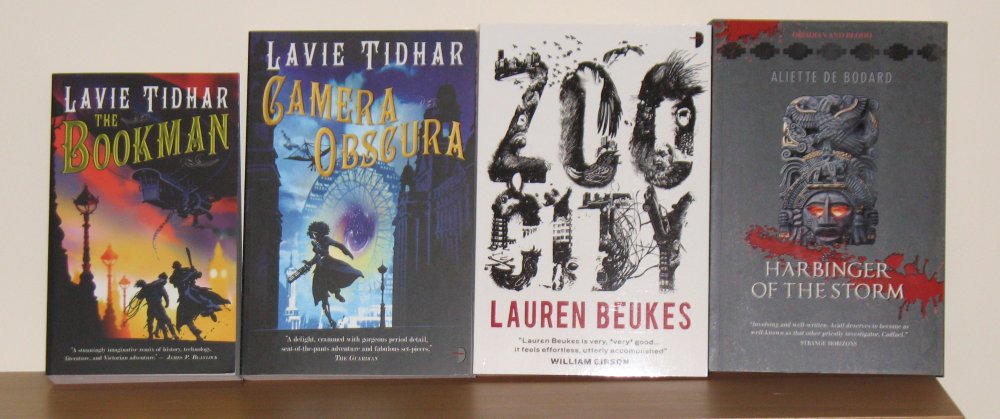
Among the many people I met over the weekend were Lavie Tidhar, Lauren Beukes and Aliette de Bodard. So of course I bought their books. And they signed them for me.

The Compton is for the collection, and the two Sellings are British SF Masterworks reads.

The Steph Swainston is for this year’s reading challenge. Toiya Kristen Finley is a writer whose fiction I’ve liked a great deal since reading her story in Text: Ur a couple of years ago. The book of reviews by Gary Wolfe will go with other two books I own.

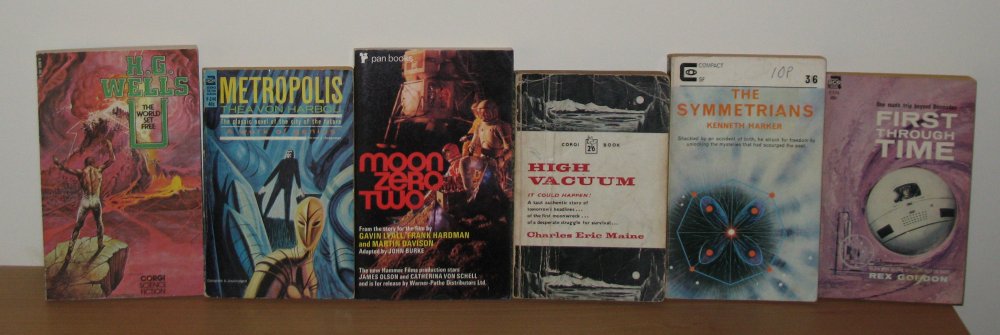
Some more for the British SF Masterworks reading list: Rex Gordon, Kenneth Harker and Charles Eric Maine. I bought Metropolis because I’d not known it had been novelised. The Wells, The World Set Free, amused me as the back-cover blurb praises Wells’ accuracy in predicting the future… including the nuclear war in 1956. Moon Zero Two… well, I like reading novels about pre-Apollo Moon landings.

I can’t remember every conversation I had over the weekend – but most were about writing and science fiction. I recall chatting to Gav Smith and Pete Hamilton – and Pete asked me if I’d reviewed A House in Space by Henry SF Cooper Jr on my Space Books blog. I was somewhat surprised to learn he knew of the blog.

The title of this post comes out of several conversations with the usual suspects – Mike Cobley, Paul Cockburn, Gary Gibson, Andrew J Wilson, Neil Williamson, and newcomer Tracy Berg – from the Glasgow and Edinburgh writers’ groups.

There was apparently a painting in the art show of a woman with unfeasibly large breasts. Tracy pointed out that the weight would prove painful. But not, we suggested, if the implants contained helium. Then the conversation turned silly.

While queuing up for food on the Saturday night, I asked one of the servers if the rogan josh was dairy-free. (It was; it was also not very nice.) Neil asked me if I could drink coconut milk. I pointed out it did not come from coconut cows… which led to a series of extrapolations in which cows lived in palm trees and were eaten by huge coconut cow crabs.

The Flying Eyes refers to a book of the title which had a perfect piece of cover art for Good Show Sir. Foolishly, I didn’t buy it straight away, and someone had beat me to it when I went back to do so.

Others I spoke to included: Paul Cornell (the ageist), Tom Hunter, Ian Mcdonald, Ian R Macleod, Kev McVeigh, Cara Murphy, Roy Gray, Philip Palmer, and my agent John Jarrold. Plus those on the two panels I was on. And probably many more I’ve forgotten to mention. It’s the people who make a con, and they made Illustrious a very good one indeed.

It is in the paradoxical nature of the Eastercon that it physically drains you but creatively recharges you. And so for this one. Talking about stories makes you want to rush away and write them straightaway. It is my theory that the constant barrage of ideas, conversation and beer so stuns you that your brain no longer realises your reach exceeds your grasp. But at least you’re going to have a damn good try.

Of course, I spent the entire weekend handing out Rocket Science flyers to all and sundry. The response was amazingly encouraging. I expect to be bombarded with excellent fiction and non-fiction come August.

I’m very glad I didn’t write-off Illustrious because if its location, theme, or confusions over the programme. I had an excellent weekend, and can’t wait for the next convention.