Yesterday, I appeared on Keith Brooke’s blog, discussing Whippleshield Books, Adrift on the Sea of Rains, and Rocket Science. You can read it here.


Yesterday, I appeared on Keith Brooke’s blog, discussing Whippleshield Books, Adrift on the Sea of Rains, and Rocket Science. You can read it here.
You can almost set your watch by the regularity with which claims that “science fiction is dead” appear. Except, of course, that wouldn’t be a very science-fictional metaphor in these days of atomic clocks and NTP. The latest iteration of this moan appears here. Certainly it’s true that fantasy outsells category science fiction, but to also claim that “half … of what is being sold as sci-fi is actually fantasy with some sci-fi elements” is risible.
Science fiction still lives but, more than that, it has also colonised the mainstream. In the cinema, sf is the genre of choice for tentpole releases. On television, it may have a less successful track-record, but many sf series have proven popular with non-genre audiences: Dr Who and Life on Mars, for example. Literary writers have in the last decade quite happily appropriated ideas from the sf toolbox for their novels – just look at this year’s Clarke Award winner, The Testament of Jessie Lamb by Jane Rogers. (Though Roger’s usual publisher refused to take the book because it was sf; I bet they feel like complete plonkers now.) But even this is hardly new: John Fowles did it back in 1985 with A Maggot; Lawrence Durrell did it even earlier with Tunc (1968) and Nunquam (1970). There are plentiful other examples.
Science fiction is changing, that much is true. But it has been doing that since Gernsback published that first issue of Amazing Stories back in 1926. For one thing, he called it “scientifiction”, which happily never caught on. The genre has undergone numerous irruptions and make-overs during the course of its ninety-year history, and the fact it is now so widespread and so varied only demonstrates its rude health.
True, we’re not living in a science-fiction world. If we were, we’d have food-pills and jet-packs, there’d be a colony on the Moon, and most people would be wearing tinfoil jumpsuits. Or something. Instead, we have a dozen tin-cans strung together in Low Earth Orbit, only robots have gone further than cislunar space, and pills invented to replace food tend to get repurposed as recreational drugs and then criminalised… On the other hand, we do have smartphones, the internet, digital cameras, cars that cost as much as the turnover of a medium-sized company, pre-cooked bacon available in supermarkets, a climate we are slowly destroying so that multinationals can continue to make profits greater than most nations’ GDPs, and television shows more fatuous than anything George Orwell at his most cynical could ever have imagined.
The problem is that the dreams of science fiction from past decades have proven either unachievable or unsustainable. Is it any wonder then that the genre has turned increasingly escapist? This doesn’t make it fantasy, by any stretch of the, er, imagination; it does mean, however, that sf is no longer predicated on dreams of a better tomorrow created by science and engineering. Genre writers now – and those literary writers who dabble in genre – are putting the tools of science fiction to other uses.
Samuel Delany once said that one of the beauties of sf was that it could literalise metaphors. The example he used was “her world exploded”. You won’t find much in the way of metaphors in sf of the 1950s and earlier. Those so-called classic stories are pretty much straight up and straight down. WYSIWYG. But that doesn’t work anymore. What was designed to be plausible has become implausible. Such optimism in scientific solutions is now unconvincing. We know that science is only a tool, and not always used with the best intentions. “Now, I am become Death, the destroyer of worlds”, so to speak. We also know that even the laws of nature are apparently open to interpretation when there’s enough money involved.
I admit I am fascinated by the optimism inherent in science and engineering of past decades. That’s why I put up my irregular The future we used to have posts. I’ve explored that optimism in some of my own fiction – Adrift on the Sea of Rains is perhaps the best example so far. I am fascinated by the achievements made using raw engineering in the twentieth century: putting twelve men on the Moon, sending two men to the deepest part of the ocean in a steel ball, the numerous attempts to go faster and faster in wheeled vehicles or boats…
The one thing science fiction initially refused to acknowledge, and which we’re only belatedly beginning to accept, is that there is no escape. The universe is too vast and too inimical. We can only populate it using our imaginations. The fact that sf now uses more and more imaginative and fantastical inventions to do so doesn’t invalidate the genre. Sf may not reflect the real world as often as it should, but by ignoring the limitations placed on us in the real world the genre is responding to those limitations. Sf hasn’t forgotten the science, it’s just finding different ways to incorporate it into its stories.
Well, the website for Whippleshield Books has now gone live and can be found here. I’ll be tweaking the design for a while yet, but at least now the books are available to buy. PayPal only at the moment, I’m afraid, but hopefully that may change.

You’ll notice there’s a section of the website selling secondhand books. I only have a couple of titles up at the moment, but more will appear during the next few weeks. I have several boxes’ worth of first edition genre novels I no longer want, so I’ll be selling them through the website. Some of them are even signed.
And then there’s the “submission guidelines”… Yes, Whippleshield Books is open to submissions. But of a very specific type of science fiction. Of a specific length. And I only plan to publish a very small handful of books a year. I wrote in the introduction to Rocket Science:
But if there’s one truism about editing a themed anthology, it’s this: the story you have in your head which perfectly illustrates your theme… you will never be sent that story.
… but I live in hope that Whippleshield Books will be sent exactly the sort of sf novellas I have in my head – and I don’t just mean those written by myself. And if some of them – say it quietly – are not even really science fiction as such, I won’t be especially bothered. I guess we’ll just have to see what gets submitted…
Science fiction is an American mode of fiction. It was born in the white-hot enthusiasm for technology which prevailed in the electronics and mechanics magazines of the US during the 1920s. A prosperous future was imprinted on every page as new devices, new inventions, new scientific breakthroughs improved the standard of living of the USA’s technophilic middle class. It was the beginning of the age of the mod con, better living through engineering. The centre could not only hold, it was invulnerable. Even from internal threats. External enemies were defeated by technological mastery (and overwhelming force).
The American Dream was the only desirable and sustainable narrative of the future.
Even then, sf’s visions were problematical. The hopes and aspirations of these Americans, the mores and sensibilities of the US middle class, provided the culture in which sf blossomed and grew. Achievements were embodied in those who were first, not in those behind the scenes who made it possible. Neil Armstrong conquered the Moon, not NASA. Indeed, NASA was seen as a brake on the exploitation of space – private industry was the best vehicle for progress. And it was powered by the most powerful engine of all: the profit motive. Profit led to riches which provided the freedom to self-actualise – and so profit came to trump all other considerations. Riches became an end, not just a means to an end. Since governments curbed such headlong growth in the name of society and not individuals, they were characterised as obstacles. Humanity – well, man – could not reach his true destiny unless his growth were unfettered.
And yet…
Progress should lead to a world which is fairer and more just. The futures we narrate should reflect this. If we look back at the history of our world, we see a clear, if somewhat irregular, progression toward a more moral and socially-improved present day. So why should we base our visions of the future on the sensibilities of the past? Why should we embody in our science fictions the aspirations of a generation ninety years ago? Their present is not our present. Some of their dreams have already been achieved, some have already been discarded as unattainable, some of them have been determined to be undesirable.
These are not thought-experiments, stories in which the world itself provides some object lesson to those unable to look up from the page. These are action-adventure stories set on alien worlds, in galactic empires, in corporate-dominated futures, in urban wastelands and plutocratic societies. And in every one, many of those freedoms and rights painfully won over the past 250,000 years have been reversed to give us… Sexism. Racism. Slavery. Endemic violence. Brutish behaviour. Rape.
Of course, science fiction is the fiction of the privileged. It’s the culture of the privileged displaying their mandate in the most naked form imaginable. Only in this way can civilisation be wrested from savagery – or so their carefully-doctored history books tell them. They have the right to kill and maim and rape and impoverish those who do not accept their dominion because they will better off for it… whether they want to be or not.
This dominion extends into the realms of the imagination, into the worlds of the yet-to-be and the never-to-be. New science leads to new forms of life and, almost universally in sf, such new people are treated as non-people, as slaves, as property. Though our science fictions demand we present them as human as ourselves, their origins tell them against them. New science leads to new scientific bigotry.
Even worse, it’s not just these new people we have invented whom sf mistreats. Women are often no better off in sciencce fictions than they were during the genre’s golden age. Other cultures are blithely ignored, or pillaged in a quest for the “exotic”. Invented worlds are always monocultural – and that culture is the culture in which sf was born and grew to squalling infanthood. But then sf is designed to explore the desires and concerns of this culture. The only Others who appear are either aliens or enemies. Foreigners need not apply.
Too many of us refuse to look too closely. We are blinded by the wonder, our gaze is captured by the shiny toys. We privilege the “idea” and forget it is only one aspect of the stories we tell. We allow our assumptions and preconceptions and prejudices to validate our fictional futures. We forget to challenge. We want our future to be comfortable for us to visit, even if it is a dystopia. So we populate it with things we will unthinkingly accept, and never question its likelihood, its rigour, its plausibility, or the effects it might have on others.
Were such Randian technowank fantasies what Hugo Gernsback had in mind when he first published Amazing Stories?
I keep on finding myself circling around a pair of genre movements from recent years: Mundane SF and Optimistic SF. I was a fan of neither when they originally appeared. They seemed unnecessary restrictions – in fact, Mundane SF felt like it was throwing out of sf all the best toys. But when genre becomes defined by its toys, perhaps it is time to re-evaluate their usefulness.
And what should we replace those toys with?
The real world of the twenty-first century, of course.
I want a time machine so I can go back to the 1960s and then go forward to the future they thought they were going to have. You know, the one with moon bases, jumpsuits, jetpacks, foodpills; where capitalism actually worked and everyone was happy and prosperous; and the only thing spoiling the clear blue skies were the sonic booms of supersonic bombers and airliners crossing the Atlantic in two hours…
Until someone actually invents that time machine, feast your eyes on these:
Aeroplanes

Convair XB-46

Artwork of the Convair XB-42

Convair XB-43 (a jet-powered version of the XB-42)
Buildings

Kamzík TV Tower, Bratislava

Kamzík TV Tower, Bratislava

Slovak Broadcast Building, Bratislava

The Memorial and Museum of the Slovak National Uprising, Bratislava

The Museum of Contemporary Art, Niterói (Oscar Niemeyer)

Liberty Pantheon, Brasilia (Oscar Niemeyer)
Fashion
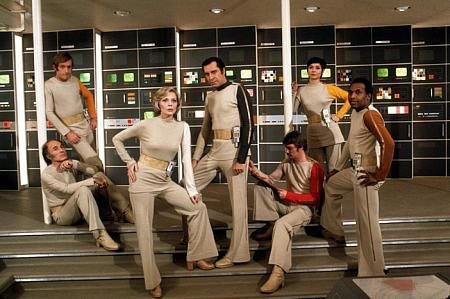
In the future, everyone will wear beige (Space: 1999)

In the future, everyone will wear string vests (UFO)

In the future, everyone will dress like humbugs (Pierre Cardin)
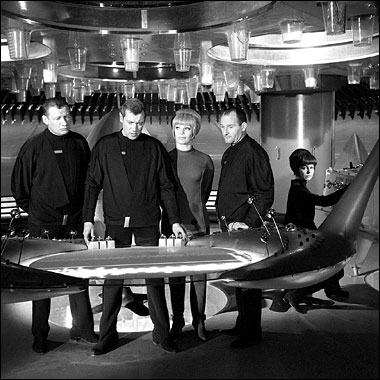
In the future, everyone will wear black– no, wait… (Raumpatrouille Orion)

In the future, everyone will wear high-heeled waders (Pierre Cardin)
It’s been a while since my last book haul post – two months, in fact – which goes some way to explaining the number of books which appear in this one. Someone needs to put more hours in the day so I can actually get around to reading some of them…

This year, of course, is the Durrell Centenary. So I’ll be rereading The Alexandria Quartet at some point, and I thought I’d buy myself the new paperback edition so I could do so. The CD is a collection of poetry readings, interviews and, er, Durrell singing.
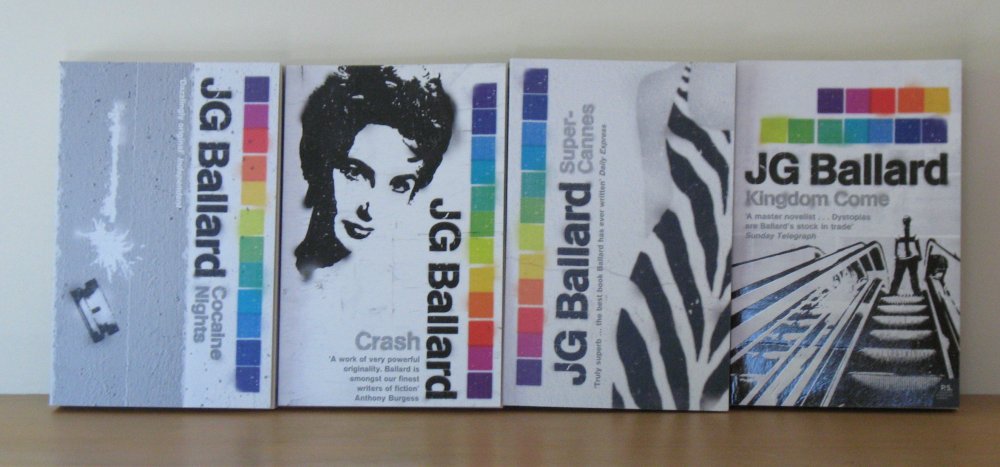
Ballard is not a young man’s writer – not enough shit gets blown up, for a start; and then there’s that cynicism – so while I’ve read many of his stories and books over the years it’s only in the past few I’ve come to really appreciate his fiction. As a result, I’ve been building up a small paperback collection of his books – and they are attractively packaged paperbacks, these 4th Estate ones.
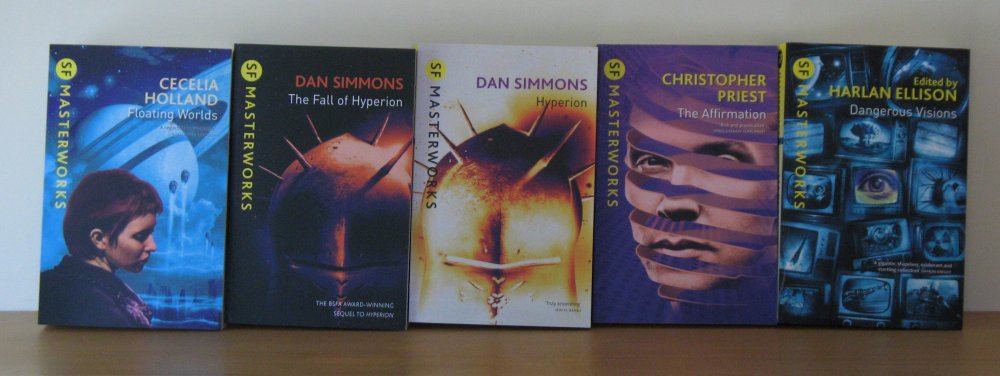
I am not, it has to be said, a particularly big fan of all the titles that have appeared in the SF Masterworks series, and most people don’t spend money on books they know they don’t especially like… but… they make a set. They’re packaged to look the same – or they were until they revamped the entire series. And some of them really are genre classics: Hyperion and The Fall of Hyperion, certainly; and much as I loathe Harlan Ellison and his works, I have to admit Dangerous Visions was an important anthology.

From my trawls through various charity shops some books from the would-like-to-read list. I’ve been working my way through Litt’s alphabetical oeuvre, though none have especially impressed me so far. McCarthy should only be read when you’re feeling unaccountably cheerful and would like to torpedo your good mood. The Satanic Verses is infamous, but I’ve never read it. The Mailer was a swap from readitswapit.co.uk, and I’m not sure why I bought The Apple.
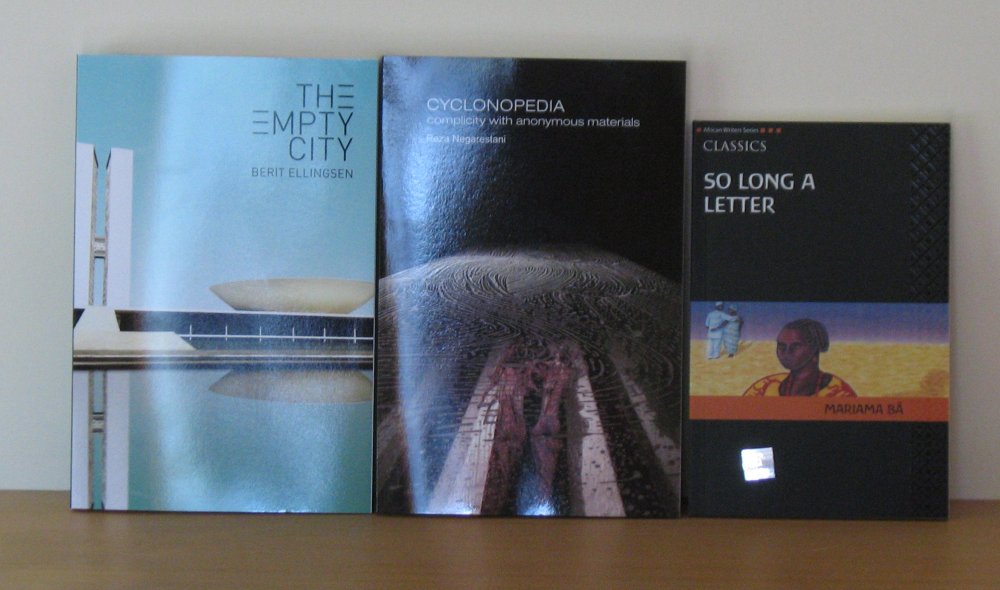
So Long A Letter is May’s book for this year’s reading challenge (see here). Cyclonopedia has been repeatedly recommended by Jonathan McAlmont, and Berit Ellingsen is one of the contributors to Rocket Science (plus, the cover art of The Empty City is the National Congress building in Brasilia – see later).
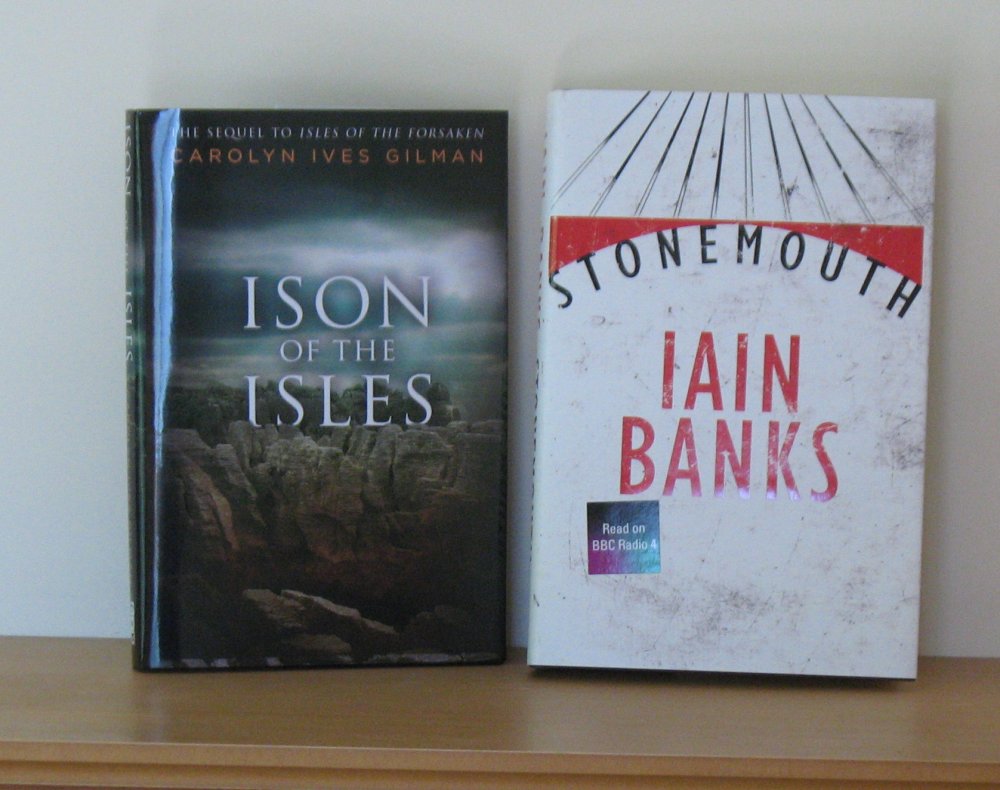
A pair of 2012 hardbacks: I pre-ordered Ison of the Isles as I was so impressed with its preceding volume, Isles of the Forsaken (see here). And Stonemouth is Banks. Enough said.
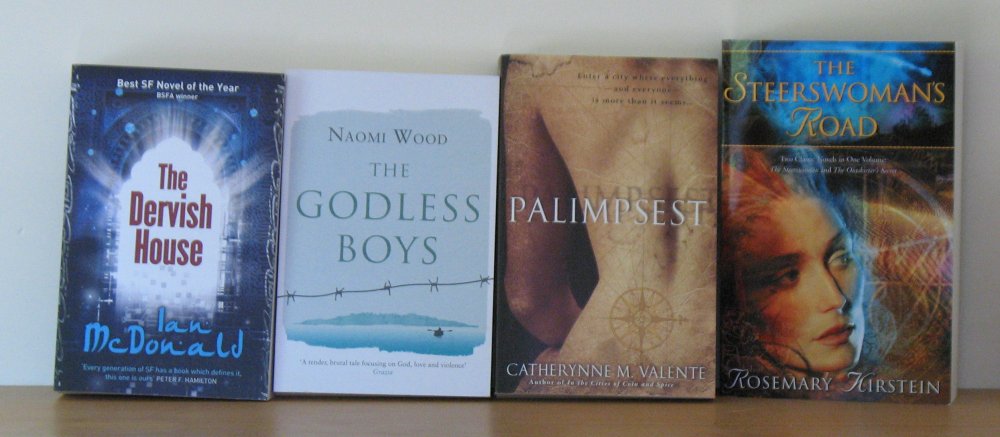
The Steerswoman’s Road is an omnibus of The Steerswoman and The Outskirter’s Secret. I’ve read the first, but not the second. The other three books are ones I want to read. Palimpsest was a charity shop find, The Godless Boys was from Richard Palmer in payment for a copy of Adrift on the Sea of Rains, and The Dervish House was from an unmentionable and unmentionably large online book retailer.

Three genre titles for the collection – both Remaking History and Moon Dogs are signed (and those two authors pretty much describe the two endpoints of the type of sf I like best). The Ice Monkey is really hard to find in hardback but I lucked out.
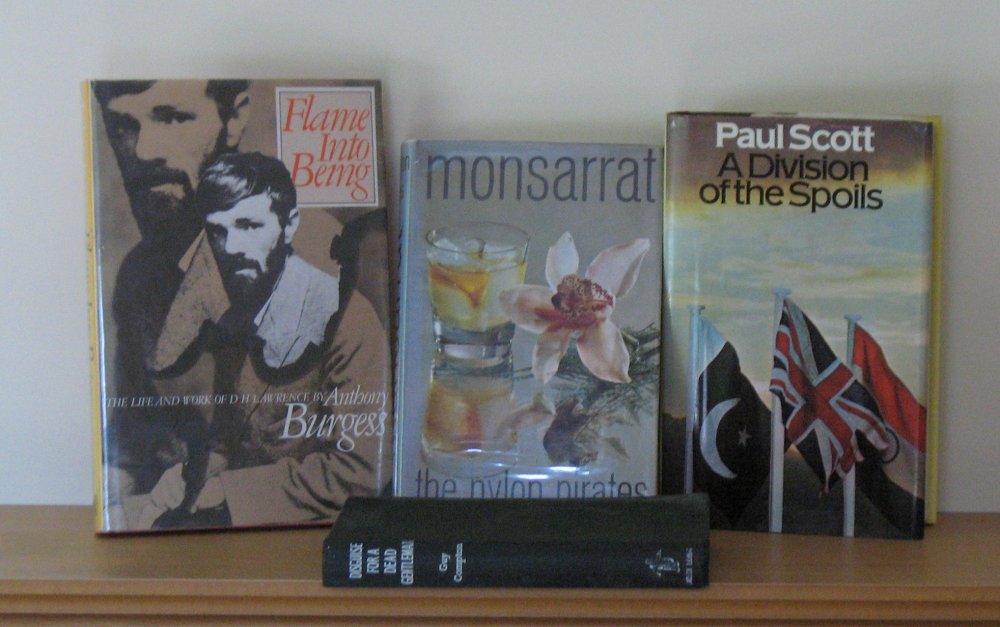
I collect first editions by Anthony Burgess, and I’m interested in the works of DH Lawrence, so Flame into Being neatly covers two of my literary interests. The Nylon Pirates is one of Nicholas Monsarrat’s potboilers – he managed to write potboilers and literary fiction with equal facility if somewhat variable results. A Division of the Spoils is the third book of the Raj Quartet, and Disguise for a Dead Gentleman is DG Compton in his initial guise as a crime writer. I expect good condition first editions of those early “Guy Compton” books are extremely difficult to find, so this tatty one will have to do.
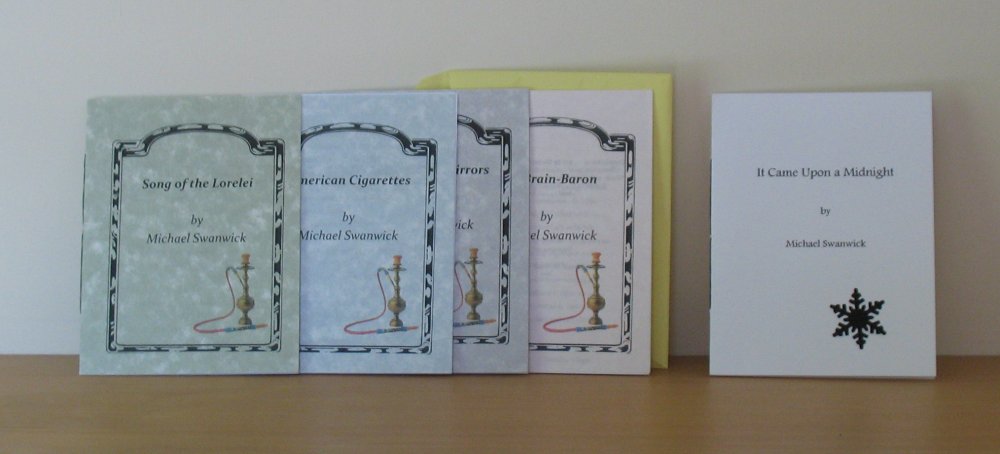
I spotted mention of these chapbooks by Michael Swanwick from Dragonstairs Press somewhere and decided to take a punt on them.

If I ever visit Brazil, it won’t be for the carnival, the beaches, the cocktails, the culture… it’ll be to see the buildings in Brasilia. I love the fact that even unfinished, or badly weathered, they still embody the optimistic future past decades imagined we’d all share. The man chiefly responsible, of course, was Oscar Niemeyer. Eastmodern is more Warsaw Pact architecture, a collection of photographs of modernist buildings in Slovakia, and some of them really are quite skiffy.
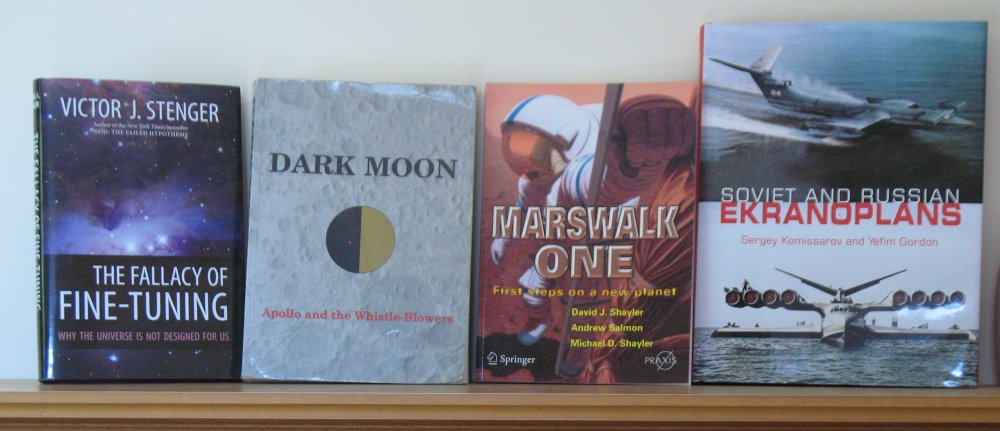
The giant book on ekranoplans was research for a story, honest. Or it will be when I’ve thought of an idea for story which has ekranoplans in it. Well, I managed it for flying boats (see here), so anything’s possible. Besides, if Sebastian Faulks can include one in his 007 novel Devil May Care, why shouldn’t I? Marswalk One is one of several Mars book I now own and which I will use as research while writing the second book of the Apollo Quartet (I got it very cheap on eBay). Dark Moon is one of those fake Moon landing nutjob books, and I thought it might prove entertaining. The Fallacy of Fine-Tuning is also research for Apollo Quartet book 2.
People continue to say nice things about Adrift on the Sea of Rains. Colum Paget has written a long positive review of it on his blog here. Gary Dalkin was nice about it in his review here. And Richard Palmer has also written positively on it here. And have I previously mentioned the five star review on Amazon.co.uk here and the review on LibraryThing by Robert Day here?
So, the pressure is well and truly mounting for the second book of the quartet…
I’ve been thinking this week about how I set about writing fiction, and it struck me that I do most of it in my head long before I sit down and start typing. Once I’ve decided what I want to write about, I start thinking about plots and worlds and characters and scenes and themes… It’s only when I have enough of those clear in my head that I start to put the sentences together using a word processor…
And once I begin the actual physical process of writing, then I start the research. The two feed into each other. Things I find in my research prompt changes in the story; the way the story develops opens up areas I need to research. Even then, everything is mutable: that first draft is mostly a brain dump larded with research. After that comes the actual shaping of the text. And revision. Lots of revision.
A case in point is the next book of the Apollo Quartet. Even before I started Adrift on the Sea of Rains I knew what the second book, Wave Fronts, would be about. It would have two narratives – call them A and B. A would be set in the present of the story, but B would be set some 100 years later. The combination of the two would explain the resolution (with supporting arguments in a glossary).
But while fleshing out the synopsis a week or so ago, a detail I added to the background of narrative A’s protagonist struck me as something worth expanding. In fact, the more I thought about it, the more I realised it provided a better dramatic counterpoint to narrative A than narrative B did. So I decided I would now tell the story using narrative A and narrative C. Narrative B would be incorporated into the glossary.
I was happy with this. Then I saw Lavie Tidhar’s review of Adrift on the Sea of Rains here. And it gave me an idea, a way to add more drama to narrative C. I already had a thematic link between the two narratives, but this new idea not only reinforced that, it also strengthened other areas of the story. It made the choice of protagonist much more plausible – in fact, it made him the only choice of person as the protagonist.
So it’s a good job all this had happened in my head. If I’d had to rewrite a 20,000-word document, I don’t think I’d have been so quick to completely re-invent the story. But the end result is, I believe, a now much stronger novella. With glossary.
Unfortunately, the original title no longer fits quite so well…
I was a little ashamed my A – Z meme only managed 15% women writers – see here. So I decided to have another bash, but this time only for women writers. I kept the ones from the previous list which qualified, but unfortunately one of letters proved just a bit too difficult…
A Angel with the Sword, CJ Cherryh (1985)
B The Balkan Trilogy, Olivia Manning (1981)
C China Mountain Zhang, Maureen F McHugh (1992)
D Dear George & Other Stories, Helen Simpson (1995)
E An Exchange of Hostages, Susan R Matthews (1997)
F Fisher’s Face, Jan Morris (1995)
G Gilead, Marilynne Robinson (2004)
H Halfway Human, Carolyn Ives Gilman (1988)
I The Inland trilogy: The Daymaker, Transformations, The Skybreaker, Ann Halam (1987 – 1990)
J Jerusalem Fire, RM Meluch (1985)
K Kairos, Gwyneth Jones (1988)
L The Left Hand of Darkness, Ursula K Le Guin (1969)
M Marq’ssan Cycle: Alanya to Alanya, Renegade, Tsunami, Blood in the Fruit, Stretto, L Timmel Duchamp (2005 – 2008)
N Native Tongue, Suzette Haden Elgin (1984)
O O is for Outlaw, Sue Grafton (1999)
P People of the Talisman, Leigh Brackett (1964)
Q Quantum Gravity series: Keeping It Real, Selling Out, Going Under, Chasing the Dragon, Down to the Bone, Justina Robson (2006 – 2011)
R Rats & Gargoyles, Mary Gentle (1990)
S The Steerswoman, Rosemary Kirstein (1989)
T The Talisman Ring, Georgette Heyer (1936)
U The Unit, Ninni Holmqvist (2006)
V V.I. for Short, Sara Paretsky (1995)
W Women of Sand and Myrrh, Hanan al-Shaykh (1988)
X no title
Y The Year of Our War, Steph Swainston (2004)
Z Zoo City, Lauren Beukes (2010)
Now I shall undoubtedly remember titles I should have included in this list…
Steampunk and science fiction author Lavie Tidhar, whose novel Osama was this year shortlisted for the BSFA Award but cruelly not for the Arthur C Clarke Award, has reviewed Adrift on the Sea of Rains on his blog. He writes: “This is probably the best piece of science fiction I’ve read so far this year, and would be a more than worthy nominee for a BSFA Award next year.” Which makes me most happy indeed.
Lavie’s review, in all its complimentary glory, is here. As he says himself, I urge you to read it.
 It Doesn't Have To Be Right...