
The back cover blurb of Wave Without a Shore (1981, USA) describes it as “a different sort of interplanetary novel by the author of Downbelow Station (1981, USA) and The Faded Sun” trilogy (1978-1979, USA). Which is almost true. It certainly doesn’t resemble the two titles mentioned – for one thing, it’s set entirely on the surface of a single planet. So, not really “interplanetary” either, I guess.
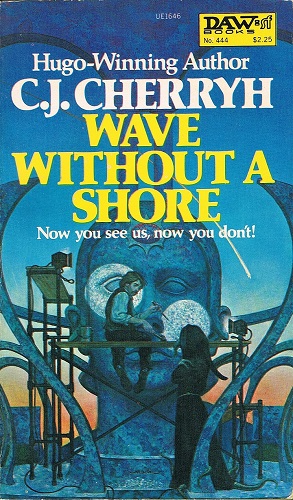
The world of Freedom was settled by humans, even though it already had a native population, the ahnit. The humans built a city, Kierkegaard, and settled down to develop a way of life that resulted them in not seeing things which do not fit their worldview or “reality”. Such as the ahnit. Who more or less become invisible to them. As do humans who drop out.
Herrin Law considers himself the cleverest person on the planet. He becomes a sculptor at the university in Kierkegaard, where he meets Waden Jenks, son of the world’s First Citizen, and almost as clever as Herrin, if not equal in intelligence. Jenks’s cleverness, however, lies in politics. There’s also a third super-smart student, Keye Lynn, who starts out as Law’s girlfriend, then after Jenks has seized power from his father, moves in with Jenks.
Jenks commissions a statue of himself from Law, which Law turns into a series of carved domes, within which is the statue, in Kierkegaard’s only square. Meanwhile, Freedom’s sole contact with other worlds, a freebooter merchant, threatens Jenks and Kierkegaard, and Jenks responds by shopping him to the military… who then start building a station in Freedom orbit.
Much of the first half of the novel is taken up with philosophical discussions between Law and Jenks. Everyone on Freedom is solipsistic to the degree they can choose what and what not to see in their surroundings. But when Jenks, encouraged by the visiting military, tells Law to never sculpt again, and then has his goons break Law’s hands to make sure… Law is driven into a crisis and begins to “see” the ahnit.
It’s a neat concept – and reminds me a little of Miéville’s The City & the City (2009, UK) – but Cherryh spends so long setting up the characters of Law and Jenks, and describing the underpinnings to the Freedom humans’ solipsism, the story drags badly for much of its length. Nor is it helped by both Law and Jenks being so arrogant and self-centred and unlikeable. It also reminds me a little of other novels by Cherryh, such as Voyager in Night (1984), and while it’s set in her Alliance-Union universe, it’s on the fringes of it, like The Faded Sun trilogy and Angel with the Sword (1985, USA). So, probably one for completists.
 It Doesn't Have To Be Right...
2025-11-29 at 18:01
I’ve picked this one up twice and set it down for various reasons. It’s generally been posed to me as a nicely philosophical work — but yes, as you say, light on the narrative drive.
2025-11-29 at 19:25
It’s a neat concept, but the philosophy is not convincing and Cherryh spends far too much time trying to convince the reader.