It Doesn't Have To Be Right…

… it just has to sound plausible


Leave a comment

Memory of Water, Emmi Itäranta

Shortlisted for the Clarke Award in 2015 – and it’s not often a translated work makes it onto the award shortlist. In fact, the only one prior to Memory of Water (2012, Finland) was Stanisław Lem’s Fiasco (1988, Poland), although there have been four since Itäranta (Frankenstein in Baghdad (2013, Iraq), The Electric State (2017, Sweden), Vagabonds (2011/2012, China) and The Anomaly (2020, France)).
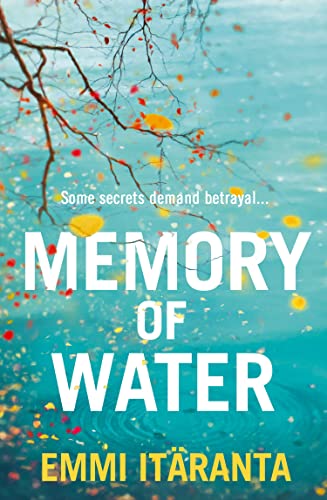
Memory of Water was originally published in Finnish. There’s no mention of a translator, and Itäranta lives in the UK according to the bio, so I’m guessing she translated the novel herself. That might explain a couple of word misuses, such as “the hidden core of the profession pertains that tea masters were once…”, and “woolgathering” when context suggests it should be “digressing”. Less understandable is the use of Scandinavian Union as the name of the novel’s setting, when it seems to be set in Finland, which is not a Scandinavian country, and both Sweden and Norway are described as polluted and uninhabitable.

Several centuries from now, climate crash, and war, has drastically changed the face of the Earth. Many former nations are now underwater, and the Chinese rule pretty much everywhere. Water is so scarce it is controlled by the military. Noria is the daughter of a tea master, and his apprentice. He shows her the family secret: a hidden spring.

After Noria’s father dies, she becomes tea master, and her mother moves to the capital, Xinjing. In a nearby garbage dump, Noria and her friend find a series of CD-ROMs which contain the log of an expedition to the Lost Lands (ie, Sweden and Norway) several centuries previously. The expedition was presumed lost and the Lost Lands uninhabitable. The novel never actually reveals what’s in the logs, only that it contradicts what everyone has been told. Noria, and her best friend, to whom Noria revealed the secret of the spring, decide to retrace the route of the lost expedition. Before they can set off, the military arrest Noria.

Memory of Water is not the first sf novel to feature a Chinese-controlled future. Two examples which spring (ahem) to mind are Gwyneth Jones’s Bold as Love quintet (2001-2006, UK) and David Wingrove’s Chung Kuo series (1989-1997 and 2010-2014 and 2017-2024, UK). Nor is it the first sf novel set in a Europe mostly underwater. Despite that, Memory of Water’s setting never quite convinces. The writing is lovely, and the surroundings are described in poetic and leisurely detail (sometimes somewhat over-leisurely). But the scarcity of water doesn’t – I’m tempted to say “hold water”, but that would be cruel. Anyway, it doesn’t seem entirely credible, and if it were indeed true then I doubt the tea ceremony would still exist centuries later. The fact Sanja can fix “past-technology”, including a CD-player, is not really feasible either, but it breaks suspension of disbelief less than the water thing.

Which is a shame, as the “water thing” is what the novel is actually about.

Leave a comment

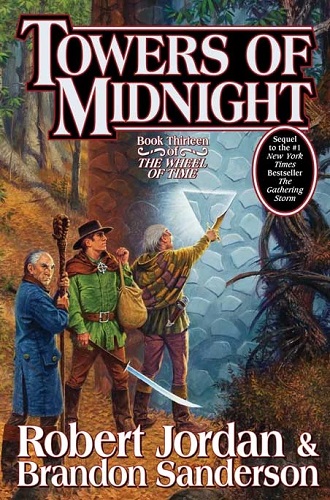
Towers of Midnight, Brandon Sanderson

The thirteenth book of the Extruded Fantasy Product that is The Wheel of Time, and the second written by premier Extruded Fantasy Producer Sanderson after Jordan’s death. This is the end-game of the series – and has been for several books – and there’s still one more humungous tome to go.

Rand al’Thor has finally grown up (it’s only taken him twelve books), and proves that when he puts his mind to it he has, well, super-powers. But he doesn’t use them to defeat the bad guys because that would end the story real quick. Meanwhile, Egwene is trying to get the Aes Sedai behind her, but someone is murdering sisters in the White Tower, so Egwene arranges an ambush in Tel’aran’rhiod, the dream world. Perrin Aybara finally accepts what people have been telling him for around seven or eight books, that he’s not just a blacksmith out of his depth but the actual leader of an actual army – oh, and he turns out he’s even more powerful in Tel’aran’rhiod than Egwene because of all the wolf dream stuff. Mat Cauthon still eyes up every woman he meets and tries to work out which of his friends he should introduce them to, but he also rescues Moiraine (remember her?) from the Aelfinn/Eelfinn (one of the genuinely dramatic bits of the novel, to be fair). Oh, and he invents cannons, as well. Elayne is, well, Elayne spends the novel being pregnant and being a queen. And there’s some weirdness going on at the Black Tower, with an increase in toxic masculine behaviour (!), and something preventing those there from Travelling out (gosh, not an obvious piece of foreshadowing at all).

There’s a few other bits and pieces going on, and a handful of sections from the POVs of supporting characters – but it still feels like there’s a lot of verbiage for very little actual progress. By the end of Towers of Midnight (2010, USA), the good guys have a gigantic army gathered at the field of Merrilor, which I think puts them in place for the Last Battle… Incidentally, I don’t recall any actual towers of actual midnight being mentioned in the novel, other than in the glossary (which places them on the Seanchen continent – er, what?).

On the plus side, Nynaeve loses her braid, so there’s no more pulling of it (although it doesn’t stop Sanderson from repeatedly mentioning she wants to pull it). Sanderson clearly doesn’t have Jordan’s fascination with spanking, but every female character is introduced with a description of her breasts. There are also lots of descriptions of clothes, mostly female. The prose reads like it was dictated (which is how I believe Sanderson “writes”), the sort of narrative scramble created by someone who puts things down as they think of them. There must have been some planning, of course, given the vast cast (ugh) of the series and the even vaster wordage, but was that Sanderson or Jordan?

Sanderson doesn’t appear to know what a chapter is. There are 57 in this novel. Each one contains sections from the POVs of the different lead – and supporting – characters. The chronology is more or less linear, but there’s no structure or logic to which narrative thread follows which – sometimes, several sections follow one POV, other times it flips between several in a single chapter. It’s not as if the chapters were all the same length, either. I couldn’t work out what in story terms signalled the end of one chapter and the beginning of the next.

There’s only one more book to go: A Memory of Light (2013, USA). There’s a lot of heavy lifting needed to finish off the story – which no doubt explains its 350,000+ words.

We shall see how that goes. 


Leave a comment

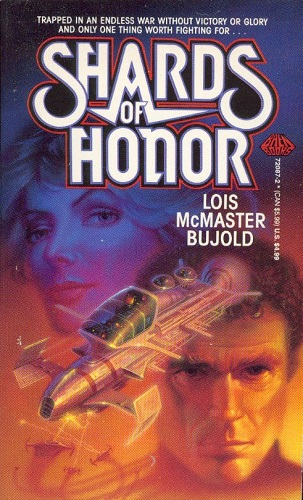
Shards of Honor, Lois McMaster Bujold

Bujold was pretty much ubiquitous on the Hugo Award shortlist throughout the 1990s and early 2000s. True, the Hugo has its favourites, and they have their moments, and then the favourites change. At the time, I couldn’t see the appeal of Bujold’s Vorkosigan series – I read a couple of them, but they seemed somewhat bland and derivative, and not what I would have expected of award-winning science fiction novels. They’re not, of course – not what you’d expect of award-winning sf novels, that is, just instalments in a well-liked, comfortable sf series, and it was the series which kept on winning awards, not the novels.

And yet, reading Shards of Honor (1986, USA) now – a reread as I’d read it once before back in the 1990s – the one thing that stands out is how… polished it all is. It was Bujold’s debut novel, but by internal chronology it’s the second book in the Vorkosigan series. The main hero of the series, Miles Vorkosigan, isn’t even born when the novel takes place – it is, in fact, about his parents.

Cordelia Naismith is an officer of the Beta Colony Survey, when her team on an uninhabited Earth-like planet is attacked by Barrayaran soldiers. She is left behind when her team-mates escape, only to be captured by Aral Vorkosigan, the captain of the Vorkosigan ship in orbit, who has himself been marooned after a mutiny by his ship’s political officer. Barrayar is a militarist empire, with an old-style aristocracy and a Soviet-like “Political Education” apparatus. Vorkosigan is completely old school, a man of honour, a stiff-necked aristocrat, and known as the Butcher of Komarr.

Naismith and Vorkosigan have to trek some 200 kilometres to reach a Barrayaran supply cache, with a brain-damaged Beta Colony officer. Unfortunately, they’re met by the mutinous political officer and his cronies, who take them prisoner. But Vorkosigan turns the tables, only for the political officer to mutiny again. Which this time is foiled by Naismith, shortly before she escapes.

Oh, and the two fell in love during the trek and Vorkosigan proposed marriage to Naismith. Despite her feelings for him, she refused.

And that’s what the novel is about: Beta Colony Survey officer and Barrayaran military aristocrat, a romance. There’s an invasion, a space battle, a gratuitous rape/torture scene, a military defeat, lots of fatuous Betan politics (including a running joke about the Betan president, “I didn’t vote for him”), and brutal Barrayaran court intrigue.

Like Jack McDevitt’s novels, there’s not much here that’s actually science fiction. Set in the future, yes. Lots of different interstellar polities, yes. But it’s all very, well, American (even the aristocratic Barrayarans, who resemble Hollywood depictions of European royalty more than anything else). There’s a few sf bells and whistles – plasma mirrors, stunners, disruptors, plasma arcs (all weapons), plus spaceships and stargates and so on. Several years ago, I invented the term “Ruritanian sf” to describe this sort of genre fiction – see here.

It’s all very entertaining and smooth, with a pair of likeable leads (important for romance, of course), and a background that seems both familiar to sf readers and yet also a tiny bit different – no doubt helped by the sympathetic treatment of what would normally be the bad guys. I can understand the appeal – well-defined universe, good buys to root for, bad guys to boo and hiss, and a fixity of worldview common to US sf.

Shards of Honor is one of the few Vorkosigan novels which didn’t get nominated for an award, although, to be fair, it was Bujold’s debut novel. I enjoyed it, and I’ll continue reading the series – but this is science fiction that doesn’t challenge, and I usually expect more of the sf I read.


Leave a comment

On the Calculation of Volume I, Solvej Balle

It’s probably premature to review this first volume before having read the rest – although only two have so far have been published in English, the third is due in November, the fourth in April next year… and to date only six of the planned seven have been published in the original Danish. (I should point out it’s not On the Calculation of, volume 1, but On the Calculation of Volume, part one.)

The basic premise is: antiquarian book dealer Tara Selter, resident in France, visits Paris to purchase new books for the home-based business she runs with her husband. While there, she wakes up one morning and discovers she is reliving the previous day. In fact, every day from that point on is 18 November. Just like Groundhog Day.

She returns to her husband, and explains the situation to him. But the following morning… is 18 November again for her, and she has to explain all over again. And again. And again. While she is stuck in time, he continues travelling forward day by day.

Tara tries several different ways to live – spending the day over and over again with her husband, living in his shadow as he repeats his 18 November… She discovers that any changes she makes carry over to her next 18 November – so if she takes food from village shops, their stock diminishes on the one day she inhabits. She explores the limits imposed on her as he lives the same day over and over again – some items return back to the beginning of the day with her, some are lost to 19 November, and so on.

It’s all very cleverly worked-out, and written in an appealing flat lucid prose. This first volume (did you see what I did there?) is Tara exploring the “rules” which seem to govern her situation, both in her home village and in Paris. She inevitably grows distant – first from her husband, then from other people, then from her own life. The novel – it’s short, only 166 pages – is almost entirely set-up. But then there are seven books (each one also short) in the series. Nonetheless, On the Calculation of Volume I (2020, Denmark) doesn’t feel abrupt or incomplete. It reads like the first step on a journey toward the solution of an impossible mystery (although the shadow of Groundhog Day does lie a little heavy across it).


Leave a comment

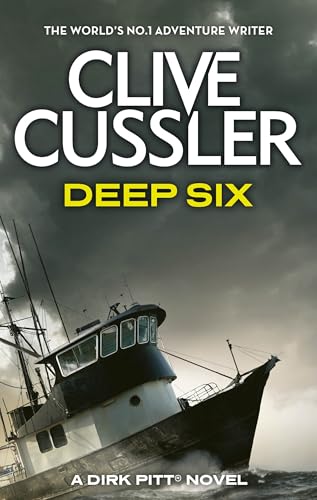
Deep Six, Clive Cussler

The seventh book featuring Dirk Pitt, NUMA Special Projects Director and all-round man’s man and action hero, but actually the sixth book as Cussler managed to sell a trunk novel, set and written before his debut novel, having now become a best-selling author. Trunk novels should generally stay trunk novels, and Cussler’s is no exception. I should point out that Deep Six (1984, USA) may have been Cussler’s seventh actual novel, but in 2025 Cussler, who died in 2020, has 27 Dirk Pitt novels in print (the last two written by his son), 21 NUMA Files novels written by assorted hands from his atelier, 18 Oregon Files novels, 15 Isaac Bell Adventures novels, and 12 Fargo Adventures novels. I make that 93 novels. That’s a fucking large, or a fucking productive, hacktelier atelier. 

Deep Six is set in 1989, five years after it was published. A tramp freighter disappears in the 1970s with a bank robber aboard. It is discovered ten years later because it was carrying a cargo of barrels of stolen US Army nerve gas, one of which has leaked and killed hundreds of people off the coast of Alaska. Pitt amazes everyone by quickly finding the ship. The barrels of nerve gas are taken away to be buried, but Pitt is intrigued by the ship itself, a Liberty ship from World War 2 from which all identification has been removed. He investigates further, and learns it was operated by a shady Korean shipping company, now based in New York.

Meanwhile, the president of the US, vice-president, speaker of the house, and a senator are off on a weekend trip on the presidential yacht, the USS Eagle (the last presidential yacht was actually the USS Sequoia, which was sold off by Carter in 1977). Overnight, a heavy fog drops, and when it lifts everyone aboard the yacht has vanished. The Administration desperately tries to cover up the fact the president is missing…

… and who has actually been kidnapped by the aforementioned Koreans, who have been paid by the Soviets, and a Soviet neuroscientist plans to brainwash the president and insert a controlling microchip into his head…

It’s action all the way as Pitt ends up involved in the hunt for the missing politicians. A Soviet liner in the Caribbean is blown up and sunk – and Pitt’s latest lover is aboard, so he’s involved in that too. But the Koreans have her, so he’s after them in a desperate race to find their secret laboratory before they kill everyone. The climax involves a battle on the Mississippi delta between the machine-gun-armed Koreans on a tug and a company of ACW re-enactors with muskets on a paddle-wheel steamer. Exciting stuff, even if not in the slightest bit credible. And the only reason Pitt found them is because the Korean shipping company named all their ships after towns on the Mississippi delta – er, what?

I’m beginning to wonder if Cussler had a time-machine and visited 2025. In Night Probe! (1981, USA), the US and Canada merged – which didn’t happen in the real world, obviously, although Trump clearly thought he could make it happen. In Deep Six, the president is controlled by the Soviets (although a microchip in Trump’s brain would be ineffective as his brain is clearly ineffective, but he’s still Putin’s puppet), he wants to pull the US out of Nato, there are troops on the streets of Washington, and the US is no longer a democracy. Hmmm. I don’t recall a tech billionaire who believes the laws of physics don’t apply to him in Raise the Titanic! (1976, USA), however. And while Iceland featured in Iceberg (1975 USA), Greenland wasn’t mentioned.

Still, another twenty Dirk Pitt novels to go…


Leave a comment

Scarpetta 20: The Bone Bed, Patricia Cornwell

The twentieth book in the Kay Scarpetta series. Only nine more to go – including the one due this October. The title refers to a palaeontological dig in Alberta, Canada. A female paleontologist disappeared and several months later Scarpetta is sent an anonymous email containing a short video of the missing woman and a photo of a severed ear. Despite Scarpetta having no connection to palaeontologist, the place in Canada, or even dinosaurs.

Then the body of a woman turns up in Boston Bay, tied to a buoy. Scarpetta manages to recover the body intact. Shortly afterwards she is in court being cross-examined by the lawyer of a billionaire industrialist who has been charged with hiring the murder of his missing wife. But the body in the bay is not her.

And when they do identify the body, it turns out she was someone Marino was flirting with on Twitter, so he comes under suspicion…

Initially, it all seems like yet another plot to destroy Scarpetta’s career and reputation, a feeling only reinforced by the grilling she gets in court and the FBI investigating Marino. But it actually isn’t. It’s just your common or garden psychopath serial killer, of which the US has plenty, and Scarpetta’s involvement is more by accident than by design, or at the very least a happy and contrived coincidence on the part of the killer.

It also starts to look like Scarpetta is going to dangle herself as a victim, only to turn the tables – as in many other books in the series. But again, the killer abducts her only because of, er, happy coincidence, and for other reasons she’s rescued by the usual gang – Lucy, Marino, etc.

I’ve no idea if Cornwell was deliberately teasing the reader with hints of her more formulaic books, but I did like the fact The Bone Bed (2012, USA) didn’t hew closely to the formula. The title came from an actual bone bed visited by Cornwell, which inspired the novel – but it’s actually more or less peripheral to the story. She could have dropped the murder of the palaeontologist and it wouldn’t have substantially changed the plot.

A middling Scarpetta novel, I think. Slight above average, but not one of the more memorable ones. In its defence, it focuses more on crimes, and a killer, who has absolutely nothing to do with Scarpetta.


Leave a comment

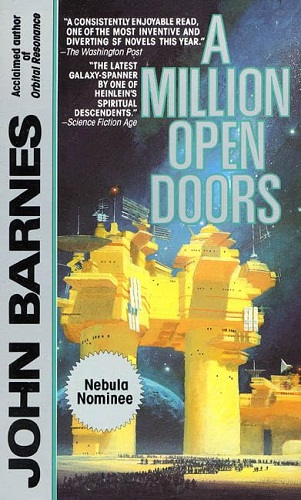
A Million Open Doors, John Barnes

Nominated for both the Nebula and the Clarke Awards. Barnes seemed to have a moment in the mid-to late-1990s, with a Hugo nomination, three Nebula nominations and three Clarke nominations. But no wins. And nothing since then except appearances on the Locus Award/readers’ poll pretty much every year until a decade ago (for his last published novel, in fact). A Million Open Doors (1992, USA) is only the second book by Barnes I’ve read – I read Mother of Storms (1994, USA) back in 1999.

A Million Open Doors is the first of four novels set in the Thousand Cultures. Taking place several centuries from now, Earth has colonised a number of worlds, each of which is home to one or more “cultures”, groups of people – ethnic, national, religious, some even completely invented. Like Nou Occitan, which is supposed to be some sort of Iberian Romantic culture of troubadours and duellists, but is really just massively sexist. The worlds were colonised by slower than light ships, but now “springers”, instantaneous transport, even across interstellar distances, connect them together.

When Giraut catches his paramour in flagrante delicto with a gang of “Interstellars” (youths aping what they think is an Earth culture by “beating up and degrading young girls”), he accompanies a friend to Caledony, which has just received its first springer. Caledony is a religious culture, which uses Christianity to justify some garbled economic philosophy. Giraut opens a school to teach Occitan culture – music, duelling, poetry, dancing, painting, etc – to the joyless Caledons. Unfortunately, the success of the Centre for Occitan Arts prompts a coup by hardliners, house arrest for the previous government, martial law and armed mobs on the streets.

To build support, Giraut and his liberal Caledon friends stage a camping trip across the continent, but there’s an accident in the mountains, resulting in several fatalities. While dashing back to get into communications range, Giraut discovers the ruin of an alien city. Meanwhile, while he was away, Council of Humanity troops have overthrown the hardliners…

Reading A Million Open Doors, I had trouble working out why it was science fiction. Yes, other planets, springers, spaceships, etc, but you could set the story on Earth. Some community full of rapists, another full of nutball religious types – I’m pretty sure you could find two towns that qualify in the US. Even the alien ruins could be the ruins of some prehistoric American culture. All the rest is just bells and whistles.

And when a science fiction novel is not science fiction, then what’s the point of it? And you also have to wonder why the novel appeared on two science fiction award shortlists. In other respects, it’s all just a little too textbook. Giraut is a male chauvinist, but he comes to value and respect women – and even falls in love with one who isn’t even attractive and whose physical flaws he mentions repeatedly. Two characters are killed irretrievably – the technology exists to bring people back using personality recordings, and there’s even an example to illustrate it, the victim of a brutal sexual assault, torture and murder. (This is not just everyday sexism, this is everyday sexual assault.) The bad guys get their just desserts – except, well, not really, a friend who insulted Giraut is humiliated (with a spanking), and the villainous pastor who seized power on Caledony is imprisoned off-world.

A Million Open Doors lost the Clarke to Jeff Noon’s Vurt (1993, UK), and the Nebula to Doomsday Book (1992, USA) by Connie Willis (Sarah Canary (1991, USA), Karen Joy Fowler, or China Mountain Zhang (1992, USA), Maureen McHugh, would have been better winners). Even so, it didn’t belong on those shortlists. It’s mediocre, its one idea is in service to a story that doesn’t even need to be science fiction, and it’s offensive in parts.