It Doesn't Have To Be Right…

… it just has to sound plausible


Leave a comment

Walking Practice, Dolki Min

The debut novel of a South Korean illustrator, recently translated and published in English, and one of four winners of the Otherwise Award this year. The narrator is an alien living in Seoul who must concentrate on presenting a human appearance, or they’re liable to sprout arms and legs and eyes in odd places. They enjoy dating people online, arranging to meet them at home for sex and then, well, eating them. Yes, the narrator presents as both male and female during the story, and the title refers in part to the different gaits required to pass as each gender. 
The prose tries to maintain a chatty tone, which I found grating. I know almost nothing about contemporary Korean literature, so I’ve no idea if it’s a popular style there (although I recall something similar in Greek Lessons (2011, South Korea) by last year’s Nobel laureate Han Kang when I read it earlier this year). I’ve read enough translated fiction, and even fiction in its original language and then translated into English (Swedish and French fiction, mostly) to know there’s a difference between translation and transliteration – and sometimes the latter often fails to take culture into account, both the original and that of the language being translated into (the same occurs all the fucking time from UK to US English, of course). The English translation of Roadside Picnic (1972, USSR) by the Strugatsky brothers didn’t work for me because it relied too much on American idioms, and I don’t expect to find them in a Russian novel. Larsson’s Millennium trilogy was translated by an American who’d lived and studied in Denmark but was unfamiliar with many elements of Swedish culture and society. It showed. On the other hand, the English subtitles for a Swedish detective show I watched recently failed completely to transliterate a common Swedish expression because there was no obvious way to do so and keep the original sense.

Then there’s the writing system… Korean, of course, has its own writing system, Hangeul, and it’s very different to the variations on the Latin alphabet used by many other languages. An afterword by the translator points out the difficulties she had representing the author’s Hangeul orthographic tricks in the Latin alphabet. The nearest she could manage was through varying the kerning – which, as she admits to worrying about, does indeed look like bad typography or misprints.

Obviously, there’s more to Walking Practice (2023, South Korea) than the tone of its narrative and the fact the English reading experience is a poor copy of the Korean reading experience. There’s a cinematic feel to the story, but unlike a movie there’s no story arc or resolution. Korean cinema doesn’t follow Hollywood story paradigms – it’s something to do with cats at present, isn’t it? – which is a good thing, and I’ve seen many excellent South Korean films. In future, I think, I’ll stick to their movies.

1 Comment

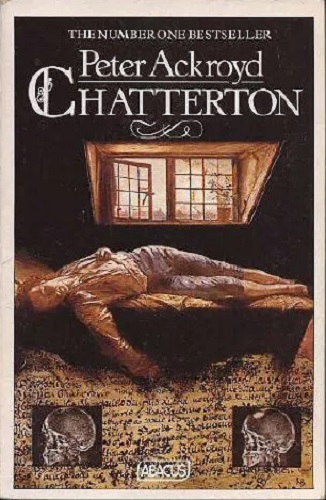
Chatterton, Peter Ackroyd

I knew I’d read this before, but I thought it was back in the very early 1990s. It turned out I was thinking of Hawksmoor (1985, UK) and although I’d read Chatterton (1987, UK) before, it was in 2004. Ackroyd is one of those authors whose books I don’t make an effort to search out, but will happily read and enjoy when I stumble across them… as I have done around half a dozen or so times to date. I should probably read more of them.

Chatterton is about Thomas Chatterton, a precocious poet and satirist, who committed suicide at the age of seventeen in 1770. He’s chiefly known for forging the poetry of an invented fifteenth-century monk, Thomas Rowley, and influencing the Romantic poets of the early nineteenth-century. Ackroyd’s novel has three narratives: Chatterton’s life shortly after he moved to London and leading up to his death; the circumstances surrounding the painting of ‘The Death of Chatterton’ some 80 years later by Henry Wallis, using Romantic poet George Meredith as a model; and in the present day, unsuccessful poet Charles Wychwood stumbles across a painting which suggests Chatterton faked his suicide, and later finds papers suggesting Chatterton forged a number of famous poem by Romantic poets.

The two historical narratives are great. Chatterton in period is convincing. Wallis, Meredith and Meredith’s wife, Mary, are even more convincing in London of eighty years later. Unfortunately, the present-day narrative (as of the year the book was published) is not so good. The characters are grotesque, mostly caricatures – not just the old couple who own the hidden-away junk shop where Wychwood finds the painting, but also Wychwood himself, and especially the ageing spinster novelist, Harriet Scrope (I mean, look at the name!), who then gets involved.

It’s a shame. It’s a fascinating mystery – or rather, it isn’t a mystery, but Ackroyd manufactures a mystery of it and does it well. But pretty much everyone involved in Wychwood’s present-day investigation is unlikeable and contemptible (with a handful of exceptions). Also, while Ackroyd’s wordplay works for the historical narratives, it feels over-egged in the contemporary narrative.

Having said all that, I’d actually remembered nothing of the novel from my previous read. So I’m glad I reread it… and it reminded me I really should read more of Ackroyd’s fiction.


Leave a comment

Black Wolf, Juan Gómez-Jurado

The second book in a trilogy featuring Antonia Scott, a neurodivergent super-genius who works for a secret European agency dedicated to solving high-profile crimes. She’s assisted by Jon Gutiérrez, a gay Basque police detective. The two first appeared in Red Queen (2018, Spain), which was adapted for television in 2024.

In Black Wolf (2019, Spain) The pair are asked to assist in investigating the attempted murder of a Russian mobster’s girlfriend in Málaga. The girlfriend escaped, and is now on the run, but the mobster did not – and it turns out she was the financial genius behind all his shell companies and money laundering schemes. And because of that, the head of the Russian mob in the area wants her dead. So he asks his superiors back in Russia to send him some help, and they send the Black Wolf, a renowned assassin.

But when Scott and Gutiérrez stumble across a shipping container containing dead women who’d been trafficked to Spain, and the container is linked to the dead mobster, Scott is determined to take down the Russian mob in Málaga. But things aren’t as simple as they seem. Someone is attacking the organisation Scott works for, the police in Málaga are not as honest as they should be, and even the Black Wolf has her own agenda.

It all comes to a head in a villa in the woods near Madrid during a snowstorm. The Russians attack, and the handful of good guys – Scott, Gutiérrez et al – in the house have to hold out until the police arrive. Black Wolf is a more straightforward narrative than Red Queen, and its focus on the Russian bratva in Spain leaves less room for social commentary. There are still plentiful hooks to the third book, White King (2020, Spain), however. This is a good series, with a pair of engaging leads, and is already being compared to Larsson’s Millennium trilogy, although I’d argue it’s probably better, and I can understand why the first book was adapted for TV. It would be nice to see the other two adapted as well.


Leave a comment

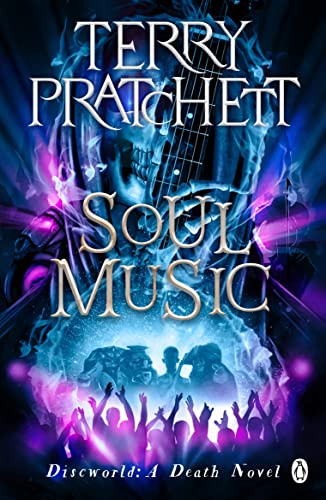
Soul Music, Terry Pratchett

I’ve heard it said the Grateful Dead were not actually very good live, but every now and again everything would sort of fall into place and it would be an almost transcendental experience – and it was those moments which led to their popularity. I’ve no idea if that’s true, but I do know that such moments can happen at a live performance. I remember one gig at Corporation in Sheffield – I forget the year, or who was the main act, but a support act was playing. I was standing with two guys, complete strangers, and none of us was impressed. Then the band started a new song and all three of us said, “Now that’s interesting.” (For the benefit of non-Brits, that means it was good.)

In Soul Music (1994, UK), Pratchett takes those moments – generated here by magic, and by some magical force for its own ends – to chart (see what I did there?) the invention of a new kind of music in Ankh-Morpork. A harpist from Llamedos (read it backwards) moves to Ankh-Morpork. Unable to afford a license to perform, the harper falls in with a troll and a dwarf, and the three form a band, The Band With Rocks In (because the troll is a drummer and his drums are, er, rocks). The harper’s, er, harp is broken at an unlicensed performance, but he finds a new one in a mysterious shop that mysteriously appears mysteriously. And that changes everything. Suddenly, all The Band With Rocks In’s performances are like those mythical Grateful Dead performances.

Meanwhile, Death has left his post, upset over the death of his apprentice and adopted daughter, so his granddaughter takes over the role. But she’s not especially good at it. When she turns up to the Mended Drum at which the harpist – now calling himself Buddy (referencing a pop star who died, um, 66 years ago), and the troll has taken the name Cliff (a rock joke, and referencing a pop star who, I suspect, will never die)… The harpist is supposed to die at the gig, but instead Death’s granddaughter allows him to live… which only makes the music magic more powerful…

Pratchett has a great deal of fun taking the piss out of the music industry, although many of his references are a good thirty years earlier than the year the book was published. And some of the jokes about bands on the road were already clichés when Pratchett made use of them. Neither of which means the book isn’t amusing. And the Death/Death’s granddaughter narrative makes for a good contrast – and introduces some interesting characters (and makes use of several old ones).

I find the music industry a more interesting target than some of the targets in earlier Discworld novels, but it does occasionally feel like the jokes are a little too obvious and the commentary not as pointed or insightful. Having said that, my taste in music is… niche, and quite specific, and has regularly been misrepresented in popular culture. So perhaps that got a little in the way when I read Soul Music. All the same, I enjoyed it, although I wouldn’t put it in the top five of Discworld novels (of the ones I’ve read).


1 Comment

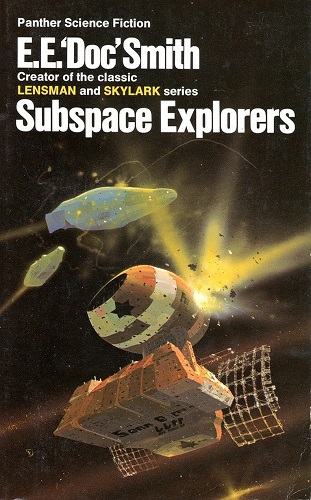
Subspace Explorers, EE ‘Doc’ Smith

There is a Brian Aldiss story, ‘Confluence’ – I’ve referenced it a number of times in reviews – which consists of amusing dictionary definitions of words from an alien language. Such as “SHAK ALE MAN: the struggle that takes place in the night between the urge to urinate and the urge to continue sleeping”. And, “YUP PA: a book in which everything is understandable except the author’s purpose in writing it”. Sadly there’s no word that means “a book in which everything is understandable except a person’s reason for reading it”. Which is certainly true when it comes to the works of EE ‘Doc’ Smith, and most especially Subspace Explorers (1965, USA). It was a reread for me, but I last read it when I was twelve or thirteen, and I remembered pretty much nothing of it. Sadly, I cannot go back to that state of blissful ignorance.

Several centuries from now – exactly when is impossible to tell as the world-building is extremely poor – the Earth is split into a WestHem and EastHem: the first is a corrupt democracy controlled by corrupt unions, and the second is a tyranny masquerading as communism. In fact, the entire political set-up of the novel is cobbled together from US knee-jerk right-wing myths: communism evil! unions bad! politicians corrupt! big government bad! monopolistic corporations good! There are also colonies on a number of other worlds, all of which were settled, and are run, by corporations. Spaceships travel through subspace to journey between these worlds and “Tellus” (the Latin name for Earth, which Smith, bizarrely, used in all his fiction). 

A spaceship, the Procyon, suffers some sort of catastrophe in subspace. There are only five survivors – the first officer, the astrogator, the daughter of the owner of the biggest oil company in existence and wed to the first officer only hours earlier, her friend who is also the girlfriend of the astrogator, and a scientist who later turns out to be the giantest brain in all of human history. The oil magnate’s daughter is an oil dowser, and the subspace wreck has given her super mind powers, which she then teaches to the other four…

Meanwhile, the nasty old unions in WestHem are trying to break the corporations, who want to automate everything in order to keep down inflation (er, what?). The copper miners threaten to strike, because copper is apparently vital in the future. But the psionic five can dowse for metal, and they find a huge copper deposit on another planet for GalMet, the mining monopoly, also based offworld. The copper miners’ strike fails, so the milk truck drivers go on strike, because centuries in the future milk is once again delivered to people’s homes in bottles and this is so vital to life on Earth that a strike could cause society to collapse… The corporations break the strike using giant-sized battle tanks to deliver the milk (yes, really).

Anyway, the corporations defeat the nasty unions, inadvertently triggering a nuclear war, but never mind, the corporations’ “superdreanought” spaceships manage to destroy the missiles before they cause any important damage. The corporations trigger a WestHem election, but lose it to a coalition of all the political parties – which are all corrupt and evil, of course. But never mind. “Enlightened self-interest”, AKA unregulated corporate operations, will win out eventually. Then the corporations’ blockade of Earth Tellus is broken by a mysterious fleet of superdreadnoughts from an unknown planet.

Then it turns out one corporation, previously unmentioned in the novel, has for more than 200 years been running a secret world with a strictly-regimented “feudal” society (it’s not feudal, of course, because Smith clearly doesn’t know what feudalism is). That’s where the mysterious fleet came from. (The Company Agents are all electrically-charged, and they wear rubber-soled boots, so if anyone touches them – which is just, no, just too fucking stupid for words.) Our hardy heroes, the five from the shipwreck mentioned earlier, with the amazing mind powers, who by now have taught pretty much everyone on the corporation-run planets their amazing mind powers, free the Company serfs on The Company World. But the Company serfs had been infiltrated by agents from a secret world settled by the USSR! And with only five pages to go our hardy heroes defeat them too! 

I went into Subspace Explorers with low expectations. It not only failed to meet them, it dug a bottomless pit and then dived into it. Reading the infantile take on politics and economics used by Smith, his hatred of unions and valorisation of unregulated corporations, the implication inflation is more dangerous to a nation than nuclear war, I can only wonder how many of the techbros responsible for the shit state of the world today were influenced by it. We may mock sf and its “Torment Nexus”, but right-leaning politics as understood by a five-year-old such as that described in Smith’s novel, has probably caused more damage. Subspace Explorers is not just bad, it can cause brain damage. Techbros may well name-drop the Culture, but it wouldn’t surprise me to learn Musk, Altman, Andressen, Thiel et al have read and assimilated this novel.

If you ever meet anyone who claims to like Subspace Explorers, back away slowly from them. Then turn around. 

And run.


Leave a comment

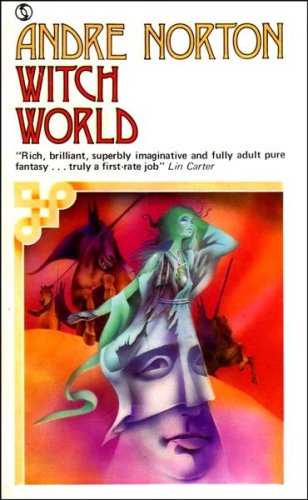
Witch World, Andre Norton

I remember reading some novels by Norton back in the 1970s, but I don’t remember if Witch World (1963, USA) was one of them. Probably not. Nothing in it seemed remotely familiar. Or particularly good. Although it was on the Hugo Award shortlist in 1964. The only memory I have of the novels by Norton I read back then is that they were science fiction adventure stories, on a par with something like the Hardy Boys. And with, I seem to recall, mostly teenage or young adult protagonists. Enjoyable, but not memorable. To a teenager, at least.

And I think you’d have to be a teenager to put up with the awful cod-mediaeval dialogue Norton uses in Witch World. The plot is simple: Simon Tregarth – who is not a teenage or young adult protagonist – is on the run after a life of adventure post-war, not always on the right side of the law. He meets a man who promises him a new life, where he will never be caught. Tregarth goes with him, and learns the man is the guardian of the Siege Perilous, a magical stone which can send people to other worlds. Tregarth gets sent to one. Cue adventure.

The world is vaguely mediaeval, with the odd bit of high tech, which even Tregarth thinks is weird in inconsistent. There’s also magic, but he doesn’t blink an eye at that. Nor the fact it’s only women who can perform magic, and they lose the ability if they’ve had sex (which is a bit annoying for Tregarth, as he fancies one of the witches big time). But then it turns out he has magical abilities – a man! inconceivable! – and he’s definitely not a virgin.

Anyway, Tregarth joins the Guards of Estcarp, and plays a pivotal role in a war against the Kolder, human invaders from another world – Norton comes within an inch of describing them as “Yellow Peril” – who turn those they capture into robot zombies. Despite proving unstoppable for much of the novel, Tregarth manages to stop them. There are, of course, a few diversions along the way – failing to defend the trader city of Sulcarkeep, meeting the misogynist Falconers of the mountains, a pogrom against those of the “old blood” in Karsten, a forced marriage in Verlaine, and even discovering the tomb of one of the ancient race who occupied the planet before the humans arrived. It’s all very thrilling…

Witch World went on to spawn a series of more than twenty books over four decades, not all by Norton alone. I have the second book of the series, Web of the Witch World (1964, USA), but I very much doubt I’ll be reading any further.


2 Comments

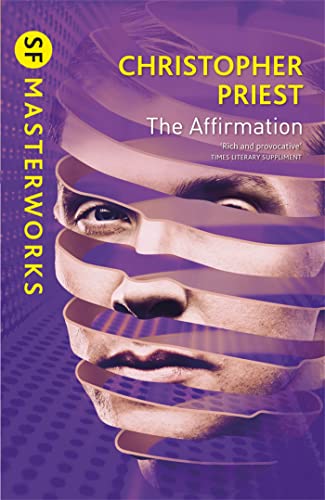
The Affirmation, Christopher Priest

I’ve read a number of Priest’s novels over the years – I think the first was The Glamour (1984, UK) back in the late 1980s. And there was a period in the late 1990s when I read each new novel by him as it hit paperback. That ended with The Separation (2002, UK), which I seem to recall had a troubled publishing history. It was nearly a decade before his next book appeared, by which point he’d sort of dropped off my radar, before slowly creeping back intermittently over the next couple of decades.

Which is not to say I didn’t like what I’d read, and I’d always admired his writing, and sort of planned to catch up with the works I’d missed. Hence, The Affirmation (1981, UK), which was originally published 44 years ago, and joined the SF Masterworks series in 2011. It’s also the first novel to feature the Dream Archipelago, which Priest returned to several times, in a collection and a further three novels.

In 1976, twenty-nine year old Peter Sinclair suffers a breakdown after a string of appalling luck over a few weeks – his father dies, he’s made redundant, his landlord evicts him, and his girlfriend dumps him. He decides to write his autobiography as a form of recovery. But as he writes, he searches for a “greater truth” by disguising its setting. So the UK becomes Faiandland, London is Jethra, and everyone in Sinclair’s life is given another name.

In this “autobiography”, Sinclair has won a lottery for immortality treatment, and travels south by ship to Collago, an island in the Dream Archipelago. There is a side-effect to the treatment: amnesia. So Sinclar must document his life in order to help the clinic’s therapists restore his memories. But this version of Sinclair has written an “autobiography” too, about his life in London…

The narrative drifts back and forth between Sinclair in the UK and Sinclair in the Dream Archipelago, each one muddying the other. UK Sinclair is clearly in a bad state. He’s rescued by his sister, and then his girlfriend turns up and the two reconcile and move in together. It does not go well. Faiandland Sinclair is not sure he wants to be immortal, even after entering into a relationship with the Dream Archipelago avatar of his girlfriend.

The Dream Archipelago is first presented as an invention of Sinclair, which explains its inconsistencies and the somewhat unharmonious names. It’s equatorial, the northern continent is inhabited, the southern continent is uninhabited, but there’s a war and the islands form a neutral zone. The point being Sinclair’s invented world is not very convincing. But Sinclair is so invested in it – intellectually and emotionally – that he has trouble determining which is which. Details slip and slide between the two, especially after Sinclair has taken the treatment and is trying to regain his memory.

The Affirmation is… unsettling, and cleverly done. Priest covered similar ground in later novels, and in a manner that was more sophisticated. Which is hardly surprising. He had a singular oeuvre, which is definitely worth exploring, and I clearly have more catching up to do.


Leave a comment

More longer

I mentioned my other blog a few months ago. I post longer, less-frequent reviews there. I also promised to post links here to those reviews. I forgot. Here are the last three:

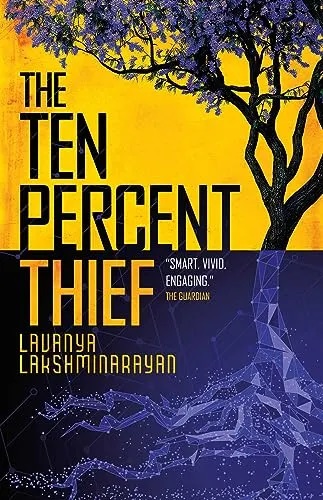
From the 2024 Arthur C Clarke Award shortlist, The Ten Percent Thief by Lanya Lakshminarayan (see here).

And from this year’s Arthur C Clarke Award shortlist, The Ministry of Time by Kaliane Bradley (see here).

And, sadly, a book that didn’t make any award shortlists, The Mars House, Natasha Pully (see here).


Leave a comment

Scarpetta 19: Red Mist, Patricia Cornwell

The nineteenth book in the Kay Scarpetta series, and following straight on from the previous one, Port Mortuary (2010, USA). Scarpetta has been invited to the Georgia Prison for Women to speak to the woman who sexually abused Jack Fielding (Scarpetta’s deputy, who was murdered in Port Mortuary) when he was twelve, and whose daughter is the psycho genius responsible for his death (and several others). Scarpetta is then contacted by Jaime Berger, no longer DA responsible for sex crimes in New York, but now based in Savannah – and it turns out she manipulated Scarpetta into visiting Georgia. Because she thinks a young woman on death row who brutally murdered a respected doctor and his family ten years prior is innocent.

Scarpetta resents being manipulated, but then Berger is murdered… and the hunt is on for a poisoner, who may be linked to the prison and responsible for the deaths of several inmates who died of “natural causes” just hours before they were due to be executed. The whole gang is in Savannah – Marino, Lucy, Benton – and it seems the poisoner was actually responsible for the doctor’s murder ten years ago.

The plot is, to be honest, a bit weak. Once again, Scarpetta’s reputation is attacked (the murderer from the previous book is claiming Scarpetta tried to kill her). There’s another psycho genius hiding in the background, and whose identity is pretty easy to guess. Everyone seems particularly slow to spot things, including Scarpetta, and the killer is found more or less by accident. But there’s some good autopsy scenes and some good deductive science in identifying the poison.

Red Mist (2011, USA) seems to close off a two-book story arc, so I expect the next one, The Bone Bed (2012), will introduce yet another psycho genius who will murder a few people, then twist the facts of the case to make Scarpetta look like the villain, before being shot and killed while trying to murder Scarpetta… But we shall see.


Leave a comment

Wish I Was Here, M John Harrison

Subtitled “an anti-memoir”, Wish I was Here (2023, UK) is actually, well, a memoir. It’s M John Harrison writing about certain periods of his life, and how he thought about it then, or at least how he imagined he thought about it then, and how he thinks about it now. It’s not about his writing per se, although his writing career is often mentioned. Nor is it his life, although that does provide the book’s narrative arc.

Harrison was born in the Midlands – Rugby, to be exact – to a middle-class family but struggled to find a career. He moved to London, he became a writer, he fell in with the New Worlds crowd. He moved north, he became a climber. He moved back to London, his writing career benefited. He moved to his current address, where he can now look back in relative comfort to a life that had few periods of relative comfort.

None of this is especially surprising, or offers any real insight to what he writes and why. But Harrison here is writing about his life much as he writes about the peripheral characters and events in his novels, and it’s plain how the two are related. There’s little doubt now Harrison is one of the finest writers UK genre has produced, and if his position in the wider UK literary scene is less certain it’s only because of anti-genre snobbery. But they’re gradually coming round and, as Harrison celebrates his 80th birthday, the quality of his fiction is becoming more widely recognised.

Myself, I’ve always admired his writing, although I’d like to reread all those novels I read back in the 1980s, 1990s and early 2000s, as I think I’d appreciate them more. (Happily, I have copies of all of them, although many are in storage.) I was surprised on reading The Sunken Land Begins to Rise Again (2020, UK) last year, and Wish I Was Here, how readable his prose is. I mean, I’ve always felt he had a superb ear for dialogue – it’s so effortlessly realistic – but I’d formed the impression he was a difficult read. He’s not. Wish I Was Here demonstrates this in abundance. It’s so straightforward that it actually suggests it’s anything but. If that makes sense.

Every time I read a novel by M John Harrison, I want to go back and reread all his previous novels. Wish I Was Here is not a novel, but it has the same effect. Much as Harrison revisited his memories to write this “anti-memoir”, I want to revisit my memories of his books, the ones I read ten, twenty, thirty, forty years ago. And explore them afresh, admire them all over again, perhaps for different reasons. Which is the whole point.