
I have a distinct memory of reading this in 1986 while I was studying at People’s College in Nottingham. Weirdly, the only thing I remember is actually reading the book, not the plot nor any of the details of the story.
The Whole Man (1964, UK) was nominated for the Hugo in 1965 – not an especially good year. It lost to Fritz Leiber’s The Wanderer (1964, USA), which I thought poor, and shared a shortlist with Edgar Pangborn’s Davy (1964, USA), which I hated, and Cordwainer’s Smith’s The Planet Buyer (1964, USA), which would have been an acceptable winner had it been a complete novel…
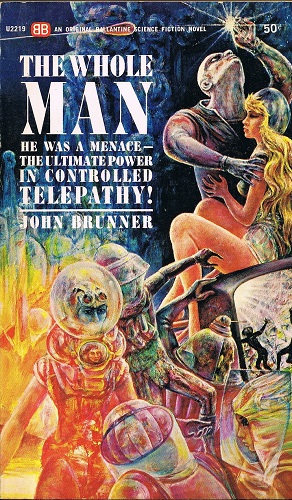
Gerald Howson was born the son of a terrorist leader in a UK where UN troops were brought in to stabilise the country. He is disabled, but also proves, after puberty, to be an enormously powerful telepath. In a world in which telepaths are routinely used by the UN to telepathically impose peace in areas where violence is about to erupt. And for psychiatric therapy.
The novel is fixed up from three stories, ‘City of the Tiger’, ‘The Whole Man’ and ‘Curative Telepath’, although the novel is split into sections called ‘Molem’, ‘Agitat’ and ‘Mens’, which is Latin for “mind over matter”. The first section is Gerald’s childhood living rough in a UK occupied by UN Peacekeepers. In the second, Gerald is at the WHO clinic in Ulaanbaatar, where he learns about telepathic therapy and catapathic groupings, which is when a powerful telepath retreats into a dreamworld and takes several people with them. Gerald is called into “cure” one such group, but it all proves to be a waste of time as the telepath had merely “taken a holiday” – not the phrase the book uses, but near enough. Gerald then returns to his hometown for a vacation, meets a group of students, helps save the life of one who commits suicide at a house party, and so discovers a path to his own happiness.
I’ve long thought debut novels should not appear on award shortlists, chiefly because the effort invested in debut novels by publishers is so much more than that put into novels by established authors – and with good reason, the publisher wants the debut novelist to have a career, it’s good for them, good for the novelist, good for readers. But does set expectations the debut novelist is unlikely to ever meet. Likewise, I can think of no reason why fix-up novels should appear on award shortlists. True, 1965 was in the early days of the Hugo Awards, but surely there were enough novels qua novels that year not to have to nominate a novel fixed up from stories published between 1958 and 1959, more than 6 years earlier?
The fix-up nature of The Whole Man is obvious – it has no actual plot, just three situations with self-contained story arcs. The world-building is a bit crap, the telepathy is not thought (ha!) through completely, and despite being set in some indefinable near-future everything reads like 1950s UK. Brunner’s treatment of a disabled protagonist in a 1965 novel is all that you would expect of a disabled protagonist in a 1958 short story.
At the time I remembered originally reading this novel, I also recall reading a novel which claimed spiders were so generally found repulsive there was a theory they were extraterrestrial. Absolute nonsense, of course, I’d always thought I’d read that in The Whole Man. Apparently not. No mention of spiders at all. Ah well. It seems likely I’ll remember The Whole Man as the one without the spiders as there’s little else to make it memorable.
 It Doesn't Have To Be Right...
2025-07-21 at 18:19
Regardless of its flaws, I still think it’s his first solid novel. I should give it a reread.
2025-07-21 at 18:21
Also, I do not believe that “fix-up” should ever prohibit a novel from a shortlist. Vonda N. McIntyre’s Dreamsnake (1978), Miller, Jr.’s Canticle for Leibowitz, etc. are all great novels.
2025-07-21 at 18:23
Everything on the shortlist but Leiber’s miserable (winner) The Wanderer was a fix-up. Davy (as I can’t help but say for the fifth time) should have won 😉
2025-07-22 at 08:12
Can’t find any reference to The Wanderer being a fix-up.
2025-07-22 at 08:08
Dreamsnake was an expansion of a novella, and there have been many fine novels expanded from shorter works. A Canticle for Leibowitz was indeed a fix-up, but I didn’t think it was very good. My issue with The Whole Man is that the stories were written in the previous decade – how can you claim something is the best of the previous year when it’s over five years old?
2025-07-22 at 12:57
Ian, that is incorrect re-Dreamsnake. It did not expand a singular novella. It expanded multiple stories! It’s a fix-up of three previously published novelettes: “Of Mist, and Grass, and Sand” (1973) (won the 1974 Nebula for Best Novelette and nominated for the 1974 Hugo), “The Serpent’s Death” (1978), and “The Broken Dome” (1978). My review: https://sciencefictionruminations.com/2022/03/25/book-review-dreamsnake-vonda-n-mcintyre-1978/
2025-07-22 at 19:00
Wikipedia needs correcting, then.
2025-07-22 at 19:20
Isfdb.org is far more reliable on those matters.
2025-07-22 at 19:27
Unfortunately, isfdb can be incomplete if an author has written non-genre or has appeared in an non-genre venue.
2025-07-22 at 19:36
Of course. But our issue concerned science fiction publication histories.
2025-07-22 at 13:02
Oh, I loved A Canticle for Leibowitz.
2025-07-22 at 19:01
I think we’ve already established our tastes in sf are different 🙂