It Doesn't Have To Be Right…

… it just has to sound plausible


Leave a comment

Lake of Souls, Ann Leckie

I still think Leckie’s Ancillary Justice (2013, USA) was a much-needed shot in the arm for space opera. It had been taking on more and more characteristics of military sf, after New British Space Opera was co-opted by US authors and editors and became New Space Opera. But that’s an argument for another day. There was lots to like in the two sequels to Leckie’s debut, as well. Also the two pendant novels published since, Provenance (2017, USA) and Translation State (2023, USA) (although less so for the latter, I thought). I’ve yet to read Leckie’s fantasy novel, The Raven Tower (2019, USA).
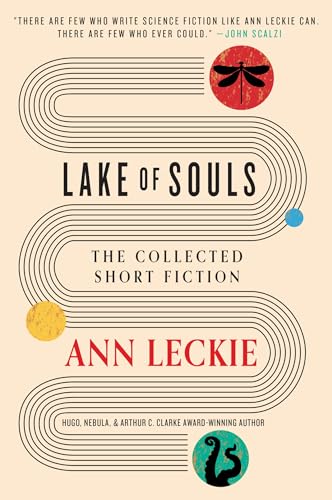
Lake of Souls (2024, USA) is Leckie’s first collection, containing stories originally published between 2006 and 2019, and including a story original to the collection. The contents are organised in three sections: stories from the Imperial Radch universe, stories from the universe of The Raven Tower, and, opening the collection, stories unconnected to either.

Collections are by definition mixed bags. It probably comes as no surprise the stories set in the universes of Leckie’s novels are (mostly) better than the unconnected ones. Having said that, of the three Imperial Radch stories, only one reads like the same universe as the novels, one could possibly be in that universe, but the third appears to have no connection at all (it’s some sort of fable). 

The unconnected stories… the title story is a first contact that goes wrong, and reminded me of several similar pieces from the 1990s, two stories are based on premises that are definitely creaking at the seams these days, but ‘The Justified’, which is a very modern type of sf, and the Le Guin-ish ‘Another Word for World’ (big clue in the title there) are better.

The seven stories set in the world of The Raven Tower are more consistent, although the longest one, ‘The God of Au’, makes a jump two-thirds of the way in and nothing after that makes sense. I quite liked ‘The Unknown God’ and ‘Beloved of the Sun’, but the others are not especially memorable. Having said that, I suspect a collection of only fantasy stories might have been a better collection than Lake of Souls.

I was not really surprised on reading Lake of Souls to discover Leckie’s short fiction wasn’t up to the standard of her novels. While the world-building was generally done well, even if some of the premises were badly shop-worn, in several stories she failed to stick the ending. There are authors whose short fiction is much better than their novels, James Tiptree Jr, for example. It seems Leckie is the opposite.

Leave a comment

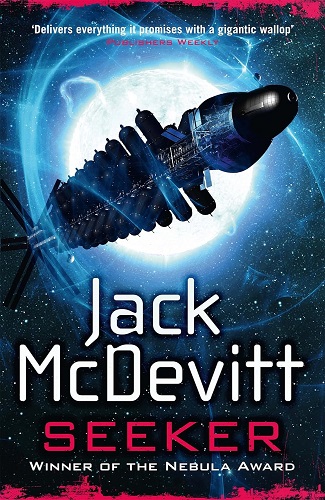
Seeker, Jack McDevitt

Seeker (2005, USA) is the final volume in the Alex Benedict omnibus I bought while it was on offer, and I still haven’t decided yet if I’m going to read further in the series. Because… they’re really bad, they’re terrible science fiction, but… they’re easy reads, you can polish one off in an afternoon, and there’s a certain fascination in seeing how poorly McDevitt builds his future federation. How the fuck this novel won the Nebula Award in 2006 is a mystery up there with, well, the commercial success of Oasis.

These stories are set nearly 10,000 years in the future, but you would never guess it. Houses have AIs, people travel between planets, cars fly, and, er, there’s probably a few other gizmos mentioned. But in terms of culture and society, McDevitt’s future resembles early twenty-first century USA – there are no characters, for example, with names that might seem out of place in present-day Los Angeles or New York. Having said that, there’s a single mention of “dark skin”, and even a paragraph on that old white sf bullshit by old white sf writers where all the races have interbred until everyone has “olive skin”. Homo sapiens has been around for over 100,000 years and we still have races. That’s not going to change in 10,000 years, even if McDevitt doesn’t like putting non-white people in his novels.

McDevitt mentions the Bataan Death March (I’ve met a survivor of this, by the way), and I still find it really bad craft where things that would be known to a late twentieth-century person are known to a twelfth-millennium person, but they know very little of the one hundred centuries in between, or even of events that happened a decade or so earlier. 

The plot of Seeker – and I’m wondering if McDevitt borrowed the structure of his novels from Clive Cussler; certainly the conceit that they’re written by narrator Chase Kolpath, Alex Benedict’s pilot and assistant, is taken from Sherlock Holmes… An opening prologue describes a man trapped in a hotel after an avalanche – something else not solved after 10,000 years – and lamenting he never got to reveal the shocking discovery he and his wife had made.

Cut to the novel’s present, thirty-some years later. A woman – apparently they also have trailer trash 10,000 years in the future – offers Benedict an antique cup for sale. It proves to have come from the Seeker, a ship which disappeared in the 26th century after delivering a group of political dissidents to a colony world. The location of the world was never revealed, and the colony has been lost ever since. And become legend.

Of course, Benedict finds the ship. And the colony. As he and Kolpath investigate, Kolpath is assaulted by a man with a history of violent assaults on women – apparently not solved after 10,000 years – and then Benedict and Kolpath narrowly escape death when a shuttle they had planned to fly on is blown up by a bomb, killing all the passengers – something else not solved 10,000 years in the future.

I’m pretty sure you could rewrite Seeker and set it at the turn of the millennium. A lost historical colony somewhere in the Pacific, perhaps. A lost ship. Abandoned ships like the Marie Celeste were pretty common during the Age of Sail. Cussler has probably already written such a novel (his Iceberg (1975, USA) involves a lost ship mysteriously re-appearing, for example). It would be difficult to hide in the opening years of the twenty-first century the survival of a colony lost for hundreds of years, but I’m sure a creative author could figure something out. Such an author would not be Jack McDevitt.


12 Comments

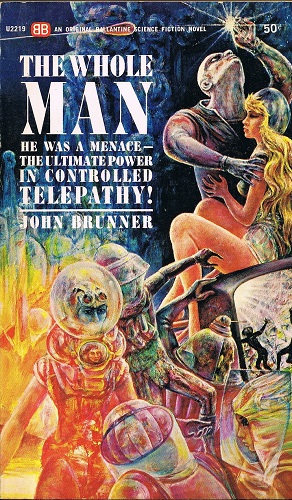
The Whole Man, John Brunner

I have a distinct memory of reading this in 1986 while I was studying at People’s College in Nottingham. Weirdly, the only thing I remember is actually reading the book, not the plot nor any of the details of the story.

The Whole Man (1964, UK) was nominated for the Hugo in 1965 – not an especially good year. It lost to Fritz Leiber’s The Wanderer (1964, USA), which I thought poor, and shared a shortlist with Edgar Pangborn’s Davy (1964, USA), which I hated, and Cordwainer’s Smith’s The Planet Buyer (1964, USA), which would have been an acceptable winner had it been a complete novel…

Gerald Howson was born the son of a terrorist leader in a UK where UN troops were brought in to stabilise the country. He is disabled, but also proves, after puberty, to be an enormously powerful telepath. In a world in which telepaths are routinely used by the UN to telepathically impose peace in areas where violence is about to erupt. And for psychiatric therapy.

The novel is fixed up from three stories, ‘City of the Tiger’, ‘The Whole Man’ and ‘Curative Telepath’, although the novel is split into sections called ‘Molem’, ‘Agitat’ and ‘Mens’, which is Latin for “mind over matter”. The first section is Gerald’s childhood living rough in a UK occupied by UN Peacekeepers. In the second, Gerald is at the WHO clinic in Ulaanbaatar, where he learns about telepathic therapy and catapathic groupings, which is when a powerful telepath retreats into a dreamworld and takes several people with them. Gerald is called into “cure” one such group, but it all proves to be a waste of time as the telepath had merely “taken a holiday” – not the phrase the book uses, but near enough. Gerald then returns to his hometown for a vacation, meets a group of students, helps save the life of one who commits suicide at a house party, and so discovers a path to his own happiness.

I’ve long thought debut novels should not appear on award shortlists, chiefly because the effort invested in debut novels by publishers is so much more than that put into novels by established authors – and with good reason, the publisher wants the debut novelist to have a career, it’s good for them, good for the novelist, good for readers. But does set expectations the debut novelist is unlikely to ever meet. Likewise, I can think of no reason why fix-up novels should appear on award shortlists. True, 1965 was in the early days of the Hugo Awards, but surely there were enough novels qua novels that year not to have to nominate a novel fixed up from stories published between 1958 and 1959, more than 6 years earlier?

The fix-up nature of The Whole Man is obvious – it has no actual plot, just three situations with self-contained story arcs. The world-building is a bit crap, the telepathy is not thought (ha!) through completely, and despite being set in some indefinable near-future everything reads like 1950s UK. Brunner’s treatment of a disabled protagonist in a 1965 novel is all that you would expect of a disabled protagonist in a 1958 short story.

At the time I remembered originally reading this novel, I also recall reading a novel which claimed spiders were so generally found repulsive there was a theory they were extraterrestrial. Absolute nonsense, of course, I’d always thought I’d read that in The Whole Man. Apparently not. No mention of spiders at all. Ah well. It seems likely I’ll remember The Whole Man as the one without the spiders as there’s little else to make it memorable.


Leave a comment

Stag Dance, Torrey Peters

A collection of four novellas, although one probably qualifies as a short story, by the author of Detransition, Baby (2021, USA). I’d tracked down one of these – ‘The Masker’ – to a site for self-published fiction after reading Peters’s novel, but I’d been waiting for this collection.

There are four stories: ‘Infect Your Friends and Loved Ones’, ‘The Chaser’, ‘Stag Dance’ and ‘The Masker’. The first is science fiction, in which the narrator is the inadvertent patient zero of a virus which prevents the body from producing hormones. Society – in the US – has fallen apart, and people fight over manufactured hormones. This is not subtle – but that’s actually a strength of the story, and indeed the collection, not a weakness, I was reminded in parts of Ralph A Sperry’s Status Quotient: The Carrier (1981, USA) and Necessary Ill (2013, USA) by Deb Taber (the latter I can definitely recommend, and would really like to see more by her).

‘The Chaser’ is much more disturbing. It’s set at a Quaker school, and narrated by a senior whose relationship with a junior room-mate is… well, one is manipulating the other, or perhaps vice versa. And when the senior tries to distance himself, the junior begins a hate campaign. In parts, I was reminded of James Clavell’s King Rat (1962, UK) and, having attended a British boarding-school I grew up hearing stories that are… “adjacent” to this one.

The title story is… astonishing. It’s set in a pirate logging camp in nineteenth-century USA. I’ve no idea if the vocabulary and practices are correct, but they read as completely authentic. The protagonist is male and oversized and nicknamed Babe after Paul Bunyan’s pet ox, but his gender identity is not so clear-cut. One member of the camp, who is not a logger, and very pretty, is a pretend wife to several – more echoes of King Rat. This all comes to a head when the camp chief puts on a “stag dance”, where some of the loggers can pretend to be women by pinning a triangle of brown cloth to their groins. Which Babe does. When I first came across mention of this collection, it had a different title – but I can see why ‘Stag Dance’ was eventually chosen as the title piece. It’s a remarkable novella. 

‘The Masker’ is the least satisfactory of the four stories. At a crossdresser/transgender convention in Las Vegas, a young crossdresser is torn between an older trans woman and a man who uses a silicone female mask to crossdress. The trans woman, an ex-law enforcement officer, persuades the narrator to set a trap for the masker but instead they do the same for the trans woman.

The first two stories are good, and the last is okay. But the title novella is worth the price of admission alone. To be honest, I think it could have been published on its own. The other stories probably only really suffer in comparison, and might well hold up better in a collection on their own, but I can understand the urge to get something into print quickly. Peters is a name to watch, not only a good writer but writing stuff that’s straight up trans, documenting (US) trans culture… and more of them are definitely needed in the mainstream.


Leave a comment

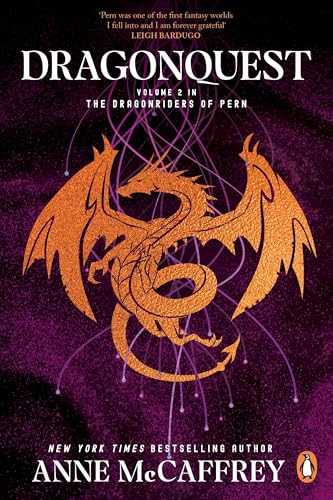
Dragonquest, Anne McCaffrey

This is the second Pern novel and reading both I’ve learned whatever assumptions I’d held for many years about the series – based on reading McCaffrey’s Killashandra trilogy back in the 1980s, and reviews of the later share-cropped books in the series – were mostly wrong. Okay, so there are dragons, and a world that has fallen from a technological past to a sort of semi-enlightened (and somewhat sanitised) Middle Ages. And romance. Although not as much romance as I’d expected. In fact, the first two books in McCaffrey’s long-running Dragonriders of Pern series are pretty much straight-up science fiction. With perhaps an over-emphasis on the emotional relationship between the dragons and their riders.

These days, that’s nothing new or unusual. Although I do wonder how I would have responded to the  books had I read them as a teenager in the late 1970s. Not so differently, I’d like to think – it was only a couple of years later I was reading, and admiring, CJ Cherryh’s fiction, and I was already a fan of Tiptree’s short stories, and, yes, aware “he” was a woman.

In the first book, Dragonflight (1968, Ireland), queen dragon rider and chief Weyrwoman, Lessa, had travelled back in time 400 years and brought forward five weyrs to help combat Thread, which had begun falling again after several hundred years. As Dragonquest (1971, Ireland) opens, the old weyrs don’t like the way things are run in the present and cling to “tradition”, which has brought them into conflict with the holds. This might sound slightly familiar in the current political climate.

Then the Thread begins to fall outside the timetable calculated for it, putting further pressure on the weyrs, especially Benden Weyr, the one led by Lessa, and the most respected, admired and generally all-round wonderful weyr of them all. After stumbling across some ancient technology – a microscope! a telescope! – the hold lords and the weyrs hatch a plan to send dragons to the Red Star, the neighbouring planet where Thread originates.

It’s all very dramatic, and McCaffrey handles the slow introduction of details from the legendary past into her world with admirable constraint. Having said that, the chief villain abruptly disappears three-quarters of the way through the novel, and is effectively written out of the story. A dragonrider ignores orders and makes a trip to the Red Star, which proves reckless and comes to exactly the end expected. Lessa is more in the background in this novel – if anything, Dragonquest never seems entirely sure who its chief protagonist is. On the other hand, this does mean McCaffrey can spend more time rounding out her world.

I plan to finish the original trilogy – I have The White Dragon (1978, Ireland) on the TBR – but I don’t think I’m going to dash out and read all the remaining books in the series – 24 novels to date, not all wholly by McCaffrey. I’m certainly not, however, going to diss the books any more, as I was clearly wrong on what I’d assumed about them. The two I’ve read so far are fun, well-crafted, quite plainly science fiction, perhaps a little dated in parts… but there were many many actively bad sf novels written back then, and these are not among them.


4 Comments

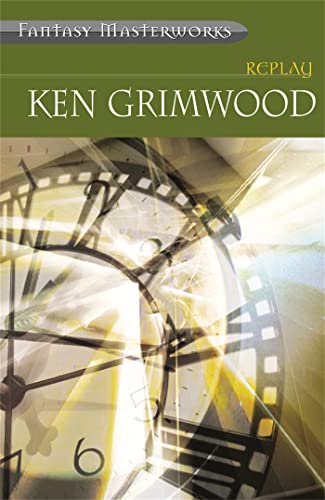
Replay, Ken Grimwood

Back in the 1980s and 1990s, Andromeda Bookshop in Birmingham was the biggest importer of US books, predominantly science fiction, into the UK. Every month, the shop posted a catalogue of the latest arrivals to subscribers. I bought a lot of books from it over the years, even when I lived in the Middle East. Replay (1987, USA) by Ken Grimwood was in every catalogue because Andromeda owner Rog Peyton loved the novel so much.

I remember liking Replay a great deal when I last read it in the late 1980s or early 1990s. But you know what they say about revisiting books decades later… Replay this time around was not actively bad, just not as good as I remembered it. Perhaps because its story takes place between 1963 and 1988, and that period is now so much further in the past it seems unconnected to the present.

The story is simple: Jeff Winston dies in 1988 at the age of 43 of a heart attack, and wakes up 25 years earlier as an 18 year old student in Atlanta. He soon realises he’s going to live his life all over again. But this time he has knowledge of the future, of the decades he lived in his previous life. He uses that knowledge to place sports bets and buy stocks and shares, building up a huge fortune, and living a life of luxury and ease… before dying of a heart-attack in 1988.

And finding himself once again back in 1963. This time he marries his college girlfriend, makes enough money to live comfortably, and… still dies of a heart attack in 1988. The third time, he embarks on a life of drugs and orgies, but then in 1972 he sees a movie in 1972, Starsea, which could only have been made by another replayer. He meets the producer, Pamela, but the two argue about their purpose, the reason they are replaying their lives. After her second film flops, Pamela goes to see Jeff and the two fall in love… and Jeff dies of a heart attack in 1988.

The next replay, they meet up, rekindle their relationship, and decide to tell the world about the years ahead. But the US government uses their information to protect and expand its interests abroad, making even more of a fuck up of its foreign policy than our current history, and ushering in World War III.

With each replay, however, Jeff and Pamela have been re-awakening later, so much so that on their fourth replay, Pamela awakes only hours before her fatal heart attack…

Replay’s premise is a powerful one – reliving your life over and over, remembering past lives – and Grimwood hits all the obvious story beats. There’s a lot he leaves out, by necessity. I didn’t find his description of the film Starsea convincing – even a decade later, was there any movie that could match 2001? –  and there were a few details here and there that were off (an American could never own an oil field in Abu Dhabi, for example). 

Replay is a fun, if a little mawkish, read. It seems more like historical fiction now, obviously, than it used to, but it’s written as if it were contemporary. It dates the book. And, the ending is, well, a little… banal. The pay-off for all those pages is a let-down.

Replay is in the original Fantasy Masterworks series (despite being science fiction, huh). It also won the World Fantasy Award. Grimwood wrote five novels in total, and was working on a sequel to Replay when he died of a heart attack at age 59. One of his earlier novels, Elise (1979), about an immortal French woman born in 1683, apparently now sells for silly money.


Leave a comment

The Girl Who Lived Twice, David Lagercrantz

This is the third sequel to Stieg Larsson’s Millennium trilogy featuring super-hacker loner Lisbet Salander written by Lagercrantz. Two books of a new sequel trilogy, by Karin Smirnoff, have so far been published. I still find it amusing the English translations of these novels use The Girl Who… as titles, unlike the Swedish novels (this one is actually titled, Hon som måste dö, She who must die), especially given Sweden cobbled together a series of unrelated Goldie Hawn movies in the 1970s and 1980s by retitling them as The Girl Who…, Tjejen som…, such as Tjejen som föll överbord (Overboard) and Tjejen som gjorde lumpen (Private Benjamin). It’s either a bizarre coincidence (possible, as the first book was The Girl with the Dragon Tattoo, after all), or someone somewhere is displaying a wicked sense of humour…

The story so far: Salander’s father was a senior GRU officer who defected to Sweden and, while there, protected by a secret department of Säpo, set up a Russian criminal syndicate, Zvesda Bratva. Salander also has a sister, who is stunningly beautiful and now the head of the syndicate. The two hate each other.

A homeless man in Stockholm dies in suspicious circumstances, and the forensic pathologist attached to the case contacts Mikael Blomkvist. Who then contacts Salander. Between them, they identify the homeless man as a sherpa, who saved the life of the current Swedish minister of defence during an ill-fated expedition to climb Everest years before. A woman died on the expedition – her husband was a US billionaire with links to Zvesda Bratva, and rumour has it she was going to reveal all. So what really happened on the mountain?

Salander is busy trying to destroy her sister; Blomkvist is hunting for a story to re-invigorate his career… and the murdered homeless man might be it… but he’s side-tracked by the apparent breakdown of the Swedish minister of defence. Of course, everything is linked. Blomkvist’s investigations result in him being kidnapped by Zvesda Bratva, and tortured. Salander rides to the rescue.

The previous two Lagerctantz novels were not very well-written – certainly, the English translations were badly-written. This one is even worse. I mean, you don’t expect shining prose from a thriller (known as deckare, here in Sweden), but even prose anti-stylists, and there are a lot of them in science fiction, would say prose which is painful to read is doing it wrong. The Swedish cultural elements are handled well enough – although Lagercrantz does like name-checking streets in Stockholm – but it’s hard to see much past Salander’s genius hacking, genius everything in fact, or Blomkvist’s amazing journalism and interstellar journalistic reputation. Neither of which are remotely credible.

The first book in the series was a solid thriller – which is why I maintain the US adaptation is better than the Swedish one – but the sequels are like… those gymkhana event things, except each jump is made up of sharks stacked one on top of the other… One day I’ll definitely read the books in Swedish… but I suspect my opinion of them will not change.


Leave a comment

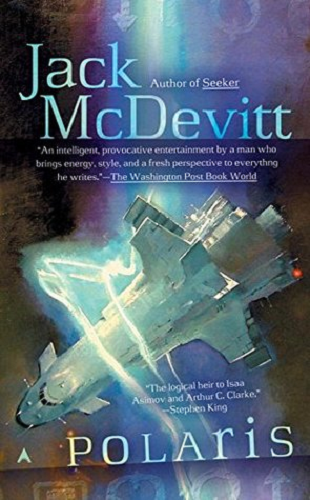
Polaris, Jack McDevitt

One question I frequently ask myself when reading a book is, why the fuck did I read (or reread) this book? If it’s a book by an author unknown to me, then perhaps I have an excuse. But a reread of a novel I know to be not very good, or even actively bad? The only possible answer is: I am an idiot. When it comes to books, and books only, I hasten to add. (Well, maybe not just books.)

Anyway. Polaris (2004, USA) is the second book in McDevitt’s series about far-future treasure hunter Alex Benedict, published fifteen years after the first book, and which is set in a human federation 9,600 years from now which somehow culturally resembles late twentieth-century USA. There’s a few sf tropes and macguffins in there, but everything else is more than familiar to a US sf reader of the 1990s and early 2000s.

The title refers to a ship which did a Marie Celeste some sixty years earlier. It carried seven famous passengers to the death of a star, and was found empty shortly after transmitting it was returning home. No one has ever solved the mystery.

Unlike the first book in the series, A Talent for War (1989, USA), Polaris is narrated by Benedict’s pilot and employee, Chase Kolpath. Benedict develops an interest in the Polaris mystery, and then shortly afterwards an exhibition of Polaris artefacts is bombed. The bombing is ostensibly a political assassination attempt, but Benedict suspects otherwise and begins digging deeper…

The solution to the mystery is, sadly, somewhat ordinary, and the real strangeness in the plot – the Polaris passengers faked their own deaths because they’d taken an immortality treatment, and have been conspiring behind the scenes ever since – is handled more or less in passing. Most of the plot covers the conspirators’ attempts to prevent Benedict from discovering the truth, and some of the events are, I think, a great deal like events in A Talent for War (wasn’t there a forced landing of a flying car into the sea in A Talent for War, as well?)

The world-building is just as sketchy as in the preceding novel, with a whole catalogue of sf tropes badly welded onto an essentially West Coast US society / monoculture. Cars fly, but remote towns can still be cut off by storm damage. The only real change from A Talent for War is that, thanks to a new starship drive discovered in that novel, interstellar travel in Polaris is more like twentieth-century air travel than sea travel.

These books are easy reads, and I suspect I’ll continue with them, but I can’t recommend them. Even the mysteries which drive their plots are feeble. Perhaps that will improve; I have no expectation the world-building will improve. In truth, the only interesting thing about these novels is that McDevitt managed to logroll his way onto the Nebula Award shortlist with them for a decade or more.


1 Comment

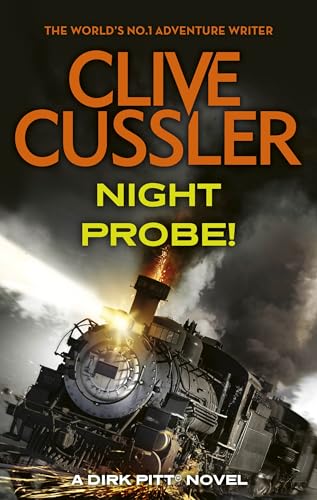
Night Probe!, Cliver Cussler

Well, this book was a timely reread. The entire plot is about Canada joining the US – although Cussler calls the conjoined nations the United States of Canada, which would undoubtedly cause President Chump’s remaining brain cell to combust.

Cussler’s formula has always been explicit – an historical mystery is the key to a present-day conspiracy, and Dirk Pitt is dragged into an investigation regarding one or the other, and so ends up resolving both. The novels are also set a decade or two ahead of when they were written, and often feature some sort of advanced tech.

Night Probe! (1981, USA) opens with a provincial railway station robbery in 1914, which nets little and prevents the two station staff from halting an express train heading for a bridge brought down in a storm. On the train were millions of dollars of gold bullion, and a Canadian official with important documents. Coincidentally, around the same time, a passenger ship heading for Britain is sunk in the St Lawrence River. On board is a British official with important documents.

Commander Heidi Milligan, introduced in the previous book, is studying for a PhD in American History, and she stumbles across a reference to a treaty between the US and Great Britain signed in 1914. But she can find nothing else about the treaty. Meanwhile, the head of a Quebecois separatist organisation tries to assassinate the prime minister of Canada. Somehow, news of the treaty, copies of which were carried on the crashed train and sunken ship, reaches the ears of the UK government, and they send a retired MI6 agent to the US to ensure the documents are never found.

Pitt uses NUMA equipment to dive on the wreck in the St Lawrence and, despite attempted sabotage by the British and Quebecois, manages to retrieve a copy of the treaty. Unfortunately, it’s unreadable. So Pitt goes looking for the crashed train, but there’s no sign of the wreck in the river below the destroyed bridge. Pitt eventually figures out the location of the train, and finds the treaty.

Night Probe! was published in 1981. While Cussler got a lot wrong (in it the USSR still exists, for example; not that he was actually trying to predict the future), I’m amused the plot is structured around the abortive sale of Canada to the US by Britain in 1914. And the desire by both the Canadians and USians to merge in the year the novel is set. Recent events have shown the Canadians are more than happy not being part of the US – as indeed is Greenland, and, in fact, every other fucking nation on the fucking planet – and I suspect the same attitude pretty much held true back in 1981. 

I’d remembered Night Probe! as one of the better Dirk Pitt novels, and it’s proven the best so far. Which doesn’t actually make it a good novel, just a good Cussler novel, which is not exactly a high bar. Trump’s deranged pronouncements since taking office, however, added a little extra to the reading. If only that were the only impact of his lunacy…