It Doesn't Have To Be Right…

… it just has to sound plausible


Leave a comment

Navigational Entanglements, Aliette de Bodard

After a number of unsatisfying, and occasionally offensive, old science fiction novels, it’s time for something new. Navigational Entanglements (2024, France) is a short novel, probably closer to a novella (and has been nominated as such in this year’s Hugo Awards), set in de Bodard’s Xuya universe.
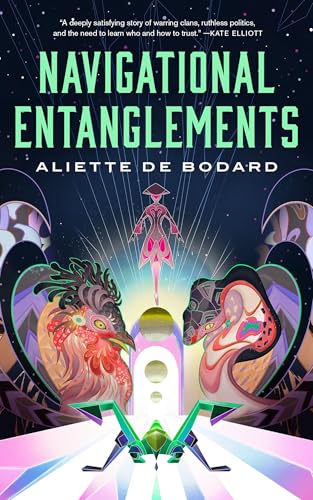
At least, I think it’s set in that universe. It’s certainly set in a space opera universe which is culturally Vietnamese, much like in The Red Scholar’s Wake (2022, France; recommended). Việt Nhi is a navigator in the Rooster Clan, one of a handful of clans responsible for guiding ships through the Hollows (some sort of hyperspace, I think), and protecting them during their journeys from tanglers (some sort of squid-like space creatures which live in hyperspace and can kill people by touching them, I think). A navigator from a rival clan crashes a ship and a tangler is let loose in the real universe. A team of four junior navigators, each of them to some extent considered a loser, is put together to catch the tangler. They’re expected to fail.

It’s all a political plot to destroy the influence of one of the clans, the Dog clan, which acts as the liaison between the other clans and the Imperial authorities. But the plot, so to speak, is more or less immaterial. The four juniors are very different characters, each one flawed; and it’s their dynamics, mediated by the protagonist, Nhi, which drives the story. Plus her attraction to one of the other juniors, Hạc Cúc of the Snake clan.

It’s all good stuff – although I do find myself a little puzzled by some of the background. I’m sure I’ve seen the Hollows mentioned in other stories set in the Xuya universe, but the concept of navigator, navigator clans and tanglers was new to me. Perhaps I missed something somewhere, but it felt like a retcon.

Having said that… on the one hand, no universe is set in stone and authors are of course free to chop and change as they wish – cf John Varley’s Steel Beach (1992, USA) for a good example. On the other, there’s something slightly less immersive about a universe that changes underneath you – and one thing the Xuya stories are very good at is immersion.

I do like these stories. The world-building is excellent, the mix of politics and (ironically) heightened emotions is effective, the level of detail in the prose is impressive, and they hit that space opera spot without being the usual hateful hyper-capitalist slave-owning oligarchic space opera universe so beloved of US science fiction writers. 

Worth a read; even better, vote for it at the Hugos.

1 Comment

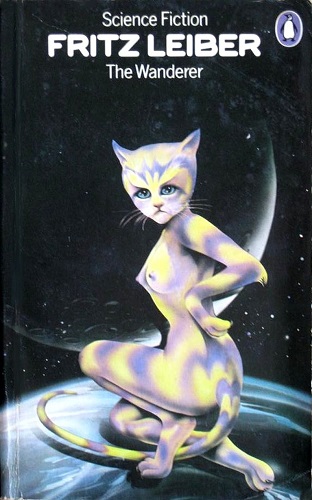
The Wanderer, Fritz Leiber

Winner of the Hugo Award in 1965, in a shortlist which included Cordwainer Smith, Edgar Pangborn and John Brunner. The Smith read like half a novel, I really didn’t like the Pangborn, and I have the Brunner on the TBR. Even so, I’m not convinced The Wanderer (1964, USA) was the best of the four.

A strange planet appears suddenly – from hyperspace, it’s theorised – in the Solar System, just outside the orbit of the Moon. Its presence causes earthquakes and tidal waves, and rips the Moon apart. The planet, named the Wanderer, proves to be actually destroying the Moon for fuel. Because it’s populated by thousands of alien races (including sexy alien cat women), and they’re on the run. The universe is packed with life – none of it visible from Earth, for, er, reasons – and it’s ruled by a government which resists change and adventurism, and the Wanderer’s dwellers are free spirits, gallivanting about the universe in search of, well, adventure.

The story is told through short sections from a wide cast of characters, all American except for a handful of non-US ones. There’s a German scientist, who appears twice and comes across like a cartoon Nazi; and a pair of drunken British writers (one Welsh, one English), who are caricatures, not characters. They also live in a UK that doesn’t exist, where people eat “sausage-and-mashed” rather than sausages and mash. 

All the time I was reading the book, I was trying to figure out when it was set. The US has a base on the Moon, and the USSR a mission on Mars… But the KKK is running around openly in Florida (there are several uses of the n-word and some really offensive racism), the English character remembers a bombing raid as a child, a man in the US claims to be the perpetrator of the Black Dahlia murder (from 1947), and South Africa still has apartheid. So, probably early Sixties, then. (Despite the moonbase and Mars.)

I’m told Leiber’s technique of using multiple viewpoints was something new in science fiction. Certainly it’s a technique more associated with techno-thrillers and the like, but they didn’t begin to appear until later. To be honest, most of the viewpoints don’t actually add anything – there’s a group of UFO nuts in California who explain what’s happening in the first half of the novel, and two Americans independently kidnapped by the aliens who have the second half of the novel explained to them. The rest are, well, not even local colour. 

Hard to believe The Wanderer was the best science fiction novel published in 1964.


Leave a comment

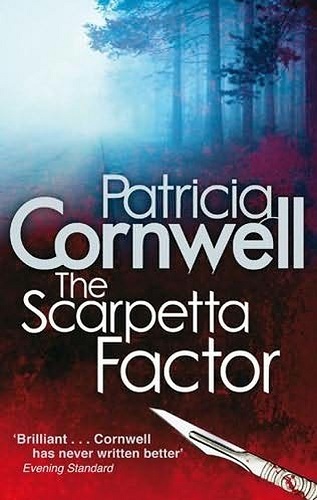
Scarpetta 17: The Scarpetta Factor, Patricia Cornwell

The last few books in this series seem to have followed a formula, although not the same formula as the first half dozen or so books in the series. I mean, they’re now third-person and present tense, a change that happened in book twelve, rather than first person-past tense, but there’s been a definite pattern since the change in narrative style. To wit, a puzzling murder occurs and Scarpetta is asked to consult, and it turns out to be about her, probably involving the French mobster family, the Chandonnes, and it’s all about destroying Scarpetta’s reputation or her relationships with her loved ones or close friends.

In The Scarpetta Factor (2009, USA), a woman is found dead in Central Park, apparently mugged and raped while jogging. But something about the body and the trace evidence doesn’t ring true to Scarpetta. Also under investigation is the disappearance a week or so earlier of a fabulously wealthy broker, the daughter of a recently deceased Wall Street mogul. There’s no apparent link between the two crimes, but…

Then there’s Dr Walter Agee, the psychologist consultant who persuaded the FBI to put Benton Wesley, Scarpetta’s lover, into the protected witness programme, so she thought he was dead for several books… But now Agee is penniless and discredited, and appearing as a resident expert on a CNN true-crime show, the same one on which Scarpetta occasionally appears.

Everything somehow or other links together, without feeling like a stretch, even if some of the characters seem to have suddenly appeared with a retconned back-history, or play not entirely convincing roles in the story. The puzzling murder which kick-starts the plot is, as usual, cleverly done; but, also as usual, there’s a lot of flailing around and then the story rushes to a neatly tied-up solution. Three pages from the end, I was wondering how Cornwell would wrap everything up… and she did it. It made sense and no plot threads were left hanging, but blink and you miss it.

It’s hardly a surprise a series of – to date – 28 books featuring the same protagonist, the same supporting cast, and the same general type of story should prove formulaic. What is surprising is that it’s becoming clear only one of the plot-threads in each novel is actually interesting. Everything wrapped around it  – the endless attacks on Scarpetta’s reputation, the familial squabbles, the Chandonne family vendetta, the US LEO inter-service rivalry – is not especially interesting and, if anything, detracts from the puzzle murder which kicks off the plot.

Having said that, I’ve another eleven books to go, so perhaps things will improve…


1 Comment

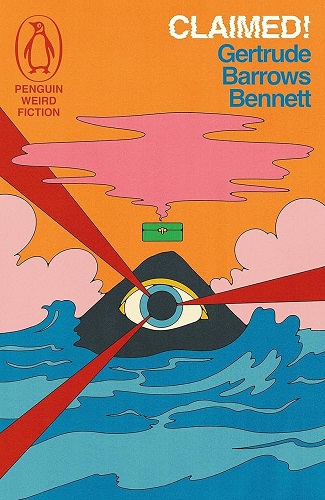
Claimed!, Gertrude Barrows Bennett

The existence of New Weird has always implied the existence of Weird, but given I’ve never explored genre fiction from the first two or three decades of last century, and what few books I had read I’d never thought of as “weird”… Edgar Rice Burroughs’s Barsoom novels, for example. HG Wells. Robert Howard. Even early science fiction magazines, such as Amazing or Astounding. Not really weird, I would have said. 

I’d heard of Francis Stevens, had even read a couple of stories by her, and knew it was a pseudonym of Gertrude Barrows Bennett, a hugely popular writer of science fiction and fantasy in the years after World War I. Again, not really weird.

Recently, Penguin published a short series of Weird Fiction books – an anthology, and novels by Bennet, Algernon Blackwood, William Hope Hodgson and Robert W Chambers. A couple of months ago, they were on offer as ebooks, but I only bought the Bennett. I was, I admit, expecting something like the Francis Stevens stories I’d read years before, even though the book’s blurb made it sound more like HP Lovecraft…

If anything, Claimed! (1920, USA) reads like a tale from some horror anthology television series, The Curse of the Monkey’s Paw or something. A doctor is called to the house of the richest man in the town, even though the man is not his patient. But the doctor was available and lived close by. The rich old man has suffered some sort of shock, and is put to bed. He has in his possession a small box made of a  strange green stone. It has red writing in an unfamiliar alphabet on the top, but whenever anyone looks away the inscription transfers to the bottom of the box. Although clearly made to be opened, no one has succeeded in learning what’s inside.

The old man is afraid someone is after his box, someone not entirely natural. He persuades the doctor to move into his house and minister directly to – keep watch on – him. The doctor agrees, chiefly because he fancies the old man’s niece.

After a series of strange events – an illusory sea seeps into the old man’s bedroom, the town is flooded several times – they learn the box was found on an island formed during a volcanic eruption near the Azores. So the old man, doctor and niece charter a ship and head for the island. But the old man and niece are kidnapped by the crew of a mysterious clipper. The doctor gives chase in the steamer chartered by the old man…

Claimed! is pretty much Lovecraft without the eldritch horror. The prose is also less overwrought. Perhaps it drags out the mystery a little too long, and then wraps it up far too quickly, but it was entertaining enough and not at all the chore to read I was expecting. 

And yes, it probably was weird after all.


Leave a comment

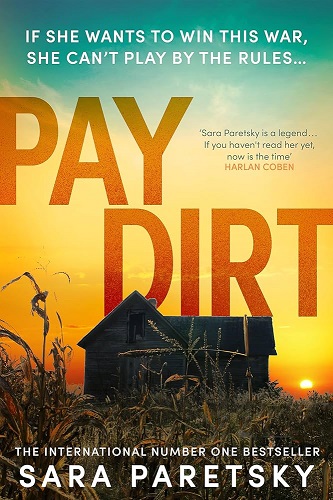
Pay Dirt, Sara Paretsky

VI Warshawski is in Lawrence, Kansas to support a flatmate of her French-Canadian friend, who is about to break some sort of scoring record in a basketball game. One of the young women in the group visiting from Chicago vanishes after the game, and Warshawski stays on to look for her. This brings her into conflict with various town worthies, which in turn leads to her stumbling across the disappearance of a young woman who managed to offend the town’s most prominent families.

It all goes back to the American Civil War, and the influx of abolitionists into Kansas, many of whom, it transpires, were not as liberal as their descendants claimed. It’s about a derelict house from the 1800s which can’t be demolished as it’s historically important, has more recently been used for drug-fuelled parties by over-titled frat boys from the nearby university, and is where Warshawski finds the missing young woman. And, a day later, a murdered woman.

Confusing matters, or perhaps related to them, is the construction site on a hilltop near the house. The company that now owns the lands is allegedly building a tourist resort, but from what Warshawski sees of the site that doesn’t seem plausible. A nearby decommissioned coal power station is about to begin generating power again (and the manager of the power station was murdered only a few weeks before).

There are two plots in Pay Dirt (2024, USA), which intertwine. The missing woman had proof a white family had stolen ownership of the hilltop from a black family in the mid-1800s. Then there’s the purpose behind the construction work on the hilltop, and the recommissioning of the old power station, which leads back to a billionaire family – clearly inspired by the Koch brothers – and their industrial empire…

As ever, Warshawski wears her politics on her sleeve, and consequently makes more enemies than friends. There’s mention of Covid and its impact, and social media plays a role in the plot – although Paretsky misses a trick when she reveals the real purpose of the hilltop site, revealing it’s for tech that was slightly news-worthy ten years ago where as there’s one that has been definitely more news-worthy the last couple of years.

Paretsky has not lost her touch. She can still generate anger – from those who agree with her at the injustices she documents, and from those who disagree with her for casting their views in an unflattering light. If anything, she’s more incandescent now than she used to be, and now I think about it her books seem to have moved from legal injustice to include political injustice and then social injustice. 

Paretsky was one of the original “Sisters in Crime” back in the 1980s, a group of female crime authors – including Sue Grafton and Linda Barnes – who set out to write female-authored and female-led crime and mystery novels. Obviously, they succeeded – in fact, I think female crime writers now outnumber male ones (female readers certainly outnumber male). She is still worth reading.


Leave a comment

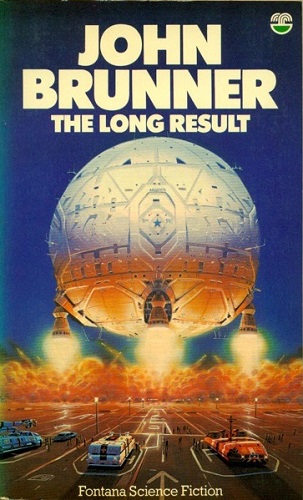
The Long Result, John Brunner

I must have last read The Long Result (1965, UK) almost 45 years ago – I’ve had a copy on my bookshelves since at least the 1980s, and it’s a paperback published in 1979 and bought new, so probably 1980 or 1981. And pretty much nothing from the book had stayed with me over the decades. Except…

Many, many years ago in my late teens I remember creating an alien race for something – a story, a role-playing game adventure; I don’t remember. I later used a variation on that alien race for a spoof space opera story written in the late 1980s and published in the very early 1990s. It wasn’t a very good story, and has thankfully vanished into obscurity. The alien – if I ever named the race, I no longer recall the name – was slightly larger than a human, with four arms, blue skin, and a vaguely equine head.

So I was a little surprised on this reread of The Long Result to discover the book was the inspiration for the alien race. In Brunner’s novel, they are the Regulans, and are pretty much indestructible. Only one appears in the book (at least until the epilogue, when a ship-full makes an appearance).

The narrator, Roald Vincent, is an assistant chief at the Bureau of Cultural Relations, the organisation which keeps tabs on Earth’s two colonies, Starhome and Viridis, and the handful of alien races so far discovered. When Starhomers turn up at Earth with a delegation of newly-contact chlorine-breathing aliens, this kicks off a series of attacks by the Stars Are For Man, a previously crank human supremacist group now turned terrorist. Vincent is in the thick of it, and manages to figure out the conspiracy before too much damage is done.

He’s supposed to be extremely clever, destined for great things, but a bit of a coaster. The narrative makes much of his uncanny ability to uncover what’s going on, yet he continually misses the most suspicious person in the entire novel.

I’ve never been a fan of Brunner’s fiction. I’ve read some of his better known works – Stand on Zanzibar (1968, UK), The Jagged Orbit (1969, UK), The Squares of the City (1965, UK) – but I didn’t like them all that much. And he wrote a lot more bad novels than he wrote good ones. So if I didn’t like the good ones… He strikes me as a writer whose reach mostly exceeded his grasp. Or is it the other way round? The Long Result makes a couple of good points, but the world-building is thin (and dated, but in an interesting 1960s futurist aesthetic sort of way), and the plot relies too much on Vincent being almost psychic at times and not at all bright at others. It’s a slight book – it took me an afternoon to read the 186 page Penguin paperback – and I’m not in the least bit surprised I remembered none of it.

Except for the Regulans. Which was a bit weird.


Leave a comment

Longer reviews

For the past few years, I’ve been writing longish reviews of books on Medium. I plan to keep that going, but I should probably post a link here when a new review goes up there. As happened last night, a review of John Scalzi’s Redshirts (2012, USA). You can find it here.

I’ve been posting reviews on Medium since May 2021, so there are quite a few. Feel free to check them out.


Leave a comment

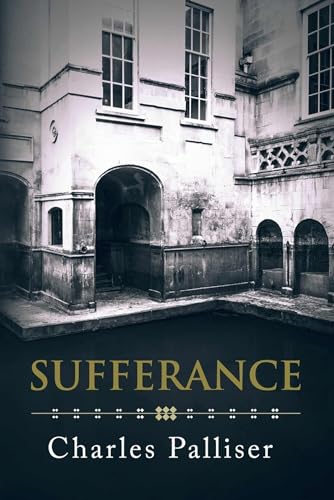
Sufferance, Charles Palliser

I’ve been a fan of Palliser’s novels since reading his debut, The Quincunx (1989, UK), a complex Dickensian novel about an orphan and the mysteries surrounding his birth back in the 1990s. Betrayals (1993, UK) features a pitch-perfect pastiche of the TV series McTaggart and a borderline litigious spoof of author Jeffrey Archer (allegedly based on fact). Sufferance (2024, UK) is the first book from Palliser since Rustication (2013, UK), and it’s perhaps the most obvious book he’s written to date.

In terms of length, it’s probably closer to a novelette, or perhaps a sf novel from the 1960s. It’s set in an unnamed country after it has been occupied by unnamed enemy forces – or rather, the western half of the country has been annexed, but the eastern half, where the story takes place, has chosen to collaborate. While Palliser names no names, we’re clearly in some analogue of World War 2 France.

A well-meaning man has taken in a schoolfriend of his youngest daughter, whose rich parents were trapped in the western half of the country when it was overrun. His motives are not entirely altruistic – he hopes for a better-paying job from the daughter’s father – but the girl’s family are members of a “community” whose rights and privileges are slowly taken away as the novel progresses. To the extent, in fact, their property and wealth is confiscated, they’re forced to live in a ghetto, and later are “relocated” to camps outside the city…

All of which makes looking after the girl ever more difficult. Initially, lies to neighbours are enough, but when rationing is introduced the lack of papers becomes a problem. Eventually, they have to hide the girl in the attic. Throughout all this, the girl is arrogant, ungrateful and manipulative. The title is clearly intended to refer to both the city under the collaborationist regime and the danger to the family brought on by the girl’s presence in their apartment (and, also, the behaviour of the girl to the family).

It’s hardly subtle. Pallier’s prose distances the reader from events – there are no names, the countries and period are not mentioned – but the narrative remains sympathetic to the narrator, even though his motives are chiefly self-serving. He hopes to be rewarded, but he’s also sensitive to the evolving situation regarding the community. And he’s powerless to prevent his family from suffering as the regime slowly collapses from corruption, greed and fear.

It’s all very inexorable, as no doubt it felt in the 1940s. Palliser manages to evoke sympathy in a narrator who does bad things out of greed, but soon finds himself doing worse simply in order to survive. Of course, he’s implicitly questioning the reader: what would you do to survive in the same situation? How long would you hold onto your principles? Should the laws still be obeyed, even when they’re plainly immoral?

After all, the family hiding Anne Frank was breaking the law; anyone who told the Gestapo about her would have been considered law-abiding.


Leave a comment

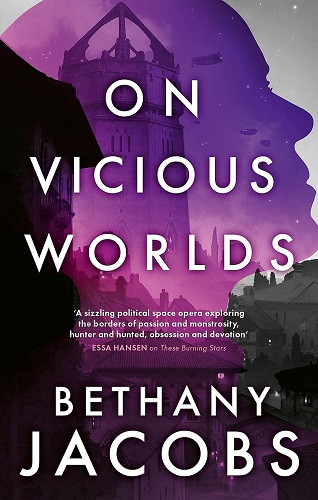
On Vicious Worlds, Bethany Jacobs

The second book of the Kindom trilogy, begun with These Burning Stars (2023, USA; see my review on Medium here). There’s a thing called Middle Book Syndrome which often affects trilogies. The first book does all the heavy-lifting for the world-building and kick-starts the plot; the final book is all about the climax for the story. So the middle one often consists of little more than re-arranging pieces on the board to set up the end-game. Jacobs makes a brave stab at avoiding the syndrome… and almost succeeds. 

Six and Chono are with the Jeveni in their ice-planet colony, reached by a stargate which has been locked against Kindom forces. But all is not well. Those non-Jeveni who were dragged along when the Jeveni escaped have been subject to, occasionally violent, prejudice. There has been a series of suspicious deaths – initially framed as suicides, but soon identified as murders – of Jeveni law enforcement officers. And there is another hacker, potentially better than Ironway, who’s been breaking important colony infrastructure. §

The identity of this hacker – called “the avatar”, but avatar of what? that’s not how you use the word – is one of the puzzles around which On Vicious Worlds (2024, USA) is structured, much as Six’s fate was in the first book. Unfortunately, it’s not as interesting; and the reveal is nowhere near as shocking, or indeed as credible.

Chono and Six return to the Kindom. Where they discover the Jeveni left behind have been forced to work in camps manufacturing vital fuel sevite – because apparently no one else in the Kindom can do it. There also seems to be some sort of power struggle going on between the three arms of the Kindom government – security, secretariat, and clergy. The secretaries seize power. They attempt to arrest Chono – who has become some sort of folk hero, although it never feels well-grounded – and Six. There’s a big fire-fight. Cue cliff-hanger ending.

They’re fun these books. Perhaps a little too Warhammer 40K, somewhat too brutal and heavy-handed; and in places it’s almost as if they’d looked to Banks’s Culture novels for inspiration and then borrowed the very things his novels were arguing against. The world-building is paper-thin in places, more so here than in The Burning Stars, and I’ve yet to be convinced some of the real-world inspirations were wise choices. The plotting is nicely convoluted, but still relentless, the action scenes well-choreographed, and there are more than enough intriguing hooks and callbacks.

If space opera had alignments, the Kindom trilogy would be chaotic evil – and Yoon Ha Lee’s Hexarchate trilogy possibly lawful evil. Given the choice, I’d sooner not read evil novels. Something lawful good, like Ann Leckie’s Radch novels, is more to my taste; or even chaotic good, such as the aforementioned Culture. But if I had to read a chaotic evil space opera trilogy, Jacobs’s trilogy would be the one.


Leave a comment

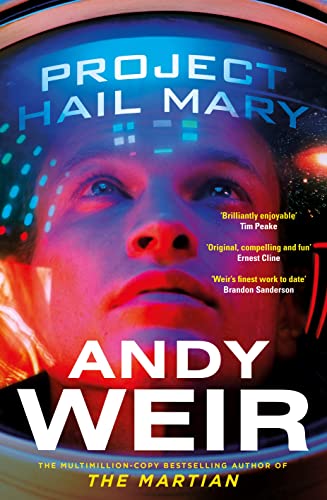
Project Hail Mary, Andy Weir

For a novel explicitly constructed as an old Analog-style puzzle story, there are four puzzles in Project Hail Mary (2021, USA) which the novel does not attempt to solve: why did I buy it, why did I read it, why was it published, and why has it been successful? I can possibly answer the first two – it was cheap, 99p in fact; and, I am an idiot. But the last two will forever remain a mystery.

Weir, of course, is best-known for The Martian (2014, USA), a surprise best-seller, originally self-published, which was then turned into a movie by Ridley Scott. The Martian is not a good book – a first-person narrative written by an unlikeable narrator, and written in the first-person for all the wrong reasons. It sold itself on its science, which is, unfortunately, not as accurate as it claimed.

Project Hail Mary is Weir’s third novel, following Artemis (2017, USA), which I have not read. In Project Hail Mary, a man wakes up aboard a spacecraft in another planetary system, with no memory of who he is or why he is there, or indeed where he is. Through chronological flashbacks, he learns he is one of three astronauts – the other two did not survive hibernation during the trip – sent to Tau Ceti. A microscopic creature has begun feeding on the Sun, and this threatens life on Earth. Tau Ceti is also infested with the microbes, called “astrophages”, but it is not losing luminance. An international project is put together to send a ship to Tau Ceti to discover why, and possibly send back a means to kill the microbes.

The microbes’ biology means they can convert mass to energy and back with no loss, making them a perfect fuel, allowing the ship to reach near light-speed. Soon after awakening, the narrator is hailed by an alien ship. It too has a single surviving crew. The alien is a rock-skinned spider-like creature which lives in a hyperbaric ammonia atmosphere. So, of course, the narrator names it Rocky. The two learn to communicate, and together discover why Tau Ceit’s astrophages have not destroyed the star.

The narrator is a high school science teacher. He was a physicist, but he published a paper on extraterrestrial life which saw him drummed out of the scientific community. Somehow or other, he ends up as an expert on the astrophage. Which is why he’s sent to Tau Ceti. He mentions repeatedly that he’s a good and well-loved teacher, which seems completely plausible as he thinks like a teenager.

Because he’s a high school science teacher, everything he encounters is solvable using high school maths. Which Weir explains in detail. All the technology, the sophisticated computers, aboard the spaceship, and yet every problem he encounters can be solved using schoolboy mathematics. It gets old very very quickly.

The astrophage is, I admit, quite ingenious, but it seems extremely unlikely to have evolved – in fact, I kept on expecting to read it was engineered. But no. Every other idea in the novel springs from the astrophage’s biology. The characters are drawn with the broadest of strokes; and while the cast is international, it’s only the handful of Russians and Chinese who don’t come across as Americans.

Many years ago, there was an international best-selling novel which taught its reader about the history of philosophy. Sophie’s World (1991, Norway) by Jostein Gaarder. I seem to remember reading it. Project Hail Mary reads like an attempt to do the same for high school maths, by showing how useful it is when, for example, trying to rendezvous with an alien spaceship, work out how not to poison yourself in an ammonia atmosphere, or even accidentally blow up the entire Earth while experimenting on microbes which are capable of total mass-energy conversion. Handy to know.

A novel that sets a low bar and all too often barks its shins on that bar. Avoid, unless you’re a masochist, or, like me, an idiot.