
It Doesn't Have To Be Right…

… it just has to sound plausible


1 Comment

Cat Karina, Michael G Coney

The late Eric Brown, a friend of many years, was a big fan of Coney’s fiction, but for some reason Coney was one of those authors I never seemed to pick up. The first was Hello Summer, Goodbye (1975, UK) about fifteen years ago, and I thought it quite good – and later I picked up and read Charisma (1975, UK). But stopped there. I’ve read more in the last few years, and found his Amorph trilogy of Mirror Image (1972, UK), Syzygy (1973, UK) and Brontomek! (1976, UK) good examples of a type of expatriate English science fiction of the 1970s which I find strangely appealing.

Cat Karina (1982, UK) is not that. It’s set in the far distant future, the Greataway, on an Earth populated by races that have been genetically melded with assorted animals, and in which technology is anathema – in fact, even fire is banned. The novel is explicitly framed as the telling of a legend, so much so it inserts commentary on later distortions and interpretations of the story. Also in the narrative are alternative timelines, happentracks, predicated on decisions made by Karina and others which might affect the future, or Ifalong.

There’s a prophecy, but it’s really a millennia-long plan to bring about the birth of someone who can free Starquin, “the greatest person the Earth has ever known”, who was imprisoned millennia earlier, and it involves the title character, who is a Specialist, a human with animal genes, and a felina, meaning the animal genes are from jaguars. Karina lives in a village on the sailway line, a wooden monorail with wind-powered sailcars. One section of the track is too steep for wind-power, so the sailcars must be hauled up to the summit. By teams of felinos. The chief cargo on the sailway is tortugas, a highly-prized fruit grown in the mountains on heavily-guarded farms.

A handmaiden of the Dedo, a part of the Starquin’s body “in human form”, whatever that is, tries to manipulate Karina so she follows the prophecy, but Karina has a mind of her own… The main story follows the preparations for an annual sailcar race to deliver the season’s first tortugas to the coast, and the plan to use a sailcar built using forbidden technology – ie, metal. Which could mean there will no longer be a need for gangs of felinos. Which prompts a revolution, with the Specialists overthrowing the True Humans.

There is little, to be honest, all that original about the plot of Cat Karina – it runs on rails as well-greased as those of the sailway. And, it must be said, the novel does a great deal of heavy-lifting when it comes to filling in the back-history of the universe (there’s a later trilogy set in the same universe), but it does so with some smart neologisms and an impressive economy. I don’t think Cat Karina privileges world-building over story, a common fault in science fiction and fantasy, but its world-building is certainly more original and accomplished than its story. Karina is an engaging hero and well-characterised, and it never feels like she’s being pushed and prodded by the plot, even though the narrative often details other happentracks. There’s some nice invention in parts, the secret of the tortugas, for example, an important plot-point, unlike the secret of the tumps (huge torpid meat animals), which is not.

Cat Karina is a well-crafted novel, and a good example of its particular type. To be honest, I much prefer Coney’s near-future sf, but for fans of sf set so far in the future it might as well be fantasy, Cat Karina (and, I expect, the trilogy which followed it) is a good read.

Leave a comment

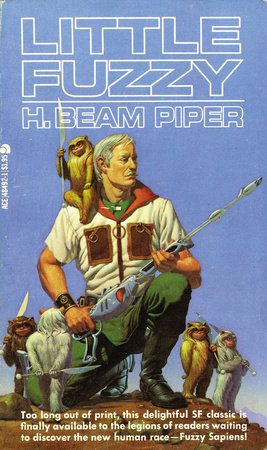
Little Fuzzy, H Beam Piper

Another allegedly classic sf novel, which was nominated for the Hugo in 1963. Dick’s The Man in the High Castle (1962, USA) won that year, and was easily the best of the shortlisted novels. Little Fuzzy (1962, USA), on the other hand, is slight, not in the least bit plausible, and opens from a position of such comprehensive US hegemony its story is pretty much unrecoverable.

The title refers to the indigenous race on Zarathustra, waist-high cute-looking furry creatures with an average intelligence comparable to that of small children. Humans have been on the world for several decades before the first “Fuzzy” appears, and the corporation which owns the planet quickly realises that a native race invalidates their ownership of the world and all its resources. So they play dirty in an effort to prove the Fuzzies either non-existent or not intelligent. A situation which comes to a head when a company bigwig stamps on a Fuzzy, killing it, and a company bodyguard is shot and killed in self-defence.

Like a lot of American sf of the period, this is resolved by people coming together, homespun legal wizardry, a general distrust of the government (and governing corporation), and a handful of native backwoods cunning from several of the cast. While the local governor is corrupt, the local Navy base is packed to the gills with upright honest officers and personnel. The corrupt mayor is a cliché, but so too is the valorisation of military probity – at least in 1962, before the Vietnam War. There are entire Hollywood movies from the 1930s through to the 1950s which use any one of those tropes on which to hang a plot. And each one is as hokey as the next. 

If anything, Little Fuzzy multiplies the hokiness. It’s a novel with far more mouthpiece characters than it needs or the reader deserves. The Fuzzies may be intelligent enough to determine their own destiny, but the humans on their side seem to treat them chiefly as precocious pets. There are many arguments to be made about the European invasion of continental North America, but this novel doesn’t even come within spitting distance of them. It’s the colonisers defending the colonised against the colonisers’ own kind, for reasons that are best not examined too deeply.


Leave a comment

Hotel du Lac, Anita Brookner

Apparently a surprise winner of the Booker Prize back in 1984. Ballard’s Empire of the Sun (1984, UK) was the favourite, although Lodge’s Small World (1984, UK) or Barnes’s Flaubert’s Parrot (1984, UK), the only other books on the shortlist I’ve read, would have been a better winner than Hotel du Lac (1984, UK). It’s not that Brookner’s novel is bad – it’s nicely written, with some sharp insights. But. It’s set at the time of writing but reads like it takes place in the 1950s or 1960s. It’s horribly old-fashioned.

Edith Hope is a single woman in her late thirties, who writes “women’s fiction” under a pseudonym, reasonably successfully. She has a lover, a married man, and lives alone. She accepts an offer of marriage from a man, but jilts him at the altar (well, outside the registry office). Her friends, upset with her, arrange for her to spend a week or two at the titular hotel in Switzerland. It’s the end of the season, and there are only a handful of other guests: Mrs Pusey and her daughter, Jennifer; La Comtesse de Bonneuil, a caricature of a early twentieth-century European grandmother, and Monica, an anorexic (although this is never said) and beautiful minor aristocrat. A group of men stay at the hotel, among them Mr Neville, the well-off owner of an electronics company, in his fifties, smug and successful. He later proposes to Edith – marriage, but a partnership predicated on comfort and position, not love.

Throughout her stay, Edith writes long letters to her lover back in London, but does not send them. Various little scenes are enacted, Edith learns more about her fellow guests, their back-stories and their personalities. Mrs Pusey is quickly revealed as selfish and mistaken in her level of consequence. Her daughter, who is the same age as Edith, is little more than an accessory. Monica is a snob and dismissive, but surprisingly friendly. Madam de Bonneuil is deaf and a figure of (gentle) fun.

It’s all very smooth, and Edith is an engaging, if overly introspective, protagonist. But it’s all so horribly outdated. Neville takes Edith on a boat-trip across the lake, and wears a deerstalker hat. In 1984? Seriously? Edith wears gloves to her aborted wedding. Women rarely wore gloves to church – or registry offices – in the 1970s, never mind the 1980s. The women are dismissive of feminism, and define themselves in relation to the men in their lives, or who were once in their lives, or all men in general. This is not the early 1980s I remember.

If Hotel du Lac had been written and presented as historical fiction, it might have read better. Having said that, even then it wouldn’t have deserved to win the Booker.


8 Comments

An exaggeration

As Mark Twain said regarding his published death – and after four years I’m tempted to bring this blog back to life. I’d become dissatisfied with posting 100-word rants about the books I’d read and the films I’d seen, so I felt I needed to walk away. And I was annoyed at the unwanted changes WordPress had made to its editor.

But the habit dies hard – the habit of reviewing, that is; although I suppose the habit of ranting is equally enduring. Soon after shuttering this blog, I started posting longer, actual proper, reviews of books on Medium – see here – and a year or two later, I began posting shorter book reviews on Facebook. It occurred to me recently I might as well post the latter here as well. I’ll continue to post them on Facebook and LibraryThing, but I’ll leave the longer reviews to Medium… And I may well branch out here and post more than just book reviews. But no rants.

Hopefully, posting reviews here will generate conversations much as it has done on Facebook – although not just among friends. Social media these days is a cesspit – actual posts by friends are in the minority on your Facebook timeline, Xitter is a shit-filled bearpit populated by fascist morons, and Bluesky started off well but is now pretty much doom-scrolling…

Maybe it’s time for a second lease of life for the blogosphere. We shall see. Or not.