
This was a reread, although I couldn’t tell you when I last read the book. The late seventies or early eighties, at a guess. I’d remembered the novel’s basic set-up, but nothing else. Venus Plus X (1960, USA) is set in the distant future, in a utopian community of hermaphroditic humans (not really an acceptable term these days, but these have the organs of both sexes and can procreate).
A man from the mid-twentieth-century is pulled forward in time to the community of Ledom. Yes, it’s “model” backwards, but Sturgeon admits in a postscript he reversed the name of a can of his favourite tobacco. The time-traveller, Charlie Johns, is asked to give his opinion on Ledom and its society. Various guides show him around and explain things. Everything in Ledom is a consequence of the “A-field”, a sort of force-field, and the “cerebrostyle”, which can write knowledge directly onto people’s brains. There is also a chapter on biology – the Ledoms have both sex organs, and two uteruses, and always give birth to twins.
Alternating with this guidebook-style narrative is some sort of sitcom featuring two families who live next door to each other. These sections are almost entirely dialogue.
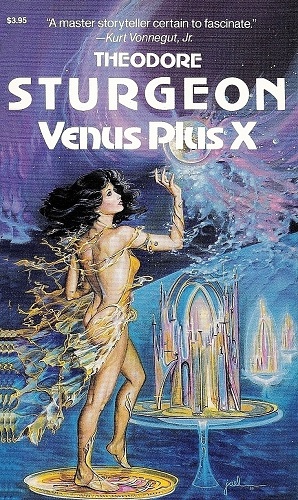
(The cover shown above, which I think is the edition I have in storage, badly misrepresents the actual story)
There are long sections on gender, which I suspect only gammons and terfs will disagree with, and religions, which manages to erase almost all of them except Christianity and misrepresents those it does mention. Sturgeon’s thesis is that both of these – the elimination of gender through the creation of hermaphroditic humans, and a charitic religion – were necessary to create the utopian Ledom. Except, while Sturgeon rightly points out gender roles are social constructs, he still defines them using biological sex; and, as others have pointed out, the gender politics Sturgeon presents were not universal even back in 1960 – and his model society only exists more because of its two magical inventions than anything else.
Charlie learns Ledom exists inside an A-field bubble on an Earth devastated by nuclear war. He also discovers – against the wishes of the Ledom senior members – that the Ledoms give birth to normal humans, which are then (surgically?) altered to be Ledoms. For some reason, this sends Charlie completely off the rails and he tells them he, and all humans, would kill them if they could. When Charlie tries to escape to the past, he discovers the truth about the time-travel machine. Meanwhile, nuclear bombs explode outside Ledom’s A-field – is this implying humans still live? Or that Ledom is actually in the present? It’s unclear.
Sturgeon writes that he wanted to write a novel about sex. The novel credited with introducing the topic of sex into science fiction is Philip José Farmer’s novella, ‘The Lovers’ (1952, USA). The earliest sf novel I can find centred around a hermaphroditic character is Katherine Burdekin’s Proud Man (1934, UK), but in that novel the hermaphrodite travels back in time from the future to 1930. Burdekin’s novel, according to Wikipedia, criticises gender roles. Venus Plus X doesn’t do that – it posits a near-utopia, which despite its arguments only survives because it hides a horrible secret, which, to be fair, is a common science fiction trope, sort of like soylent green. I wasn’t convinced.
The title, incidentally, comes from the phrase “men are from Mars, women are from Venus”, and Charlie speculates the hermaphroditic Ledoms are women with a bit extra, “x”. Ugh.
 It Doesn't Have To Be Right...