It Doesn't Have To Be Right…

… it just has to sound plausible


Leave a comment

Up the Walls of the World, James Tiptree Jr

Tiptree, whose real name was Alice Sheldon, not only convinced the science fiction world she was a male writer for much of her career, she also wrote a number of stone cold classic science fiction short stories. I am definitely a fan of her short fiction. She only wrote two novels, however: Up the Walls of the World (1978, USA), and Brightness Falls from the Air (1985, USA). This was my first read of Tiptree at novel-length.
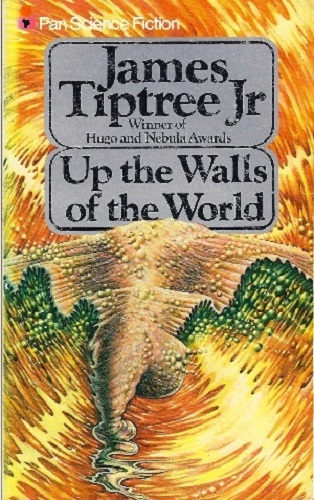
The title refers to the “walls” of a vast maelstrom in the atmosphere of a gas giant, Tyree. It is inhabited by huge manta ray-like aliens, who communicate using light but also seem to experience some radiation as “sound”. It takes a while before the synaesthesia Triptree uses makes sense, and I’m not entirely convinced it, and the fact the males nurture the young, makes the aliens as, well, alien as Tiptree intended.

Meanwhile, on Earth, Dr Dan Dann (yes, really) is the medical support for a US Navy-sponsored experiment in ESP involving a handful of varied subjects – a pair of identical twins, two teenage girls, a a matronly housewife, an embittered dwarf, and a somewhat dim-witted young man. The experiment is moved to a remote Navy camp, when the twins are used to test telepathic communication between land and a submarine.

A third narrative, written entirely in CAPITALS, which proves really irritating to read, is the stream of consciousness of some sort of distributed interstellar intelligence, which has been destroying stars.

The Destroyer’s attack on Tyree’s star prompts the aliens to attempt to take over the minds of Earth’s humans, and a “test mission” results in some of those involved in the Navy experiment finding themselves in alien bodies on Tyree. One of the experiment’s staff, however, a POC computer programmer instead becomes part of the Destroyer. Which she tries to control, using her knowledge of programming.

There are things to like in Up the Walls of the World, but I’m puzzled at the praise given to the novel around the time it was published. I get that a novel from Tiptree, a controversial figure and a well-known writer of top-notch science fiction short stories, is worthy of serious consideration… But I suspect time hasn’t been especially kind to the book. The descriptions of Tyree are good, and its inhabitants are original and well-presented – but not all that, well, alien. Dr Dan Dann (yes, really) is very much a typical narrator for US science fiction of the time (and Tiptree does well at channelling her inner Jubal Harshaw), and her POC character is unusual for the late 1970s and handled sensitively.

As I read Up the Walls of the World, I couldn’t help wondering if CJ Cherryh’s Voyager in Night (1984, USA), published six years later, was partly written in response. It’s another novel that hasn’t quite survived the millennium. Nonetheless, I still recommended reading everything Tiptree wrote.
Leave a comment

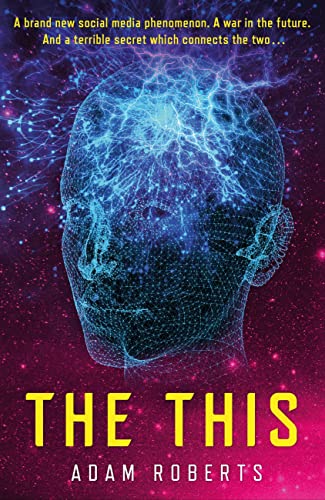
The This, Adam Roberts

It has been suggested good Bruce Willis movies are the ones where he has hair, and in bad ones he is bald. Obviously the same wouldn’t work for Adam Roberts’s novels, because, well, his hairline may be receding but it doesn’t vary by book. I did think, however, something similar might operate with the titles of his novels – those which start with the word “the” were excellent, those without are merely good. But, according to Wikipedia, of Roberts’ twenty-four novels, only three have the definite article as the first word in their title… 

True, I liked two of them, including The This (2022, UK); but I’ve not read the third. And, to be honest, I did like some of the ones without an initial “the”. So, not a good theory then. I suppose I was trying to find a reason why I liked The Thing Itself (2015, UK) and The This so much more than the other novels I’d read by Roberts. The answer was, of course, there in the books: they are explicitly explorations of the ideas of individual philosophers, Kant and Hegel, respectively. What I know about philosophy and philosophers can be written on a small post-it note, so perhaps it’s the discipline which hewing to the particular philosopher’s works has forced on Roberts – sort of like Oulipo, I guess – which has, to my mind, produced works of science fiction I find I much prefer.

On the other hand…

The title refers to a company which creates a hands-free app for social media. In the future, a war between Hive Mind Theta, the end-result of all those people having the hands-free social media client implanted in their brains, and the rest of humanity takes place in orbit about Venus, which HMΘ are intending to terraform. 

The two main narratives are set around a century apart. In the very near future, Rich Rigby, a freelance journalist, interviews a PR person from The This. The company then sets out to recruit him to their network, so intently it draws the attention of, er, HMG. They persuade him to join The This, but he’ll have a computer virus embedded in his brain. This will allow the authorities to spy on the hive mind.

Then there’s Adan Vergara, a none-too-bright New Yorker of a century or so after Rigby, who is cut off by his mother and has to join the military. They’re fighting HMΘ, but Vergara seems to be able to shutdown HMΘ droids on the battlefield simply by uttering a single gnomic phrase. He was told this phrase by someone, or something, who hacked his Phene (a semi-aware sexbot, essentially), which Adan profoundly loves.

As the war ends, Adan is pulled into the far distant future, where he meets the embodiment of Hegelian world spirit, which was threatened by the existence of the hive mind. He is told how he, and Rich Rigby, helped put humanity back on track, so the universe would end with a Prime Mover as intended. 

As I read the final section of The This, I was reminded of AE van Vogt’s The Universe Maker (1953, Canada), where the hero is pulled into the far distant future to have the plot of the novel explained to him by a giant space brain. The This is, of course, considerably better written, and a “novelisation” of Hegel’s Phenomenology of Spirit (1807, Germany) is hardly the same as Van Vogt’s crackpot science and dream-inspired haphazard plotting.

To be honest, I was more taken with Rigby’s and Vergara’s narratives. The opening section, a piece of experimental prose, was good, but experimental prose is best in small doses. But Rigby and Vergana – it’s superior prose. I do wonder how much of Roberts’s The Black Prince (2018, UK) project, the completion of an unfinished novel by Anthony Burgess, rubbed off on The This, because there’s a distinct Burgessian feel to the language. I also suspect one of the earlier sections, which features a string of social media posts as marginalia, was included only so Roberts could include some of his bad Twitter jokes – but perhaps that’s unkind.

The This is the best of Roberts’s novels I’ve read so far (which is around half of them). Recommended.


Leave a comment

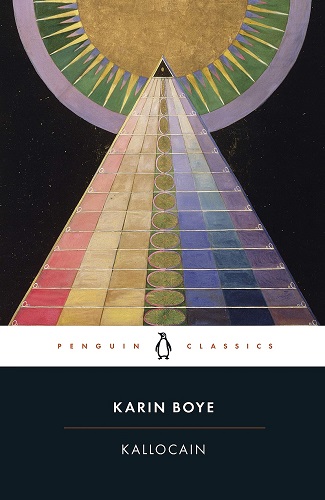
Kallocain, Karin Boye

I’m not a big fan of dystopian fiction, mostly because it all seems so obvious. Oh noes, things are bad, this is what they will look like if they carry on in the same vein… Which , of course, they rarely do. And there’s no real evidence dystopian fiction helps prevent what it describes – if anything, it’s the reverse, as pointed out by the oft-repeated meme about a Torment Nexus…

Of course, dystopia is in the eye of the beholder – or rather, the politics of one era define that era’s dystopia but may not hold true a decade or a generation later. (On a side-note, I find fascinating dystopias where the citizens have been programmed – chemically, technologically, or neuro-surgically – to be happy with their lot; Alastair Reynolds describes one such in one of his Glitter Band novels, John Varley has written something similar.)

Boye, a Swede who lived in Nazi Germany, wrote Kallocain (1940, Sweden) very much as a response to her experiences living there. In the world of Kallocain, there is a World State. But it has enemies. And a border. Which means it’s not a world state. But that’s just a name. Leo Kall is a chemist in a Chemistry City (which sounds very Soviet). He discovers a new truth serum, which he names after himself and for which the book is named. It allows the authorities to interrogate people while they are only thinking about crimes – pre-crime, as Philip K Dick has it.

Kall uses his discovery to better his situation, and to destroy his superior, who he believes (wrongly) is having an affair with his wife. What follows is pretty much inevitable. There are hints the leaders live lives of luxury and freedom, which reads as a direct dig at the Nazi leadership. The general air of paranoia and deprivation echo both the USSR and the final years of the Nazi regime. 

If you’ve read Orwell’s Nineteen Eighty-four (1948, UK) or Zamyatin’s We (1924, Russia), there’s little here that’s different, although Kallocain is less brutal than the former and less science-fictional than the latter. It should by rights be held in as high regard as those two novels, but it wasn’t translated into English until 1966 and, of course, its author is female. A good historical dystopian novel that stands alongside better-known examples.


Leave a comment

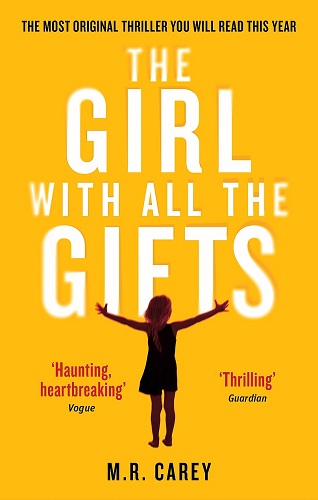
The Girl with All the Gifts, MR Carey

I’d heard The Girl with All the Gifts (2014, UK) was zombie fiction, and I don’t like me zombie fiction no matter how you spin it, and that includes The Passage (2010, USA), so I had no great expectations for this, even though: a) it was nominated for the Clarke Award (but lost out to Station Eleven (2014, USA), a book I admit I did not like), b) I’ve met Mike Carey and he’s a nice guy, and c) it was on offer at 99p.

There’s a “but” implicit in all that, and yes, I did think The Girl with All the Gifts was actually pretty good. It opens firmly focused on the titular girl, Melanie, who is in some sort of research facility. Clearly, she’s not an ordinary girl – she has to be locked into a wheelchair for classes, she eats once a week (a bowl of worms), and the staff of the underground bunker where she lives is scared of her and her classmates. 

Carey doles out his information slowly and carefully. The UK – the world – has collapsed following a plague of some sort, which has reduced the bulk of the population to flesh-eating zombies, or “hungries”. But Carey provides a rationale – the zombie fungus which infects ants, takes over their bodies and forces them to climb plants in order to provide a higher platform to spore (and which really exists), has crossed the species barrier and infected humans.

Melanie is infected, but she is different. As are her classmates. She may crave human flesh, when triggered by pheromones, but she’s not mindless, she can think like a normal human being – if anything, she actually has a genius-level IQ.

Junkers  – Mad Max-like survivalists – attack and overrun the military base holding Melanie and her classmates. Melanie escapes with Sergeant, the head of base security, a trooper, Dr Caldwell, the head of the research programme, and Miss Juneau, a teacher on whom Melanie has a crush. They must travel south to Beacon City, the sole bastion of uninfected humans in the UK.

As they make their way through a deserted London, populated only by “hungries”, they learn more about the fungus. Sadly, Caldwell is something of a Mengele figure, happy to sacrifice people if it leads her to a better understanding of the fungus, and her willingness to let the others die gets annoying quickly. Having said that, she does discover Melanie’s secret – although her proposed “cure” would kill Melanie, and the kids like her they’ve encountered as they travelled toward Beacon – but not necessarily save humanity.

I do not, as I said, like zombie fiction much, and The Girl with All the Gifts is pretty much a zombie novel. But the use of the real-life zombie fungus to explain it, the focus on the disease, rather than just using it as a mechanism for menace, lifts this novel above others of its ilk. I rather enjoyed it. A good Clarke nominee, I think.


Leave a comment

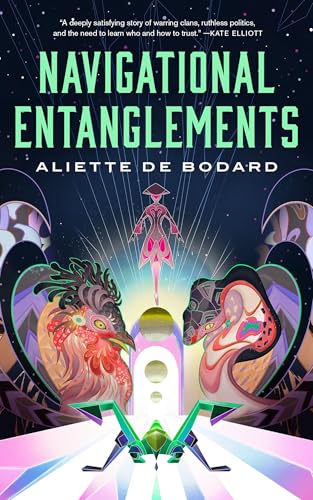
Navigational Entanglements, Aliette de Bodard

After a number of unsatisfying, and occasionally offensive, old science fiction novels, it’s time for something new. Navigational Entanglements (2024, France) is a short novel, probably closer to a novella (and has been nominated as such in this year’s Hugo Awards), set in de Bodard’s Xuya universe.

At least, I think it’s set in that universe. It’s certainly set in a space opera universe which is culturally Vietnamese, much like in The Red Scholar’s Wake (2022, France; recommended). Việt Nhi is a navigator in the Rooster Clan, one of a handful of clans responsible for guiding ships through the Hollows (some sort of hyperspace, I think), and protecting them during their journeys from tanglers (some sort of squid-like space creatures which live in hyperspace and can kill people by touching them, I think). A navigator from a rival clan crashes a ship and a tangler is let loose in the real universe. A team of four junior navigators, each of them to some extent considered a loser, is put together to catch the tangler. They’re expected to fail.

It’s all a political plot to destroy the influence of one of the clans, the Dog clan, which acts as the liaison between the other clans and the Imperial authorities. But the plot, so to speak, is more or less immaterial. The four juniors are very different characters, each one flawed; and it’s their dynamics, mediated by the protagonist, Nhi, which drives the story. Plus her attraction to one of the other juniors, Hạc Cúc of the Snake clan.

It’s all good stuff – although I do find myself a little puzzled by some of the background. I’m sure I’ve seen the Hollows mentioned in other stories set in the Xuya universe, but the concept of navigator, navigator clans and tanglers was new to me. Perhaps I missed something somewhere, but it felt like a retcon.

Having said that… on the one hand, no universe is set in stone and authors are of course free to chop and change as they wish – cf John Varley’s Steel Beach (1992, USA) for a good example. On the other, there’s something slightly less immersive about a universe that changes underneath you – and one thing the Xuya stories are very good at is immersion.

I do like these stories. The world-building is excellent, the mix of politics and (ironically) heightened emotions is effective, the level of detail in the prose is impressive, and they hit that space opera spot without being the usual hateful hyper-capitalist slave-owning oligarchic space opera universe so beloved of US science fiction writers. 

Worth a read; even better, vote for it at the Hugos.


1 Comment

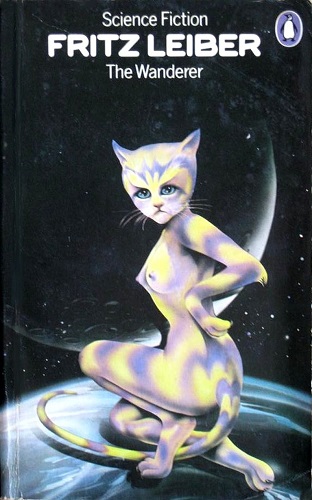
The Wanderer, Fritz Leiber

Winner of the Hugo Award in 1965, in a shortlist which included Cordwainer Smith, Edgar Pangborn and John Brunner. The Smith read like half a novel, I really didn’t like the Pangborn, and I have the Brunner on the TBR. Even so, I’m not convinced The Wanderer (1964, USA) was the best of the four.

A strange planet appears suddenly – from hyperspace, it’s theorised – in the Solar System, just outside the orbit of the Moon. Its presence causes earthquakes and tidal waves, and rips the Moon apart. The planet, named the Wanderer, proves to be actually destroying the Moon for fuel. Because it’s populated by thousands of alien races (including sexy alien cat women), and they’re on the run. The universe is packed with life – none of it visible from Earth, for, er, reasons – and it’s ruled by a government which resists change and adventurism, and the Wanderer’s dwellers are free spirits, gallivanting about the universe in search of, well, adventure.

The story is told through short sections from a wide cast of characters, all American except for a handful of non-US ones. There’s a German scientist, who appears twice and comes across like a cartoon Nazi; and a pair of drunken British writers (one Welsh, one English), who are caricatures, not characters. They also live in a UK that doesn’t exist, where people eat “sausage-and-mashed” rather than sausages and mash. 

All the time I was reading the book, I was trying to figure out when it was set. The US has a base on the Moon, and the USSR a mission on Mars… But the KKK is running around openly in Florida (there are several uses of the n-word and some really offensive racism), the English character remembers a bombing raid as a child, a man in the US claims to be the perpetrator of the Black Dahlia murder (from 1947), and South Africa still has apartheid. So, probably early Sixties, then. (Despite the moonbase and Mars.)

I’m told Leiber’s technique of using multiple viewpoints was something new in science fiction. Certainly it’s a technique more associated with techno-thrillers and the like, but they didn’t begin to appear until later. To be honest, most of the viewpoints don’t actually add anything – there’s a group of UFO nuts in California who explain what’s happening in the first half of the novel, and two Americans independently kidnapped by the aliens who have the second half of the novel explained to them. The rest are, well, not even local colour. 

Hard to believe The Wanderer was the best science fiction novel published in 1964.


Leave a comment

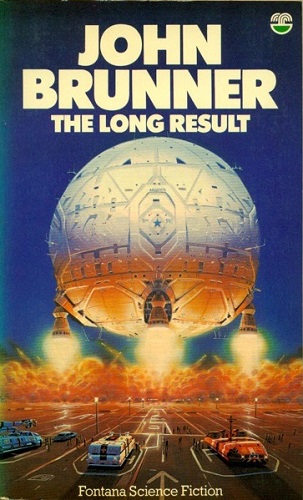
The Long Result, John Brunner

I must have last read The Long Result (1965, UK) almost 45 years ago – I’ve had a copy on my bookshelves since at least the 1980s, and it’s a paperback published in 1979 and bought new, so probably 1980 or 1981. And pretty much nothing from the book had stayed with me over the decades. Except…

Many, many years ago in my late teens I remember creating an alien race for something – a story, a role-playing game adventure; I don’t remember. I later used a variation on that alien race for a spoof space opera story written in the late 1980s and published in the very early 1990s. It wasn’t a very good story, and has thankfully vanished into obscurity. The alien – if I ever named the race, I no longer recall the name – was slightly larger than a human, with four arms, blue skin, and a vaguely equine head.

So I was a little surprised on this reread of The Long Result to discover the book was the inspiration for the alien race. In Brunner’s novel, they are the Regulans, and are pretty much indestructible. Only one appears in the book (at least until the epilogue, when a ship-full makes an appearance).

The narrator, Roald Vincent, is an assistant chief at the Bureau of Cultural Relations, the organisation which keeps tabs on Earth’s two colonies, Starhome and Viridis, and the handful of alien races so far discovered. When Starhomers turn up at Earth with a delegation of newly-contact chlorine-breathing aliens, this kicks off a series of attacks by the Stars Are For Man, a previously crank human supremacist group now turned terrorist. Vincent is in the thick of it, and manages to figure out the conspiracy before too much damage is done.

He’s supposed to be extremely clever, destined for great things, but a bit of a coaster. The narrative makes much of his uncanny ability to uncover what’s going on, yet he continually misses the most suspicious person in the entire novel.

I’ve never been a fan of Brunner’s fiction. I’ve read some of his better known works – Stand on Zanzibar (1968, UK), The Jagged Orbit (1969, UK), The Squares of the City (1965, UK) – but I didn’t like them all that much. And he wrote a lot more bad novels than he wrote good ones. So if I didn’t like the good ones… He strikes me as a writer whose reach mostly exceeded his grasp. Or is it the other way round? The Long Result makes a couple of good points, but the world-building is thin (and dated, but in an interesting 1960s futurist aesthetic sort of way), and the plot relies too much on Vincent being almost psychic at times and not at all bright at others. It’s a slight book – it took me an afternoon to read the 186 page Penguin paperback – and I’m not in the least bit surprised I remembered none of it.

Except for the Regulans. Which was a bit weird.


Leave a comment

Longer reviews

For the past few years, I’ve been writing longish reviews of books on Medium. I plan to keep that going, but I should probably post a link here when a new review goes up there. As happened last night, a review of John Scalzi’s Redshirts (2012, USA). You can find it here.

I’ve been posting reviews on Medium since May 2021, so there are quite a few. Feel free to check them out.


Leave a comment

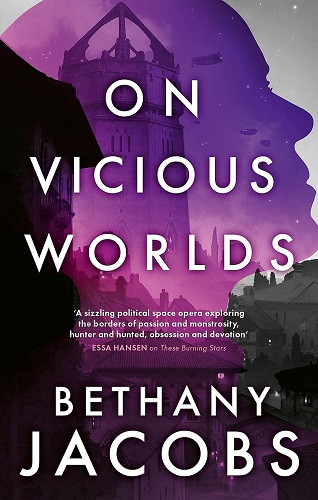
On Vicious Worlds, Bethany Jacobs

The second book of the Kindom trilogy, begun with These Burning Stars (2023, USA; see my review on Medium here). There’s a thing called Middle Book Syndrome which often affects trilogies. The first book does all the heavy-lifting for the world-building and kick-starts the plot; the final book is all about the climax for the story. So the middle one often consists of little more than re-arranging pieces on the board to set up the end-game. Jacobs makes a brave stab at avoiding the syndrome… and almost succeeds. 

Six and Chono are with the Jeveni in their ice-planet colony, reached by a stargate which has been locked against Kindom forces. But all is not well. Those non-Jeveni who were dragged along when the Jeveni escaped have been subject to, occasionally violent, prejudice. There has been a series of suspicious deaths – initially framed as suicides, but soon identified as murders – of Jeveni law enforcement officers. And there is another hacker, potentially better than Ironway, who’s been breaking important colony infrastructure. §

The identity of this hacker – called “the avatar”, but avatar of what? that’s not how you use the word – is one of the puzzles around which On Vicious Worlds (2024, USA) is structured, much as Six’s fate was in the first book. Unfortunately, it’s not as interesting; and the reveal is nowhere near as shocking, or indeed as credible.

Chono and Six return to the Kindom. Where they discover the Jeveni left behind have been forced to work in camps manufacturing vital fuel sevite – because apparently no one else in the Kindom can do it. There also seems to be some sort of power struggle going on between the three arms of the Kindom government – security, secretariat, and clergy. The secretaries seize power. They attempt to arrest Chono – who has become some sort of folk hero, although it never feels well-grounded – and Six. There’s a big fire-fight. Cue cliff-hanger ending.

They’re fun these books. Perhaps a little too Warhammer 40K, somewhat too brutal and heavy-handed; and in places it’s almost as if they’d looked to Banks’s Culture novels for inspiration and then borrowed the very things his novels were arguing against. The world-building is paper-thin in places, more so here than in The Burning Stars, and I’ve yet to be convinced some of the real-world inspirations were wise choices. The plotting is nicely convoluted, but still relentless, the action scenes well-choreographed, and there are more than enough intriguing hooks and callbacks.

If space opera had alignments, the Kindom trilogy would be chaotic evil – and Yoon Ha Lee’s Hexarchate trilogy possibly lawful evil. Given the choice, I’d sooner not read evil novels. Something lawful good, like Ann Leckie’s Radch novels, is more to my taste; or even chaotic good, such as the aforementioned Culture. But if I had to read a chaotic evil space opera trilogy, Jacobs’s trilogy would be the one.


Leave a comment

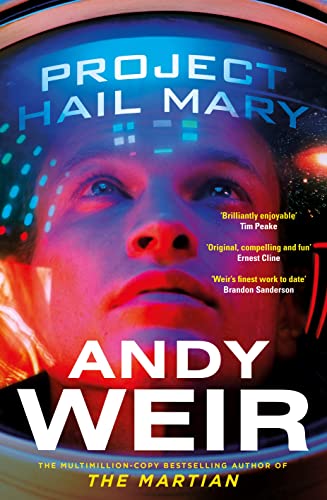
Project Hail Mary, Andy Weir

For a novel explicitly constructed as an old Analog-style puzzle story, there are four puzzles in Project Hail Mary (2021, USA) which the novel does not attempt to solve: why did I buy it, why did I read it, why was it published, and why has it been successful? I can possibly answer the first two – it was cheap, 99p in fact; and, I am an idiot. But the last two will forever remain a mystery.

Weir, of course, is best-known for The Martian (2014, USA), a surprise best-seller, originally self-published, which was then turned into a movie by Ridley Scott. The Martian is not a good book – a first-person narrative written by an unlikeable narrator, and written in the first-person for all the wrong reasons. It sold itself on its science, which is, unfortunately, not as accurate as it claimed.

Project Hail Mary is Weir’s third novel, following Artemis (2017, USA), which I have not read. In Project Hail Mary, a man wakes up aboard a spacecraft in another planetary system, with no memory of who he is or why he is there, or indeed where he is. Through chronological flashbacks, he learns he is one of three astronauts – the other two did not survive hibernation during the trip – sent to Tau Ceti. A microscopic creature has begun feeding on the Sun, and this threatens life on Earth. Tau Ceti is also infested with the microbes, called “astrophages”, but it is not losing luminance. An international project is put together to send a ship to Tau Ceti to discover why, and possibly send back a means to kill the microbes.

The microbes’ biology means they can convert mass to energy and back with no loss, making them a perfect fuel, allowing the ship to reach near light-speed. Soon after awakening, the narrator is hailed by an alien ship. It too has a single surviving crew. The alien is a rock-skinned spider-like creature which lives in a hyperbaric ammonia atmosphere. So, of course, the narrator names it Rocky. The two learn to communicate, and together discover why Tau Ceit’s astrophages have not destroyed the star.

The narrator is a high school science teacher. He was a physicist, but he published a paper on extraterrestrial life which saw him drummed out of the scientific community. Somehow or other, he ends up as an expert on the astrophage. Which is why he’s sent to Tau Ceti. He mentions repeatedly that he’s a good and well-loved teacher, which seems completely plausible as he thinks like a teenager.

Because he’s a high school science teacher, everything he encounters is solvable using high school maths. Which Weir explains in detail. All the technology, the sophisticated computers, aboard the spaceship, and yet every problem he encounters can be solved using schoolboy mathematics. It gets old very very quickly.

The astrophage is, I admit, quite ingenious, but it seems extremely unlikely to have evolved – in fact, I kept on expecting to read it was engineered. But no. Every other idea in the novel springs from the astrophage’s biology. The characters are drawn with the broadest of strokes; and while the cast is international, it’s only the handful of Russians and Chinese who don’t come across as Americans.

Many years ago, there was an international best-selling novel which taught its reader about the history of philosophy. Sophie’s World (1991, Norway) by Jostein Gaarder. I seem to remember reading it. Project Hail Mary reads like an attempt to do the same for high school maths, by showing how useful it is when, for example, trying to rendezvous with an alien spaceship, work out how not to poison yourself in an ammonia atmosphere, or even accidentally blow up the entire Earth while experimenting on microbes which are capable of total mass-energy conversion. Handy to know.

A novel that sets a low bar and all too often barks its shins on that bar. Avoid, unless you’re a masochist, or, like me, an idiot.