
I’m a big fan of KSR’s fiction, because of the subjects he tackles and his treatment of them just as much as the stories he tells. He doesn’t just make use of common sf tropes, he interrogates them. A lot more sf authors should do that.
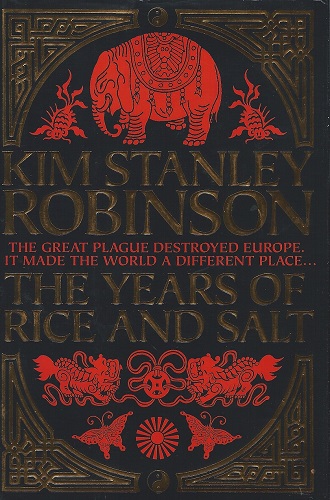
The Years of Rice and Salt (2002, USA) may be an alternate history, but it’s not a story set in a world which differs from ours due to some change in the past; it is in fact several stories – ten of them. Nor is it the book promised by its back-cover blurb, which posits a story set in a present-day world in which the Black Death in the fourteenth century killed 99% of the population of Europe instead of one-third. As a result, other civilisations flourished. Obviously, they flourished in real history – but in KSR’s novel they ended up dominating the world. The Years of Rice and Salt is not that either. It’s not a history of the world following on from the jonbar point. Which I suppose would be almost impossible – and huge! – to write. Like Laurent Binet’s Civilizations (2019, France), it is a series of vignettes which skip forward through the centuries, and around the world, from the Black Death to the present day.
The linking conceit is that there is a group of people, connected eternally as a “jati”, who are repeatedly reincarnated. They die, spend time in the bardo, and are then reincarnated – as humans, or as animals. Allowing KSR to provide a focus point from which to hang to ten different stories taking place over the centuries in his alternate history. Sometimes the members of the jati remember their earlier lives, but usually they don’t.
The Black Death wipes out Europe. The Islamic Empire is never dislodged from the Iberian Peninsula. The Chinese continue to war on their western border, but also explore east and eventually settle the western coast of North America. A progressive empire develops in southern India. A league of Native American nations in central North America form a federation and keep their independence. There is a decades-long war which involves all three of the major world powers – the Indian empire, the Islamic empire, and the Chinese empire. Once the dust has settled, a new world order prevails. The various members of the jati are present, or pivotal, in some of the more important events in this 700 year history. Which also take place all over the world – Samarkand, Beijing, the Great Lakes, an Islamic city in western France, a Chinese San Francisco, and so on…
It’s fascinating stuff. The linking text is, to be honest, a not especially interesting mechanism to give the novel structure, and the ten “books” in The Years of Rice and Salt would be equally engrossing without them. KSR’s research is impressive – but not perfect: at one point, he states the Islamic punishment of cutting off the right hand of criminals is worsened because it forces criminals to use their left “unclean” hand when eating. That’s the whole point of the punishment. But the invented history KSR has created is astonishing. It feels all too real, which I guess is the point of the novel. Recommended.
 It Doesn't Have To Be Right...