It Doesn't Have To Be Right…

… it just has to sound plausible


22 Comments

On genres, modes, distances and invention

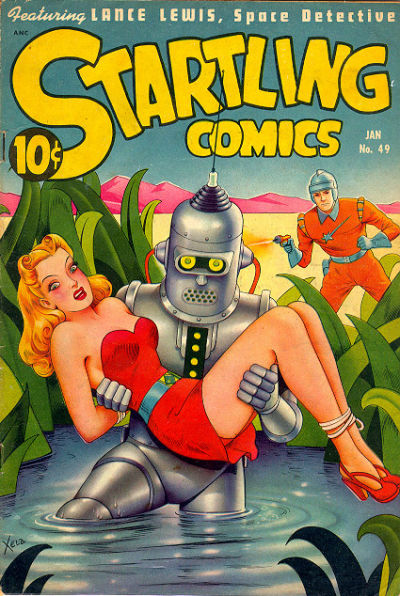
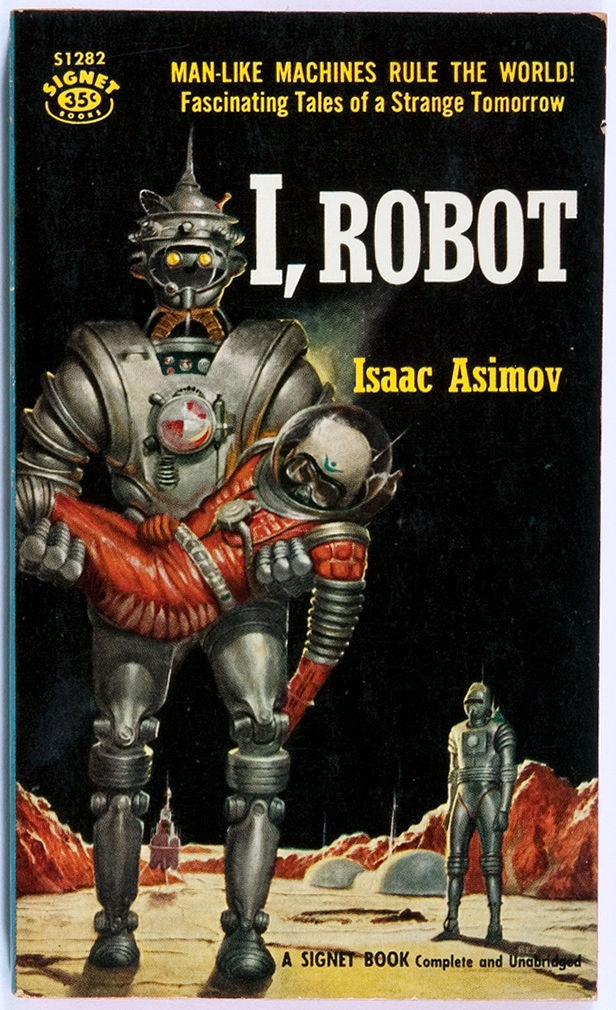
I won’t say where, or on what, I was at the time but this weekend I was thinking about definitions of hard science fiction for a podcast, and my thoughts spiralled out from there to definitions of science fiction itself. And it occurred to me that sf narratives break down into three rough forms: encountering the Other, embracing the Other and rejecting the Other. And the more I thought about it, the more it seemed to hold true. Think of a random sf novel, like… Dune. That’s embracing the Other – both Paul Atreides becoming a Fremen and learning to  use his new-found powers.

Since its earliest days, science fiction stories have been characterised by distance just as much as they’ve been characterised by science and/or technology. Alongside the Gernsbackian tales of new inventions which would improve the lives of all were stories of alien places and the strange peoples found there. Distance is a signifier for the “exotic” (in both meanings of the word). Before science fiction, they told tales of the South Seas.

The further away a place is, the more Other it is – it’s a simplistic formula, but this is pulp fiction, after all. The difficulty of the journey is less important than the distance travelled. There are very few Shangri-Las hidden in inaccessible mountain valleys, or their galactic equivalents, but lots of worlds on the rim of the empire or the edges of the galaxy. Travel itself is not uncomfortable, but does take time. Real spacecraft are small and cramped, with no amenities. Sf’s starships are interstellar ocean liners with cabins and restaurants and promenades. This is because the journey does not matter, it is only a metaphor. If there are hardships, they are associated with either finding the destination, or at the destination itself. Off the top of my head, the only sf story I can think of in which the journey itself is an obstacle is Ursula K Le Guin’s ‘The Shobies’ Story’ (in Gwyneth Jones’ Buonarotti stories, and her novel Spirit, there’s a similar effect with interstellar travel, but it does not make the journey an obstacle). No doubt there are other stories, though I maintain such stories are rare within the genre.

But then, there’s not much that’s Other about the act of travelling from A to B. Even in the Le Guin story mentioned above, the means of making the journey affects the travellers’ perceptions of their destination, making the act of encountering, or even embracing, the Other so much harder and more prone to misunderstanding.

Space opera, of course, is traditionally predicated on rejecting the Other, as is military sf. The drama in both subgenres typically derives from conflict, either from within the world or from without. And the further the enemy is from known space, the more Other they generally are. Even when they’re humans, they’re typically barbarians from the edge of the empire – though that may simply be science fiction ripping off the history of the Roman empire… which it has done far too many times.

The same argument might well apply to fantasy, even though it is a different genre. I suspect there are more narratives of rejecting the Other in epic commercial fantasy than of the other two forms. Given its generally consolatory nature, this is no surprise. Other modes of fantasy may well be more evenly distributed – I’m not as well read in fantasy as I am science fiction. It might well be that the same argument does not apply to fantasy, given that it is an entirely different genre to sf.

Science fiction is not, and has never been, a branch of the fantastic. You can’t categorise fiction by the degrees of invention it exhibits. All fiction by definition contains invention, whether it’s literary fiction with made-up characters , fantasy with made-up worlds, or science fiction with made-up science and/or technology. Nor can you categorise by trope… because first you would have to define each and every trope. And lay out the conditions under which each trope is fantasy and not science fiction, or vice versa. If a fantasy novel has a dragon in it, then it does not follow that all novels containing dragons are fantasy. And so on. Science fiction is a fundamentally different genre to fantasy, and it’s an historical accident that the two are typically marketed alongside each other.


Leave a comment

The fastest man on earth

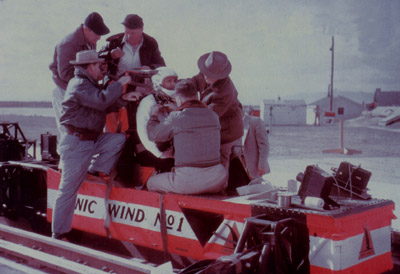
No, not me. Though I suppose if you strapped enough rocket bottles to me, I could probably qualify. Which is what happens – to someone else, I hasten to add – in my story ‘The Incurable Irony of the Man who Rode the Rocket Sled’. It was published yesterday in the The Orphan #5. You can find my story here.

sonicwind

‘The Incurable Irony of the Man who Rode the Rocket Sled’ was inspired by some of the research I did for the Apollo Quartet. I’d come across mention of the rocket sleds that were used in the 1950s to test how many Gs a human body could safely withstand, and I thought it would be pretty cool to write about that. So I did. The end result, however, isn’t exactly typical – as science fiction, my fiction, or even fiction per se: The Orphan itself describes it as possessing “footnotes, no plot, and genre content visible, yet near microscopic”. So, no launching rocket sleds into space to fight aliens or anything. Just a man, the rocket sleds, and the world around him.

They were bonkers, the volunteers on the rocket sled programme – especially the man who created it, John Paul Stapp. But what they achieved did prove useful and ultimately saved many lives. Here’s a USAF information film about rocket sleds, which gives you some idea of what it was all about.

Enjoy.


3 Comments

Songs of the Dying Earth

sdelgSongs of the Dying Earth, edited by George RR Martin and Gardner Dozois
(Harper Voyager, 660pp, £8.99 pbk)

Few of us would disagree that Jack Vance is a man whose career deserves respect; and since imitation is the sincerest form of flattery, then an anthology of stories which ape one of his creations must seem like a fine and commercial tribute. And yet… The Dying Earth first appeared in 1950. It is over sixty years old. The average age of the contributors to Songs of the Dying Earth is no younger. This anthology, then, is an exercise in nostalgia. Though its cover proclaims it contains “stories in honour of Jack Vance”, it is not a homage: its contents are not inspired by Vance’s creation, they pastiche it. Each of the twenty-two stories uses places and characters invented by Vance. Further, while some directly reference stories written by Vance; one, by Liz Williams, bases its plot directly on one by Vance.

The original The Dying Earth was a short story collection of 176 pages. Songs of the Dying Earth is nearly four times larger. This means those factors which lent the original its charm soon overstay their welcome: the ornate, archaic language; the amusing names of people, places and spells; the science-fictional tone in service to fantastical magic; the constant references to the dying sun. Over 660 pages, these conceits lend every story a similar affect, making each of the stories blend and merge into the one following. Songs of the Dying Earth reads like a novel without a plot and an interchangeable cast. It is, then, a book to be dipped into, not to be read from cover to cover.

While the anthology may provide a varied read only in small doses, the quality – and flavour – of the contents is equally variable. A handful stand out. Kage Baker, who appears to be the only contributor who remembered that many of Vance’s Dying Earth stories were very funny. Lucius Shepard, who shows more invention than most (with footnotes), though a thorny moral discussion in the middle jars somewhat. Elizabeth Hand, whose story is the only one to feature female protagonists (she should also be rewarded for the invention of “Punctilious Trousers”). And Jeff Vandermeer, who brings a foreign, but welcome, note of the surreal; his is perhaps the least accurate imitation, but it is better for it.

However, John C Wright’s and Elizabeth Moon’s stories are completely tone-deaf; unlike Terry Dowling and Walter Jon Williams, who both manage to catch the flavour of Vance’s originals. Neil Gaiman’s story bizarrely opens in present-day Florida. Matthew Hughes, given his career to date, provides an oddly disappointing tale. Robert Silverberg’s opening story is dull, as is Mike Resnick’s. Liz William’s is memorable chiefly for being so miserable. Dan Simmons provides a novella, the longest story in Songs of the Dying Earth. The remainder – Paula Volsky, Phyllis Eisenstein, Tad Williams, Glen Cook, Byron Tetrick, Tanith Lee, Howard Waldrop and co-editor George RR Martin – are somewhere in between.

Each story features an afterword in which the writer explains how they first discovered Vance’s The Dying Earth, and what it now means to them. In almost all cases, they discovered the book at an impressionable age during the 1960s or early 1970s. These afterwords suggest that Songs of the Dying Earth is indeed a celebration of Vance’s creation. Certainly, it seems poorly-designed to introduce a new generation of readers to Vance’s oeuvre – most of which is out of print, anyway. And purely as an anthology, the sameness of its contents works against it.

Overall, it’s hard to not suspect the writers had more fun writing the stories in Songs of the Dying Earth than readers will have reading them.

This review originally appeared in Interzone, #238, January-February 2012.


5 Comments

When I’m sixty-four

The Easter weekend in the UK traditionally sees around a thousand fans of science fiction, fantasy, horror and steampunk descend on a hotel somewhere in the country to discuss genre in all its forms, drink beer and generally socialise. They’ve been doing this since 1948 – but not the same group of people, obviously. This year, the Eastercon returned to the Cedar Court Hotel in Bradford, the site of 2009’s Eastercon LX. I remember Eastercon LX as a relaxed convention, and this year’s EightSquaredCon proved to be much the same. I had an excellent weekend, saw many old friends, met new ones, pretended to be erudite on a few programme items, bought a number of books, drank some beer, didn’t eat as much as I should have done, and, oh yes, I won a BSFA Award…

I’d planned to leave for Bradford around two pm on the Friday, but by lunchtime I was itching to go so I caught a train an hour earlier… which got me into Bradford around four pm. I had with me a suitcase full of copies of Adrift on the Sea of Rains and The Eye With Which The Universe Beholds Itself, which fortunately had wheels, so I dragged it across City Square to the hotel in which I was staying, Jurys Inn. It proved to be one of those modern minimalist places – restaurant/bar and reception on the ground floor, seven floors of rooms, all very comfortable. After checking in, I texted Mike Cobley, who I knew was staying in the same hotel and due to arrive around the same time as me. We agreed to meet in the lobby, which we did, and where we sat around for about thirty minutes catching up on each others’ news while we waited for the bus to the Cedar Court Hotel.

Because the con hotel is outside the city centre, but doesn’t have enough rooms for all the attendees, most of us were staying in either the Jurys Inn or Midland Hotel in the centre of town, or the Campanile a five-minute bus-ride from the Cedar Court Hotel. The con had organised two sets of buses running between the town-centre hotels and the Campanile every 15 to 20 minutes.

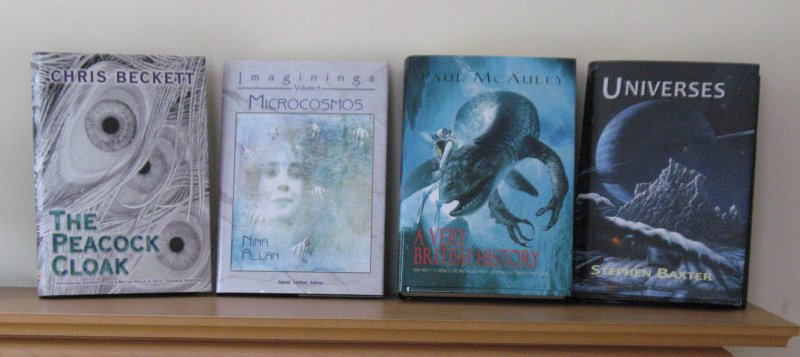
We arrived in time for the small press launch in the hotel’s Conservatory. Both PS Publishing and NewCon Press had new titles, and some of them I wanted. The hour that followed was my most expensive of the weekend – I bought four titles at £20 each. I also got them signed, though the NewCon Press ones were signed editions.

20130401a

The books are all collections – The Peacock Cloak, Chris Beckett, and Microcosmos, Nina Allan, from NewCon Press; and A Very British History, Paul McAuley, and Universes, Stephen Baxter, from PS Publishing.

After the launches, it was down to the bar… which is where I spent most of the con, a not unusual state of affairs for me.

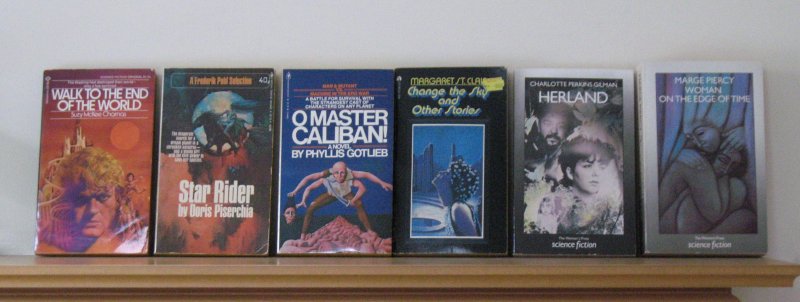
The following morning, I met up with Mike Cobley for breakfast, after which we went for a wander in a deserted Bradford city centre. We caught the bus to the Cedar Court Hotel, and I paid my first visit to the dealers’ room. I had a bunch of copies of Adrift on the Sea of Rains and The Eye With Which The Universe Beholds Itself to drop off at the Interzone table (thanks, Roy), but I also had a bimble about the room.. Aside from the Friday night launch titles, I only bought secondhand books all weekend, and they were all by women writers.

20130401d

A selection of sf by women writers – two from The Women’s Press: Herland (donated by Kev McVeigh, thanks) and Woman on the Edge of Time. Both Walk to the End of the World and Star Rider are in The Women’s Press sf series, but these editions will do for now. O Master Caliban! has the horriblest cover art I’ve seen for a long time. Change The Sky And Other Stories is a, er, collection.

20130401b

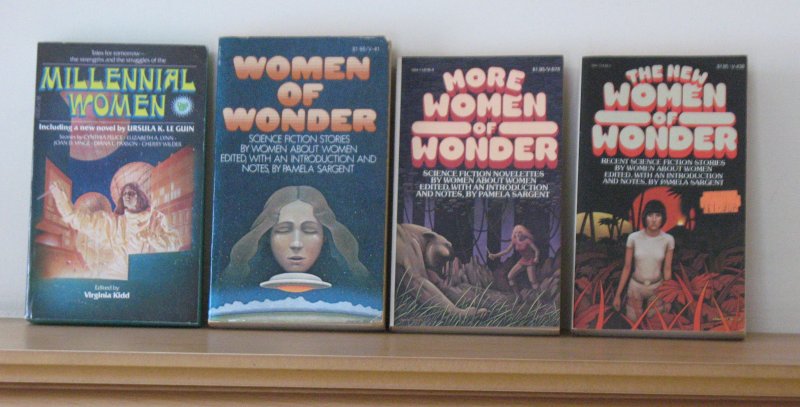
I’d have missed these if Mark Plummer hadn’t pointed them out to me, as they were squirrelled away in a box – the three female-only anthologies edited by Pamela Sargent from the 1970s, Women of Wonder, More Women Of Wonder and The New Women of Wonder. And Millennial Women, which was a new one to me.

20130401c

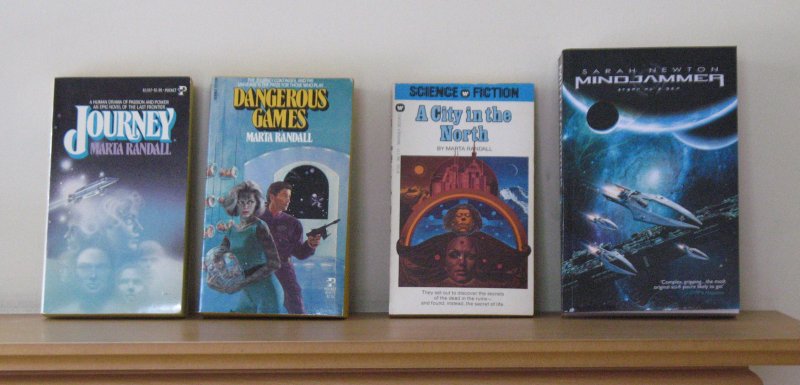
Three by Marta Randall, including the first two books of a trilogy – Journey and Dangerous Games – and her second novel, A City in the North. Plus Sarah Newton’s Mindjammer, which was self-published and is set in the RPG universe of the same name designed by Sarah.

That afternoon, Mike and I were moderating a programme item on designing a constitution for a Mars Colony. I’d agreed to co-chair in a fit of stupidity, as I had absolutely no idea what to say. I’d provide some technical background, but that was as much thought as I’d put into it. The item started, Mike went into his introduction, I spoke a little about the technical challenges, and then Mike started talking about politics… and I could see we were starting to lose the audience. So I mentioned something Mike and I had actually thought of as we were climbing the stairs to the room where the item was taking place. And that triggered off a discussion which lasted for over an hour. I don’t think we reached any specific conclusions, but people seemed to have had an interesting time.

That evening, my agent John Jarrold threw his now-traditional party for clients and publishers. That was fun. I had intended to avoid the wine and just stick to beer, but I ended up having a couple of glasses without any ill effect. I ate in the hotel that night. As they had done in 2009, the con hotel laid on a canteen-style eaterie all weekend. The food was basic and a bit bland, but it was also cheap and filling. I never actually managed to get out of the hotel to eat, which was a pity.

Sunday I was on two programme items, and the first one was at ten am. The subject was “Older women in genre fiction”, moderated by Caroline Mullan, and including GoH Freda Warrington, as well as Rochita Loenen-Ruiz, David Tallerman and myself. I thought the panel went reasonably well, though none of us could think of many genre novels with an older woman as the protagonist – but Freda did mention her Midsummer Night, which qualified.

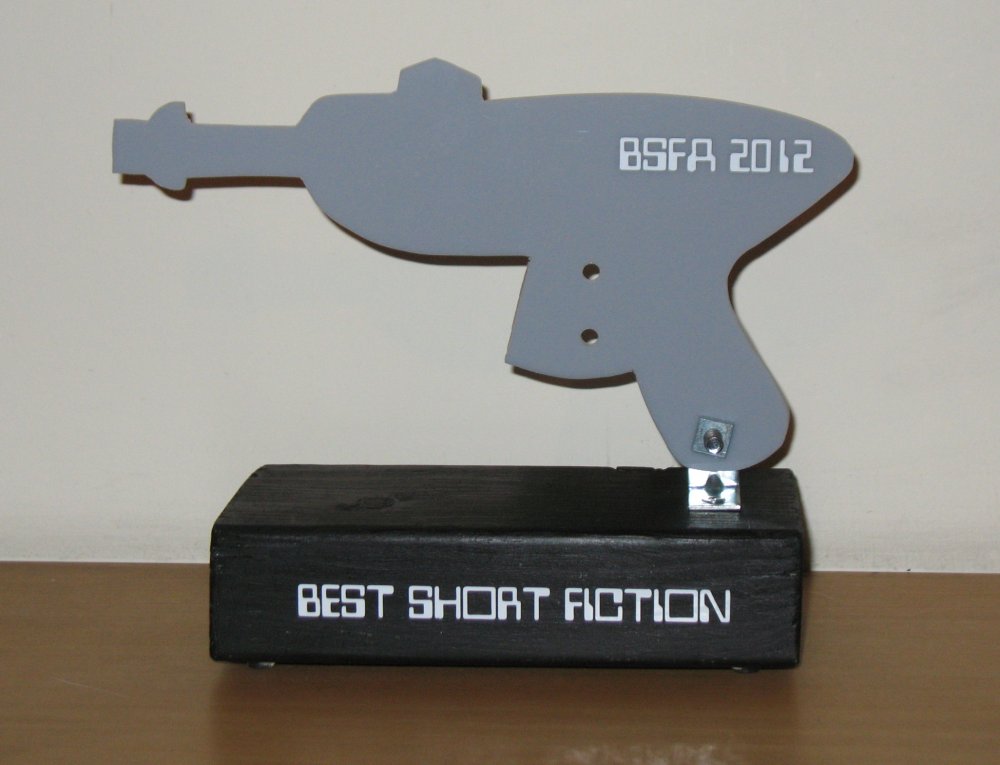
Before my second programme item of the day was the BSFA Awards ceremony. I sat on the front row, alongside fellow short fiction shortlistees Aliette de Bodard and Rochita. Paul Cornell emceed the ceremony entertainingly, but I don’t think he expected to get quite as much laughter as he did when he explained that, “BSFA… that’s what you get when you put BS together with FA”. GoH Anne Sudworth then presented the best artwork prize, which went to the cover for Jack Glass, and Freda presented best non-fiction, which was won by the World SF Blog. And then GoH Edward James took the stage to announce the winner of the short fiction category… I was so sure one of the others would win that it took a second or two to realise it was my name Edward had read out. And I hadn’t bothered to make any notes on what to say should I win. I did have a speech in my pocket, but it was by Karen Burnham, to be used in the event she won the non-fiction category. The best novel BSFA Award then went to Adam Roberts’ Jack Glass. Stephen Baxter was presenting this; he had also been asked by Adam to accept it on his behalf. Which led to a slightly surreal sketch in which Steve both presented and accepted the award.

bsfa2012

I then had to dash straight upstairs for a panel on Joanna Russ vs Anne McCaffery. Again, Caroline Mullan moderated, and the panel comprised Tanya Brown, Bob Neilsen and myself. When it came to doing our introductions, I said that for a week or two I’d be introducing myself as “the award-winning Ian Sales”… I have read a handful of books by both Russ and McCaffery, and I’d have preferred to have been better read in both… but given the way the discussion went it didn’t prove any handicap. There was plainly a lot of love for McCaffery in the room, and I was frequently Russ’s lone defender. I think the eventual conclusion was that Russ’s more cerebral work might have longer staying power than McCaffery’s more emotional oeuvre.

Then it was down to the bar, where I didn’t have to buy a drink all night. I caught the last bus back to my hotel at one am. It had been a good day…

… And I felt fine when I woke the next morning. Admittedly, the thermostat in my room had been misbehaving all weekend, and randomly resetting the temperature to 30 C. Which had led to some bizarrely hot nights. But I was the first in the hotel to make it down to breakfast, then I went for a walk, and then I caught the first bus to the Cedar Court Hotel… Colin Tate of Clarion Publishing had mentioned the day before there was a small press showcase in the Conservatory from 10 am to noon, and he was leaving early and so wouldn’t be able to use the table he’d booked. I was welcome to it. So I used it. I set out copies of my books alongside Sarah Newton and her sf novel Mindjammer. Also present were the Albedo One group, and Tony and Barbara Ballantyne and their new serial genre magazine Aethernet. It was freezing cold in the Conservatory, but I stuck it out and managed to sell some books.

By this point, the con was already winding down. I got a bite to eat and then just hung around in the foyer with friends until it was time to make a move.

I liked Bradford as a venue the last time the Eastercon was there, despite the split hotel thing; and I enjoyed this convention very much too. It was relaxed – somewhat colder than is usual, true; but very friendly and sociable. I saw many old friends and got to meet in person some people I knew only online. I’d need to take notes to recall all the conversations I had, the topics ranged from death metal to reviews of our own books to Chris Beckett’s fashion sense (sorry, Chris), and all points in between. Some names I remember speaking with at some length, in no particular order: John Jarrold, Neil Williamson, Gary Gibson, Mike Cobley, David Hebblethwaite, Leisel Schwartz, Cory Doctorow, Adrian Tchaikovsky, Cara Murphy, Kev McVeigh, Will and Jenny, the Ballantynes, Gillian Redfearn, Darren Nash, Roy Gray, Helen Jackson, Nina Allan, Donna Scott, Neil Bond, Alex Bardy, Johan Anglemark, Eric Brown, Paul Graham Raven, Paul Cockburn, David Tallerman, Jobeda Ali, Sarah Newton, Chris Beckett, Aliette de Bodard, Rochita Loenen-Ruiz, Simon Ings, Paul McAuley, Phil Palmer, Simon Morden, Ian Watson, Andy Stubbings, Chris Amies, Jim Burns, Colin Tate, Brian Turner, Steve Baxter… and no doubt I’ve forgotten some people. Sorry.

For all that, I think I came away from EightSquaredCon with a desire to do more at conventions. Sitting around in the bar all day is not as much fun as it once was. I could attend programme items, of course; and this time I sat through one panel I wasn’t on, which is almost a record for me. While cons are social events, and an excellent opportunity to hang out with friends you don’t otherwise see, we interact daily online anyway so no real catching up needs to be done. The internet has changed the nature of friendship in that respect. I spend every day with my friends on Twitter, Facebook, blogs, etc, etc, and while they’re no real substitute for meeting IRL, they do make something less special of the infrequent times you do meet in person. And that was what cons used to be for. (Perhaps if I lived in London, and regularly attended events there, the same effect would apply – and would have applied prior to the World Wide Web.)

Anyway, EightSquareCon. A good con. Now I have to wait twelve months for the next one. Which will be in Glasgow, a city I’ve always liked. Roll on Satellite 4


8 Comments

A British sf masterwork? Implosion, DF Jones

The SF Encyclopedia makes no real comment on the works of Dennis Feltham Jones, preferring instead to précis his novels. He is perhaps best known for his first novel, Colossus, which was filmed as Colossus – The Forbin Project. Implosion, from 1967, is his second novel.

An unnamed Eastern Bloc country develops a substance which renders women sterile. Because the nation’s premier is the illegitimate son of a British diplomat, he chooses to use this powder on the UK. Two years later, fully eighty percent of British females can no longer ovulate. The country’s population begins to fall, and is calculated to hit around five million by the mid-1980s. A government with far-reaching powers and a mandate to fix the problem is voted into power. All the fertile women are put into camps to become baby machines. Children are put in National Schools, where they are kept safe from harm and educated to as high a level as possible. Villages are demolished, and towns abandoned, when their populations fall below sustainable levels.

In charge of all this is John Bart, the Minister for Health and Regeneration. His wife Julia proves to be one of the rare fertile women, and is packed off to a camp. Meanwhile, the government tightens its grip on the country. After a raid on the lab which developed the powder, the Brits reverse-engineer it but can find no cure. They publish the formula, so that now everyone has it. Naturally, other countries soon find themselves in the same situation.

Meanwhile, Julia has come to realise that the regime in the fertile women’s camps has turned nasty. Women are whipped for the slightest infraction, such as smoking (even when not pregnant). She escapes… and discovers that the world outside is very different to what she had been told. She finds her husband, who is still the number two man in the government, and likely soon to be the number one, and learns that he is now shacked up with her twin sister. The twins turn on one another, Julia gets sent back to the camp, and that’s that. Except Nature has one final trick up her sleeve…

There’s a very 1960s British po-faced earnestness to Implosion. The characters are exemplary – Bart himself is young and noble and brilliant at organisation and making decisions. His wife is beautiful and loving and a true soulmate. Or at least, she starts out like that. Even their lady who does is a treasure. The prime minister is a hearty man of the people, straight-talking and more than willing to do the necessary. The Britain of the story appears pretty much the same as the Britain of 1967. Even though it begins in the early 1970s, the currency is still pounds, shilling and pence.

Implosion reads like a novel in which the author had a good idea and then set out to show clever he was in solving it. Its politics are simplistic, as is its view of the British people. The Barts are very much the “right sort”, and what few working class people do make an appearance are viewed with all the patronising indulgence of the privileged. Implosion is not a cosy catastrophe – there’s more brandy drunk than tea, for one thing – but it is peculiarly English. Perhaps it could be called a “Mayfair catastrophe”. That’s what it feels like, a black and white 1960s television Play for Today with a cast speaking in cut-glass accents, while around them the world they don’t much care for slowly falls apart…

So, not a British sf masterwork, then.

(And no, I’ve no idea what that blobby thing on the cover of the book is supposed to represent.)


9 Comments

How science fiction works

Let’s be reductive and say science fiction refers only to those subgenres which occupy what is generally considered the genre’s heartland – hard sf, space opera, soft sf, first landing, first contact, military sf, etc. Let’s call all the rest “speculative fiction”, a term I dislike, but since they seem not to bother with the science aspect it is perhaps more appropriate.

Let’s say there are two types of science fiction as defined above. There is the type of science fiction that appeals to people who would happily read supplements for a role-playing game. And there is the type for people who would prefer to read a physics text, or a book about the engineering involved in building the Saturn V. Both types, at heart, operate by adjusting a reader’s sense of scale and turning that which cannot be conceived into something which can. Or vice versa. For example…

Credit: ESA/NASA/JPL/University of Arizona

Look at the photograph above. That’s the surface of Titan, a moon of Saturn. The photo was taken by Cassini-Huygens, a space probe which launched in 1997, and the Huygens part of which descended to Titan’s surface in 2005. Saturn orbits between 1.3 billion and 1.5 billion kilometres from the Sun. Earth orbits between 147 million and 152 million kilometres from the Sun. If you could travel to Titan in a straight line (which you can’t), it’d be a journey of around 1.2 billion kilometres… That’s equivalent to flying from London to New York and back over 108,000  times, or 6.5 million circuits of the M25 (at an average speed of 120 kph, that would take you about 1,150 years).

Numbers. They define our world – what we can directly see and experience, and what we can’t see or experience. As those numbers increase in size, so our sense of place in our world is increasingly diminished. Using science we can investigate, and gain an intellectual understanding of, this feeling of diminution. Science fiction, however, postulates situations in which we can experience it directly. It also gifts us with agency in this new world being explored. It is a visceral, albeit vicarious, manifestation of what science can show us.

Science fiction is scale, its uses and abuses. It can take something huge and beyond direct human experience, and by giving it the purpose of something within the reader’s real-world frame of reference, render it unfamiliar:

Planets. Seven of them. Armed and powered as only a planet can be armed and powered; with fixed-mount weapons impossible of mounting upon a lesser mobile base, with fixed-mount intakes and generators which only planetary resources could excite or feed. (p 40, Second Stage Lensman, EE ‘Doc’ Smith (1953))

It can directly manipulate the human frame of reference, and make of it something which would otherwise be strange and impossible to fathom:

It was not clear what had happened to the man for the next million years or so. One line of argument held that he had expanded himself to encompass a massive swathe of galactic space – swallowing hundreds of thousands of systems, across thousands of lights. (p 239, House of Suns, Alastair Reynolds (2008))

Or, it can simply map parts of the real world we cannot experience, and allow us to compare the scale of our frame of reference with that being described:

It took an effort to remember that the distance to the horizon was more than ten times that on Earth. That the storm was two thousand kilometres across. That the sky was hydrogen and helium a thousand kilometres deep, with cloud layers of ammonium ice above and decks of ammonium hydrosulphide and ammonium-rich water-ice and water-droplet clouds below, endlessly blowing around this vast world. (p 215, The Quiet War, Paul McAuley (2008))

There are a number of rhetorical tools and literary devices science fiction uses to manipulate scale and the reader’s perception of it. Analogy is a particularly common one – by directly referencing something known, and of a size encompassable by the reader’s mind, the sf text can make manageable the scale of something normally beyond comprehension. This is not always a good thing, as it can have a trivialising effect.

There is a great deal of implication in the findings of science. The photograph earlier in this post does not in and of itself present a particularly impressive-looking picture. It’s a stretch of orange ground littered with pebbles. But it’s on Titan. Which means… the launch of the space probe, the journey there, the distance the probe travelled, the mechanisms which comprise the probe and the science behind them, the descent into Titan’s atmosphere, Titan’s surface conditions… the real and true fact that it is an alien world.

Science fiction not only gives us the orange photograph, but it also shows us how it was achieved. It makes explicit the wonder. And since wonder is central to science fiction, then to define wonder is to define science fiction:

…where:
W = wonder
lg = greatest distance mentioned in the text
tg = greatest length of time mentioned in the text
Nn = number of ideas/nova in the text
Nf = number of ideas/nova reader has encountered previously
ir = closeness of the viewpoint character to the reader as a function of background, worldview, attitudes, etc – ie, an indicator of their ability to identify with the character
jn = number of situations of jeopardy for point-of-view character(s)
ja = amplitude of situations of jeopardy for point-of-view character(s), where 1 is fatal
Cn = size of cast in the text
Br = bandwidth of the reader (calculated from educational level, number of books read, age)
Dr = willingness of the reader to suspend disbelief


1 Comment

Fragment

So a year or two ago I had this idea for a postmodern planetary romance, a Leigh Brackett-style story as much about story as it was about the events in its strange and implausible world. But like most such projects – and I have an embarrassingly large number of them – it never got beyond some vague ideas and a couple of hundred words. I had a great title, ‘Gods of Saturn’, and what I thought was a pretty cool opening, but then other new shiny ideas captured my attention and my postmodern planetary romance got filed away in a forgotten folder. Until now. Maybe one day I’ll do something with it, actually finish it off perhaps, but for now it qualifies as one of those “stories that never were”, of which I have far more than I care to enumerate. But rather than let it go totally to waste and, in part, to perhaps prompt me into actually working on it and maybe finishing it, here’s the opening of ‘Gods of Saturn’ for you to enjoy…

Of all the winds which blow across the sand seas, an easterly is the most disagreeable. From that quarter, the town of Kumpara boasts no defence against the scouring grains of sand. The western wall of Pu Chou rises behind Kumpara’s tumbled blocks, and curves enfolding arms to north and south. But to the east: nothing.

There was, however, much which could be said about the couple who strolled along Kumpara’s long stone jetty one day in the Age of Helium, as small wisps of easterly wind whipped up dancing devils of sand.

Kumpara had seen better years, but had yet to reach the nadir of its decline; or its subsequent rise to quiet gentility. See it now, and perhaps you would find it hard to picture the narrow streets thick with blinding red dust, the sand whipped into fountains fifty feet high, and every house shuttered and doors firmly bolted. Those who lived there knew better than to risk the wind’s wrath.

A local spy – and there was one – who watched the young couple will have deduced they were strangers to Kumpara. The wind was not yet dangerous, but only the foolhardy or ignorant remained out once it began to blow. So too did their garments advertise their origins. The young lady was dressed in a fashion yet to be seen in the town. The eye in the telescope might have glimpsed the split skirt which was common at that time in the capital city, Xu; the high-collar, with its arcane symbols of rank and allegiance; the long gloved sleeves. Her companion was equally well-dressed.

As they turned to stroll back along the jetty, some feeling or whim caused the young woman to look back. She halted, head turned and, as if conjured into being by her gaze, features formed on the face of Saturn. The lemon and orange and tan stripes swirled like the ingredients of some decadent cocktail. It was a vast face, a face which filled the planetary canvas on which it appeared, and it caused the spy to drop his telescope and scramble from his vantage point.

As a result, he did not see the reactions of the Xuan lady and her companion. He did not see her turn her back on the face in disdain.

If such an occurrence sounds remarkable but the couple’s reaction does not, it is because at that time the gods of Saturn would often manifest on the face of the gas giant. From their celestial vantage point, they would gaze on each of the moons and on each of its civilisations. Their impact depended very much on the moon’s distance from Saturn. Here on Janus, where Saturn occupies a significant portion of the horizon, the gods held sway more than on, say, distant Iapetus.

When a god appears, all see him or her. When a god speaks, only those to whom they direct their instructions hear.

Lady Eresu turned to Captain Quradu and took his arm. She gently pulled him about. “Ignore him, Quradu,” she said softly. “He cannot harm us.”

The captain dropped his hand from the butt of his tantalum-pistol. That looming face – its presence alone in the sky suggested great power. Quradu looked up at Lady Eresu – as befitted her rank, she was a head taller than he – and noted her lack of concern.