
Depraved Heart (2015, USA) continues on directly from Flesh and Blood (2014, USA) – which ended with a major cliffhanger: Scarpetta shot with a speargun and possibly dead… But of course she isn’t: there are at present six more books in the series.
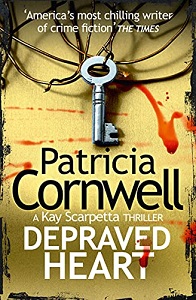
Depraved Heart opens some months later. Scarpetta is still recovering, and while she has no doubt she was shot by returned-from-the-dead psycho killer Carrie Grethen, the FBI is not so convinced. In fact, they seem to think Lucy is the killer. From the reader’s point of view, it’s all nonsense. And whatever is happening to defend Lucy is being kept from Scarpetta – by Benton, by Lucy, by pretty much everyone.
All of which manifests itself as a raid on Lucy’s well-defended mansion by the FBI. There’s also a young woman who seems to have fallen to her death while drunkenly adjusting a chandelier in her mother’s palatial home… but Scarpetta is not convinced it’s accidental. And there’s plenty that’s a bit weird about the murder and the victim. Not the least of which is that she knew Lucy.
All this is going on and Scarpetta is deliberately left in the dark, which means there’s lots of interiority about Grethen shooting her, and Scarpetta doubting her own memories, and suspecting some sort of conspiracy aimed at her and her loved ones…
It’s all resolved, of course, although Grethen spends the novel entirely off-stage. Given she’s the fulcrum around which the plot revolves – the title, a legal term in US justice, seemingly applies to her, although Scarpetta does worry at one point whether it could also apply to Lucy. I’m assuming everything comes to a head in the next novel in the series, Chaos (2016, USA), as Scarpetta discusses Grethen’s career of “causing chaos” several times in Depraved Heart.
Most of the Scarpetta novels stand alone, but I’m not convinced this one does. It reads like the middle novel of a trilogy. On the other hand, Cornwell does like to make full use of her psycho killers over several novels, even if she has to bring them back from the dead a few times.





 It Doesn't Have To Be Right...