It Doesn't Have To Be Right…

… it just has to sound plausible


1 Comment

One-liners

It’s been a while since I last noted here what books I’d read. Yes, I’ve given up on the readings & watchings posts, but I’d still like to record what literature I’ve consumed throughout the year. Here I shall attempt to do it in a single line per book (occasionally through the creative use of punctuation, I must admit).

A Torrent of Faces, James Blish (1967) Pleasingly detailed, somewhat dated, but a much more interesting sf novel than I’d expected.

The Girl with the Dragon Tattoo, Stieg Larsson (2005) Oof – worse than I’d expected (though I’ve heard the translation was rushed), but Blomqvist is a Gary Stu and the attempts to drag in references to the original title (Män som hatar kvinnor, Men Who Hate Women) are hamfisted to say the least.

The Immersion Book of SF, Carmelo Rafala, ed. (2010) Small press anthology of, er, science fiction; some contents better than others, though nothing stands out especially.

The Ghost, Robert Harris (2007) Blair’s biographer is murdered so pro ghost writer is drafted in and discovers something rotten in the ex-PM’s career– oh wait, it’s not Blair, it’s a made-up politician…

Devil May Care, Sebastian Faulks (2008) Faulks does Fleming and makes a pretty good fist of it – also: a Caspian Sea Monster!

Diadem from the Stars, Jo Clayton (1977) Reviewed on SF Mistressworks here.

Hear Us O Lord from Heaven Thy Dwelling Place, Malcolm Lowry (1961) Some astonishingly good novellas, some not so good short stories; planning to read more Lowry.

Islands, Marta Randall (1976) Reviewed on SF Mistressworks here.

If the Dead Rise Not, Philip Kerr (2009) Bernie Gunther in Berlin after leaving the Kripo; and decades later in Cuba – and it’s all about corruption by US mobsters over building work for the 1936 Olympics in Berlin.

Eastmodern, Herta Hurnaus (2007) Bratislava, home to some surprisingly interesting-looking Modernist buildings; as this book amply demonstrates.

The Omcri Matrix, Jay D Blakeney (1987) Reviewed on SF Mistressworks here.

Dulcima, HE Bates (1953) I read it but I’m not sure why it was written; apparently they made a film of it too…

The Maginot Line, Rob Redman, ed., (2012) Literary paperback anthology, contains some good stories, including one by a bloke called Sales.

Goldfinger, Ian Fleming (1959). A bit like the film, but with added homophobia and sexism! – Bond turns ice-cold lesbian Pussy Galore into a warm and loving heterosexual with a good rogering; plus a half-page homophobic rant by 007.

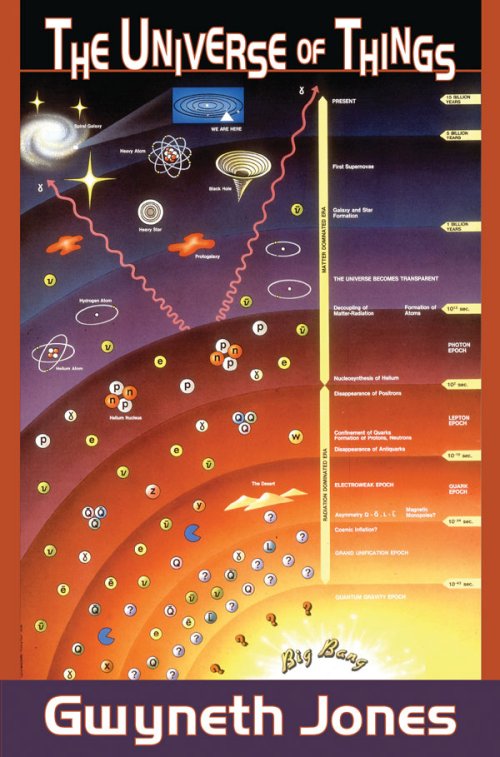
The Universe of Things, Gwyneth Jones (2011) Reviewed on Daughters of Prometheus here.

Oscar Niemeyer Buildings, Alan Weintraub (2009) Does what it says on the cover: lovely photographs of lovely buildings.

Building Brasilia, Marcel Gautherot (2010) Yet more lovely Niemeyer buildings – they should let Neimeyer design the entire world.

Jerusalem Fire, RM Meluch (1985) Reviewed on SF Mistressworks here.

So Long a Letter, Mariama Bâ (1980) April’s book for my reading challenge; I wrote about it here.

Girl, David Thomas (1995) Man goes into hospital but through implausible mix-up gets vaginoplasty; played for laughs, manages some sensitivity, but definitely from the male gaze so nothing learned.

The Maquisarde, Louise Marley (2002) Reviewed on Daughters of Prometheus here.

Machine, Jennifer Pelland (2012) Read for review in Vector; interesting approach to the central conceit, though a little muddled in execution.

Disguise for a Dead Gentleman, Guy Compton (1964) Actually DG Compton: murder most foul at a public school; some nice-ish writing but a bit all over the place structurally.

Two Sides of the Moon, David Scott & Alexei Leonov (2004) Reviewed on A Space About Books About Space here.

The Summer Book, Tove Jansson (1972) Not a Moomin in sight, just grandma and granddaughter having fun and games among Finland’s islands; simple, elegiac.

Impact Parameter & Other Quantum Realities, Geoffrey A Landis (2001) Variable collection by Analog/Asimov’s stalwart; contains a couple of good ones, but a few are surprisingly poor given their initial publication venues.

Time Future, Maxine McArthur (1999) Reviewed on SF Mistressworks here.

Valerian 3: The Land Without Stars, Mézière & Christin (1972) English slowly catches up with famous French lightweight space opera bande dessinée series.

The Jagged Orbit, John Brunner (1969) Even in 1969, Brunner should have thought twice about this – a near-anarchic over-armed US with voluntary racial segregration; painfully, embarrassingly and datedly hip.

West Coast Blues, Jacques Tardi (2009) Bande dessinée about a man who goes on the run after being mistakenly targetted by hitman; astonishingly nihilistic.

In Great Waters, Kit Whitfield (2009) European history re-imagined with mermen, sort of; a slow start, drags even slower for the first third, then gets moving… and proved actually rather good.

The White Peacock, DH Lawrence (1911) His first novel: structurally weird and the viewpoint lacks rigour, but some lovely prose and it all feels very local to me; will definitely be reading more.

Ison of the Isles, Carolyn Ives Gilman (2012) Read for review in Vector – sequel to Isles of the Forsaken (see here), and not quite the expected story; some excellent bits nonetheless, though the plot feels a little problematical.

Starship Winter, Eric Brown (2012) Third in a quartet of seasonal novellas set on the world of Chalcedony; shenanigans at an art exhibition; the weakest of the three so far.

The League of Extraordinary Gentlemen: Century 2009, Alan Moore (2012) Third and last (?) in the Century series, which sees the League sort of re-unite to defeat a stoned Antichrist.

Aliens of the Heart, Carolyn Ives Gilman (2007) Reviewed on Daughters of Prometheus here.

The Sea, The Sea, Iris Murdoch (1978) Published in 1978, from the characters’ ages would appear to be set in 1968, feels like it was set in 1958; Booker Prize winner, though felt far too long and flabby to me.

Starshadows, Pamela Sargent (1977) Collection of early short fiction with a patronising introduction by Terry Carr; will be reviewed on SF Mistressworks soon.

‘À Propos of Lady Chatterley’s Lover’ & Other Essays, DH Lawrence (1961) English literature’s one true Puritan wibbles on about masturbation (bad), the right sex (good), marriage (sacrosanct!) and obscenity (“moi?”) – he really was a dirty old reactionary…

Griffin’s Egg, Michael Swanwick (1990) Novella about, er, a group of astronauts stranded on the Moon after a nuclear war on Earth – not an inspiration, honest; nor anywhere as good as I’d vaguely remembered it.
6 Comments

The best of the half-year: 2012

It’s halfway through 2012, and it must be shaping up to be one of the wettest years on record in the UK. But that’s okay because my hobbies are chiefly indoor ones – reading books, watching films and listening to music. I occasionally do a bit of writing too. But, since we’re in June, with around six months to go until the end of the year, it’s time to look back and determine what was the best of what I read, watched and heard in 2012. And it goes something like this…

Words
I seem to have read a lot of books that were good without being great; and possibly a larger number of books that weren’t good at all. Picking the best five proved harder than expected, though one or two titles were obvious…

The Universe of Things, Gwyneth Jones (2011). Jones has been my favourite writer for many years, so this collection’s appearance on the top five is no surprise. I had, in fact, read most of the stories in The Universe of Things before (I even published one; sort of), but rereading them only cemented my admiration of them. Jones has not written many stories, but there are no clunkers among them. This collection is an excellent introduction to her fiction. I wrote a review of the book for Daughters of Prometheus.

Omega, Christopher Evans (2008). I’ve long admired Evans’ fiction, but he seemed to stop writing after 1995’s Mortal Remains… until Omega four years ago. I won’t say it was worth the wait, because it’s never good when a writer whose books you enjoy and admire disappears for more than a decade. But certainly Omega is a good book, a clever alternate history dimension-slip thriller partly set in a world where World War II continued on throughout the twentieth century. I wrote about Omega on my blog here.
The Door, Magda Szabó (1987). This year for my reading challenge I decided to read books by non-Anglophone writers I’d never read before. The Door was the second book I read for the challenge, and I really enjoyed it. Unfortunately, the challenge has got a little bogged down of late – I failed to finish March’s book, read April’s book late, and have yet to even start May’s. Anyway, I wrote about The Door on my blog here.

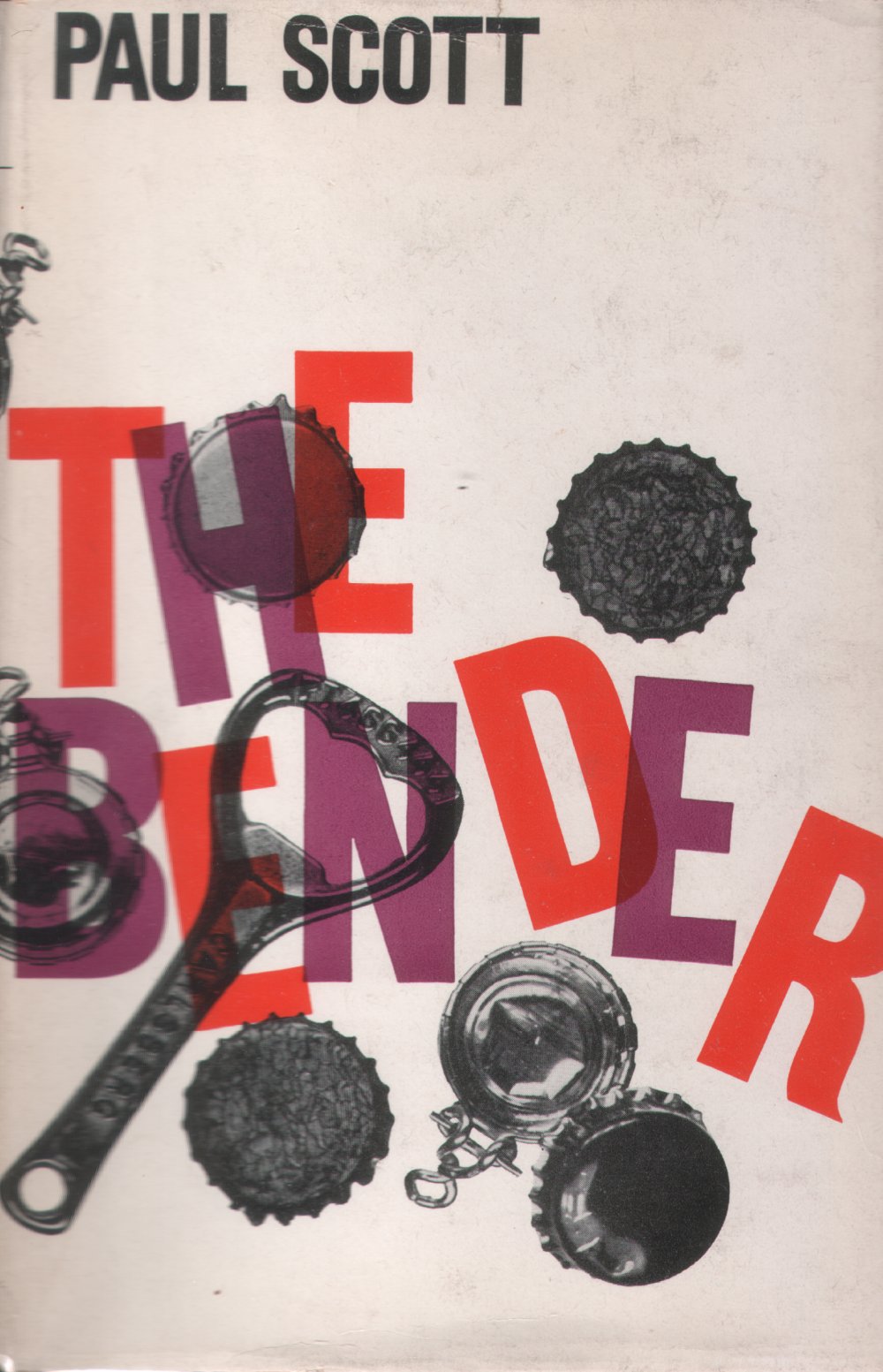
The Bender, Paul Scott (1963). I read the first book of the Raj Quartet for one of my reading challenges, and thought the book was superb. As a result, I added Scott to the list of authors whose books I track down to read. In first edition. The Bender predates the Raj Quartet and is not as weighty as those four books. It’s a very 1960s comedy, but also a beautifully witty one. I wrote about it on my blog here.

Betrayals, Charles Palliser (1994). I’m surprised this book isn’t better known. It’s an amazingly-put-together series of stories which form a much greater story. It opens with a series of Victorian travellers, trapped on a train by snow, who tell each other stories… and then proceeds to unravel and then stitch together the stories told by those travellers. There’s a superb take-down of a cult semiotician, a clever spoof of the Scottish detective programme Taggart, and a brilliant pastiche of Jeffrey Archer. Perhaps the links between the stories aren’t quite strong enough to carry the story-arc, but Betrayals is a very clever, very amusing, and excellent novel.

Honourable mentions go to Eastermodern by Herta Hurnaus, Oscar Niemeyer Houses by Alan Weintraub and Building Brasilia by Marcel Gautherot, which are books of photographs of modernist and brutalist buildings. Niemeyer’s work perfectly encapsulates the future we could have had, and all cities should resemble Brasilia. Also worthy of note are How to Suppress Women’s Writing by Joanna Russ, which every writer and critic should read; Alias Grace, which is probably Margaret Atwood’s best novel; and Hear Us O Lord from Heaven Thy Dwelling Place by Malcolm Lowry, a collection by an author new to me which contains some excellent novellas and some not so interesting short stories.

Pictures
I’ve already visited the cinema twice so far this year, which is something of a record for me. One of the films I saw in IMAX 3D makes it onto my top five; the other one was rubbish, so it doesn’t. The other films I’ve seen were all on DVD – some borrowed, some bought, and some rented.

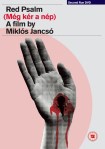
Red Psalm (Még kér a nép), Miklós Janscó (1972). I bought this after seeing a review of the DVD in Sight & Sound. I wasn’t sure what to expect, but it certainly wasn’t a group of hippie-looking Hungarians wandering around a farm spouting socialist rhetoric and singing folk songs, and then getting shot at by soldiers. I loved it. I wrote about Red Psalm on my blog here.
Red Desert (Il deserto rosso), Michelangelo Antonioni (1964). I’ve admired Antonioni’s films since first seeing L’Avventura several years ago. Red Desert was his first film in colour, and it shows – it’s an amazingly painterly film. Unlike in most films, the characters do not over-shadow their world but are very much a part of it. It creates a distance between viewer and cast, but there’s an immersive quality to the mise en scène which renders that of little importance. Films don’t need viewer analogues – that’s just confining the medium to the simplicity of oral storytelling: films use images just like books use words, and that’s where their focus should lie. I wrote about Red Desert on my blog here.

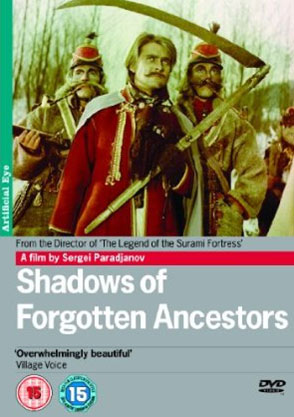
Shadows of Forgotten Ancestors (Тіні забутих предків), Sergei Parajanov (1965). I watched Parajanov’s The Colour of Pomegranates last year. That film is perhaps the zenith of “poetical cinema”, but Shadows of Forgotten Ancestors is definitely a way-station on the climb to it. It is, on the face of it, a simple story of one young man’s trials and tribulations. He is a member of Ukrainian Hutsul culture, and the film is rich with its costumes, music and traditions. Shadows of Forgotten Ancestors is by no means an easy film to watch, however, as it operates on so many levels – but it at least has a coherent plot, which is more than can be said for The Colour of Pomegranates.

On the Silver Globe (Na srebrnym globie), Andrzej Żuławski (1978/1988). If you can imagine a film that out-Tarkovskys Solaris, then you might have some idea of what On the Silver Globe is like. It’s based on a trilogy of novels published in Poland in 1911 by Jerzy Żuławski, which have apparently never been translated into English. On the strength of this film, they should be. It’s probably evident that I’m not a huge fan of traditional Hollywood-style cinema; it often feels to me like a waste of the medium’s potential. And yet films such as Red Psalm and On the Silver Globe, with their declarative dialogue, often feel like they’re only partway to what film could truly be. I like the painterly mise en scène of poetical cinema, but often find the declarative dialogue as clumsy as science fiction’s crude use of exposition. And so it is in On the Silver Globe – characters run around and gurn at the camera, and then speechify on the meaning of life. However, it’s in the story and the imagery that the film really impresses – enough, in fact, to offset the fact the film was never completed – much like Andrzej Munk’s Passenger. The Polish Ministry of Culture closed down the production of On the Silver Globe when the film was only 80% complete. It was ten years before Żuławski returned to it, and then he could only complete it by using stock footage and voice-over for some parts. It works surprisingly well. I plan to write more about On the Silver Globe on this blog.
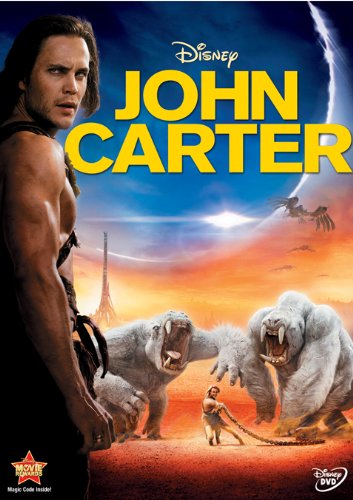
John Carter, Andrew Stanton (2012). John Carter received a mauling at the US box office, so much so it was officially declared a flop by its studio, Disney. Happily, the world outside the US had more discerning taste and went to see the film in sufficient numbers for it to eventually turn a profit. But the profitability of a film is measured solely on its performance at the US box office – which is both dumb and parochial – so it’s unlikely a sequel to John Carter will ever be made. Which is a shame. John Carter was a spectacle, with a clever script that managed to make something twenty-first century of its early twentieth-century source material. It had its flaws – some longeurs, and an inelegant info-dump to explain the plot – but other parts more than made up for it. I wrote more about it on my blog here.

Honourable mentions go to , Federico Fellini (1962), which after seeing La Dolce Vita many years ago and disliking it, I had expected to hate – I didn’t; I loved it. Troll Hunter, André Øvredal (2010), was another deadpan Norwegian spoof and cleverly done, though not quite as good as Norwegian Ninja. The Third Part of the Night, Andrzej Żuławski (1971), was the first Żuławski I saw, and it’s off-the-wall Hitchcockian style appealed to me greatly (as did Andrzej Korzyñski’s superb soundtrack). Went the Day Well?, Cavalcanti (1942), was a surprisingly brutal piece of wartime propaganda in which a German fifth column try to conquer a small English village. It goes badly. The Extraordinary Adventures of Adèle Blanc Sec, Luc Besson (2010), gets a mention as an entertaining adaptation of Jacques Tardi’s bande dessinée, and though it’s completely silly it was great fun. Finally, some quality telly: Twin Peaks (1990 – 1991), which has not dated at all, and is still great entertainment despite being completely bonkers; and Caprica (2010), which promised so much more than it ever got the chance to deliver.

Sounds
I knew from early this year that 2012 was going to be good for music. Perhaps few of my favourite bands are releasing albums, or touring the UK, but I’ve stumbled across some bands new to me that have been on almost constant play on the iPod.

Dwellings, Cormorant (2011). The band self-released this last year and it’s a powerful mélange of half a dozen metal genres. I loved it from the first listen, and even went back and got copies of their earlier two albums.

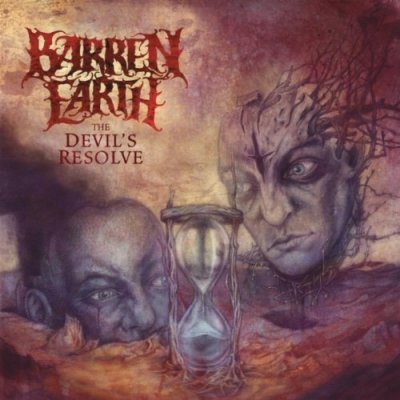
The Devil’s Resolve, Barren Earth (2012). This is the superband’s second album, and it’s a heavier and yet proggier effort than their first. The riffs are not quite as memorable as they are on The Curse of the Red River, but the lead breaks are much more impressive, and the proggy break-outs even stranger. Opeth’s Heritage proved there was a market for 1970s-inspired weird Scandinavian prog, and Barren Earth have taken that and melded it with Scandinavian death/doom to create a winning combination.

The Weight of Oceans, In Mourning (2012). I saw a review of this and it sounded appealing, so I ordered a copy from a Finnish website. It’s death/doom in that way the Finns do so well, but with added slow modern progginess. It’s not proggy like Barren Earth is proggy, inasmuch its acoustic parts feel more of a piece with the heavy parts. I’ve been playing it constantly since it arrived.

Nostalgia, Gwynbleidd (2009). Another band I came across mention of and who I thought I might like. So I bought the album. And yes, I do like them. Very much. They’re a sort of mix between Opeth and Northern Oak, but also not much like either. There are long sustained death metal parts, interspersed with folky acoustic guitar, and it all hangs together exceedingly well.
Legacy, Hypnos 69 (2010). I’ve been a fan of Hypnos 69 since hearing their The Intrigue of Perception several years ago. I’s taken me a while to get hold of Legacy, chiefly because it was released by a small label in Germany and wasn’t available in the UK. Recently I discovered it was on bandcamp, so I bought it from there. It’s Hypnos 69 doing Hypnos 69-type stuff, and I love it.

Honourable mentions go to Finnish death metallers (Psychoparalysis), who have self-released three excellent EPs; Weather Systems by Anathema (2012), which I much prefer to the previous album; Wood 5: Grey Skies & Electric Light by Woods of Ypres, which is folky black metal that sounds a little like Type O Negative in places  and includes strings and oboe; and finally, All Spawns, a recent compilation of Czech death metal pioneers Apalling Spawn’s two released from the late 1990s (now, if I can only find a copy of the Sparagmos compilation, I’ll be really happy…).


2 Comments

Words invade a home book by book

In the past six months, I’ve given away several hundred books, and yet the ones remaining seem to take up more and more space. Admittedly, some authors’ books I’ve been steadily replacing paperback copies with hardbacks… But that can’t be the only reason. However, some of the following may go some way to explaining it:

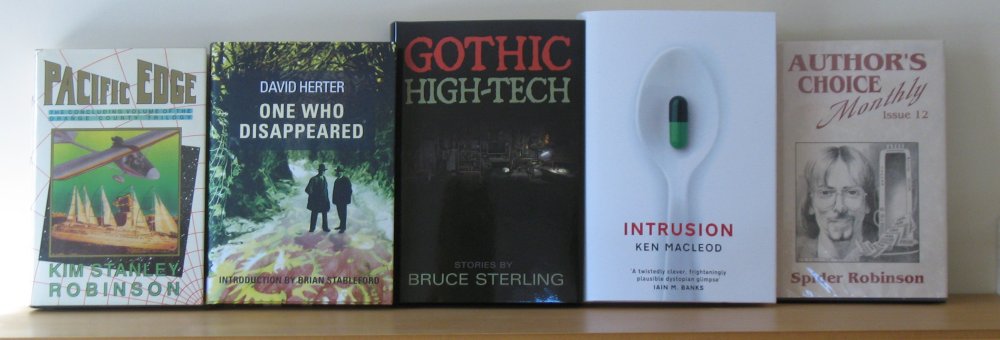
Some signed firsts: Gothic High-Tech and One Who Disappeared I pre-ordered ages ago, from Subterranean and PS respectively. Intrusion was the only book I bought at the SFX Weekender, and since Ken was there he signed it for me. Pacific Edge is for the KSR Collection, and the Spider Robinson Author’s Choice Monthly joins the others I own (currently twelve). I can’t say I’m a fan of all the writers they published, but there are several excellent ones.

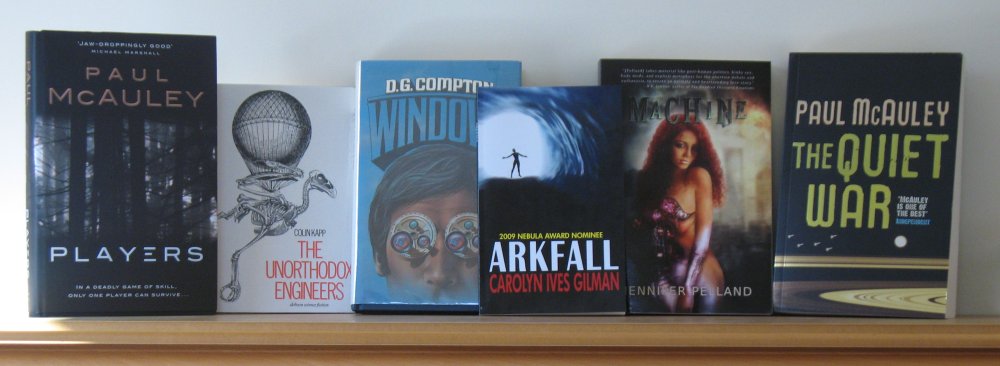
I bought The Quiet War from a seller on abebooks.co.uk, who had it down as a hardback. When it proved to be the trade paperback, they gave me a refund. There’s a copy of Players on coldtonnage.com for £50; I got my copy for £5 on eBay. Windows – a US hardback, it was never published in the UK – is for the Compton Collection. And Arkfall and Machine are two recent books by women sf writers. I thought Gilman’s Isles of the Forsaken excellent (see here), and I’ve heard good things about Pelland’s fiction (shame about the cover-art, though).

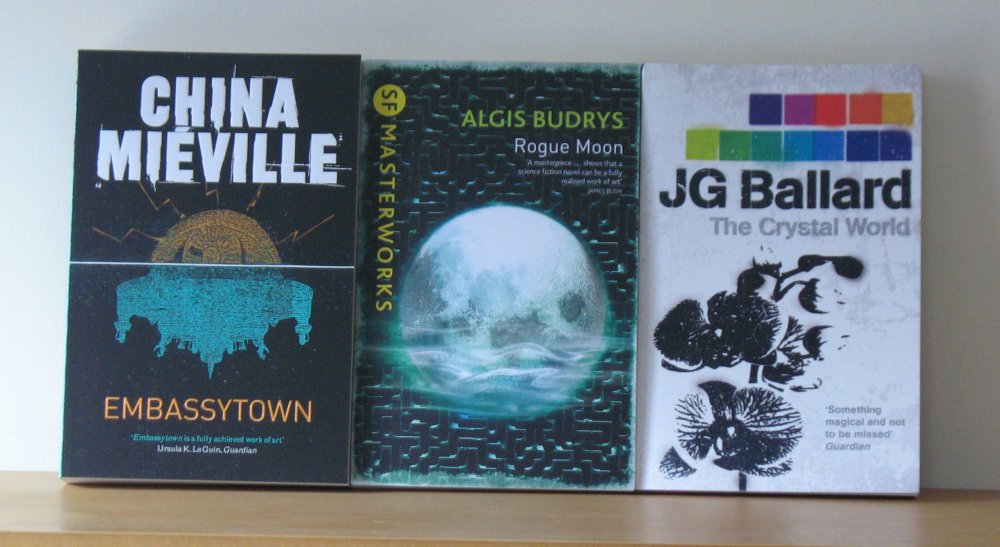
Some new paperbacks. If Embassytown is shortlisted for the Clarke, I’m going feel a little silly. I guess I’d better read it then. Rogue Moon joins the rest of my SF Masterworks collection, though I reread the book only a couple of years ago. I do like the design on these 4th Estate Ballard books – The Crystal World makes it six I now own.

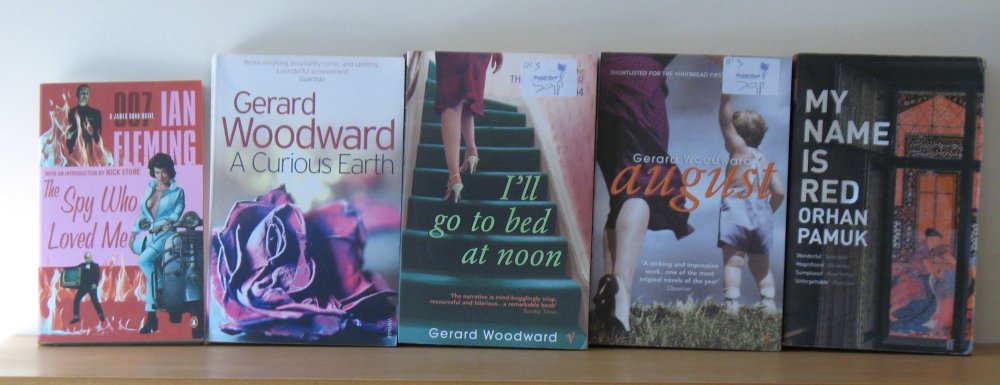
Charity shop finds. My Name is Red becomes March’s book for this year’s reading challenge (see here). I’m still determined to work my way through the 007 books, despite thinking they’re not very good – hence The Spy Who Loved Me. And I’ve quite fancied trying some of Gerard Woodward’s novels for a while, and last weekend I found three in a charity shop: August, I’ll Go To Bed At Noon and A Curious Earth.

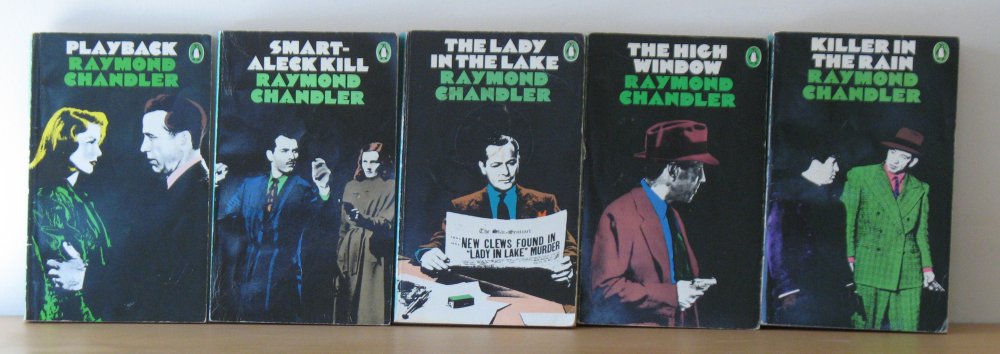
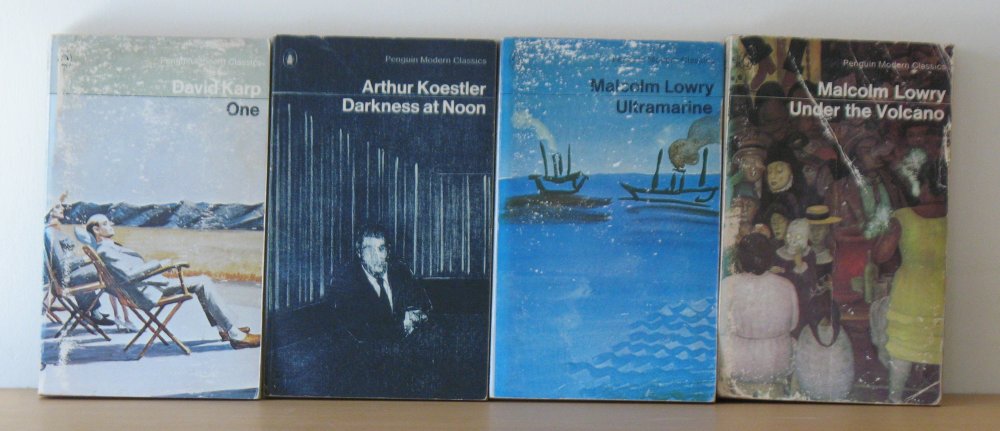
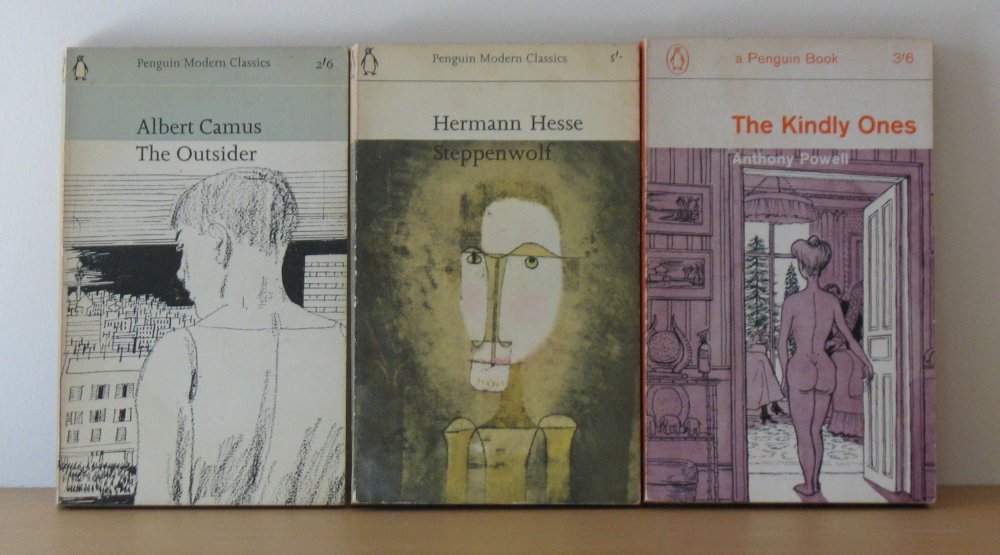
This is the last lot from my Dad’s collection of Penguin paperbacks. A bunch of Raymond Chandlers: Playback, The High Window, The Lady in the Lake, Smart-Aleck Kill and Killer in the Rain. A couple by Malcolm Lowry: Under the Volcano and Ultramarine. One by David Karp (did you see what I did there?). Another Camus – The Outsider; one from the Dance to the Music of Time – The Kindly Ones (a popular book title, it seems) – and Herman Hesse’s Steppenwolf and Arthur Koestler’s Darkness at Noon.

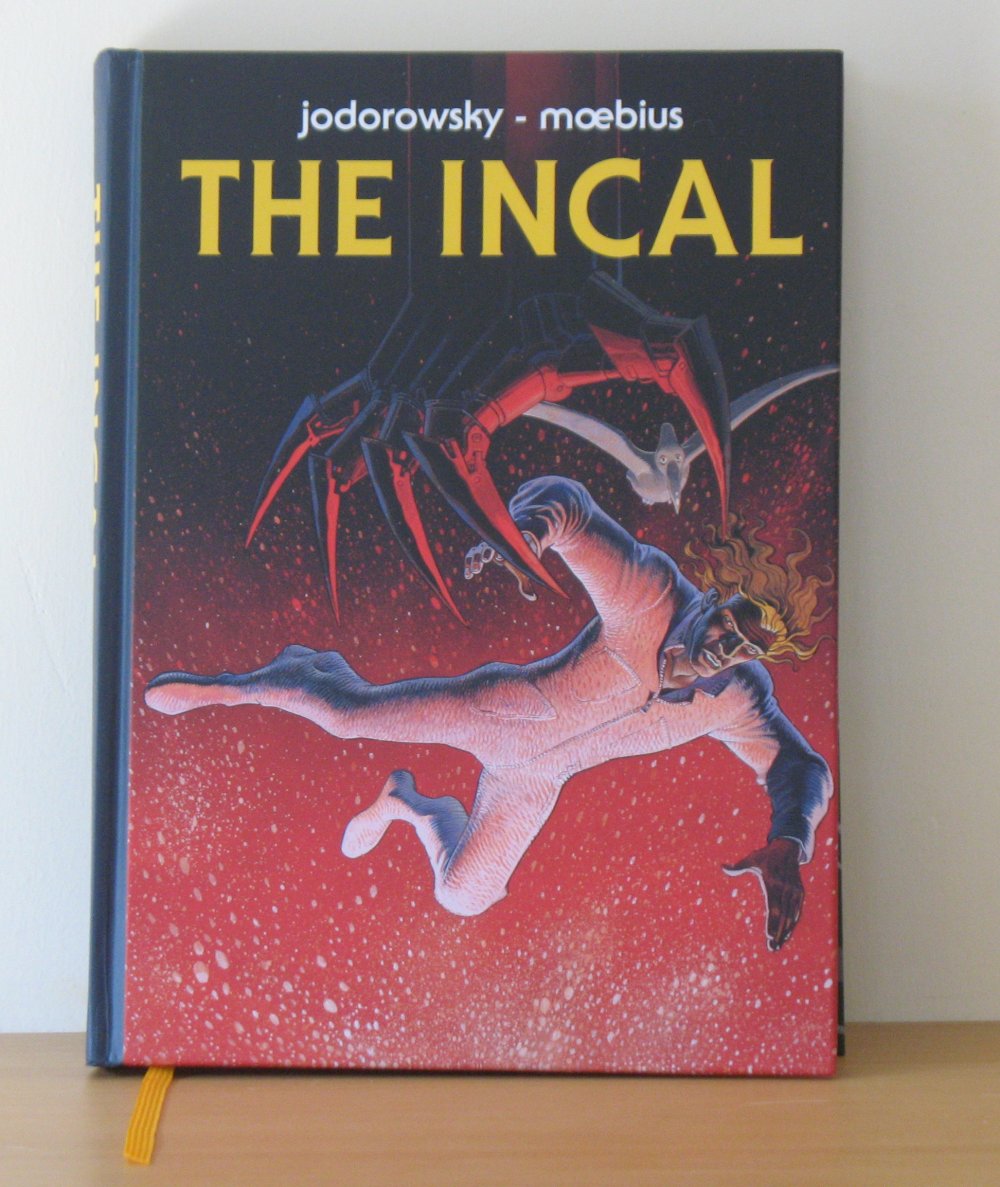
This is the third time The Incal has been published in English – first by Titan Books, then by Humanoids Associates, and now by SelfMadeHero. But this new edition is much nicer than previous ones, so even though I have the Humanoids paperbacks I had to get this one.

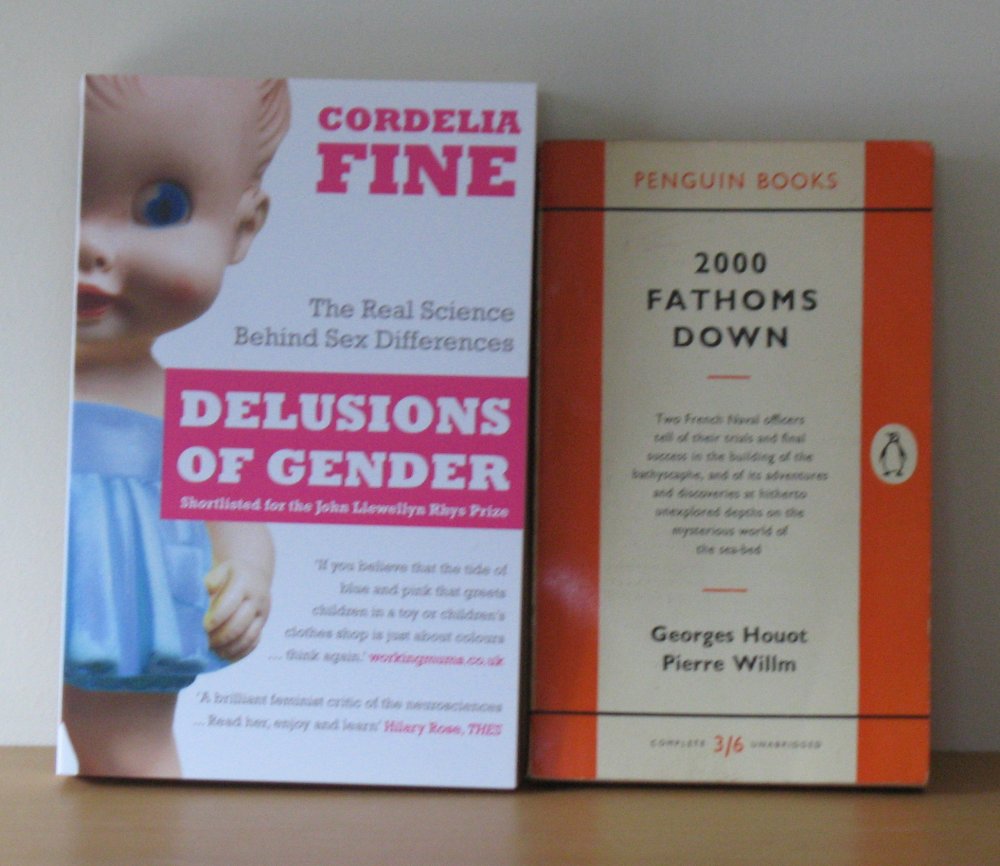
2000 Fathoms Down is for the underwater collection (that’s a collection of books on underwater topics, rather than a collection of books located underwater, of course), and I’ve seen so many positive mentions of Delusions of Gender I thought it was about time I bought my own copy.


1 Comment

Festive activities

Christmas is over for another year, and life can now return to what passes for normal. Once again, I was in Denmark for the festivities, but this year it was wet and windy rather than the usual deep snow. There was a lot of eating involved, and a lot of walking. The day after Boxing Day, we went to see David Fincher’s The Girl with the Dragon Tattoo at the cinema (English with Danish subtitles, fortunately). Though I’ve not read the book, I have seen the Swedish version of the film. To be honest, I’m not sure which of the two versions is the better.

The flight back from Denmark was… interesting. On the approach to Manchester Airport, the plane was thrown around by turbulence and we almost touched down… before the captain decided to abort and up we went for another go around. Fortunately, the second attempt was much smoother and we landed in one piece. I first flew in 1968 and I’ve flown at least once a year since, and that was the first time I’ve ever been in an aircraft that took more than one attempt to land. Having said that, I’ve never been a big fan of air travel – and less so these days than I used to be. All that “security theatre” is just unnecessary palaver – how many terrorists has it actually caught? We certainly know it failed to catch two bombers… And while airlines seem to want us to believe that air travel has become easier and more convenient, the reverse is actually true. Also, budget airlines appear to hold their customers in complete contempt. They ask you to queue at the boarding-gate for an hour but don’t provide anywhere to sit. Aircraft are not buses – and given all the hoops passengers are forced to jump through before boarding at present, they never will be. The entire industry needs over-hauling.

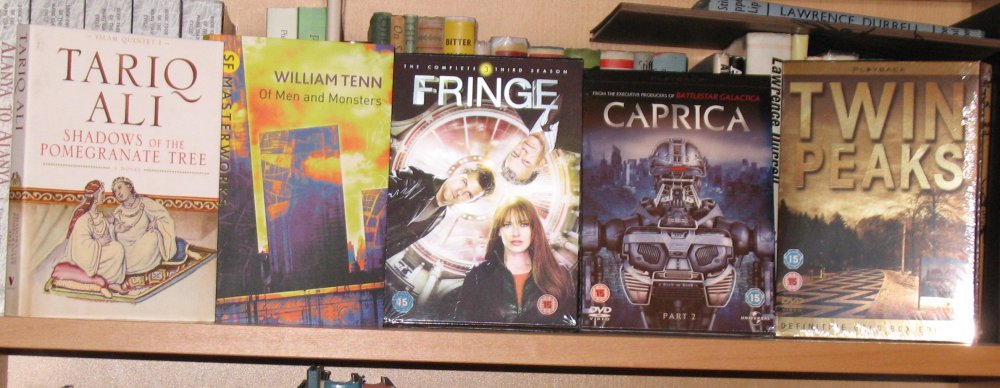
Santa brought me some books and some DVDs: William Tenn’s Of Men and Monsters and Tariq Ali’s Shadows Of The Pomegranate Tree, the first book of the Islam Quintet; and Twin Peaks: Definitive Gold Box Edition, Fringe Season 3 and Caprica Season 1 Volume 2. I read the two books before returning to the UK. Of Men and Monsters was better than I expected, though I’m in two minds whether it belongs in the SF Masterwork series. Shadows Of The Pomegranate Tree is set in Moorish Spain in 1500 CE, and chronicles the Spanish Catholics’ campaign to wipe out Islam and its practitioners on the peninsula. It’s strong stuff, though Ali’s frequently inelegant prose didn’t do the book any favours. I’ll probably read the rest of the Quintet at some point, but I’m not going to dash out and buy them immediately.

I’ll also read a number of books during the holiday – in fact, I was averaging one a day. The books were Engleby, Sebastian Faulks (2007), which was a definite improvement on the longeur-packed On Green Dolphin Street. A working-class scholar at Oxford University fancies a female student from afar, but one day she disappears and is never found. It’s not difficult to work out what happened to her, though it’s hard to tell if Faulks thought the reveal was an actual plot twist. The final third of the book is a character-study of the narrator, which not only means Engleby is not a murder-mystery novel but also means it’s unsatisfactory as either murder-mystery or literary fiction.

The Manual of Detection, Jedediah Berry (2009), I remember seeing an approving review of in the Guardian by Michael Moorcock when the book was published. As a result, I’ve kept an eye open for a copy in charity shops ever since. It is… an odd beast. The story seems better-suited to a comic or graphic novel and, as a result, doesn’t work all that well as prose. A clerk for the Agency, a huge detective agency which seems to be the most important company in a 1950s-style city, is promoted to detective when the detective whose reports he files disappears. He soon ends up out of his depth in some weird conspiracy between the Agency and a villain based in a carnival, and it’s all to do with the way the Agency actually operates. The missing detective is called Travis S Sivart, but nothing is actually made of the fact that the name is a palindrome. It makes you wonder why the author bothered.

Black Swan Green, David Mitchell (2006), is Mitchell’s fourth novel, and is told entirely in the voice of a thirteen-year-old boy living in the eponymous Worcestershire village in 1982. He’s being bullied at school, his parents’ marriage is on the rocks, and an act of petty revenge leads to a tragedy. Everything in the book struck me as a little clichéd, but perhaps that’s because I remember the early eighties quite well. Mitchell handles his narrator’s voice with skill and it’s a very readable story, but it all felt a bit soap-opera-ish in places. It’s not as successful as Cloud Atlas, though it is better than his first two novels, Ghostwritten and number9dream.

Of course, in the weeks leading up to Christmas the postie was also busy. Since my last book haul post, the following books have landed on the mat:

These are the aforementioned Christmas goodies.

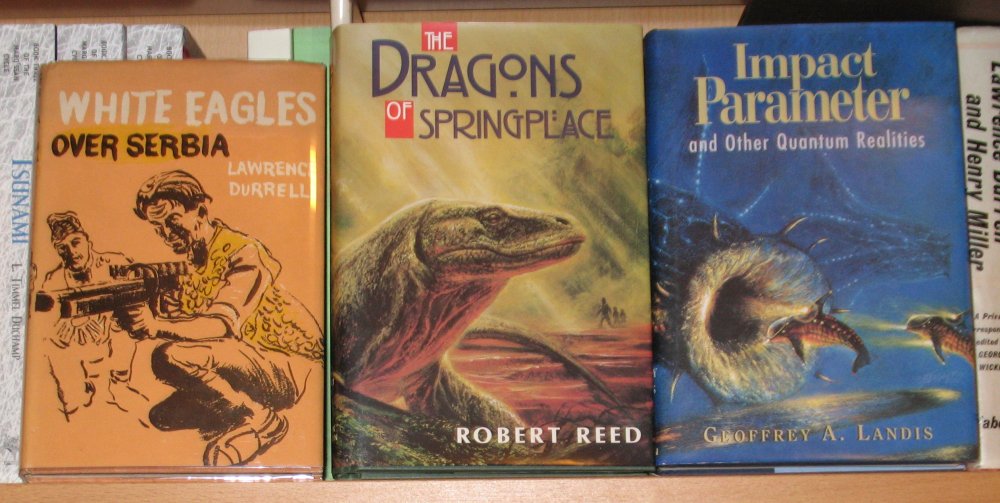
Some first editions: White Eagle Over Serbia is for the Lawrence Durrell collection. The Dragons of Springplace and Impact Parameter I bought in the recent Golden Gryphon 50% off sale.

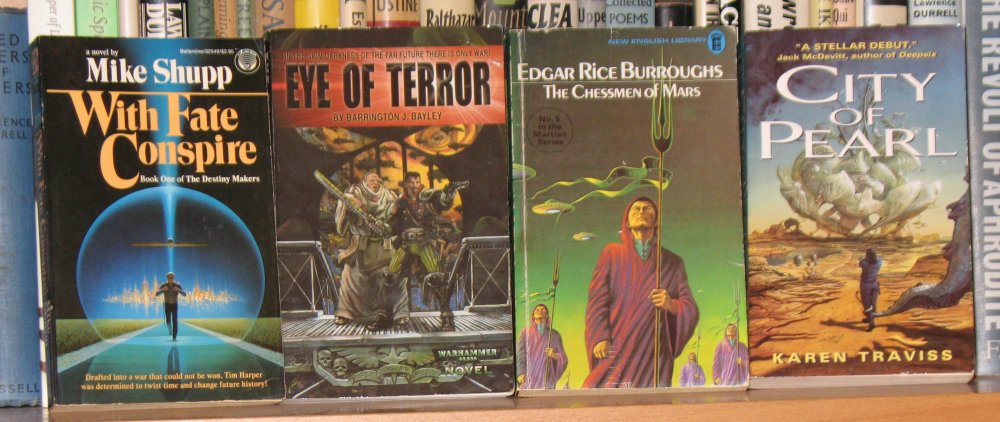
A few sf paperbacks. I used to correspond with Mike Shupp, and I’ve always wanted to read his Destiny Makers quintet, but it’s taken me a while to find decent copies. Now that I have the first book in the series, With Fate Conspire, I can make a start, although I still need to find a copy of the third book, Soldier of Another Fortune. Eye of Terror is Barrington Bayley’s only Warhammer 40K novel, and by all accounts is especially mad – even for him. The Chessmen of Mars almost completes my set of 1970s NEL editions of the John Carter books – because, of course, I have to have a set that all looks the same, and the ones I already had were NEL paperbacks from the 1970s. City of Pearl is November’s belated read for the reading challenge. I doubt I’ll read it before the end of the year, but never mind.

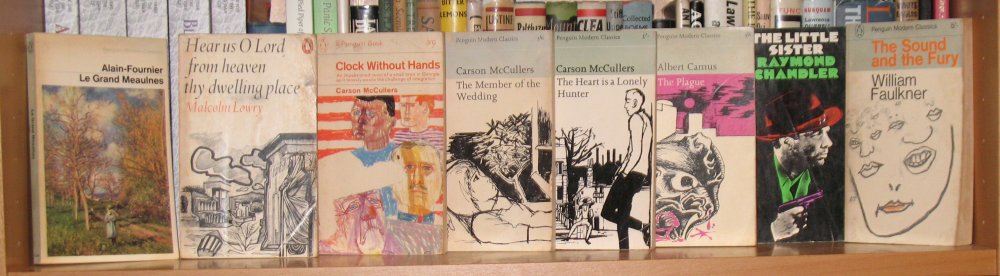
My father owned quite a large collection of Penguin paperbacks. I found an invoice in one, and discovered that he’d actually ordered them direct from the publisher. This was back in the mid-1960s. Though he read and admired all the Penguin books he bought, for the past few decades his reading had mostly been thrillers. Some of his books I want to read myself so I’ve started bringing them home a few at a time, and so… Le Grand Meaulnes, Alain-Fournier; Hear Us O Lord from Heaven Thy Dwelling Place, a short story collection by Malcolm Lowry; Clock Without Hands, The Member of the Wedding and The Heart is a Lonely Hunter, all by Carson McCullers; Albert Camus’ The Plague; Raymond Chandler’s The Little Sister; and The Sound And The Fury by William Faulkner.

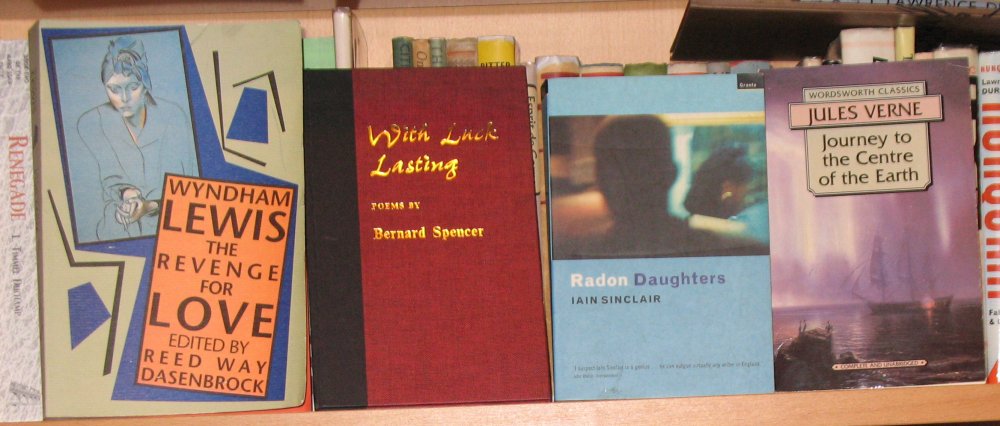
The Revenge for Love and Radon Daughters I found in charity shops. Journey to the Centre of the Earth was a swap from readitswapit.co.uk. With Luck Lasting is Bernard Spencer’s second poetry collection, and while it’s an ex-library book it’s in excellent condition and doesn’t appear to have ever been booked out.

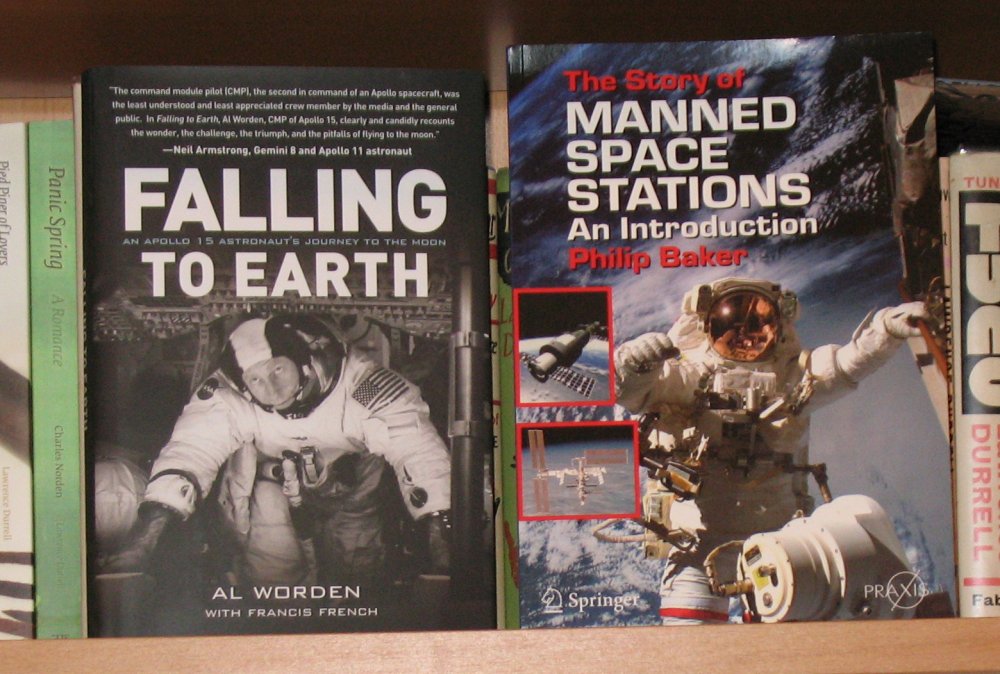
Finally, two books for the space books collection. Falling to Earth is the autobiography of Apollo 15 astronaut Al Worden. It’s signed. The Story of Manned Space Stations was ridiculously cheap on eBay – about £3.50 compared to £18.99 on Amazon.