
It Doesn't Have To Be Right…

… it just has to sound plausible


Leave a comment

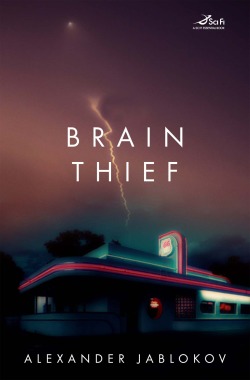
Brain Thief, Alexander Jablokov

Brain Thief, Alexander Jablokov
(2010 Tor, $24.99, 383pp)

In recent years, a number of literary authors have dipped their toes in the waters of science fiction. However, their lack of confidence, or inexperience, in deploying sf tropes often gives such attempts an air of diffidence, which in turn gives the novels an old-fashioned feel. This is because sf is a mode of storytelling, it is not just the garden in which its stories play. The reverse, science fiction authors writing mainstream fiction, is less common. But when science fiction authors write non-sf, it is never really not science fiction. Brain Thief, Alexander Jablokov’s new novel, is a case in point. It is science fiction lite; it presents its mystery credentials with greater authority than it does its science fiction credentials. But it is still at heart a story told in science fiction mode.

Brain Thief is Jablokov’s first novel after a ten-year hiatus. When a pop singer or rock star disappears for a decade, they’re retrenching, or “charging their creative batteries”, and there’s an expectation their new material will be a significant improvement over their last. When a writer – especially a genre writer – vanishes for ten years, it’s usually because real life has intervened. And so it was with Alexander Jablokov, whose previous novel, Deepdrive, was published in 1998. Jablokov has made no secret of that fact that he stopped writing novels “to raise a family and make a living”.

If there’s a fear attached to the return to writing of novelists after a lengthy period, it’s that they’ve failed to keep progress with their chosen genre and their new book reads like one that could have been written before they dropped from sight. Admittedly, Jablokov had shown a wide facility within the genre, from knowing interplanetary adventure to cyberpunk to new space opera. Happily, Brain Thief is very much a late noughties sf novel and – if this doesn’t sound too much like jacket copy – is almost the novel Bruce Sterling might have written if he hadn’t written The Caryatids.

While there are clear likenesses to Sterling’s fiction, Jablokov does not spin off ideas with the same frequency or outrageousness. Nor does he need to – Brain Thief is, after all, not a science fictional novel, but a mystery novel told in science fiction mode. Initially, this collision of modes makes for an annoying read – in science fiction, there is a world to be laid out before the reader; in a mystery novel, much has to be withheld. So while Jablokov happily explains the world of his story, he’s less open about the plot which drives it.

Bernal Haydon-Rumi is personal assistant to Muriel Inglis, a wealthy widow who finances oddball projects. One of these projects is Hesketh, an AI-controlled interplanetary probe under development by lone researcher Madeline Ungaro. On his return from a business trip, Bernal discovers that both Muriel and Hesketh have disappeared. And their disappearances are linked. He finds himself following a trail of clues – some generated by Muriel herself, some discovered on his own. Both disappearances, of course, have a single solution – not only the nature of the Artificial Intelligence which drives Hesketh, but also the one thread which binds all the characters into a single narrative.

Brain Thief is populated with a well-drawn, entertaining cast of characters. Bernal himself might be a tabula rasa, as is required by the story, but the rest might well populate an oddball comedy-drama set somewhere in one the USA’s more oddball corners. This is not a criticism – Brain Thief‘s characters are one of its strengths. Another is its writing. Its biggest strength is perhaps the fact that it isn’t trying to be a science fiction novel and a mystery novel. The sf permeates the mystery story, it’s not continually fighting it for dominance. Which means the resolution satisifies because it doesn’t need to do more than resolve the story. Jablokov has judged his plot, and integrated his world, to a nicety.

I wouldn’t surprised to see Brain Thief on a few shortlists in 2011.

This review originally appeared in Interzone #226, January – February 2010.

(Yet more evidence that sf awards are completely out of touch, irrelevant and no longer serve a useful purpose – Brain Thief, an excellent novel, appeared on only the Locus SF Novel list (as 16th of 18 titles). The big winner in 2011 was the bloated monstrosity that is Connie Willis’ Blackout/All Clear. Why bother, eh?)

Leave a comment

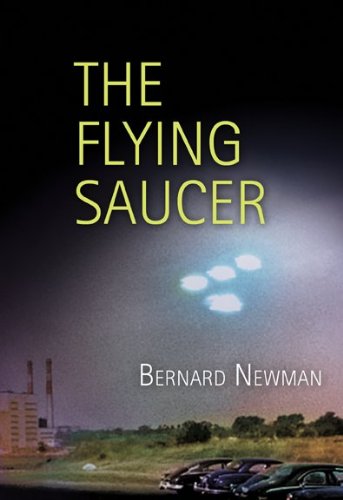
The Flying Saucer, Bernard Newman

The Flying Saucer, Bernard Newman
(2010 Westholme Publishing, $14.95, 250pp)

America Reads is a series of books which are “rediscovered fiction and nonfiction from key periods in American history”. The Flying Saucer by Bernard Newman is the first of three books in the series subtitled “1950s: Visions of the Future”. Strange then, that America apparently reads a novel by a British writer as a vision of its future. Further strangeness lies in the title. This novel was apparently the first to use the phrase “flying saucer” as a title, and yet no flying saucer actually appears in the story. They are, like the novel’s central conceit, smoke and mirrors. Project Blue Book is just as much a work of fiction as The Flying Saucer, but the author is not the United States Air Force.

The author is, in fact, Bernard Newman, who, as Bernard Newman the author, narrates the story of The Flying Saucer. Such postmodern narrative games sit oddly in what is essentially postwar pulp fiction – especially given the book’s overt nods towards HG Wells and prewar scientific romances. Newman, riffing off The Shape of Things to Come, looks to a scientific elite to save the world from itself, despite only five years having passed since World War Two ended with its frenetic technological progress resulting in V-2s and jet-fighters and radar. The opening chapter of The Flying Saucer recounts a conversation between Newman, eminent polymath scientist Drummond, and ex-spy and comedy Frenchman Pontivy. Together, they hatch a cunning plot, based on the canard that Earth’s nations will unite against a common foe. They chose Mars to be the home of Earth’s enemy. Drummond invents a rocket, made of some indestructible substance, and powered by mysterious means. It lands in Leicestershire, but unlike in Wells’ The War of the Worlds, contains only a message in a strange “alien” alphabet.

As the story progresses, as more rockets land in various parts of the world, the central trio recruit more scientists to their cabal. The messages, for example, were written by the world’s leading linguist. Who is subsequently asked by the UN to translate it. Newman, the author, adds to the global tension by placing stories of UFO encounters in various newspapers and magazines. A British film about aliens invading the Earth becomes a worldwide blockbuster after it is hyped by Newman’s contacts in the media. Meanwhile, Pontivy’s plan to extort more money for the plot from a French criminal backfires badly when the criminal tries to take over the self-created scientific elite. It all comes to a head when a Martian lands in Africa. It carefully manages to escape before the deception can be unmasked. By this point, the nations of the Earth have put away their atomic toys, are in thrall to Drummond’s League of Scientists, and eventually line up to vote in a world leader who proves to be Winston Churchhill in all but name.

It’s all wildly improbable and implausible. There’s no science in this science fiction, only vague handwaving by the narrating author. The central conceit is as old as Tsun Tsu, the book owes many of its ideas to the oeuvres of Verne and Wells, and Pontivy is an offensive racial stereotype. The end result is a potboiler which fails to convince on almost every level, yet remains mostly entertaining. It’s certainly not a definitive or seminal work, by any means. Likely it owes its alleged importance only to an accident of titling. Newman can’t have known a handful of years after the term “flying saucer” was coined that the term, that ufology itself, would prove so popular, or indeed that it would still be going strong sixty years later.

It is good to hear that America Reads. But it’s a shame, if The Flying Saucer is any indication, that it has such poor taste in books.

This review originally appeared in Interzone 232, January – February 2011.


1 Comment

Template, Matthew Hughes

Template, Matthew Hughes
(2008, PS Publishing, £20, 253pp)

Comparisons between Matthew Hughes and Jack Vance are inevitable, because if any writer is a template for Hughes’ fiction then it is Vance. Hughes’ Archonate novels are set on an Earth not unlike the Dying Earth, or on the worlds of a formless galactic polity called The Spray which resembles the Alastor Cluster (in fact, hussade, from Vance’s Trullion: Alastor 2262, is mentioned in Template).

Like many of Vance’s novels, Template is a bildungsroman, and one in which the protagonist is involuntarily pitched into a quest for his true identity. Said protagonist is Conn Labro, a highly-skilled and indentured duellist on the world of Thrais. Despite his abilities, Labro is a naïf and Thrais, with its culture based on contracts and transactions, has given him poor social skills. So when a regular customer is murdered, leaves him a fortune and an encrypted bearer deed to a planet, and an attempt is made on his own life, Labro has no idea how to respond. Happily, there is a young woman at hand to help him. Labro buys out his indenture and determines to discover his origin and the location of the planet he apparently now owns. The young woman, Jenore Mordene, he “hires” as a guide.

It’s in the nature of such a story’s template that the naïf’s voyage of discovery is as much literal as it is metaphorical. Labro’s bearer deed has determined his destination, Earth, and so he must travel there. En route, he learns something of The Spray – which gives Hughes opportunity to discourse on various cultural templates for societies. For example, one character posits a theory of societies each built upon one of the seven deadly sins. Thrais, with its “transactionalism”, is of course Greed. Unfortunately, Hughes makes little of this idea, using it merely as the topic of conversation.

On Earth, Labro sees all social interactions as a form of transaction. Mordene, however, is from a region of Earth which eschews money, and sees something different. This provides some interesting repartee, but does not advance the plot as such. But it certainly sets the template for their relationship.

It’s only when Labro learns what he has inherited that the villain of the piece steps in to the story. Now the template is Gothic. Not only does the villain remain masked but, as is often the case in such fictions, there is a greater enemy hiding behind him. And this greater villain must be defeated if Labro is to win and keep knowledge of his origin, his legacy, and the girl. And yes, the book’s climax does reveal Labro’s origin. It also explains the story’s title – there is indeed a very real template in the story.

At some point reading Template, everyone is sure to ask why we need Hughes when we have Vance. And the answer is: because we can never have too much Vance. And providing it’s done with invention and wit, then it’s as enjoyable as the real thing. Happily, Hughes matches the wit and invention of Vance. He also brings slightly off-kilter philosophical musings to his stories, and they provide a depth Vance sometimes lacks. Having said that, the writing in Template is a little stilted. While clearly intentional, it’s not entirely successful. Further, Labro is somewhat stiff a character, and Mordene is under-written. Neither characteristic is unexpected – at that intersection of bildungsroman and travelogue, where both protagonist and world are mapped, there’s little room for immersion.

This review originally appeared in Interzone 218, October 2008.


4 Comments

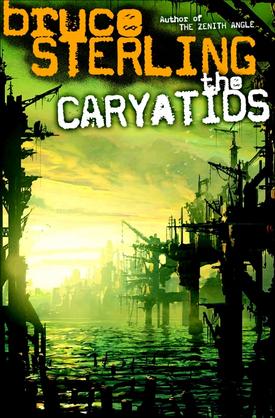
The Caryatids, Bruce Sterling

The Caryatids, Bruce Sterling
(2009, Del Rey, $25.00, 297pp)

In 1930, Hugo Gernsback wrote, “Not only is science fiction an idea of tremendous import, but it is to be an important factor in making the world a better place to live in, through educating the public to the possibilities of science and the influence of science on life which, even today, are not appreciated by the man on the street.” And yet in the decades since then, the genre has ceased to be either didactic or predictive. A science fiction may have something to say – and most certainly do – but any such conversation will most likely be about the present.

Bruce Sterling, however, is not just a science fiction writer. He has also been a “Visionary in Residence”, at both the Art Center College of Design in Pasadena, California, and the Sandberg Instituut in Amsterdam. He has eleven science fiction novels to his name, and five collections of short stories. He has also written non-fiction, such as Tomorrow Now and Shaping Things. His last three novels could be described as conversations with the future: in Zeitgeist, it was the commodification of entertainment product and the feral capitalism of the ex-Soviet client states; in The Zenith Angle, it was the War on Terror and ubiquitous surveillance; and now, in The Caryatids, it is the collapse of the earth’s climate, of the global economy, and of nation-states.

The Caryatids of the book’s title are the four surviving clone sisters of a group of seven created by a female Croatian warlord (what is the female equivalent of warlord? warlady? bellatrix?). Vera is a member of a recovery team on the Adriatic island of Mljet (known to the Ancient Greeks as Melita), which has suffered toxic pollution. Radmila has married into a powerful Hollywood family and is now a media star. Sonja is a medic, living and working for the Chinese in a space city in the Gobi Desert. And then there’s Biserka, who is insane.

I suspect it’s no accident there are seven clone sisters – that’s one for each continent. It’s equally telling that only four have survived. Vera is Europe – technological, non-authoritarian, looking for new ways to live. Radmila is the US – technology-backed spectacle, a self-imposed role as the guardian of the planet, and wielding capitalism as a weapon with the clinical precision of a scalpel. Sonja is Asia – undefeatable, strong, and finding a way to live that neither Europe nor the US would ever contemplate. And poor Biserka is Africa – the dark continent, forever at war with itself.

There is also an eighth clone, a man. His name is Djordje – AKA George – and he is a Viennese businessman. He has a nice Viennese hausfrau wife and dalring children. He is successful, and makes more than enough money to keep his family safe and secure. He’s not above bending laws, or ethics, when making deals. He has just started using the latest business tools and he thinks they’re wonderful. George is perhaps the world as it used to be.

And the “mother”? She is the climate disaster which created the world of The Caryatids. Once she’s done her bit, she’s hustled off to a space station in orbit, out of the way of story and history.

Each clone has her story – and The Caryatids is a story. And shown to be a story about a story in the afterword “interview” with Radmila’s daughter, Mary Montalban. There are three sections to the novel: Vera, Radmila and Sonja. An epilogue sees all four meet for the funeral of their mother. They are burying the world’s past as much as they burying their own.

The world as it is in The Caryatids is not the world we know. The climate has crashed, billions have died, and most nation-states have failed. The world is now dominated by two supra-national societies – the Dispensation and the Acquis. The Dispensation is Californian and supremely capitalist. Its members talk like the flakiest of Hollywood “business” people. The Acquis are European.

As a writer or a visionary, Sterling has never been short of ideas, and there are plenty in The Caryatids. Most of them seem extrapolated from his arguments in Tomorrow Now and Shaping Things – ubiquitous computing, and complex devices created from simple components using unsophisticated techniques. This is a “spime”-dominated future.

Conversations can change minds. They can alter opinions. When conversing about the future, wiggle-room for such changes is built-in. The Caryatids is not going to be “educating the public to the possibilities of science and the influence of science on life”, but it may well prove a catalyst for conversations which will do that. Gernsback might not recognise the 21st century version of his “scientification”, but for those of us living in the 21st Century and gazing into the abyss of the future, The Caryatids provides a thought-provoking, entertaining and perhaps important roadmap for the decades ahead.

This review originally appeared, with an interview with Bruce Sterling, in Interzone 221, March-April 2009.