It Doesn't Have To Be Right…

… it just has to sound plausible


Leave a comment

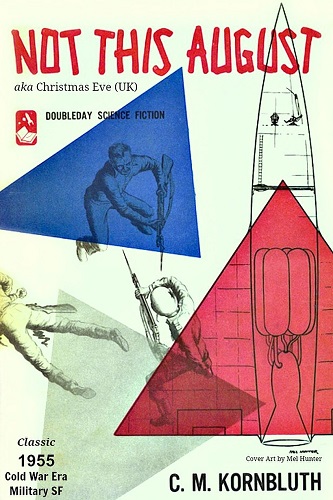
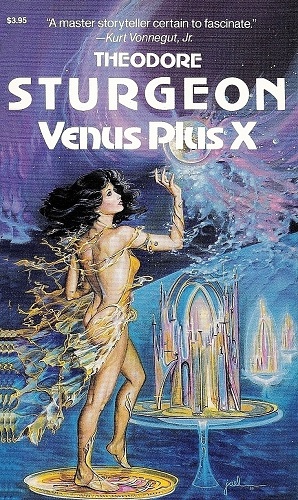
Not This August, Cyril M Kornbluth

Nominated for the Hugo in 1956, which was won that year by Robert Heinlein’s Double Star (1955, USA). Not This August (1955, USA) takes place in 1965 in a US that has been fighting USSR and Chinese forces for three years. The war has not been going well, and life in the US is grim, deprived and increasingly restrictive.

Billy Justin is a veteran and a small milk farmer barely scraping by. He hires a local itinerant who doesn’t appear to have all his marbles, only for the man to reveal he headed a secret project to build a crewed orbital bomb platform to end the war. The project was in danger of being discovered so he sealed the secret bunker and fatally gassed everyone inside.

The Soviets conquer the US and a political troop take over the county where Justin lives. He hooks up with a US resistance, and they restart the orbital bomb platform project, which was nearly finished anyway. Then the Soviet occupying troops are replaced with more hardline troops, but the Americans manage to stage an uprising, which serves as a successful ploy to prevent the Soviets from stopping the launch of the bomb platform.

Not This August reminded me a little of MJ Engh’s Arslan (1976, USA), a novel I didn’t like. One of the problems I had with that novel was the US at the time of writing, 1976, threw off fifty years of progress seemingly overnight, going from cars to carts and horses in a matter of days. In Not This August, the US has at least been at war for three years, and while it has taken most of the nation’s resources, it has not at the start of the novel managed to take US territory. Except the life lived by Justin is not the 1965 we remember, but closer to 1935. True, there were still farms and rural communities in the US without electricity until the mid-1960s in the real world, but even so… 

There’s a lot of American sf written and set in the early latter half of last century that feels like it’s set between the wars. Because that’s when the writers were teenagers, or young men (they’re almost always men; except for, well, Engh), and their imagination doesn’t stretch much further than that. Either that, or the US was a lot more backward, and perhaps still is, than it liked, or likes, to insist. Not This August is an entertaining if dated and not especially plausible sf novel. I remember living under the threat of Mutually Assured Destruction, and Kornbluth obviously was when he wrote this novel, but there’s nothing here to evoke that – or, I suspect, to remind those who lived during rationing what it was like (the US had rationing during WWII, but it was nowhere near as severe as in the UK). Nice try, but no Blue Peter badge, I’m afraid.


Leave a comment

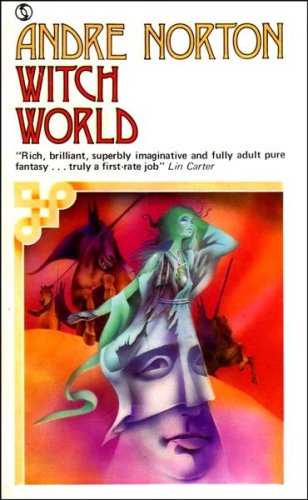
Witch World, Andre Norton

I remember reading some novels by Norton back in the 1970s, but I don’t remember if Witch World (1963, USA) was one of them. Probably not. Nothing in it seemed remotely familiar. Or particularly good. Although it was on the Hugo Award shortlist in 1964. The only memory I have of the novels by Norton I read back then is that they were science fiction adventure stories, on a par with something like the Hardy Boys. And with, I seem to recall, mostly teenage or young adult protagonists. Enjoyable, but not memorable. To a teenager, at least.

And I think you’d have to be a teenager to put up with the awful cod-mediaeval dialogue Norton uses in Witch World. The plot is simple: Simon Tregarth – who is not a teenage or young adult protagonist – is on the run after a life of adventure post-war, not always on the right side of the law. He meets a man who promises him a new life, where he will never be caught. Tregarth goes with him, and learns the man is the guardian of the Siege Perilous, a magical stone which can send people to other worlds. Tregarth gets sent to one. Cue adventure.

The world is vaguely mediaeval, with the odd bit of high tech, which even Tregarth thinks is weird in inconsistent. There’s also magic, but he doesn’t blink an eye at that. Nor the fact it’s only women who can perform magic, and they lose the ability if they’ve had sex (which is a bit annoying for Tregarth, as he fancies one of the witches big time). But then it turns out he has magical abilities – a man! inconceivable! – and he’s definitely not a virgin.

Anyway, Tregarth joins the Guards of Estcarp, and plays a pivotal role in a war against the Kolder, human invaders from another world – Norton comes within an inch of describing them as “Yellow Peril” – who turn those they capture into robot zombies. Despite proving unstoppable for much of the novel, Tregarth manages to stop them. There are, of course, a few diversions along the way – failing to defend the trader city of Sulcarkeep, meeting the misogynist Falconers of the mountains, a pogrom against those of the “old blood” in Karsten, a forced marriage in Verlaine, and even discovering the tomb of one of the ancient race who occupied the planet before the humans arrived. It’s all very thrilling…

Witch World went on to spawn a series of more than twenty books over four decades, not all by Norton alone. I have the second book of the series, Web of the Witch World (1964, USA), but I very much doubt I’ll be reading any further.


12 Comments

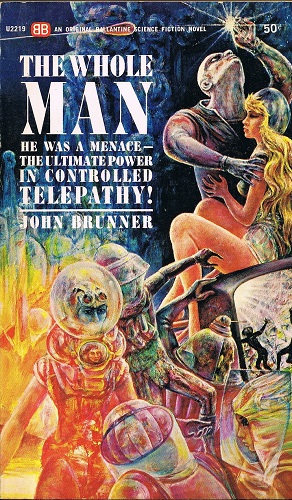
The Whole Man, John Brunner

I have a distinct memory of reading this in 1986 while I was studying at People’s College in Nottingham. Weirdly, the only thing I remember is actually reading the book, not the plot nor any of the details of the story.

The Whole Man (1964, UK) was nominated for the Hugo in 1965 – not an especially good year. It lost to Fritz Leiber’s The Wanderer (1964, USA), which I thought poor, and shared a shortlist with Edgar Pangborn’s Davy (1964, USA), which I hated, and Cordwainer’s Smith’s The Planet Buyer (1964, USA), which would have been an acceptable winner had it been a complete novel…

Gerald Howson was born the son of a terrorist leader in a UK where UN troops were brought in to stabilise the country. He is disabled, but also proves, after puberty, to be an enormously powerful telepath. In a world in which telepaths are routinely used by the UN to telepathically impose peace in areas where violence is about to erupt. And for psychiatric therapy.

The novel is fixed up from three stories, ‘City of the Tiger’, ‘The Whole Man’ and ‘Curative Telepath’, although the novel is split into sections called ‘Molem’, ‘Agitat’ and ‘Mens’, which is Latin for “mind over matter”. The first section is Gerald’s childhood living rough in a UK occupied by UN Peacekeepers. In the second, Gerald is at the WHO clinic in Ulaanbaatar, where he learns about telepathic therapy and catapathic groupings, which is when a powerful telepath retreats into a dreamworld and takes several people with them. Gerald is called into “cure” one such group, but it all proves to be a waste of time as the telepath had merely “taken a holiday” – not the phrase the book uses, but near enough. Gerald then returns to his hometown for a vacation, meets a group of students, helps save the life of one who commits suicide at a house party, and so discovers a path to his own happiness.

I’ve long thought debut novels should not appear on award shortlists, chiefly because the effort invested in debut novels by publishers is so much more than that put into novels by established authors – and with good reason, the publisher wants the debut novelist to have a career, it’s good for them, good for the novelist, good for readers. But does set expectations the debut novelist is unlikely to ever meet. Likewise, I can think of no reason why fix-up novels should appear on award shortlists. True, 1965 was in the early days of the Hugo Awards, but surely there were enough novels qua novels that year not to have to nominate a novel fixed up from stories published between 1958 and 1959, more than 6 years earlier?

The fix-up nature of The Whole Man is obvious – it has no actual plot, just three situations with self-contained story arcs. The world-building is a bit crap, the telepathy is not thought (ha!) through completely, and despite being set in some indefinable near-future everything reads like 1950s UK. Brunner’s treatment of a disabled protagonist in a 1965 novel is all that you would expect of a disabled protagonist in a 1958 short story.

At the time I remembered originally reading this novel, I also recall reading a novel which claimed spiders were so generally found repulsive there was a theory they were extraterrestrial. Absolute nonsense, of course, I’d always thought I’d read that in The Whole Man. Apparently not. No mention of spiders at all. Ah well. It seems likely I’ll remember The Whole Man as the one without the spiders as there’s little else to make it memorable.


1 Comment

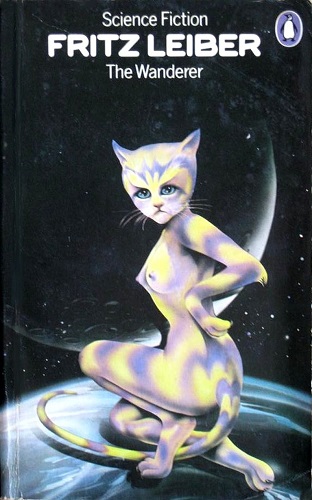
The Wanderer, Fritz Leiber

Winner of the Hugo Award in 1965, in a shortlist which included Cordwainer Smith, Edgar Pangborn and John Brunner. The Smith read like half a novel, I really didn’t like the Pangborn, and I have the Brunner on the TBR. Even so, I’m not convinced The Wanderer (1964, USA) was the best of the four.

A strange planet appears suddenly – from hyperspace, it’s theorised – in the Solar System, just outside the orbit of the Moon. Its presence causes earthquakes and tidal waves, and rips the Moon apart. The planet, named the Wanderer, proves to be actually destroying the Moon for fuel. Because it’s populated by thousands of alien races (including sexy alien cat women), and they’re on the run. The universe is packed with life – none of it visible from Earth, for, er, reasons – and it’s ruled by a government which resists change and adventurism, and the Wanderer’s dwellers are free spirits, gallivanting about the universe in search of, well, adventure.

The story is told through short sections from a wide cast of characters, all American except for a handful of non-US ones. There’s a German scientist, who appears twice and comes across like a cartoon Nazi; and a pair of drunken British writers (one Welsh, one English), who are caricatures, not characters. They also live in a UK that doesn’t exist, where people eat “sausage-and-mashed” rather than sausages and mash. 

All the time I was reading the book, I was trying to figure out when it was set. The US has a base on the Moon, and the USSR a mission on Mars… But the KKK is running around openly in Florida (there are several uses of the n-word and some really offensive racism), the English character remembers a bombing raid as a child, a man in the US claims to be the perpetrator of the Black Dahlia murder (from 1947), and South Africa still has apartheid. So, probably early Sixties, then. (Despite the moonbase and Mars.)

I’m told Leiber’s technique of using multiple viewpoints was something new in science fiction. Certainly it’s a technique more associated with techno-thrillers and the like, but they didn’t begin to appear until later. To be honest, most of the viewpoints don’t actually add anything – there’s a group of UFO nuts in California who explain what’s happening in the first half of the novel, and two Americans independently kidnapped by the aliens who have the second half of the novel explained to them. The rest are, well, not even local colour. 

Hard to believe The Wanderer was the best science fiction novel published in 1964.


Leave a comment

Longer reviews

For the past few years, I’ve been writing longish reviews of books on Medium. I plan to keep that going, but I should probably post a link here when a new review goes up there. As happened last night, a review of John Scalzi’s Redshirts (2012, USA). You can find it here.

I’ve been posting reviews on Medium since May 2021, so there are quite a few. Feel free to check them out.


Leave a comment

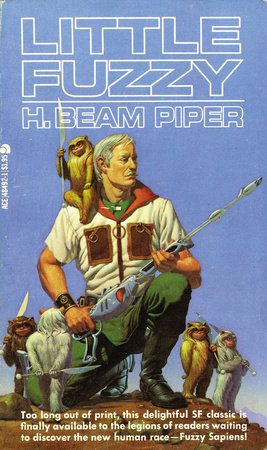
Little Fuzzy, H Beam Piper

Another allegedly classic sf novel, which was nominated for the Hugo in 1963. Dick’s The Man in the High Castle (1962, USA) won that year, and was easily the best of the shortlisted novels. Little Fuzzy (1962, USA), on the other hand, is slight, not in the least bit plausible, and opens from a position of such comprehensive US hegemony its story is pretty much unrecoverable.

The title refers to the indigenous race on Zarathustra, waist-high cute-looking furry creatures with an average intelligence comparable to that of small children. Humans have been on the world for several decades before the first “Fuzzy” appears, and the corporation which owns the planet quickly realises that a native race invalidates their ownership of the world and all its resources. So they play dirty in an effort to prove the Fuzzies either non-existent or not intelligent. A situation which comes to a head when a company bigwig stamps on a Fuzzy, killing it, and a company bodyguard is shot and killed in self-defence.

Like a lot of American sf of the period, this is resolved by people coming together, homespun legal wizardry, a general distrust of the government (and governing corporation), and a handful of native backwoods cunning from several of the cast. While the local governor is corrupt, the local Navy base is packed to the gills with upright honest officers and personnel. The corrupt mayor is a cliché, but so too is the valorisation of military probity – at least in 1962, before the Vietnam War. There are entire Hollywood movies from the 1930s through to the 1950s which use any one of those tropes on which to hang a plot. And each one is as hokey as the next. 

If anything, Little Fuzzy multiplies the hokiness. It’s a novel with far more mouthpiece characters than it needs or the reader deserves. The Fuzzies may be intelligent enough to determine their own destiny, but the humans on their side seem to treat them chiefly as precocious pets. There are many arguments to be made about the European invasion of continental North America, but this novel doesn’t even come within spitting distance of them. It’s the colonisers defending the colonised against the colonisers’ own kind, for reasons that are best not examined too deeply.


2 Comments

How have the Hugos changed?

When you look at the Hugo Award fiction category nominees of the last few years, it seems like the same names keep on cropping up. Only an idiot would deny the Hugo nominees are more diverse than they were twenty years ago, but shouldn’t that mean the award now selects from a wider pool of authors? You’d assume so, given the existence of the internet. True, in recent years, the short fiction categories have been dominated by fiction published on tor.com or Clarkesworld; but in the 1980s and 1990s, the short fiction categories were dominated by fiction published in Analog, Asimov’s and F&SF.

Has anything really changed? I decided to have a look. (I was bored last weekend, obviously.)

There’s little point in comparing the representation of gender, race, nationality, etc, of nominees over the decades, as the awards are clearly far more inclusive. I was interested only in the number of writers considered by Hugo Award voters.

I split the Hugo Awards into three cohorts: early years (1953 to 1970), middle years (1971 to 2000), and present day (2001 to 2020). They’re unevenly-sized cohorts – the 1950s is not a full decade and we don’t have all the nominees for the early awards; in the 1970s, the novelette category was dropped for several years, and… 17 years (no award in 1954), 30 years and 20 years… But the split works when you consider the various cultural movements in sf and sf fandom.

big fish in a small pond

In total, over 67 years, 397 authors have been nominated for a Hugo fiction award – on average, five each in novel, novella, novelette and short story. For 1,256 nominations… 397 is a surprisingly low number. It gets even weirder when you look at how many times individual authors have been nominated. Almost half of those 397 have only a single nomination. Among the others…

The most-nominated author is Mike Resnick, with 30 nominations. The top ten looks like this:

1 Mike Resnick 30 1989 – 2012
2 Connie Willis 24 1980 – 2011
3 Robert Silverberg 23 1968 – 1990
4 Michael Swanwick 22 1986 – 2009
5 Ursula K Le Guin 20 1970 – 2003
6 Larry Niven 19 1967 – 1990
7 Harlan Ellison 18 1966 – 1994
8 George RR Martin 17 1980 – 2012
9= Poul Anderson 15 1959 – 1990
9= Orson Scott Card 15 1979 – 1992
9= Kim Stanley Robinson 15 1983 – 2018
9= Charles Stross 15 2002 – 2014

The years are first nomination to last nomination. The writers’ careers typically lasted much longer.

That’s a lot of old white men. Interestingly, the only author nominated in all three cohorts is Ursula K Le Guin, who had nominations dating from 1970 to 2003.

Among authors who have been nominated only since the turn of the century, the highest number of nominations is for Charles Stross, who managed 15 nominations in 12 years. Seanan McGuire, who has had 13 in just eight years, will likely end up beating his record.

Digging into the Hugo Award nominations for each year, it was surprising how often authors achieve multiple nominations in the same year. Seanan McGuire managed four in 2013, as did Michael Swanwick in 2003. (John C Wright also had four in 2015, but that was entirely due to Sad Puppy bloc voting.)

In early years, it was even more prevalent, with several authors appearing three times across all the fiction shortlists. John Varley even managed an unbroken six-year run, from 1977 to 1982, of two nominations per year.

The one thing the numbers do show clearly is that authors “have their day”. They will be nominated for half a dozen years on the trot, and then disappear. Some pop up a few years later, but most don’t. In some cases, it’s because their career has ended – either retirement or death – but others continue to be published but are never nominated, perhaps because they’re out of fashion or their fans no longer vote for the Hugo. Everything, as they say, shall pass.

But I set off down this rabbit hole to understand if the size of the pool of writers nominated for the Hugo Awards has changed. Overall, 49% of nominees are “one-hit wonders” (a statistic slightly thrown out by the Sad Puppy campaigns of 2014 and 2015), and 16% have had only two nominations.

And when you look at the one-hit wonders, it’s clear present-day voters read much wider: from 1953 to 1970, 51% of nominees appeared only once; from 1971 to 2000, 44% of nominees appeared only once; and from 2001 to 2020, fully 57% of nominees appeared only once (without the Sad Puppies, it would probably be a couple of percentage points lower, but still better than earlier cohorts). I had not expected that. The second cohort, 1971 to 2000, also shows more authors being repeatedly nominated. There were indeed some authors very popular among Hugo voters during this period, such as Connie Willis and Ursula Le Guin, but also Silverberg, Resnick, Varley, Niven and Card. (Lois McMaster Bujold’s success stretched across two cohorts, so she doesn’t score so highly here.)

debut or established?

One other question occurred to me. Present day Hugo voters, it seems to me, like debut novels. Certainly, the industry has changed and debut novels are pushed much harder than they used to be, sometimes even more so than new works by established authors. The whole concept of “building a career” has gone, killed by the need for a quick profit. Best-selling series of the past, like the Wheel of Time or Malazan Books of the Fallen, took several volumes to build up to best-seller levels. That wouldn’t happen now. Instead, we get instant best-sellers, like the Kingkiller Chronicles, followed by a decade-long wait for a sequel. If this is meant to be an improvement, it’s hard to understand how.

But, Hugo nominations can at least show – for best novel, specifically – which nominated novels over the years were debut novels. Popular perception – based on changes in the industry – suggest this is a recent phenomenon. So I went through every best novel shortlist, marking off those which were debuts – as in, the first book the author had published, also including collections. It’s a little difficult to be sure for the first cohort, since novels were often serialised in magazines, and it wasn’t always the serialised version that was nominated but a later hardcover/paperback release, and sometimes even both versions – ‘Dune World’, for example, was nominated two years before Dune, which was a joint-winner in 1966.

The results were… interesting.

I’d have expected a few more debuts in this cohort, given the genre was relatively young. But magazines had been serialising novels from the very beginning, so most well-known authors likely had plenty of novel-length works under their belts by 1953.

There’s considerable overlap between the earlier cohort and this one, and it takes a good fifteen years to fade away. (Perhaps I should have defined my cohorts differently – 1953 to 1965, 1966 to 1985, 1986 to 2015, and 2016 to 2020?) Aside from a blip in the early 1980s, debut novels were not that popular, appearing in only seven of the years. Interestingly, one of the two debuts on the 1985 shortlist was Neuromancer by William Gibson; the other was Emergence by David R Palmer, a fix-up of two novellas nominated for the Hugo in previous years. Palmer published one more novel and then vanished.

Again, there’s overlap from the preceding cohort, and it too takes around fifteen years to fade away. But debuts are also clearly more popular, appearing on the shortlists of eleven of the twenty years, and even making up half of the shortlist in 2020. On the other hand, the one debut novel on the 2004 shortlist was Charles Stross’s Singularity Sky – and he was then nominated each year for further five years. The debut novels nominated in 2011, 2012, 2013 and 2014 were by, respectively, NK Jemisin, James SA Corey (technically not a debut as one of the two authors who write under that name had been previously published), Saladin Ahmed (who has published no novels since), and Ann Leckie. At least two novels I’d thought were debuts – by Paolo Bacigalupi and Yoon Ha Lee – proved not to be, as both had published collections earlier.

in conclusion…

While recent years have seen several authors nominated multiple times, or for several years on the trot, it’s to a lesser degree than was the case in the decades before the turn of the millennium. So it may seem like the same names keep on appearing, but it was much worse in the past. On the other hand, it’s true debut novels are now more prevalent on the Best Novel shortlist than they were previously. I suspect this is a result of both social media and changes in the industry. Sf fandom has always been tribal – does anyone seriously believe Mike Resnick was the absolute best genre author of the 1990s and 2000s? – although I wouldn’t be surprised if a number of writers in twentieth-century Hugo Award shortlists owed their many nominations to logrolling…

Tribalism still plays a major role, of course, with lists of eligible works posted by influential authors, fans basically providing unpaid marketing for their favourites, and authors branding themselves as personalities separate from their novels (rather than “the death of the author”, it’s privileging the author over the work). But this is the world in which the Hugo Award now operates, and it too will likely change over the next decade or two.

additional findings

The most popular middle initial for Hugo nominees is apparently “M”.

The author with the most works published before their first Hugo nomination is Kevin J Anderson, with over one hundred novels or collections. A number of authors had published at least twenty books before their first nomination – Jim Butcher, Neil Gaiman, Frederik Pohl, Bob Shaw, Sheri S Tepper, Philip José Farmer, Michael Bishop, Robert Silverberg, Andre Norton and John Brunner.

The longest unbroken run for best novel nominations is Charles Stross, with six years. Orson Scott Card managed five years in a row.

Only Robert Silverberg has managed more than one novel on the shortlist – two in 1972 (A Time of Changes and The World Inside) and two in 1973 (The Book of Skulls and Dying Inside). He was obviously very popular then. Of course, there was also Blackout and All Clear by Connie Willis, which were published as two books, but the Hugo administrator decided to combine their votes, so giving Willis a win in 2011. As I remember, it was not a popular decision.

Only three people have been nominated for a Hugo posthumously for novel-length works. Both Edgar Rice Burroughs (died 1950) and EE Doc Smith (died 1965) were nominated for Best All-Time Series in 1966. Robert Jordan (died 2007) was, with Brandon Sanderson, nominated for Best Novel for The Wheel of Time series. And no, I can’t remember how they managed to swing that, either.