It Doesn't Have To Be Right…

… it just has to sound plausible


24 Comments

Ian’s 50 essential sf novels, part 2

Day two and here are my essential sf novels, from 26 through to 50. See here for Jared’s on Pornokitsch and here for James Smythe’s.

To me, what constitutes science fiction has always been quite clear, and my numerous attempts at defining the genre have merely been a way of communicating that certainty. But what does “essential” mean? I found that much harder to define. Yes, I relied a lot on my favourite novels when compiling this list – I thought they were brilliant, therefore they must be essential. Except several of them I could not quite squeeze in. My favourite DG Compton novel, for example, is Synthajoy, but in yesterday’s list I instead included The Continuous Katherine Mortenhoe – because I think it covers a theme more essential to a true exploration of the science fiction genre. Likewise, I wanted to include Jed Mercurio’s Ascent, a novel that has been a touchstone work for my own writing for several years. But it only hints at being alternate history in its final pages, and it barely qualifies as space fiction. Oh well.

We readily agreed that graphic novels, or bandes dessinées, were allowed. I picked the most obvious choice – see number 26 below. I’d like to have chosen Dan Dare or the Trigan Empire, but I don’t think either really characterises a tradition in British sf comics – certainly not one that continues to this day. So, much as I love them, I found their inclusion hard to justify.

Certainly, there were movements during the last few decades in sf which I needed to represent in my list: cyberpunk, steampunk, New Space Opera… As long as I picked one work from each, and could justify its presence, then job done. The works I chose for those subgenres are not the most obvious ones, but I think they’re the most important – or  I certainly believe they deserve to be. Others may disagree.

Anyway, the list…

26 The Incal, Alejandro Jodorowsky & Moebius (1981)
In France, there is a strong sf tradition associated with comics, or bandes dessinée. Not all of these have been translated into English – sadly. The Incal is one of the most popular bandes dessinée, and rightly so. It is completely bonkers, beautifully drawn, and an excellent example of what the medium can do.

27 Downbelow Station, CJ Cherryh (1981)
Cherryh has been churning out muscular hard sf since 1976, and she’s still going. Somehow she has managed to stitch all these novels in to a single future history. It’s an astonishing achievement. This book is perhaps her best-known, and is very much characteristic of her oeuvre.

28 Native Tongue, Suzette Elgin Haden (1984)
Women-only utopias do not happen overnight – though from some of the novels which feature them you might think so. Native Tongue charts one route, starting from a near-future in which women are reduced once again to the status of chattel. The development of a women-only language, Láadan, is instrumental in overturning this situation. This novel is both linguistic sf and feminist sf.

29 The Handmaid’s Tale, Margaret Atwood (1985)
The scary thing about this book is that it’s completely made-up but it feels like it could really happen – might be happening now, in fact. You see it in the news every day, and sometimes you have to wonder what is going through people’s heads – the Young Earthers and Creationists, the congresswoman who publicly declares women should not have the vote, New Mexico recently passing a law which requires rape victims to carry pregnancies to term… I’d consider making such people read this book, but I have a horrible feeling they’d consider it utopian fiction…

30 Last Letters from Hav, Jan Morris (1985)
Hav is not a real place, though you might be fooled into thinking so as you read this novel. Very early proto-sf often couched its tall tales in the form of travel journals, but once Gernsback bootstrapped the genre into existence, as a form of sf it seemed to go into decline. A pity, if Last Letters from Hav is any indication of what it can do.

31 Metrophage, Richard Kadrey (1988)
Say “cyberpunk” and everyone immediately thinks of Neuromancer. But I’m not convinced that’s an especially essential book – cyberpunk has become a lifestyle, and does it really matter which novel – arguably – booted it up into existence? What is essential, however, is the book which folded cyberpunk back into science fiction. This one. It marked the end of cyberpunk as a sf literary movement. All the cyberpunk novels and stories that followed were just twitchings of the subgenre’s rotting corpse.

32 ‘Great Work of Time’, John Crowley (1989)
This is one of my two slightly sneaky inclusions. We did agree to allow novellas, and many novellas are indeed published as independent books. But this one never was – it first appeared in the collection Novelty. It is possibly the best time paradox story ever written, with the possible exception of Ted Chiang’s The Merchant and the Alchemist’s Gate.

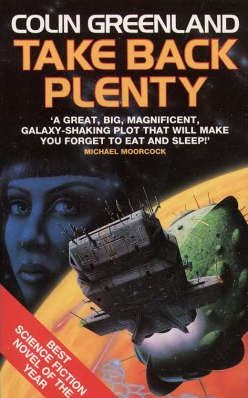
33 Take Back Plenty†, Colin Greenland (1990)
New Space Opera has been good for science fiction. But if this book had been its model rather than Banks’ Culture novels, it could all have turned out very differently. Take Back Plenty celebrates the pulp side of sf, and does so with intelligence, wit and verve. It is one of the genre’s best books.

34 The Difference Engine†, William Gibson & Bruce Sterling (1990)
Another slightly sneaky choice, as Sterling appears alone at the end of this list. The term “steampunk” was coined by KW Jeter, and his Morlock Night and Infernal Devices are emblematic of the subgenre. But they’re not actually that good. The Difference Engine is good. It is the one steampunk novel that stands head and shoulders above the rest of the subgenre (which is now, sadly, a lifestyle).

35 Stations of the Tide, Michael Swanwick (1991)
This sf novel is the only one I can think of which mixes science fiction and Southern Gothic. It’s a mashup that shouldn’t by rights succeed. But it does. It is a rich and strange book – and sf needs to be rich and strange more often.

36 Sarah Canary†, Karen Joy Fowler (1991)
Not all first contact novels involve hardy explorers beaming down onto an alien planet and trying to communicate with mysterious aliens. Sometimes the mysterious aliens are here on Earth; and sometimes we will never know if they were alien or even if we have made contact. This book is proof that sf does not need to be about the future, spaceships, robots, time travel, or giant computer brains.

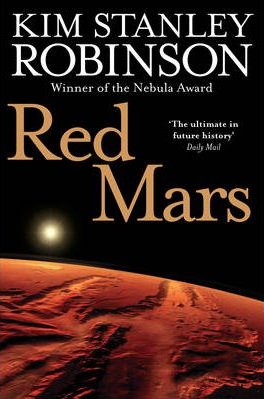
37 Red Mars*, Kim Stanley Robinson (1992)
This is the definitive novel on the near-future colonisation of another planet – in this case, our neighbour, Mars. Enough said. (Don’t forget to read the sequels too.)

38 China Mountain Zhang, Maureen F McHugh (1992)
Near-future sf is difficult to do well, if only because the author is expected to have some sort of magical crystal ball. But sf has never been predictive, and when it has got something right it’s been a happy accident. China Mountain Zhang is a near-future novel, but that’s incidental. It is beautifully written. That’s all that matters. McHugh is one of the genre’s very best writers.

39 Dark Sky Legion, William Barton (1992)
We may never find a way to circumvent the speed of light. Which means 90% of science fiction is just so much magical hogwash. But some writers have tried to envisage a distant future in which the speed of light restriction still holds true. This is the best of the bunch. It also does something interesting philosophically – and sf is traditionally not very good at that.

40 A Fire Upon the Deep, Vernor Vinge (1992)
Some space operas aren’t New, though they appeared while New Space Opera was doing its thing. The central premise of A Fire Upon the Deep, the Zones of Thought, is one of those ideas that shows why sf is such an important and vibrant mode of fiction. The somewhat ordinary plot attached is almost incidental.

41 Fatherland, Richard Harris (1992)
One form of alternate history is vastly more popular than any other: Hitler winning WWII. It’s impossible to write a story based on it that is neither derivative nor clichéd. This is probably the best of the lot – because it is set decades after the War, and is only peripherally concerned with the fact of the Nazi victory.

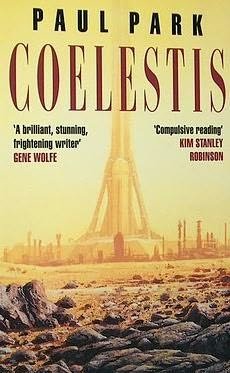
42 Coelestis, Paul Park (1993)
There are many themes which science fiction rarely tackles. Postcolonialism is one. It smacks too much of the real world – and too much of the real world that is not the First World – for most sf writers and readers. Coelestis treats the subject with intelligence, and then goes on to deconstruct the colonial identity of one of its protagonists. A masterwork.

43 Shadow Man, Melissa Scott (1995)
Among the many themes covered by sf over the decades has been sexuality and gender. The most famous such novel is LeGuin’s The Left Hand Of Darkness, but given the one-book-per-author rule I couldn’t pick that. (And besides, its treatment of its hermaphroditic humans is somewhat problematical.) Scott complicates matters here by throwing in five genders and nine sexual preferences and, while the gender politics are still a little iffy, this is an essential exploration of the theme.

44 Voyage, Stephen Baxter (1996)
This is not only alternate history, it is also space fiction: it is an alternate history of a NASA mission to Mars. The research is impeccable, and it makes a highly plausible fist of its premise. Space fiction has been chiefly dominated by writers who are not very good, which is unfortunate. Happily, Baxter can write well, and he does so in this book.

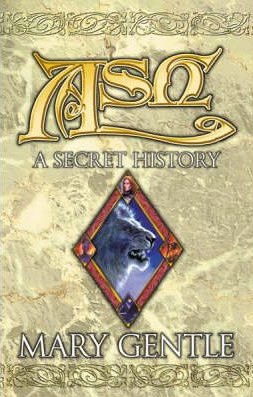
45 Ash: A Secret History, Mary Gentle (2000)
Is it science fiction, or is it fantasy? The world of the title character does seem more fantastical than sfnal, but it’s wrapped in a near-future narrative which is resolutely sf. And the way the two narratives interact, and change each other, is definitely straight from science fiction’s toolbox.

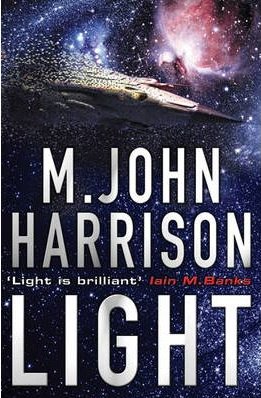
46 Light, M John Harrison (2002)
This is perhaps the most literary science fiction novel ever written (not counting, of course, the two sequels). Or perhaps it’s the most science-fictional literary novel ever written. On balance, I suspect the former – it is too steeped in genre to be wholly accessible to readers of literary fiction. That still makes it essential for sf readers, however.

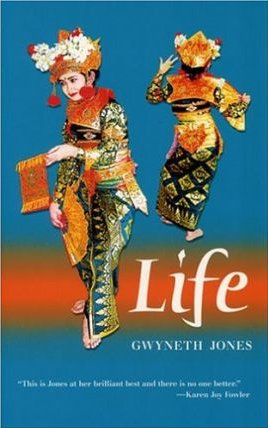
47 Life, Gwyneth Jones (2004)
Surprisingly, working scientists are not especially popular as protagonists in science fiction. This novel is about one. And science. It is also brilliant.

48 Alanya to Alanya, L Timmel Duchamp (2005)
First contact is a genre staple. This novel – the first of the Marq’ssan Cycle quintet – is not the first in which the visiting aliens choose to speak only to women, and which subsequently prompts a global crisis. It is, however, notable for a near-future world in which the ultra-rich rule openly and cruelly. Elizabeth Weatherall, PA to the chief villain of this book, goes on in later volumes to become one of the genre’s great villains in her own right. Go read all five books.

49 The Road, Cormac McCarthy (2006)
Post-apocalypse is such a well-established subgenre that recently most such novels have been by writers of literary fiction. And this is the best of those. It’s also much better than any genre post-apocalypse novel. Sadly, the trope has now been so over-used it’s become banal. Someone needs to do something different with it.

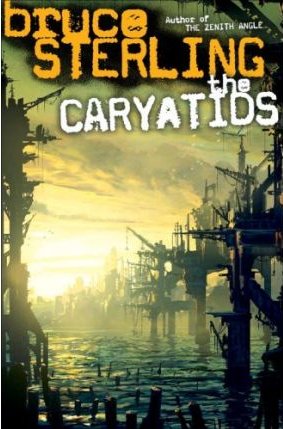
50 The Caryatids, Bruce Sterling (2009)
We look at the world today and see impending climate crash and the collapse of national economies… but no sf novel except this one has dealt with such a scenario. It’s for good reason that Sterling was one employed as”Visionary in Residence” at a Californian university. Essential reading for the near-future.

And that’s it. I think I’ve covered all the major bases. Not every book in my list of fifty is a blinding piece of literary genius – this is science fiction, after all… But I think my choices show a good spread of themes and subgenres, and every book is certainly worth reading. I couldn’t get everything in, however. Some choices were just too hard to justify. For example, one subgenre of sf I was keen to have on my list was early space travel. Unfortunately, I’ve not read Garitt P Serviss or Willy Ley, and there’s a reason why High Vacuum (1956), First on the Moon (1958) and The Pilgrim Project (1966) are forgotten. So, no early space travel. Instead, I have Voyage as my entry for realistic space fiction (as if I’d really pick Bova, or Steele, or their like).

Finally, it has been a little dismaying putting together this list to discover how many of my selections are out of print. Some have recently been made available after many years OOP, either in the SF Masterworks series, or as ebooks through the SF Gateway. Respect to both for that. But others on my list have languished in obscurity since their original publication. This, I feel, doesn’t invalidate their, er, essentialness. After all, books don’t stay in print because they are essential, they stay in print because they’re popular, because people keep on buying them.

We have no real agreed academic canon in genre fiction, no fixed list of sf novels which teachers and lecturers turn to when designing courses on the subject. Yes, there are several books that people point to when the word “classic” is mentioned, but most of those are artefacts of the genre’s history. They were not chosen because experts in the subject have over the decades deemed them the best science fiction has produced in its eighty-seven years. Perhaps it’s good that sf is democratic in that regard… but when it elevates Foundation, Starship Troopers, the Lensman series and the like to greatness, I have to wonder…

3 Comments

Best of the year 2012

It’s that time of year again when I go back through my spreadsheets of books read, films seen and albums bought, and try to decide which are the best five of each. And yes, I do keep spreadsheets of them. I even have one where I record the bands I’ve seen perform live. And no, it’s not weird. It is organised.

Back in June, I did a half-year round-up – see here. Some of the books, films, albums I picked then have made it through to the end of the year, some haven’t. This time, for a change, I’m going to actually order my choices, from best to, er, least-best.

BOOKS
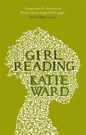
girl_reading1 Girl Reading, Katie Ward (2011)
This is probably the most impressive debut novel I’ve read for a long time. It could almost have been written to appeal directly to me. I like books that do something interesting with structure; it does something interesting with structure. I like books whose prose is immediate and detailed; its prose is immediate (present tense) and detailed. I like books that are broad in subject; it covers a number of different historical periods. And it all makes sense in the end. I’ll certainly be keeping an eye open for further books by Ward. I read this book in the second half of the year, so it didn’t make my half-year best. I wrote more about Girl Reading here.

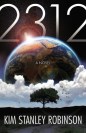
23122 2312, Kim Stanley Robinson (2012)
This year, I’ve actually read eleven genre novels first published during the twelve months, which I think may be a personal record. Having said that, it’s been a good year for genre fiction for me, as a number of my favourite authors have had books out. Sadly not all of them impressed (The Hydrogen Sonata, I’m looking at you). 2312 was everything I expected it to be and nothing like I’d imagined it would be. The plot is almost incidental, which is just as well as the resolution is feeble at best. But the journey there is definitely worth it. It is a novel, I think, that will linger for many years. Again, I read 2312 during the latter half of the year, so it didn’t make my half-year list. I wrote more about it here.

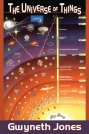
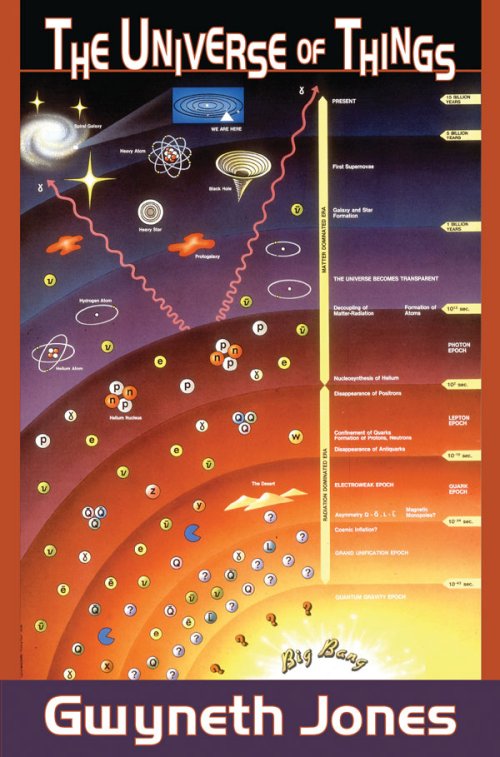
universe-cvr-lr-1003 The Universe of Things, Gwyneth Jones (2011)
Some collections aim for inclusiveness, some collections try for excellence. I’m not sure why Aqueduct Press chose the stories in this collection – it’s by no means all of Jones’ short fiction – but as a representative selection, The Universe of Things does an excellent job. I reviewed it for Daughters of Prometheus here, and I opened my review with the line: “Gwyneth Jones does not write many short stories – forty-one in thirty-seven years – but when she does, by God they’re worth reading.” This book did make my half-year list. Now I just have to read PS Publishing’s larger Jones collection, Grazing the Long Acre

intrusion-ken-macleod4 Intrusion, Ken MacLeod (2012)
The endings of Ken’s last few novels I have not found particularly convincing. It’s that final swerve from near-future high-tech thriller into heartland sf. Though the groundwork is usually carefully done, it too often feels like a leap too far. But not in Intrusion. The world-building here is cleverly done – I love the pastiche of Labour, with its “free and social market” – the thriller plot works like clockwork, and the final step sideways into pure genre slots straight in like the last piece in a jigsaw puzzle. Intrusion is another book I read in the second half of 2012, so it didn’t make my half-year list. I reviewed Intrusion for SFF Chronicles here.

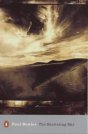
sheltering5 The Sheltering Sky, Paul Bowles (1949)
Curiously, I’d always liked the film adaptation by Bernardo Bertolucci, which inspired me to read the novel, but after finishing the book, I tried rewatching the film and found myself hating it. Mostly it was because the Lyalls, who are creepy and villainous in the novel, had been turned into comic caricatures. A lot had also been left out – though that’s not unusual, given the nature of the medium. The Arabic in the novel used French orthography, which meant I had to translate it twice to work out what it meant. And it looks like four out of the five books in this list I read after June, so the Jones collection is the only one from my half-year list that made it through to the end of the year one.

There are, however, a ton of honourable mentions – it’s turned out to be quite a good year, book-wise. They are: The Bender, Paul Scott (1963), which read like a sophisticated 1960s comedy starring Dirk Bogarde; The Door, Magda Szabó (1987), the best of my world fiction reading challenge (which I really must catch up on and finish); Betrayals, Charles Palliser (1994), a very clever novel built up from several stories, including a fun spoof of Taggart and a brilliant piss-take of Jeffrey Archer; How to Suppress Women’s Writing, Joanna Russ (1983), which should be required reading for all writers and critics; Hear Us O Lord from Heaven Thy Dwelling Place, Malcolm Lowry (1961), which introduced me to the genius that is Lowry; Ison of the Isles, Carolyn Ives Gilman (2012), successfully brings to a close the best fantasy of recent years; Omega, Christopher Evans (2008), a long overdue novel from a favourite writer, and a clever and pleasingly rigorous alternate history / dimension slip work; and Blue Remembered Earth, Alastair Reynolds (2012), the start of a near-future trilogy, which is very good indeed but also stands out because it’s not regressive or dystopian.

FILMS
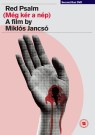
red_psalm1 Red Psalm, Miklós Jancsó (1972)
It’s about the Peasant Uprising in nineteenth-century Hungary, and consists of hippy-ish actors wandering around an declaiming to the camera. Occasionally, they sing folk songs. Then some soldiers arrive and some of the peasants get shot. But they’re not really dead, or injured. Then the landowners turn up and start espousing the virtues of capitalism. But the peasants shout them down. A priest tries to explain the “natural order of things”, but the peasants aren’t having it. Then more soldiers arrive and round up all the peasants. The ending is very clever indeed. It’s a hard film to really describe well, but it’s fascinating and weird and beautifully shot. I wrote about it here.

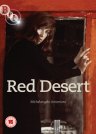
red_desert2 Red Desert, Michelangelo Antonioni (1964)
This was Antonioni’s first film shot in colour and it looks absolutely beautiful. In terms of story, it is much like his earlier masterpieces, L’Avventura, La Notte and L’Eclisse, and, like them, stars Monica Vitti. But also a (weirdly) dubbed Richard Harris. It’s a surprisingly bleak film – although perhaps not “surprisingly”, given that earlier trilogy – but it’s hard not to marvel at the painterly photography and mise-en-scène – who else would have the fruit on a barrow painted in shades of grey in order to fit in with the colouring of the surroundings? I wrote about it here. And I really must write more on my blog about the films I watch.

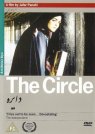
circle3 The Circle, Jafar Panahi (2000)
This is one of those films where one story hands off to another one and so on, and in which there is no real story arc, just a journey through episodes from the lives of the characters. Each of which is a woman living in Tehran, and all of whom have just recently been released from prison. They were not, however, imprisoned for doing things that would be criminal in other nations. As the title indicates, the stories come full circle, and the film’s message is far from happy or pleasing, but there is still room for hope. This film won several awards, though the Iranian authorities were apparently very unhappy with it.

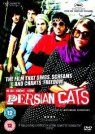
persiancats4 No One Knows About Persian Cats, Bahman Ghobadi (2009)
It’s not about cats, it’s about two musicians in Tehran who have been invited to perform at a music festival in London. But first they need to find some more musicians for their band, and they also need the necessary paperwork to leave Iran. But western-style music, which is what they play, is illegal in Iran, and there’s no way they’ll be able to get the visas they need legally. So they visit all the musicians they know, hoping some of them will be willing to go to London with them, and they also pay a well-known underground figure for the papers they require to travel. It’s an affirming film, but also a deeply depressing one.

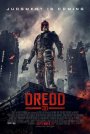
Dredd5 Dredd, Pete Travis (2012)
I was badgered into going to see this at the cinema by Tim Maugham on Twitter. I hadn’t really thought it would appeal to me. Even the fact it was touted as being more faithful to the 2000 AD character didn’t mean I’d like it. Although I grew up reading 2000 AD, Judge Dredd was far from my favourite character, and I’ve not bothered buying any of the omnibus trade paperbacks that are now available. But I went… and was surprised to find it was a bloody good film. It’s sort of like a weird munging together of an art house film and a Dirty Harry film, and strangely the combination works really well. It’s violent and horrible and grim and panders to all the worst qualities in people, but it all makes sense and fits together, and despite its simple plot is cleverly done. I plan to buy the DVD when it is available.

Iranian cinema did well this year for me. Not only did The Circle and No One Knows About Persian Cats make it into my top five, but two more Iranian films get honourable mentions: A Separation, Asghar Fahadi (2011), and The Wind Will Carry Us, Abbas Kiarostami (1999). Kiarostami I rate as one of the most interesting directors currently making films. Other honourable mentions go to: John Carter, Andrew Stanton (2012), which was undeservedly declared a flop, and is a much cleverer and more sophisticated piece of film-making than its intended audience deserved; Monkey Business, Howard Hawks (1952), is perhaps the screwball comedy par excellence; On the Silver Globe, Andrzej Żuławski (1988), is bonkers and unfinished, and yet works really well; there is a type of film I particularly like, but it wasn’t until I saw Sergei Parajanov’s The Colour of Pomegranates that I discovered it was called “poetic cinema”, and his Shadows Of Forgotten Ancestors (1965) is more of the same – weird and beautiful and compelling; and finally, François Ozon’s films are always worth watching and Potiche (2010) is one of his best, a gentle comedy with Catherine Deneuve and Gérard Depardieu in fine form.

ALBUMS
mourningweight1 The Weight Of Oceans, In Mourning (2012)
I saw a review of this album somewhere which made it seem as though I might like it. So I ordered a copy from Finland – which is where the band and the label are from. And I’ve been playing it almost constantly since. It’s Finnish death/doom metal mixed with progressive metal, which makes it the best of both worlds – heavy and intricate, with melodic proggy bits. The Finns, of course, know how to do death/doom better than anyone, but it’s been a surprise in recent years to discover they can do really interesting prog metal just as well – not just In Mourning, but also Barren Earth (see my honourable mentions below).

aquilus2 Griseus, Aquilus (2011)
A friend introduced me to this one. It’s an Australian one-man band, and the music is a weirdly compelling mix of black metal and… orchestral symphonic music. It sounds like the worst kind of mash-up, but it works amazing well. In the wrong hands, I suspect it could prove very bad indeed. Happily, Waldorf (AKA Horace Rosenqvist) knows what he’s doing, and the transitions between the two modes are both seamless and completely in keeping with the atmosphere the album generates. The album is available from Aquilus’s page on bandcamp, so you can give it a listen.

dwellings3 Dwellings, Cormorant (2011)
The same friend also introduced me to this band, who self-released Dwellings. It’s extreme metal, but extreme metal that borrows from a variety of sub-genres. I’ve seen one review which describes them as a mix of Ulver, Opeth, Slough Feg and Mithras, which really is an unholy mix (and two of those bands I count among my favourites). Most of the reviews I’ve seen find it difficult to describe the album, but they’re unanimous in their liking for it. And it’s true, it is very hard to describe – there’s plenty of heavy riffing, some folky interludes, some proggy bits, and it all sort of melds together into a complex whole which is much greater than the sum of its parts. This album is also available from the band’s page on bandcamp, and you can listen to it there. (You’ve probably noticed by now that I’m terrible at writing about music. I can’t dance about architecture either.)

25640_woods_of_ypres_woods_iv_the_green_album4 Woods 4: The Green Album, Woods of Ypres (2009)
Woods of Ypres was a band new to me in 2012. I first heard their final album, Woods 5: Grey Skies & Electric Light, but at Bloodstock I picked up a copy of the preceding album and I think, on balance, I like the earlier one better. The music is a bit like Type O Negative meets black metal, with oboes. Sort of. The opening track ‘Shards of Love’ is, unusually for black metal, about a relationship, and it starts off not like metal at all and then abruptly becomes very metal indeed. An excellent album, with some strong riffs and some nicely quiet reflective moments. (It’s pure coincidence that I chose it as No 4 in my list, incidentally.)

obliterate5 Obliterate EP, Siphon the Mammon (2012)
I have no idea how I stumbled across this Swedish progressive death metal band. It was probably the name that caught my attention. And it is a silly name. But never mind. Anyway, I downloaded the EP from their bandcamp page… and discovered it was bloody good. It’s technical and accomplished, with some excellent riffs and song structures. I particularly like ‘The Construct of Plagues’, which features an excellent bass-line, but the final track ‘End of Time’ is also nicely progressive. And… this is the third album in my top five which is available from the band’s bandcamp page, which surely must say something about the music industry and the relevance of labels… or my taste in music…

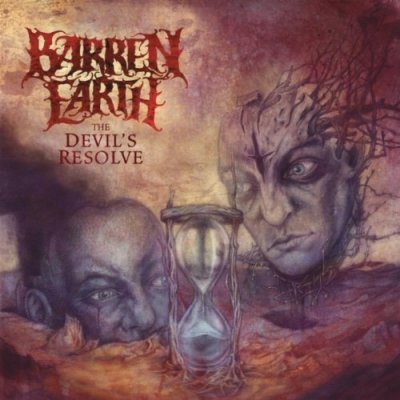
This year’s honourable mentions go to: (Psychoparalysis), for a trio of EPs I bought direct from the band, and which are good strong Finnish progressive death metal; Anathema’s latest, Weather Systems, which I liked much more than the three or four albums which preceded, and they were bloody good live too; Hypnos 69’s Legacy, which I finally got around to buying and was, pleasingly, more of the same (this is good, of course); Barren Earth’s The Devil’s Resolve, which is definitely heavier than their debut album, but still very proggy and weird; A Forest of Stars, which is steampunk meets black metal, and it works surprisingly well (check out this video here); Nostalgia by Gwynbleidd, who, despite the name, are Poles resident in New York, and sound a little like a cross between Opeth and Northern Oak; Headspace, I Am Anonymous, another Damian Wilson prog rock project, but I think I prefer it on balance to Threshold’s new album; and Alcest, another band new to me in 2012, who play shoegazer black metal, which, unfortunately, works much better on an album than it does live.

IN CONCLUSION
And there you have – that was the year that was. On balance, I think it’s been a good year in terms of the literature, cinema and music I have consumed. There’s been some quality stuff, and some very interesting stuff too. Which is not to say there hasn’t been some crap as well, but it seemed less numerous this year. This may be because I chose to ignore what the genre, and popular culture, value and focus more on the sort of stuff that appeals directly to me – I’ve cut down on the number of Hollywood blockbusters I watch, I no longer read as much heartland genre fiction. There’s always a pressure to stay “current”, but the more I watch genre and comment on it, the more I see that it does not value the same things I do. It’s not just “exhaustion”, as identified by Paul Kincaid in his excellent review of two Year’s Best anthologies here, but from my perspective also a parting of the ways in terms of objectives, methods and effects. I want stuff – books, stories, etc – that is fresh and relevant, that does interesting things and says something interesting. I don’t want the usual crap that just blithely and unquestioningly recycles tropes and worldviews, stories about drug dealers on Mars in some USian libertarian near-future, space opera novels in which an analogue of the US gets to replay its military adventures and this time get the result it feels it deserved…

I mentioned in a post last week that I don’t read as much genre short fiction as I feel I should. After all, my views outlined above are taken from the little I’ve read on awards shortlists and in year’s best anthologies. Just because that’s what the genre values doesn’t mean the sort of stuff I value doesn’t exist. I just need to find it. So by including a short fiction best of list in 2013, I’ll be motivated to track down those good stories, to seek out those authors who are writing interesting stories.

All of this, of course, will I hope help with my own writing. I had both a very good year, and a not so good year, in that respect in 2012. Rocket Science, an anthology I edited, and quite obviously the best hard sf anthology of the year, was published in April. As was the first book of my Apollo Quartet, Adrift on the Sea of Rains. The Guardian described Rocket Science as “superb”, which was very pleasing. And Adrift on the Sea of Rains has had a number of very positive reviews see here. Unfortunately, as a result of those two publications, I haven’t been very productive. I spent most of the year after the Eastercon working on the second book of the Apollo Quartet, The Eye With Which The Universe Beholds Itself. Those few who have read it say it’s as good as Adrift on the Sea of Rains, which is a relief. Everyone else will get to find out in January, when it’s published. But I really should have worked on some short fiction as well. I’m not the quickest of writers – I marvel at those people who can bang out a short story in a week – but each story you have published, irrespective of quality, widens your audience a little more, adds a little more weight to your name. And that’s what it’s all about. No matter how good people say Adrift on the Sea of Rains is, I’ve only sold just over 200 copies – add in review copies… and that means perhaps between 250 and 300 people have read it. Some semi-literate self-published fantasy novels available on Kindle sell more copies than that in a week…

But that’s all by the by. This post is about 2012, not 2013. Sadly, I didn’t manage to reread much Durrell to celebrate his centenary. I’ve had The Alexandria Quartet by the side of the bed for about nine months, and I dip into it every now and again, but then I have to put it to one side as I have to read a book for Interzone or SF Mistressworks… Speaking of which, I had to drop to a single review a week on SF Mistressworks, but I still plan to keep it going. During 2012, I read 41 books by women writers, compared to 63 by male writers, which is about 40% of my reading (this doesn’t include graphic novels, non-fiction or anthologies). I also reviewed a handful of books for Daughters of Prometheus, although I haven’t posted one there for several months. (I’ve no plans to drop either responsibility in 2013.) Just over a third of my reading was science fiction, and a quarter was mainstream – so sf is still my genre of choice. Numbers-wise, I’ve not managed as many books as last year – only 146 by the middle of December, whereas last year I’d managed 165 by the end of the year. But I think I’ve read some more substantial books this year, and I did “discover” some excellent writers, such as Malcolm Lowry, Katie Ward and Paul Bowles. It’s a shame I never managed to complete my world fiction reading challenge. I still have half of the books on the TBR, so I will work my way through them, though I may not blog about it.

But, for now, it’s Christmas – bah humbug – in a week. And then the start of 2013 follows a week after that. Here’s hoping that next year is better for everyone, that the good outweighs the bad, and that every surprise is a pleasant one.


1 Comment

One-liners

It’s been a while since I last noted here what books I’d read. Yes, I’ve given up on the readings & watchings posts, but I’d still like to record what literature I’ve consumed throughout the year. Here I shall attempt to do it in a single line per book (occasionally through the creative use of punctuation, I must admit).

A Torrent of Faces, James Blish (1967) Pleasingly detailed, somewhat dated, but a much more interesting sf novel than I’d expected.

The Girl with the Dragon Tattoo, Stieg Larsson (2005) Oof – worse than I’d expected (though I’ve heard the translation was rushed), but Blomqvist is a Gary Stu and the attempts to drag in references to the original title (Män som hatar kvinnor, Men Who Hate Women) are hamfisted to say the least.

The Immersion Book of SF, Carmelo Rafala, ed. (2010) Small press anthology of, er, science fiction; some contents better than others, though nothing stands out especially.

The Ghost, Robert Harris (2007) Blair’s biographer is murdered so pro ghost writer is drafted in and discovers something rotten in the ex-PM’s career– oh wait, it’s not Blair, it’s a made-up politician…

Devil May Care, Sebastian Faulks (2008) Faulks does Fleming and makes a pretty good fist of it – also: a Caspian Sea Monster!

Diadem from the Stars, Jo Clayton (1977) Reviewed on SF Mistressworks here.

Hear Us O Lord from Heaven Thy Dwelling Place, Malcolm Lowry (1961) Some astonishingly good novellas, some not so good short stories; planning to read more Lowry.

Islands, Marta Randall (1976) Reviewed on SF Mistressworks here.

If the Dead Rise Not, Philip Kerr (2009) Bernie Gunther in Berlin after leaving the Kripo; and decades later in Cuba – and it’s all about corruption by US mobsters over building work for the 1936 Olympics in Berlin.

Eastmodern, Herta Hurnaus (2007) Bratislava, home to some surprisingly interesting-looking Modernist buildings; as this book amply demonstrates.

The Omcri Matrix, Jay D Blakeney (1987) Reviewed on SF Mistressworks here.

Dulcima, HE Bates (1953) I read it but I’m not sure why it was written; apparently they made a film of it too…

The Maginot Line, Rob Redman, ed., (2012) Literary paperback anthology, contains some good stories, including one by a bloke called Sales.

Goldfinger, Ian Fleming (1959). A bit like the film, but with added homophobia and sexism! – Bond turns ice-cold lesbian Pussy Galore into a warm and loving heterosexual with a good rogering; plus a half-page homophobic rant by 007.

The Universe of Things, Gwyneth Jones (2011) Reviewed on Daughters of Prometheus here.

Oscar Niemeyer Buildings, Alan Weintraub (2009) Does what it says on the cover: lovely photographs of lovely buildings.

Building Brasilia, Marcel Gautherot (2010) Yet more lovely Niemeyer buildings – they should let Neimeyer design the entire world.

Jerusalem Fire, RM Meluch (1985) Reviewed on SF Mistressworks here.

So Long a Letter, Mariama Bâ (1980) April’s book for my reading challenge; I wrote about it here.

Girl, David Thomas (1995) Man goes into hospital but through implausible mix-up gets vaginoplasty; played for laughs, manages some sensitivity, but definitely from the male gaze so nothing learned.

The Maquisarde, Louise Marley (2002) Reviewed on Daughters of Prometheus here.

Machine, Jennifer Pelland (2012) Read for review in Vector; interesting approach to the central conceit, though a little muddled in execution.

Disguise for a Dead Gentleman, Guy Compton (1964) Actually DG Compton: murder most foul at a public school; some nice-ish writing but a bit all over the place structurally.

Two Sides of the Moon, David Scott & Alexei Leonov (2004) Reviewed on A Space About Books About Space here.

The Summer Book, Tove Jansson (1972) Not a Moomin in sight, just grandma and granddaughter having fun and games among Finland’s islands; simple, elegiac.

Impact Parameter & Other Quantum Realities, Geoffrey A Landis (2001) Variable collection by Analog/Asimov’s stalwart; contains a couple of good ones, but a few are surprisingly poor given their initial publication venues.

Time Future, Maxine McArthur (1999) Reviewed on SF Mistressworks here.

Valerian 3: The Land Without Stars, Mézière & Christin (1972) English slowly catches up with famous French lightweight space opera bande dessinée series.

The Jagged Orbit, John Brunner (1969) Even in 1969, Brunner should have thought twice about this – a near-anarchic over-armed US with voluntary racial segregration; painfully, embarrassingly and datedly hip.

West Coast Blues, Jacques Tardi (2009) Bande dessinée about a man who goes on the run after being mistakenly targetted by hitman; astonishingly nihilistic.

In Great Waters, Kit Whitfield (2009) European history re-imagined with mermen, sort of; a slow start, drags even slower for the first third, then gets moving… and proved actually rather good.

The White Peacock, DH Lawrence (1911) His first novel: structurally weird and the viewpoint lacks rigour, but some lovely prose and it all feels very local to me; will definitely be reading more.

Ison of the Isles, Carolyn Ives Gilman (2012) Read for review in Vector – sequel to Isles of the Forsaken (see here), and not quite the expected story; some excellent bits nonetheless, though the plot feels a little problematical.

Starship Winter, Eric Brown (2012) Third in a quartet of seasonal novellas set on the world of Chalcedony; shenanigans at an art exhibition; the weakest of the three so far.

The League of Extraordinary Gentlemen: Century 2009, Alan Moore (2012) Third and last (?) in the Century series, which sees the League sort of re-unite to defeat a stoned Antichrist.

Aliens of the Heart, Carolyn Ives Gilman (2007) Reviewed on Daughters of Prometheus here.

The Sea, The Sea, Iris Murdoch (1978) Published in 1978, from the characters’ ages would appear to be set in 1968, feels like it was set in 1958; Booker Prize winner, though felt far too long and flabby to me.

Starshadows, Pamela Sargent (1977) Collection of early short fiction with a patronising introduction by Terry Carr; will be reviewed on SF Mistressworks soon.

‘À Propos of Lady Chatterley’s Lover’ & Other Essays, DH Lawrence (1961) English literature’s one true Puritan wibbles on about masturbation (bad), the right sex (good), marriage (sacrosanct!) and obscenity (“moi?”) – he really was a dirty old reactionary…

Griffin’s Egg, Michael Swanwick (1990) Novella about, er, a group of astronauts stranded on the Moon after a nuclear war on Earth – not an inspiration, honest; nor anywhere as good as I’d vaguely remembered it.


5 Comments

55 reading questions

I took this meme from David Hebblethwaite’s Follow the Thread blog, and he says he found it Story in a Teacup. It’s fifty-five questions about your reading. I think some of my answers are pretty much the same as David’s…

1 Favourite childhood book? I started out in sf reading Dr Who novelisations, but I can remember virtually nothing about them now. I don’t recall any specific books that I loved prior to that. I just read voraciously.

2 What are you reading right now? Finished ‘A Propos of Lady Chatterley’s Lover’ and other Essays by DH Lawrence on the weekend; and then started The Wanderground by Sally Miller Gearhart, which I’m reading for SF Mistressworks.

3 What books do you have on request at the library? I don’t use the library.

4 Bad book habit? Buying more books than I can read, and starting books when I haven’t finished the current read.

5 What do you currently have checked out at the library? I don’t use the library.

6 Do you have an e-reader? Nope.

7 Do you prefer to read one book at a time, or several at once? I prefer to read serially, but sometimes – often – I end up reading several books in parallel.

8 Have your reading habits changed since starting a blog? Yes. Since starting SF Mistressworks, and contributing to Daughters of Prometheus, I read far more fiction by women writers. I’ve also used this blog to challenge myself to read books I wouldn’t normally read – see this year’s world fiction reading challenge here.

9 Least favourite book you read this year (so far)? The Girl with the Dragon Tattoo, Stieg Larsson.

10 Favourite book you’ve read this year? Either The Universe of Things, Gwyneth Jones; Omega, Christopher Evans; or The Door, Magda Szabó.

11 How often do you read out of your comfort zone? Regularly.

12 What is your reading comfort zone? Science fiction and/or literary fiction. Also non-fiction about space exploration.

13 Can you read on the bus? Yes. I commute to work on a tram and read on it every day.

14 Favourite place to read? I usually read for 30 minutes to an hour in bed every night.

15 What is your policy on book lending? For my collectible books, never. Others, I’m happy to give away – and visitors have occasionally left with piles of paperbacks.

16 Do you ever dog-ear books? Never.

17 Do you ever write in the margins of your books? Never. But I will probably buy an ereader of some description soon because it’ll allow me to annotate what I’m reading.

18 Not even with text books? Nope.

19 What is your favourite language to read in? English.

20 What makes you love a book? Beautiful prose, it says something important, engaging characters, interesting structure… rigour, beauty, insight and depth.

21 What will inspire you to recommend a book? I’m happy to recommend books I both enjoy and admire; and often do.

22 Favourite genre? Science fiction.

23 Genre you rarely read (but wish you did)? I’ve read just about every genre there is, but… The genres I don’t read I generally have no intention of reading. Like urban fantasy.

24 Favourite biography? Carrying the Fire by Michael Collins.

25 Have you ever read a self-help book? No. I’ve no intention of ever doing so.

26 Favourite cookbook? I don’t have one. I prefer eating to cooking.

27 Most inspirational book you’ve read this year (fiction or non-fiction)? I don’t think of books as “inspirational”, or read ones that describe themselves as such.

28 Favorite reading snack? I don’t usually eat while I’m reading.

29 Name a case in which hype ruined your reading experience. Probably The Quantum Thief by Hannu Rajaniemi. It was good, but not as good as I’d expected it to be.

30 How often do you agree with critics about a book? Depends on the critic, obviously. But quite often. Award shortlists, on the other hand…

31 How do you feel about giving bad/negative reviews? Not giving a negative review to a bad book is dishonest. And dishonest reviews are next to useless.

32 If you could read in a foreign language, which language would you choose? I’ve tried reading in French, German and Arabic, and I’d like to improve my facility in those languages. But I also quite like the idea of being able to read Russian classic literature in Russian.

33 Most intimidating book you’ve ever read? In terms of sheer size, probably Ash: A Secret History by Mary Gentle. It proved to be excellent.

34 Most intimidating book you’re too nervous to begin? Possibly House Of Leaves by Mark Z Danielewski. Ian McNiven’s biography of Lawrence Durrell is also intimidatingly big, especially in hardback.

35 Favourite poet? Bernard Spencer or John Jarmain.

36 How many books do you usually have checked out of the library at any given time? I don’t use the library. When I lived in the UAE, I was a member of a subscription library and would generally take out four books every fortnight.

37 How often have you returned books to the library unread? In the UAE, I did it a couple of times. One such book was… The Alexandria Quartet by Lawrence Durrell. I later bought a copy and read it, and subsequently became a huge fan of his writing.

38 Favourite fictional character? I don’t know. There are characters I admire as writerly creations; there are characters who are little more than placeholders for the reader. I prefer the former.

39 Favourite fictional villain? See above.

40 Books I’m most likely to bring on vacation? Big fat ones that require sustained bouts of reading, such as I’ll enjoy on a plane flight or long train journey.

41 The longest I’ve gone without reading. A week, maybe slightly longer.

42 Name a book that you could/would not finish. Most recently, The Windup Girl by Paolo Bacigalupi.

43 What distracts you easily when you’re reading? The television, the internet, the cat…

44 Favourite film adaptation of a novel? It used to be The Right Stuff, but after a recent rewatch I found myself disappointed by the film. Now it would be Fahrenheit 451 – though I love the film but hate the book. Irony in action…

45 Most disappointing film adaptation? The Sylvia Kristal adaptation of DH Lawrence’s Lady Chatterley’s Lover? It’s a bad film and it’s an adaptation. But the same could be said for a lot of sf adaptations… I don’t really know. I rate David Lynch’s Dune as a flawed masterpiece (and I’d have paid good money to see Alejandro Jodorowski’s film of the book had it been made). And Paul Verhoeven’s Starship Troopers is vastly superior to the book…

46 The most money I’ve ever spent in the bookstore at one time? No idea. I’ve spent around £100 on a single order at Amazon a number of times. The most money I’ve spent on a single book is $500, for a first edition of Pied Piper of Lovers, Lawrence Durrell’s first novel. See here.

47 How often do you skim a book before reading it? Very rarely.

48 What would cause you to stop reading a book halfway through? Blatant racism and/or sexism. Offensive sensibilities. Eye-stabbingly bad prose. An inability to plot. Despicable characters.

49. Do you like to keep your books organized? Yes, though the collection is getting a little bit out of hand…

50 Do you prefer to keep books or give them away once you’ve read them? Depends. Collectibles I keep. Likewise books that were hard to find. Others I get rid of as soon as I’ve read them. I’ve also purged my book shelves several times – for example, I saw no good reason to keep the Stainless Steel Rat novels I originally bought back in the early 1980s…

51 Are there any books you’ve been avoiding? Urban fantasy novels. Anything with zombies in it. Many of the books that have appeared on recent Hugo Award shortlists…

52 Name a book that made you angry. Leviathan Wakes by James SA Corey. See my review here.

53 A book you didn’t expect to like but did? Lady Chatterley’s Lover, DH Lawrence. My father was a big fan of Lawrence’s writing, but I never bothered trying any of his books. And this despite Lawrence Durrell being a big admirer of Lawrence. But after watching Pascale Ferran’s excellent adaptation, Lady Chatterley, in 2009, I decided to have a go at the book. And loved it. After my father died, I promised myself I would read all of Lawrence’s fiction, and recently finished The White Peacock. Structurally it’s a bit odd, but there’s some lovely prose in it. And it is sort of “local” fiction for me as I was born in Nottinghamshire. I am now becoming a bit of a Lawrence fan.

54 A book that you expected to like but didn’t? Bodies by Jed Mercurio. I loved his Ascent, and thought American Adulterer very good indeed. But Bodies was just too gruesome for me.

55 Favourite guilt-free, pleasure reading? Georgette Heyer, probably.


6 Comments

The best of the half-year: 2012

It’s halfway through 2012, and it must be shaping up to be one of the wettest years on record in the UK. But that’s okay because my hobbies are chiefly indoor ones – reading books, watching films and listening to music. I occasionally do a bit of writing too. But, since we’re in June, with around six months to go until the end of the year, it’s time to look back and determine what was the best of what I read, watched and heard in 2012. And it goes something like this…

Words
I seem to have read a lot of books that were good without being great; and possibly a larger number of books that weren’t good at all. Picking the best five proved harder than expected, though one or two titles were obvious…

The Universe of Things, Gwyneth Jones (2011). Jones has been my favourite writer for many years, so this collection’s appearance on the top five is no surprise. I had, in fact, read most of the stories in The Universe of Things before (I even published one; sort of), but rereading them only cemented my admiration of them. Jones has not written many stories, but there are no clunkers among them. This collection is an excellent introduction to her fiction. I wrote a review of the book for Daughters of Prometheus.

Omega, Christopher Evans (2008). I’ve long admired Evans’ fiction, but he seemed to stop writing after 1995’s Mortal Remains… until Omega four years ago. I won’t say it was worth the wait, because it’s never good when a writer whose books you enjoy and admire disappears for more than a decade. But certainly Omega is a good book, a clever alternate history dimension-slip thriller partly set in a world where World War II continued on throughout the twentieth century. I wrote about Omega on my blog here.
The Door, Magda Szabó (1987). This year for my reading challenge I decided to read books by non-Anglophone writers I’d never read before. The Door was the second book I read for the challenge, and I really enjoyed it. Unfortunately, the challenge has got a little bogged down of late – I failed to finish March’s book, read April’s book late, and have yet to even start May’s. Anyway, I wrote about The Door on my blog here.

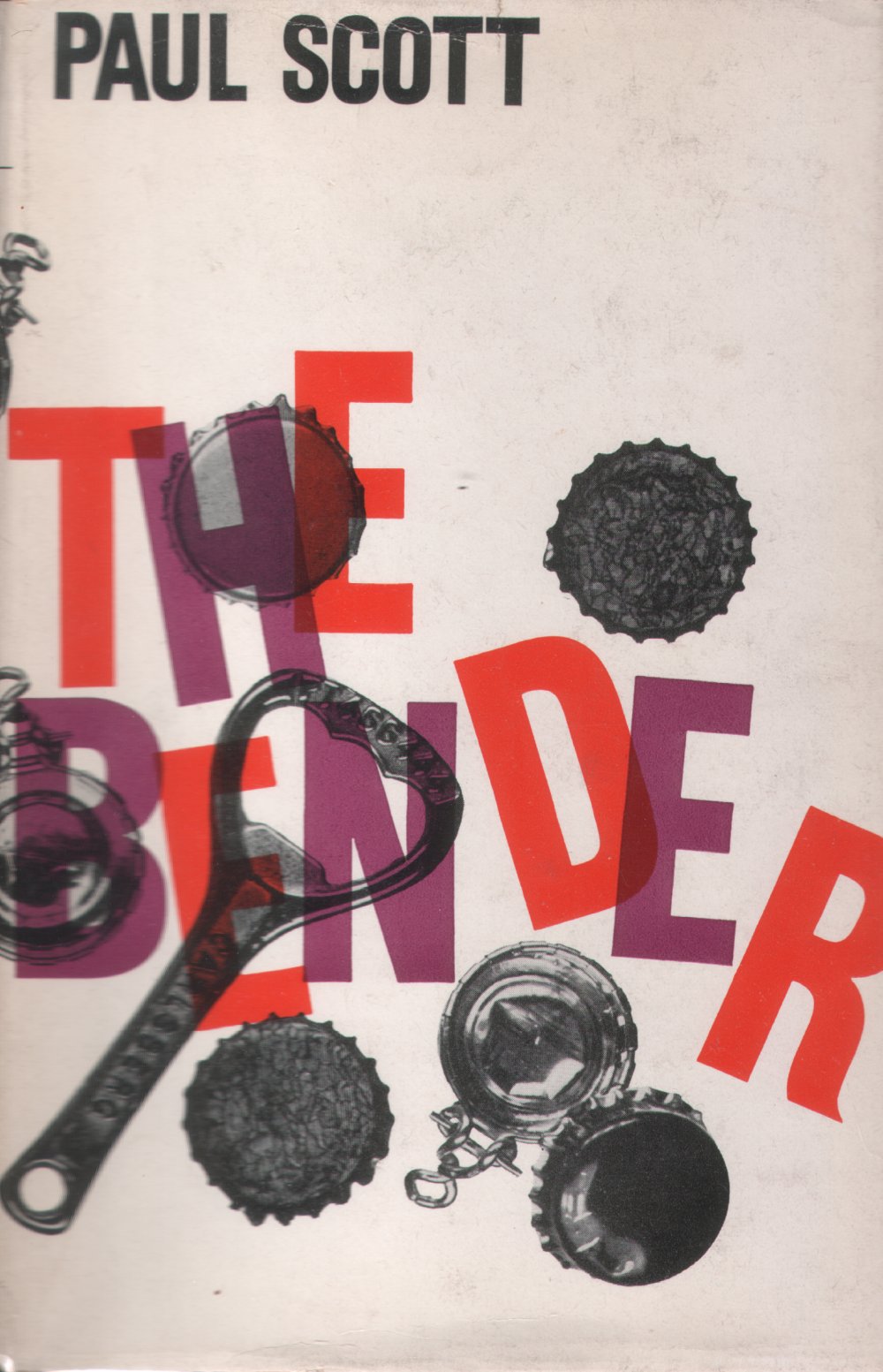
The Bender, Paul Scott (1963). I read the first book of the Raj Quartet for one of my reading challenges, and thought the book was superb. As a result, I added Scott to the list of authors whose books I track down to read. In first edition. The Bender predates the Raj Quartet and is not as weighty as those four books. It’s a very 1960s comedy, but also a beautifully witty one. I wrote about it on my blog here.

Betrayals, Charles Palliser (1994). I’m surprised this book isn’t better known. It’s an amazingly-put-together series of stories which form a much greater story. It opens with a series of Victorian travellers, trapped on a train by snow, who tell each other stories… and then proceeds to unravel and then stitch together the stories told by those travellers. There’s a superb take-down of a cult semiotician, a clever spoof of the Scottish detective programme Taggart, and a brilliant pastiche of Jeffrey Archer. Perhaps the links between the stories aren’t quite strong enough to carry the story-arc, but Betrayals is a very clever, very amusing, and excellent novel.

Honourable mentions go to Eastermodern by Herta Hurnaus, Oscar Niemeyer Houses by Alan Weintraub and Building Brasilia by Marcel Gautherot, which are books of photographs of modernist and brutalist buildings. Niemeyer’s work perfectly encapsulates the future we could have had, and all cities should resemble Brasilia. Also worthy of note are How to Suppress Women’s Writing by Joanna Russ, which every writer and critic should read; Alias Grace, which is probably Margaret Atwood’s best novel; and Hear Us O Lord from Heaven Thy Dwelling Place by Malcolm Lowry, a collection by an author new to me which contains some excellent novellas and some not so interesting short stories.

Pictures
I’ve already visited the cinema twice so far this year, which is something of a record for me. One of the films I saw in IMAX 3D makes it onto my top five; the other one was rubbish, so it doesn’t. The other films I’ve seen were all on DVD – some borrowed, some bought, and some rented.

Red Psalm (Még kér a nép), Miklós Janscó (1972). I bought this after seeing a review of the DVD in Sight & Sound. I wasn’t sure what to expect, but it certainly wasn’t a group of hippie-looking Hungarians wandering around a farm spouting socialist rhetoric and singing folk songs, and then getting shot at by soldiers. I loved it. I wrote about Red Psalm on my blog here.
Red Desert (Il deserto rosso), Michelangelo Antonioni (1964). I’ve admired Antonioni’s films since first seeing L’Avventura several years ago. Red Desert was his first film in colour, and it shows – it’s an amazingly painterly film. Unlike in most films, the characters do not over-shadow their world but are very much a part of it. It creates a distance between viewer and cast, but there’s an immersive quality to the mise en scène which renders that of little importance. Films don’t need viewer analogues – that’s just confining the medium to the simplicity of oral storytelling: films use images just like books use words, and that’s where their focus should lie. I wrote about Red Desert on my blog here.

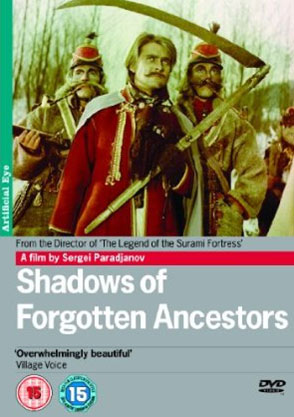
Shadows of Forgotten Ancestors (Тіні забутих предків), Sergei Parajanov (1965). I watched Parajanov’s The Colour of Pomegranates last year. That film is perhaps the zenith of “poetical cinema”, but Shadows of Forgotten Ancestors is definitely a way-station on the climb to it. It is, on the face of it, a simple story of one young man’s trials and tribulations. He is a member of Ukrainian Hutsul culture, and the film is rich with its costumes, music and traditions. Shadows of Forgotten Ancestors is by no means an easy film to watch, however, as it operates on so many levels – but it at least has a coherent plot, which is more than can be said for The Colour of Pomegranates.

On the Silver Globe (Na srebrnym globie), Andrzej Żuławski (1978/1988). If you can imagine a film that out-Tarkovskys Solaris, then you might have some idea of what On the Silver Globe is like. It’s based on a trilogy of novels published in Poland in 1911 by Jerzy Żuławski, which have apparently never been translated into English. On the strength of this film, they should be. It’s probably evident that I’m not a huge fan of traditional Hollywood-style cinema; it often feels to me like a waste of the medium’s potential. And yet films such as Red Psalm and On the Silver Globe, with their declarative dialogue, often feel like they’re only partway to what film could truly be. I like the painterly mise en scène of poetical cinema, but often find the declarative dialogue as clumsy as science fiction’s crude use of exposition. And so it is in On the Silver Globe – characters run around and gurn at the camera, and then speechify on the meaning of life. However, it’s in the story and the imagery that the film really impresses – enough, in fact, to offset the fact the film was never completed – much like Andrzej Munk’s Passenger. The Polish Ministry of Culture closed down the production of On the Silver Globe when the film was only 80% complete. It was ten years before Żuławski returned to it, and then he could only complete it by using stock footage and voice-over for some parts. It works surprisingly well. I plan to write more about On the Silver Globe on this blog.
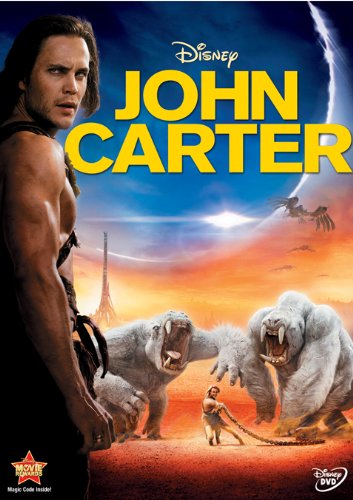
John Carter, Andrew Stanton (2012). John Carter received a mauling at the US box office, so much so it was officially declared a flop by its studio, Disney. Happily, the world outside the US had more discerning taste and went to see the film in sufficient numbers for it to eventually turn a profit. But the profitability of a film is measured solely on its performance at the US box office – which is both dumb and parochial – so it’s unlikely a sequel to John Carter will ever be made. Which is a shame. John Carter was a spectacle, with a clever script that managed to make something twenty-first century of its early twentieth-century source material. It had its flaws – some longeurs, and an inelegant info-dump to explain the plot – but other parts more than made up for it. I wrote more about it on my blog here.

Honourable mentions go to , Federico Fellini (1962), which after seeing La Dolce Vita many years ago and disliking it, I had expected to hate – I didn’t; I loved it. Troll Hunter, André Øvredal (2010), was another deadpan Norwegian spoof and cleverly done, though not quite as good as Norwegian Ninja. The Third Part of the Night, Andrzej Żuławski (1971), was the first Żuławski I saw, and it’s off-the-wall Hitchcockian style appealed to me greatly (as did Andrzej Korzyñski’s superb soundtrack). Went the Day Well?, Cavalcanti (1942), was a surprisingly brutal piece of wartime propaganda in which a German fifth column try to conquer a small English village. It goes badly. The Extraordinary Adventures of Adèle Blanc Sec, Luc Besson (2010), gets a mention as an entertaining adaptation of Jacques Tardi’s bande dessinée, and though it’s completely silly it was great fun. Finally, some quality telly: Twin Peaks (1990 – 1991), which has not dated at all, and is still great entertainment despite being completely bonkers; and Caprica (2010), which promised so much more than it ever got the chance to deliver.

Sounds
I knew from early this year that 2012 was going to be good for music. Perhaps few of my favourite bands are releasing albums, or touring the UK, but I’ve stumbled across some bands new to me that have been on almost constant play on the iPod.

Dwellings, Cormorant (2011). The band self-released this last year and it’s a powerful mélange of half a dozen metal genres. I loved it from the first listen, and even went back and got copies of their earlier two albums.

The Devil’s Resolve, Barren Earth (2012). This is the superband’s second album, and it’s a heavier and yet proggier effort than their first. The riffs are not quite as memorable as they are on The Curse of the Red River, but the lead breaks are much more impressive, and the proggy break-outs even stranger. Opeth’s Heritage proved there was a market for 1970s-inspired weird Scandinavian prog, and Barren Earth have taken that and melded it with Scandinavian death/doom to create a winning combination.

The Weight of Oceans, In Mourning (2012). I saw a review of this and it sounded appealing, so I ordered a copy from a Finnish website. It’s death/doom in that way the Finns do so well, but with added slow modern progginess. It’s not proggy like Barren Earth is proggy, inasmuch its acoustic parts feel more of a piece with the heavy parts. I’ve been playing it constantly since it arrived.

Nostalgia, Gwynbleidd (2009). Another band I came across mention of and who I thought I might like. So I bought the album. And yes, I do like them. Very much. They’re a sort of mix between Opeth and Northern Oak, but also not much like either. There are long sustained death metal parts, interspersed with folky acoustic guitar, and it all hangs together exceedingly well.

Legacy, Hypnos 69 (2010). I’ve been a fan of Hypnos 69 since hearing their The Intrigue of Perception several years ago. I’s taken me a while to get hold of Legacy, chiefly because it was released by a small label in Germany and wasn’t available in the UK. Recently I discovered it was on bandcamp, so I bought it from there. It’s Hypnos 69 doing Hypnos 69-type stuff, and I love it.

Honourable mentions go to Finnish death metallers (Psychoparalysis), who have self-released three excellent EPs; Weather Systems by Anathema (2012), which I much prefer to the previous album; Wood 5: Grey Skies & Electric Light by Woods of Ypres, which is folky black metal that sounds a little like Type O Negative in places  and includes strings and oboe; and finally, All Spawns, a recent compilation of Czech death metal pioneers Apalling Spawn’s two released from the late 1990s (now, if I can only find a copy of the Sparagmos compilation, I’ll be really happy…).


2 Comments

International Women’s Day

Today is the 101st International Women’s Day, a celebration created by the Socialist movement in 1911. The poster below is not actually for the Day, but it seemed appropriate.

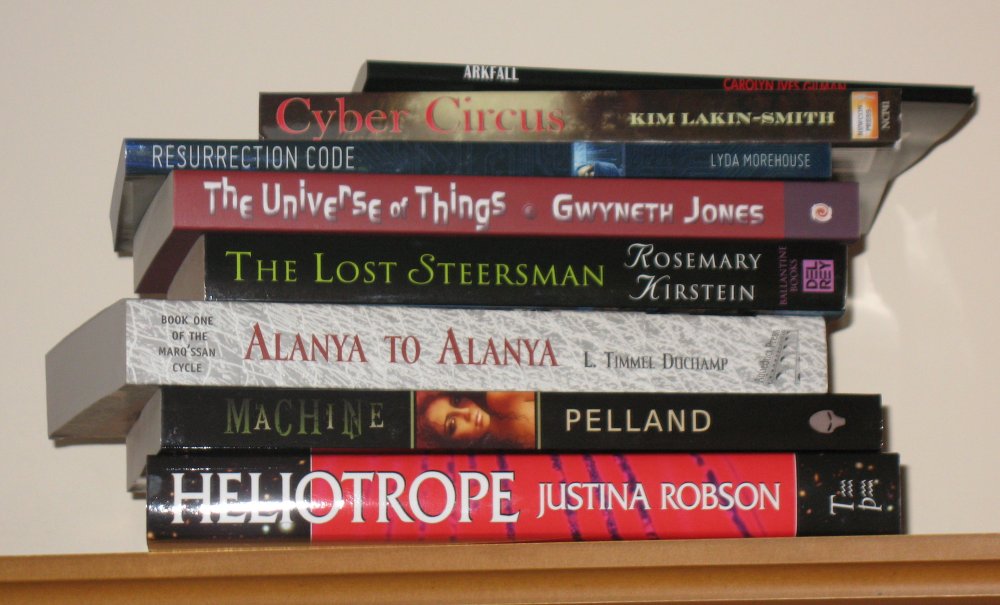
In recognition of International Women’s Day, here are eight recent science fiction novels / collections by women writers I will read / reread and then write about on this blog some time during the next few months (as they’re all too recent to qualify for reviews on SF Mistressworks).

The books are: Arkfall, Carolyn Ives Gilman; Cyber Circus, Kim Lakin-Smith; Resurrection Code, Lyda Morehouse; The Universe of Things, Gwyneth Jones; The Lost Steersman, Rosemary Kirstein; Alanya to Alanya, L Timmel Duchamp; Machine, Jennifer Pelland; and Heliotrope, Justina Robson. All of them except the Kirstein are small press.


10 Comments

A critical bookshelf

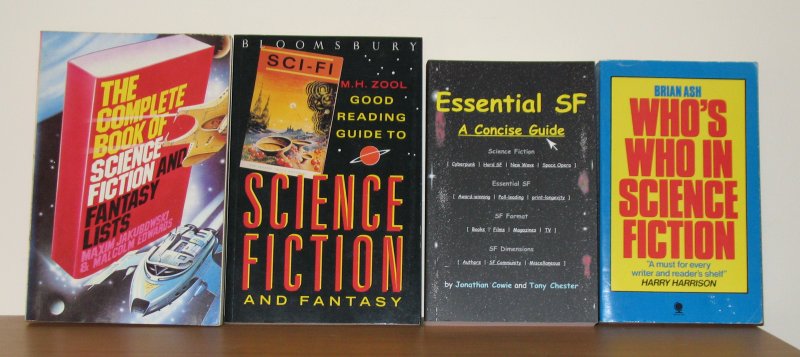
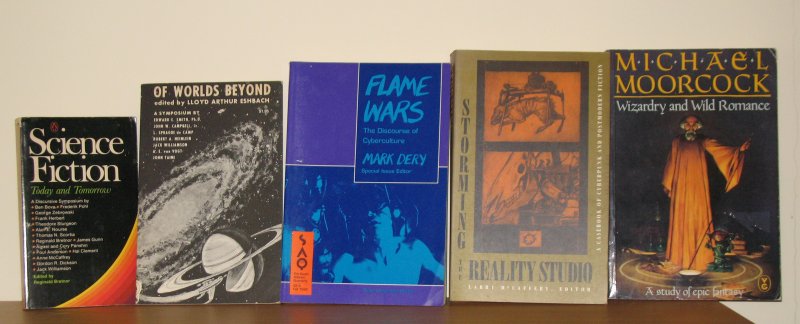
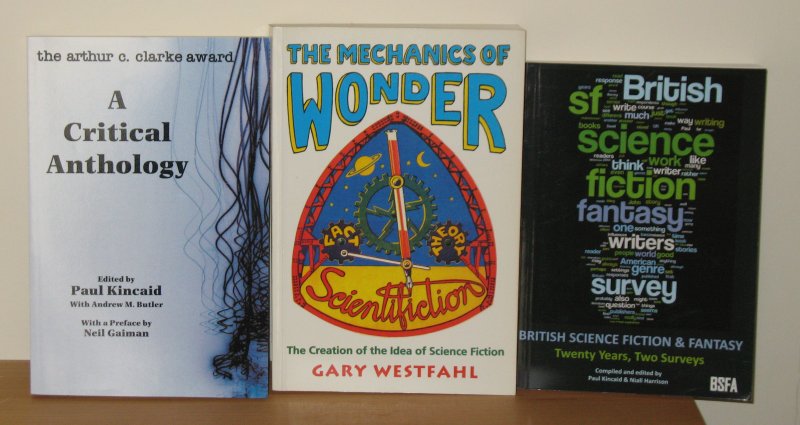
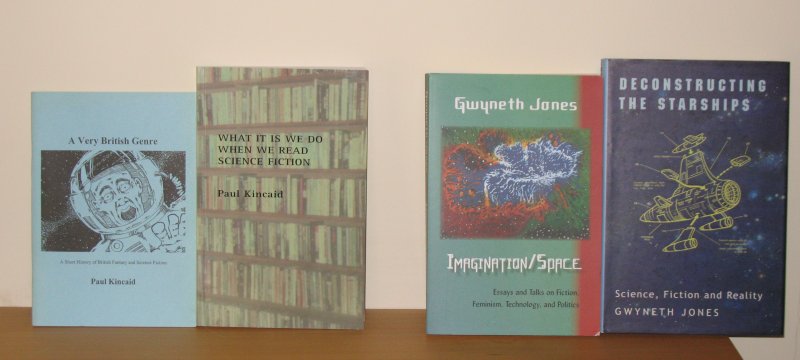
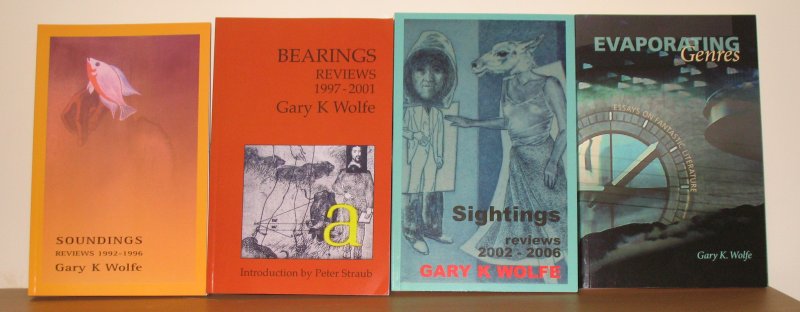
Over the years I’ve picked up a number of book about science fiction and about science fiction writers. These are books I’ve mostly dipped into, rather than read from cover to cover. Not all of them cover authors I still read, and some of them aren’t at all useful as critical works… but still I hang onto them. And here they are:


First up, four books by Gary K Wolfe: Soundings, Bearings, Sightings and Evaporating Genres. Wolfe writes sharp incisive reviews of genre books, and the first three books are collections of his reviews. Evaporating Genres is a more general critical work, and I’ve yet to read it (it was only published this year).

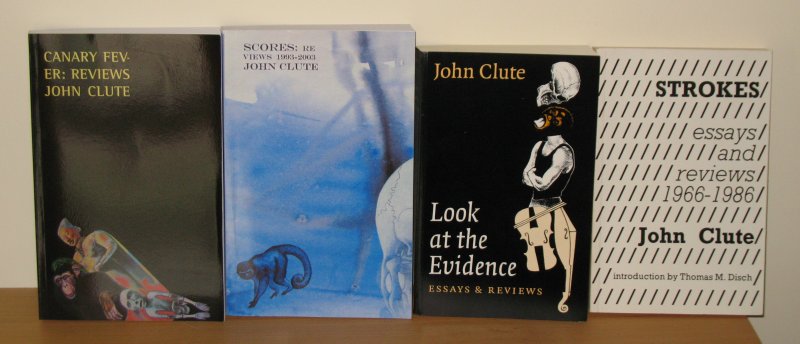
On this side of the Atlantic, we have sf critic John Clute, whose reviews are collected in these four books: Strokes, Look at the Evidence, Scores and Canary Fever. A new book of his essays has just been published, Pardon This Intrusion, but I’ve yet to buy a copy. Clute’s reviews can be difficult, if not willfully obscure, but he is also extremely sharp and clever.

These three books do exactly what it says on the tin: annotated lists of the top one hundred genre books, as chosen by the editors. Science Fiction: The 100 Best Novels and Fantasy: The 100 Best Books are sister-works; I’m guessing Pringle wanted to do both but ended up approaching another publisher for his Modern Fantasy: The Hundred Best Novels . Interesting books, but I can’t say I agree with the majority of their choices.

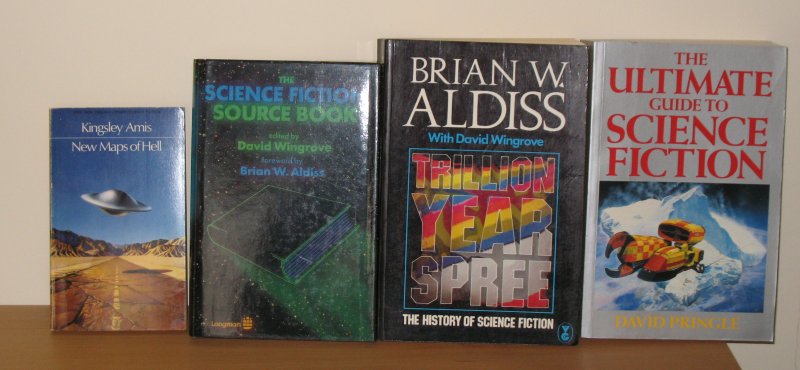
Two important critical works, New Maps of Hell by Kingsley Amis and Trillion Year Spree by Brian Aldiss, and a couple of general guides to sf, David Wingrove’s The Science Fiction Source Book and David Pringle’s The Ultimate Guide to Science Fiction.

I’m not sure what use is The Complete Book of Science Fiction and Fantasy Lists, but never mind. Likewise, the Good Reading Guide to Science Fiction and Fantasy (Zool is actually the Oxford SF Group). Essential SF is, well, just that – at least according to the authors. Who’s Who in Science Fiction lists the pseudonyms used by genre writers.

Four critical works. Bretnors’ Science Fiction Today and Tomorrow is a collection of essays by many big name authors of the 1970s and earlier: Frederik Pohl, Frank Herbert, Theodore Sturgeon, Jack Williamson, Gordon R Dickson, Ben Bova… Of Worlds Beyond is a series of essays on science fiction and writing science fiction by big name authors of an earlier generation: AE van Vogt, Robert Heinlein, EE ‘Doc’ smith, John W Campbell, and, er, Jack Williamson (most of the writing advice in the book is actually quite useless). Flame Wars and Storming the Reality Studio are academic studies of cyberpunk. Wizardry and Wild Romance is Michael Moorcock biting the hand that kept him in whisky for several decades.

I seem to recall Gary Westfahl’s The Mechanics of Wonder causing something of a fuss when it was published in the late 1990s. I enjoyed it and, like Westfahl, I’ve always felt science fiction began in 1926 with the publication of the first issue of Amazing Stories. The Arthur C Clarke Award: A Critical Anthology is just that, and the title of British Science Fiction and Fantasy: Twenty Years, Two Surveys pretty accurately describes its contents too.

A pair of British critics: Paul Kincaid’s A Very British Genre and What It Is We Do When We Read Science Fiction; and Gwyneth Jones’ Deconstructing the Starships and Imagination / Space.

Some books about writers: Snake’s Hands is a study of the fiction of John Crowley; The Cherryh Odyssey covers CJ Cherryh’s works; Parietal Games is criticism about, and by, M John Harrison; Heinlein in Dimension is about Robert Heinlein; and The Universes of EE Smith is about the works of EE ‘Doc’ Smith.

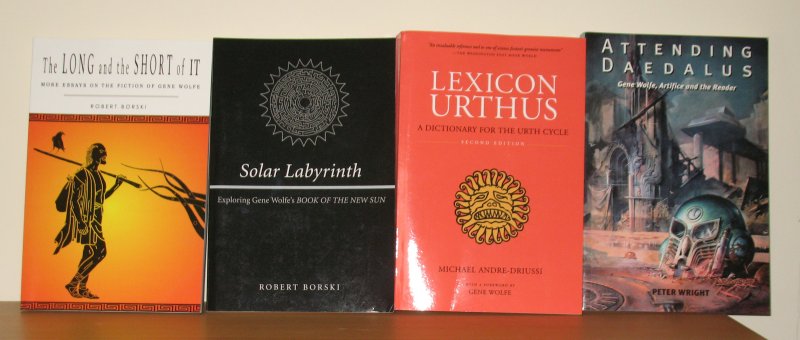
Some books about one writer: Gene Wolfe. The Long and the Short of It does not cover any specific work of Wolfe’s, unlike Solar Labyrinth, Lexicon Urthus, Second Edition and Attending Daedalus, all of which are about The Book Of The New Sun. I reviewed Lexicon Urthus, Second Edition for Interzone.

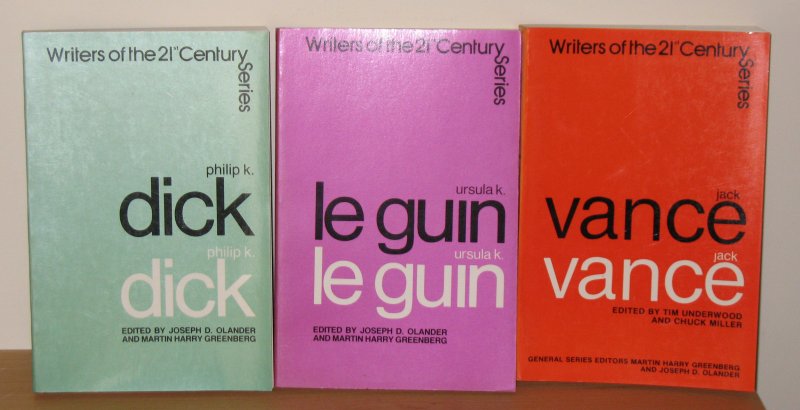
I picked these up years ago in a publishers’ clearance bookshop. I’m not sure why the series is titled Writers of the 21st Century, as only one – Le Guin – is still writing. Mind you, Philip K Dick is still being published, and having his stories adapted for the cinema, even though he died in 1982 (the book is copyrighted 1983). Jack Vance‘s last novel, Lurulu, was published in 2004, but we’re extremely unlikely to ever see anything new from him.

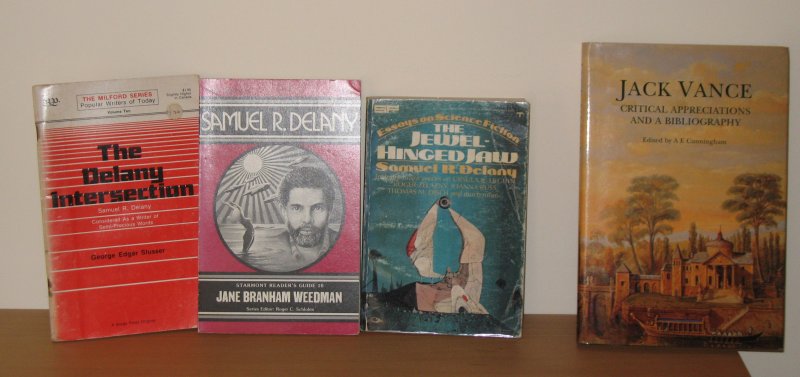
The Delany Intersection and the Starmont Reader’s Guide are both about Delany’s fiction. The Jewel-Hinged Jaw is Delany’s first and probably best-known work of criticism, though he’s written nearly a dozen such books. Jack Vance – Critical Appreciations and a Bibliography is just that.

Finally, two books about Edgar Rice Burroughs, Master Of Adventure about his fiction and A Guide to Barsoom specific to his Mars books. Who Writes Science Fiction? and Wordsmiths of Wonder are both collections of interviews with genre writers.

As well as the above books, I also have a number of science fiction and fantasy encyclopaedias and reference works. But that’s a post for another day.


7 Comments

The laden mantlepiece

I must not buy so many books. I must not buy so many books. I must not buy so many books. I tell myself this every day, but it doesn’t seem to work.

See:

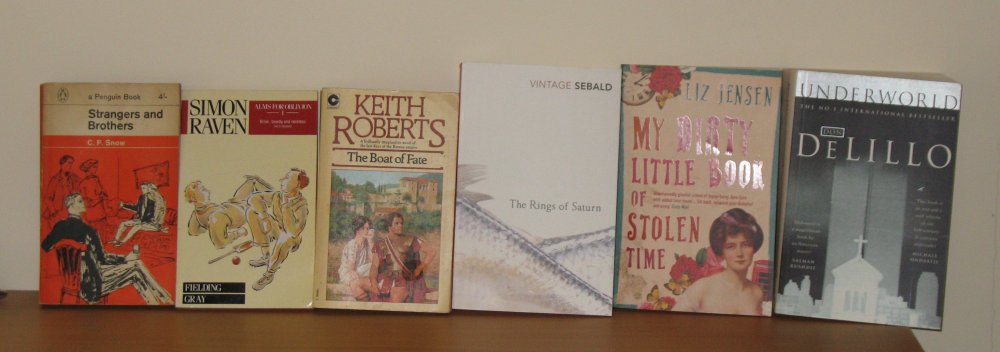
Some mainstream fiction. Strangers and Brothers, CP Snow, the second book of the series of the same name (although the first written). I read the first, Time of Hope, a couple of weeks ago and enjoyed it. Fielding Gray, Simon Raven, the first book of his Alms for Oblivion series, which I was told is similar to Snow’s. The Boat of Fate, an historical novel by Keith Roberts, an excellent sf writer best-known for SF Masterwork Pavane. The Rings Of Saturn, WG Sebald, a writer I admire much. My Dirty Little Book of Stolen Time, Liz Jensen – a charity shop find, which I picked up because I enjoyed her The Rapture (my review here). And Underworld, also a charity shop find, because I’ve been meaning to read some Don DeLillo for ages.

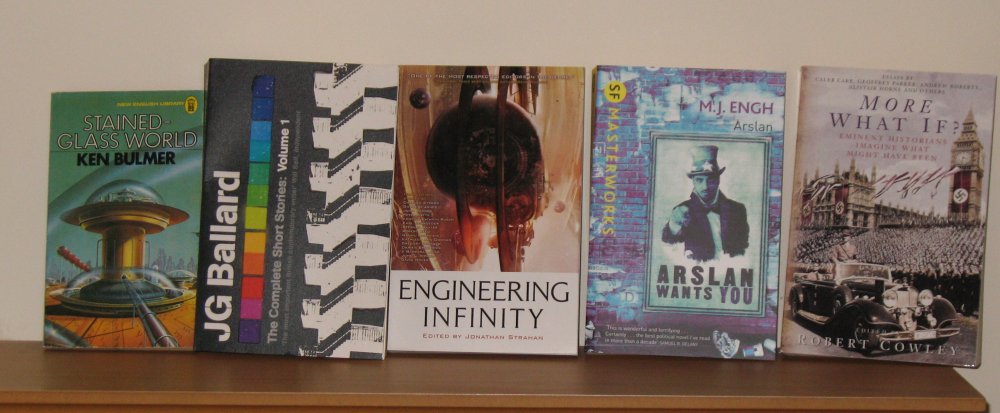
Some science fiction: Stained-Glass World, Ken Bulmer, a British sf writer of the 1960s and 1970s. A bit of a hack, by all accounts, but we’ll see. JG Ballard’s The Complete Short Stories: Volume 1, Engineering Infinity, Arslan, and More What If? I’m looking forward to reading. The last one was a charity shop find, the other three were birthday presents.

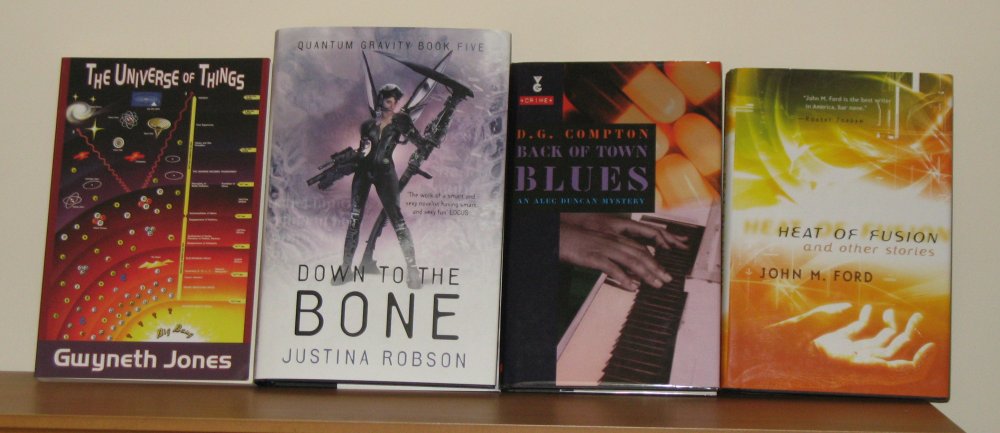
Some first editions. The Universe of Things is for the Gwyneth Jones collection. Down to the Bone is the last of Justina Robson’s Quantum Gravity series. Back of Town Blues is for the DG Compton collection. Heat of Fusion and Other Stories, John M Ford, because he is apparently a writer of excellent sf short fiction.

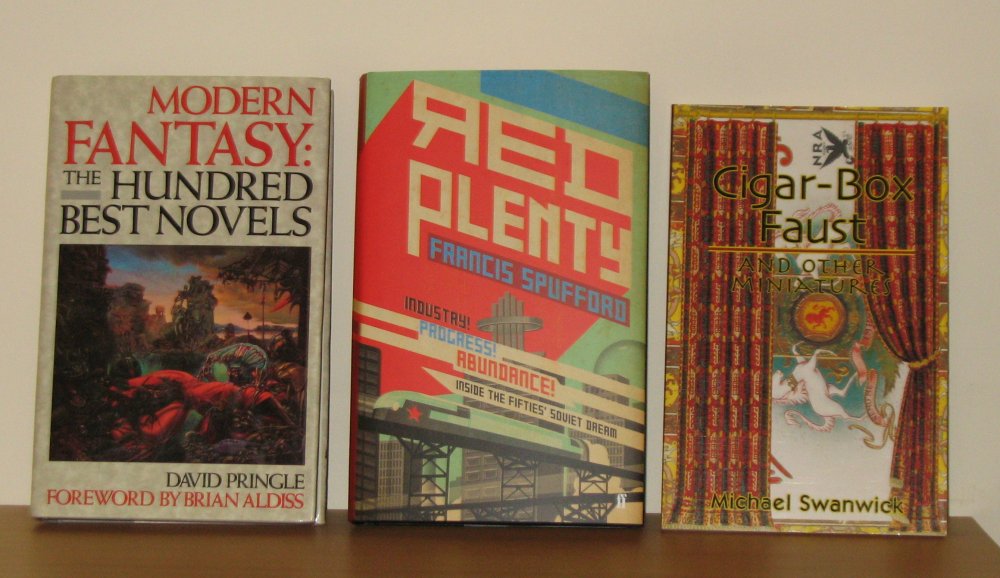
A bit of a mix. Modern Fantasy: The Hundred Best Novels, David Pringle, which is sort of not the companion volume to Pringle’s Science Fiction: The 100 Best Novels, because the actual real companion volume to that is Fantasy: The 100 Best Books by Michael Moorcock and James Cawthorn (which I also own). Red Plenty, BSFA Award-shortlisted non-fiction/fiction, which many folk have told me I will like (I was going to wait for the paperback, but what the hell). And Cigar-Box Faust and Other Miniatures, a signed and numbered limited edition chapbook of Michael Swanwick short stories.

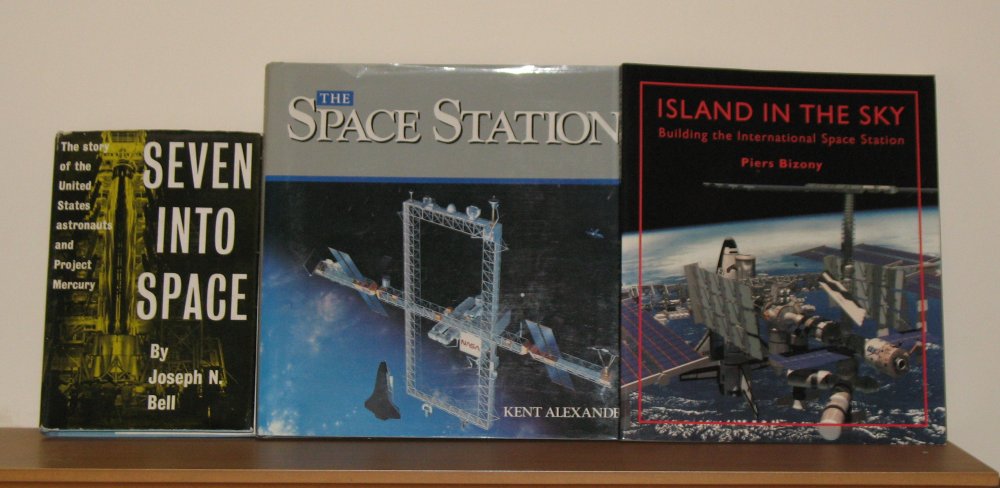
Three space books. Seven into Space, kindly donated to the Space Books collection by Adam Roberts. The Space Station and Island in the Sky were both bargains from eBay.

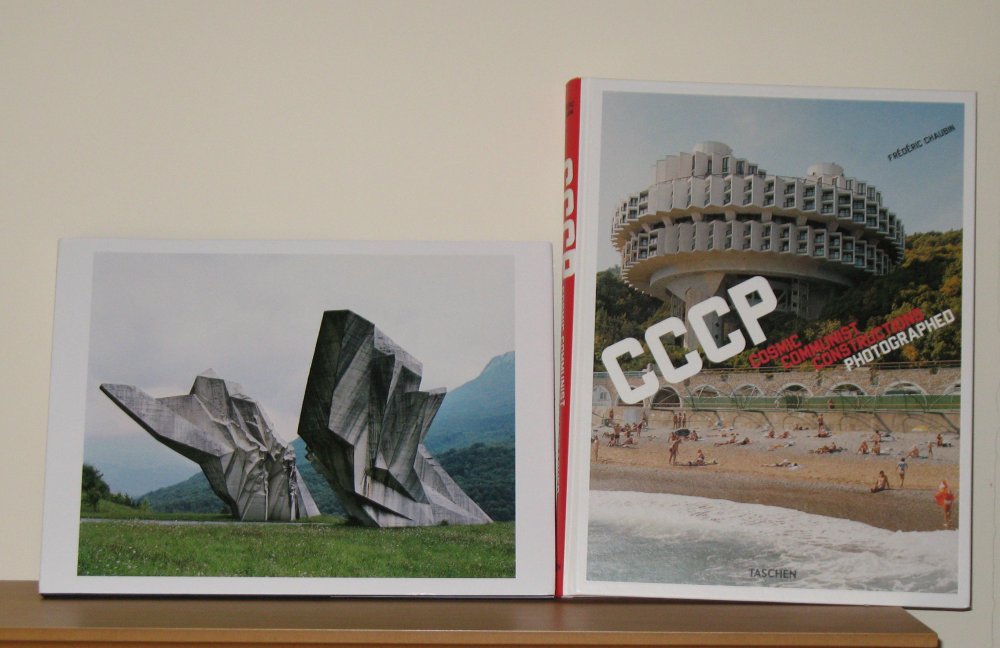
Finally, a pair of coffee-table books. Spomenik, Jan Kempenaers, is the book of his photographic exhibition. The title refers to WWII monuments in the former Yugoslavia. Many have been destroyed, or left to fall into ruin, but Kempenaers’ book contains photos of twenty-two of the best-preserved ones. Strange, but quite beautiful, stuff. CCCP: Cosmic Communist Constructions Photographed, Frédéric Chaubin, is a ginormous book of photographs of many gloriously modernist buildings from the former USSR. Also strange, but quite beautiful, stuff.


12 Comments

Ten Greatest Authors

I can’t even remotely pretend the ten authors in this list are the “greatest” in any commonly-accepted sense. They’re not all favourites, but they’re certainly the authors whose writing I admire the most. Still, it’s a list. Everyone likes lists.

In no particular order…

  1. Lawrence Durrell – I love the way he uses the English language. At a sentence level, I think he writes the best prose of any writer I’ve ever read. The Alexandria Quartet is required reading.
  2. Anthony Burgess – because fiction should be clever – although, to be honest, Burgess was occasionally too clever for his own good. Once described as a great writer who never wrote a great novel… except Earthly Powers is a great novel.
  3. John Fowles – the sheer readability of his prose disguises the depth and insight of his fiction. The French Lieutenant’s Woman is one of the great works of post-war British literature.
  4. DH Lawrence – I came late to Lawrence, but I immediately fell in love with his prose – the level of detail, the insight, the poetry…
  5. John Crowley – the Ægypt Sequence remains one of the best works of American literature from the second half of the twentieth century. Often it seems the height of hubris to claim Crowley as a genre writer.
  6. M John Harrison – the finest British prose stylist who self-identifies as a genre fiction writer. Light is a touchstone work of science fiction.
  7. Paul Park – the finest American prose stylist who self-identifies as a genre fiction writer. His books are less challenging than M John Harrison’s, but they also make more original use of genre tropes.
  8. Gwyneth Jones – her prose is an order of magnitude better than is typical for science fiction; and her science fiction is an order of magnitude more sophisticated than is typical for the genre.
  9. WG Sebald – because he’s such a resolutely interesting writer in the way he frames and presents narratives.
  10. Kim Stanley Robinson – the most thoughtful science fiction writer of his generation, and extremely readable with it. The Mars trilogy is a touchstone work of science fiction.

Honourable mentions: Mary Gentle, Paul Scott, Joseph Conrad, Frank Herbert, Margaret Atwood, Kazuo Ishiguro.

Also: my Ten Greatest Film Directors post.


36 Comments

The Ten Best Science Fiction Books… Ever

Everyone loves lists. Contentious lists are even better. So here’s one: the ten absolute best science fiction novels ever published – written by sf authors, published by sf publishers. These ten books show what the genre is capable of when it aims to be more than mindless escapism. They are fiercely intelligent, beautifully written, meaningful, inventive, rigorous, and sf from the first word to the last. They are, in chronological order:

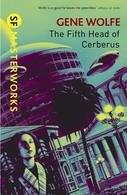
The Fifth Head of Cerberus, Gene Wolfe (1972). A collection of three novellas – but not a cheat, as the three are linked and form a novel together. This is the sort of science fiction that can be read and enjoyed, and then carefully puzzled through to determine what was really going on. Wolfe is a tricksy writer, and in The Fifth Head of Cerberus he’s at his tricksy-est.

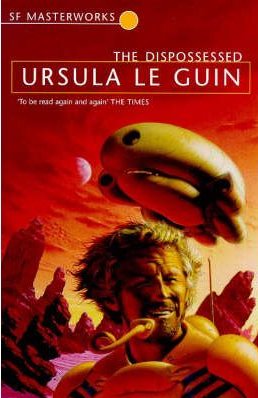
The Dispossessed, Ursula K Le Guin (1974). Donald Wollheim once claimed that the benevolent dictatorship was the government of choice of sf fans. That’s clearly what comes of reading too many space operas with interstellar empires and the like. And yet sf also has a history of documenting the road to utopia. All that benevolent dictator stuff is nonsense, of course – it’s as much fantasy as the Competent Man as hero. Thankfully, not everyone subscribes to it. The Dispossessed is a political book – it’s even subtitled “An Ambiguous Utopia” – and it’s political in a way that makes you think, that shows you what sf is really for.

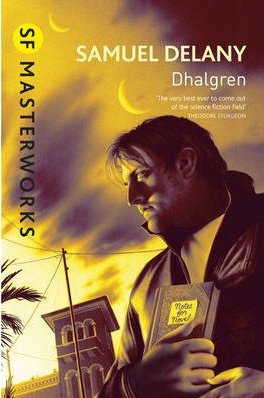
Dhalgren, Samuel R Delany (1975), is definitely science fiction – it’s in the relaunched SF Masterworks series, for a start – even though it’s proven extremely popular outside the genre. Sometimes it reads like a novel of its time, sometimes it seems almost timeless. But every time you read it, it’s different. It is also the most profoundly literary book in this list, and from an author who is steeped in genre.

Take Back Plenty, Colin Greenland (1990). Yes, so Iain M Banks’s Consider Phlebas arguably kicked off the whole New British Space Opera thing in 1987, but to my mind the movement didn’t really gel until the appearance of Take Back Plenty three years later. I remember the buzz the book caused – and I remember on reading it discovering that it was as good as everyone said it was. I reread it a couple of years ago, and it’s still bloody good. So why is it not in the SF Masterworks series, eh?

The Martian trilogy, Kim Stanley Robinson (1992 – 1996), is a bit of a cheat as it’s three books. While many are full of admiration for the first book, Red Mars, but not so keen on the sequels, Green Mars and Blue Mars, I maintain that the whole is greater than the sum of its parts. You need to read Green Mars and Blue Mars after you’ve finished Red Mars because the first book only poses a small handful of the questions the three books ask and attempt to answer.

Coelestis, Paul Park (1993), was once described by John Clute as “Third World sf”, but I prefer to think of it as “post-colonial sf”. But not “post-colonial” in the same way as Ian McDonald’s River of Gods. I was an expat until only a few years ago, so it’s no surprise I’m drawn to fiction which documents the British expat experience abroad – hence my admiration for Lawrence Durrell’s Alexandria Quartet and Paul Scott’s Raj Quartet. While Park is an American, Coelestis is infused with that same atmosphere. Plus Park is one of the best prose stylists in this list. Why has this book been allowed to go out of print? Someone publish a new edition, please.

Ash: A Secret History, Mary Gentle (2000). This is the biggest book on this list – it contains nearly a million words. It is, with Red Mars, one of the most rigorous too. Rigour is important in sf – you can’t just make shit up as you go along (but you can, of course, as Iain Banks is fond of putting it, “blow shit up”). The bulk of the story may be set in an alternate mediaeval Europe, but it is not fantasy. It is clever, it is visceral, it is also physically heavy.

Light, M John Harrison (2002). They say Harrison is a writer’s writer, and the prose in Light certainly suggests as much. Light is also one of those novels that’s often described as one which “redefines” science fiction. Which it does. Sort of. But not by coming up with something new, only by shedding new light on those genre tropes being over-exercised at the turn of the century. They say that sf is a genre in conversation with itself, which makes Harrison one of sf’s sharpest conversationalists.

Life, Gwyneth Jones (2004). I need only repeat David Soyka from his review of this book on sfsite.com: “You can stop reading right now and go out and buy the book. Otherwise, you’ll have to endure yet another one of these diatribes about how science fiction doesn’t get any respect from the literary mainstream. Because you can’t read this book and not reflect on the fact that had this been written by, say, Margaret Atwood, Life would be receiving more of the widespread attention it deserves.”

The Caryatids, Bruce Sterling (2009). I’ve never believed sf should be predictive, but if any sf writer could be called an “architect of futures” then it would be Bruce Sterling. And in The Caryatids he has produced his most inventive and meaningful conversation with the future yet. It is the best book he has written. So why hasn’t it been published in the UK? Why is there only a US edition of this excellent book?

These are not “seminal” sf novels, they are not “classics”, they are not even especially popular. But they are “best” in the true meaning of the word – i.e., “of the highest quality”. If you haven’t read them, you should do so immediately.

Now tell me which books I’ve missed off my list. No mainstream authors slumming it in the genre, please. And I don’t care what impact a book had in, or outside, the genre. It has to be, in your eyes, one of the best-written science fiction novels ever published. And that doesn’t mean the “most entertaining”, or any other excuse used to justify flat writing, cardboard characters, or simplistic plotting. I’m not talking about fit for purpose; I’m talking about excellence in writing, in prose, in literature, in genre.