
I remember reading Brin’s Uplift novels many years ago and quite enjoying them, although something about them never sat quite well with me. I no longer remember what that was, although I’ve never made an effort to seek out his novels since. But Glory Season (1993, USA) was nominated for the Hugo Award, and is set on a world of cloned women, so it sounded like it might be worth a go.
So I was surprised to discover Brin is actually a pretty bad writer – sloppy, a tendency to stretch his story long past what the narrative can bear, with a handful of good ideas buried under a mass of banal detail. Characters change hair colour between paragraphs, a woman described as Chuychin (one of the cloned women clans) becomes half-Chuchyin a couple of sentences later. The writing is mostly clumsy, but occasionally manages an easy readability.
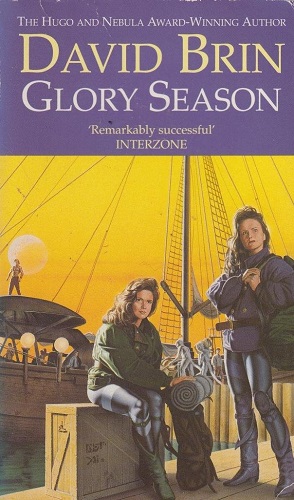
The world of Stratos was settled millennia before by a group who wanted to create a society that was safe for women. They needed men to “spark” their parthagenetic clones, but they limited the male libido to a single season of each year, and allowed them to also produce non-clone children (needed to replace the men, of course, but also daughters). The clones live in clans, each of which fulfils some sort of “niche”, or specialisation, in Stratoin society. Non-clone daughters, known as vars, hope to find niches and so get permission to start their own clans of clones.
Maia and Leie are twin vars, who leave their clan on their majority to seek their fortune. They sign aboard a pair of coal hauliers travelling down the coast. Maia stumbles across a conspiracy to supply a drug to men which triggers their libido out of season. From there, it spirals into a plot between two hardline factions, at the centre of which is a recently-arrived scout from the interstellar society the founders of Stratos left millennia before. Maia learns more about her world’s history, about the Game of Life, which is important to the men of the world, and about humanity on worlds other than Stratos.
In the best of hands, that’s a lot to cover, but Brin still manages to make it drag over 600 pages. At one point, Maia and her companions are trapped in a room with a hidden exit, and Brin spends over twenty pages explaining how they eventually discover the exit. For huge chunks of the book, Maia has no agency, and is little more than a witness to elements of the world-building Brin wants to show off. It makes for an aggravating read.
There are also many similarities between Glory Season and Mary Gentle’s Golden Witchbreed (1983, UK). The plots are vaguely similar, although Brin’s novel is told from the perspective of a native of the world, not a visitor – but the same lost past, a high tech war fought thousands of years earlier, and an ancient high tech citadel… Coincidence, or did Glory Season simply “borrow” elements of Golden Witchbreed‘s plot? Glory Season may have been nominated for the Hugo, but Golden Witchbreed is greatly superior (it was nominated for the BSFA, but lost to Tik-Tok (1983, UK)).
Discovering Brin was a worse writer than I’d remember was not a surprise. Spotting the resemblances between Glory Season and Golden Witchbreed was. I’ve no idea if Brin had knowledge of Gentle’s novel. I would like to think not, but it was definitely published in the US. Even so, on its own merits alone, Glory Season is not very good: overly long, and its poor writing works against its few good ideas.
 It Doesn't Have To Be Right...