I won’t say where, or on what, I was at the time but this weekend I was thinking about definitions of hard science fiction for a podcast, and my thoughts spiralled out from there to definitions of science fiction itself. And it occurred to me that sf narratives break down into three rough forms: encountering the Other, embracing the Other and rejecting the Other. And the more I thought about it, the more it seemed to hold true. Think of a random sf novel, like… Dune. That’s embracing the Other – both Paul Atreides becoming a Fremen and learning to use his new-found powers.
Since its earliest days, science fiction stories have been characterised by distance just as much as they’ve been characterised by science and/or technology. Alongside the Gernsbackian tales of new inventions which would improve the lives of all were stories of alien places and the strange peoples found there. Distance is a signifier for the “exotic” (in both meanings of the word). Before science fiction, they told tales of the South Seas.
The further away a place is, the more Other it is – it’s a simplistic formula, but this is pulp fiction, after all. The difficulty of the journey is less important than the distance travelled. There are very few Shangri-Las hidden in inaccessible mountain valleys, or their galactic equivalents, but lots of worlds on the rim of the empire or the edges of the galaxy. Travel itself is not uncomfortable, but does take time. Real spacecraft are small and cramped, with no amenities. Sf’s starships are interstellar ocean liners with cabins and restaurants and promenades. This is because the journey does not matter, it is only a metaphor. If there are hardships, they are associated with either finding the destination, or at the destination itself. Off the top of my head, the only sf story I can think of in which the journey itself is an obstacle is Ursula K Le Guin’s ‘The Shobies’ Story’ (in Gwyneth Jones’ Buonarotti stories, and her novel Spirit, there’s a similar effect with interstellar travel, but it does not make the journey an obstacle). No doubt there are other stories, though I maintain such stories are rare within the genre.
But then, there’s not much that’s Other about the act of travelling from A to B. Even in the Le Guin story mentioned above, the means of making the journey affects the travellers’ perceptions of their destination, making the act of encountering, or even embracing, the Other so much harder and more prone to misunderstanding.
Space opera, of course, is traditionally predicated on rejecting the Other, as is military sf. The drama in both subgenres typically derives from conflict, either from within the world or from without. And the further the enemy is from known space, the more Other they generally are. Even when they’re humans, they’re typically barbarians from the edge of the empire – though that may simply be science fiction ripping off the history of the Roman empire… which it has done far too many times.
The same argument might well apply to fantasy, even though it is a different genre. I suspect there are more narratives of rejecting the Other in epic commercial fantasy than of the other two forms. Given its generally consolatory nature, this is no surprise. Other modes of fantasy may well be more evenly distributed – I’m not as well read in fantasy as I am science fiction. It might well be that the same argument does not apply to fantasy, given that it is an entirely different genre to sf.
Science fiction is not, and has never been, a branch of the fantastic. You can’t categorise fiction by the degrees of invention it exhibits. All fiction by definition contains invention, whether it’s literary fiction with made-up characters , fantasy with made-up worlds, or science fiction with made-up science and/or technology. Nor can you categorise by trope… because first you would have to define each and every trope. And lay out the conditions under which each trope is fantasy and not science fiction, or vice versa. If a fantasy novel has a dragon in it, then it does not follow that all novels containing dragons are fantasy. And so on. Science fiction is a fundamentally different genre to fantasy, and it’s an historical accident that the two are typically marketed alongside each other.
Yesterday, SF signal posted one of its regular Mind Melds – see here – this time on the subject of Orwell’s Nineteen Eighty-Four, totalitarianism and total war. And I contributed to it. I sort of riffed about dystopias, which wasn’t entirely on topic but never mind.
I mentioned several relevant sf novels, including Anthony Burgess’s 1985, Alastair Reynolds’s The Prefect, Frank Herbert’s Hellstrom’s Hive, Francis Spufford’s Red Plenty and Margaret Atwood’s The Handmaid’s Tale. But I wish I’d remember to mention Adam Roberts’ multi-award-winning Jack Glass, which pretty much demonstrates one of the points I was trying to make. The second and third parts of the novel feature the daughters of one of the super-rich families which effectively run the Solar System, a situation not that far removed from our current situation. Everyone else, of course, gets to live in abject misery and poverty in order to fund the super-rich’s lifestyles. I’ve said before that our current lords and masters appear to be taking Dickens as a model rather than Orwell, and Jack Glass is a good illustration of that.
And in the comments to the Mind Meld, I also sort of got accused of being a Nazi. Apparently pointing out that Nineteen Eighty-Four doesn’t really map onto the current political climate is a form of Godwinism. Er, no. It’s not a way to stifle argument, it’s simply pointing that if you believe Orwell’s book is relevant to the twenty-first century then your argument is wrong. Which, of course, has nothing to do with Nazis.
A couple of weeks ago, abebooks.com published a list of 50 Essential SF Novels, about which, of course, there is much to argue. This prompted a discussion on Twitter between Jared Shurin of Pornokitsch, James Smythe of The Explorer, and myself. We decided to each generate our own list of 50 essential sf novels, which we would post over two days – 25 books per day. Jared’s list is here and James’ list is here. The rules were simple: the definition of science fiction up to the individual, novels only (so no collections or anthologies), novellas allowed, graphic novels (or bandes dessinées) also allowed, only one book per author, and only books that you have yourself read.
It proved a harder exercise than I expected. I could have picked 50 of my favourite sf novels – but what made them “essential”? Instead, I chose novels across a mix of science fiction modes and subgenres. I also wanted a gender-balanced list, but unfortunately couldn’t manage it – only 16 of the 50 writers below are female. That one-book-per-author rule did no help at all. There are many women sf writers who probably belong on this list, but whose books I’ve not actually read – such as Octavia Butler, MJ Engh, Charlotte Perkins Gilman, CL Moore, Judith Merrill, Carol Emshwiller, Marge Piercy, Naomi Mitchison… I could only choose those I’d read.
But, the list. Here it is, the first twenty-five novels of fifty that every self-respecting sf fan should have on their bookshelves, given in order of original publication. The remaining twenty-five will appear tomorrow.
1Frankenstein†, Mary Shelley (1818)
The original proto-sf novel and a bona fide classic of English literature. Of course it’s essential.
2The Time Machine†, HG Wells (1895)
Another proto-sf novel. Time travel is a well-established subgenre, but which time travel novel is the most essential in a collection? I submit it is this one. Far too many time travel stories use the trope merely to improve matters for the protagonist. Well’s classic describes, and comments on, the time of its writing through the future history of humanity.
3A Princess of Mars, Edgar Rice Burroughs (1912)
Edgar Rice Burroughs has a lot to answer for – this planetary romance arguably fixed science fiction as a pulp genre, and it took a good forty or more years for sf to break free. A Princess of Mars is a silly book, with its Gary Sue hero and naked Martians, its magical science and its simplistic set-up… but it is also an essential stop on the road to modern science fiction.
4Metropolis, Thea von Harbou (1926)
One of the genre’s first novelisations – if not the actual first – as it was based on the 1924 screenplay of Lang’s film. It’s all a bit overwrought and florid, in direct contrast to the movie, but its message remains timeless.
5Last And First Men†, Olaf Stapledon (1930)
It starts in the twentieth century and finishes two billion years later. It also throws away more idea for novels within its pages than any other book in the entire sf canon. Except perhaps Stapledon’s own Star Maker, which I’ve not read yet…
6Nineteen Eighty-Four*, George Orwell (1948)
For some reason, totalitarian dystopias haven’t been especially common in genre sf – perhaps because this one did it so well; or perhaps because most sf writers and fans aren’t willing to engage with politics that don’t match their own… Where dystopias do appear in sf (they’re more common in literary fiction), they’re generally little more than background, a dim setting against which some noble-browed hero can shine.
7The House That Stood Still, AE van Vogt (1950)
Like many early sf writers, van Vogt was hugely prolific. Also like them, most of his stories and books were not very good. In this one, van Vogt crashed together noir and pulp sf, and the result is something which stands above everything else he wrote (despite the occasional characteristic silliness). It’s essential because it’s emblematic of genre fiction of the period. If Philip Marlowe and Flash Gordon had a baby, it would look like this book.
8The Sword of Rhiannon, Leigh Brackett (1953)
Planetary romance as a subgenre is hard to take seriously. We’ve put robots on the surface of Mars, we know there are no ancient civilisations, no canals, etc. But Brackett was an order of magnitude better than most writers working in this subgenre, and it shows. This is probably her most characteristic planetary romance.
9The Stars My Destination†, Alfred Bester (1956)
Thinking about it, I don’t know why this book is “essential”, but I do know that any sf book collection without it feels incomplete. It is in many ways the distillation of 1950s sf, a crazy pulp re-imagining of The Count of Monte Cristo, which revels in its pyrotechnic prose.
10Solaris*, Stanisław Lem (1961)
The Anglophone world is not, of course, the only one with a sf tradition. Many countries have strong sf traditions. Such as Poland – and Solaris is perhaps the best-known Polish sf novel by the Polish sf writer best-known outside Poland. It’s also an excellent film (but that was made by a Russian).
11Dune*†, Frank Herbert (1965)
On a prose level, Dune is not especially good. It’s also unevenly structured. But its world-building is second to none, and it is the first truly immersive sf novel. All that praise for its ecological theme is just hogwash to disguise the fact that most males when they were teenagers wanted to be Paul Atreides.
12A Torrent of Faces, James Blish & Norman L Knight (1967)
Overpopulation is a common theme in sf, and the first three-quarters of the twentieth century were awash with Malthusian nightmares. This one shows its age somewhat, but its prose is very nicely detailed and its story is well-balanced.
13Camp Concentration, Thomas M Disch (1968)
People do things – mostly nasty – to other people, and sometimes sf writes about it. This is not the best-known sf novel about an experiment to increase the intelligence of a human being, but it is the best one.
14The Fifth Head of Cerberus†, Gene Wolfe (1972)
You’d think that a genre of fiction with the word “science” in its name would be clever. But it isn’t always. Sometimes, however, it can be very clever. Like The Fifth Head of Cerberus, which is a sort of cunning puzzle in fictive form.
15Rendezvous With Rama*†, Arthur C Clarke (1972)
Some people think sf is all about Big Dumb Objects, and Clarke’s Rama is probably the most iconic BDO of them all. A mysterious alien vessel, seemingly dormant, enters the Solar System and then leaves it. This is sf as fiction of the ineffable. Ignore the inferior sequels.
16Crash, JG Ballard (1973)
Good sf is about the real world, no matter when and where it is set. Or what happens in the story. Crash is avant garde, it is brutal, it can and will offend. But it also says something important about people’s relationship to technology.
17The Continuous Katherine Mortenhoe†, DG Compton (1973)
A quarter of the world’s CCTV cameras can be found in the UK. It is the most-surveillanced nation on the planet. And yet it’s not some horrible Stalinist totalitarian state – as sf insists would be the case. (Our current lords and masters seem to prefer Dickens as a model.) The Continuous Katherine Mortenhoe shows the ultimate in paparazzi – a reporter who has had one eye secretly replaced with a television camera. His subject just wants to be allowed to die in peace. But it’s not going to happen. A sf novel that says something important, now more than ever.
18The Dispossessed†, Ursula K LeGuin (1974)
Too much sf ignores politics, content to describe some simplistic system which meets the needs of either story or writer. Given the breadth of the genre and the size of its toolbox, it’s a shame sf doesn’t try more often for meaningful political commentary in its fictions. Happily, some writers have made a career of doing so, and LeGuin is among the best at this. As this novel demonstrates.
19Dhalgren†, Samuel R Delany (1974)
There aren’t many sf novels which could legitimately make it onto a list of twentieth-century literary classics, but Dhalgren is one of them.
20The Female Man*†, Joanna Russ (1975)
This is not just a book about women-only worlds, it is also an excellent explanation of why such worlds need to exist. Sf is far too useful a tool to be merely tales of action/adventure in outer space. This book demonstrates why, and does it in a way that cannot fail to affect readers.
21Hello Summer, Goodbye, Michael G Coney (1975)
There are not that many sf novels in which humans never appear – possibly because it’s a difficult trick to pull off well. But Coney manages it in this beautifully-written coming of age story set on an alien world.
22A Scanner Darkly†, Philip K Dick (1977)
One word: drugs. This is Dick’s best novel – perhaps not his druggiest, or funniest, or most paranoid; but certainly the one where all three elements work together most effectively. Happily, it doesn’t read like he made it up as he went along, even if he did. Which is more than can be said for the bulk of his oeuvre.
23The Ophiuchi Hotline, John Varley (1977)
Varley set three novels and a number of novellas and short stories in his Eight Worlds universe. In it, mysterious aliens have destroyed human civilisation on Earth, leaving only those on the other planets and moons of the Solar System to survive – as best they can. Happily, they have access to advanced technology beamed in blueprint form from Ophiuchi. A silly conspiracy plot provides the excuse for a travelogue through the Eight Worlds, before reaching an ending that actually throws away an entire novel’s worth of ideas. But this novel is an excellent example of sf’s penchant for optimism in the face of adversity.
24Gateway†, Frederik Pohl (1977)
Another one of sf’s better-known Big Dumb Objects. The space station of the title is a mysterious depot for alien FTL starships, which humans use Russian roulette-fashion to fire themselves off into the rest of the galaxy, hoping to return with riches. It’s like the National Lottery, but with aliens off-stage somewhere (instead of hosting the prime-time game shows).
25The Wanderground, Sally Miller Gearhart (1979)
There has been a strong tradition in sf throughout its history of women-only utopias – from Charlotte Perkins Gilman’s Herland in 1915 through works by Francis Stevens, Marge Piercy, Joanna Russ, Pamela Sargent, Suzy McKee Charnas, Sheri S Tepper, Nicola Griffith, and others. Sadly, it’s been marginalised by a readership who would sooner read about derring-do by manly men. The Wanderground is not entirely women-only – the men still live in the cities, and they’ve not changed their ways much – but the women-only settlements in the hills are something very much different. Perhaps there’s a bit too much magical powers about it all, but this novel possesses a great deal of charm.
The remaining twenty-five essential sf novels will be posted here tomorrow.
note: * means the book is also on abebooks.com’s list; † means the book is in the SF Masterworks series.
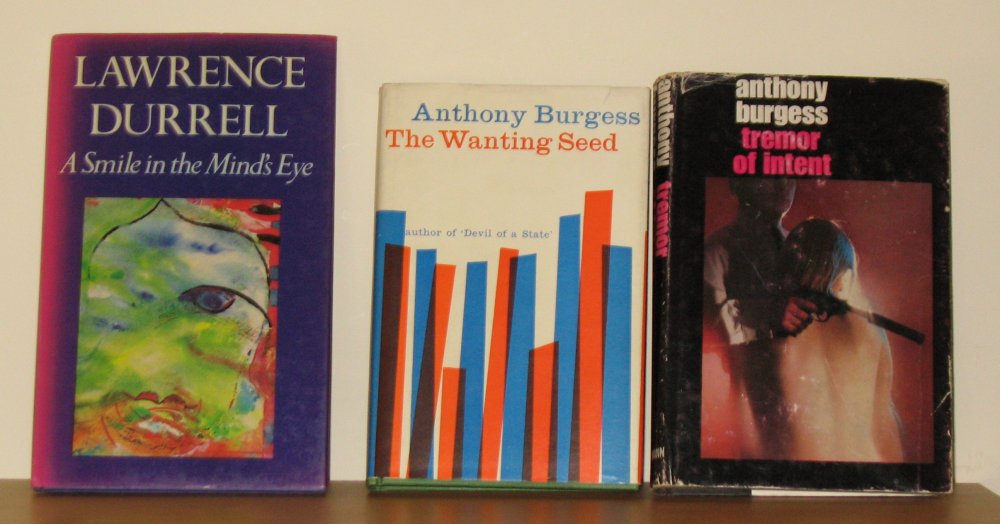
It’s been over a month since my last book haul post, but if I leave it any longer, it’ll take me an entire weekend to photograph my purchases. So herewith approximately five to six weeks worth of slippery “bid”, “buy it now” and “place order” buttons, and the results thereof.
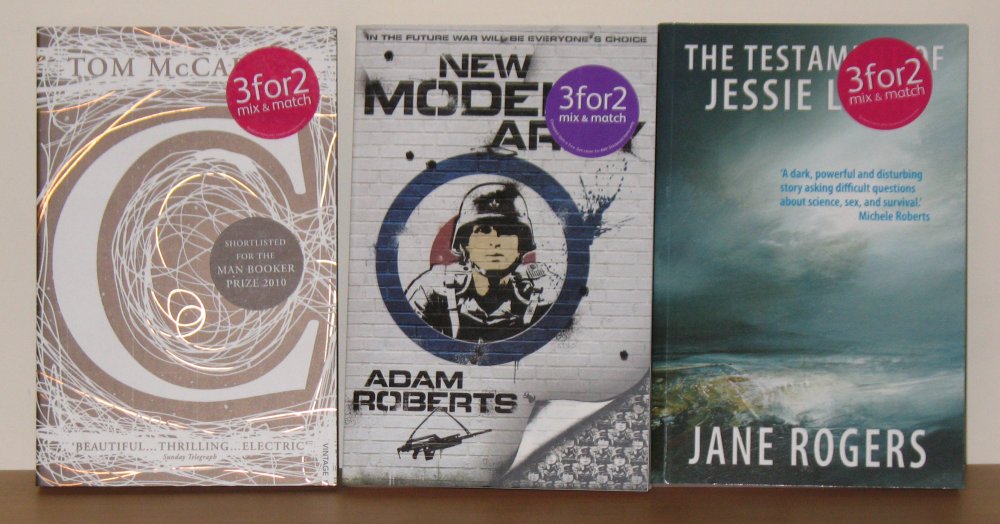
Some time this month, we say goodbye to Waterstone’s 3-for-2 offer, so I felt obliged to go out and have one last go on it. C I’m told is very, very good; I haven’t quite found the right way to read Adam Roberts yet, but I’m reliably informed New Model Army is very good; and The Testament of Jessie Lamb is a literary-but-it’s-really-sf novel and was on this year’s Booker long list.
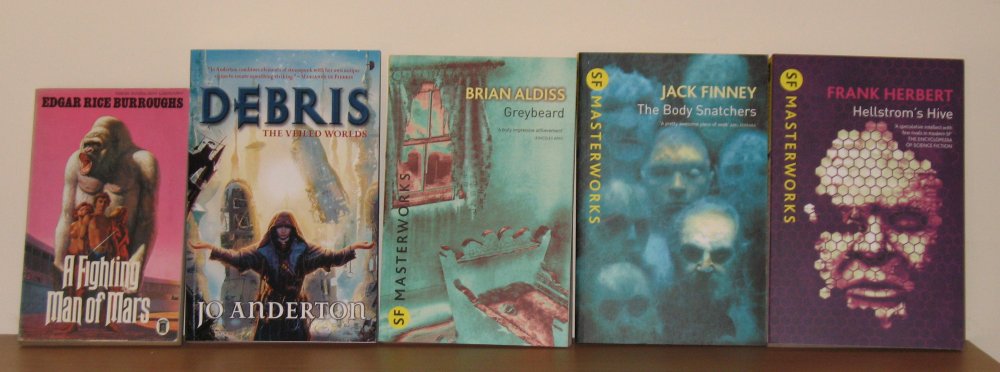
Some science fiction, which I do of course still read every now and again. Three SF Masterworks: Greybeard and The Body Snatchers I’ve never read; Hellstrom’s Hive I’m looking forward to rereading. Debris I have to review for Interzone. A Fighting Man of Mars… well, I’m looking forward to the film due out later this year – I may even go to see it at the cinema. The books I’m less keen on, but never mind.
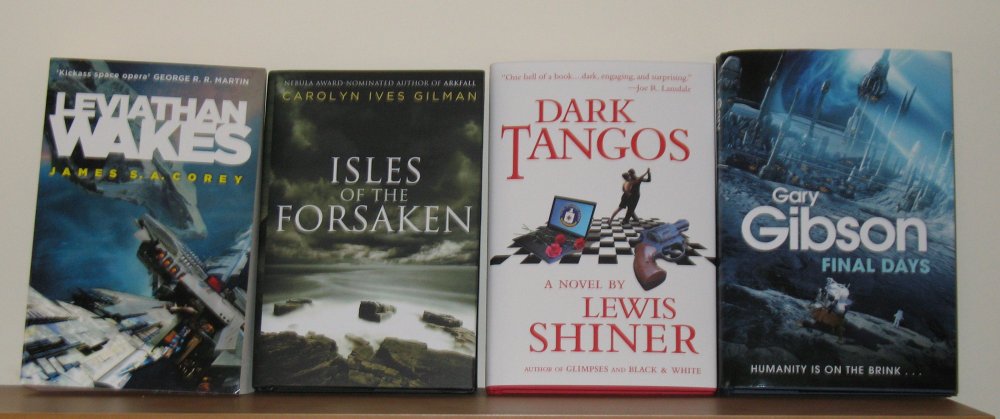
First editions: Final Days and Leviathan Wakes are both science fiction (much thanks to Gary for the former, and Sharon for the latter). Isles of the Forsaken is fantasy – and yes, that’s the signed, numbered edition. Dark Tangos is, well, it’s by Lewis Shiner. And it’s also the signed edition.
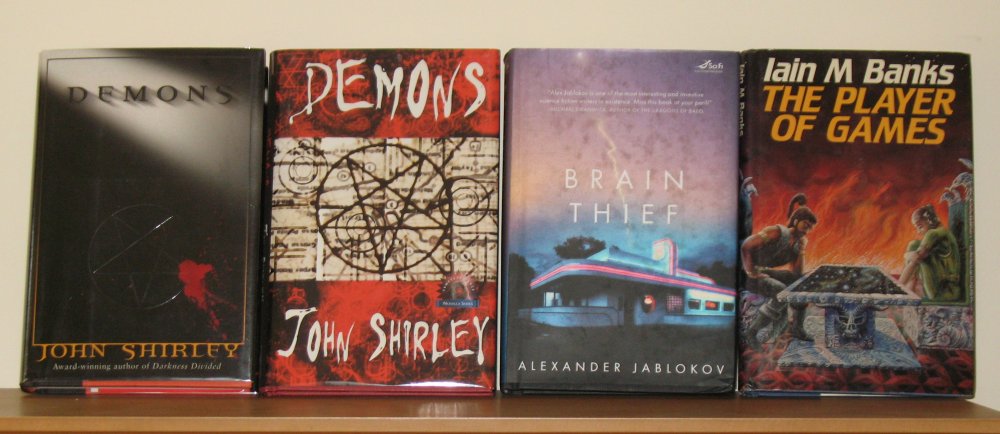
First editions for the collection. Yes, that really is Demons by John Shirley and, er, Demons by John Shirley. The one with the red cover is a novella from Cemetery Dance, and the other is a novel, of which the novella forms the first half. Both are signed. As is Brain Thief, which I reviewed for Interzone last year (but was only sent an ARC). The Player of Games is hard to find for a reasonable price in first edition, but I managed it.
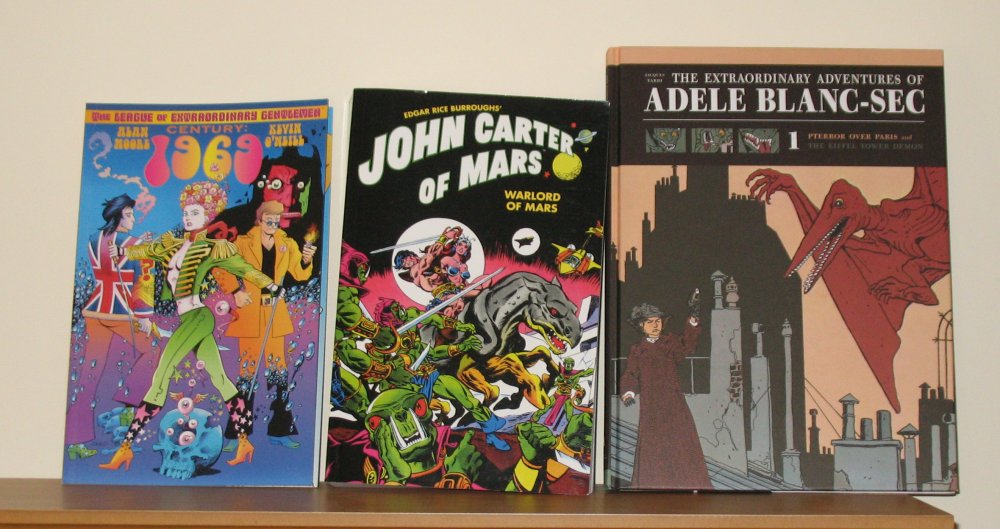
Graphic novels: the latest in The League of Extraordinary Gentlemen, the fab and groovy Century 1969. I have fond memories of Marvel’s John Carter of Mars comic from the 1970s, and a few years ago tracked down all 28 issues and three “king size” annuals. But a trade paperback is so much more convenient – except the artwork in it is black and white, and not colour as in the original comics. The Extraordinary Adventures of Adéle Blank-Sec 1 I bought after enjoying Tardi’s The Arctic Marauder.
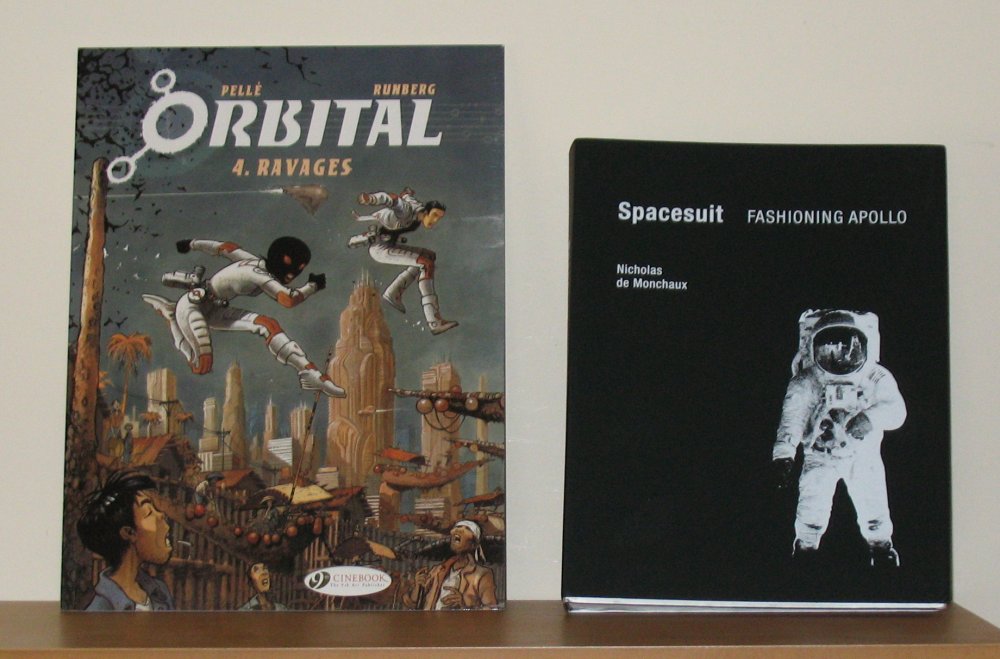
Finally, Ravages, the last, I think, of the Orbital graphic novels, and a book about, er spacesuits titled Spacesuit: Fashioning Apollo. I don’t know what the cover of the latter is made from but it has a similar texture to rubber matting and is quite strange.

 It Doesn't Have To Be Right...