
Nominated for the Hugo in 1956, which was won that year by Robert Heinlein’s Double Star (1955, USA). Not This August (1955, USA) takes place in 1965 in a US that has been fighting USSR and Chinese forces for three years. The war has not been going well, and life in the US is grim, deprived and increasingly restrictive.
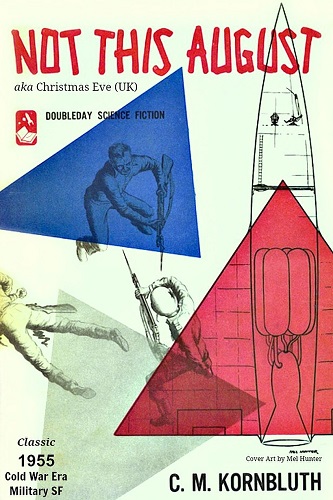
Billy Justin is a veteran and a small milk farmer barely scraping by. He hires a local itinerant who doesn’t appear to have all his marbles, only for the man to reveal he headed a secret project to build a crewed orbital bomb platform to end the war. The project was in danger of being discovered so he sealed the secret bunker and fatally gassed everyone inside.
The Soviets conquer the US and a political troop take over the county where Justin lives. He hooks up with a US resistance, and they restart the orbital bomb platform project, which was nearly finished anyway. Then the Soviet occupying troops are replaced with more hardline troops, but the Americans manage to stage an uprising, which serves as a successful ploy to prevent the Soviets from stopping the launch of the bomb platform.
Not This August reminded me a little of MJ Engh’s Arslan (1976, USA), a novel I didn’t like. One of the problems I had with that novel was the US at the time of writing, 1976, threw off fifty years of progress seemingly overnight, going from cars to carts and horses in a matter of days. In Not This August, the US has at least been at war for three years, and while it has taken most of the nation’s resources, it has not at the start of the novel managed to take US territory. Except the life lived by Justin is not the 1965 we remember, but closer to 1935. True, there were still farms and rural communities in the US without electricity until the mid-1960s in the real world, but even so…
There’s a lot of American sf written and set in the early latter half of last century that feels like it’s set between the wars. Because that’s when the writers were teenagers, or young men (they’re almost always men; except for, well, Engh), and their imagination doesn’t stretch much further than that. Either that, or the US was a lot more backward, and perhaps still is, than it liked, or likes, to insist. Not This August is an entertaining if dated and not especially plausible sf novel. I remember living under the threat of Mutually Assured Destruction, and Kornbluth obviously was when he wrote this novel, but there’s nothing here to evoke that – or, I suspect, to remind those who lived during rationing what it was like (the US had rationing during WWII, but it was nowhere near as severe as in the UK). Nice try, but no Blue Peter badge, I’m afraid.
 It Doesn't Have To Be Right...