It Doesn't Have To Be Right…

… it just has to sound plausible


Leave a comment

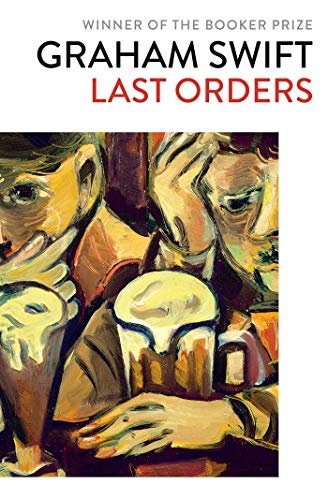
Last Orders, Graham Swift

Winner of the Booker Prize in 1996, beating out, among others, Margaret Atwood’s Alias Grace (1996, Canada), which is an outstandingly good novel, probably her best. But Last Orders (1996, UK) is very good, and one that grows on you as you read it.

Jack Dodds has died and his adopted son and three old friends agree to take his ashes to Margate to throw them into the sea. The novel is about the journey, but it’s also about the past of the five men, their wives and daughters (although they don’t appear much in the story), and their relationships. Jack and Ray fought together in North Africa during WWII. Jack’s butcher shop was on the other side of the street to Vic’s funeral parlour. Lenny was a childhood friend, whose daughter had a relationship with Jack’s son. Who isn’t really his son, but the sole survivor of a neighbouring family whose house was hit by a bomb during the Blitz. Vic is the closest to middle-class as he’s a funeral director, he might even be lower middle class. Vince, the adopted son, is upwardly mobile (a very definite thing in the 1980s), a butcher’s son turned mechanic, but now running a car showroom specialising in top-end second-hand motors. The odd one out is Ray, who works in an office as an insurance clerk, but makes a tidy living betting on the horses.

Last Orders is set mostly in Bermondsey, south east London, during the years following World War II. Jack dies in the 1980s – the film is explicitly set in 1989. The story is told through the voices of its cast, which is East End English – not Cockney, not Estuary Speak, but the English of the London working class of the first half of last century. Swift’s control of voice is really impressive. The prose is a joy to read.

It occurred to me while reading the novel the setting had been spoiled by Guy Ritchie and all those “Mockney” movies. Last Orders is about working class culture in central London. Little of which exists anymore. For example, the novel mentions hop-picking, which was a thing up until the 1960s. Working class people from London would spend the summer in Kent, living in tents and shacks, and picking hops. It was the only holiday they had. The practice ended when farmers began using machines to pick hops.

Which suggests Last Orders is in part a paean to a lost way of life – signified, for example, by Vince’s refusal to be the son in “Dodds & Son, family butchers”. It’s in the nature of progress for ways of life to disappear. Tradition is a social brake, usually imposed for the wrong reasons. Ruing change is healthy, rolling it back is not. Last Orders makes that explicit, because disposing of Jack’s ashes also disposes of the world he knew.

Last Orders: lovely writing, with an excellent command of voice. And if it’s overly nostalgic, that’s the point. Recommended (the book more so than the film).


Leave a comment

Quartet in Autumn, Barbara Pym

Shortlisted for the Booker Prize in 1977. (It has always puzzled me that books can be shortlisted for the Booker in their year of publication, sometimes before they’re even published – but, of course, the award is totally fair and impartial, of course.) And (breaking out of parentheses) I can hardly point to Quartet in Autumn (1977, UK) as evidence, as it’s apparently unlike Pym’s previous work (so much so, she’d been unable to sell a novel for fifteen years).

Letty, Marcia, Norman and Edwin work in an office for a company in London. They have worked there for many years. The novel doesn’t explain what they actually do – although apparently the rest of the company, as well as the author, have no idea either. All are in their sixties – in fact, the two women retire halfway through the novel (women retired at 60 until 2010). You see what Pym did there with her title: “in autumn” means the “autumn” of the lives of her quartet of protagonists. Clever, that.

The four are lonely and mean-spirited. Edwin is active – although perhaps “interfering” would be a better word – in his local church. High Anglican, I think. Norman lives in a bedsit, and seems to have no hobbies other than the occasional flutter. Letty also lives in a bedsit, and seems the most active and pleasant of the four. When the house she shares is bought by a Nigerian reverend, Letty decides to move. (Some racism here, although Letty does like the Nigerian family.) Marcia is a hoarder, and grows increasingly frail following a mastectomy.

The UK in the 1970s was a mostly grim place. I remember visiting London in 1975 or 1976 (I vividly recall reading a Tarzan annual containing a story in which Tarzan makes a special fireproof suit so he can walk through flames; unfortunately, the covers for the Tarzan annual in 1975 and 1976 are very similar, so I’m not sure which annual it was in). We stayed in a hotel somewhere in the centre, with a shared bathroom on each floor and a TV lounge.

Pym’s depiction of London in 1977 reminds me of that hotel, and the dourness of it all is reinforced by her four characters. They’re petty and narrow-minded. Even the supporting cast – such as Marcia’s visiting social worker, or her neighbours – are snide and contemptible. It makes for an unpleasant read. There’s a thing you sometimes see in British television and films from the early 1960s through to the mid-1970s, especially those set in London, where the city is plainly culturally and politically important globally, but Londoners live small lives of impotence, pettiness and middle-class scrimping. Quartet in Autumn documents the latter but ignores the former. I didn’t like it.


Leave a comment

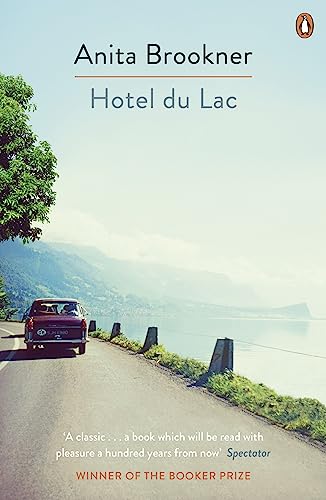
Hotel du Lac, Anita Brookner

Apparently a surprise winner of the Booker Prize back in 1984. Ballard’s Empire of the Sun (1984, UK) was the favourite, although Lodge’s Small World (1984, UK) or Barnes’s Flaubert’s Parrot (1984, UK), the only other books on the shortlist I’ve read, would have been a better winner than Hotel du Lac (1984, UK). It’s not that Brookner’s novel is bad – it’s nicely written, with some sharp insights. But. It’s set at the time of writing but reads like it takes place in the 1950s or 1960s. It’s horribly old-fashioned.

Edith Hope is a single woman in her late thirties, who writes “women’s fiction” under a pseudonym, reasonably successfully. She has a lover, a married man, and lives alone. She accepts an offer of marriage from a man, but jilts him at the altar (well, outside the registry office). Her friends, upset with her, arrange for her to spend a week or two at the titular hotel in Switzerland. It’s the end of the season, and there are only a handful of other guests: Mrs Pusey and her daughter, Jennifer; La Comtesse de Bonneuil, a caricature of a early twentieth-century European grandmother, and Monica, an anorexic (although this is never said) and beautiful minor aristocrat. A group of men stay at the hotel, among them Mr Neville, the well-off owner of an electronics company, in his fifties, smug and successful. He later proposes to Edith – marriage, but a partnership predicated on comfort and position, not love.

Throughout her stay, Edith writes long letters to her lover back in London, but does not send them. Various little scenes are enacted, Edith learns more about her fellow guests, their back-stories and their personalities. Mrs Pusey is quickly revealed as selfish and mistaken in her level of consequence. Her daughter, who is the same age as Edith, is little more than an accessory. Monica is a snob and dismissive, but surprisingly friendly. Madam de Bonneuil is deaf and a figure of (gentle) fun.

It’s all very smooth, and Edith is an engaging, if overly introspective, protagonist. But it’s all so horribly outdated. Neville takes Edith on a boat-trip across the lake, and wears a deerstalker hat. In 1984? Seriously? Edith wears gloves to her aborted wedding. Women rarely wore gloves to church – or registry offices – in the 1970s, never mind the 1980s. The women are dismissive of feminism, and define themselves in relation to the men in their lives, or who were once in their lives, or all men in general. This is not the early 1980s I remember.

If Hotel du Lac had been written and presented as historical fiction, it might have read better. Having said that, even then it wouldn’t have deserved to win the Booker.