It Doesn't Have To Be Right…

… it just has to sound plausible


Leave a comment

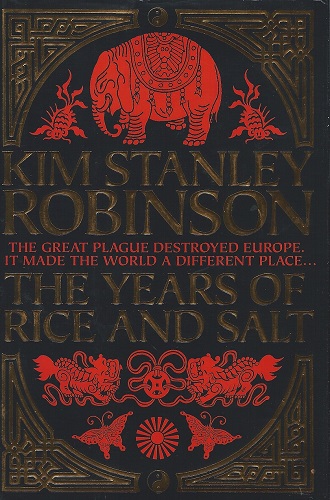
The Years of Rice and Salt, Kim Stanley Robinson

I’m a big fan of KSR’s fiction, because of the subjects he tackles and his treatment of them just as much as the stories he tells. He doesn’t just make use of common sf tropes, he interrogates them. A lot more sf authors should do that.

The Years of Rice and Salt (2002, USA) may be an alternate history, but it’s not a story set in a world which differs from ours due to some change in the past; it is in fact several stories – ten of them. Nor is it the book promised by its back-cover blurb, which posits a story set in a present-day world in which the Black Death in the fourteenth century killed 99% of the population of Europe instead of one-third. As a result, other civilisations flourished. Obviously, they flourished in real history – but in KSR’s novel they ended up dominating the world. The Years of Rice and Salt is not that either. It’s not a history of the world following on from the jonbar point. Which I suppose would be almost impossible – and huge! – to write. Like Laurent Binet’s Civilizations (2019, France), it is a series of vignettes which skip forward through the centuries, and around the world, from the Black Death to the present day. 

The linking conceit is that there is a group of people, connected eternally as a “jati”, who are repeatedly reincarnated. They die, spend time in the bardo, and are then reincarnated – as humans, or as animals. Allowing KSR to provide a focus point from which to hang to ten different stories taking place over the centuries in his alternate history. Sometimes the members of the jati remember their earlier lives, but usually they don’t.

The Black Death wipes out Europe. The Islamic Empire is never dislodged from the Iberian Peninsula. The Chinese continue to war on their western border, but also explore east and eventually settle the western coast of North America. A progressive empire develops in southern India. A league of Native American nations in central North America form a federation and keep their independence. There is a decades-long war which involves all three of the major world powers – the Indian empire, the Islamic empire, and the Chinese empire. Once the dust has settled, a new world order prevails. The various members of the jati are present, or pivotal, in some of the more important events in this 700 year history. Which also take place all over the world – Samarkand, Beijing, the Great Lakes, an Islamic city in western France, a Chinese San Francisco, and so on…

It’s fascinating stuff. The linking text is, to be honest, a not especially interesting mechanism to give the novel structure, and the ten “books” in The Years of Rice and Salt would be equally engrossing without them. KSR’s research is impressive – but not perfect: at one point, he states the Islamic punishment of cutting off the right hand of criminals is worsened because it forces criminals to use their left “unclean” hand when eating. That’s the whole point of the punishment. But the invented history KSR has created is astonishing. It feels all too real, which I guess is the point of the novel. Recommended.


2 Comments

The Apollo Quartet that never was

The Apollo Quartet is hard sf, but it’s also alternate history. And the books of the quartet themselves have their own alternate history too. They say a plan never survives contact with the enemy and, in pretty much the same way, a synopsis never survives unscathed once you actually get into writing a novel, novella or story.

I can’t remember at what point in the writing of Adrift on the Sea of Rains I decided it would be the first of the quartet… but once I’d made the decision I obviously needed to come up with three more stories. I had one sitting in my “ideas book” (actually, it’s just a Google doc) that I thought would be suitable. It was only when I started writing the second book of the quartet that I realised it didn’t quite fit. So I kept one narrative thread, left the other as implied, added a new narrative about the mission to Mars, set the story decades earlier… and changed the title to The Eye With Which The Universe Beholds Itself.

The original Apollo Quartet 3 and 4 bear no resemblance to the ones that have been/will be published. The original synopsis for Apollo Quartet 3 just simply didn’t fit in with how the quartet was shaping up. And I’d decided I really wanted to write about the Mercury 13 and the bathyscaphe Trieste. So I did.

With the Mercury 13 as the subject of Then Will The Great Ocean Wash Deep Above, another theme was rising to the forefront of the four novellas… and so I needed a new story for the final book. I’d already “borrowed” the title of my favourite film, but the link to Sirk’s masterpiece was too thin. That wasn’t going to work. But with a little sleight of hand, I had myself a new plot which provided a suitable end to the quartet, and then the title – with a little tweaking – would suit it perfectly. Instead of an Avro engineer, my protagonist would be an astronaut’s wife. And rather than just a fan of science fiction, she’d be a writer…

So here, for your delight and delectation, are the original synopses for Apollo Quartets 2 to 4, which I recently discovered in a Google doc created back in September 2011.

2. Wave Fronts The Earth has a single interstellar colony – administered by NASA, ESA and JASA – on SuperEarth2 at Gleise 581, twenty light years from Earth, and which has been in existence for twenty years. By now radio waves from the colony should have reached Earth, but there has been nothing. So Shepard has been sent to find out what’s happened. He travels to Gleise 581 by bubble-ship, and when he arrives at SuperEarth2, he discovers that the colony has completely vanished. Using one of the bubble-ship’s re-entry capsules, he lands on the surface and treks across the land to the settlement’s location. But it is as if it had never existed. And now he stuck there as there is no way for him to get into orbit. A second narrative depicts the dismantling of a colony and its preparations to leave its world before the light front reaches Earth. The colonists move onto another planetary system… where they meet an alien race, engaged in the same method of colonisation as themselves.

3. The Shores of Earth Earth is now home only to the empress of the Healing Empire, her family and staff, who all live in a vast palace. The rest of humanity lives off-Earth, scattered throughout the Solar System. The protagonist travels to Earth and lands in capsule which can reconfigure itself into lifting-body/glider. He is immediately arrested by the empress’s personal guard, and subsequently interrogated by a captain of the guard. The protagonist has come to report the arrival of a vessel from an interstellar colony populated centuries before by a generation ship, but its arrival is too soon – there’s not been enough time to get to the exoplanet, and then build the necessary infrastructure to send the ship back. Perhaps the visiting ship is alien? Except no evidence of aliens has ever been found…

4. All That The Stars Allow It is the late 1950s, and a British electronics engineer is offered a job in Houston with NASA, which entails moving from his current job in Canada where he works for Avro. (A lot of Mission Control was designed and built by British engineers, many of which had previously worked for Avro in Canada.) He packs up and drives south, anticipating the future of manned spaceflight given what he knows of NASA’s plans. The engineer is an avid reader of science fiction, and the second narrative is the text of a story of the period of an engineer in a future in which humanity has colonised the Solar System.

Perhaps one day these stories may appear, no doubt in somewhat changed form. But when all’s said and done, I think the Apollo Quartet as it now exists is a much better piece of work than it would have been had I used the above plots.