It Doesn't Have To Be Right…

… it just has to sound plausible


1 Comment

Moving pictures, #12

Time to catch up on films again…
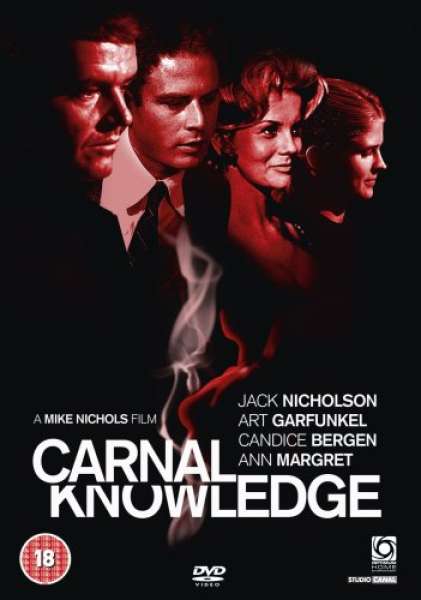
carnalCarnal Knowledge, Mike Nichols (1971, USA). According to imdb.com, this is a sexual satire but I couldn’t see much that was satirical in a film that unironically treats women like objects. At one point, Jack Nicholson even gives a slide show of his girlfriends, giving a running commentary on each woman’s appearance and sexual prowess. You see Nicholson and Art Garfunkel were at college together, and they both fell in love with Candice Bergen, but Nicholson ended up marrying Ann-Margret… and years later both men treat the women in their lives like shit, and I seriously have to wonder why this is classified as entertainment. There are a lot of classic films that have never been released on DVD, there are a lot of foreign films that have never been released in English-language editions on DVD… So you have to wonder why they bothered to waste non-biodegradable plastic on crap like Carnal Knowledge.
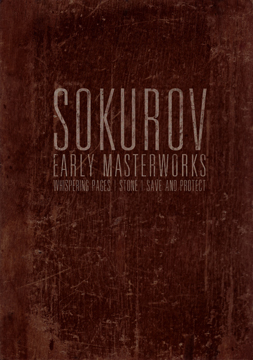
sokurov_earlyWhispering Pages, Aleksandr Sokurov (1994, Russia). And speaking of foreign languages films not release in– ah wait, I’ve said this before about Sokurov. Whispering Pages is only available as part of a US-only release, Early Masterworks, on Blu-ray and DVD. The films opens with a distorted image of a riverside block of flats in St Petersburg, before eventually focusing on a series of pillars which distortion have rendered almost two-dimensional, and then a man sitting on some steps at the side of the river. He wanders through a series of buildings, a sort of enclosed city, on some sort of quest. I’ve watched the film three times now I’m no clearer as to what’s going on. I’m guessing it’s Limbo or Purgatory, existence as a struggle with some lesson to be learnt, but Sokurov is so allusive and the references so opaque – according to The Cinema of Alexander Sokurov: Figures of Paradox, the film borrows from both Dostoevsky and Gogol, the works of neither of whom I’m familiar with (although I should be grateful for small mercies in that I didn’t wake up the morning after watching the film and learn I’d ordered their books from Amazon…). But all this, of course, is part of the appeal. The film defies easy understanding, and the beauty and strangeness of the cinematography – it’s weird shifts from sepia-tinted to washed out blues and greys to black and white – sucks you into a world in which there is clearly a pattern but it requires work to discern. I will be watching this again; eventually, I will figure out what it’s about.
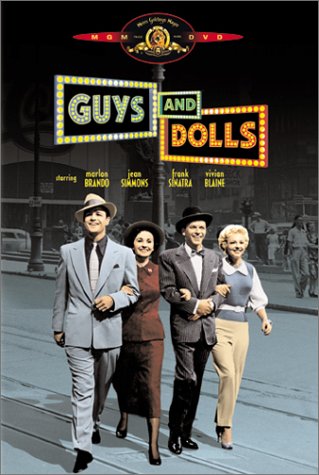
guysanddollsGuys and Dolls*, Joseph L Mankiewicz (1955, USA). If I added up all my pet hates, I’d have a respectable zoo. Well, a small petting one. Probably full of hamsters. And maybe a goat or two. But one of my pet hates is surely that stupid formalised language like that what is used by the writer Damon Runyan in the speech of his gangster characters in the stories that he wrote. Which is what’s used in Guys and Dolls – likely because the stage show, and so the film, were both based on a pair of stories by Runyan. As it is, Sinatra seems peculiarly charisma-free, Marlon Brando is actually less annoying than usual (although not at first), and Jean Simmons provides a surprisingly common-sensical romantic lead. I didn’t think the songs especially memorable, although one or two of the set-pieces were amusingly done. I am not, it has to be admitted, a fan of musical films, and though I have watched many of them – for reasons I have yet to figure out – I thought this one middling at best.
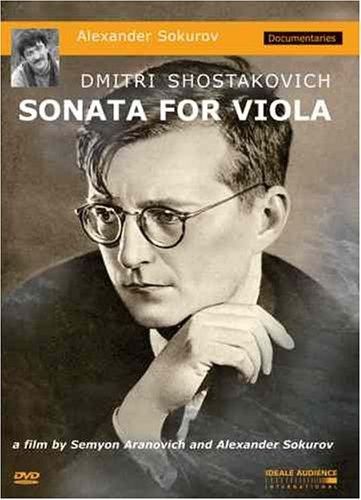
sonataviolaSonata For Viola, Aleksandr Sokurov (1981, Russia). And here’s another film that features music, that is actually about music – or rather, a composer. I know very little about classical music, it just isn’t my thing; so the appeal here is likely to be limited. And so it proves. Sokurov puts together a documentary on Dmitri Shostakovich based on archive footage. It’s an early work, so the voice-over tends to be more factual and less philosophical than later documentaries; and while it does a good job of laying out Shostakovich’s life, and setting it in context, it’s not likely to attract viewers unless they’re interested in the topic or the director. One for the collection, without a doubt. But no, not a favourite in Sokurov’s oeuvre.
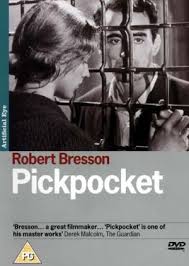
pickpocketPickpocket*, Robert Bresson (1959, France). Bresson is a highly regarded director, and several of his films appear on various lists of great or top 100 or films to see before you die lists. Which is why I’ve seen several… despite not actually taking to any of them. Such as Pickpocket. Non-professional actor Martin LaSalle plays a young man who drifts into thievery, initially for kicks but later as a means to make a living. He meets various other pickpockets and thieves, learns the tricks of the trade, has metaphysical discussions with assorted people, finds himself in a battle of wits with a police inspector… but it’s all played so flat, so affect-less, that’s it’s hard to give much of a shit. LaSalle is a cipher, the remainder of the cast are mouth-pieces, and the story’s only saving grace is its irony. But for irony to really bite, you have to care about its victims. And Bresson does a piss-poor job of making LaSalle, or indeed anyone in the film, sympathetic. He can do it for a donkey, but apparently not for a criminal. Disappointing.

shock_aweNymphomaniac, Volume I and II, Lars von Trier (2013, Denmark). I remember seeing posters for this all over Copenhagen when I was there for Christmas in 2013. And since catching a film at the cinema is an sort on-and-off family tradition over the holiday, I did briefly consider this as a possible contender… But it’s 241 minutes long in total, and I suspected it wasn’t really suitable family viewing… Both facts I can now confirm, having watched it on Blu-ray – although I saw the version bundled in the Shock & Awe von Trier box set, which is not the 325 minute director’s cut. So beware. Stellan Skarsgård finds a badly-beaten Charlotte Gainsbourg one night, takes her home and sees to her injuries. Once recovered, she explains she is a nymphomaniac and tells him her life-story – which is shown in flashback, with Stacy Martin playing the young Gainsbourg. It begins with teenage sexual games, moves onto unhealthy relationships, and finally a marriage which slowly disintegrates, in part because Martin is now visiting sadist Jamie Bell on a regular basis. Skarsgård tries to explain Gainsbourg’s stories by relating them to fly-fishing, as he later admits to having never experienced sex himself. Both parts of Nymphomaniac are pretty much typical von Trier, that unhappy mix of beautiful cinematography, keen observation of the banal, and an almost schoolboyish desire to shock. He also does that thing where a line of genuine insight is often followed by a banal cliché – because he’s at his best when he’s observing and at his worst when he fails to resist the temptation to let his story jump the rails. I still think von Trier is an important director, and the Shock & Awe box set was certainly worth purchasing… but of the von Trier films I’ve seen so far I think Antichrist is the best in this collection – it’s the most emblematic of his later work, not to mention the least misogynistic. It often feels as though von Trier considers himself the enfant terrible of cinema – and tries just a little bit too hard to live up to the label.

1001 Movies You Must See Before You Die count: 589

Leave a comment

Moving pictures, #11

I seem to have gone on a bit of a Russian film binge in this one – a Sokurov box set I’d ordered arrived, and I decided I’d better finish off the Eisenstein box set.

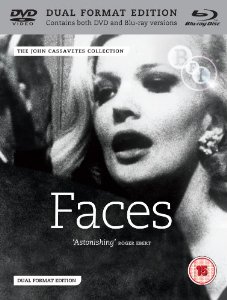
facesFaces*, John Cassavetes (1968, USA). I think this is the second Cassavetes films I’ve seen, it would appear he’s one of those highly-praised US independent directors, like Hal Hartley, whose appeal completely passes me by. Faces is shot in black and white, in a cinéma verité style, and seems to consist chiefly of a group of small people at various times, whose constituents change, being drunk and either talking crap, larking about or treating women badly. Buried somewhere among these scenes is a narrative, which apparently describes the slow disintegration of a marriage. But, to be honest, I didn’t much care. Most of the cast were pretty reprehensible, and their drunken boasting was hardly edifying or particularly entertaining. I’m afraid the high regard in which Faces is held is completely beyond me.

elegylandMaria, Aleksandr Sokurov (1978 to 1988, Russia). Sokurov’s films are not easy to find, and many of them have yet to be released on DVD. Elegy of the Land, on which this film appears, is fortunately relatively easy to find. Sokurov began his career making television documentaries, often from found footage, but Maria is original footage about the eponymous farmer, first filmed in 1978, and then added to ten years later. It’s a propaganda piece, but it’s also typically Sokurovian, although some of the cinematography is not as sophisticated as that displayed in later films. There are, for example, no distortions of the image, as used in later films, and the narrative is relatively straightforward. The film is also vibrantly-coloured – albeit only in the first half, the 1978 segment which last some 18 minutes and 30 seconds. The only dialogue is that spoken by the women farmers (only one or two men actually appear in this part of the film). Ten years later, Sokurov returned to film Maria, opening this half of the film with a typically Sokurovian long take shot from a vehicle driving along a road. The inhabitants of Maria’s village are invited to a showing of the first half of the film, and Sokurov films them (in black and white), and provides a voice-over. Maria dies, and he takes stills of the funeral, while commenting on her career and what she represented to those who knew and loved her. Maria is an odd piece – those first 18½ minutes seem very typical of Soviet propaganda – a colourful cinematographic essay on Soviet agriculture, although without the usual self-aggrandizing commentary. But the second half of the film is much more like one of Sokurov’s elegies, a meditation on its subject visualised using a variety of cinematic techniques. The more Sokurov I watch, the more he climbs in my estimation.

sokurov_earlyStone, Aleksandr Sokurov (1992, Russia). This is available on the Early Masterworks box set, which has only a US release (and includes a Region A Blu-ray), so it’s a little harder to find. But it’s worth taking the trouble to track down a copy. And I say that having now seen Stone three times and still being no wiser as to what it is actually about. In fact, the second time I watched it was after spending the afternoon on a bit of a pub crawl, so I fell asleep about ten minutes in. I then decided to rewatch it straight away, while reading the essay on the film in The Cinema of Alexander Sokurov: Figures of Paradox… And the following morning I discovered I’d ordered two paperbacks by Anton Chekhov from Amazon… But then I find Sokurov’s films – both fiction and documentary – endlessly fascinating not only because he distorts his cinematography to generate a specific visual look and feel – something I would like to be able to do in fiction – but also because he builds his narratives from allusion, metaphor and references, and there is so much going on in his films that every other director’s oeuvre seems almost juvenile by comparison. As far as I can determine, Stone is about Chekhov, returning to his house after his death, I think – but it shares a look and feel, and a thematic similarity with my favourite Sokurov film The Second Circle, although in this one the picture is distorted rather than just filtered. It’s another film with those long takes which suck you in, until you find yourself focusing on every aspect of the film with a degree of concentration it’s impossible to give to a nanosecond jump-cut Hollywood tentpole blockbuster…

dersuDersu Uzala*, Akira Kurosawa (1975, Japan/USSR). This is the first film Kurosawa made after attempting suicide following the commercial and critical failure of Dodes’kaden, and apparently he had known of the book of the same title by Vladimir Arsenyev since the 1930s. Whatever the provenance, I have to admit this is the Kurosawa film I’ve enjoyed and admired the most – but how much of that is due to my favouring of Russian cinema over Japanese? The title character is a hunter of the Goldi (Nanai), one of the Tungusic peoples of the Russian Far East, who Arsenyev runs into while on an army expedition to survey the Sikhote-Alin region. Uzala is a wily old man of the woods, and though the Russian soldiers initially consider him a primitive, he quickly earns their respect. So far so good. Kurosawa handles his wilderness filming with his usual excellence, and makes particular use of his fondness for placing the camera at odd angles. There is a weird spiritual interlude, which feels like pure Kurosawa, but which I felt didn’t quite gel with the other parts of the film. And then there’s the bit where Arsenyev attempts to “tame the savage” by offering Uzala his home when the hunter finds he can no longer live in the wilds as he once did. But he soon begins to long for his previous life. I thought Dersu Uzala very good – and while I may be starting to appreciate Kurosawa’s films more, I suspect it’s the story which is responsible for my liking it so much.

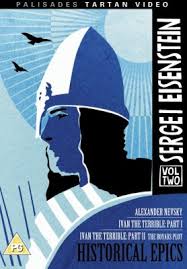
esisensteinIvan the Terrible, part 1*, Sergei Eisenstein (1944, USSR). No, I don’t understand why the first part of this is on the 1001 Movies You Must See Before You Die list, but the second isn’t. Especially since I preferred part 2 to part 1. The film tells the story of, er, Tsar Ivan IV, who ruled all the Russias from 1547 until his death in 1584. It’s all very in your face, with much gurning, and some quite fantastic costumes. In many respects, it feels and looks like Eisenstein’s Alexander Nevsky, although some 300 years separates the two films (their subjects, not their filming). This first part deals with Ivan’s ascension to the throne, with much politcking from the boyars, many of whom had their own candidates for tsar. Then there’s a mob scene – Eisenstein likes his mob scenes – and there’s also his marriage to Anastasia Romanovna, which doesn’t go all that well… The spectacle and melodrama tend to overwhelm the story, and disguise the fact Ivan the Terrible was a pretty fascinating historical figure – this is in many respects  an historical biopic turned up to 11.

esisensteinIvan the Terrible, part 2, Sergei Eisenstein (1958, USSR). Apparently, Stalin banned this part, which is why it didn’t appear until fourteen years after the first. It was also filmed partly in colour, unlike the black and white of part 1. And I found myself enjoying it more. Again, you have those fantastic costumes, and a lot of scenes set in Ivan’s throne room. And in some of those scenes, a dance springs to mind especially, Eisenstein actually turns it up to twelve – which is quite an achievement.  In other words, this film is more of the same, with the emphasis on more. Incidentally, I’m still a little annoyed I’ve yet to find a copy of Tartan’s Sergei Eisenstein Collection Volume 1 (containing Strike, Battleship Potemkin and October) for a reasonable price… although I see the Sergei Eisenstein Collection Volume 2 is now going for silly money… so I’m glad I bought my copy when I did.

1001 Movies You Must See Before You Die count: 587


3 Comments

Moving pictures, #10

I think I maintain a good spread of films in my viewing – current movies, classic movies and art house movies. Working my way through the 1001 Movies You Must See Before You Die list has introduced me to some good films I might otherwise have never seen, as well as some right crap I’d have been better off avoiding. Either way, I recommend using the list to supplement your own viewing. However, one thing has been readily apparent over the past few years, and it’s that I find current Hollywood product less and less appealing. I used to watch US films, as most people do, it was pretty much all I knew. But movies from other countries do exist, other nations do have cinematic traditions… and many of them are, well, actually much better than Hollywood. You can’t call yourself a film fan if you only watch Hollywood films. That’s like describing yourself as a gourmet despite only eating burgers.

So here is some haute cuisine (with a little fastfood thrown in):

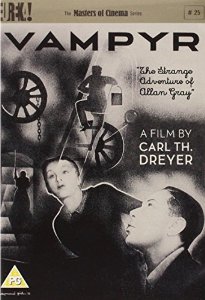
vampyrVampyr*, Carl Theodor Dreyer (1932, Germany). Subtitled “The Strange Adventure of Allan Gray”. This eureka! edition is actually the German print, although, as was common at the time, multiple language versions were filmed – in this case, German, French and English. Gray is a somewhat saturnine-looking young man, who visits the village of Courtempierre and rents a room at the local inn. Vampyr uses both intertitles and spoken dialogue to tell its story – which in terms of vampire mythology is relatively straightforward. The lord of the manor’s oldest daughter is ill, and it transpires it’s from the bite of a vampire. Gray tries to help, gets sucked into events as they unfold… but it all ends well. Dreyer is especially good on atmosphere in this, and even though the pace is somewhat slow he manages to lay it on thick. The ending, in which the vampire’s servant is drowned in flour, is also pretty effective. On balance, I much prefer Dreyer’s later work – his three Danish films are superb – but this one, on the cusp of his early German silent work and later Danish films with sound, is still very good.

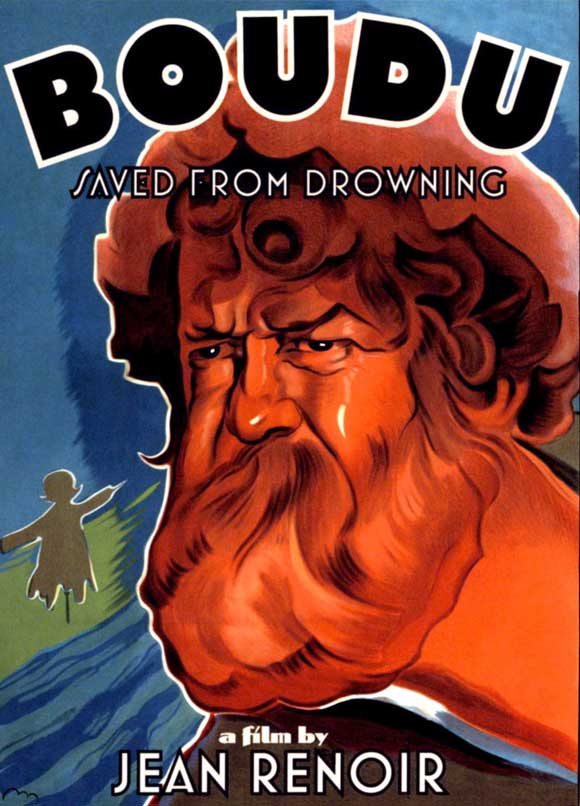
Boudu-PosterBoudu Saved From Drowning*, Jean Renoir (1932, France). There are films which clearly belong on the 1001 Movies You Must See Before You Die list, but there are also other movies on there, by directors of films which deservedly belong on the list, whose presence is, quite frankly, a bit of a puzzle. La Règle du jeu and La Grande illusion are stone-cold classic movies… but Boudu Saved From Drowning? Really? It’s mildly amusing, and even though the social commentary is biting, it’s still somewhat obvious. Technically, it’s clearly ahead of its time – at no point while watching it does it seem like a film made in 1932. But its story of a tramp rescued from, er, drowning, who his saviours then try to turn into a useful member of society, is a little too broadly comical to be pointed – if that’s not a contradiction. It didn’t help that Boudu with a beard bore an uncanny resemblance to Stephen Fry. Whatever – a diverting film even if not one that clearly belonged on the list.

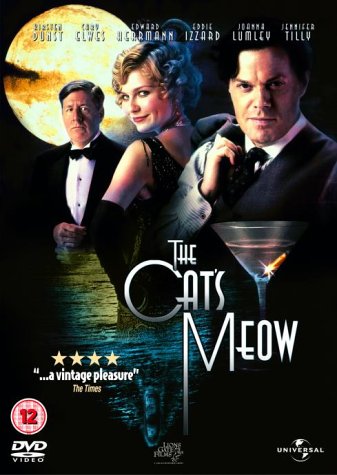
catsmeowThe Cat’s Meow, Peter Bogdanovich (2001, USA). This is apparently based on a true story. In 1924, a group of people spent the weekend aboard William Randolph Hearst’s luxury yacht, ostensibly to celebrate the birthday of Thomas H Ince, a cinema pioneer who owned one of the first movie studios. Other guests included Charlie Chaplin, gossip columnist Louella Parsons, writer Elinor Glyn, and Hearst’s mistress, actress Marion Davies. Allegedly, Ince died of a heart attack but rumour has it he was shot by Hearst over Marion Davies. The film suggests his death was an accident – Hearst thought he was firing at Chaplin, who had been trying to persuade Davies to leave Hearst and marry him. The film is a well-played period piece, although Eddie Izzard as Chaplin is actually pretty bad. The story is the sort of ultra-rich privileged crap that all too often gets accepted as the natural order of things, which is just offensive bollocks. Entertaining but forgettable.

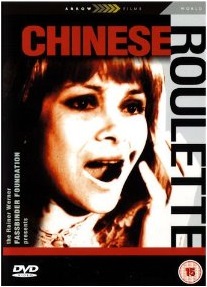
chineserouletteChinese Roulette, Rainer Werner Fassbinder (1976, Germany). Fassbinder, I think – and I say this having only seen eight of his films – did better when the plots of his films were more tightly constrained, either by their literary origin, as in Effi Briest, or the need to present an historical period, as in The Marriage Of Maria Braun, or by, as in this case, the tight focus of the story. An affluent husband and wife make arrangements for separate trips away, only to turn up together with their lovers at the family holiday home in a piece of really bad planning. But never mind, they all get along fine, and so behave as two couples – even if they’re not quite coupled as their marriage certificate defines it. At which point the crippled young daughter and her mute nanny arrive, and events take an odd turn… culminating in a parlour game among them all, in which each asks a speculative question demanding an honest answer from everyone. It’s a living-room drama, with some externally-filmed scene-setting, but it does a beautifully-paced job of setting up its situation and characters, and as a piece of writing probably betters the two Fassbinder films mentioned earlier. If the final frame of the truth or dare game feels a bit seventies television drama, with the cast walking about too much while speaking their lines, Chinese Roulette is certainly a masterclass in defining a dramatic situation. Definitely one of the good ones in the box set.

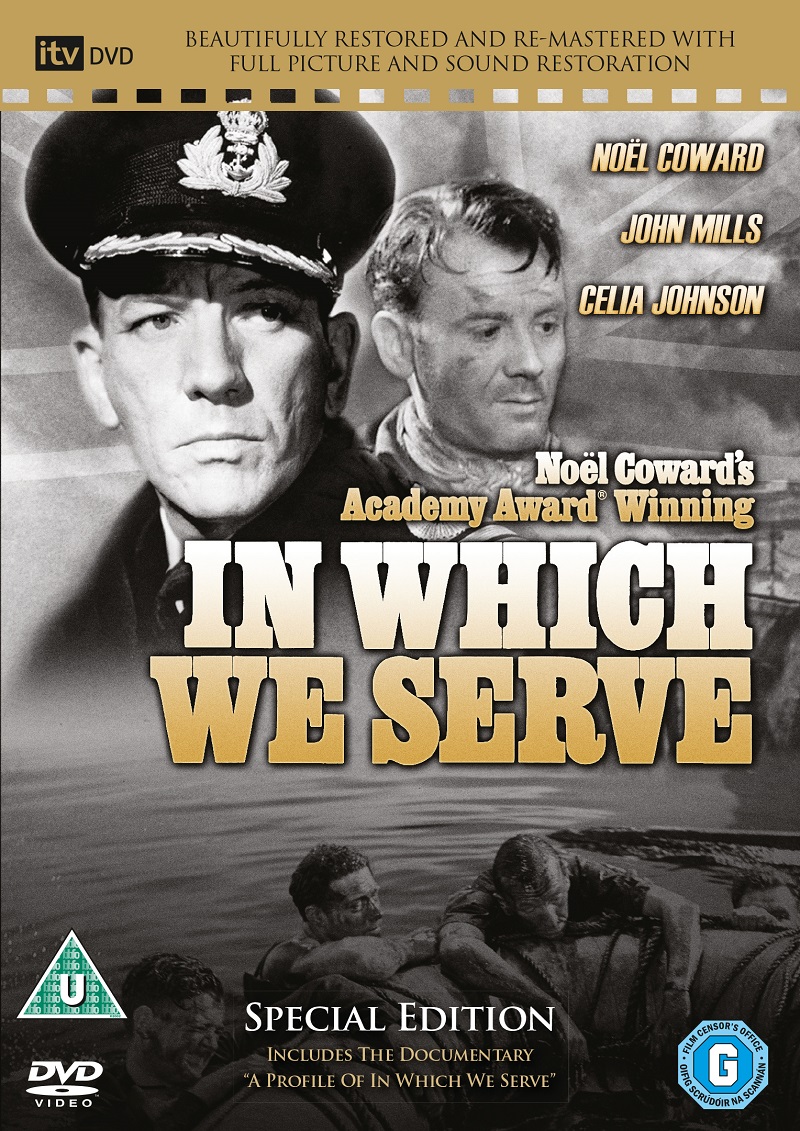
InWhichWeServeIn Which We Serve, Noël Coward and David Lean (1942, UK). Allegedly, this was based on the wartime exploits of Lord Mountbatten. Noël Coward plays the captain of a RN destroyer during the first two years of WWII. It’s careful to show life both for the ratings and the officers of the ship – the film was made with the assistance of the Ministry of Information. The model-work is a bit naff – the UK film industry never did quite manage to make model warships look like the real thing – and Coward is far too fruity to be a steadfast navy officer, no matter how plummy his background. The film is at its best when it’s belowdecks, and John Mills puts in a good turn as an ordinary seaman. But, to be honest, In Which We Serve is not even a wartime curiosity, just one in a long line of not very good war films the UK churned out during the 1940s, mostly for propaganda purposes. Not even Lean directing the “action scenes” is a saving grace (although, to be fair, I can never make up my mind about Lean – he made a handful of excellent films, but a number of very ordinary ones too). If you’re interested in UK wartime cinema, you’re probably better off checking out a few “quota quickies”.

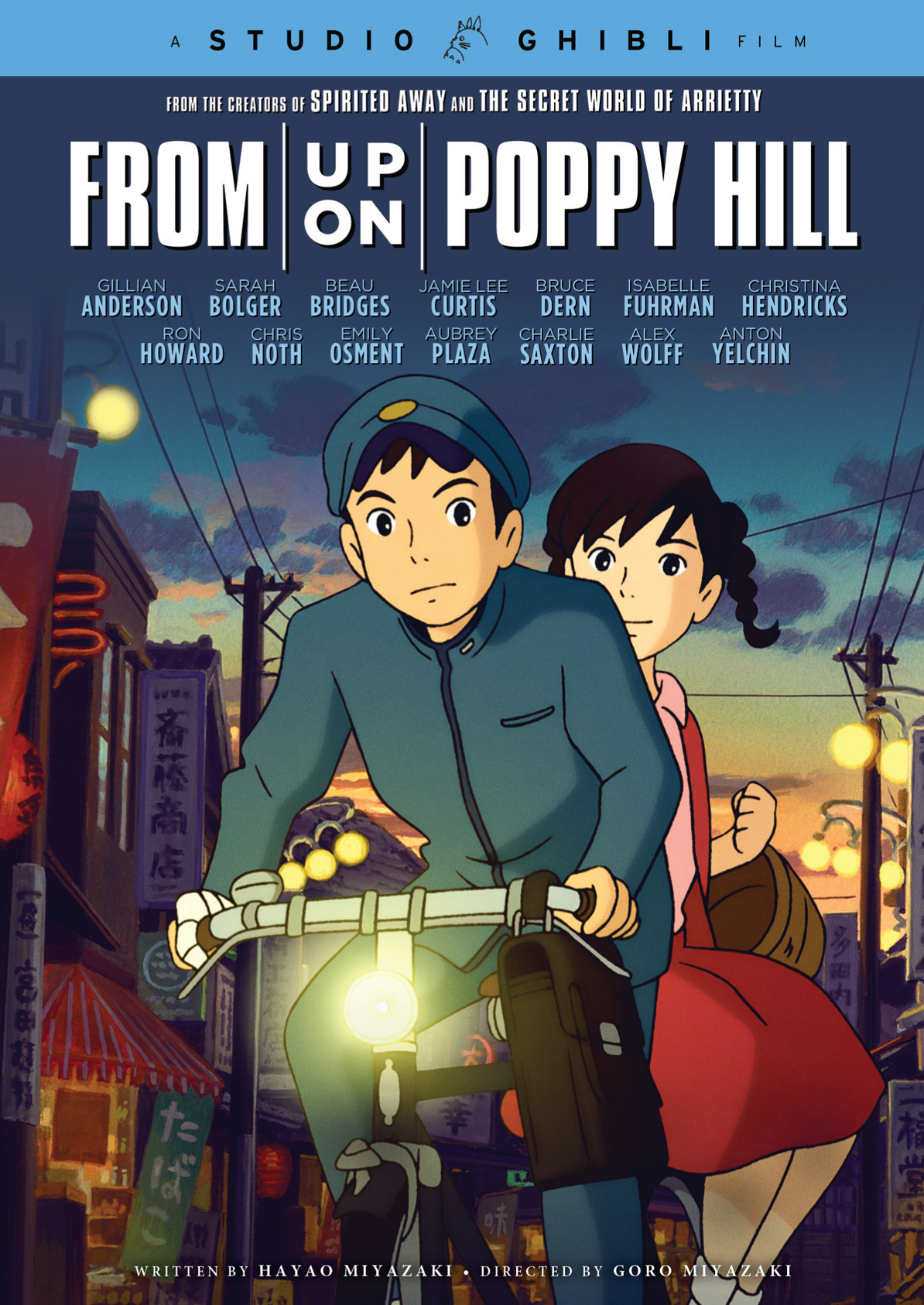
FromUpOnPoppyHillFrom Up On Poppy Hill, Goro Miyazaki (2011, Japan). I’ve enjoyed the Ghibli films the most when they are not genre – such as this one is. Er, isn’t. I mean, it’s not genre. It’s a relatively straightforward – and genre-free – story about a pair of students in early 1960s Yokohama, who are attracted to one another and then learn they may in fact be brother and sister. Wrapped around this is a student protest to prevent a building used by the various student clubs, called the Latin Quarter, from being demolished by a Tokyo businessman. From Up On Poppy Hill is at its best when it’s about the relationship between the two leads, Umi and Shun, but the comedy antics as the students clean and refurbish the Latin Quarter feel like they detract from the real story. Enjoyable, but I don’t think anyone will be calling this their favourite from Studio Ghibli.

edgeoftomorrowEdge of Tomorrow, Doug Liman (2014, USA). Confused. I saw this film advertised on theatrical release as Edge of Tomorrow, but it seems to have been retitled Live Die Repeat for the sell-through (which is the name of the Japanese source text), so obviously it’s such a good film it can’t even decide what its title is. And, okay, perhaps it was a little facile to describe it as Groundhog Day meets Starship Troopers, but that’s pretty much the plot in a nutshell. Nasty aliens invade Earth, obviously the only way to defeat them is to throw human cannon fodder at them, although strangely enough this strategy doesn’t appear to be working. As Tom Cruise repeatedly discovers because he keeps on waking up back on his first day of basic training (although no training actually takes place) and all because he was covered in a particular type of alien’s blood on the battlefield. But that’s okay, since it allows him to figure out there is a hidden mega-alien thing somewhere running the whole show and if he kills that then humanity wins – stop me if you’ve heard this before. Oh, you have? Lots of times? Seriously, if Edge of Tomorrow is being held up as a good sf film, then that says a lot about the piss-poor state of sf cinema – oh, wait, Interstellar was supposed to be the best sf film of last year, so yes, it looks like sf cinema is in a piss-poor state…

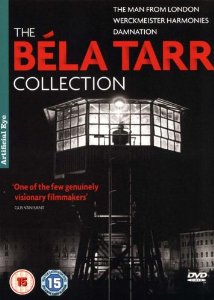
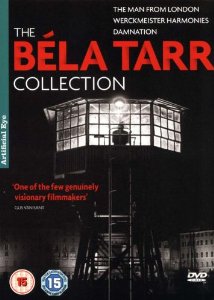
bela_tarr_collectionDamnation, Béla Tarr (1988, Hungary). I think I’m going to have to withhold judgement on Tarr’s films for now. I’ve now seen all three in the pictured box set – and while Tarr is noted for the glacial pace of his movies, and I actually like films that take time to tell their stories, I’ve not yet plugged into Tarr’s languorous way of movie-making. Damnation is, I suppose, the most straightforward of the three films, but there are long stretches where no one speaks, there is only music… And then characters speak dialogue that feels more like it should be… declaimed, like in a Jancsó film. Their naturalistic speech is… odd, perhaps even a little off-putting. Having grown up reading science fiction, I’m all too familiar with mouthpiece characters – but where Jancsó’s are overt, Tarr appears to sneak his into the story in the guise of ordinary people engaged in ordinary activities. Tarr’s films will not only bear rewatching, I strongly suspect they demand it. Meanwhile, I shall sort of hover on the edge of liking and admiring them.

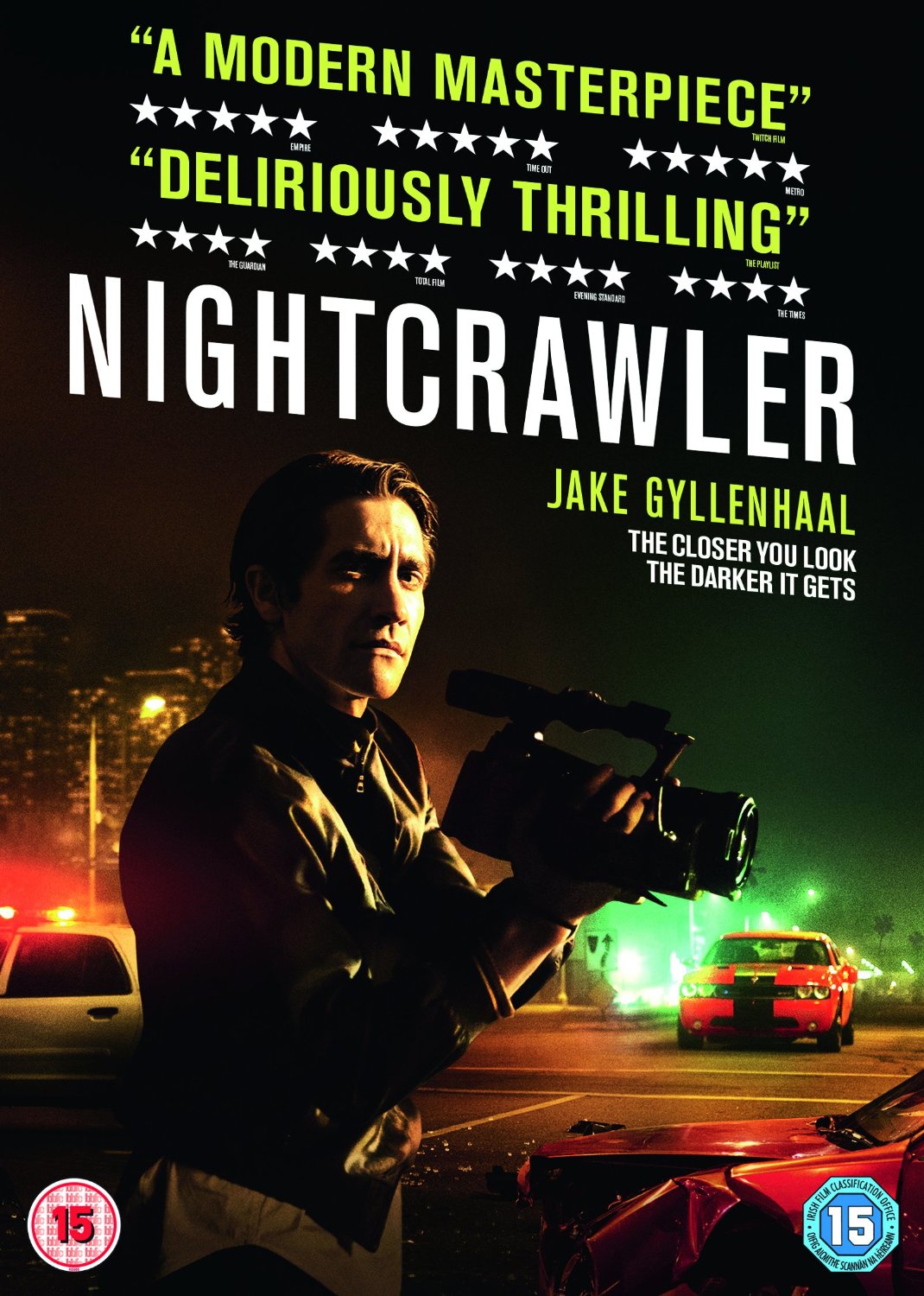
nightcrawlerNightcrawler, Dan Gilroy (2014, USA). Watching this film prompted an interesting discussion on Twitter. Since thrillers depend upon violence and fear to drive their plots and maintain viewer interest, I suggested they were morally bankrupt, if not morally corrupt. In order to generate “story”, they over-state the incidence of violence and harm in the real world. And while the protagonist of Nightcrawler – played by a frankly creepy Jake Gyllenhall – does cover road traffic accidents, it’s his relationship with violent crime which comprises the plot of the film. He’s a freelance cameraman – or rather, he starts on a career as one after witnessing Bill Paxton at work – who forms a business, and increasingly poisonous and misogynistic, relationship with news channel producer Rene Russo. When Gyllenhall gets too close to his subjects, and starts crossing the line between reportage and incitement… it all goes horribly wrong. Yawn. This sort of moral conundrum is completely banal, and has been covered repeatedly in both books and films. Perhaps Nightcrawler‘s take on it rings a few trivial changes, but all we’ve really got here is a creepy update of His Girl Friday. Without the wit.

spiritualvoicesSpiritual Voices, Aleksandr Sokurov (1995, Russia). I have no idea how to write about this. I was lucky enough to find a copy on eBay going for a reasonable price – it typically goes for $95 or more, but at 327 minutes split over five episodes, I suppose that’s not bad value for money (I paid less than half that). Spiritual Voices is a documentary filmed at a Russian army dugout in northern Afghanistan – but its opening episode consists of forty minutes of time-lapse photography of a village in Siberia, as night falls and dawn breaks, while Sokurov talks about Mozart and then Beethoven. The second, and following, episodes are hand-held documentary footage of Russian soldiers going about their duties night and day, sometimes interacting with the camera, but usually ignoring its presence. The soldiers, of course, are conscripts; they are also young men. And though they wear the uniform, and spend their days following orders, there is something not quite real about their situation. Sokurov also films the landscape surrounding them, and he’s extremely good at using landscape to paint a moral picture of the story he’s telling. Spiritual Voices is a long film, a very long film, and after a single viewing I’m not entirely sure what to make of it. That first episode is an amazing work of art – I’ve now watched it three times – but I’ve yet to determine how it fits in with the piece as a whole… This is just one of the reasons why I find Sokurov one of the most fascinating directors currently working, and why I’ve tracked down as much of his oeuvre on DVD I can find.

1001 Movies You Must See Before You Die count: 584


5 Comments

Moving pictures, #9

Yet more films wot I have watched of late. This brings the moving pictures posts pretty much up to date, so I won’t need to spam my blog with them quite so much from now on. Although I’m still watching rather a lot of movies, due to a lack of anything interesting on terrestrial or cable television. Perhaps I should turn the damn thing off some evenings and read a book or something…

aharddatsnightA Hard Day’s Night*, Richard Lester (1964, UK). I think I must have seen this, perhaps back in the 1970s or something, because it seems an unlikely film to have missed. Having said that, I could remember almost nothing about it – and even now, a couple of weeks after watching it, I’m having trouble recalling the actual plot. Not, it has to be said, that there was much of one. The Fab Four travel to London with Paul McCartney’s grandfather (played by Wilfred Brambell), their manager and their road manager. The band are due to perform on a television programme. It was pretty clear the cast had fun making the film, and there was definitely a manic energy to it – but Lennon’s snidery palled quite quickly, a couple of long-running jokes ran too long, and the music was, well, frankly not that great.

dulwaleDilwale Dulhania le Jayenge*, Aditya Chopra (1995, India). This one was a surprise. I’ve seen bits and pieces of Bollywood films over the years, but I don’t think I’ve sat all the way through one. Nonetheless, I thought I knew what to expect and I suspected watching this film was going to be a chore… but I really enjoyed it, it was actually really good. Wastrel son of a wealthy NRI in London decides to go Interrailing before joining the family firm. Meanwhile, eldest daughter of a hard-working NRI who manages a petrol station will soon be married to the son of her father’s best friend back in Kashmir… so she too decides to go Interrailing first. The two bump into each other as they travel about Europe, fall in love, with much singing and dancing and comedy. Afterwards, she has to go to Kashmir for the wedding, there’s no getting out of it, but he follows and tries to win over her family (the two pretend not to know each other). A smart well-made rom com, with some fun song and dance routines, a well-handled plot and a pair of likeable leads. If you fancy trying a Bollywood film, put this one at the top of your list.

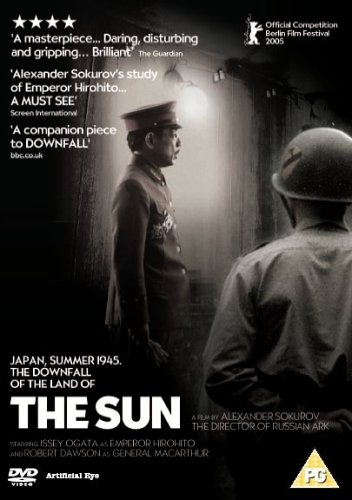
thesunThe Sun, Aleksandr Sokurov (2005, Russia). This is the second of Sokurov’s quartet of films about men in power, and the subject of it is Emperor Shōwa of Japan. (While we in the West know him as Emperor Hirohito, that was his personal name and he’s now actually referred to using his posthumous name, Shōwa.) The Sun concerns the days immediately following Japan’s surrender and the emperor’s meetings with General MacArthur. Apparently, the film caused a bit of a fuss on release, perhaps because it suggests the emperor is almost an innocent, a mild-mannered educated man who tinkers with marine biology and lives in a hermetically-sealed world in which he is considered divine by all about him. That is, until he meets MacArthur. It’s considered likely he was actually a war criminal, and very much responsible for Japan’s conduct of the war – but he seemed to escape justice. Sokurov, however, is not concerned with the truth, or as in Moloch, an historically accurate portrayal. The Imperial Palace depicted in The Sun, for example, is simply a large 1920s villa and bears no resemblance to the actual Tokyo Imperial Palace. The film depicts the emperor’s descent from divine to human – not an actual change, of course, but a matter of perception. I’m not convinced it’s as successful as Moloch, perhaps because it follows a more considered approach, which tends to flatten the story’s affect, whereas Moloch‘s manic infantilism suited its topic perfectly. I still want to know why Taurus isn’t available in an English-language edition, however.

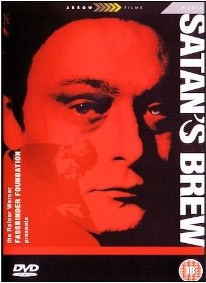
satansbrewSatan’s Brew, Rainer Werner Fassbinder (1976, Germany). Not the most successful Fassbinder film I’ve seen so far. A previously-successful poet, now suffering from writer’s block, shoots his mistress, and then sort of runs around manically, demanding sex from Ingrid Caven, who is married someone else, visiting his own wife and intellectually disabled brother? brother-in-law?, and charging around various places demanding money. The Wikipedia plot summary, which is not very long, concludes with, “Some more obscure things happen but in the end everyone is back on stage”. Which is as good a way of describing it as any. The contents of this Fassbinder box set have been somewhat variable, but I’m glad I’ve seen the films.

bela_tarr_collectionWerckmeister Harmonies, Béla Tarr (2000, Hungary). I’ve yet to decide what to make of Tarr’s films. That they’re slow, with very long takes, and filmed in stark black-and-white, and that sort of film-making appeal to me far more than the frenetic jump-cuts of your present-day Hollywood tentpole franchise movies. (But I also like Technicolor movies, too.) Tarr’s films are also allusive, which again is something I appreciate, in both film and literature. But I think what’s preventing me from really falling for this movie, or the other Tarr I have seen, The Man from London, is that there’s something very play-like about the way they’re put together. And for some reason the mismatch between theatrical presentation and cinematic technique never quite  works for me. In Werckmeister Harmonies, a travelling circus, whose chief attraction is a stuffed whale, appears in a Hungarian town, and triggers a wave of violence. I’m going to have to watch this film again, I think, as while some bits of it seemed to work really well, the allegorical skeleton on which the plot was hung didn’t articulate quite as well for me as it was likely intended to. But at least I bought the box set, so I can rewatch the films at my leisure. Incidentally, I also bought mysql a copy of Sátántangó, so I’ll be able to watch all seven hours of that at my leisure…

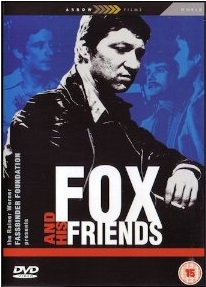
foxFox and his Friends*, Rainer Werner Fassbinder (1975, Germany). A young gay man, played by Fassbinder himself, is obsessed with winning the lottery. Which he does, shortly after entering into a relationship with an older man, an antiques dealer. When the antique dealer’s friends discover that the oick they’re looking down their nose at is worth half a million DMs, they set about swindling him out of his money, seducing him and persuading him to pay their way out of their financial difficulties. Which he happily does, wrongly impugning more than just mercenary motives to their treatment of him. Prior to receiving this Fassbinder box set for Christmas, I had never seen one of his films. And I’ve now seen seven (of the eight films in the box set), and there have been some good ones and some not so good ones. I’ve yet to decide whether I want to explore more of Fassbinder’s oeuvre – and he made a lot of films – probably because so many of the contemporary ones seem very similar in tone and presentation. Perhaps I just watched too many of his films in too short a period – like the time I watched three seasons of The X-Files back-to-back, three or four episodes a night, and could hardly sleep afterwards I felt so paranoid…

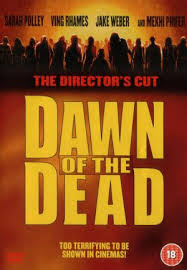
dawnofdeadDawn of the Dead*, George A Romero (1978, USA). No, I’ve never actually seen this before, and no, I probably would never have bothered if it hadn’t been on the 1001 Movies You Must See Before You Die list (and how many films on the list have I said that about?), and I’ve never been a fan of zombies, a trope that’s been used intelligently perhaps a handful of times since it first appeared. And, to be brutally honest, this isn’t one of them. Something has caused the dead of the US to rise as flesh-eating zombies – your basic zombie trope, in other words – and a group of people escape various encounters with them, including an extended sequence set in a shopping mall. The film was made of the cheap, and looks it; and the some of the special effects, while gruesome, look cheap and stagey. Apparently, I watched a director’s cut but there’s some confusion over which particular one. All I remember is that it was long, and while there was plenty of action there wasn’t much plot. I’ll admit I’m not a fan of horror films – I’m far too squeamish – and I can perhaps understand how Dawn of the Dead might be seen as a “classic”… But there wasn’t a fat lot there to appeal to me, and I’m happy to just cross it off the list.

1001 Movies You Must See Before You Die count: 582


2 Comments

Moving pictures, #7

More catching up on my viewing. Despite the death of the DVD-player, and a few hiccups from the Blu-ray player, I’ve still managed to watch around two films a night for the past few weeks. Actually, quite a few of the ones mentioned below are rewatches…

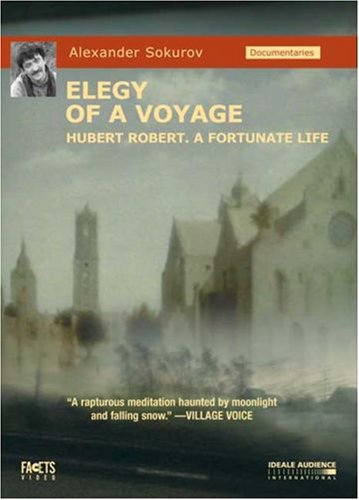
elegy_voyageElegy of a Voyage, Aleksandr Sokurov (2001, Russia). It should be obvious by now I’m a complete Sokurov fanboi, but it’s films like Elegy of a Voyage I admire most from his oeuvre. The imdb plot summary is is a model of unhelpfulness: “From a misty night into the dark exposition rooms of a museum to ponder philosophically at paintings by Pieter Jansz Saenredam, Hercules Pieterszoon Seghers, Hendrikus van de Sande Bakhuyzen, Andreas Schelfhout, Vincent van Gogh, Pieter Bruegel, Charles Henri Joseph Leickert” – and quite possibly misinformation (I also think they mean “exhibition” and not “exposition”, but never mind.) . Because while Elegy of a Voyage – a documentary, with a voice-over by Sokurov himself – does indeed describe a voyage from a Russian city to a German city and then onto a museum where, among other paintings, the narrator muses on Bruegel’s ‘The “Little” Tower of Babel’, there’s so much more to the film than that. It is, as you’d expect from Sokurov, beautifully photographed, and some of the cinematography is quite breathtaking. The voice-over is also both literate and philosophical – if watching Ingmar Bergman is like watching literary fiction adapted for the cinema, watching Sokurov is like watching the cinematic equivalent of literary fiction. I think this is another film that hovers between ten to twenty in my list of favourite films – which gives Sokurov three spots in my top twenty… And yet many of his films are still not available with English subtitles. I think the BFI should do something about that. They did an excellent job with Carl Theodor Dreyer’s films, so why not for Aleksandr Sokurov’s?

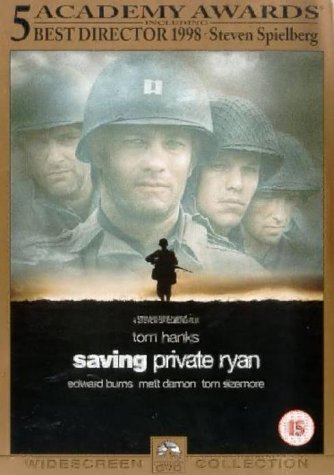
savingprivateryanSaving Private Ryan*, Steven Spielberg (1998, USA). I’d never actually seen this, and being a Spielberg film I probably would never have bothered… but it’s on the 1001 Movies You Must See Before You Die list, and it’s actually held in reasonably high regard… So when I saw a copy in a charity shop for 99p, I bought it. And, to be fair, if I were going to put together a top ten list of WWII films only – and I’m not much of a fan of WWII films – then, yes, I think I’d put Saving Private Ryan in that top ten. The opening scenes depicting the Normandy landings are worth the price of entry alone. The story which follows, in which Tom Hanks tries to find the eponymous private because his three brothers have been killed in combat (in different theatres) and he needs to be shipped home before he enjoys the same fate and leaves the Ryan family with no male heirs… is both faintly ridiculous and a bit dull. Worse than that, however, is the film’s suggestion that WWII was fought entirely by the US. The Germans and Japanese are mentioned as the enemy, but watching this film you’d never know the Allies included a whole raft of nations beside the USA, many of which had been fighting the Nazis for several years before the Americans deigned to get involved. I firmly believe if you teach people lies, they’ll start to treat them like the truth – and Hollywood is one of the greatest liars on the planet. For all its strengths as a war film, it’s astonishing how Saving Private Ryan manages to incorporate something that might offend or upset every other nationality on the planet.

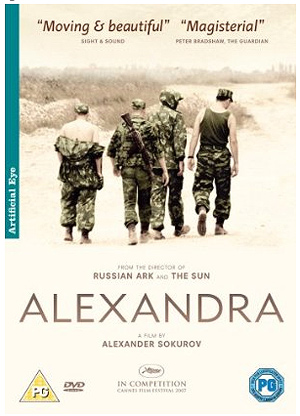
alexandra-lst062587Alexandra, Aleksandr Sokurov (2007, Russia). This was a rewatch – I think I originally watched it on a rental, but having started building up my own collection of Sokurov DVDs, I rewatched it. The title refers to the grandmother of a Russian army officer currently stationed in Chechnya. She goes to visit him, travelling by troop train, and stays in his camp. He, however, is sent away on a mission shortly after her arrival, so she has to look after herself. She wanders about the camp, making friends with the soldiers – they’re all conscripts – and even visits the local market… where she meets some of the local Chechens, and strikes up an acquaintance with a local woman of her own age. Alexandra comments on the Russian invasion of Chechnya simply by documenting it. You see the conscripts in the camp, and it’s clear they don’t really understand what they’re doing; you see the damage the war has wrought on the town. And there’s the commentary of the grandson of Alexandra, who has to maintain discipline using violence (in an incident he explains to his grandmother). Yet what Sokurov depicts is the aftermath and cost of war – the soldiers are innocents, the Chechnyans have survived in spite of the war, Alexandra’s grandson treats his military service like a job… Sokurov apparently is not a believer in plot: “If the film is based on the principle of the story, the narrative, it is not art.” This probably explains my love of his work.

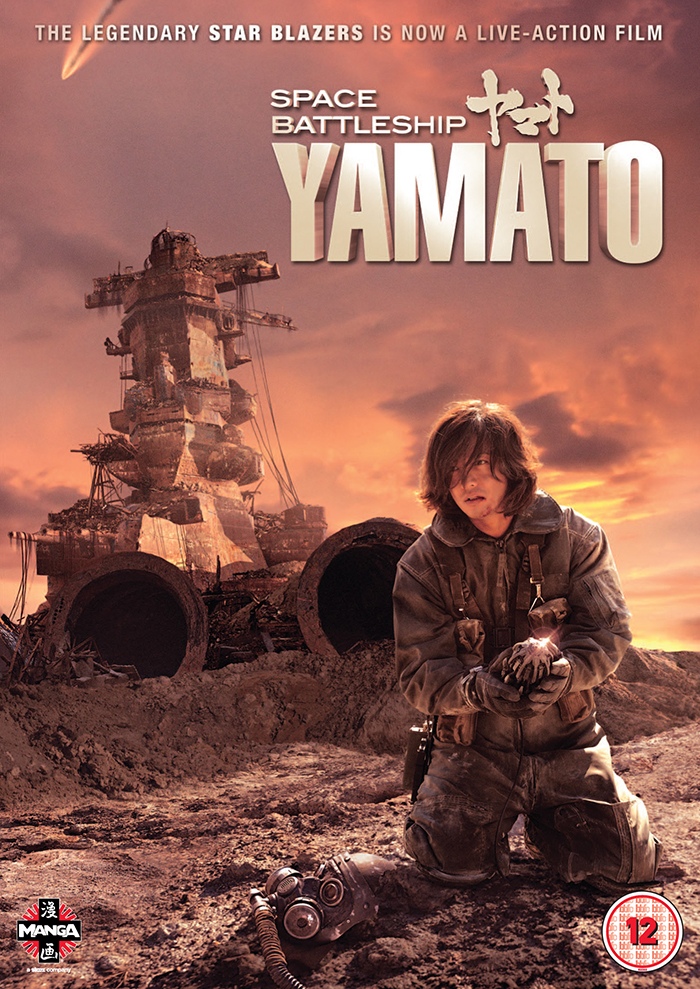
spacebattleship2dSpace Battleship Yamato, Takashi Yamazaki (2010, Japan). This is a live action version of a long-running anime property and, while I’ve been aware of the anime version, anime’s not really my thing so I’ve not made an effort to watch it. But the cover art to the live action version’s DVD sort of appealed to me (I like battleships), so I picked up a copy to watch. And… Well, it starts out like Battlestar Galactica and finishes up like Starship Troopers. The surface of the Earth has been rendered uninhabitable during a war with aliens, but when the hero stumbles across a beacon from crashed alien spaceship it proves to include blueprints for a new intergalactic drive, a powerful weapon, and a set of coordinates in another galaxy. So they fit the Yamato with the drive and a “wave gun” and send it off to the Andromeda Galaxy where, according to the beacon, there is a world which has the technology to return the Earth to its previous state, before it became a radiation-blasted wasteland. It’s not enough that the first two-thirds feel like Battlestar Galactica distilled down until it’s no more than a string of clichés, stereotypes and archetypes, the film then turns into the sort of Vietnam War in Spaaace film, with a bit of Iwo Jima thrown in, as typified by Starship Troopers and Aliens. There’s a vague hand-wave in the direction of a twist, when it transpires the good aliens are just another facet of the bad aliens… but it’s too little too late. The viewer’s brain has already been pummelled into mush by the constant battering of clichés. The CGI is very pretty, though.

52-pickup52 Pick-up, John Frankenheimer (1986, USA). A charity shop find this one, which I bought as I have soft spot for bad 1970s and early 1980s thrillers. Except this one turned out to be okay, if a little sweary and with somewhat too much gratuitous nudity. Roy Scheider plays a successful businessman – he owns a foundry which makes some special patented alloy for NASA. He has an affair, but is then blackmailed by three hooded men (the young woman proves to have been in on it). Initially, Scheider plays ball, but then he decides to get his own back on the blackmailers – he tracks them down, one by one, and confronts them. But this doesn’t go well. In that respect, the plot is almost text-book. The NASA connection adds a little flavour, and wife Ann-Margret’s incipient political career is a nice touch; but in most other respects this is a standard victim-turns-tables thriller, and Hollywood churned out an uncountable number of those during the 1970s and early 1980s. There must have been something in the water at the time…

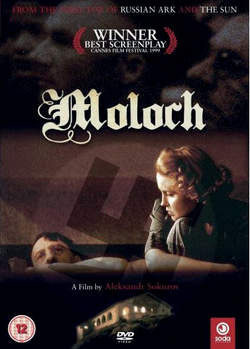
molochMoloch, Aleksandr Sokurov (1999, Russia). From what I’ve read, Sokurov’s Mother and Son (1997) was extremely well received (and it is indeed excellent), but Sokurov’s following film, Moloch, completely flummoxed his admirers. And it’s easy to see why. It’s not just that its subject is Hitler, but also its deliberate flouting of historical record. The Berghof of Moloch is not the airy Bavarian chalet of history but a Gothic mountain-top castle. But it’s the ahistoricity of Moloch which makes it more interesting. It’s not, like Downfall, an attempt at an accurate record of an incident during WWII, it’s more of an allegory told using Hitler’s relationship with Eva Braun. He visits Eva at the Berghof, with the Goebbels and Martin Borman. There are several dinners, Hitler watches some newsreels, and even pretends to conduct an orchestra shown on a film. The party go for a picnic – and here the cinematography resembles the paintings of Caspar David Friedrich and the like, and though the party act about like children – there’s a very infantile cast to much of their behaviour throughout the film – it makes for an affecting juxtaposition against the scenery. (Which is only made more so when Hitler goes for a shit among the rocks.) Moloch is plainly a more ambitious film than Mother and Son, and it has a lot more going on under the surface. The visuals are not so striking, and the casting of the Berghof as some sort of castle from a cheap horror film is initially off-putting. But as the film progresses and Sokurov’s take on Hitler is built up layer by layer, so Moloch becomes a stronger film than Mother and Son (although it is never as emotionally affecting as that earlier film). Sokurov made three movies about men and power – the first was Moloch, the third was The Sun (2004), about Emperor Hirohito. The second, Taurus (2001), was about Lenin… and it has never been made available in an edition with English subtitles. Argh.

mortal_instrumentsThe Mortal Instruments: City of Bones, Harald Zwart (2013, USA). I started watching this thinking it was Divergent, another derivative but highly successful YA property adapted for film, which explains my initial confusion, not to mention my complete puzzlement, as to why the studio would open the DVD with an extended trailer for the film of the DVD… To make it clear, there is nothing odd about opening a DVD of The Mortal Instruments: City of Bones with an extended trailer for Divergent, but there is – as I thought was the case – in opening a DVD of Divergent with an extended trailer for Divergent. Anyway, The Mortal Instruments: City of Bones… Young woman witnesses mother attacked by demon, and subsequently falls in with Goth type at some Goth type night club. This really was shite, badly acted, badly scripted, and it managed to hit every cliché in the genre, with an astonishing lack of charm. I ended up taking the piss out of the film on Twitter as I watched it because actually watching it was making my brain hurt.

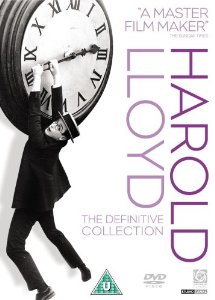
harold_lloydThe Kid Brother*, Ted Wilde (1927, USA). I’m pretty sure I’ve seen the Harold Lloyd which features that iconic image of him hanging from the clock-face – as shown on the DVD cover left – but I’ve seen nothing else by him. This one is on the 1001 Movies You Must See Before You Die list, which is why I rented it. Lloyd plays the youngest son of a sheriff, a real man’s man, with a pair of older manly brothers. Lloyd is ineffectual, clumsy, and usually gets it wrong. He’s mucking about at home and pretending to be sheriff, when a travelling fair passes by. Taken with the fair’s dancing girl, he gives them permission to set up in the town. But his father, the real sheriff, is not impressed and tells Lloyd he must go and tell the fair to pack up and leave. In the ensuing chaos, thieves from the fair steal the money the town has collected to build a dam, and which was being held for safe-keeping at the sheriff’s house. Lloyd decides to prove himself – and win the girl – by retrieving the money… It may be a pretty well-worn story, but you don’t watch Harold Lloyd for insights or human truths, you watch it for the slapstick. And there’s plenty of excellent slapstick in The Kid Brother. Worth seeing.

element_of_crimeEpidemic, Lars von Trier (1987, Denmark). The second film in the E-Trilogy set, but the last one I watched – chiefly because the plot summary didn’t much appeal. It is, like the other films in the set, somewhat experimental in form. It documents a pair of scriptwriters’ attempt to make a film titled The Policeman and the Whore (one of the scriptwriters is von Trier himself), but instead decide to write a script about an outbreak of a plague-like disease. And then real life starts to mimic their script, as people are taken ill in an actual epidemic. Then it all goes a bit weird. I’m in no doubt that von Trier is an important film-maker (strange that Denmark, such a small country, should have produced two: Dreyer and von Trier; but the UK has, er, Hitchock, the Archers*…), but I find many of his films problematic. I like the black box theatre of Dogville, but the story eventually descends into misogynism and OTT violence. Melancholia looked beautiful but was wildly implausible. Breaking the Waves only succeeded because its cast managed to make their roles seem believable. I like that von Trier pushes the boundaries of cinema, I admire him for it, and he is clearly superb technically, but I also think his choice of material never quite fits. There is, for me, something a little bit off about each of von Trier’s films, but I’ve yet to decide if that is a weakness or a strength.

1001 Movies You Must See Before You Die count: 573

* I’m being disingenous, of course. The UK has produced a number of important directors, although who would appear on that list is no doubt debatable. But given Denmark’s 5 million population, you’d expect the UK to have, proportionally, at least two dozen important directors… and I don’t think that’s the case.


1 Comment

Moving pictures, #5

And now it seems the Blu-ray player is starting to act up. Bugger. Annoyingly, I recently discovered it’s also region-locked for DVDs, although I was sure it was region-free when I bought it. I definitely need to get myself a new one – region-free for both formats. Sigh.

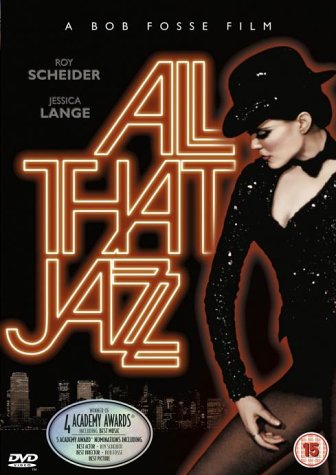
allthatjazzAll That Jazz*, Bob Fosse (1979, USA). There are some movies I’d never have come to watch if they hadn’t been on the 1001 Movies You Must See Before You Die list, and not just because I’d otherwise never have known about them. On first pass, All That Jazz doesn’t really seem to be my sort of film. It’s a semi-autobiographical musical, based on Fosse’s own experiences staging a big Broadway musical and editing a feature film, a work-load which led to health problems and hospitalisation. I am not much of a musicals-type person – in fact, there’s only one I actually rate, High Society – and if I were I think I’d prefer ones from the 1950s… But All That Jazz is also one of those films in which an unexpected dance sequence makes something very interesting of it. And “unexpected” is not a word associated with dance sequences you’d think would apply to All That Jazz. But there it is. As Roy Scheider lies in his hospital death, he hallucinates a big dance production number featuring the Angel of Death, and it’s cleverly and affectingly done. I found myself really liking All That Jazz, and I hadn’t expected to.

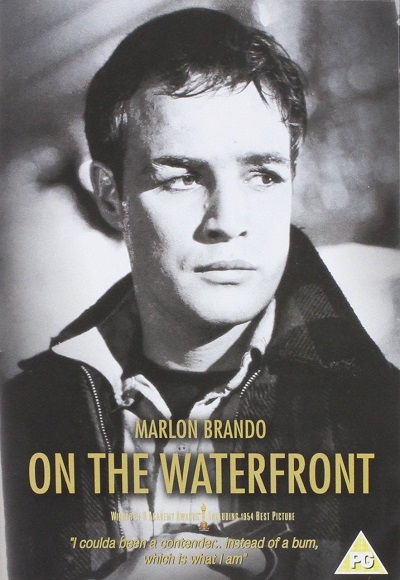
onthewaterfrontOn the Waterfront*, Elia Kazan (1954, USA). Marlon Brando is apparently one of the great actors, but I’ve seen him now in two of his most famous roles – in A Streetcar Named Desire and this one – and, well, he’s just annoying. That stupid voice. I guess that must be Method Acting. Brando plays a dim-witted ex-boxer whom circumstances force into going up against his chapter of the longshoremen union and its corrupt chief. It’s the sort of story which is, I guess, meant to celebrate a good man, but all it does to me is demonstrate that the capitalist model is corrupt, open to abuse and a piss-poor end-result after ten thousand years of civilisation. Seriously, we’re meant to just accept the injustice and violent coercion which was apparently standard operating procedure on the docks of New York some sixty years ago? We shouldn’t be cheering on Terry Malloy as he battles the union, we should be asking why the US government is apparently so inept, corrupt or just plain evil to have allowed the situation to arise in the first place. Either way, this doesn’t really meet my criteria for a good movie.

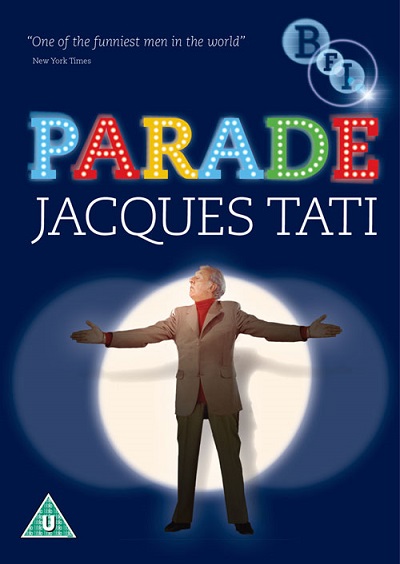
paradeParade, Jacques Tati (1974, France). I’ve almost finished the Tati box set, and it was definitely one of my better purchases – even if this isn’t one of Tati’s better films. It’s a made-for-TV piece, set in a circus, in which Tati himself occasionally appears as a clown. It is also a film chock-a-block with dungarees. I’ve never seen so many pairs in a single movie before. There are some amusing set-pieces, but if this weren’t Tati it would be just another fly-on-the-ringside documentary, albeit a very 1970s one. Worth seeing, but buy the Tati box set for the other films.

motherkustersMother Küsters Goes To Heaven, Rainer Werner Fassbinder (1975, Germany). And I’m about halfway through the Fassbinder box set. I like box sets. (I received a Bergman one for my birthday, only a week or so ago, incidentally). One thing I’m coming to realise from watching these Fassbinder films is that he definitely made use of a stable of actors. Brigitte Mira, who played the female lead in Fear Eats the Soul, plays the title character, a working-class widow who loses everything when her husband kills his supervisor and commits suicide at the factory. She and her family are interviewed by the press, who then libellously paint the dead man as a drunk who was violent toward his wife and a bully to his children. A pair of middle-class communists offer to help Mother Küsters clear her husband’s name, although her family are suspicious of the communists’ motives. But they prove too slow for Mother Küsters and she falls in instead with some anarchists… who invade the local office of the newspaper which published the libellous article. This isn’t exactly the most subtle Fassbinder film I’ve watched so far – he sets out to show the perfidy of the press and the way they monster people, and does precisely that. Interestingly, the film has two endings. One is represented by stills, while a voice-over reads the script, but the other was actually filmed. The latter apparently was written especially for the US market (it’s the happier ending), but I do wonder why the first ending was never actually put on film.

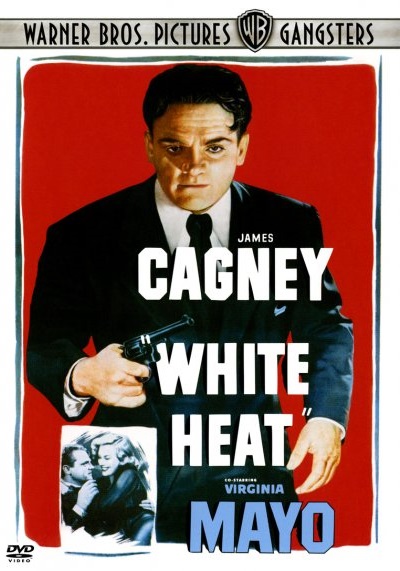
White_HeatWhite Heat*, Raoul Walsh (1949, USA). “Look at me, ma! I’m on top of the world!” Yup, this is where that line comes from. It’s a classic gangster film, in which Cagney plays a complete psychopath – albeit a somewhat tame one by today’s standards, in fact superheroes in twenty-first century films show about as much remorse as Cagney’s character does after killing someone. That’s progress for you. Anyway, Cagney gives himself up for a crime he didn’t commit because it provides an alibi for one he did, a particularly brutal train robbery. A cop goes undercover in the prison, breaks out with Cagney and joins his gang. The film ends with an attempt to rob the payroll from a refinery, and Cagney ends up stuck on the top of a storage tank, starts of a gun battle… which causes the storage tank to blow. KABOOM. A good bit of classic noir.

lesmisLes Misérables*, Tom Hooper (2012, USA/UK). Here’s another film that I’d have otherwise assiduously avoided if it hadn’t been for the 1001 Movies You Must See Before You Die list, but unlike All That Jazz I can’t really say I’m glad I watched it. I knew going in it wasn’t going to be the sort of film I like and, lo and behold, I really didn’t like it. The singing was terrible, the songs were awful – even that brain-burning one popularised by Susan Boyle – the characters were unredeemable, and the CGI was so over the top it might as well have taken place in some fantasy world. Rubbish.

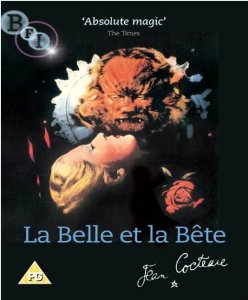
labelleLa Belle et la Bête*, Jean Cocteau (1946, France). I thought Cocteau’s Orphée really good, but this retelling of ‘The Beauty and the Beast’ fairy tale was a bit dull. While the staging was cleverly done, particularly for the time, the production design did resemble some amateur dramatic pantomime production (although the Beast’s make-up was good). Perhaps it deserves a second watch – but it was a rental disc and it’s gone back. On the other hand, I’m only just over halfway through the 1001 Movies You Must See Before You Die list… although I would like to see more films by Cocteau.

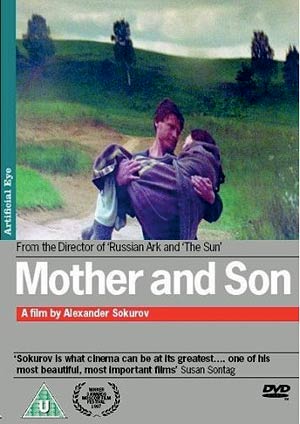
mother-and-sonMother And Son, Aleksandr Sokurov (1997, Russia). I’ve watched this a couple of times now, and I continue to find it completely mesmerising. A young man cares for his mother as she lies on her death-bed. He reads to her, he carries her outside and shows her the surrounding countryside, he feeds her and nurses her. There is a dream-like quality to the visuals, so much so that some of the landscape shots actually resemble oil paintings. This is a beautiful film, one of the most beautiful I’ve ever watched. I’d place it a close second after The Second Circle as my favourite Sokurov, and while it doesn’t quite make my top ten it certainly makes my top twenty. But I also suspect that more often I watch it, the more my opinion of it will rise. I’ve been watching a lot of Sokurov recently, and have even tracked down copies of some of his hard-to-find DVDs. I think he’s one of the most interesting directors currently making films. There’s something very… literary about his movies. Watching them is like reading a beautifully-written short story.

1001 Movies You Must See Before You Die count: 567


8 Comments

Moving pictures, #13

It’s the second week of December, and all that’s left of the year is the culmination of our annual consumerism frenzy and all the excesses of food and drink which go with it. So I might as well finish my viewing diary now. 2014 was definitely the year of films for me. I watched 345 films† on television, DVD / Blu-ray and at the cinema. Although very few of the last. Er, only two, in fact: Under The Skin and Interstellar. Most of the DVDs I watched were rentals – I averaged three a week for the entire year. And many of them I put on my rental list because they were on 1001 Movies You Must See Before You Die (as before, films on that list mentioned here are asterisked).

element_of_crimeElement Of Crime, Lars von Trier (1984, Denmark) After watching Breaking the Waves, I decided to try some more von Trier, particularly his early stuff; so I picked up a copy of his E-Trilogy, which contains this film, Epidemic and Europa. And deciding that Element Of Crime was the most accessible of the three, I sat down to watch it… And it’s all a bit like a film school project. Orange neon lighting is used throughout, which makes everything look, well, orange. Michael Elphick plays an ex-detective who undergoes hypnosis in order to remember his last case, the hunt for a serial killer in post-war Germany. In order to solve the case, Elphick tries to identify with the killer, and soon begins to behave like him. It all felt a bit obscure for obscurity’s sake, and whatever cleverness was there seemed lost in an orange haze. I also seem to remember lots of Dutch angles and light reflected in water. There’s an interesting idea somewhere in this film, but I’m not convinced its presentation made the best use of it.

worlds_endThe World’s End, Edgar Wright (2013 UK) A bunch of school friends get together for reasons that never quite convince in order to complete a pub crawl they had previously failed to complete twenty years before in the invented town of Newton Haven, a crawl of twelve pubs which ends at the titular hostelry. The five friends are drawn pretty broadly, as are their relationships, both historical and during the film, and for the first hour or so you’re wondering if it could get any more pointless… when it suddenly transpires that the town of Newton Haven has been taken over by alien robots. Which is where it all turns very silly. Parts of the town of Newton Haven looked scarily familiar – something that doesn’t happen in films or television very often if you happen to be from the north of this country – so I checked online and discovered The World’s End was partly filmed in Letchworth Garden City, a city I remember particularly well, despite only visiting it once, thanks to a Christmas work night out when I worked at ICL in Stevenage back in the early 1990s. Anyway, The World’s End: very silly, but mildly amusing; a bit juvenile in parts; probably best seen after a few beers.

IKnowWhereImGoingI Know Where I’m Going*, Michael Powell & Emeric Pressburger (1945, UK) I think I had this film confused with another Archers film, A Canterbury Tale, because I had thought it was about soldiers during World War II, but I Know Where I’m Going is actually set in the Hebrides, and while Roger Livesey’s character is on furlough from the Navy, the war is barely mentioned. Wendy Hiller is heading for the invented Hebridean island of Kiloran in order to meet up with her wealthy fiancé and marry him. But when she gets to the Isle of Mull, the weather prevents a crossing to Kiloran. There, she meets Livesey, who is the laird of Kiloran, and the film moves smoothly into rom com territory. It is, as you’d expect from the Archers, a polished piece, with bags of charm. Livesey, who possesses a voice only marginally less fruity than Brian Blessed, is eminently watchable and a surprisingly good romantic lead; as is Hiller, who exhibits a similar spikiness to that which bought Katherine Hepburn a bagful of Oscars. I’ve always been a fan of the Archers, and there’s nothing in I Know Where I’m Going to make me change my mind.

kippurKippur*, Amos Gitai (2000, Israel) This is based on Gitai’s own experiences in the Israeli military during the Yom Kippur War. Two friends on military service fail to meet up with their unit thanks to the Syrian invasion, and eventually end up joining a helicopter rescue unit. This involves flying out onto battlefields to evacuate the wounded. It’s dangerous work, but at least they’re not shooting at anybody. It’s all very realistic, blackly comic, and quite gruesome. The two end up wounded themselves, when their helicopter enters Syrian territory and is shot down by a missile. A good film.

father_and_sonFather And Son, Aleksandr Sokurov (2003, Russia) I have a lot of time for Sokurov’s films, but boy are they slow. They make Tarkovsky’s look like they were made for the MTV generation. The plot of Father And Son is almost inconsequential. It’s about a man and, er, his son, and their relationship. The son is at a military academy, but he spends time with his father in his roof-top apartment and… it doesn’t really matter what happens. Father And Son is a microscopic examination of the relationship between the two, beautifully photographed and remorselessly documented. I’ve maintained for the last couple of years that Sokurov’s The Second Circle (a favourite film) is the epitome of the father-son film and, though you’d expect from its title Father And Son would be more so, I’m not sure  that it is. But I do really like this film, I like the gentle construction of its central relationship, and I especially like the visuals. Sokurov is without a shadow of a doubt one of the best film-makers currently working. I only wish more of his stuff were available in the UK.

in_lonely_placeIn A Lonely Place*, Nicholas Ray (1950, USA) Humph is an acerbic screenwriter who has been asked by a producer to adapt a best-selling novel. Since the book is trash and he has no intention of actually reading it, he asks a hat-check girl at the nightclub who admits to having read it to come home with him and tell him the story. She does so, but during her journey back to her own home later that night she is murdered. The police immediately suspect Humph. He is partly alibied by next-door neighbour Gloria Grahame, and the two later enter into a relationship. Humph gets cracking on the screenplay, but the police still suspect him and he’s such a nasty piece of work that pretty soon everyone thinks he murdered the hat-check girl, even Grahame. So she decides to leave him… but then the real killer confesses to the police, but Humph and Grahame’s relationship has already crashed and burned. A neat little noir this, although Humph’s character really was quite unpleasant. And while the did he/didn’t he aspect never quite convinced, tying it to his relationship with Grahame was a neat move.

noahNoah, Darren Aronofsky (2014, USA) When I was a kid I went to Sunday School, but I don’t remember any of this from those Biblical colouring books we had. Six-limbed angels made out of stone? A giant fantasy stonepunk empire? Two races of humans? I don’t even remember it from history lessons at school. There was the big boat, of course, and the Deluge. And the animals going in two by two, and even the stranger creatures which got left behind. Apparently, the religious nutjobs in the US more or less approved of Noah, which is surprising given that the word “God” is not mentioned once – it’s “the Creator” throughout. So it seems turning a bit of the Bible into a fantasy film is fine, but using a fantasy novel or film to comment on Christianity is not. The Golden Compass was a much better film than this, and it’s a shame the trilogy was spiked. But one man and his floating wooden fort full of sedated animals in fantasyland seems to be acceptable. Huh.

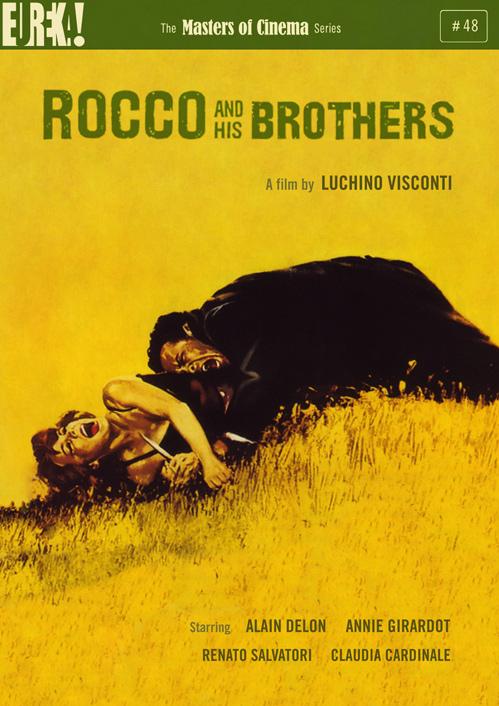
rocco_and_his_brothers_masters_of_cinema_series_uk_dvdRocco and his Brothers*, Luchino Visconti (1960, Italy) Mother and four sons head from their village in southern Italy to go live with the eldest son in Milan, although he apparently doesn’t seem to be expecting them. And their sudden appearance puts the kaibosh on his impending nuptials. The five brothers, ranging in age from early teens to mid-twenties, and their mother struggle to survive. The film is presented in five parts, one for each of the brothers – the title role, incidentally, is played by Alain Delon. One brother becomes a boxer, but fails and becomes a gangster. Another turns his back in the family and settles down. Another gets a job in a car factory, and supports the rest of the family. A prostitute befriended by Delon becomes embroiled in the lives of the brothers, and is brutally murdered by the boxer – but Delon won’t give him up to the police, so one of the others does so. I don’t know if Rocco and his Brothers was the first Italian Realism film, but it’s certainly a textbook example – and so very far from Visconti’s later work, such The Damned or Death In Venice. I can understand why this film is on the 1001 Films You Must See Before You Die list.

belle_de_jourBelle de Jour*, Luis Buñuel (1967, France) Catherine Deneuve is the bored wife of a doctor, with an active and somewhat dodgy fantasy life (featuring, among other things, being whipped by coach hands), and when the creepy older friend of her spouse drops hints – not to mention outright lewd proposals – about a brothel on a particular street in Paris, Deneuve makes her way there and joins the staff as a part-time sex worker. One of her early customers is a young and angry gangster, and the two fall in love – although, to be honest, I couldn’t understand what she saw in him. Then creepy older man from earlier turns up and the cat is out of the bag. Meanwhile young gangster has worked out who Deneuve really is, and lies in wait outside her apartment so he can kill her husband. It goes badly, but ends well for Deneuve. An odd film, and I’m not entirely sure what to make of it. The men are horrible, it all feels horribly bourgeois, and Deneuve is a complete cipher. I much preferred The Discreet Charm of Bourgeoisie.

wolf_of_wall_streetThe Wolf of Wall Street, Martin Scorsese (2013, USA) This has appeared on several best of the year lists from film critics (although released on 25 Dec 2013 in the US, it wasn’t released in the UK until 17 Jan 2014). To be honest, I’ve no idea why. It’s a well-made film, certainly; as Scorsese’s films always are. But the reason I don’t like Scorsese’s movies is that he valourises scumbags. If it’s not Mafia, bonkers billionaires or psychotic killers, then it’s the sort of amoral Gecko-like figure the title of this film refers to – and he’s a real person, Jordan Belfort. Just after joining a Wall Street firm, Belfort finds himself out of a job when it crashes and burns as a result of Black Monday. He stumbles across the penny stocks market, and jumps in with both feet, basically ripping off ordinary people in order to make a fortune for himself. And he makes a very large fortune. Which, of course, leads to a lifestyle of complete excess – the film opens with Belfort explaining the drugs he takes during a typical day. The FBI take an interest in him because, well, because what he’s doing is illegal, although they can’t prove it. Chiefly because he’s salted away most of his funds in a Swiss bank. Although Belfort loses access to the account when his courier, a British aunt of his wife, dies. Eventually, everything comes crashing down. Belfort is indicted and sentenced… to 36 months in a minimal-security prison. They should have thrown away the key. And taken every cent his firm earned and given it back to the people he ripped off. Belfort, of course, remains unrepentant and claims 95% of his business was legit. (Reading up on him, it seems much of the memoir on which the film was based is doubtful, Belfort was ordered to repay $110 million but has to date only repaid $11 million; and he now works as a motivational speaker, making more, he claims, than he did as a stock broker/fraudster.)

peeping_tomPeeping Tom*, Michael Powell (1960, UK) This film pretty much destroyed Powell’s career. Although he was well-regarded as one half of the Archers, British critics savaged Powell’s film on its release – so much that he never made another feature film in the UK. It’s tempting to say the film is tame to a twenty-first century viewer, but to be honest I suspect the reaction to it in 1960 was nine parts the British press monstering someone to one part actual outrage. After all, they did the same eleven years later over A Clockwork Orange. In actual fact, Peeping Tom is a smart thriller, similar to Hitchcock’s Psycho in many respects, but made with a British sensibility and incorporating a number of Archer touches. A young man who works in a film studio, and as a photographer on the side, murders women and photographs them at the moment of their deaths. The film follows him, so there’s no mystery to it; but the film does discuss the psychology, as outlined in a number of conversations with the young woman who lives downstairs. Moira Shearer makes an appearance halfway through the movie, only to become the next victim ten minutes later – given her stature in British cinema of the time, this struck me as similar to Hitchcock’s trick with Janet Leigh in Psycho. Especially since she performs a quick impromptu dance number. Definitely worth seeing.

cone_of_silenceCone Of Silence, Charles Frend (1960, UK) I forget why I put this on my rental list, possibly because it’s an aviation drama and I enjoy them. As it turned out, it wasn’t quite what I was expecting. Yes, it’s a drama about a particular aircraft, a jetliner called an “Atlas Phoenix” and which was played by an Avro Ashton – the Ashton was a prototype airliner which never entered production, but the one used in the film was actually a test-bed, fitted with two additional jets in wing nacelles for engine-testing. Bernard Lee plays a by-the-book captain who crashes a Phoenix at “Ranjibad” on take-off – the Phoenix flies the Empire route from the UK to Australia – and an inquest finds the crash the result of pilot error. Lee, and those who know him, of course disagree. Against the wishes of Atlas, Lee is permitted to once again captain the Phoenix. But some elements within the airline want to see him either fired or demoted to piston-engined airliners. And then he crashes again at Ranjibad, in identical conditions to the first crash. But this time everyone is killed. And it turns out Atlas didn’t let on that under certain conditions, the manual for take-off is incorrect. The story is, of course, based on the de Havilland Comet, and de Havilland’s reluctance to reveal data that might point to the aircraft itself being the cause of the crashes which grounded it. Given the prestige wrapped up in the Comet – not to mention the money – as it was the world’s first airliner, it’s no surprise de Havilland acted as they did, although many lives were lost as a result. Cone Of Silence spends perhaps too long on the lives of its characters, so the actual plot is wrapped up a little too quickly in the last ten minutes, but it’s a good solid piece of 1960s British cinema and worth seeing.

1001 Movies You Must See Before You Die count: 535

(† This includes complete seasons of television programmes I watched on DVD, but not on terrestrial or cable television.)


2 Comments

Moving pictures, #7

If it weren’t for rental DVDs, I’d have been in a cultural vacuum this past couple of months. All that sportsing on television. Just when one ended, another began. And it’s still going on. It’s interminable. And, truth be told, so were some of the films I’ve watched over the past few weeks. But not all of them.

There’s books too, of course; though obviously I don’t get through as many of those per month. And I’m reluctant to write about every book I’ve read because a) I’m not a book blogger, b) not all of them are worth writing about, and c) quite a few of them are for review anyway – either for SF Mistressworks or for Interzone. Having said that, I really ought to write about books that have blown me away… except they seem to have been in somewhat short supply this year.

But, films. Movies. Moving pictures. Cinema. I continue to get my money’s worth from Amazon rental (Lovefilm as was), and if I chuck the occasional twenty-first century Hollywood blockbuster on my rental list because everyone’s talking about them, I usually end up wondering what all the fuss was about. But then, I do have an odd taste in movies. I recently had another look at my ten favourite films and made a few changes to it – and now it looks like this: 1 All That Heaven Allows, Douglas Sirk (1955, USA), 2 Alien, Ridley Scott (1979, UK/USA), 3 Fahrenheit 451, François Truffaut (1966, USA) 4 The Second Circle, Aleksandr Sokurov (1990, Russia), 5 Mięso (Ironica), Piotr Szulkin (1993, Poland), 6 The White Ribbon, Michael Haneke (2009, Austria/Germany), 7 Dune, David Lynch (1985, USA), 8 Divine Intervention, Elia Suleiman (2002, Palestine), 9 Star Trek: The Motion Picture, Robert Wise (1979, USA), 10 Rio Bravo, Howard Hawks (1959, USA)… but it’ll likely change. It seems to do so every year or two anyway. Which is, I guess, a sign of a healthy list of favourites…

Anyway, on with the last few weeks’ worth of viewing:

Thor: The Dark World, Alan Taylor (2013, USA) Perhaps they should have just called it Thor: The Dark Film, because this is not a film to watch on a television on a summer evening. There were these dark shapes doing something in darkness, and it was all to do with Christopher Ecclestone in trollish make-up being evil. Or something. I don’t know, I couldn’t honestly give a shit. Marvel have mangled Norse mythology so much it’s frankly embarrassing they continue to use names like Thor and Loki. And the Marvel Cinematic Universe is a huge step backwards in terms of both comic rigour (not hugely adhered to, in the first place) and blockbuster cinema. Comic fans, they have taken something you admire and made something dumb of it. Do not celebrate that.

bogart_barefoot

The Barefoot Contessa, Joseph L Mankiewicz (1954, USA) An archetypal rags-to-riches story, told after the fact by laconic screenwriter Humphrey Bogart, who was there at the start and also there at the end. Ava Gardner plays a flamenco dancer who catches the eye of a Wall Street millionaire (that’s all they were back in those days, millionaires) who dabbles in movies. Turns out she’s photogenic and she becomes an international film star… and then marries an Italian count. But it all ends very badly. A Hollywood melodrama, with a nice voice-over by the Humph but very little substance.

The Hunger Games: Catching Fire, Francis Lawrence (2013, USA) This series baffles me. The games themselves are clearly the core of the story, and the dystopian world exists to justify their existence… but the obvious plot – that Katniss becomes some sort of rebel figurehead due to her success in the games (and no, I’ve not read the books) – seems to be taking so long to get moving you spend most of the time waiting for a whole marching band’s worth of shoes to drop. Instead you get a bunch of caricatures carefully plodding through a plot which refuses to engage with its central theme. But then, when the most memorable thing in a film is, ooh! Her dress is on fire!, it seems churlish to complain about thematic depth…

Nights Of Cabiria, Federico Fellini (1957, Italy) Truth be told, the best parts of this film are the beginning and the end. It opens with Cabiria, a Roman prostitute, being pushed into a river and then being saved from drowning; and finishes with her stumbling onto a group of happy young people playing music after her fiancé has admitted to trying to kill her for her money. And yet, despite that, this is not a dour movie. Cabiria, played by Giulietta Masina, is irrepressibly optimistic, and it rubs off. It feels like a happy film, like a corner is forever about to be turned… even though it never does, even though Nights Of Cabiria is never as grim as Cabiria’s profession would suggest. This could be Fellini having his cake and eating it, but I prefer to think it’s the character of Cabiria rising above the material. Not my favourite Fellini film, but a good one.

Mildred Pierce, Todd Haynes (2011, USA) This is actually a five-part mini-series, adapted from the James M Cain novel of the same name, as was the 1945 Joan Crawford film also of the same name. I’ve always wanted to like Haynes’ films more than I end up doing, but this one proved excellent from start to finish. Kate Winslet plays the title character, and she’s very good in the role. Haynes also manages to portray a convincing 1940s Los Angeles, and it’s certainly a less glamorous one than in the Crawford film. Recommended.

Mrs Miniver, William Wyler (1942, USA) Despite being an American film, this is set in the UK. Although Mr Mininver is American (Walter Pidgeon). It’s about a housewife during WWII, played by Greer Garson, and to be honest I remember almost nothing about it. Garson was, I seem to remember, very good, if somewhat terribly terribly… but I have zero memory of the plot. I think their house got bombed? If you’re looking for cinema verité about the Second World War, this is not the film to get.

the-act-of-killing

The Act of Killing, Joshua Oppenheimer (2012, Denmark) The “elevator pitch” for this did not deserve to work – or rather, in the real world it should not have worked. But it did. The director took a team to Indonesia and interviewed those responsible for the huge numbers of killings of “communists” (over half a million) between 1965 and 1966, and asked them to re-enact those killings. The film starts by interviewing one of the gang leaders during that time, Anwar Congo, before exploring the Indonesian paramilitary organisations known as “preman”, especially the largest one, Pancasila Youth. The scenes acted out by Congo and his associates turn increasingly strange as they explore through cinema conventions what they did and how it affected them. That Congo at the end has an epiphany as a direct result of his re-enactments – what he did, he now realises, was bad – feels like too neat an ending, almost a cliché, and yet the murders committed by the preman back in the 1960s, and the stuff they get up to even now, are anything but trite and should not be forgotten.

Stranded, Roger Christian (2013, Canada) You see a crap straight-to-DVD sf film these days, and chances are it was made in Canada. Most are best avoided. Like this one. Christian Slater – whose career is clearly no longer what it once was – stars as the commander of a base on the Moon. A meteor strike damages the base shortly before the crew of four are about to rotate out. One of the meteorites contained some alien gunk, which impregnates the sole female character and overnight she becomes nine months pregnant. Then whatever it was she was carrying vanishes, I think it was an alien which was impersonating another member of the crew but by that point my brain was dribbling out of my ears.

The Second Circle, Aleksandr Sokurov (1990, Russia) This was a rewatch, and it’s probably my favourite Sokurov film (and, of course, one of my ten favourite films). The subject matter and cinematography perfectly complement each other, which is not always true of his movies (another in which it does is Confession, but that’s also incredibly slow and long). A young man travels to Siberia to bury his father, and he has to deal with his loss as he deals with the local bureaucracy. I’ve tried to work out why this film appeals to me so strongly – I have an aversion to films with father-son narratives as I find Hollywood’s use of the trope typically stretches from the banal to the inane. But The Second Circle seems to me to give due emotional weight to its topic – it’s a father-son narrative that’s about grief and loss, not disappointment or approval. It is, in other words, real. Too many Hollywood films by male directors feel like they can be reduced to the director (or perhaps the writer) acting out in disguised form the issues they had with their own fathers; but this is one of the few movies that tackles the subject head-on and does it with intelligence. Oh, and why aren’t all of Sokurov’s films available in UK editions, eh? For example, he’s made a quartet of films about “the corrupting effects of power”, and one of them, the third, has never been released in this country.

goldencoach

The Golden Coach, Jean Renoir (1952, France) This was unexpected; I mean, I’ve seen several of Renoir’s films and they’re excellent – La Règle du jeu, La Grande Illusion, Partie de campagne… So I had high expectations for The Golden Coach. But it turned out to be a dodgy Hollywood-style historical film, with none of Renoir’s wit, a mostly wooden cast, and the only real touch of Renoir was the start, which was framed as the beginning of a play on a stage, but as the camera moved onto the stage, so it all opened out into a cinematic world. Avoidable.

Le Voyage dans la Lune, Georges Méliès (1902, France) I was surprised to discover this was only around fifteen minutes long, and that its story is quite mad. Though, to be honest, the documentary about Méliès also on the DVD was more interesting than the film. But at least I can now say I’ve seen it (and you can too, in fact, as there’s loads of versions of it on YouTube).

The Lego Movie, Phil Lord & Christopher Miller (2014, USA) I’d heard lots of good things about this, even from normally sensibly people – so, despite it not being my thing at all, I borrowed it from a friend. There were a couple of laugh out loud moments, and more references to sf films than you could shake a reasonably-sized stick at… but in places it felt a bit by-the-numbers and, sigh, it all boiled down to a son and his relationship with his father. Even bloody toys can’t escape the father-son Hollywood narrative. Mildly entertaining.

Incidentally, if you’re wondering why I watch some of the films I’ve written about, it’s because I’m working my way through this list of 1001 Movies You Must See Before You Die. It’s not an especially good list – lots of spelling mistakes, for a start – and I’m finding many of films that I don’t think belong on it, and some not on it that I believe should be. To date, I’ve seen 494 of them – most of them as rental DVDs, but some of them are proving hard to source…


4 Comments

Moving pictures, #6

I’m not entirely sure what happened to June. It seemed to pass really quickly, without me getting much done. And July is looking like it might go the same way. But I have watched a lot of films – if only because of that damned f**tball. So while I scramble to catch up with various ongoing projects – including something a little more intelligent to post on this blog than just lists of books and films – here is a, er, list of films wot I have watched recently.

Sherlock Jr, Buster Keaton (1924, USA) Keaton is a cinema projectionist and dreams himself the hero of the film he’s showing, a murder-mystery among the wealthy, and, of course, there’s a nubile daughter, who Keaton wants to impress. There are some good gags in this, but none that matched the train journey in Our Hospitality (see here).

Wages Of Fear, Henri-Georges Clouzot (1953, France) The oil well is on fire, and the only way to put it out is using lots of nitroglycerine, but that’s stored a couple of hundred miles away at the company HQ, and the only way to get it to the wellhead is by truck. Which is, of course, really really dangerous – if not suicidal. But that’s okay because there’s loads of desperate men trapped in the nearby town, who have no jobs and not enough money to leave… The film takes a while to get going, but the drive over the mountains with two trucks full of explosives is pretty good.

Faust, Aleksandr Sokurov (2011, Russia) If Tarkovsky’s film often seem glacially-paced, then Sokurov’s are geological. But, like Tarkovsky’s, they’re also beautifully shot and observed. The title pretty much tells you all you need to know about the story of this film. The mise en scène looks fantastic, and the moneylender (ie, the devil) is horrible and creepy… a film to savour.

faust

Moscow Elegy, Aleksandr Sokurov (1987, Russia) Sokurov and Tarkovsky had been friends since film school, and this documentary was put together – from footage by Chris Marker, Tarkovsky himself (behind the scenes footage from both Nostalgia and The Sacrifice), and excerpts from Tarkovsky’s films – to be shown on Tarkovsky’s birthday in 1982. Interference by the Soviet authorities led to delays and, sadly, Tarkovsky died before the film premiered. Despite all the Tarkovsky footage in this, there’s no mistaking it for a Sokurov film. This is one of three documentaries on The Andrei Tarkovsky Companion, which I bought when it was released… and I see it now goes for around £88.

Lincoln, Steven Spielberg (2012, USA) I know only what most non-USians know about Lincoln, and this film pretty much covers all those – Civil War, emancipation, assassinated in a theatre, peculiar beard. It’s a dull film for the first half, but Lincoln proves a surprisingly pragmatic president – ie, openly buying votes to push his amendment through Congress. Things pick up a little in the second half, and despite it being an historical conclusion, Spielberg manages to wring some tension from the final vote scene. Having said all that, this is very much by the numbers American History 101. Day-Lewis plays a good part, but all those historical forces feel of the moment rather than the endgame of a long political struggle. Meh.

Make Way for Tomorrow, Leo McCarey (1937, USA) Old retired couple’s house is repossessed by the bank, leaving them homeless, and the grown-up kids are pretty adamant they don’t want the old folks dumped on them – though, in the end, one takes the father and another takes the mother. And they really are an unpleasant family. While this film may be 84 years old, not a fat lot appears to have changed since then. But when you have a welfare state with state pensions and council houses, old people don’t get left on the street to die as they are in some allegedly civilised countries…

Black Moon Rising, Harley Cokliss (1986, USA) A straight-to-DVD thriller notable only for the astonishing mullet worn by Linda Hamilton during the first half-hour (happily, it proves to be a wig). Tommy Lee Jones is a top thief, working for the government, but a job goes wrong, and he has to hide the stolen computer tape in an experimental 300 mph supercar invented by Richard Jaeckel. But then Hamilton’s gang of car thieves, run by shady billionaire Robert Vaughn, steals the supercar, and Jones must get it back.

blackmoon

Tristana, Luis Buñuel (1970, Spain/France) Catherine Deneuve plays an orphan who is adopted by a wealthy don in 1960s Toledo, who treats her like a daughter, but the moment she turns nineteen, he decides she’s his mistress. Meanwhile, she falls in love with a man nearer her own age, runs off to live with him, is taken ill, which results in her losing a leg, and she eventually ends up back with her don. An odd film, it played like an historical melodrama, but didn’t look like one.

The White Ribbon, Michael Haneke (2009, Austria/Germany) This is probably my favourite Haneke film, and it’s beautifully put together. A series of mysterious incidents in a German village just prior to World War I cause the villagers to turn on each other, but Haneke refuses to explain who is responsible or why. Beautifully photographed and really quite unsettling.

Golem, Piotr Szulkin (1979, Poland) That Szulkin box set was definitely a good buy. There isn’t a duff film in it, although this is perhaps the least interesting. In a future much like the ones Szulkin has depicted in his other films – ie, grim and dystopian – clones are used to fill out the workforce, and are treated very badly. But one clone may actually be a man – he’s not sure as he can’t remember, and the scientists are too clear on the matter either, as they may have got confused between the clone and the original human.

Mięso (Ironica), Piotr Szulkin (1993, Poland) I suspect this film is going to make my best of the year – which is a little perverse as it’s a 26-minute television short included as an extra feature in the Piotr Szulkin box set I bought earlier this year – and the actual films in the box set are all very good and worth seeing. But Mięso (Ironica) is in a class of its own. It’s a lecture on the history of Poland under Communism, using the availability of meat and meat products as illustration. It’s filmed in an outdoor meat market, by a cast who are clearly not actors, and in many cases are holding the script in their hand, or need prompting by others. There are also a number of dance routines, including one in which half a dozen riot police dance off against half a dozen Roman Catholic clergy in full regalia. In one scene, a woman in a wheelchair tries to position herself before the camera, but the cobbles are so slippery that by the time she’s in place she’s too knackered to speak.

Mięso (Ironica) (1993) 4 - 007

The Seventh Continent, Michael Haneke (1989, Austria) Another favourite by Haneke, and allegedly inspired by true events. A middle-class Austrian family, after spending much of the film going about their lives, suddenly tell everyone they are emigrating to Australia. They then eat a large feast, smash everything they own, and then commit suicide. Like The White Ribbon, it’s deeply unsettling, but this time the lack of explanation plays off against the prosaic nature of what has gone before.

Lola Montès, Max Ophüls (1955, France) This has one of the strangest framing narratives I’ve come across in a mainstream film. Lola Montès is a circus performer, enacting scenes from her life, with the help of the other circus performers and narrated by ringmaster Peter Ustinov. As each new chapter in her life begins, the view fades from the circus ring to a flashback of the actual events. It’s all very colourful, sumptuous even, but Montès is not a sympathetic protagonist and not even the well over-the-top staging prevents interest from flagging. Apparently, this flopped on release, and was butchered by the studio in an attempt to save it. I saw the restored version, and it clearly should have been left alone – but I think I understand why it did so badly back in 1955…

lola-montes--max-ophuls


2 Comments

2013, the best of the year

We’re a couple of weeks away from Christmas and the end of the year, so it’s time to look back with a critical eye over the past twelve-ish months and the words, pictures and sounds I consumed during that period. Because not everything is equal, some have to be best – and they are the following:

BOOKS
UnderTheVolcano1 Under the Volcano, Malcolm Lowry (1947) A classic of British literature and rightly so. I fell in love with Lowry’s prose after reading ‘Into the Panama’ in his collection Hear Us O Lord from Heaven thy Dwelling Place, although I already had a copy of the novel at the time (I’d picked out the collection, Under the Volcano and Ultramarine from my father’s collection of Penguin paperbacks back in 2010). Anyway, Under the Volcano contains prose to be treasured, though I recommend reading Ultramarine and Lowry’s short fiction first as it is semi-autobiographical and you can pick out the bits he’s used and re-used. This book was also in my Best of the half-year.

wintersbone2 Winter’s Bone, Daniel Woodrell (2006) I’d bought this because I thought the film was so good and because Woodrell had been recommended to me. But instead of the well-crafted crime novel I was expecting to read, I found a beautifully-written – and surprisingly short – literary novel set in the Ozarks that was perhaps even better than the movie adaptation. I plan to read more by Woodrell. Winter’s Bone was also in my Best of the half-year.

empty3 Empty Space: A Haunting, M John Harrison (2012) The third book in the Kefahuchi Tract trilogy, and I’m pretty damn sure I’ll have to reread all three again some time soon. Although the fulcrum of the story is Anna Waterman and the strange physics which seems to coalesce about her, Empty Space: A Haunting also does something quite strange and wonderful with its deployment of fairly common sf tropes, and I think that’s the real strength of the book – if not of the whole trilogy. And this is another one that was in my Best of the half-year.

sons4 Sons and Lovers, DH Lawrence (1913) When I looked back over what I’d read during 2013, I was surprised to find I held this book in higher regard than I had previously. And higher than most of the other books I’d read during the year too, of course. At the half-year mark, I’d only given it an honourable mention, but it seems to have lingered and grown in my mind since then. It is perhaps somewhat loosely-structured for modern tastes, but there can be little doubt Lawrence fully deserves his high stature in British literature.

promised_moon5 Promised the Moon, Stephanie Nolan (2003) I did a lot of research for Then Will The Great Ocean Wash Deep Above, and this was the best of the books on the Mercury 13. But even in its own right, it was a fascinating read and, while sympathetic to its topic, it neither tried to exaggerate the Mercury 13’s importance nor make them out to be more astonishing than they already were. If you read one book about the Mercury 13, make it this one.

Honourable mentions: Ancillary Justice, Ann Leckie (2013), an exciting debut that made me remember why I read science fiction; Invisible Cities, Italo Calvino (1972), beautifully-written tall tales presented as Marco Polo’s report to a khan; The Wall Around Eden, Joan Slonczewski (1989), a masterclass in writing accessible sf, this book needs to be back in print; The Day Of The Scorpion, Paul Scott (1968), the second book of the Raj Quartet and another demonstration of his masterful control of voice; The Sweetheart Season, Karen Joy Fowler (1996), funny and charming in equal measure; The Lowest Heaven, edited by Anne C Perry & Jared Shurin (2013), some excellent stories but also a beautifully-produced volume; Sealab, Ben Hellwarth (2012), a fascinating history of the US’s programme to develop an underwater habitat; Cities of Salt, Abdelrahman Munif (1987), a thinly-disguised novelisation of the US oil companies’ entry into Saudi, must get the rest of the trilogy; and Wolfsangel, MD Lachlan (2010), Vikings and werewolves are definitely not my thing but this rang some really interesting changes on what I’d expected to be a routine fantasy, must get the next book in the series…

Oops. Bit of a genre failure there – only one sf novel makes it into my top five, and that was published last year not this; although four genre books do get honourable mentions – two from 2013, one from 2010 and one from 1989. I really must read more recent science fiction. Perhaps I can make that a reading challenge for 2014, to read each new sf novel as I purchase it. And I really must make an effort to read more short fiction in 2014 too.

FILMS
about-elly-dvd1 About Elly, Asghar Farhadi (2009) A group of young professionals from Tehran go to spend the weekend at a villa on the Caspian Sea. One of the wives persuades her daughter’s teacher, Elly, to accompany them (because she wants to match-make between the teacher and her brother, visiting from his home in Germany). Halfway through the weekend, Elly vanishes… and what had started out as a drama about family relationships turns into something very different and unexpected. This film made my Best of the half-year.

consequences2 The Consequences Of Love, Paolo Sorrentino (2004) The phrase “stylish thriller” could have been coined to describe this film, even if at times – as one critic remarked – it does resemble a car commercial. A man lives alone in a hotel in a small town in Switzerland. Once a week, a suitcase containing several million dollars is dropped off in his hotel room. He drives to a local bank, watches as the money is counted by hand and then deposited in his account. One day, the young woman who works in the hotel bar demands to know why he always ignores her… and everything changes.

lemepris3 Le Mépris, Jean-Luc Godard (1963) I don’t really like Godard’s films, so the fact I liked this one so much took me completely by surprise. Perhaps it’s because it feels a little Fellini’s if it had been made by Michelangelo Antonioni. I like , I like Antonioni’s films. Perhaps the characters are all drawn a little too broadly – the swaggering American producer, the urbane European director (played by Fritz Lang), the struggling novelist turned screenwriter, and, er, Brigitte Bardot. Another film that made my Best of the half-year.

onlyyesterday_548494 Only Yesterday, Isao Takahata (1991) An animated film from Studio Ghibli which dispenses entirely with whimsy and/or genre trappings. A young woman goes to stay with relatives in the country and reflects on what she wants out of life. The flashback sequences showing her as a young girl are drawn with a more cartoon-like style which contrasts perfectly with the impressively painterly sequences set in the countryside. Without a doubt the best Ghibli I’ve seen to date… and I’ve seen over half of them so far. Once again, a film that made my Best of the half-year.

gravity5 Gravity, Alfonso Cuarón (2013) I had to think twice whether or not to put this in my top five. It was the only film I saw at the cinema this year, and I suspect seeing it in IMAX 3D may have coloured my judgement. To be fair, it is visually spectacular. And I loved seeing all that hardware done realistically and accurately on the screen. But. The story is weak, the characters are dismayingly incompetent and super-competent by turns, some of the science has been fudged when it didn’t need to be, and it often feels a little like a missed opportunity more than anything else. Perhaps I’ll feel differently after I’ve seen it on Blu-Ray…

Honourable mentions: She Should Have Gone to the Moon, Ulrike Kubatta (2008), an elegantly-shot documentary on the Mercury 13; Gertrud, Carl Theodor Dreyer (1964), grim and Danish but subtle and powerful; Man With A Movie Camera, Dziga Vertov (1929), astonishing meta-cinema from the beginnings of the medium; Sound of My Voice, Zal Batmanglij (2011), Brit Marling is definitely becoming someone to watch; Love in the Afternoon, Éric Rohmer (1972), the best of Rohmer’s Six Moral Tales; The Confrontation, Miklós Jancsó (1969), more socialist declamatory and posturing as a group of students stage their own revolution; Tears For Sale, Uroš Sotjanović (2008), CGI-heavy Serbian folk-tale, feels a little like Jeunet… but funny and without the annoying whimsy; Ikarie XB-1, Jindřich Polák (1963), a Czech sf film from the 1960s, what’s not to love?; Dear Diary, Nanni Moretti (1993), an entertaining and clever paean to Rome and the Italian islands, and a rueful look at the Italian health service; and The Sun, Aleksandr Sokurov (2005), a poignant and beautifully-played character-study of the Emperor Hirohito in 1945.

This year for a change I’m also naming and shaming the worst films I watched in 2013. They were: The Atomic Submarine, Spencer Gordon Bennet (1959), a typical B-movie of the period with the eponymous underwater vessel finding an alien saucer deep beneath the waves; Cyborg 2: Glass Shadow, Michael Schroeder (1993), an unofficial sequel to the Van Damme vehicle and notable only for being Angelina Jolie’s first starring role; The Girl from Rio, Jésus Franco (1969), Shirley Eaton as Sumuru, leader of the women-only nation of Femina, plans to take over the world, it starts out as a cheap thriller but turns into cheaper titillatory sf; The 25th Reich, Stephen Amis (2012), WWII GIs in Australia find a UFO, go back in time millions of years to when it crashed, then a Nazi spy steals it and ushers in an interplanetary Nazi regime, bad acting and even worse CGI; Battlestar Galactica: Blood and Chrome, Jonas Pate (2012), they took everything that had been good about Battlestar Galactica and removed it, leaving only brainless military characters and CGI battle scenes.

ALBUMS
construct1 Construct, Dark Tranquillity (2013) Every time Dark Tranquillity release a new album, it makes my best of the year. I guess I must be a fan then. In truth, they are probably my favourite band and their last half-dozen albums have each been consistently better than the one before. So many bands seem to plateau at some point during their career but DT amazingly just get better and better. This album was on my Best of the half-year.

spiritual2 Spiritual Migration, Persefone (2013) Another band who improves with each subsequent album. And they’re good live too – although I’ve only seen them the once (they really should tour the UK again; soon). This is strong progressive death metal, with some excellent guitar playing and a very nice line in piano accompaniment. I didn’t buy this album until the second half of the year, which is why it didn’t appear in the half-year list.

DeathWalks3 Death Walks With Me, Noumena (2013) A new album by a favourite band after far too long a wait, so this was pretty sure to make my top five. Noumena play melodic death/doom metal, an inimitably Finnish genre, but they also use clean vocals, and a female vocalist, quite a bit. One song even features a trumpet solo. I posted the promo video to one track, ‘Sleep’, on my blog here. And the album also made my Best of the Half-Year.

Winterfylleth-The-Threnody-Of-Triumph4 The Threnody Of Triumph, Winterfylleth (2012) I first saw Winterfylleth live before they were signed back in 2008 at the Purple Turtle in Camden at the Day of Unrest (see here), and I’ve seen them a couple of times since. This, their latest album, shows how far they’ve come and amply demonstrates why they’re so good. They call it English heritage black metal, which I think just means they sing about English historical sort of things (the band’s name is Anglo-Saxon for “October”). Another album from my Best of the half-year.

Of-breath-and-bone5 Of Breath And Bone, Be’lakor (2012) On first listen I thought, oh I like this, it deserves to be played loud. And it really does – it’s not just that Be’lakor, an Australian melodic death metal band, have excellent riffs, but also that there’s a lot more going on in their music than just those riffs. The more I listen to Of Breath And Bone, the more I like it – originally I only gave it an honourable mention in my Best of the half-year, but having played the album so much throughout 2013, I think it deserves a promotion.

Honourable mentions: Dustwalker, Fen (2013), shoegazery black metal that works extremely well; Where the End Begins, Mentally Blind (2013), excellent sophomore EP from a Polish death metal band, with an astonishingly good opening track (see here); Unborn and Hollow, Forlorn Chambers (2013), a demo from a Finnish death/doom band, and very very heavy, sort of a bit like a doomy version of Demilich, in fact, but without the vocal fry register singing; Shrine of the New Generation Slaves, Riverside (2013), more polished, er, Polish progginess, a little rockier than the previous album, although one track does include some very melodic “sexamaphone” [sic]; All Is One, Orphaned Land, proggier than previous albums but still with that very distinctive sound of their own, incorporating both Arabic and Hebrew; and Nespithe, Demilich (1993), a classic piece of Finnish death metal history, I picked up a copy of the re-mastered edition at Bloodstock – there’s a special Demilich compilation album, 20th Adversary of Emptiness, due to be released early next year, I’ve already pre-ordered it.

One of the things I really like about metal is that it’s an international genre, and here is the proof – the bands named above hail from Sweden, Andorra, Finland, the UK, Australia, Israel and Poland. There’s also quite a good mix of metal genres, from death to black metal, with a bit of prog thrown in for good measure.