It Doesn't Have To Be Right…

… it just has to sound plausible


Leave a comment

Frankenstein in Baghdad, Ahmed Saadawi

Very little science fiction has been translated from Arabic into English – in fact, I knew of only one other author, Emirati Noura Al Noman, and she hasn’t been published since 2014. Ahmed Khaled Tawfik wrote several sf novels, most notably Utopia (2008, Egypt), and a little hunting revealed it had been translated into English – but with his name spelt Towfik. There’s been plenty of fantasy translated from Arabic, however, from Alf Laylat wa Layla to Naguib Mahfouz, and a number of contemporary writers. Having said that, Frankenstein in Baghdad (2013, Iraq) was not published as category sf, and likely only deserves the label because its central conceit references Mary Shelley’s novel, a proto-sf novel. (The English title, incidentally, is a direct translation of the original Arabic title.) It was nominated for both the Arthur C Clarke Award and the International Booker Prize.

The central conceit of Frankenstein in Baghdad is actually not at all rigorous as science fiction. It’s a neat twist on the original – the monster (because of course Frankenstein is the doctor) in Saadawi’s novel is made from the body parts of victims of IEDs in post-invasion Iraq, and the monster’s mission is to avenge those deaths. But Saadawi seems more interested in telling a more general story about life in present-day Baghdad, as seen through the eyes of a handful of characters. Chief among these are the junk dealer Hadi, who originally creates the monster in some sort of fever dream; Mahmud, a young journalist, who takes Hadi’s tales of a monster semi-seriously, but is more interested in becoming like his rich and powerful editor; Elishva, an old Armenian woman who mistakes the monster for her long-dead son; and General Majid, who runs a secret police bureau of astrologers and magicians who predict bomb attacks in the city.

The novel bounces around between these characters, and a handful of others, mostly centred around the area of Bataween, and occasionally focusing on the monster. Who has discovered that once it avenges the death of one of the people whose parts make up its body, that body part rots and falls off. So the monster needs new parts – and it reaches the point where, with its own small army of followers, it too begins murdering people to keep itself together (so to speak).

The monster is a great invention, and there’s so much commentary that could be attached to the concept, but Frankenstein in Baghdad doesn’t seem all that interested in it. It’s more like an introduction, or a framing narrative, to the personal stories of the book’s cast. Which is a shame. It’s a good novel, don’t get me wrong, and its descriptions of life in post-invasion Baghdad are both heart-breaking and enraging.

A good novel, but one that feels like it failed to capitalise on its central idea.

1 Comment

Easter parade

Yes, I know, Easter is over. And I don’t think they have parades at Easter, anyway. At least not in this country. But it’s still April, and here is a parade of books wot I have recently added to the collection.

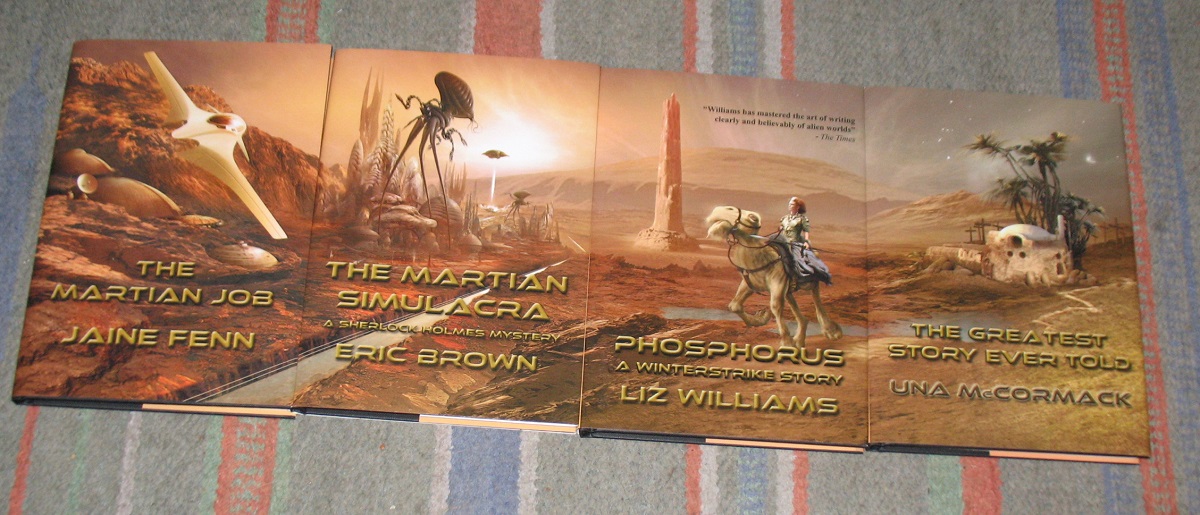
This is the third set of novellas from NewCon Press – I didn’t bother with the second set as it was horror – and, as you can see, the covers form a single piece of art. By Jim Burns. I’ve already read The Martian Job (see here), and The Martian Simulacra and The Greatest Story Ever Told (see here), but have yet to read Phosphorus.

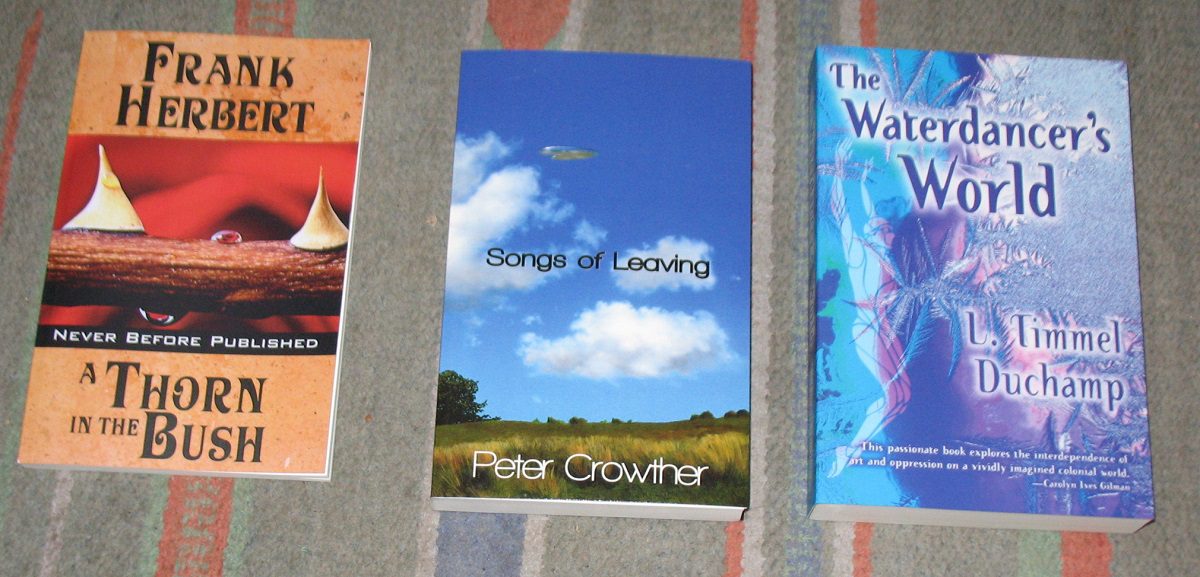
Three new-ish science fiction books. Well, A Thorn in the Bush is not really new – it was written decades ago but never published – and it’s not actually science fiction either, as Herbert initially set out to be a writer of thrillers. But never mind. Songs of Leaving was the only book I bought in the dealers’ room at Follycon 2. I’m a big fan of Duchamp’s writing, so I’ve been after a copy of The Waterdancer’s World for a while.

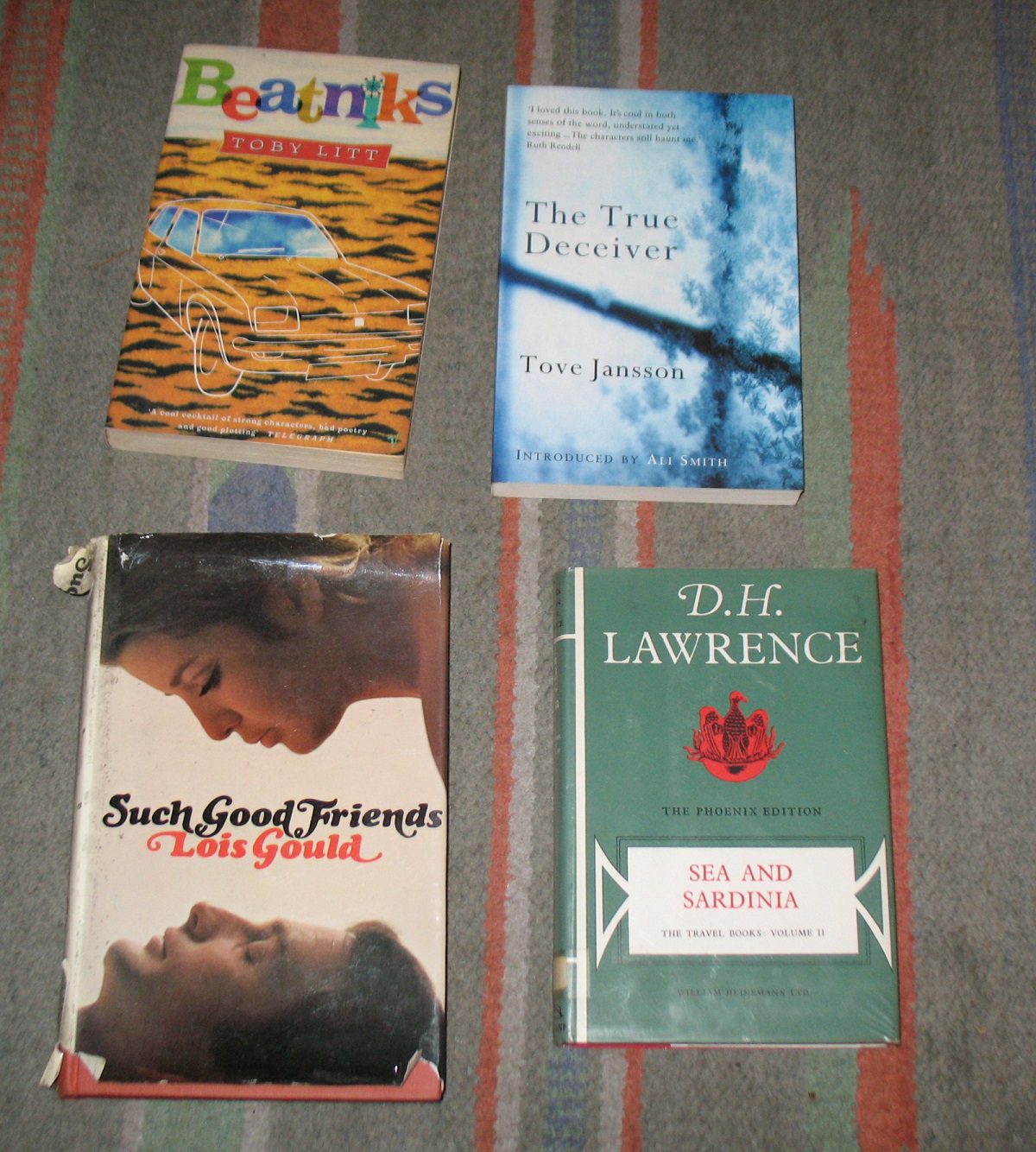
I started reading Litt’s novels several years ago – although not in alphabetical order, as I started with Journey into Space (Litt has titled each of his books alphabetically; he’s currently up to N). I thought I ought to fill in some of the gaps, hence Beatniks. The True Deceiver was a charity shop find. Sea and Sardinia is another for the DH Lawrence Phoenix Edition collection. Such Good Friends was the consequence of drunk eBaying, bought after seeing Preminger’s not very good film adaptation, reading up about it on Wikipedia, and thinking the original novel sounded mildly interesting…

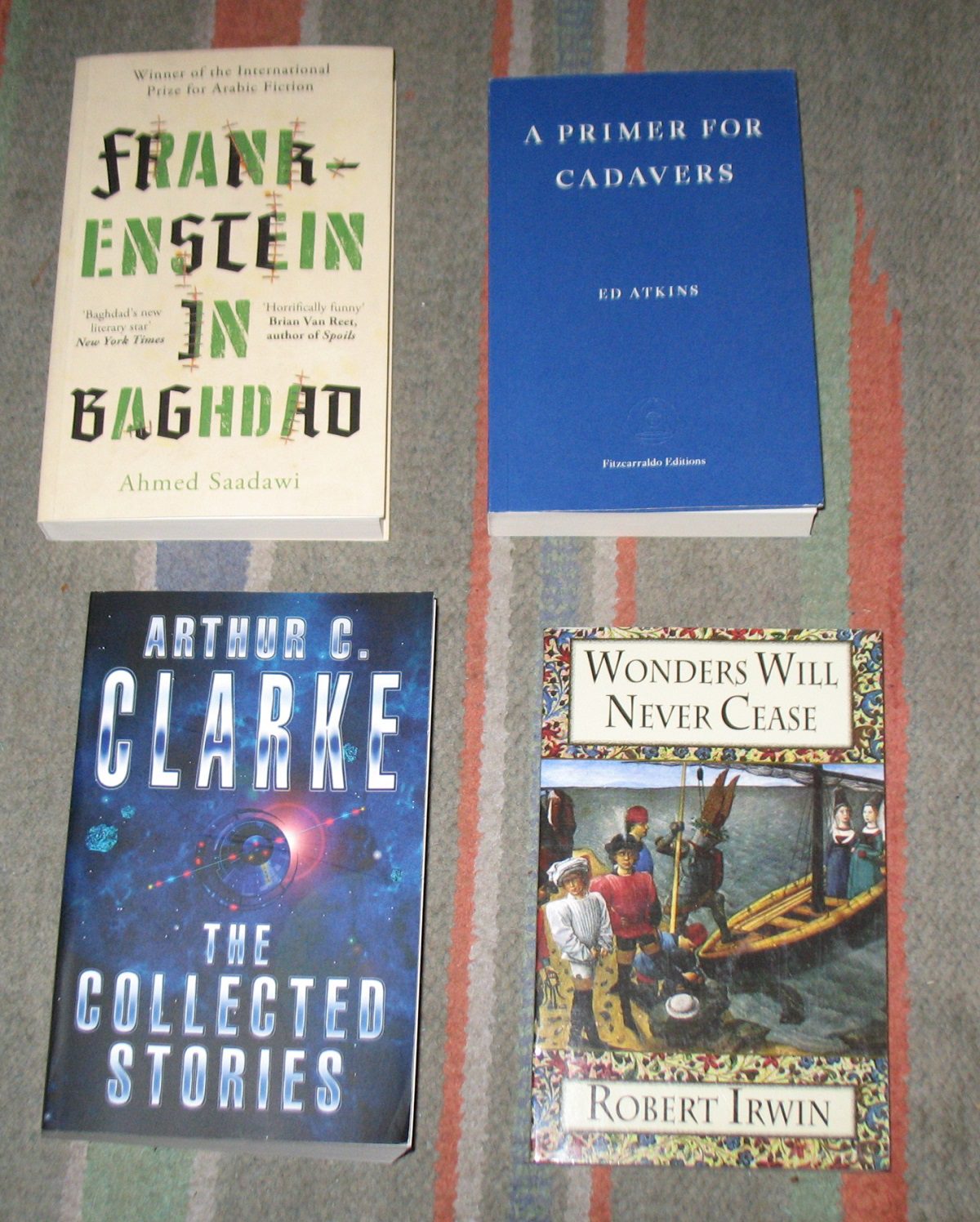
Some birthday presents from last month from my sisters. I’ve heard good things about Frankenstein in Baghdad. A Primer for Cadavers I’ve already read (see here). I’ve always wanted to work my way through Clarke’s short fiction, so I’m glad I now have The Collected Stories. And I’ve been a fan of Irwin’s writing since reading his book on classical Arabic literature years ago, and Wonders Will Never Cease is his latest novel.

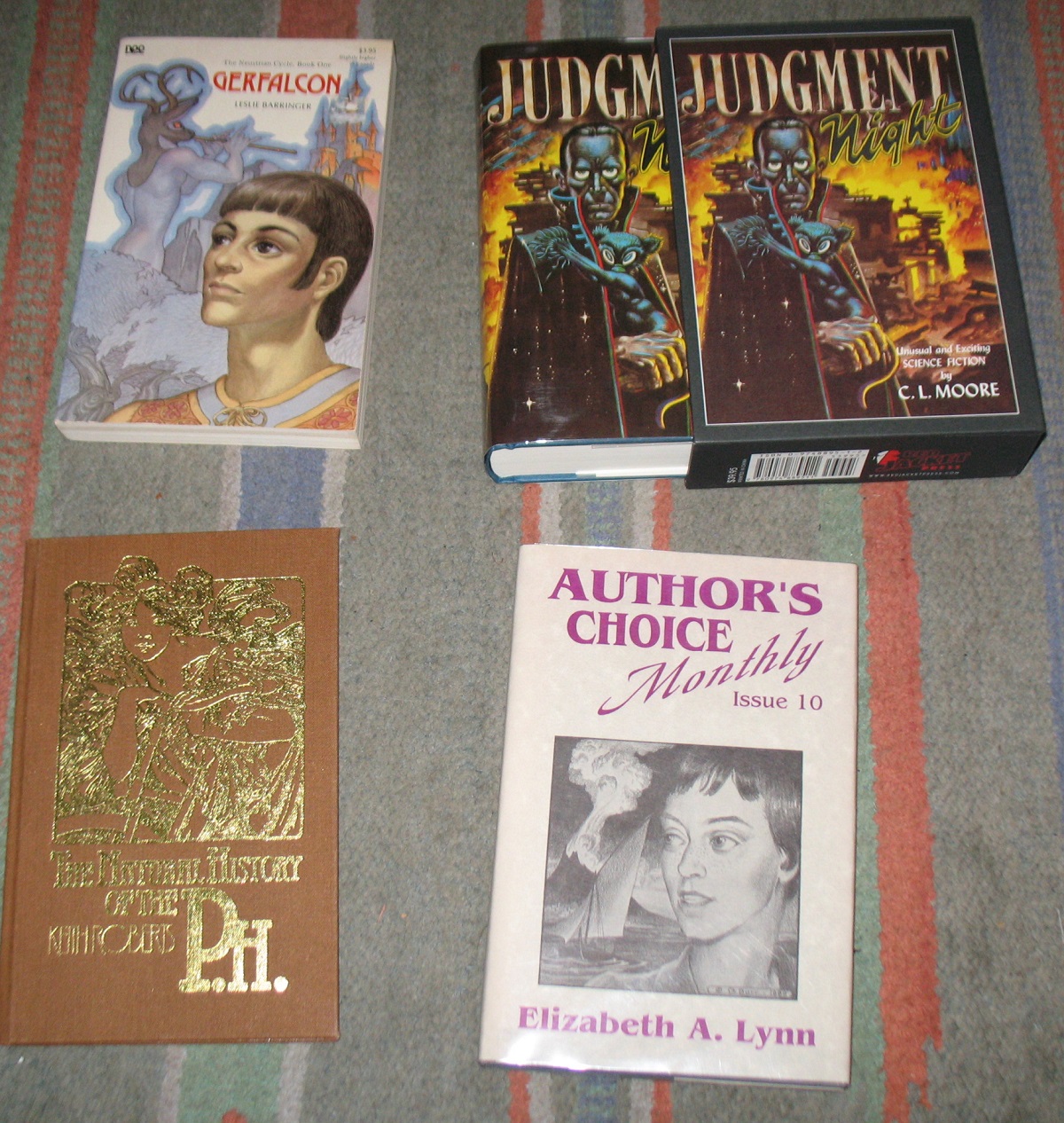
Some collectibles. The Elizabeth A Lynn is actually titled Tales from a Vanished Country, although none of the books in the 29-volume Author’s Choice Monthly series from Pulphouse Publications actually put the titles on the cover. Anyway, I’m slowly completing the set. The Natural History of the P.H. is an essay by Roberts on something that drove his fiction in his later years. It was published by Kerosina. Judgment Night is a facsimile edition of the first edition, published by Red Jacket Press. Gerfalcon, is from the Newcastle Forgotten Fantasy Library, although annoyingly I don’t think it’s the original cover art for the book.

Finally, some graphic novels. Memories from the Future (see here) is the final volume in the Valerian and Laureline series. While Crosswind (see here) is the first volume in a new series. And Inside Moebius Part 1 is, er, also the first in a series, of, I think, three volumes.