This is not the first book haul post of 2015 but the last book haul post of 2014. I have yet to purchase a book this year, and I’m trying to resist the urge for a few weeks longer. Meanwhile, here are assorted Christmas presents, charity shop finds and drunken purchases on eBay…
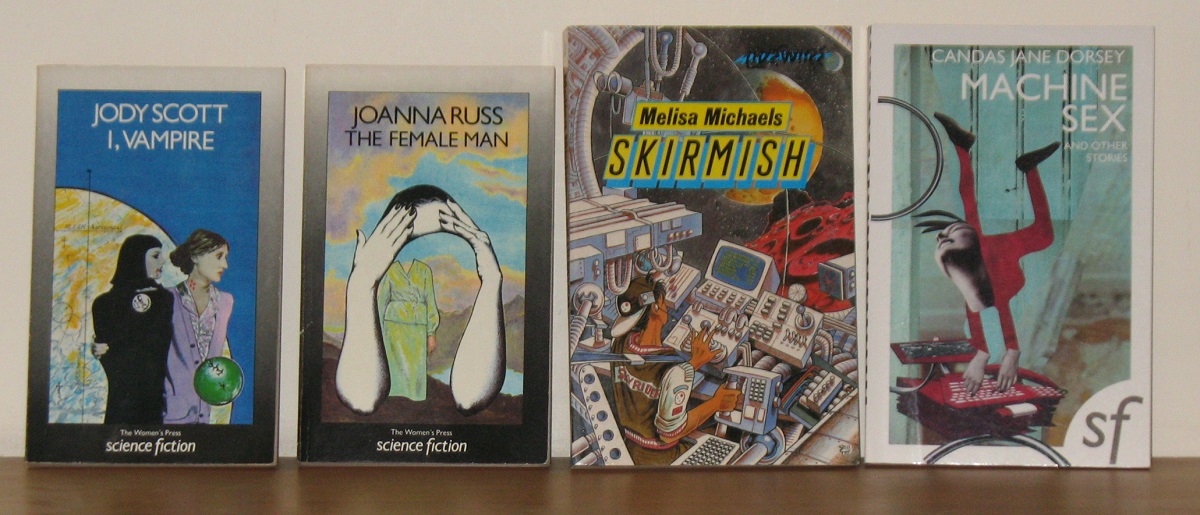
Four more books for the Women’s Press SF collection, which brings the total to 40 (out of 52, by my count). I, Vampire, The Female Man, Skirmish and Machine Sex… and Other Stories were all bought from Porcupine Books. I already have the SF Masterwork edition of The Female Man, but never mind. I’d also previously read Machine Sex… and Other Stories. Skirmish is one of only two sf YA novels published by the Women’s Press under the Livewire imprint – the other was Gwyneth Jones’s The Hidden Ones (I’ve owned a copy for years, of course). Skirmish, the first book of the Skyrider quintet, was originally published in the US, but not as YA.
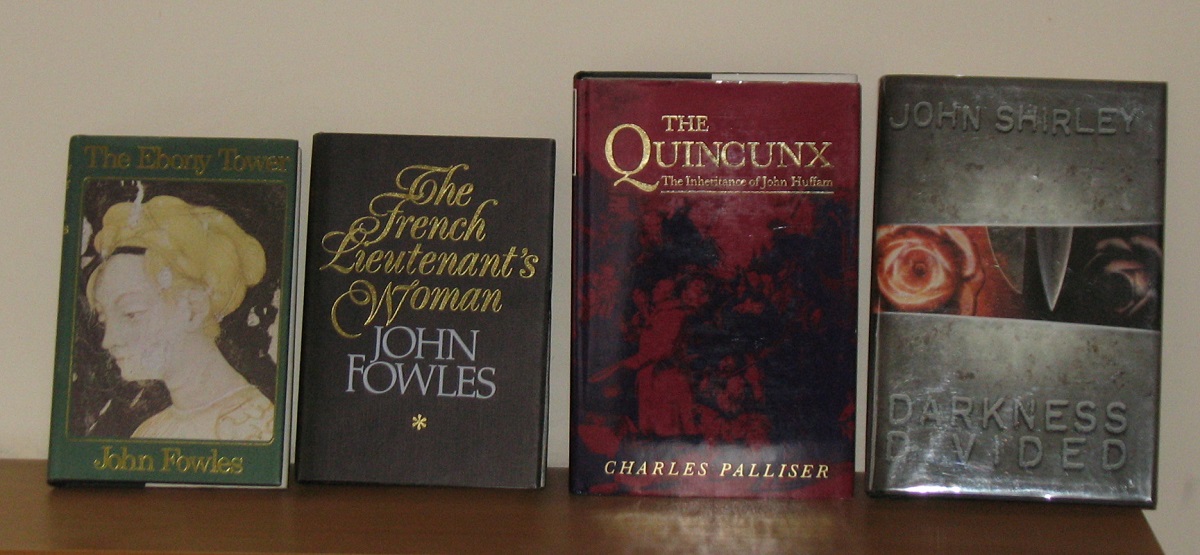
I already had paperback copies of both The Ebony Tower and The French Lieutenant’s Woman, but these are signed reprint hardbacks and were relatively cheap. The Quincunx is a first edition by a favourite author. Darkness Divided is a hard-to-find first edition from a US small press. It’s signed, of course.
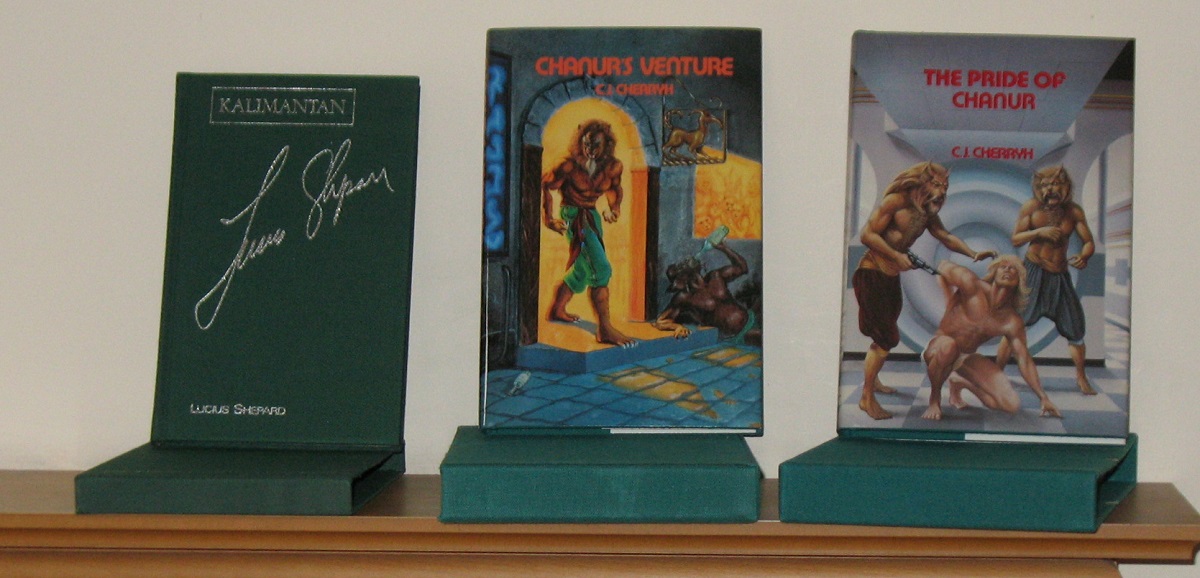
The slipcased signed edition of Kalimantan was a bargain find. The Pride of Chanur and Chanur’s Venture – both signed – were purchased on eBay after perhaps one glass too many of wine. Having said that, I’ve owned a signed first edition of the final book of the series, Chanur’s Legacy, for years, so I really ought to complete the set…
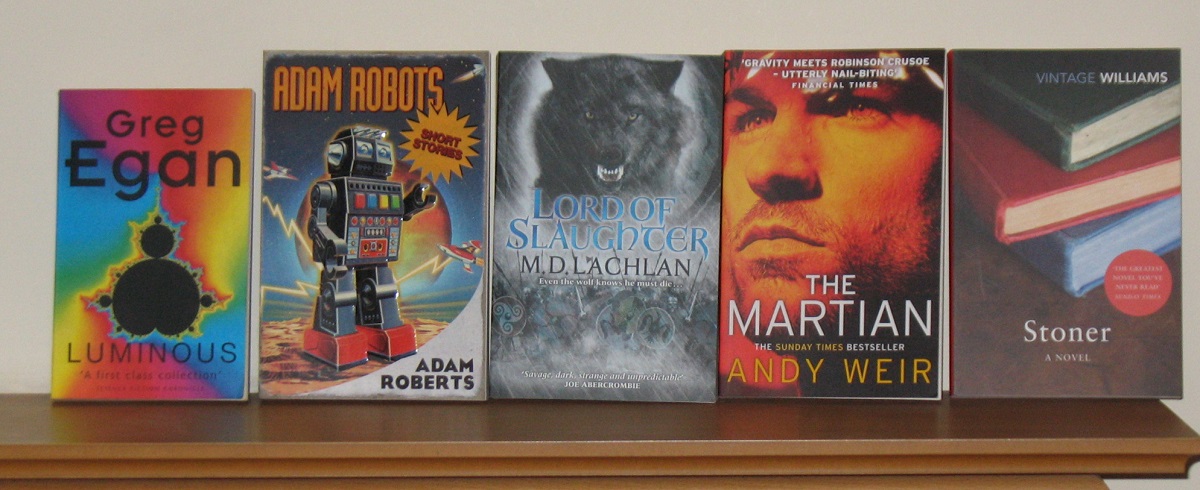
Luminous was a charity shop find. Adam Robots, Lord of Slaughter, The Martian and Stoner were all Christmas presents. I’ve received a Lachlan novel for the last three Christmases – it’s almost become a tradition. Fortunately, they’re good books. I’ve already read The Martian – I was not impressed (see here). John Williams is an author new to me.
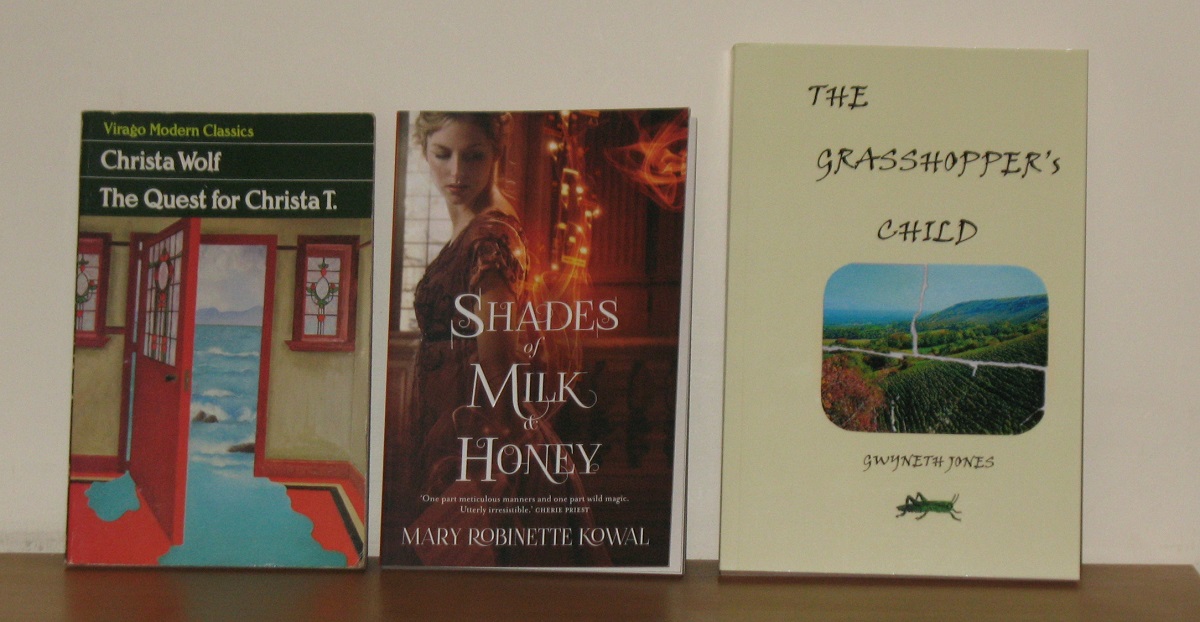
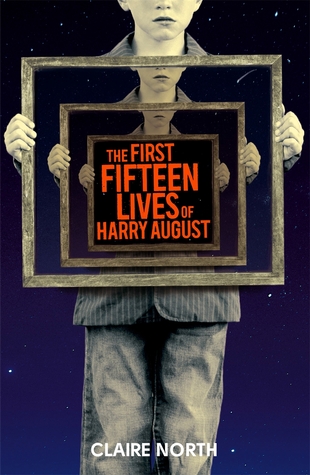
Can I say how chuffed I am I have a copy of The Grasshopper’s Child? I’m reviewing it for Vector, and I’m really looking forward to reading it. Shades of Milk and Honey was a Christmas present. I received a few odd looks reading it on the train journey home. The Quest for Christa T. was a charity shop find. I keep an eye out for the green Virago paperbacks now, so I can expand my reading of postwar UK women writers. Not shown is The First Fifteen Lives of Harry August, which I found in a charity shop, read over Christmas, and left in Denmark for my sister to read. I thought it pretty good (see here).
I don’t know why I bother, I rarely manage to keep to the bloody things. Looking back at my post on “reading resolutions” for 2014 (see here), I see I successfully kept… one of them. I stuck to alternating genders for long fiction, but failed to read every 2014-published book I bought and only read seven translated works during the year (and two of those were anthologies of Soviet science fiction). Ah well. For 2015, I think I’ll continue the alternating genders thing. But I’m not going to make any other promises about what I read during the year. I’ve signed up for the GoodReads reading challenge and set myself a target of 150 books, and I think that’s sufficient.
I doubt I’ll be visiting the cinema any more often in 2015 than I did in 2014 (which was twice). I might go and see Jupiter Ascending, but is there anything else due out during the year worth catching in 3D IMAX? I do intend, however, to keep watching films on DVD from the 1001 Movies You Must See Before You Die list. I doubt I’ll finish the list – some of the films are just too hard to find, but I’d like to get as close to complete as possible. But not to die when I’ve seen them all, I don’t want to do that. Obviously.
And then there’s the other stuff, what I laughingly call my writing career… Later this month should see the completion of the Apollo Quartet, with the publication of All That Outer Space Allows (at last!). Plus, shiny new paperback editions of Adrift on the Sea of Rains, The Eye With Which The Universe Beholds Itself and Then Will The Great Ocean Wash Deep Above. I’ll need to do some promoting once all four books are available, so prepared to be spammed. Mercilessly. And in February, I’ll be publishing Aphrodite Terra, an anthology of six stories sort of about the planet Venus.
I’ve gone off short stories, so I suspect I’ll not bother writing any in 2015. None of the current crop of magazines publish the sort of science fiction I’m interested in reading or writing. I have a couple of ideas for novellas I might have a go at, although it will be fun trying to sell them… And then there’s the novel, the infamous literary hard sf novel, which will obviously have a very short title, something like A, perhaps, or Z. Um, except that won’t be much use for internet searches. Something a bit longer, then. I did like Tim Maughan’s suggestion, Fuck the Outward Urge, but I suspect the profanity will make it difficult to sell. At the moment, I’m sort of leaning toward Bow Shock. Eight letters. Easy to type. Let’s hope the novel itself proves as easy to type…
Mostly, I just hope I’ll be a more productive in 2015 than I was in 2014. I did take on a lot last year, and I didn’t manage to finish all that much of it to my intended schedule, but it also felt like I wasted a lot of time. I’d like to better manage my time this year. So, of course, with that in mind, I’ve decided to take on even more than I did in 2014… And, hopefully, that may soon require a small announcement about something. So keep checking back.
Time to crunch some numbers on what I read and viewed during 2014. I don’t consider myself an especially fast reader, and I seem to throw away huge amounts of time I could have spent reading… There are still so many books sitting on my shelves that I really want to read but have yet to get around to… A situation not helped by buying more books that I really want to read. Likewise for films. Anyway…
books
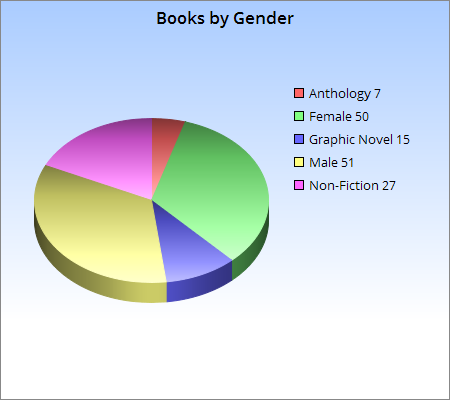
During 2014, I read 149 books, which is up by 1 on 2013. Thirteen of those books were published during 2014. I alternated genders for my long fiction reading, and managed to read 50 novels/collections by women authors and 51 by men. The rest of the books I read were either anthologies, non-fiction or graphic novels (well, bandes dessinées). Twenty-three of those novels, collections or anthologies, I read to review on SF Mistressworks. Two were for Interzone, and one was for Vector. The remainder I mostly blogged about here.
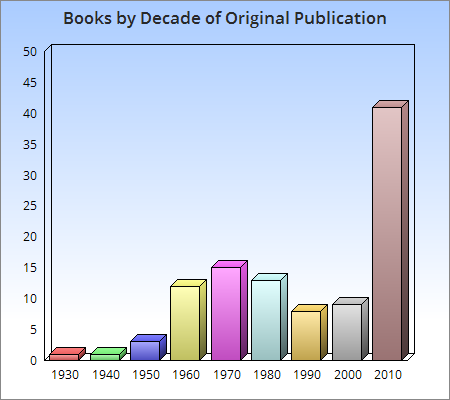
I don’t normally read so much recent fiction, but during 2014 I joined the Worldcon – although I later sold my membership and didn’t attend – which allowed me to nominate works for the Hugo Award. I also managed to read a number of 2014 books during the year. I suspect the high number of fiction books published between 1961 and 1989 is a result of reading for SF Mistressworks.
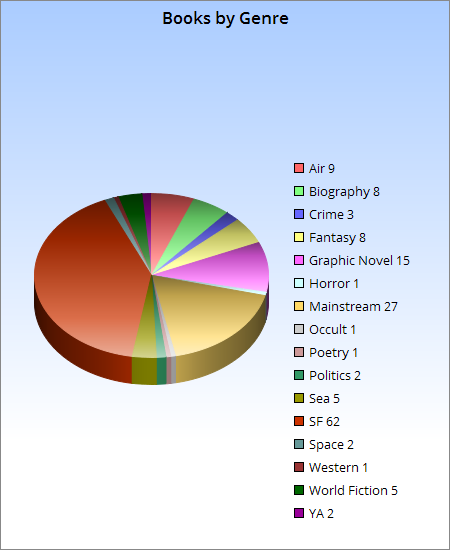
The bulk of my reading was, as is usual, science fiction at 41% – which is less than half, so that’s not too bad – and closely followed by mainstream (or literary) fiction at 18%. Fantasy manages 5% and horror only 1%. I did use a number of books on science fiction criticism and spaceflight as research for Apollo Quartet 4 All That Outer Space Allows, but the only research books I actually read were biographies.
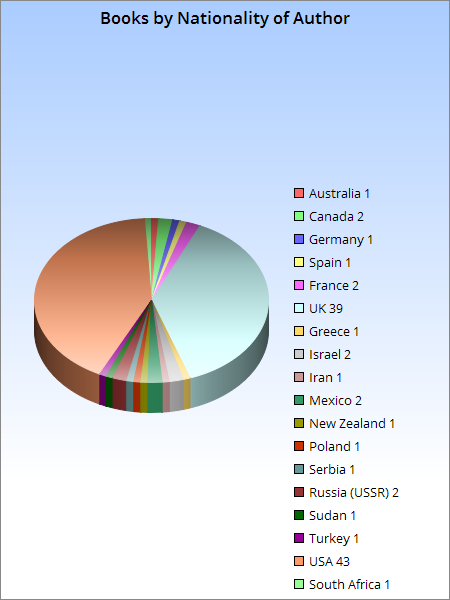
I should make more of an effort to read fiction by authors from other nations. More than three-quarters of my fiction reading was from the UK (38%) or USA (42%). But I did manage to read one or two novels/collections each from a further sixteen countries.
During 2014, I purchased – or was given, or sent for review – 217 books, of which 30 were published during 2014 and 23 were better editions of books I already owned. By the end of the year, I’d read 77 of those purchased books (although that figure does include books I’d read in earlier years but had not owned, or had purchased a better edition in 2014).
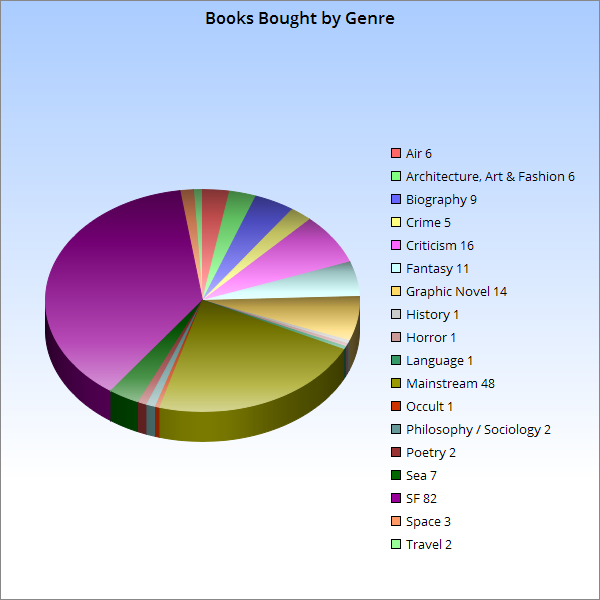
I had to munge a couple of categories together, due to the crappy chart-building website I’ve used. Even so, it’s clear that most of the books I bought were science fiction (38%), closely followed by mainstream (22%). I bought one horror book – a John Shirley collection – and, surprisingly, 11 fantasy books (most were probably freebies from Fantasycon). My book purchases by genre break down as:
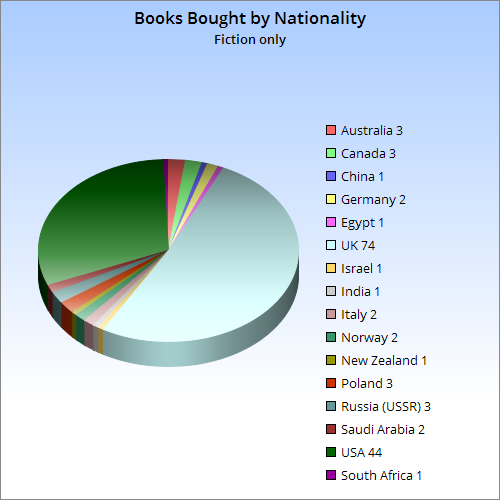
It seems just over half (51%) of the fiction books I purchased in 2014 were by Brits. Less than a third were by Americans. The remainder are scattered across fourteen countries.
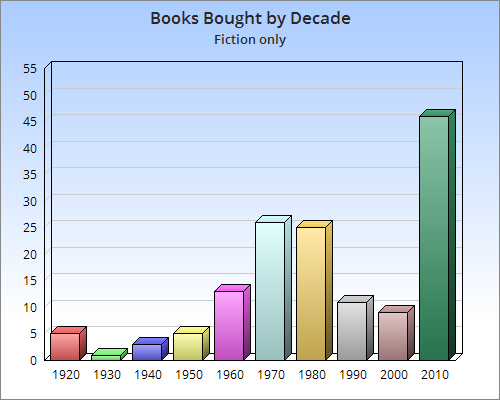
The relatively high number of fiction book purchases from the 1920s is a result of buying a number of DH Lawrence paperbacks. The high number for this decade is due to Hugo Award reading and my habit of buying books the moment they’re released by favourite authors who are still writing. Otherwise, it doesn’t surprise me that the 1970s is the next highest decade, although only just. That’s also likely a result of reading for SF Mistressworks.
If I’ve done my sums correctly, I bought 194 new books during 2014 but only managed to read 149. Which means the TBR has grown by 45. Some of those book purchases were for research or reference, so not really the sort of books you read from cover to cover – but still. So far I’m managing to keep the TBR manageable by dumping at charity shops books that I’ve belatedly realised I’ll never get around to reading – but I really ought to make more of an effort to get the humungous TBR down to more realistic levels. At the last count, given my average reading speed, I could probably go for a good five or six years without having to buy another book before I ran out of stuff to read.
films
In 2014, I started on a new viewing project: watching all the films on the 1001 Movies You Must See Before You Die list. I’d already seen almost half, but I still had plenty of titles to track down. Mostly, I’ve been using Amazon rentals, but not every film on the list is available there so I had to buy a few of them. As a result, 2014 proved to be, well, a year of lots of film-watching. And I mean lots. By 31 December, I had seen 369 films… which is 182 more than in 2013. Basically, I watched two years’ worth of movies in twelve months. I managed this chiefly because Amazon changed my rental agreement so they sent out replacement DVDs as soon as I returned the ones I had, which pretty much meant I had three rental DVDs every weekend throughout the year (149 in total over the year, in fact).
I documented many of the films I watched in fourteen Moving Pictures posts on this blog. I still have one more – the fourteenth – to post. It should go up in a few days. Not every film I watched was any good, but several did become favourites. Around a third were rewatches (29%), and that includes several rewatches of All That Heaven Allows. Ninety-one of the films were from the 1001 Movies You Must See Before You Die list (25%), which puts my final total at 541 out of 1001.
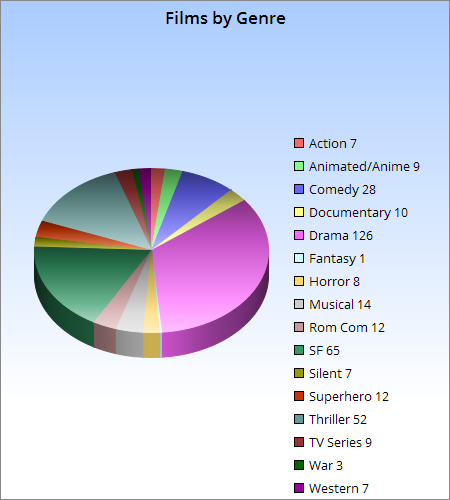
By genre, my viewing was, unsurprisingly, not dominated by science fiction – I’m not that big a fan of sf cinema. It accounted for only 18% of the films I watched. The biggest genre was drama at 34%. The actual breakdown is:
Incidentally, the television series category doesn’t include two series I didn’t manage to complete during the year – The Jewel In The Crown (I need to read A Division Of The Spoils before I watch the last few episodes) and From the Earth to the Moon (I rewatched selected episodes as research for All That Outer Space Allows).
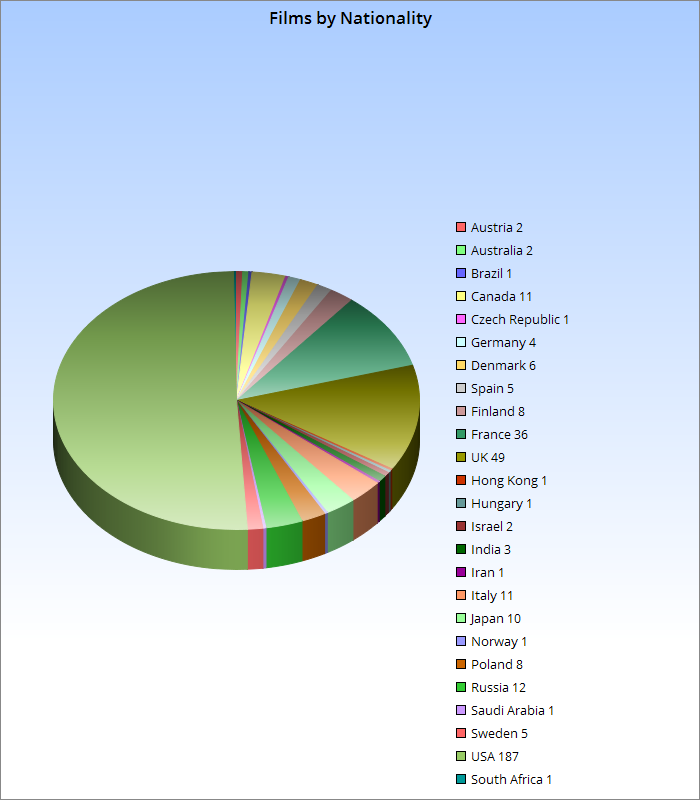
I’ve long been a fan of the cinema of nations other than the USA and UK – although those two nations do dominate my viewing. In my defence, most of the American films I saw in 2014 were classics. In total, I watched films from 25 different countries. Some films were actually multi-national efforts, in which case I’ve assigned them to whichever nation seemed dominant. The high number of Italian films is a surprise – I hadn’t realised I’d seen that many. Likewise for Russia… although I did rewatch several of Aleksandr Sokurov’s movies during the year. I’d expected Poland to score higher, given that I “discovered” both Piotr Szulkin and Andrzej Wajda during 2014. Denmark’s good showing will be from watching a bunch of films by von Trier and a rewatch of some Dreyer.
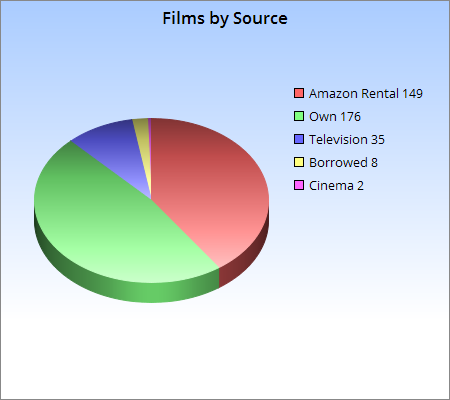
I mentioned earlier that the bulk of films I watched were rental DVDs – 40% of my viewing, in fact. But almost half were from own collection (48%). The actual figures break down as:
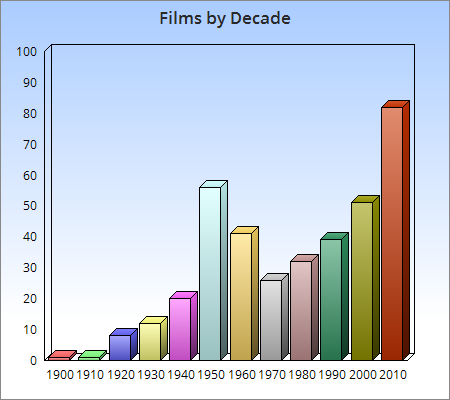
After claiming I don’t watch much twenty-first century Hollywood product, it seems most of the films I watched in 2014 were from the last four years. Oops. But at least the next highest decade was the 1950s. Altogether, I don’t think that’s too bad a spread. I could do with watching more films from the 1940s and 1970s. Likely I’ve seen most films released during the 1980s – or at least those I’d be interested in seeing from that decade. I’d like to watch more early cinema, but a lot of those films are hard to find on DVD – in the UK, anyway. In fact, the UK’s record on DVD releases is pretty poor.
I mentioned Piotr Szulkin earlier – I only got to watch his films because I ordered a DVD box set from Poland. I also bought several Region 1 DVDs, because the films had never been released in this country. And even a couple of Region A Blu-ray discs… only to discover my Blu-ray player was locked to Region B. Argh. That’s something I’ll have to address in 2015. There are even a handful of recent documentaries yet to appear in the UK that I really want to see – Jodorowskys Dune and James Cameron’s Deepsea Challenge, for example. As soon as I get myself a region-free Blu-ray player, I’ll be getting Blu-rays of those from the US. There are also several favourite directors whose oeuvres are incomplete in the UK, but not in other countries – such as Douglas Sirk, Aleksandr Sokurov, Andrzej Żuławski, Miklós Jancsó or Sergei Parajanov. Having said that, much praise to the BFI and Second Run DVD for continuing to release excellent films on DVD and Blu-ray.
The last bunch of books read in 2014… Almost. There’s one more I’m currently reading, but I’ll lead off my first reading diary post of 2015 with it. I’ll do a numbers post once the year is actually over.
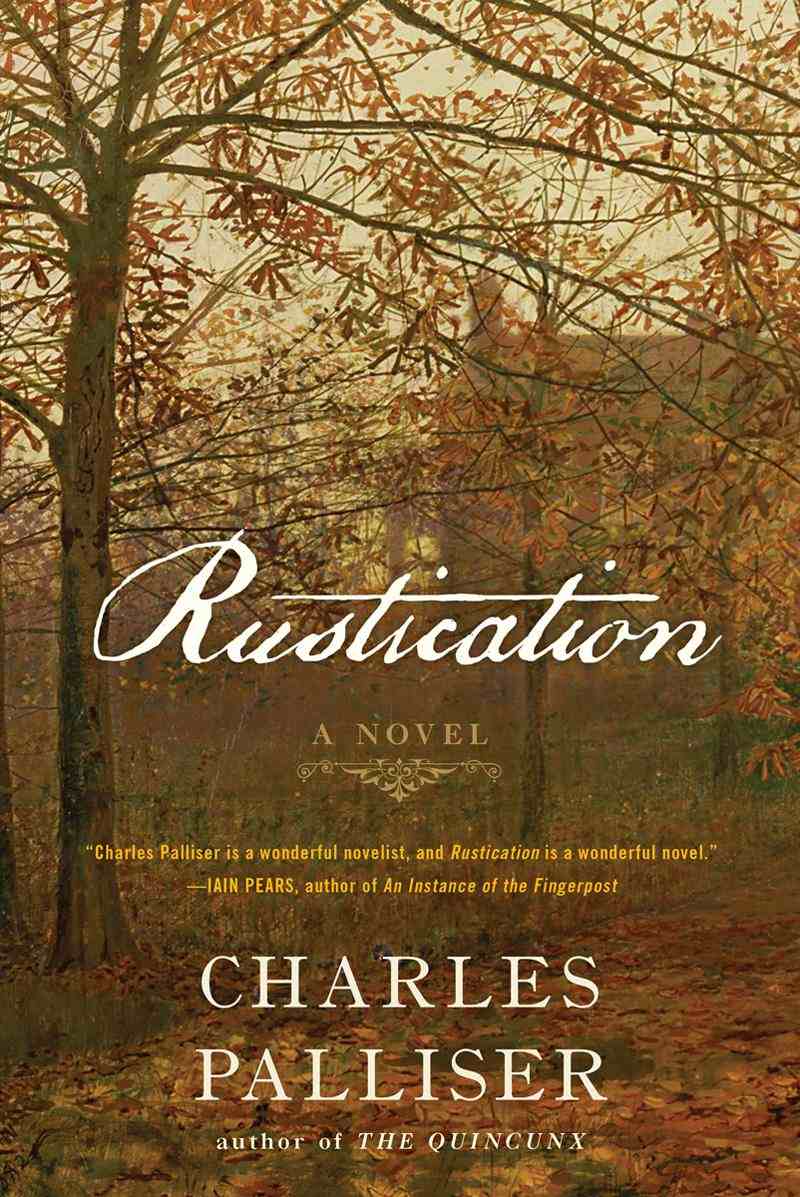
Rustication, Charles Palliser (2014) I’ve been a fan of Palliser’s works for years, but he doesn’t produce much. In fact, I thought he’d packed it in. But during this summer I’d spotted a new charity shop in town, near Fanoush, where I occasionally go for a falafel wrap at lunch-time. So one day after getting my wrap – they’re actually made with proper khubz, not stupid tortillas – I popped into the charity shop. And spotted Rustication. Result. The novel is set in 1863 over the Christmas holiday and takes the form of a journal, with anonymous letters inserted. Richard Shenstone has been rusticated from Cambridge after the suspicious death of a friend. His father died earlier in disgrace, and his near-destitute mother and sister are now living in a run-down house on the edge of a salt marsh near the town of Thurchester. Shortly after Richard’s arrival, someone starts sending obscene poison pen letters to the worthy women of the area and their daughters, and sneaking about at night and killing farm animals in horrible ways. Clues suggest Richard is responsible, although since it’s his journal which forms the narrative it’s clears it’s not him. Having said that, he does have an opium habit, which leads him to do a number of stupid things which make him look guilty. It all comes to a head when the local earl’s nephew and heir is murdered returning from an Assembly at which Richard had threatened him for compromising his sister’s honour. Rustication is pure Gothic, but tricked up as a literary thriller. It’s a slighter work than The Quincunx or Betrayals, but I’m still a fan.
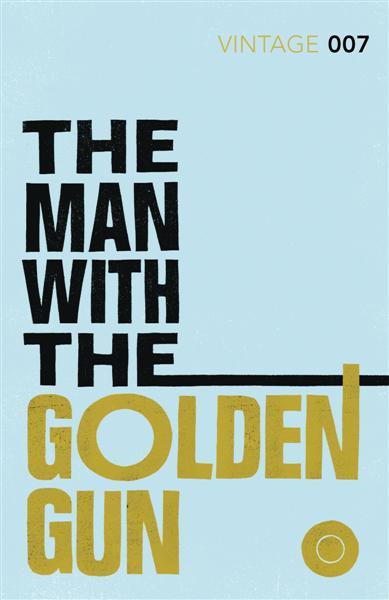
The Man with the Golden Gun, Ian Fleming (1965) There’s a story that Fleming had told people he planned to become a writer once World War II ended, but one of his upper crust friends told him, “Oh Ian, don’t. You don’t have the brains for it.” And he didn’t, you know. Have the brains for it. The 007 novels, and I’ve now read them all except for Octopussy & The Living Daylights (which is on the TBR), range from bad to terrible. And The Man with the Golden Gun is toward the terrible end of the scale. Of course, the film bears no resemblance to it. (The only film which follows the plot of the novel is Thunderball, and that’s because it’s actually a novelisation of the script… and a rights battle between Fleming and four others subsequently tied up the title for decades.) In The Man with the Golden Gun the novel, Scaramanga plies his trade in the Caribbean and has links to the Castro regime. Bond has been sent after him because he returned from You Only Live Twice brainwashed by the KGB to kill M. But now he’s had electro-shock therapy and he’s back to his normal self. M is still wary, however: hence the mission to terminate Scaramanga. Either Bond will prove his mettle, or Scaramanga will get rid of an embarrassing loose end. Bond stumbles across a clue revealing that Scaramanga is in a town in Jamaica, heads there, meets the man in a brothel, and is hired as security for an upcoming meeting Scaramanga is hosting at his half-finished luxury hotel nearby, where “investors” (ie, mobsters) will be persuaded to hand over more cash to finish the hotel. Scaramanga talks like a hoodlum from a cheap television series, Bond is his usual two-dimensional self, and Fleming can’t resist getting in his usual offensive digs at homosexuality, women and non-whites. Parts of the novel simply don’t ring true at all, as if Fleming has done little or no research; the only bits that are convincing are his descriptions of the countryside (Fleming, of course, lived in Jamaica). As with the bulk of the Bond books, you’re better off sticking with the film.
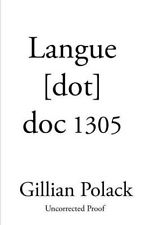
Langue[dot]doc 1305, Gillian Polack (2014) A team of scientists have been sent back in time to the titular place and time, and they have a single historian with them – who was parachuted in at the last minute after the original two historian members of the team pulled out. Artemisia Wormwood, however, is not an expert on 14th-century Languedoc, but on mediaeval saints. Fortunately, she knows considerably more about the time and place than the scientists, who are there to refine their theory of time travel and investigate the natural environment. The team set up in a system of caves under a hill beside the village of St-Guilhelm-le-Désert and, while they keep apart from the villagers (only Wormwood speaks old French, and she does that haltingly), they make no secret of their presence. In fact, the scientists behave like a bunch of spoilt kids. They don’t seem to care about the impact they may be having on the lives of those in the village. Wormwood acts as an unofficial liaison between the two groups, via disgraced knight Guilhelm. This one is definitely a slow-burner. Not much happens during the course of the novel, it’s more a diary of incidents experienced by the time team. However, it definitely packs a sting in the tail. The prose is polished, Polack evokes her period extremely well, and the whole thing is very readable if somewhat languidly paced. I thoroughly enjoyed it.
The Race, Nina Allan (2014) Allan’s first novel-length piece of fiction is actually four linked novellas, and also very lightly meta-fictional. I wrote about it here.
From the Legend of Biel, Mary Staton (1975). This was the first book of the second series of Ace Specials. I read it for SF Mistressworks. My review is here.
The Moon King, Neil Williamson (2014). I’m working on a longer review of this, so I’ll just mention it in passing here. I will say, however, that I enjoyed it much more than I had expected to. (I’ve known Neil for ages, so I expected it to be well-written, but had thought it wouldn’t be quite to my taste – I was wrong.) Anyway, a post on this novel should appear here soon-ish.
The First Fifteen Lives of Harry August, Claire North (2014). Found this in a charity shop, had heard it mentioned here and there, understood it to be not unlike Kate Atkinson’s Life After Life (which I thought good), so decided to give it a go. And yes, I did enjoy it. The prose is nice and breezy, the central premise – people who relive their lives over and over again – was handled quite cleverly, and the eponymous protagonist was sympathetic and plausible. Plot-wise, the book is less successful – although hinted at on the first page, the plot didn’t actually kick into gear until over halfway in, and even then it spent more time on the silly maguffin at the core of the book than it did the far more interesting process by which the villain removed all his enemies. I’d seen mention of North’s Touch, due out early in 2015, and thought it might be worth a go. On the strength of The First Fifteen Lives of Harry August, I’ll almost certainly be picking up a copy.
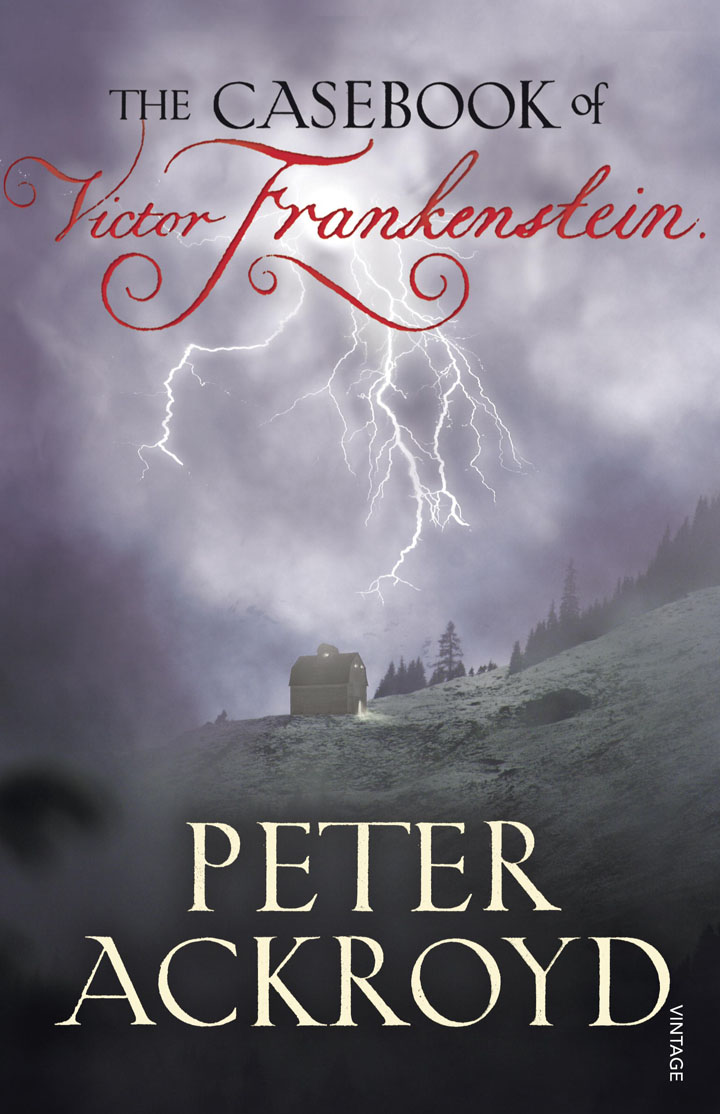
The Casebook of Victor Frankenstein, Peter Ackroyd (2008). Victor Frankenstein, a young man from Switzerland, joins Oxford University, where he meets Percy Bysshe Shelley. The two become friends, although their interests only just coincide – Frankenstein wants to understand how life is created, and focuses his investigations on reanimating dead bodies using “the electrical fluid”, whereas Shelley’s investigations are more metaphysical. Even after Shelley is expelled, the two remain close – Frankenstein even moves to London to be near him. In order to further experiment, Frankenstein contacts some “resurrection men” and has them deliver cadavers to his laboratory in Limehouse. Most of his experiments are failures, but when he is handed the body of Jack Keat, a few short hours after he committed suicide (he was dying of consumption), Frankenstein successfully brings him back to life… And you just know the story going to end up at the Villa Diodati. Ackroyd takes a few liberties with Shelley’s life, and Byron comes across as a dickhead, but the whole adds up to an entertaining take on the Frankenstein story and the Romantic poets. The period detail is impressively handled, Frankenstein is a sympathetic narrator, and there are a number of neat touches to the scientific thought of the day which I found amusing. A good book.
The Female of the Species, Carol Joyce Oates (2006). My second Oates. This one is a collection of short stories, many of which originally appeared in genre magazines. I think I can safely say now that Oates doesn’t quite work for me. According to the blurb, in these stories “women are confronted by the evil around them and surprised by the evil they find within them”. I thought the most successful story was ‘Madison at Guignol’, in which a trophy wife polished to a lacquer-like gloss learns of a secret door at one of her favourite high-end boutiques and insists on admittance through it: Fifth Avenue meets Gothic horror. Another one I liked was ‘Hunger’, a much longer piece about a bored wife who, after a holiday affair with a younger man, is horrified when he turns up at her home. Even though she loves him – though it seems to be more of a passion – she’s not willing to jeopardise her marriage. Not all of the stories worked for me – the one about the nurse felt too much like reportage, in some of the others the prose seemed too focused on effect rather than the story. The reason for Oates’ stature is plain to see in this collection, but there are other writers I’d sooner read.
The Martian, Andy Weir (2014). This is an odd one. The book has been hugely successful, so much so Ridley Scott is apparently making a film of it. Yet most of the praise for the book I’ve seen has been outside fandom. Is this because the book was originally self-published, and did so well on Kindle it was then picked up by a major imprint? Or is it that hard science fiction has fallen out of favour with genre fandom? Actually, I think it’s neither, but rather the fact that a) The Martian is a resolutely commercial book, and in style and approach has more in common with technothrillers than it does science fiction novels, b) it is completely hollow, there’s no meaty idea for a sf reader to get their teeth into, and c) it’s actually not very good, just pages and pages of a very irritating narrator explaining how he managed to survive on Mars after accidentally being left behind. It’s basically “Home Alone on the Red Planet”, with the planet itself playing the part of the inept burglars. (Sticking Val Kilmer, or his lookalike, on the cover, probably didn’t harm its chances either.) The original self-published novel has been padded out with scenes set at NASA, as they learn the narrator, Mark Watney, is still alive and then set about putting together a rescue plan. But the characterisation is paper-thin and everyone sounds pretty much the same. Watney’s various predicaments are interesting, and some of his solutions are mildly clever – but Weir throws so much bad luck at him, it soon beggars belief. We also get little real idea of what it would be like to be on the surface of Mars. A handful of mentions of the 0.4G, no mention at all of the surface radiation, but lots about the cold. Lots. It was also my understanding that at such low atmospheric pressures, gale-force winds would actually cause very little damage. The Martian could have taken place pretty much anywhere, even the Antarctic, and very little would need to change (well, the technology would have to be dialled down a little). I’m completely mystified by all the praise this book has been receiving. We might as well claim Clive Cussler’s latest sweatshop effort is one of the best sf novels of the year…
I first came across Allan’s fiction in Interzone, and while her stories always struck me as well-written, there was a vagueness to some of the details in them which never quite rung true for me. ‘Flying in the Face of God’, which was shortlisted for the BSFA Award in 2010, is a case in point. The relationship between the two central characters is handled beautifully, but the story is also about a space programme for which one of them has been selected. And something about that space programme felt unconvincing. A recent reread of the story in the collection Microcosms did not change my mind.
Of course, many people will say I’m missing the point of the story – or rather, by focusing on that one aspect, I’m missing what the story is about. And that’s almost certainly true. But a story is more than the sum of its parts, and a failure in one of those parts can throw the whole out of balance. It’s entirely subjective, of course – I can admire a story like ‘Flying in the Face of God’, without thinking it as good as everyone else seems to. And one thing I do admire about the story is Allan’s facility at creating worlds slightly off-kilter from ours, ones just strange enough to unsettle without seeming completely unfamiliar. Which brings us to The Race, her first piece of novel-length fiction.
The Race comprises four novellas, titled ‘Jenna’, ‘Christy’, ‘Alex’ and ‘Maree’ after their narrators. Jenna lives in Sapphire, a town on the edge of Romney Marsh, in a future that is plainly not our own. Her brother, Del, manages a dog track, where smartdogs are raced by “runners”, people with an empathic connection to the smartdogs mediated by implants. ‘Jenna’ is essentially a family history and an exploration of Jenna’s small world (we learn very little of the world outside Sapphire). Jenna becomes a maker of handmade gauntlets for the runners, and Del gets married and has a baby girl. A few years later, the girl is kidnapped, and it transpires Del was involved with drug dealers and owes them money for a missing shipment.
Christy, on the other hand, lives in our world. Her father and brother run a house clearance firm. ‘Christy’ focuses on Christy’s relationship with her brother, Derek, and his girlfriends. First Monica, and then Lin. Derek is a thug and a nasty piece of work. After he sexually assaults Christy, she leaves for London and university. She becomes a writer, and ‘Jenna’ is revealed as one of her stories. It is during one visit home that she meets Lin, who Derek tells her he will marry. But then Lin disappears, and Christy fears her brother may have murdered her.
Alex is the ex-boyfriend of Lin, and a journalist based in London. He is contacted by Christy – several years have passed since the central events of ‘Christy’ – who asks him to come and visit her in her home in Hastings. She asks him about Lin, and he describes an incident when Derek assaulted him because Lin had come to talk over her fears about Derek. Alex also reveals that Lin is alive and well, as he saw her in the street several years later but she blanked him.
The final novella is set in an alternate UK. Maree is an orphan and an empath, and she leaves her home in Scotland to cross the Atlantic to work on a secret project in Thalia (which seems to be a country in South America). This world also has smartdogs and shares some elements with that of ‘Jenna’ – in fact, it may be the same one but the narrow focus of ‘Jenna’ concealed the parts in ‘Maree’ that are invented. And the invention in the novella is… odd. Some places – London, Inverness – have the same names as real places; others do not – Lilyat (Lisbon?), Bonita (Buenos Aires?), Kontessa… And then there are the whales. Much of ‘Maree’ takes place aboard a ship crossing the Atlantic. This is considered a hazardous journey as convoys of whales sink ships when they come across them. And chief among the whales is the “baer-whale”, which is bigger than most ships. Maree discovers during the journey, from a fellow passenger who admits he is a private detective who had been hired to find her, that she is Del’s missing daughter from ‘Jenna’, and that she wasn’t kidnapped because of the drugs but because she is a natural empath. In other words, she doesn’t need an implant. This also means she is gifted at acquiring languages. The secret project she is joining is trying to translate alien messages from outer space.
The things that are good about The Race are the things that Allan is good at. The mosaic structure plays to her strengths in that it allows for a tight focus over a relatively short wordcout. However, it also reveals a weakness: the links between the novellas are not quite strong enough to hold the novel together. Take the murder which appears in ‘Christy’ and ‘Alex’. Christy is afraid her brother killed Lin, but the truth is revealed in passing by Alex. Which makes the resolution of it, and the relief Christy must feel, completely secondhand, robbing it of any emotional impact. It’s not central to either novella, of course, but it feels like one of those details which never quite rings true. Which is not to say that every detail rings false. One of Allan’s strengths as a writer is the off-focus lens she shines on the worlds of her stories, and she does this by changing some details, such as the names of places, so that everything feels slightly off-kilter, and by keeping the relationships between the characters firmly at the centre of the narrative and the plot beats somewhere to the side. This is something that is more obvious in The Race than other works because each of the novellas exists at the edges of the preceding one.
The writing throughout is, unsurprisingly, very good, and the characters are drawn extremely well – although if Jenna, Christy and Maree seem a little similar that’s an artefact of the structure, I suspect. As is the novel’s lack of, well, plot. The two science-fictional novellas wrap the real world ones, when you’d expect the reverse to be the case; but Christy’s life – since ‘Alex’ too is about that – doesn’t really provide a key to ‘Jenna’ and ‘Maree’. The mystery which exercises Christy for years does sort of map onto the disappearance of Jenna’s brother’s daughter. And Maree does end up with a completely new life, much as Alex reveals Lin to have. Even then, revealing what happened to Del’s daughter doesn’t really resolve anything, as ‘Maree’ only catapults her into a new, and unsolved, mystery. I’m also not really sure what role the dog racing plays, or why it provides the title, since it only appears in ‘Jenna’, which is Christy’s creation anyway.
The end result is, I think, one of 2014’s more interesting genre novels, and certainly proves Allan is a writer to watch. I’m not convinced The Race is wholly successful, but it’s definitely a worthy attempt. If it doesn’t quite match another 2014 genre mosaic novel, Paul Park’s All Those Vanished Engines, that’s probably because Park goes full-on metafictional, and Allan sort of nibbles at the edges and never quite commits. Or perhaps it’s just that Allan’s form of metafiction is less overt – it lives within her stories rather than providing the stories’ building-blocks. Having said all that, I won’t be surprised if The Race appears on one or two shortlists next year.
This is something Joachim Boaz (see here) and some other bloggers did yesterday, and I was then challenged by Joachim on Twitter to produce my own list. Ten books I think Gollancz should add to their SF Masterwork series. There are a number of “rules”, to be followed at your own discretion: one book per author; no books by an author currently in the series; and a goodly number of years between publication and 2014 – I chose twenty years, so a publication of date of 1994 or older. Of course, this list totally ignores any rights issues that might prevent Gollancz from including the books.
So, in chronological order of publication…
The House That Stood Still, AE van Vogt (1950) I’m surprised there’s no van Vogt in the SF Masterwork series – he was, after all, hugely popular for many decades. Admittedly, most of his books are complete tosh, and he was second only to Philip K Dick in making shit up as he went along (and there is, of course, at lot of Dick in the series). But I still rate The House That Stood Still (AKA The Undercover Aliens). I once described it as “if Philip Marlowe and Flash Gordon had a baby, it would look like this book”, and I stand by that description.
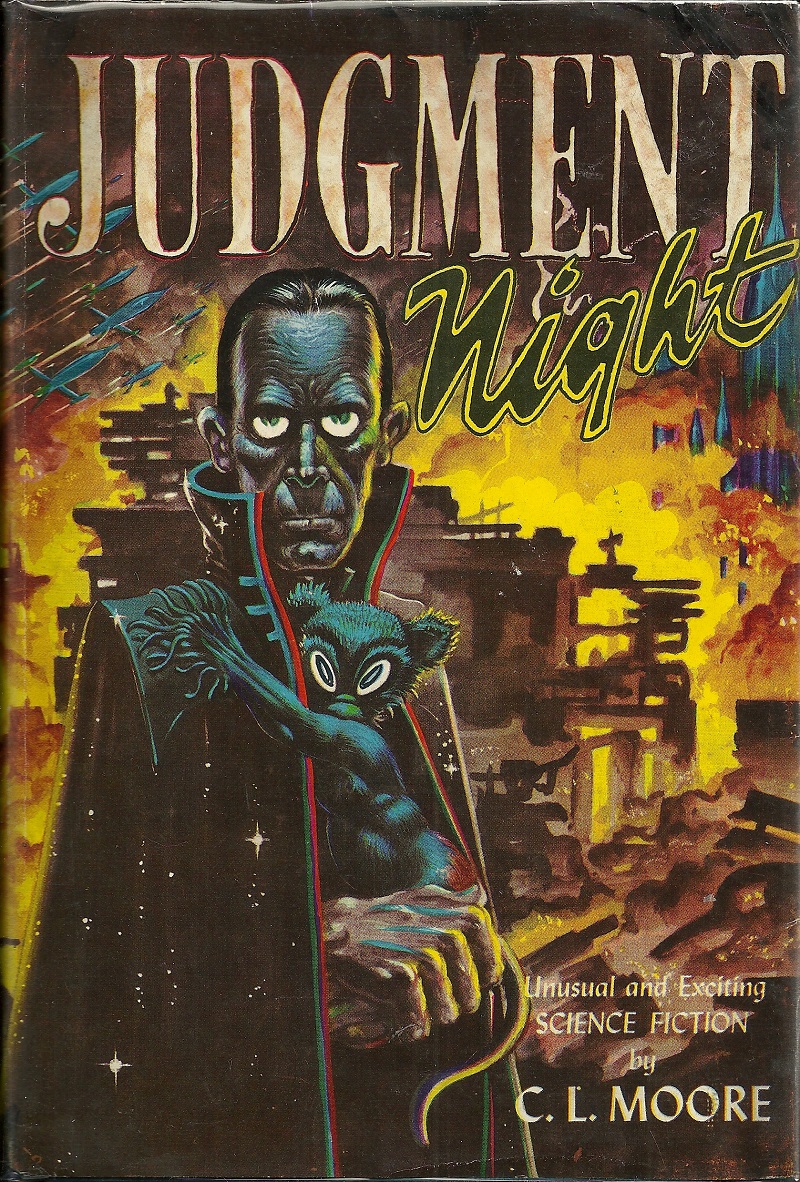
Judgment Night, CL Moore (1952) I will admit I wasn’t expecting much of this short novel when I read it – a typical piece of Planet Stories space opera nonsense, I thought. But it proved to be a lot more interesting than I’d expected. The plot is relatively straightforward, but the characterisation of the protagonist, the warlike Princess Juille, is clever, and there are some really interesting ideas in the world-building. It’s a very short novel, however, only 156 pages in its first paperback publication; so perhaps it ought to be bundled with another of Moore’s novels, or a Northwest Smith novella, or something. I reviewed Judgment Night on SF Mistressworks here.
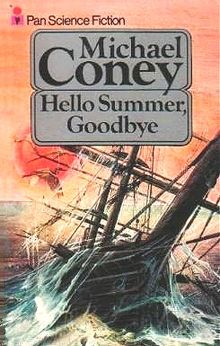
Hello Summer, Goodbye, Michael G Coney (1975) There are few sf novels written from the viewpoint of the alien, and among them even fewer in which humans never appear. Hello Summer, Goodbye is an elegiac coming-of-age novel set on an alien world with an entirely alien cast and an alien culture. And it works really well. It’s also a lovely piece of writing. I’m actually surprised this hasn’t appeared in the series yet. There is a sequel, I Remember Pallahaxi, which I’ve not read.
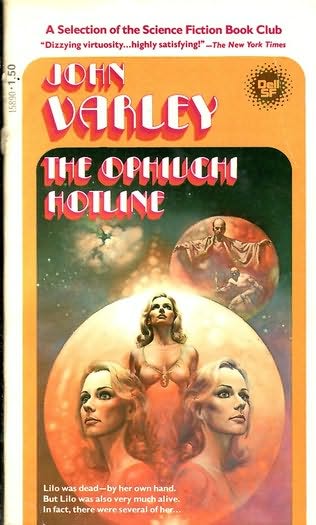
The Ophiuchi Hotline, John Varley (1977) Varley’s Eight Worlds – in which the mysterious Invaders threw humanity off the Earth, so we now eke out an existence on various moons – is one of sf’s more memorable middle-distance futures, and while he explored it to better effect in numerous stories, The Ophiuchi Hotline is the first of three novels set in that universe. It’s also the best of them. The ending throws away an entire novel’s worth of ideas in a single paragraph, but the journey to that point is strange and wonderful.
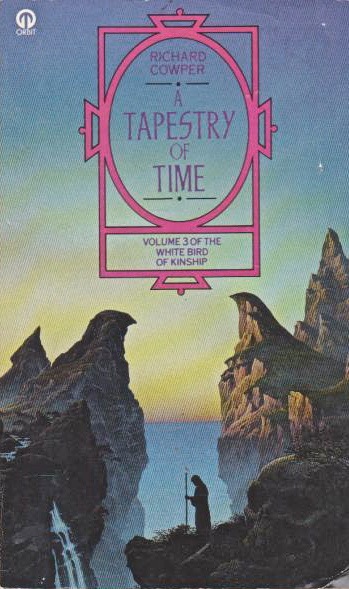
The White Bird of Kinship, Richard Cowper (1978 – 1982) This one is a bit of a cheat as it’s an omnibus of three short novels – The Road to Corlay (1978), A Dream of Kinship (1981) and A Tapestry of Time (1982). There’s also a novella, ‘Piper at the Gates of Dawn’, which inspired the novels, so perhaps we should throw that in as well. The story is set in a UK after water levels have risen so the country now comprises many small islands. It is very British sf. The SF Gateway has published the four in an omnibus, but it belongs in the SF Masterwork series too.
Serpent’s Reach, CJ Cherryh (1980) I’m guessing rights issues have prevented Cherryh from appearing in the SF Masterwork series so far. Because given her stature in the genre during the 1980s, she certainly qualifies for inclusion. Of course, there is then the question of which book to include… My favourite is Angel with the Sword, but it’s not her best. Downbelow Station and Cyteen are worthy contenders, but I plumped for Serpent’s Reach because its plot is closer to heartland science fiction.
Queen of the States, Josephine Saxton (1986) There are lots of books in the SF Masterwork series which never got within sniffing distance of an award, so why ignore one that appeared on two shortlists during its year of publication? Queen of the States was shortlisted for both the BSFA Award and the Clarke Award in 1987 – it lost out to The Ragged Astronauts, Bob Shaw, and The Handmaid’s Tale, Margaret Atwood, respectively. Queen of the States is also a great novel. I reviewed it for SF Mistressworks here.
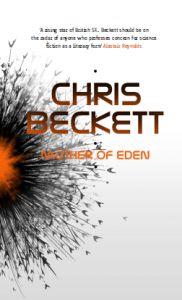
The Wall Around Eden, Joan Slonczewski (1986) I picked up this book and read it just so I could review it on SF Mistressworks – see here. I knew very little about it or the author, so I was somewhat surprised to discover it was a masterclass example of accessible science fiction. It is one of the best-constructed sf novels I have come across, and I’m surprised it’s long out of print. It needs to be introduced to a new audience. As soon as possible.
Kairos, Gwyneth Jones (1988) This is one of my favourite sf novels and appears pretty much on every “top” or “classic” science fiction list I put together. It’s set in a Thatcherite near-future of its time of writing which, of course, now makes it alternate history – but it captures the fears and anxieties of that period with clinical precision. And it’s beautifully-written. In many ways, Kairos prefigures Jones’s Bold As Love sequence in that it remakes the political landscape of the UK using people outside mainstream culture as catalysts. Sf authors don’t write enough of this sort of science fiction.
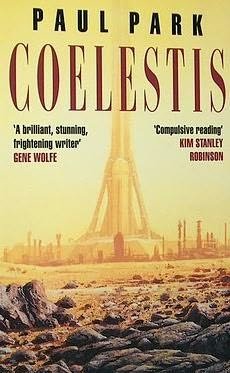
Coelestis, Paul Park (1993) Another favourite science fiction novel and mainstay of the various “best” sf lists I put together on this blog every so often. An intelligent commentary on postcolonialism – a subject not often explored in sf, which seems to prefer rehashing First World colonialist imperatives of earlier, and less enlightened, centuries – Coelestis then goes on to deconstruct the colonial identity of one of its protagonists. An important book that deserves to be back in print.
There were a further two books I would have liked to include in my list of ten, but since both authors already had entries in the SF Masterwork series I ruled them ineligible. And one was a bit of a cheat, anyway. They were Synthajoy, DG Compton (1968), which I think is actually a better book than The Continuous Katherine Mortenhoe (Compton’s only entry in the SF Masterwork series), though it reads a little more dated than that book; and The Collected Joanna Russ, because Russ is an author who deserves to have all her fiction collected together into big career-defining collection, and the SF Masterwork series is the perfect venue for that.
This time last year I said 2013 hadn’t been a particularly good year, but this year has been worse. Admittedly, last year felt bad, but quite a lot of good stuff happened during it – including winning the BSFA Award. This year… well, the event of 2014 was Loncon 3, and I chose not to go to it (for a variety of reasons which felt right at the time). I did, however, attend the Eastercon in Glasgow, Edge-lit in Derby and Fantasycon in York. No trips abroad, sadly. I also went to Bloodstock Open Air festival, and it was a good one.
Only three of my stories saw print in 2014. ‘Waters of Lethe’ appeared in Perihelion SF in June; ‘The Spaceman and the Moon Girl’, my first ever sale to a literary magazine, appeared in Litro #137 in September; and ‘Far Voyager’ provided the title to the latest Postscripts anthology, #32#33 Far Voyager, in November. Another two stories were due to appear in an anthology this year, but its appearance has been delayed.
Speaking of delayed… I’d hoped to have Apollo Quartet 4 All That Outer Space Allows out in 2014. My initial hope was to have it ready for Loncon 3, but by July I was still busy doing research. And sort of feeling out the story and how I wanted to tackle it. Once I started writing it, and decided it was going to be a short novel rather than a novella, publishing it by the end of the year seemed unlikely. So it’s going to be a 2015 release and I’m aiming for the second half of January.
I’d used MPG Biddles to print the paperback editions of Apollo Quartet 1 Adrift on the Sea of Rains and 2 The Eye With Which The Universe Beholds Itself, but they went bust in June 2013. So I had to use Amazon’s CreateSpace for book 3 Then Will The Great Ocean Wash Deep Above. And now that I’m running low on my stock of books 1 and 2 in paperback and would have to use CreateSpace to replenish… I decided it was a good opportunity to produce a second edition of each. New cover art, such that all four books will look like a set; and even some bonus material to up the page-count as CreateSpace can only put lettering on the spine for books of more than 100 pages. One advantage of this is that Amazon will print and carry its own stock, so I won’t make a loss every time I sell them a book. I’m also hoping shiny new editions will give sales of the books a kick in the pants – as too will the appearance of book 4 All That Outer Space Allows. As of 12 December 2014, sales of books 1,2 and 3 stand at 1,160, 540 and 255 respectively.
All of this had unintended consequences for another project I was working on: Aphrodite Terra, a mini-anthology of six stories about the planet Venus. Again, I’d planned to have it out for Loncon 3, but that didn’t happen. And given the amount of work I’ve ended up doing in the last quarter of this year, I’ve had to knock that into early 2015 too. I hope it’ll be worth the wait.
On the non-fiction front, I was interviewed at the beginning of the year by some Spanish bloggers – the Spanish-language version appears on Leticia Lara’s Fantástica Ficción here, and the English version is on Odo’s Sense of Wonder here. I was also interviewed on Confessions of a Book Geek for Sci-Fi November. I reviewed 23 books for SF Mistressworks and 3 books for Interzone. I also started a new reading project: postwar British women writers. Only two books read so far – by Storm Jameson and Susan Ertz – but it’s an informal, unstructured reading project so there’s no rush. I also contributed a pair of ‘Friday Fives’ to Pornokitsch: 5 Trips to the Moon in June and 5 Pieces of Soggy Sci-Fi Cinema in August.
2015 should prove… interesting. I’m determined it will be a more productive year than 2014 has been. Once All That Outer Space Allows and Aphrodite Terra are out, I plan to get started on a literary hard sf novel. I also have a stand-alone novella I’d like to write. And some short stories – I have several I started this year but never quite managed to finish. Toward the end of 2015, I’d like to gather together my space fiction stories and publish a short collection through Whippleshield Books. I also have another little project I’m considering tackling, a sort of pendant to All That Outer Space Allows. But we’ll see how everything goes.
It’s that time of year again, when everyone is doing their best of the year lists. For some people, it’s the best of what was released during the year in question, for others it’s the best of what they consumed. For me, it’s the latter. While I’ve done better this year reading, watching and listening to new stuff, the bulk of the books, films and albums I’ve enjoyed are from previous years, decades and, er, even centuries.
For a change, this year I’ve included the positions of items from my best of the half-year (see here). That’s the number in square brackets after some of them.
books
I did some reading for the Hugo in the early part of the year, and a couple of those books make it into this post – although they didn’t make it onto the Hugo shortlist. But then the Hugo didn’t exactly cover itself in glory with its fiction categories this year. My top five includes three favourite authors, one new to me, and another who I’d read before.
1Dark as the Grave Wherein My Friend is Laid, Malcolm Lowry (1968). Lowry came first last year as well, with Under the Volcano, so clearly my love for the man’s prose remains undiminished. This one, however, is a meta-fictional novel, and I do like me some meta-fiction. I wrote about it here.
2All Those Vanished Engines, Paul Park (2014). And this is another meta-fictional novel, but constructed from three separate novellas. One of those novellas, Ghosts Doing the Orange Dance, made my best of the half year list. I wrote about it here.
3Life After Life, Kate Atkinson (2013) [1]. I read this for my Hugo nominations, and was surprised at how effortlessly good it was (it’s the first Atkinson I’ve ever read).
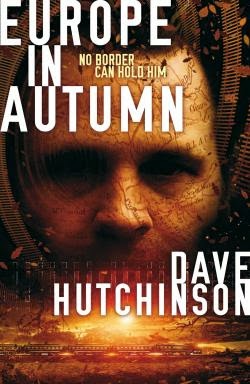
4Europe in Autumn, Dave Hutchinson (2014) [5]. I fully expect this to be on a couple of award shortlists in 2015. I’m also very much looking forward to the sequel.
5Home, Marilynne Robinson (2008). Just lovely writing. And, for me, a more believable character-study than Gilead.
Honourable mentions: Daughters of Earth, Justine Larbalestier, ed. (2006), excellent anthology of historical sf, with critical articles; Shaman, Kim Stanley Robinson (2013), Ice Age adventures from a writer I’ve long admired who seems to be entering something of a golden period; The Machine, James Smythe (2013) [3], Ballardian near-future, bleak but lovely writing; Busy About the Tree of Life, Pamela Zoline (1988) [4], excellent collection and the author’s only book, which I reviewed for SF Mistressworks here; HHhH, Lauren Binet (2013) [HM], meta-fictional treatment of the assassination of Reinhard Heydrich in 1942; Queen of the States, Josephine Saxton (1986) [HM], very good but not quite categorisable novel, I reviewed it for SF Mistressworks here; The Towers Of Silence, Paul Scott (1971), the third part of the Raj Quartet and featuring the brilliantly-drawn Barbie Bachelor.
films
It was a good year for films. Not only did I see many films but I also saw many good ones. Hence the somewhat large number of honourable mentions.
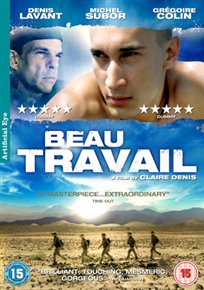
1Beau Travail, Claire Denis (1999, France) [1]. This was my No. 1 back in June, and it still is in December. A beautifully-shot film whose final scene lifts it from excellent to superb.
2Mięso (Ironica), Piotr Szulkin (1993, Poland). This became an immediate favourite the moment I watched it. A history of Poland under communism told by an amateur cast using meat products as illustration? With dance interludes? What’s not to love?
3Man of Marble, Andrzej Wajda (1976, Poland). I’d seen the sequel to this, Man of Iron, earlier in the year and thought it good, but this film is so much better.
4Under The Skin, Jonathan Glazer (2014, UK) [2]. Beautiful and enigmatic, by far the best science fiction film to appear in cinemas in 2014. And a great improvement on the novel too.
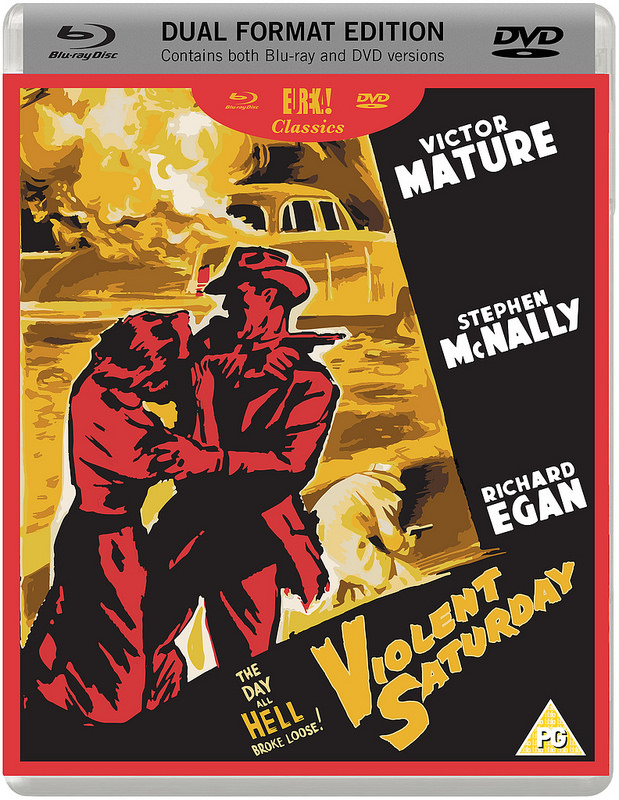
5Violent Saturday, Richard Fleischer (1955, USA). I like 1950s melodramas, I like noir thrillers. So how could I not like a film that combines the two? In glorious Technicolour too.
Worst films: The Philadelphia Experiment, Paul Ziller (2012), dreadful remake with the crappiest CGI ever; Dr. Alien, David DeCouteau (1989), horribly unfunny straight-to-video comedy; Stranded, Roger Christian (2013), really bad cross between Alien and The Thing set at a base on the Moon, Christian Slater’s career has really gone downhill; Starship Troopers: Invasion, Shinji Aramaki (2012), CGI shoot-em-up with as much subtlety as an arcade game and a gratuitous female nude scene… in CGI; huh?
albums
During the summer, I started exploring bandcamp.com. I was aware of it, of course, and had even bought a couple of albums from it in previous years… but I’d never really made an effort to see what was on there. Lots of really good metal bands, it seems. That’s how I stumbled across In Vain, who quickly became a favourite. Toward the end of summer, I had to upgrade the Debian distro on my work PC, and afterwards the soundcard started working properly – which meant I could stream music at work, rather than just listen to my iPod. And that led to even further explorations of bandcamp.com. All of which means my top five for the end of the year bears no resemblance to the one from my best of the half-year. And of the five bands listed, four of them I discovered on bandcamp.com.
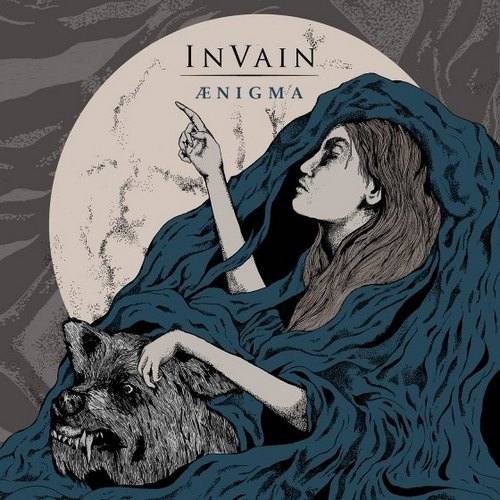
1Ænigma, In Vain (2013, Norway). I discovered this band in back in July and immediately bought all three of their albums. I wish I could nominate all their albums, but that would be unfair, so I’ll limit myself to this, their latest.
2Mantiis, Obsidian Kingdom (2014, Spain). The only band on this list I didn’t discover through exploring bandcamp.com. Because I saw them perform at Bloodstock. And they were excellent. So I bought the album as soon as I got home.
3Kentucky, Panopticon (2012, USA). Black metal and blue grass… who knew it would actually work? And it does, more so on this album than Panopticon’s others. The subject matter is also unusual – not the usual black metal occult nonsense, but the exploitation of miners in the titular US state.
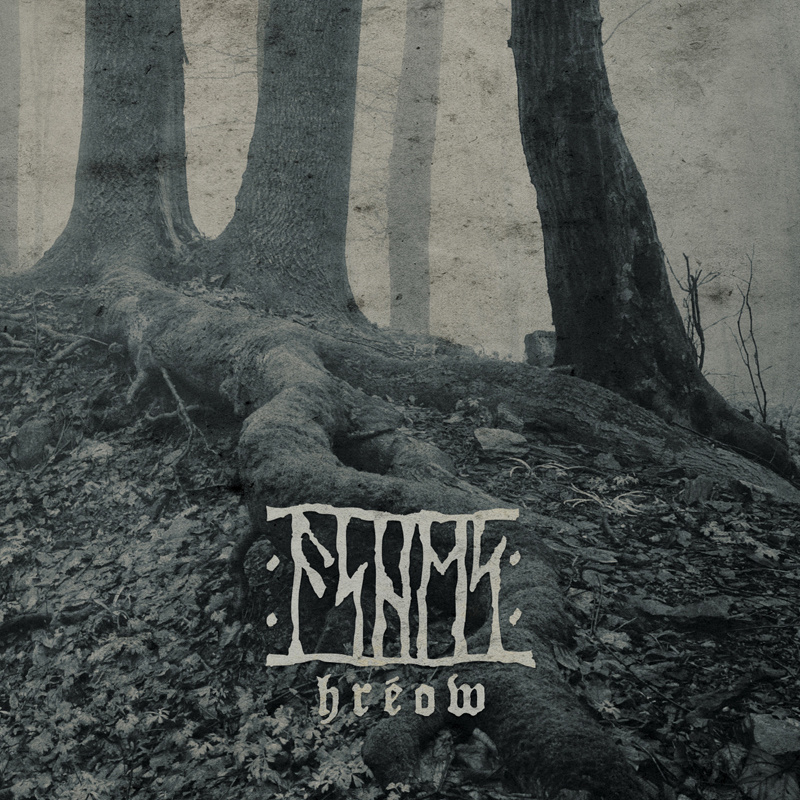
4Hrēow, Ashes (2014, UK). Does for Scotland what Winterfylleth does for England.ETA: Er no, they don’t. I seem to have got confused with Falloch, who are Scottish. Ashes are actually an English atmospheric black metal (from Devon, in fact), and a very good English atmospheric black metal too.
5Citadel, Ne Obliviscaris (2014, Australia). The last thing you expect a progressive metal band to do is go all Rondo Veneziano on you, but that’s what this album does in places. And it works really well.
Honourable mentions: Shadows Of The Dying Sun, Insomnium (2014, Finland) [1], the dictionary definition of Finnish death/doom turn out another polished piece; From a Whisper, Oak Pantheon (2012, USA) [3], neofolk/black metal not unlike Agalloch, but a little more metal; Earth Diver, Cormorant (2014, USA) [5], epic metal that refuses to confine itself to a single genre, and that’s in each song; The Cavern, Inter Arma (2014, USA), a 45-minute track of metal epicness; Kindly Bent to Free Us, Cynic (2014, USA), seminal death metal band go all prog/jazz fusion, but their roots are still showing; The Divination of Antiquity, Winterfylleth (2014, UK), more atmospheric black metal from the English masters of the genre; Comfort in Silence, Dryad’s Tree (2007, Germany), prog metal, the vocals need a little work but the music is excellent; Treelogia (The Album As It Is Not), The Morningside (2011, Russia), prog/black metal band, this EP is perhaps their best work so far.
2014 was a pretty good year for new releases, and saw new fiction by some of my favourite authors. It looks like 2015 might be the same. Here are the books I’m particularly looking forward to next year. I’ve put them alphabetically by author rather than by month of release as the latter can – and often does – change.
Poems, Iain Banks. I think the title pretty much says it all.
Dark Orbit, Carolyn Ives Gilman. A murder-mystery set during the exploration of a new planet and a possible first contact. “Intellectually daring, brilliantly imagined, strongly felt. This one’s a winner,” according to Ursula K Le Guin. I’m especially looking forward to this one as I thought Gilman’s Isles of the Forsaken and Ison of the Isles very good indeed.
A Song for Europe, Dave Hutchinson. The sequel to the excellent Europe in Autumn. There’s no information online at present for this book, but as far as I’m aware it’s due out next year.
The Buried Giant, Kazuo Ishiguro. Set in post-Roman Britain, a couple set out to find their missing son.
Touch, Claire North. I’ve not read anything by North, but the premise to this sounds appealing: a person who can switch bodies just by touching. I’m pretty sure sf has covered similar ground before, but this one does sound really good.
Other Stories, Paul Park. I’m not sure when this’ll be out (it has yet to appear on the PS Publishing website), but a collection by one of my favourite writers is a cert for my wishlist.
Arcadia, Iain Pears. I’ve really liked Pears historical novels, and although this one opens in 1962 it apparently also features a future dystopia. Should be interesting.
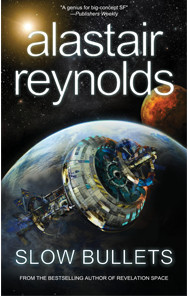
Poseidon’s Wake and Slow Bullets, Alastair Reynolds. The first is the final book in the Poseidon’s Children trilogy; the second is a small press novella from Tachyon Press.
Aurora, Kim Stanley Robinson. A generation starship story, set at the point at which the ship approaches its destination.
The Glorious Angels, Justina Robson. I heard Justina read an excerpt from this at the York pub meet in November. “On a world where science and magic are hard to tell apart a stranger arrives in a remote town with news of political turmoil to come.”
The Woman in the Green Coat, Katie Ward. A novel about suffragette Lady Constance Georgina Bulwer-Lytton. I loved Ward’s debut Girl Reading, so I’m expecting to love this too. It certainly sounds fascinating.
Anything I’ve missed? Yes, I know there’s the final book of the Imperial Radch trilogy due next year, and no doubt a number of fantasy novels – de Bodard, for example; possibly the second book of the Worldbreaker Saga from Hurley. But while I may or may not give them a go, I have very little interest in epic fantasy. There may also be one or two debuts which create a bit of a buzz, and which I might be persuaded to read. But is there anything not mentioned here which I really should make a note of?
It’s the second week of December, and all that’s left of the year is the culmination of our annual consumerism frenzy and all the excesses of food and drink which go with it. So I might as well finish my viewing diary now. 2014 was definitely the year of films for me. I watched 345 films† on television, DVD / Blu-ray and at the cinema. Although very few of the last. Er, only two, in fact: Under The Skin and Interstellar. Most of the DVDs I watched were rentals – I averaged three a week for the entire year. And many of them I put on my rental list because they were on 1001 Movies You Must See Before You Die (as before, films on that list mentioned here are asterisked).
Element Of Crime, Lars von Trier (1984, Denmark) After watching Breaking the Waves, I decided to try some more von Trier, particularly his early stuff; so I picked up a copy of his E-Trilogy, which contains this film, Epidemic and Europa. And deciding that Element Of Crime was the most accessible of the three, I sat down to watch it… And it’s all a bit like a film school project. Orange neon lighting is used throughout, which makes everything look, well, orange. Michael Elphick plays an ex-detective who undergoes hypnosis in order to remember his last case, the hunt for a serial killer in post-war Germany. In order to solve the case, Elphick tries to identify with the killer, and soon begins to behave like him. It all felt a bit obscure for obscurity’s sake, and whatever cleverness was there seemed lost in an orange haze. I also seem to remember lots of Dutch angles and light reflected in water. There’s an interesting idea somewhere in this film, but I’m not convinced its presentation made the best use of it.
The World’s End, Edgar Wright (2013 UK) A bunch of school friends get together for reasons that never quite convince in order to complete a pub crawl they had previously failed to complete twenty years before in the invented town of Newton Haven, a crawl of twelve pubs which ends at the titular hostelry. The five friends are drawn pretty broadly, as are their relationships, both historical and during the film, and for the first hour or so you’re wondering if it could get any more pointless… when it suddenly transpires that the town of Newton Haven has been taken over by alien robots. Which is where it all turns very silly. Parts of the town of Newton Haven looked scarily familiar – something that doesn’t happen in films or television very often if you happen to be from the north of this country – so I checked online and discovered The World’s End was partly filmed in Letchworth Garden City, a city I remember particularly well, despite only visiting it once, thanks to a Christmas work night out when I worked at ICL in Stevenage back in the early 1990s. Anyway, The World’s End: very silly, but mildly amusing; a bit juvenile in parts; probably best seen after a few beers.
I Know Where I’m Going*, Michael Powell & Emeric Pressburger (1945, UK) I think I had this film confused with another Archers film, A Canterbury Tale, because I had thought it was about soldiers during World War II, but I Know Where I’m Going is actually set in the Hebrides, and while Roger Livesey’s character is on furlough from the Navy, the war is barely mentioned. Wendy Hiller is heading for the invented Hebridean island of Kiloran in order to meet up with her wealthy fiancé and marry him. But when she gets to the Isle of Mull, the weather prevents a crossing to Kiloran. There, she meets Livesey, who is the laird of Kiloran, and the film moves smoothly into rom com territory. It is, as you’d expect from the Archers, a polished piece, with bags of charm. Livesey, who possesses a voice only marginally less fruity than Brian Blessed, is eminently watchable and a surprisingly good romantic lead; as is Hiller, who exhibits a similar spikiness to that which bought Katherine Hepburn a bagful of Oscars. I’ve always been a fan of the Archers, and there’s nothing in I Know Where I’m Going to make me change my mind.
Kippur*, Amos Gitai (2000, Israel) This is based on Gitai’s own experiences in the Israeli military during the Yom Kippur War. Two friends on military service fail to meet up with their unit thanks to the Syrian invasion, and eventually end up joining a helicopter rescue unit. This involves flying out onto battlefields to evacuate the wounded. It’s dangerous work, but at least they’re not shooting at anybody. It’s all very realistic, blackly comic, and quite gruesome. The two end up wounded themselves, when their helicopter enters Syrian territory and is shot down by a missile. A good film.
Father And Son, Aleksandr Sokurov (2003, Russia) I have a lot of time for Sokurov’s films, but boy are they slow. They make Tarkovsky’s look like they were made for the MTV generation. The plot of Father And Son is almost inconsequential. It’s about a man and, er, his son, and their relationship. The son is at a military academy, but he spends time with his father in his roof-top apartment and… it doesn’t really matter what happens. Father And Son is a microscopic examination of the relationship between the two, beautifully photographed and remorselessly documented. I’ve maintained for the last couple of years that Sokurov’s The Second Circle (a favourite film) is the epitome of the father-son film and, though you’d expect from its title Father And Son would be more so, I’m not sure that it is. But I do really like this film, I like the gentle construction of its central relationship, and I especially like the visuals. Sokurov is without a shadow of a doubt one of the best film-makers currently working. I only wish more of his stuff were available in the UK.
In A Lonely Place*, Nicholas Ray (1950, USA) Humph is an acerbic screenwriter who has been asked by a producer to adapt a best-selling novel. Since the book is trash and he has no intention of actually reading it, he asks a hat-check girl at the nightclub who admits to having read it to come home with him and tell him the story. She does so, but during her journey back to her own home later that night she is murdered. The police immediately suspect Humph. He is partly alibied by next-door neighbour Gloria Grahame, and the two later enter into a relationship. Humph gets cracking on the screenplay, but the police still suspect him and he’s such a nasty piece of work that pretty soon everyone thinks he murdered the hat-check girl, even Grahame. So she decides to leave him… but then the real killer confesses to the police, but Humph and Grahame’s relationship has already crashed and burned. A neat little noir this, although Humph’s character really was quite unpleasant. And while the did he/didn’t he aspect never quite convinced, tying it to his relationship with Grahame was a neat move.
Noah, Darren Aronofsky (2014, USA) When I was a kid I went to Sunday School, but I don’t remember any of this from those Biblical colouring books we had. Six-limbed angels made out of stone? A giant fantasy stonepunk empire? Two races of humans? I don’t even remember it from history lessons at school. There was the big boat, of course, and the Deluge. And the animals going in two by two, and even the stranger creatures which got left behind. Apparently, the religious nutjobs in the US more or less approved of Noah, which is surprising given that the word “God” is not mentioned once – it’s “the Creator” throughout. So it seems turning a bit of the Bible into a fantasy film is fine, but using a fantasy novel or film to comment on Christianity is not. The Golden Compass was a much better film than this, and it’s a shame the trilogy was spiked. But one man and his floating wooden fort full of sedated animals in fantasyland seems to be acceptable. Huh.
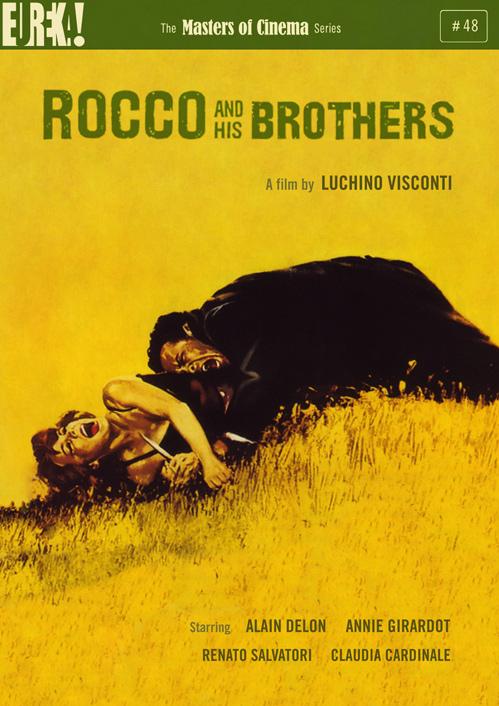
Rocco and his Brothers*, Luchino Visconti (1960, Italy) Mother and four sons head from their village in southern Italy to go live with the eldest son in Milan, although he apparently doesn’t seem to be expecting them. And their sudden appearance puts the kaibosh on his impending nuptials. The five brothers, ranging in age from early teens to mid-twenties, and their mother struggle to survive. The film is presented in five parts, one for each of the brothers – the title role, incidentally, is played by Alain Delon. One brother becomes a boxer, but fails and becomes a gangster. Another turns his back in the family and settles down. Another gets a job in a car factory, and supports the rest of the family. A prostitute befriended by Delon becomes embroiled in the lives of the brothers, and is brutally murdered by the boxer – but Delon won’t give him up to the police, so one of the others does so. I don’t know if Rocco and his Brothers was the first Italian Realism film, but it’s certainly a textbook example – and so very far from Visconti’s later work, such The Damned or Death In Venice. I can understand why this film is on the 1001 Films You Must See Before You Die list.
Belle de Jour*, Luis Buñuel (1967, France) Catherine Deneuve is the bored wife of a doctor, with an active and somewhat dodgy fantasy life (featuring, among other things, being whipped by coach hands), and when the creepy older friend of her spouse drops hints – not to mention outright lewd proposals – about a brothel on a particular street in Paris, Deneuve makes her way there and joins the staff as a part-time sex worker. One of her early customers is a young and angry gangster, and the two fall in love – although, to be honest, I couldn’t understand what she saw in him. Then creepy older man from earlier turns up and the cat is out of the bag. Meanwhile young gangster has worked out who Deneuve really is, and lies in wait outside her apartment so he can kill her husband. It goes badly, but ends well for Deneuve. An odd film, and I’m not entirely sure what to make of it. The men are horrible, it all feels horribly bourgeois, and Deneuve is a complete cipher. I much preferred The Discreet Charm of Bourgeoisie.
The Wolf of Wall Street, Martin Scorsese (2013, USA) This has appeared on several best of the year lists from film critics (although released on 25 Dec 2013 in the US, it wasn’t released in the UK until 17 Jan 2014). To be honest, I’ve no idea why. It’s a well-made film, certainly; as Scorsese’s films always are. But the reason I don’t like Scorsese’s movies is that he valourises scumbags. If it’s not Mafia, bonkers billionaires or psychotic killers, then it’s the sort of amoral Gecko-like figure the title of this film refers to – and he’s a real person, Jordan Belfort. Just after joining a Wall Street firm, Belfort finds himself out of a job when it crashes and burns as a result of Black Monday. He stumbles across the penny stocks market, and jumps in with both feet, basically ripping off ordinary people in order to make a fortune for himself. And he makes a very large fortune. Which, of course, leads to a lifestyle of complete excess – the film opens with Belfort explaining the drugs he takes during a typical day. The FBI take an interest in him because, well, because what he’s doing is illegal, although they can’t prove it. Chiefly because he’s salted away most of his funds in a Swiss bank. Although Belfort loses access to the account when his courier, a British aunt of his wife, dies. Eventually, everything comes crashing down. Belfort is indicted and sentenced… to 36 months in a minimal-security prison. They should have thrown away the key. And taken every cent his firm earned and given it back to the people he ripped off. Belfort, of course, remains unrepentant and claims 95% of his business was legit. (Reading up on him, it seems much of the memoir on which the film was based is doubtful, Belfort was ordered to repay $110 million but has to date only repaid $11 million; and he now works as a motivational speaker, making more, he claims, than he did as a stock broker/fraudster.)
Peeping Tom*, Michael Powell (1960, UK) This film pretty much destroyed Powell’s career. Although he was well-regarded as one half of the Archers, British critics savaged Powell’s film on its release – so much that he never made another feature film in the UK. It’s tempting to say the film is tame to a twenty-first century viewer, but to be honest I suspect the reaction to it in 1960 was nine parts the British press monstering someone to one part actual outrage. After all, they did the same eleven years later over A Clockwork Orange. In actual fact, Peeping Tom is a smart thriller, similar to Hitchcock’s Psycho in many respects, but made with a British sensibility and incorporating a number of Archer touches. A young man who works in a film studio, and as a photographer on the side, murders women and photographs them at the moment of their deaths. The film follows him, so there’s no mystery to it; but the film does discuss the psychology, as outlined in a number of conversations with the young woman who lives downstairs. Moira Shearer makes an appearance halfway through the movie, only to become the next victim ten minutes later – given her stature in British cinema of the time, this struck me as similar to Hitchcock’s trick with Janet Leigh in Psycho. Especially since she performs a quick impromptu dance number. Definitely worth seeing.
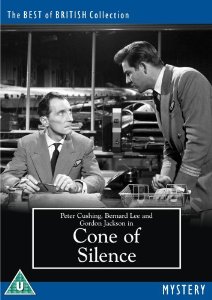
Cone Of Silence, Charles Frend (1960, UK) I forget why I put this on my rental list, possibly because it’s an aviation drama and I enjoy them. As it turned out, it wasn’t quite what I was expecting. Yes, it’s a drama about a particular aircraft, a jetliner called an “Atlas Phoenix” and which was played by an Avro Ashton – the Ashton was a prototype airliner which never entered production, but the one used in the film was actually a test-bed, fitted with two additional jets in wing nacelles for engine-testing. Bernard Lee plays a by-the-book captain who crashes a Phoenix at “Ranjibad” on take-off – the Phoenix flies the Empire route from the UK to Australia – and an inquest finds the crash the result of pilot error. Lee, and those who know him, of course disagree. Against the wishes of Atlas, Lee is permitted to once again captain the Phoenix. But some elements within the airline want to see him either fired or demoted to piston-engined airliners. And then he crashes again at Ranjibad, in identical conditions to the first crash. But this time everyone is killed. And it turns out Atlas didn’t let on that under certain conditions, the manual for take-off is incorrect. The story is, of course, based on the de Havilland Comet, and de Havilland’s reluctance to reveal data that might point to the aircraft itself being the cause of the crashes which grounded it. Given the prestige wrapped up in the Comet – not to mention the money – as it was the world’s first airliner, it’s no surprise de Havilland acted as they did, although many lives were lost as a result. Cone Of Silence spends perhaps too long on the lives of its characters, so the actual plot is wrapped up a little too quickly in the last ten minutes, but it’s a good solid piece of 1960s British cinema and worth seeing.
1001 Movies You Must See Before You Die count: 535
(† This includes complete seasons of television programmes I watched on DVD, but not on terrestrial or cable television.)












 It Doesn't Have To Be Right...