It Doesn't Have To Be Right…

… it just has to sound plausible


5 Comments

The art of brewing fiction

At the end of 2014, I sold a space opera trilogy to Tickety Boo Press. I’d written the first two books a few years before, but had never got around to writing the third. This wasn’t a problem, however. I saw it as an opportunity to prove I could write a big commercial novel in a reasonable timeframe, despite never having tried it before. Unfortunately, I hadn’t factored in two important things: a) real life, and b) even when I start writing commercial science fiction it turns into something else.

Anyway, the first book, A Prospect of War appeared in March 2015, and the second book, A Conflict of Orders, six months later. Everything seem to be going well… Until, in early 2016, the day job dumped a major project on me… and the writing on book three, A Want of Reason, ground to a halt. But – and this is, I hope, the point of this piece – the months off from writing space opera will, I think, make A Want of Reason a stronger and better novel. I may not have been banging out the words, but I’ve never stopped thinking about the story; and I’ve jotted down notes when ideas occurred to me.

When two chargers are set at an angle of 23.7 degrees to each other, they cause a catastrophic distortion in reality: an implosion.

One of my objectives when I set out to write An Age of Discord (the trilogy’s overall title) was to explore the structure of commercial fantasy trilogies. I chose to do this using space opera because I much prefer science fiction to fantasy. A Prospect of War is based on the hero’s journey template, in which a young man of humble birth is elevated to leader of a powerful military force pledged to defend the throne against the evil usurper. (There are a few narrative loops and detours thrown in there too, of course.) For A Conflict of Orders, I wanted to avoid “middle book syndrome”, in which the author just shuffles pieces around the board for the epic final battle in book three. So I made the epic final battle the centre-piece of my second novel. The second half of A Conflict of Orders then covers the lifting of the siege of the Imperial Palace and the aftermath of the attempted coup.

The angle must be precise. A fraction of a degree either way and the two chargers will simply bounce apart, like magnets of the same pole.

But when it came to writing A Want of Reason, some five years after I’d completed A Conflict of Orders… The first thing I did was throw away the original synopsis. I’d planned the novel to have two main narratives: one set in the days following A Conflict of Orders, in which the main characters prepare the Imperial capital for the final act of the 1000-year-old conspiracy which has been driving the trilogy’s plot; and another narrative set 1000 years in the past and describing the events which led to that conspiracy forming. But I decided I didn’t like the idea – for a start, it felt like too much work to create a version of the empire as it was 1000 years earlier, given all the work I’d put into world-building for the empire of the time the main story is set. Instead, the novel would follow on directly from A Conflict of Orders, but I’d take the story in an entirely different direction…

The exact angle is, of course, a closely-guarded secret, known only to a few hundred academicians and munitions artificers.

But I don’t want to write too much about A Want of Reason, because things might still change as I get further into the writing of it. And I don’t want to spoil people’s enjoyment of the novel when it does finally appear. It’s just that recent thoughts I’ve had about the book have led to me thinking about the creative process and how it relates to A Want of Reason and the trilogy. For example, a major part of the first third of A Want of Reason is two characters, Dai and Finesz, each investigating a minor mystery. While it had been clear in my mind right from the start what the answer to those mysteries were, I’d not quite figured out how they linked into the plot of the novel and the story-arc of the trilogy. Later, not only did I come up with a way of fitting them in, but a way of using them to actually advance the plot and add to the world-building.

Marla Dai could not remember when she had originally come across the information, but she was making good use of it now. It had been easy enough to find an unused aerocraft at Kukoi Aerodrome, likely belonging to some noble with more money than sense. It had not flown for months. Less than an hour later, Dai had removed a pair of chargers from its underside and concealed them nearby.

I chose the word “brewing” for this blog post deliberately, because for me ideas often feel like the product of fermentation. I envy those writers who can start writing and ideas just come to them; as well as those who sit down and plan out their writing like a military campaign. But creativity is a subconscious process – I don’t know how many times during the writing of An Age of Discord I’ve come up with what felt like a neat idea, only to find several chapters later it served as an excellent hook for an even neater idea

justi_imagine

There’s that old saw of the writer being asked, “where do you get your ideas from?” There are as many answers as there are writers. For me, it’s lying in bed at night, thinking, “Shit, I’ve got Finesz hunting for Azeel now, so how does she go about tracking her down and what does she discover when she does find her?” And it all has to work within the universe of the book, it has to be rigorous. I know where the story is going, of course; I have a general direction in mind – and sometimes a quite detailed idea of the end – and I know what sort of things I want to write about. I suppose it won’t come as much of a surprise to those who know me, but A Want of Reason is primarily about the fascistic character of space opera empires. I admit a lot of it was about the uniforms when I was writing A Prospect of War, but now, some 350,000 to 400,000 words later, and however many years, and one of the major points I want to make in An Age of Discord is the way space operas always default to the right, and the easy acceptance of same by readers of the sub-genre. And the best way to comment on that, I decided, was to push the empire of the story even further rightwards. It’s there in the final pages of A Conflict of Orders, the forced closing of the civil government and a crackdown on what little political freedom already exists…

The troopers had already subdued most of those inside by the time Inspector Sliva Finesz of the Office of the Procurator Imperial entered the premises. This was not her operation, she had been roped in to help, although no one had bothered to fill her in on the details. She strode into the building, pulling her gloves onto her hands, and found herself in a large workshop room, two storeys high, with a sharply-raked roof supported by narrow iron pillars, and filled with large mechanisms… Printing-presses? The air stank of hot oil overlaid with the acrid tang of some chemical she did not recognise. Troopers held a group of proles at the back of the room. Some of the proles were injured—bruised and bloodied. Above them, half a dozen yeomen peered out of office windows on a mezzanine floor, while a couple of low-ranking OPI officers stood by in attendance.

Although it was not planned, the last six months of fermentation have proven beneficial to A Want of Reason. Last year, I decided the Involutes’ main headquarters would be called the Fastness. But all I had was a name. A couple of months ago, as I lay in bed, natch, an idea occurred to me… and a number of things just started slotting together, not just the Fastness, but the Involutes’ masks, things that had happened in the earlier books… It was like watching a Transformer, er, transform. It may be a dilettante-ish way to write, but it works for me. I once said that if the half-story ever became an art-form, I’ve a body of work ready and waiting. Because that’s how it goes for me. I have an idea, I start on a story… I give up after a few hundred words because it’s not working… And then the story sort of sits there in the back if my mind, brewing away, until one day I pretty much bang it out fully-formed. That’s what happened with ‘Geologic’.

They met an hour after dawn in a secluded corner of a park beneath the wall of jagged hills which separated Gahara from the rest of Toshi. Dew lay heavy on the grass and bowed the thin branches of the trees surrounding the spot they had chosen. A faint mist lay a ceiling across the sky some two or three hundred feet up, the sun a hot diffuse dot of orange above the hills. Despite this, the air smelled cool and fresh, with a faint hint of the sea from the bay below. A young lieutenant from the Honourable Basilisk Company, with more decency than most of the nobility Casmir Ormuz had met in Toshi, acted as second. Ormuz’s opponent, a viscount and the son of an earl, who had not expected a challenge but had responded to it with alacrity, appeared both composed and quietly confident. He either discounted the stories he might have heard about Ormuz, or he had never heard them. His equally doltish second smirked at what he clearly expected to be a quick and victorious bout.

I’d wanted to write a story about saturation diving in a science-fictional context for a while, and had decided that a world with high atmospheric pressure was the best setting. And there’d need to be some sort of alien ruin or something to justify explorers spending so much time in such an inimical environment. But that’s as far as I got. I wrote a few hundred words… and there it sat for several months. Brewing away Until one weekend I sat down and wrote it. A read-through by my beta readers, some cleaning up, and I submitted to Interzone. The magazine bought it, and it appeared in issue 262.

Unfortunately, it’s not always so easy. The final story in Dreams of the Space Age, ‘Our Glorious Socialist Future Among the Stars!’ may have gestated and been born in a similar fashion – “I’m writing a story about Yuri Gagarin crash-landing on Mars and I’m going to pastiche Robinson Crusoe on Mars… and, I know, I’ll have all the dialogue in Russian! And… this is a great idea… I’ll throw in lots of references to Soviet sf!” – but I never managed to sell it to a magazine. Was it the title? The Russian dialogue? The quotes from The Communist Manifesto? Who knows. Although most comments about Dreams of the Space Age single out ‘Far Voyager’ as the best story; and that was originally published in Postscripts, was in fact the title story in Postscripts 32/33: Far Voyager.

People like to ask, what’s the best writing advice you’ve received, and all I can think of is Bob Shaw’s admonition in his How to Write Science Fiction to “read lots of books”. Example and self-experimentation are powerful learning tools. But I’d go one further, and say, read lots of books from lots of genres and modes of fiction. Read too widely outside sf and there’s a danger of being disillusioned with the genre, but that can also feed back into your writing. Science fiction should never be given special dispensation; instead, we writers of sf should strive to lift the genre up to the level where it is taken as seriously as any other mode of fiction. Which is why writers should read widely. (I don’t get that thing about writers who refuse to read other books when working on a project, I really don’t.)

Of course, this is merely in reference to the prose and story-telling. Don’t get me started on research. Assume at least one of your readers is an expert in the subject you are writing; assume they will mock you for getting it wrong. So get it right. Don’t make it up as you go along. In the past, the writer might never have learnt that some people thought him or her an idiot for getting simply physics wrong in a sf novel, but these days, with social media, someone is sure to “helpfully” let the writer know… (Or even bully them over it – it’s scumbag behaviour, but it happens.) But that’s a discussion for another day…

[This post contains some lines from the opening chapters of A Want of Reason.]

Leave a comment

Moving pictures, #44

More viewing, only one from the 1001 Movies You Must See Before You die list this time, and it’s an American film… although, once again, half of the films below are from the US. I need to increase the number of non-Anglophone films I watch.

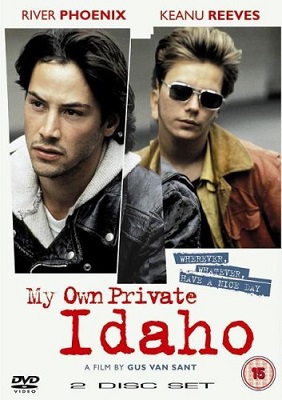
idahoMy Own Private Idaho*, Gus Van Sant (1991, USA). The only thing I knew about Gus Van Sant prior to deciding to work my way through the 1001 Movies you Must See Before You Die list was that he’d made a shot-for-shot remake of Hitchcock’s Psycho. Which sounds like an interesting exercise, except, well, that’s pretty much what a play is, the same story with a different cast. And since I’d seen Hitchock’s film a number of times and was familiar with it, Van Sant’s experiment proved even more disappointing. Van Sant’s most-famous film, however, is My Own Private Idaho, which, okay, I may have heard of before, but knew nothing about. And it turns it’s about a pair of street hustlers, played by River Phoenix and Keanu Reeves, except Phoenix has narcolepsy, and Reeves’s father is rich and the mayor of Portland. Oh, and the story is roughly based on Shakespeare’s Henry IV plays… which is fine as far as it goes, but when Van Sant starts using Shakespeare’s dialogue it really doesn’t work. Having Reeves call the Falstaff figure, Bob Pigeon, “a horseback-breaker, a mountainous tub of lard”, just sounds really silly in 1990s Oregon. In fact, it’s the Shakespeare-isms which spoil My Own Private Idaho. Okay, so Reeves’s character is not entirely believable (make him actual royalty, though, as Shakespeare did, and it weirdly seems okay), although it does make for an effective ending. But it’s that mix of Rechy’s City of Night and old Bill’s Henry IV Part 1, etc, which doesn’t gel. It’s like oil and water, or even a lava lamp. It’s just too obvious when Reeves et al start spouting the Bard’s couplets, and it upsets the balance of the film. I can see how My Own Private Idaho might appeal to some, but it wasn’t a movie I rated highly.

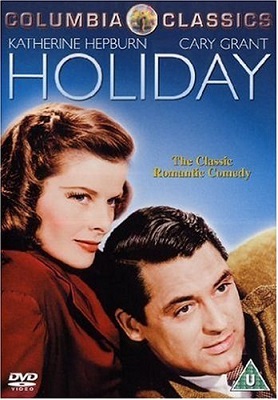
holidayHoliday, George Cukor (1938, USA). An early screwball romance starring Cary Grant and “box-office poison” (as she was at the time) Katharine Hepburn? What’s not to like? Quite a bit, according to audiences when it was released. Grant plays a man who plans to quit his job as soon as he can afford to and do nothing, and Hepburn plays the sister of his fiancée, who is stinking rich. This was during the Great Depression. Hollywood: super-sensitive, as usual. Grant meets Doris Nolan while on holiday in Lake Placid, and the two get engaged. He doesn’t realise she is filthy rich and the youngest daughter of an eminent New York banker. He turns up to the family home, learns the truth, but manages to charm the father and so get permission to marry. But it seems Nolan is a bit of a stuffed shirt, and it’s her libertine sister, Hepburn, who’s a better match for Grant. This one is early in Grant’s career, so he hasn’t got the polished urbanity of later films. If anything, he’s a bit of a galumpher, more of a tail-wagging puppy. Hepburn is Hepburn – did she ever change? – and it’s hard to believe she was ever box-office poison. By all accounts, this film did much to rehabilitate her. Edward Everett Horton and Jean Dixon provide excellent comic relief as Grant’s best friends, a pair of cycnical academics. Both stars, and director, made much better films, but Holiday has its moments. It’s not great, but if you’re into films from the era, it’s probably worth seeing. But I can understand why it flopped at the box office.

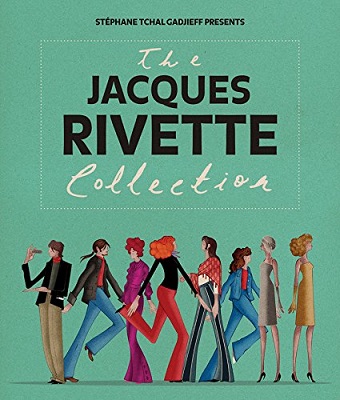
rivetteMerry-Go-Round, Jacques Rivette (1983, France). I watched Rivette’s La belle noiseuse, because it was on the 1001 Movies you Must See Before You Die list, and I thought it very good; and then Arrow Academy released a limited edition Blu-ray collection of some of Rivette’s films, none of which I knew anything about… but the collection was a limited edition, and I’ve learnt to my cost previously it’s best to buy things like this straight away because when you finally come to realise you want a copy they’re either not available or cost silly money. So I bought The Jacques Rivette Collection. On the basis of having seen a single film by the director. So it goes. And yet there’s nothing in Rivette’s movies that immediately appeals to me. They’re well-crafted, certainly; and very French. And, er, very long. Especially the centre-piece of this collection Out 1 – 12 hours and forty minutes! fucking hell – which I admit I have yet to watch. In fact, I’m working my way through the the collection in installments, beginning with Merry-Go-Round, which clocks in at a mere 2 hrs and 40 mins. And I’m not entirely sure what to make of it. A woman sends a telegram to her sister in Rome, Léo, and an ex-boyfriend in New York, Ben, asking them to meet her at a hotel in Paris. But when they turn up, she’s not there. They follow a series of clues and end up at her old home, where she tells them that her father, who died two years previously after embezzling $4 million, isn’t dead. And then she’s kidnapped and taken away in an ambulance. There then follows an almost dream-like quest, in which Ben and Léo try to track down the not-dead father and his millions. Much of this involves running through woods. Including being chased by a knight on horseback. Or exploring empty houses, particularly ones where doors give onto different landscapes – breaking that compact between director and viewer in which the spaces depicted on screen connect in a logical and plausible manner. (Sokurov does something similar in Faust, by having characters enter the frame from parts of the space the camera has already shown do not have entrances.) So the world of Merry-Go-Round doesn’t quite follow the “rules”, but then neither does the quest narrative. There are long extended scenes which do nothing to advance the plot. There are also plot-holes. And interludes in which two odd-looking blokes play noodley jazz on double bass and bassoon. In parts, Merry-Go-Round feels like an early-1980s L’Avventura – or rather, it sets up an expectation of being a 1980s L’Avventura, perhaps on little more than its lack of plot momentum. I am, on balance, glad I bought The Jacques Rivette Collection (it’s still in stock! Get it now while you can! Only 3,000 copies!), and I think they’re films which will bear rewatching, if not demand it; but I’ve a way to go yet before I call myself a Rivette fan.

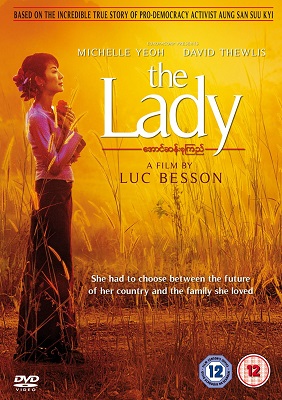
ladyThe Lady, Luc Besson (2011, France). Of all the subjects about which Luc Besson might make a film, I must admit a biography of Aung San Suu Kyi is not one I’d ever have guessed. But then, in many respects, The Lady doesn’t feel much like a Besson film. There’s a moment of almost cartoon-like violence when paramilitaries of the former prime minister assassinate the Executive Council (ie, the government-in-waiting for when the British withdraw), including Suu Kyi’s father. But in most other respects, The Lady is pretty restrained. Michelle Yeoh is especially good in the title role, and if David Thewlis was a bit too thespian as her husband, it didn’t detract overly much from the film. I will admit to knowing only the broadest details about Suu Kyi and Myanmar, and so films such as The Lady are eye-openers. Seriously, military juntas are not governments. The UN could surely make a legal, ethical and moral case for overthrowing such governments. But, of course, military juntas are excellent customers for arms dealers, and selling weapons is what it’s all about in the twenty-first century. The UK is now second only to the US as a seller of armaments. Mostly to the same countries we bomb or which have created the current refugee crisis. If you truly did reap what you sow, this country would neck-deep in salt.

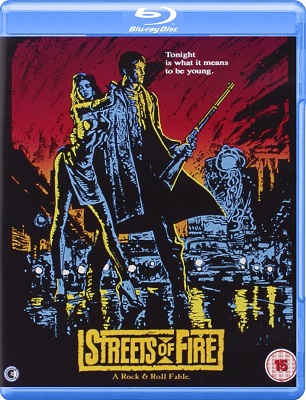
streets_of_fireStreets of Fire, Walter Hill (1984, USA). I had vaguely fond memories of this, after seeing it back in the 1980s, so despite its somewhat negative reputation I thought it might be worth watching. And having now seen it… I think my memories were a little imprecise. It looks great, mostly, no doubt about that; and the music, while of its time, is quite listenable. But that script. It’s fucking awful. It’s totally misogynistic, and it puts words in the mouths of its cast – Rick Moranis, especially – they should have been embarrassed, if not fucking offended, to speak. Diane Lane plays a rock star who is kidnapped by a bike gang led by Willem Dafoe. A young woman persuades her ex-soldier brother, Michael Paré, an ex-boyfriend of Lane’s, to come home and rescue the rock star. And it pretty much goes as you’d expect. I’d hoped time had been kind to Streets of Fire, that it’s 1980s macho posturing might seem more like kitsch thirty years later. It hasn’t. Rick Moranis snarling misogynistic comments at the camera is still a horrible thing to see. Paré does his best with a bad part, Dafoe does even better with a worse part, but Lane does nothing with a nothing part. Visually, the film still scores, and its influence on later films is easy to see. But the reasons why it flopped it 1984 are also obvious, and not even thirty years is going to make it a cult hit.

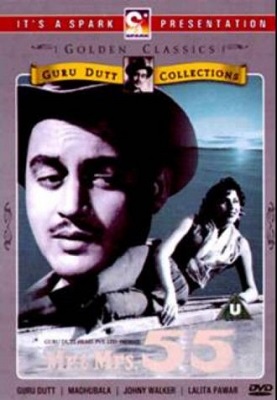
mr55Mr & Mrs 55, Guru Dutt (1955, India). The more of Dutt’s films I watch, the more I appreciate them. Admittedly, this was not a good transfer – BFI, why are you not all over Dutt’s films? – and the plot was pretty much a Hollywood staple (never mind a Bollywood staple), but even so… Rich playgirl Anita is living the high life but then discovers she has to marry before the age of 21 in order to inherit seven million rupees. And she only has a month to do it. She approaches her friend, tennis pro Ramesh, but he’s off to Wimbledon. In desperation, her mother pays cartoonist Dutt Rs 10,000 to marry Anita, with the promise of a quickie divorce soon after. Of course, the two fall in love after the ceremony. But then careful lying by the mother ensures each thinks the other doesn’t really love them, so the divorce goes through… But they get together and realise they do actually love each other after all. It’s all keyed off American signifiers of success – not just Anita hanging around a posh tennis club and worshipping pro Ramesh at the beginning – but also the trappings of wealth enjoyed by Anita’s family are familiar to Western audiences. And yet, there’s also something indefinably Indian about it – and I don’t mean the fact it breaks into song at assorted moments. It feels like an Indian film based on a Hollywood template, by someone who was quite aware of, and more than capable of using, the story patterns of both Indian and Hollywood cinema. Dutt makes good films. He really needs transfers worthy of his work.

1001 Movies You Must See Before You Die count: 795


2 Comments

Moving pictures, #43

Well, 2016 is definitely turning into the year of movies. To date, I’ve seen 431 movies, mostly on DVD and Blu-ray, mostly my own or from LoveFilm or Cinema Paradiso or on Amazon Prime. Some of them have been very good indeed, and I will probably watch them again (if I haven’t done so already). Some were rentals I liked so much, I went and bought a copy of my own. And some… well, best not mention them…

Anyway, on with the next half-dozen adventures on the silver screen wot I have partaked:

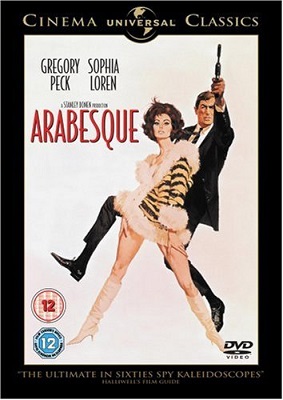
arabesqueArabesque, Stanley Donen (1966, USA). Who remembers Charade? Cary Grant and Audrey Hepburn in Paris. Lee Marvin as the villain. Missing millions. Which turned out to be a rare stamp on an innocuous envelope. It’s a film with bags of 1960s charm – with a pair of leads like Grant and Hepburn, how can it not have charm? Arabesque was apparently Donen’s attempt to hit the same sweet spot again. Unfortunately, while Donen wanted Grant, he got Peck. And Grant’s dialogue doesn’t work when coming from Peck. Sophia Loren manages to hold up her end, however. But both are hampered by a convoluted plot that’s almost impossible to follow. Donen apparently remarked that the film could only succeed if he made it “so visually exciting the audience will never have time to work out what the hell is going on”. And having now seen it, I can certainly vouch for the second half of that statement. Peck plays an Eygptologist who is asked to translate a message in heiroglyphics by head of an Arab state. It’s all to do with some big oil develoment deal and a plan to assassinate the ruler, but most of the plot consists of Peck getting beaten up by the villain’s henchmen or Peck and Loren chasing around London after the scrap of paper with the heiroglyphics on it. Not a high point on all three cvs, to be honest.

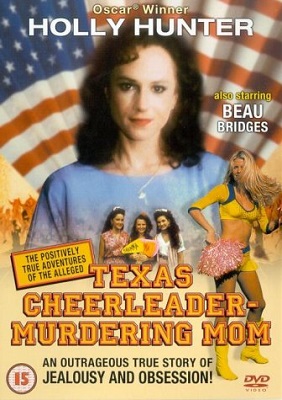
texasThe Positively True Adventures of the Alleged Texas Cheerleader-Murdering Mom, Michael Ritchie (1993, USA). In the normal course of events, I’d not give this film a second look, or indeed even a first one. But a film blog I read, Antagony & Ecstasy, wrote a long semi-approving piece on it, and a week or two later I stumbled across a copy in a charity shop… But, well, I guess this is not a movie that travels well. I’ve never seen the appeal of, or humour in, films depicting US white trailer trash or working class, and that’s pretty much what this is – although it’s based on a true story. Holly Hunter plays the title role, a mother who was so determined to see her daughter succeed she sort of agreed when her drunken brother-in-law (Beau Bridges) tried to entrap her into paying him to off a rival mother. The film is framed partly as Hunter preparing for an interview after the fact, and partly a dramatisation of events, and the whole thing seems mostly motivated by stupidity because the actual character motivations are somewhat opaque. Which makes Hunter’s character come across like a sociopath. Which, to me, sort of ruins the whole desperate housewife story. It’s not very funny film, either. I gave my copy to David Tallerman, so we’ll see if he makes anything of it.

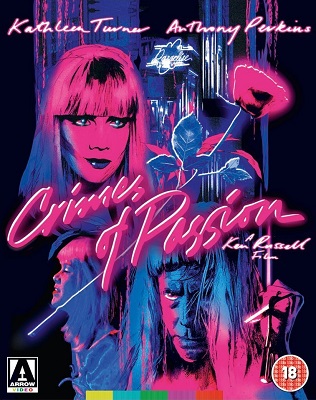
crimesCrimes of Passion, Ken Russell (1984, USA). I don’t think I’d ever call Russell an “interesting” director – he made a handful of solid films, one or two near-classics, and a lot of self-indulgent crap. From the write-up, I suspected Crimes of Passion fell on the border between “solid work” and “self-indulgent crap”, so watching it was a bit of a gamble. And having now watched it… yes, it pretty much straddles the two groups. Kathleen Turner plays a fashion designer who moonlights as a prostitute, using the name China Blue. A surveillance expert is asked to spy on her because her employer suspects her of selling designs to competitors, and he becomes obsessed with her. There’s Anthony Perkins, in full frothing-at-the-mouth mode, wandering around as preacher, who alternately demands to “save” China Blue or have sex with her. He also frequents peep shows. And then there’s China Blue’s customers, with their fetishes… It all looks a bit cheap (and I mean that in its pecuniary sense), and with Perkins drooling and spraying spittle one minute, and then Turner chewing the scenery in the next, it makes it all look like a shoestring exploitation flick with bizarrely high production values. An odd film.

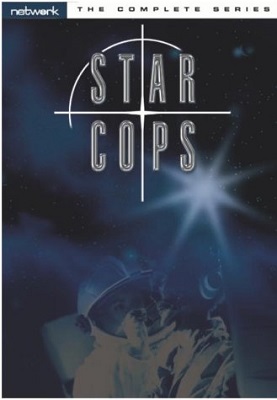
star_copsStar Cops (1987, UK). Many thanks to Paul Cornell for tweeting that a third-party seller on Amazon had clearly found a stash of these somewhere and was selling them at a decent prize (around £20, if you must know). I’d missed buying myself a copy of Star Cops before it was deleted, and by the time I wanted one the price had reached silly money. But now I have one. I remembered the series from its original broadcast back in 1987, although having now seen all nine episodes on the DVD I think I might have missed one or two of the episodes. Anyway, I remembered it as smartly-written, with slightly dodgy production design and cheap effects. What I’d certainly forgotten was the vastly irritating theme song by Justin Hayward, which, while not quite as bad as Enterprise‘s, does have the added horror of getting stuck in your head for days afterwards. David Calder plays a British police officer on 2017 who distrusts the computers and continues to investigate a case the computers have ruled a suicide. It turns out he’s right, of course; but it makes him enough enemies, and leads to the murder of his girlfriend, so he accepts a position as the new head of the International Space Police Force, based on a station in LEO. After a coupleof episodes there, the ISPF moves to an office at a base on the lunar surface (which was obviously a relief for the actors and the budget as it meant no more wires). One of the star cops is presented as a bit of an old-school dimwit, but he also does a nasty line in racist and sexist remarks. The other star cops are an Australian engineer, a US engineer, and a Japanese doctor. Most of the stories are pretty good, although the final one, ‘Little Green Men and Other Martians’, despite having a neat premise, does suggest the lunar base is wide open to whoever turns up – which I wouldn’t have thought all that likely. I’m glad I finally got hold of a copy. These days, sf television series may have fancy special effects, but they rarely have writing as good as this.

vidas_secasVidas Secas*, Nelson Pereiras dos Santos (1963, Brazil). This is generally reckoned to be the first film in Brazil’s Cinema Novo movement. I wanted to watch it because it’s on the 1001 Movies You Must See Before You Die list – and because I’d become a fan of Glauber Rocha after watching three of his Cinema Novo movies – but Vidas Secas is almost impossible to find on DVD (as I type this, there’s one copy available on Amazon for… £101.95). Fortunately, I managed to get a copy from another source, for no more than the price of a typical DVD. And yes, it was worth it. It’s an adaptation of a novel of the same title, by Graciliano Ramos, and tells the story of a poor family in north-east Brazil. It was entered into the Cannes Film Festival and won the OCIC Award. Its plot isn’t easy to summarise, as it’s really just a series of incidents in which the family move from one place to another, try to scratch a living, are preyed on by those more powerful than themselves, and so move on elsewhere. In one village, a local policeman drags the husband into a card game, but when the husband leaves after losing his money, and so the policeman loses even more, the policeman goes after him, beats him up, and then arrests him for resisting arrest. The husband is thrown into jail and whipped. It’s a grim film, althugh not unaffecting – near the end, the family are so hungry the husband tries to shoot their dog, but it takes him ages to work up the courage to do it, and then he botches it and the dog crawls away to die slowly. This is not a film to watch if you’re not in a cheerful mood. It definitely belongs on the 1001 Movies you Must See Before You Die list, though.

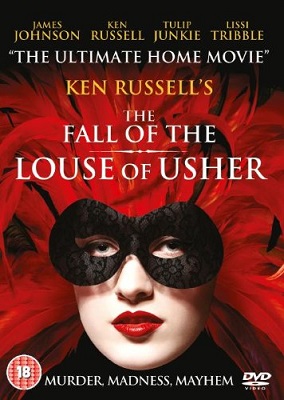
usherThe Fall of the Louse of Usher, Ken Russell (2002, UK). Well, I mentioned Russell’s self-indulgent crap earlier, and I hadn’t watched this. Which is absolutely awful. It’s Russell’s last film, was shot on his own property, and features himself and friends as the cast. A rock-star, Roddy Usher, played by James Johnston of Gallon Drunk, is consigned to a mental institution after killing his wife and walling up her body. His doctor is played by Russell himself. He gives Usher shock treatment and, well, lots of things happen, few of which I can, thanksfully, remember. It all looked horrible and cheap and amateurish, and I’m surprised it ever saw a general release. The DVD, released by Final Cut, calls it “the ultimate home movie”, but even that fails to convey how crap it is. This is definitely a film to avoid. It was Russell’s last feature film, and a poor epitaph for a man who did make some good stuff during his long career.

1001 Movies You Must See Before You Die count: 794


Leave a comment

Reading diary, #35

As a general rule, I try to spread my reading across genders and genres, but it doesn’t always work out that way. So far this year, around forty percent of my reading has been science fiction, I suppose chiefly because when I fancy an easy read it’s my go-to mode of fiction. Which might tell you something about recent sf, except that quite a bit of my sf reading has been twenty- or thirty-year-old sf novels by women writers for review on SF Mistressworks…

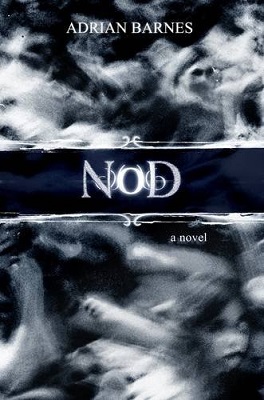
nodNod, Adrian Barnes (2012). We’ve just had a somewhat controversial Clarke Award – but then, when hasn’t the Clarke been somewhat controversial? It was back in 2013, when Nod was shortlisted. From what I remember, Nod was seen as a quite baffling choice; although the same could also be said for The Dog Stars, also shortlisted that year, and which I read a year or two ago and thought not very good at all. Whereas NodNod is one of those books written with a strong, idiosyncratic voice – not idiosyncratic like Riddley Walker or Engine Summer – but the first person narrator is chatty and irreverent and likes to pepper his story with witticisms and snide remarks and it’s really fucking annoying. The central premise is nicely done – suddenly no one can sleep, except for a handful – and the breakdown of civilisation as sleep deprivation psychosis kicks in, as seen in the narrator’s home town of Vancouver, is well-handled… But the way the book is written, the prose style, is like fingernails on a blackboard for me. I hated it. It was a test of endurance to read it. This is one of those books which illustrates the difference between “this book is good” and “I enjoyed this book”. I hated it, didn’t enjoy it at all, but could see it was put together with skill. My response to it is entirely personal; the book’s quality is intrinsic to it. The two should not be confused.

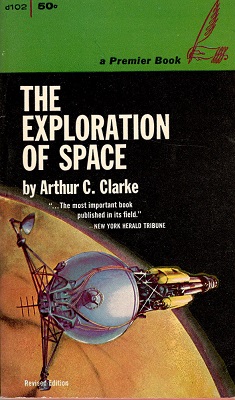
exploration_space_smallThe Exploration of Space, Arthur C Clarke (1951). Why did I read a book about space exploration written more than half a century ago, when the appropriate science and engineering was in its infancy, I hear you ask? Er, I don’t know. But I thought it might be interesting to see what Sir Arthur had got right – the edition I read was an updated one published in 1960, so pre-Gagarin and -Apollo – and the answer is… not all that much, actually. His explanation of freefall, for example, is sort of right but doesn’t explain it very well. Astronauts at the ISS (which, of course, didn’t exist when the book was written, so Clarke’s example is hypothetical) are not experiencing zero gravity because the gravity in Low Earth Orbit is exactly the same as it is on the ground. The astronauts are falling toward the ground, and so is the ISS, at exactly the same speed; but the ground is rotating away from them, also at the same speed. So, to paraphrase Douglas Adams’s description on how to fly, they’re throwing themselves at the ground… and missing. True, science and engineering didn’t know then what we now know, and the stuff Clarke gets right is the stuff that had been known for decades, if not centuries. The chapter on ‘The Lunar Base’ speculates the Moon would be exploited solely for minerals – thus ignoring the US Army’s Horizon lunar base study from 1959 – and that spacesuits would have to be hard-shelled. A later chapter on space stations claims their chief role would be in communications – and this from the man who “invented” the communications satellite… although first active repeater communications satellite wasn’t launched until 1960. The Exploration of Space is mostly good on the basics, and it has that weirdly unrealistic optimic take on its subject, much like those famous Colliers Magazine articles. But it’s very much an historical document, and no different in that respect to a science fiction novel published during the same year.

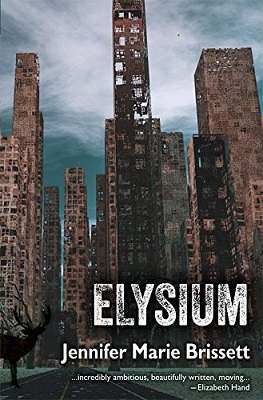
elysiumElysium, Jennifer Marie Brissett (2014). I must be getting jaded. I mean, I know I apparently don’t see science fiction in the same way as many others do – for instance, I thought The Book of Phoenix a terrible book, and yet it received a huge amount of praise (and was even tipped by many to take the Clarke). Elysium is another sf novel which has received lots of praise, but has a much lower profile than the Okorafor. It is also a better novel than The Book of Phoenix, but… The book opens with a series of vignettes depicting Adrian/Adrianne and Antoine/Antoinette, in each of which the two are of different genders – male/female, male/male, female/female; as are also some of the supporting characters. This section (sections) reads like mimetic fiction, but breaking them up is what appears to be output from a computer program (in the form of error messages). The novel then takes an abrupt swerve into alternate history, in which Adrianne is a Vestal Virgin in a modern-day Western city, before then heading into post-apocalypse territory as off-stage alien invaders release some form of dust which mutates human beings and brings about the collapse of civilisation. One of the two main characters becomes one such mutant herself and develops wings. Another shift, and now Adrian is the chief designer of an underground city – a geofront, from the description – in which some of humanity plan to survive, safe from the mutagenic dust and the alien invaders. They’re also building starships to take them to another world. It is at this point in the story that the novel reveals a plan to use the atmosphere to store an archive of human civilisation, and it is the operating system of this which is genersating the computer messages and actually “telling” the story of Elysium. In the final section, Adrianne is a prisoner in a concentration camp run by the alien invaders, and when one of the aliens is imprisoned with them, she learns from it that the aliens had killed all the humans who had not escaped Earth, and that she is no more than a simulation run by the archive in the atmosphere (as, indeed, were all the other narratives in the novel). While Elysium certainly has its moments, the writing is rough to begin with – “The water of sorrow ran like a river down the curve of Adrianne’s cheek”? – but soon improves, or at least becomes less of a barrier. The gender- and sexuality-switching in the opening sections is also neat and cleverly-done, and I thought the Vestal Virgin part especially good… but the post-apocalypse section, and the geo-front section, were a bit dull, and the novel only picked up again with Adrianne in the prison camp, a section which pretty much seems to serve no purpose other than to explain the entire book. In many respects, Elysium reminded me a lot of Sue Thomas’s Correspondence, although I thought Correspondence a much more difficult, but more rewarding, read (see here). I bought Elysium at the end of last year, along with Jackie Hatton’s Flesh & Wires, Deb Taber’s Necessary Ill, and a pair of novellas, Lisa Shapter’s A Day in Deep Freeze and Lori Selke’s The XY Conspiracy, from Aqueduct Press (and I cannot recommend Aqueduct Press enough). The Shapter I thought good enough to nominate for the BSFA Award. I’ve yet to read the Taber; but of the other two novels, I think Hatton’s may just be the better one.

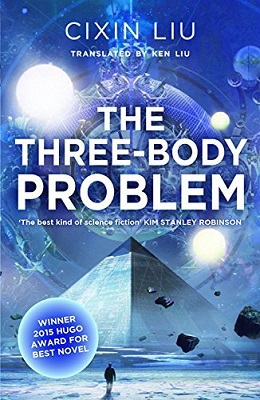
3bodyThe Three-Body Problem, Cixin Liu (2008). So the puppies managed to fuck up the Hugos in 2015, but one of the novels on their slate was pulled by its author, and The Three-Body Problem was promoted onto the shortlist… and went on to win the award. I don’t normally read books because they’ve won a Hugo – if anything, that’s a good indication I won’t like it – but the premise of The Three-Body Problem sounded interesting, and Liu is a big name in Chinese sf. (I have a collection of his three novellas, The Wandering Earth, knocking around somewhere, but have yet to get around to reading it.) So, anyway, The Three-Body Problem… I wasn’t expecting much: old school sf, but set in China, and with a clever premise. And so it initially seemed. The writing was serviceable at best, although the info-dumps were often intrusive and clumsy… but this is sf, this is what it looks like a lot of the time. However, when protagonist Wang Miao stumbles into the conspiracy at the heart of the novel, and the “end of science” is demonstrated to him through, first, a countdown mysteriously appearing on photographs he has taken, then in his actual vision, and then he witnesses the cosmic background radiation of the universe flicker… Well, this was a fascinating puzzle. Throw in a MMORPG set on a world orbiting three suns and in which players have to figure out a solution to the three-body problem – not that there is one, but the game proved an interesting illustration and history of the issue. It was all going so well: mysterious secret project, the end of science, clever VR game… And then Liu whips away the curtain to reveal what’s really going on and… big disappointment. It’s like a sf novel from the 2010s and a sf novel from the 1950s were welded together. Even that thing with the countdown proved to be a massive letdown. The Three-Body Problem is the first of a trilogy, followed by The Dark Forest and Death’s End. I won’t be bothering with them. But I will dig out that collection of novellas and read that, I think.

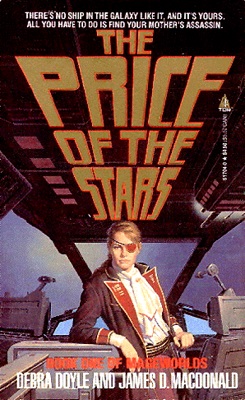
price_starsThe Price of the Stars, Debra Doyle & James D Macdonald (1992). This is the first book of the Mageworld series, as the cover helpfully explains. There are seven books in the series, the last in 2002 (the blurb for which does not read like it’s the final book of a series). Initially, I wasn’t all that impressed – The Price of the Stars wears its inspirations – kof kof St*r W*rs kof kof – far too openly, and even the changes it rings are overshadowed by that media behemoth. But I sort of got into it, and began enjoying the read… so I’ll probably end up tracking down the rest of the series and giving them a go, despite their faults.  I reviewed it on SF Mistressworks here.

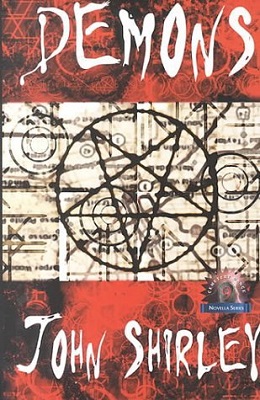
demonsDemons, John Shirley (2000). For some reason I have yet to figure out, I cottoned onto John Shirley as an author worth collecting… despite not being a fan of horror. I think it was partly because in the early 1990s, he was producing some exciting stuff – Wetbones, Heatseekers, Eclipse, A Splendid Chaos – and, like Lucius Shepard and Lewis Shiner, two genre writers I admire, he began publishing limited edition novellas through small presses. Anyway, I have a number of his books in those signed limited editions, and yet most of them are, well, pretty forgettable. Demons – not to be confused with the Ballantine collection of the same title which includes this novella/short novel (and which I’ve had to link to on Am*z*n because the Cemetery Dance limited edition is apparently very rare) – is fairly typical of Shirley’s output. The gonzo horror inventiveness, the slightly off-kilter approach to the world, nailed into place with the careful use of details, the often slapdash prose, and a story that’s usually more than it appears. In Demons, er, demons start to appear, all over the world. And they kill people, without rhyme or reason. There are seven specific types of demons, which a glossary before the story helpfully describes, and which artwork in the book depicts. Ira is an illustrator for an occult magazine and a bit of a slacker. He’s love with Melissa, the daughter of Dr Paymenz, an occultist professor at a California university. And he’s with them when the demons appear. The three manage to hook up with a symposium of like-minded academics, where Ira learns of the Conscious Circle of Humanity, a group of 23 psychically-gifted people who keep humanity safe, and about a conspiracy which prepared the world for the demons’ arrival. Eventually, they figure out that various large-scale industrial accidents were triggered to usher in the demons, so that a small group of men can use the ensuing slaughter as “sacrifices” to gain immortality. Cliver Barker would probably have made a 900-page epic out of this plot, but in Shirley’s hands it doesn’t outstay its welcome. Better than I had initially thought. But I’m still not sure why I collect Shirley’s books.

1001 Books You Must Read Before You Die count: 126


3 Comments

Awards, rewards and self-publishing

Adrian Tchaikovsky’s Children of Time won the Clarke Award, which was a surprise – but a pleasant one. At least the book I’d expected to win didn’t take the prize; but, sadly, neither did the book I wanted to win. I had Children of Time pegged more as a BSFA Award book than a Clarke Award, but when I wrote about it in August last year I predicted good things would happen to it. And I’m happy for Adrian, who is a thoroughly good bloke (and scarily prolific). Children of Time is one of the very few books I started reading on the day of purchase – and it was completely by accident. I’d bought the book at Edge-Lit 4, but during the journey home I finished the novel I’d brought to read on the train and so turned to Children of Time. I wonder if it’s repeatable…

I’ve written about the Clarke Award shortlist elsewhere, and about the individual books on it in scattered Reading diary posts on this blog. It was – and I’m not the only person to use this word – a lacklustre shortlist. The Clarke has always been a boundary-pushing sort of literary award, but the last few years it seems to have been circling its metaphorical wagons. There has been surprisingly little commentary about the books on the shortlist this year, despite it being the award’s thirtieth anniversary, despite the extended period between the announcement of the shortlist and the announcement of the winner. But when most commentary on sf these days seems to consist of brainless hyperbole on social media, having all the criticial insight of marketing copy, it’s plainly a problem much wider than an award shortlist. In today’s genre conversation, books receive either five stars or one star. It’s a piss-poor excuse for a conversation, and it’s poisoning the genre. Not only is sf blanding out, we seem to be actively encouraging it to do so…

110962_web

Which makes the award’s decision to allow self-published works to submit baffling. The vast majority of self-published books are derivative commercial sf, space opera or military science fiction. It’s precisely the sort of sf you’d hope the Clarke Award would avoid. Of course, there are also self-published works which are anything but commercial – and may well have been self-published for that very reason. But the award director cites the examples of Becky Chambers’s The Long Way to a Small, Angry Planet and Jeff Noon’s Channel Skin (which I’ve not read) as good reasons for including self-published works. Of course, the Chambers was already eligible because it had been picked up and published by Hodder. I’m a bit annoyed the award bent the rules to allow me to submit All That Outer Space Allows – which was also selected for the Tiptree Award’s honour list – but then hasn’t seen fit to hold it up as an example of a self-published novel that was worthy of submission.

I deliberately set out when writing each book of the Apollo Quartet to upset the expectations of readers, something I had the freedom to do because I was self-publishing. And while that has seen the books win one award, be nominated for a further two, and appear on the honour list of another… I’ve sold only 3700 copies since April 2012. And Dreams of the Space Age, a collection of short stories set in the same, er, space as the Apollo Quartet, published in April of this year… well, I can barely give them way – 86 copies sold since its launch. However, I don’t have the marketing clout or the distribution channels of a major publishing imprint, so this was hardly unexpected. To be honest, I’d actually expected Adrift on the Sea of Rains to sink without trace.

Because I self-published, because I had no expectations of commercial success, so I was free to write something challenging. The fact that some people appreciated that enough to nominate the books for awards was a huge surprise. And I saw that as grounds to write even more challenging sf. Which at least might have stood me in good stead for some awards. Except now the Clarke Award appears to prefer more commercial works, and by opening itself up to self-published books, is likely to become yet more commercial. I’m guessing, of course; but you can’t get more commercial than the Firefly fanfic that is The Long Way to a Small, Angry Planet

It’s an inevitable conclusion, and one that has plainly occurred to Adam Roberts, who has gone on record as saying he will no longer write challenging science fiction novels as he would sooner not have his books ignored. And I think to myself I would sooner write more difficult sf. On the other hand, success brings its own acclaim, and it’s astonishing how popular books become “awesome” and “amazeballs” and “the best book ever written”. Which is not to say challenging works can never be popular, nor commercial works possess literary quality, nor literary works enjoy commercial success… But we’re in danger of losing what’s best about science fiction if the only game in town is “most popular kid in the playground”… And I was going to write something about lone voices in the wilderness being the only ones to carry the flame, but that really is a mixed metaphor too far… But it’s not unrealistic to expect, to hope, that the Clarke Award is skewed toward challenging science fiction novels, and not the dull, and often juvenile, meat-and-potatoes/bread-and-butter sf which sells by the yard (and is likely written by the yard too), and which appears to comprise the vast undifferentiated mass of self-published science fiction.

But I’m speculating – and we shall see next year how the Clarke Award implements its expanded remit. A juried award at least has the advantage of not being bent out of shape by eligibility posts, or fan and tribe affiliations; and for that reason I look to the Clarke as a truer picture of what the word “best” means in science fiction in any given year. I would hate to lose that…


Leave a comment

Moving pictures, #42

More films. So it goes.

fanThe Fan, Otto Preminger (1949, USA). I have a fondness for Preminger’s films, although that may well be simply because he was a name I fastened onto when I started tracking my film watching… but I started out watching his movies so I may as well carry on and complete his oeuvre. Of which this is not a good example. It is an especially unwitty adaptation of Oscar Wilde’s ‘Lady Windermere’s Fan’, which inadvertently has the advantage of making the story much simpler to parse – although, to be fair, I’ve not seen Wilde’s play, so the loss of his dialogue is not one I’d notice. (There are, of course, more faithful adaptations of the play, but I’ve not seen any of those either.) It opens shortly after WWII, when an old woman in an auction room objects that the fan which is for sale, found in the ruins of a bombed house and unclaimed, is hers. The auction house tells her that if she can verify her claim, they’ll hand it over. So she goes looking for Lord Darlington, a friend from many years before… And after a bit of banter (very little of which is Wildean), we’re in flashback territory, and it’s the last decade of the nineteenth century and the “adventuress” Mrs Erlynne has arrived in London and attached herself to the company of Lord Darlington and the young Windermeres. And when Arthur Windermere puts up for a London residence for Mrs Erlynne, and is often seen her company, tongues begin to wag, and a nasty rumour eventually reaches Margaret Windermere. It all comes to a head at a fancy party at the Windermeres, to which Erlynne is invited, and at which she reveals her secret (she’s Margaret Windermere’s black sheep mother, who ran away decades before). As historical drama, this is a pretty solid, if unadventurous, movie, but you expect more from Wilde and the bowdlerisation of his lines has done it few favours. One for Preminger completists, I think.

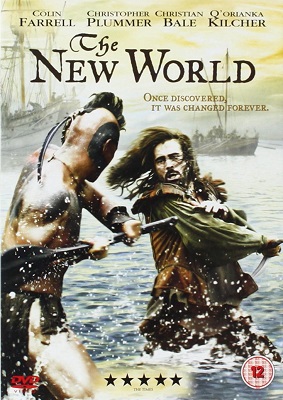
new_worldThe New World, Terrence Malick (2005, UK). I don’t know what to make of Malick. His films are beautifully shot but also complete nonsense. There is, for example, a brilliant idea at the heart of The New World, but for some reason it doesn’t quite work. It may be that Malick’s use of Hollywood stars, and their highly-promoted identities, works against what he is trying to achieve… The New World tells the story of Pocahontas, although focusing mostly on the English men with which she had relationships. Malick has gone for a completely authentic look and feel to his story – even going as far as getting a professor of linguistics to reconstruct the extinct Powahatan language spoken by the Native Americans of the period and location the film takes place. But the real genius of The New World – or rather, what could have been the real genius – is that the bulk of the dialogue is actually voiceover and is the characters, all of whom are real historical figures, speaking the text from their own diaries and journals. But. It doesn’t quite work because this is not a documentary and the real historical figures are played by recognisable Hollywood actors such as Colin Farrell, Christopher Plummer, David Thewlis or Christian Bale. True, the pivotal role of Pocahontas is played by an unknown, Q’orianka Kilcher, a German actress, in her first major role. And she’s very good in it too. It goes without saying that The New World is mostly gorgeous to watch, and it looks and sounds exactly how you would expect a English colony in North America in the early seventeenth century to look and sound (well, except for the drama school kids, but we won’t mention them)… I remain conflicted about Malick and his films. They look lovely, he’s probably the closest the Hollywood system has come to slow cinema, but… there’s always something slightly off about them. Perhaps it’s simply that his style of film-making doesn’t work in Hollywood, is fatally compromised by Hollywood’s use of familar names and faces in roles where the baggage they bring undermines their parts. It doesn’t help that Malick’s reputation in the US as “auteur supreme” likely gives him the freedom to be self-indulgent, and a little self-indulgence goes a long way. But whatever it is, there’s something about Malick’s films that rubs the wrong way, and I wonder if it’s the friction between the Hollywood system and the sort of films Malick’s movies try to present themselves as being.

city_of_womenCity of Women, Federico Fellini (1980, Italy). As male writers get older, they enter a Dirty Old Man phase – cf John Fowles’s Mantissa, or anything by Robert Heinlein after the mid-1960s… – and creators in situations which give them more than the usual artistic freedom are especially susceptible. True, Fellini has been self-indulgent since day one, but I do love that self-indulgence in his colour films – or, at least, I loved those I’d seen… But Fellini has made many films, and bizarre as Satyricon is, or Casanova… others would no doubt fall either side of that indulgence divide (to coin a phrase). I had very little idea of what to expect from La città della donne, except perhaps something like a cross between Giuglietta della spiriti and something created by a middle-aged Italian male… And, er, that’s a bit what it’s like. It feels like it can’t decide if it’s an attack on feminism or a celebration of it, and the fact it sends mixed messages is clearly not to its credit. There are things to like in City of Women – and they’re the same sort of things to like in Fellini’s career – but there’s also that weird undercurrent that feels like a, well, MRA attack on feminism. Which is like watching a comedian whose every other joke falls flat, but you’re never entirely sure if that’s deliberate. Things have changed in the four decades since the film was made, and it renders some of its complaints weirdly old-fashioned, others weirdly trivial, and some even more relevant now than they were then. A man on a train (Marcello Mastroianni playing, well, Marcello Mastroianni) flirts with a woman, and when the train stops in the middle of nowhere and she disembarks, he follows her… through some woods to a sort of isolated hotel where a conference on feminism, attended entirely by women, is taking place. And, er, that’s it. This is Second Wave Feminism as the butt of an extended joke… except, there’s a sense throughout that the joke is on those who see the feminism as the joke. I don’t know. Given Fellini’s career I’m inclined to think he was having fun at the expense of anti-feminists (while not subscribing to feminism himself), but parts of City of Women are so bonkers – the final third of it, pretty much – that it’s hard to be sure what he meant. Given his previous films, I’d give him the benefit of the doubt, I think; but City of Women still remains the least satisfactory of his colour films I have seen so far.

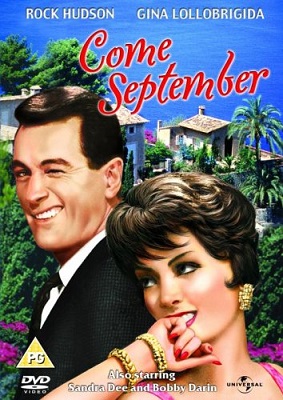
septemberCome September, Robert Mulligan (1961, USA). I do love me some Rock Hudson rom com, and he was at his best in these during the 1960s. And, let’s face it, how can you go wrong with Gina Lollobrigida as the female lead? And Italian locations? (Although apparently Lollobrigida was not keen on returning to Italy.) Anyway, Hudson plays a successful industrialist who, each year, spends the month of September in his large villa on the Genoese coast. But one year he decides to go in July instead… which promptly screws up a few things. For a start, his girlfriend, Lollobrigida, is about to get married to some English wet, but breaks it off when she gets his call. And his butler, played superbly by Walter Slezak, has been runnnig the villa as a hotel for eleven months of the year. And, en route to his villa, Hudson has a run-in with a bunch of American rowdies led by Bobby Darin. So Hudson finds his girlfriend wavering, his house occupied by a group of young American women and their chaperone, and he has Darin’s rowdies camped outside on the road because Darin fancies one of the guests of the “hotel”, Sandra Dee (Darin and Dee actually married after the film)… Aside from Hudson’s massive sense of entitlement, this is a pretty straightforward 1960s rom com. It has its charms, and some of its jokes are quite good, but it’s hamstrung by the fact that Hudson’s character is actually a nasty piece of work. It’s watchable because Hudson is eminently watchable – and there are probably only a handful of actors of the time who could have got away with playing such a role – but not even Lollobrigida’s screen presence and charm, Darin’s cinematic surliness, or even Dee’s all-American bland chirpiness, can make this more than a middling rom com of the period, even for Rock Hudson.

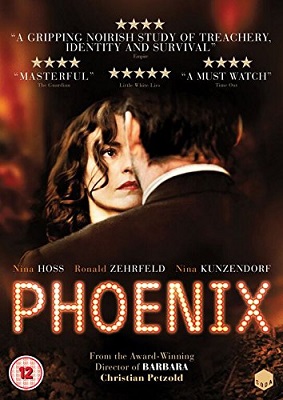
phoenixPhoenix, Christian Petzold (2014, Germany). I don’t chose my viewing entirely from lists of best films. Sometimes it’s stuff I stumble across that takes my fancy, and sometimes it’s movies recommended by friends. As this one was. By David Tallerman. Who has recommended good films to me in the past (some, it must be said, better than others). In fact, Phoenix had not pinged on my radar at all, and having now watched it I’m glad David recommended it. A Jewish woman who survived the camps returns to Berlin to discover what happened to her Gentile husband. She had been badly wounded in the face, and she requires plastic surgery, which results in her appearance changing. So when she tracks down her husband, he does not recognise her. But he does think she looks enough like his “missing” wife that she could impersonate her and so claim the inheritance left to her. The woman does not reveal her true identity and plays along with this subterfuge, partly to disprove the lie of a friend who insists the husband was the one who gave up the woman to the Gestapo. Phoenix is based on a 1961 French novel, Le retour des cendres, but, to be honest, to my mind it seems to work better with a German setting – it certainly gives the central premise a bigger emotional payload. A good film and definitely worth seeing. It might well make a future 1001 Movies list, if it hasn’t already.

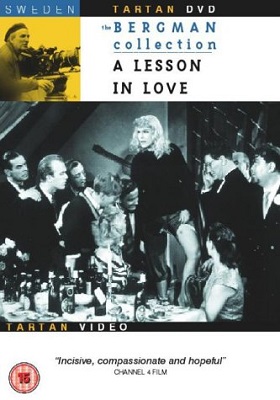
lessonA Lesson in Love, Ingmar Bergman (1954, Sweden). Bergman made a lot of films and some of them are bona fide classics of the medium. Others are little more than cinematic adaptations of middling stage plays – or, at least, that’s how they come across, even if they’d been written directly for film. As far as I know, A Lesson in Love was conceived of and produced purely as a film. But it’s not that easy to tell with Bergman. A Lesson in Love is also minor Bergman, inasmuch as it’s entertaining and has something to say, but when all’s said and done, it sort of fades into that middle Bergman ground where so many of his films reside and where it’s hard to tell one of them from the other. I could put together a list of a dozen top-notch Bergman films, and even for a director who made over sixty films, that’s an enviably large list. Sadly, A Lesson in Love would not be on that list. It’s a 1950s Swedish comedy about a gynecologist and his patients and marriage and affairs, and to be honest it all sort of blurs into one after a bit. There’s some good witty dialogue and some on-target points, but nothing in it really stands out. It probably needs a rewatxch, to be fair, but if there’s one thing about Bergman’s oeuvre that is true it’s that it can stand multiple rewatches. And not many directors can say that.

1001 Movies You Must See Before You Die list: 793


1 Comment

Moving pictures, #41

Despite a weekend away at Bloodstock, I managed to keep to my somewhat heavy schedule of film-watching; although, once again, most of the movies below are not from the 1001 Movies You Must See Before You Die list (only one is, in fact). But that’s chiefly due to the vagaries of the DVD rental services I use. Anyway, avanti…

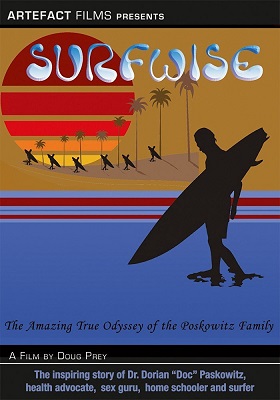
surfwiseSurfwise, Doug Pray (2007, USA). Dorian Paskowitz graduated from Stanford Medical School in 1946, ended up in Hawaii, and became enamoured of surfing. This led to your typical surfer dude philosophy of diet and lifestyle, albeit several decades before it came to prominence… Paskowitz went on to introduce surfing to Israel, and many years later to Palestine. But Surfwise is more about Paskowitz and his family than it is his accomplishments. Initially, the film clearly admires the man, but the interviews with his eleven children paint a somewhat different picture: of a man who was harsh, if not abusive, and left his children with a completely different legacy to that painted by the opening third of the documentary. Paskowitz himself seems unrepentant – he led an interesting life and knows it, and he stands by pretty much every idea he has ever had, no matter how unpopular or crackpot. Certainly, Paskowitz is an interesting individual, with a story to tell; and it’s quite clever how Surfwise uses that to hide the fact he isn’t half as nice as protrayed, and then slowly shifts the sympathy of the viewer away from him. But when all’s said and done, Surfwise is a well-made documentary about a not-especially-interesting topic.

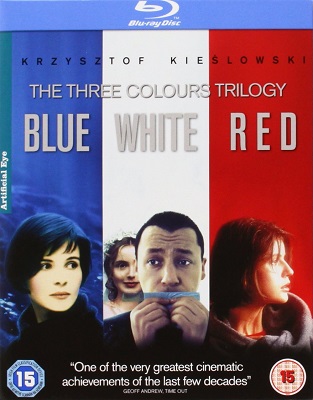
three_coloursThree Colours: White, Krzysztof Kieślowski (1994, France). I’m prepared to accept that Kieślowski belongs on a list of the greatest directors, and I’ll happily agree he’s created several superior examples of a particular type of film. But… These rewatches – prompted by upgrading my DVD copies to Blu-ray – have proven an interesting exercise, if somewhat disappointing, inasmuch as the movies haven’t quite matched up to what memory, and the weight of critical opinion, has insisted they’re worth. True, White is generally considered the weakest of the trilogy, although having now watched it again I’m not sure why. The story is more obvious, and the driving emotion of the story more… primal; and there are a few bits which are implausible… But the plot has more drive than Blue and the characters’ motivations more obvious (except, perhaps, for Juliette Delpy’s character, who comes across more like a motivation for the lead character, played by Zbigniew Zamachowski, than a character in her own right). Delpy and Zamachowski, both hairdressers, were married, but the film opens with their divorce. In Paris. Where Zamachowski is at a disadvantage as he doesn’t speak French. He ends up with nothing, but a chance encounter with another Pole sees him smuggled back to Poland, by air, in a suitcase (even in 1994, this was implausible). Through a combination of contacts and clever dealing, Zamachowski becomes a millionaire… and promptly fakes his own death and frames Delpy for his murder. The “white” apparently refers to “equality” in the three political ideals of the French Revolution, and I guess that applies to Zamachowski’s revenge on his wife, although revenge seems a curious means of applying equality. It goes without saying that White is beautifully shot and arranged, and that the cast put in spotless performances, but it still feels like a movie of a type rather than a movie per se. Kieślowski was very good at what he did, and Piesiewicz wrote scripts perfectly suited to Kieślowski’s approach to film-making… But a little goes a long way, and while my tastes have turned more toward slow cinema than they had been before, it does seem a little like Kieślowski’s reputation is a little over-stated… Nonetheless, an excellent film, an certainly more deserving of a place on the 1001 Movies You Must See Before You Die list than many that are actually on it.

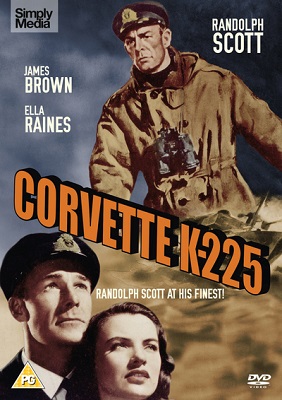
corvetteCorvette K-225, Richard Rosson (1943, USA). I had thought this was a Howard Hawks film, which is why I added it to my rental list; but he apparently only produced it. Oh well. Still, I enjoy WWII naval films, almost as much as I enjoy Cold War USAF films, and considerably more than I enjoy WWII infantry films. The title of the movie refers to a Flower-class corvette, built in Canada and operated by the Royal Canadian Navy. The ships were originally designed for near-shore operations, but ended up as escorts for convoys across the Atlantic. Lead Randolph Scott returns to Halifax after losing his corvette, and most of his crew,  to a U-Boat. He’s a given a new ship – the titular ship – currently on the slipway being built. They build the ship, Scott gets his crew, they go out on escort duty, accompanying a convoy to Southhampton. There’s a romantic triangle, of course – well, sort of: Scott starts seeing the sister of an officer who died on his previous ship, and, to make matters worse, her young brother joins the new corvette as a junior officer, fresh out of the academy. The convoy goes as you’d expect – from a dramatic standpoint rather than an actual WWII standpoint – and even results in an encounter with the U-Boat which sank Scott’s previous corvette. This is solid wartime drama, good for the folks at home, good for those fighting; and interesting because it gives an accurate idea of life aboard a corvette on a trans-Atlantic convoy. Better than I expected.

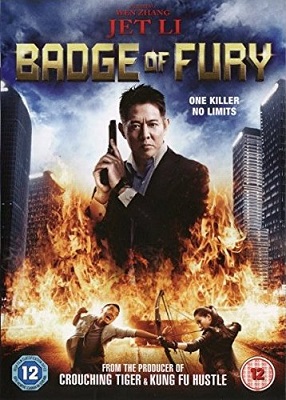
badgeBadge of Fury, Wong Tsz-ming (2013, China). Some confusion over the title of this, since the DVD seems to be Badge of Fury but the streamed version I watched on Amazon Prime was titled Badges of Fury. No matter. Anyway, I stumbled across it on Amazon Prime, didn’t up to watching something too weighty and this seemed like it’d be worth a go. And so it was. The beginning wasn’t too auspicious – three bumbling cops who mess up a sting to catch a gangster at a posh party when one of the cops recognises an entirely different gangster and attempts to arrest him instead (although Jet Li can never be “bumbling”, so his character is just lazy and a clock-watcher). In fact – title aside – the film doesn’t initially come across as a comedy and it’s only when you twig that it’s getting increasingly silly that you realise. As a Hong Kong comedy/action movie, Badge of Fury is perhaps more polished than most, although the repartee is somewhat repetitive. But when you start spotting references to other Hong Kong action films, well… it gains a whole other dimension. Not only are there direct references, including to some of Li’s own films, but the final fight scene riffs off climactic fights from at least four films that I counted, of which Once Upon A Time in China was only the most obvious. I hadn’t expected much of Badge of Fury, and initially it seemed to promise very little, but as it progressed it showed itself to be a clever piece of work, and even a halfway decent comedy. Worth seeing.

kesKes*, Ken Loach (1969, UK). I’m surprised I’ve managed to fail to see this over the past couple of decades, although it’s not like I’ve made an effort to avoid it. But it’s a well-known and highly-regarded British film – probably one of the best-known from this country, in fact (second only to, shudder, Four Weddings and a Funeral, I suspect). It’s also pretty much a local film – not so much for where I’m from but where I now live (although my home town is not that far from my current city of residence). Anyway, it’s set in Barnsley. A young boy who is bullied by his older brother and at school, steals a kestrel chick from a nest and raises it following the advice given in a book he stole from the local library. I’ve no idea if Kes prompted the media characterisation of “it’s Grim Up North”, but it certainly must have fed into it. Because Kes paints a bleak picture of Barnsley (not undeservedly; I’ve been there); although, of course, one depressed area is not all depressed areas – and I say that as someone whose relatives’ background is not dissimilar to that of the characters in Kes (although not my own personally as my parents moved to the Middle East when I was two). But the life depicted in Kes was not unfamiliar. Although I did struggle once or twice with the dialect. Yet, when all’s said and done, the film deserves its plaudits. Loach’s documentary-style approach made the story emotionally powerful – helped by a good cast, including Brian Glover with actual hair (in his first ever role). I’ve now seen two Loach films in quick succession, and been inmpressed by both. Those Loach box sets are looking more attractive every day…

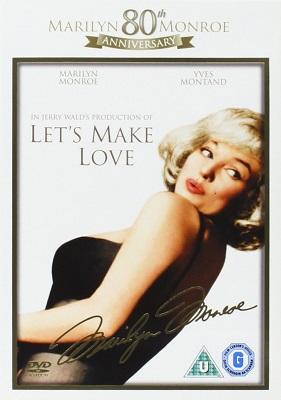
lets_make_loveLet’s Make Love, George Cukor (1960, USA). I like 1950s films, even musical ones, although not as much as melodramas, and at least one 1950s musical by Cukor I’ve seen I like a lot – that would be Les Girls – but I’m not a huge Marilyn Monroe fan (I’d sooner watch, say, Ginger Rogers)… But anyway it seems I stuck this on my rental list, and so it dropped through the letter-box and I watched it and… Meh. Yves Montaud plays a billionaire playboy who learns an off-Broadway revue intends to take the piss out of him in one of their musical numbers. So he decides to check it out himself, walks into the rehearsal… and spots Marilyn Monroe rehearsing a musical number. He immediately falls in love, auditions for and wins the part of a lookalike of himself, with the intent of wooing Monroe incognito. It’s a hoary old plot, and I’m pretty sure Hollywood trots it out at least once a decade. Monroe provides a couple of iconic moments, Frankie Vaughn is a bit whiny as the male star of the revue, and Montaud can’t seem to decide if he should play it stiff or charmant and so manages some weird state in between the two. There’s a bit of fun in Milton Berle, Gene Killy and Bing Crosby appearing as themselves, each hired to teach Montaud, respectively, comedy, dancing and singing – all in order to increase his appeal to Monroe. But the film’s biggest fault is that it all seems a bit drab, and the sets and costumes for the musical numbers are weird and cheap-looking. Not the best film in either Monroe’s or Cukor’s oeuvres, although apparently it provided Hollywood with plenty of gossip about Monroe and Montaud…

1001 Movies You Must See Before You Die count: 793


Leave a comment

Summer harvest

I have been mostly very good of late and have managed not to add more books to the TBR than I read per month, so it is slowly – very slowly – dwindling. This doesn’t however, prevent me from buying better editions of books I’ve already read – because, of course, they don’t count. There have also been a couple of lucky finds in local charity shops since my last book haul post.

2016-08-20 11.06.37

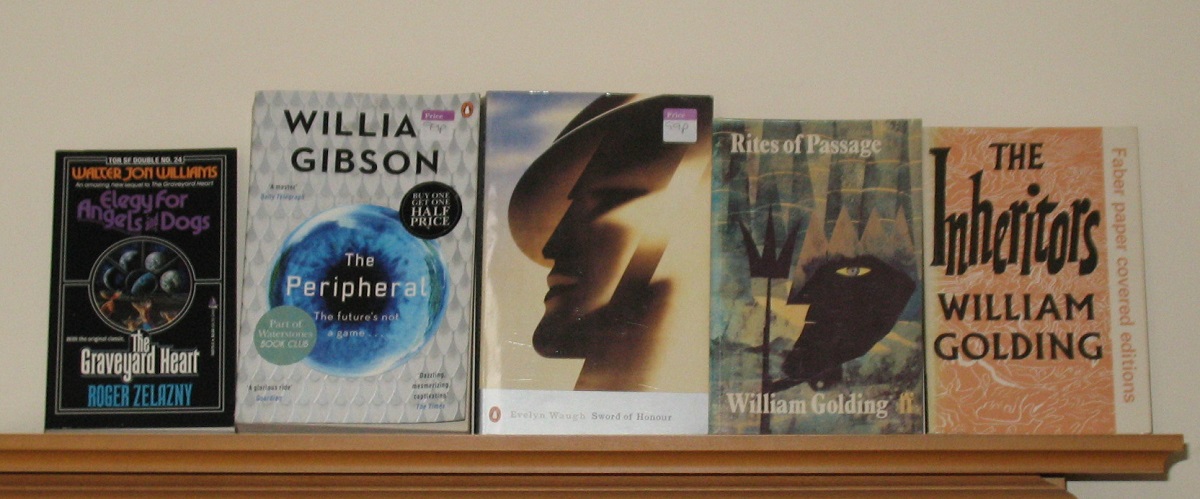
The aforementioned charity shop finds: Rites of Passage and The Inheritors I’ve always fancied reading, but had never come across copies before. And the Sword of Honour trilogy was another on my wants list that I’d never expected to find. (Yes, yes, I know; I could have bought the books new from a bookshop, but there are some books you fancy reading but not enough to buy them new.) I stopped reading Gibson after Virtual Light, but I really ought to read him again, so The Peripheral was a fortunate find. Tor double No. 24 Elegy for Angels and Dogs / The Graveyeard Heart was, unlike the others, an eBay purchase. Four more and I’ll have all 36 of the series.

2016-08-20 10.36.11

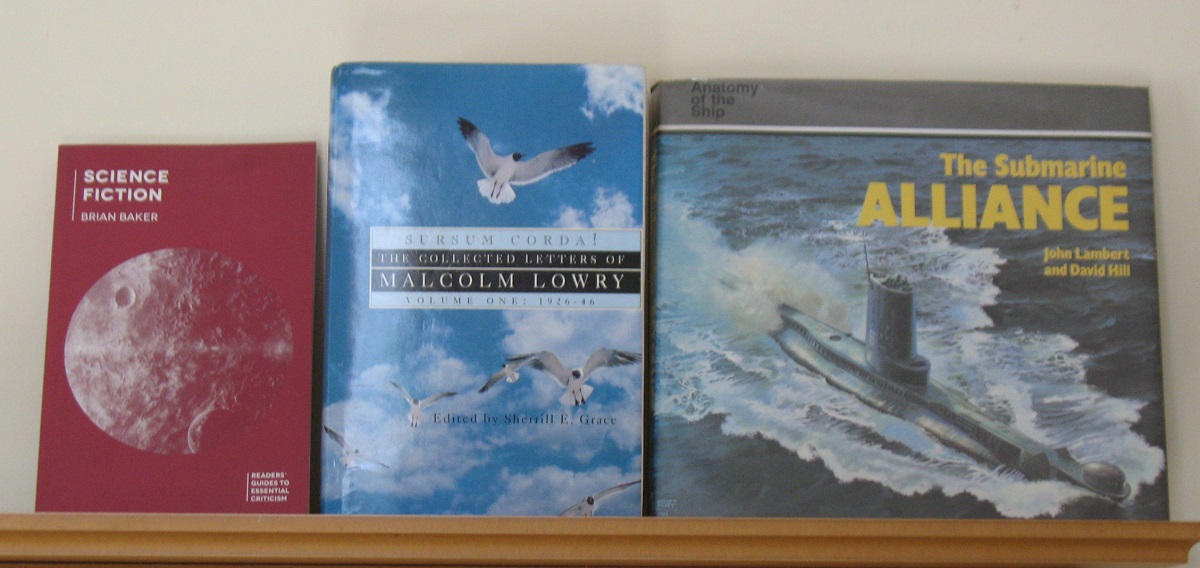
And speaking of series… Now that I have The Submarine Alliance, I only need one more and I’ll have all of the Anatomy of the Ship books (all, that is, of the twentieth century ships; I’ve not bothered with the sailing ship ones). The University of Toronto Press collected all of Malcolm Lowry’s letters in two volumes, under the title Sursum Corda! (it means “lift up your hearts”, but I don’t know – yet – what the Lowry link is). This is volume 1, found on eBay. Both books are pretty scarce, so I’m still trying to track down a copy of the second volume. Science Fiction is an actual new book, bought at whatever price it was the (online) retailer had set. I’m mentioned in it too! It’s only in passing and in reference to SF Mistressworks, but it’s my first appearance in an actual critical work on science fiction in book format.

2016-08-20 10.37.09

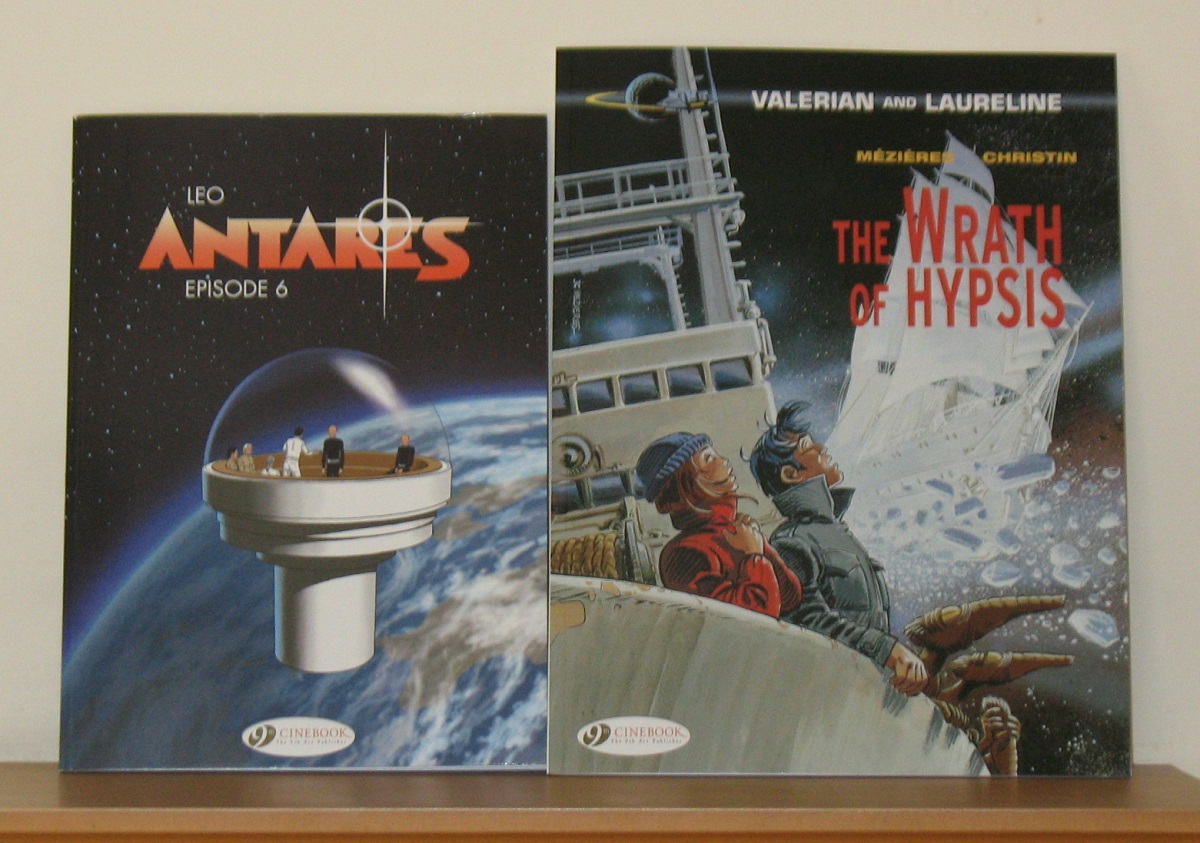
A pair of bandes dessinées from series I’ve been reading: The Wrath of Hypsis is the twelfth volume in the Valerian and Laureline series (there are 23 in print so far in French). Antares Episode 6, however, is the latest volume in both French and English in the Antares series. I wrote about both of these here.

2016-08-20 10.39.36

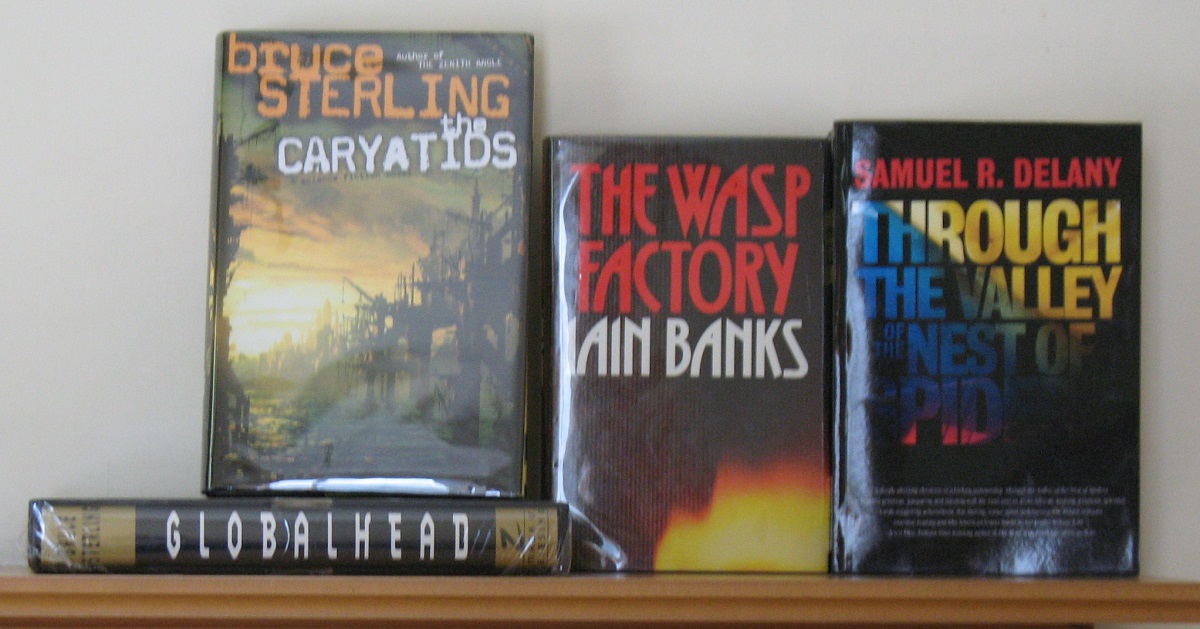
Mention of Delany somewhere recently reminded me that I wanted a copy of Through the Valley of the Nest of Spiders, which I’d negelcted to buy when it was published… and wow, copies are dear now. I eventually found one on eBay for a reasonable price. It’s a surprisingly fat book. A couple of weeks ago, I was chatting on Twitter with Steve Savile about collecting books, and mentioned I had all of Banks’s in first edition (some signed) except his debut, The Wasp Factory, which had always been too expensive. To prove the point, I searched on eBay… and found a copy going for much less than I’d expected (roughly half of what it had been the last time I checked). Reader, I bought it. The Caryatids I reviewed for Interzone – and interviewed Sterling as well – back in 2009, so I only had an ARC. But I always fancied a proper first edition, and when a signed one popped up on eBay for $15, I snapped it up. I also wanted the slipcased edition of Globalhead… and when a copy popped up on eBay for $30, I snapped it up. It’s even shrinkwrapped! Results all round.


Leave a comment

Reading diary, #34

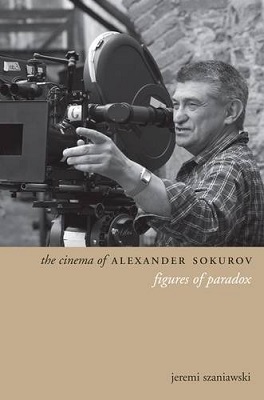
I stuck to my plan to read only non-fiction in July, but unfortunately I’d not considered one consequence: it usually takes longer to read non-fiction than fiction. So I’ve still not finished The Third Reich: A New History, I’m only three-quarters of the way through The Cinema of Alexander Sokurov: Figures of Paradox, and I barely got started on Imagination/Space. However… I did manage to sneak in a few fiction books…

visitationVisitation, Jenny Erpenbeck (2008). Erpenbeck’s The End of Days was the best book I read during the first half of this year, and is likely set to take the top spot come December… which I guess implies that I didn’t think Visitation as good. And, well, fair enough, it’s not as good as The End of Days… but it’s still an excellent novel. It’s written in a similar distanced sort of present tense without direct speech or speech tags. It’s also similarly episodic, although rather than the episodes being based around a person they’re based around a place. Which, in this case, is a patch of land beside a lake in what became East Germany. The story opens in the late nineteenth century (and it really does have a The White Ribbon atmosphere), when the land was covered by a wood. But the owner is forced to sell it after the First World War, and a succession of holiday homes are built on it. There’s some continuity in the form of the “Gardener”, a man who lived in the wood and who never speaks in the novel. At one point, the holiday home is owned by a Jewish family, but is then seized by the Nazis. It comes into the hands of a professional couple from East Berlin, and an old woman who has returned home after several decades living and working in Moscow… The land endures; the people, and the systems they create, do not. Erpenbeck is definitely my discovery of the year, and if Visitation doesn’t quite have the breadth or audacity of The End of Days, it’s likely only because it’s a much thinner book, little more than novella length. But in its approach to its material, it certainly presages The End of Days, although it runs as serial history rather than parallel or alternate history. I can’t recommend Erpenbeck enough. She has one more book available in English. I will be buying it and reading it before the year is out.

hangmanTor double 21: Home is the Hangman / We, in Some Strange Power’s Employ, Move on a Rigorous Line, Roger Zelazny / Samuel R Delany (1968/1975). A bunch of these Tor doubles appeared in the Isam Bookshop in Abu Dhabi back in the 1990s when I lived in the city. They’d obviously been remaindered as that was all the shop sold: remaindered books from the US and UK. (A colleague I ran into once in the shop told me in all seriousness that the books had been “rejected because they contain spelling mistakes”.) Every now and again, when I can find copies, I add to my collection. Tor published 36 doubles in total between 1989 and 1991; some, like this one, are a pair of older reprints, some an older work and a newer one (which was often a sequel or prequel by another hand to the earlier work). The two stories in this double, however, are completely unrelated – if there’s a thematic link, I missed it. According to the cover of Home is the Hangman, “He’s back from the stars – and he isn’t happy”, which tells you two things about the title character and manages to get both wrong. A nine-word blurb that is 100% wrong. Quite an achievement. The novella is narrated by a private investigator / security specialist type, who manages to live under the radar because he was a programmer on a project to computerise everyone’s personal details and ensured his own data was not recorded (this may have seemed like a plausible idea in 1968, but in 2016 it makes no sense). This, however, adds almost nothing to the story… which is about an AI which had been built to explore the moons of the outer planets, and has now returned to Earth for reasons unknown. Four people had been involved in “training” the AI and now, a couple of decades later, one runs a store, one is a psychiatrist, one is an engineer and one is a wealthy industrialist. The store-owner is brutally killed and the industrialist thinks the AI was responsible because of something horrible that happened in the past. Think Original Sin. This novella won the Hugo and Nebula and came second in the Locus Award. Zelazny is a well-known name, and a famous genre prose stylist… so I was surprised at how rubbish this was. The prose was bland, the plot obvious, and time had has not been kind to the world-building… But turn the book upside down and flip it about and you get… We, in Some Strange Power’s Employ, Move on a Rigorous Line, which is a pure hit of the pure Delany… and yes, it’s dated quite a bit but it doesn’t matter because with Delany it’s always the late 1960s/early 1970s… and yes, the central premise – giant crawler factories which lay electricity cable, free of charge, to every household on the globe – is bizarrely old-fashioned and weird for 1975… But but but. There are Hells Angels living in an abandoned house in the mountains, and they ride flying bikes. And when one of the crawling factories offers to lay cable to the house (what was wrong with the original utilities infrastructure? Delany never tells us), it breaks apart the biker gang. It’s pretty much nonsense from start to finish but it’s also what a real prose stylist looks like. Reading these two novellas is a bit like reading some sort of writing match between a pair of big names from the late 1960s. Delany wins hands-down, no doubt there; especially since Delany’s novella reads like a product of its time but the Zelazny reads like a story that could have been written at any time but does a piss-poor job of its world-building. So, Delany 1 – Zelazny 0.

agentAgent of the Imperium, Marc Miller (2015). The Traveller RPG was first published in 1977, and has been through several incarnations in the decades since. And during those years, there have been a handful of tie-in novels published – two by the game’s original publishers, GDW; one by a major imprint; but most by fans. Miller was the inventor of the game, and has been seen as its authority ever since – much as Gary Gygax was for Dungeons & Dragons – but until Agent of the Imperium, Miller had never published fiction (unlike Gygax). Agent of the Imperium was published by Miller’s company, Far Future Enterprises, but was financed via Kickstarter. Despite not think highly of other Traveller novels I’ve read, I decided it might be worth reading Miller’s go at one. And… there’s some interesting ideas in the novel, and the way it covers so much of the Third Imperium’s history is cleverly done… But it reads like a series of unconnected episodes, which eventually lead up to the seizing of the Iriridum Throne by Arbellatra, the founder of the Alkhalikoi dynasty (which was still in power five hundred or so years later, at the time the setting of Traveller “began”). The narrator of the novel is the agent of the title, and he works for the Imperial Quarantine Agency, which is charged with preventing epidemics on individual worlds from spreading across the Imperium. Of course, it takes something especially virulent to put the Imperium in danger, and the opening incident describes a world where a species of parasite has taken mental control of the population. The Agent, however, is not a real person. He was a high-level bureaucrat during the early years of the Imperium, but his personality was encoded on a wafer (a fatal process), and now, in certain circumstances, the commanders of Imperial Navy vessels or fleets are instructed to insert a copy of the wafer into a suitable officer equipped with a jack, and so invoke the Agent, who can then advise on the situation. These situations usually result in the Agent advising the fleet to destroy the world. After several such incidents, the Agent (there is a system in place to keep his memories updated and in synch) assists Arbellatra onto the Iridium Throne. I’m a big fan of Traveller and the universe its designers have created and yes, it’s a good playground for fiction… But most of the fiction set in the universe has never quite managed to grasp the flavour of it. Unsurprisingly, Miller manages that really well – despite throwing in virtual personalities and wafers and jacks, none of which, as far as I remember, appeared in any of the incarnations of the RPG. However… Miller is no prose stylist; in fact, he makes Asimov look like a prose stylist. This is commercial sf prose stripped down to its most basic, and the best that can be said of it is that it’s serviceable (although an editor should have spotted that “flang” is not the past tense of “fling”). The story is also far too episodic, and the links between the episodes too minor, to give the whole a feeling of a plot. Fans of the RPG will enjoy it – because it’s by Miller, because it’s set in the RPG’s universe – but if it had been a non-Traveller work it would be a poor one.

Vendetta, MS Murdock (1987). I stumbled across this at Fantastika 2016 in Stockholm, looked it up online and decided it was eligible for review on SF Mistressworks. Which I have now done. It wasn’t… very good. See here.

coming_up_for airComing Up for Air, George Orwell (1939). George Bowling is in his forties, fat, works as in insurance inspector for the Flying Salamander, and ives in the suburbs with a wife and two kids. He is, in pretty much every respect, an ordinary lower-middle-class Londoner of the thirties. He wasn’t always, of course. He was born and grew up in a small Thames Valley village, the son of a seed merchant whose business is failing. He leaves school early and goes to work for a local grocer. And then war is declared, and George signs up. He finishes the war as a commissioned officer, which is enough to lift his ambitions above a grocer’s shop. He is, he admits, one of many men who survived the Great War and whose experiences were enough to lift them from working class to the lower rungs of middle class. All this is told to the reader by George in evocative and surprisingly chatty prose – his childhood in Lower Binfield, his aspirations, his current mid-life crisis… And it’s the latter which persuades him to return to Lower Binfield for a visit after twenty-five years away. Naturally, what he finds is not the bucolic village of the turn of the century that he remembers. I took this book with me to Bloodstock, something to read when I needed an occasional time-out from the metal and the beer, and when I started it I wondered if I’d picked a wrong ‘un. The only Orwell I’d read previously was Nineteen Eighty-Four and Animal Farm, his two most famous works – and Coming Up for Air‘s chatty first-person narrative is nothing like those. But the more I read, the more I found myself fascinated by George Bowling and his life. Orwell paints a picture of a life that is as foreign to me because of the time it’s set as it is because Bowling grew up in a small agricultural village in southern England (ie, not the industrial north). I enjoyed Coming Up for Air a lot more than I’d expected to, and found it a much better book than I’d anticipated. Worth reading.

FIGURESThe Cinema of Alexander Sokurov: Figures of Paradox, Jeremi Szaniawski (2014). Though I’ve been subscribing to Sight & Sound for nearly two decades, I’ve never read any actual academic film criticism. Until now. But I’m a huge a fan of Sokurov’s films, and I felt I needed a little help to parse some of them. And Figures of Paradox has been very useful in that regard, but… The language used throughout is that sort of obfuscatory academic bollocks that gives academic criticism a bad name. Having said that, Szaniawski knows his subject well, and there is plenty of information about the production of Sokurov’s films which I found both fascinating and helpful in deciphering them. However, the more I read the book, the more it becamse clear that Szaniawski had A Theory, and he was determined to prove it. There is, it cannot be denied, a certain amount of homoeroticism in Sokurov’s films, and Sokurov himself is famously celibate. Although Sokurov has denied being gay, Szaniawski is convinced he is, and the evidence for it is there in his films. I can see in part what Szaniawski claims, but there’s as much evidence in Sokurov’s filmography to “prove” he is gay as there was in Ken Russell’s – and Russell wasn’t gay. Not, of course, that it makes the slight bit of difference. It just seems a peculiar drum to bang. Reading the book, I put it down to an academic’s need to add some new angle to justify their research. (Szaniawski’s book is not the only critical work on Sokurov, but the others are all spread across a variety of magazines.) In all, I found Figures of Paradox something of a curate’s egg – a useful work in helping to parse Sokurov’s films, and better appreciate them; but it also displayed some of the worst aspects of academic film criticism. But Sokurov is still an amazing director, though.


3 Comments

Moving pictures, #40

This is the second Moving pictures post in which I’ve not watched a film from the 1001 Movies You Must See Before You Die list. Oh well. I have, on the other hand, now watched all of the Sokurov films I now own. But there are still a couple more I’m after before I have everything he has made. And two US films out of six isn’t bad, I can live with that.

dialoguesDialogues with Solzhenitsyn, Aleksandr Sokurov (1998, Russia). I was dead chuffed at getting hold of this. The only copy I’d seen available was priced around £180, which was way too much for me (it’s now £220, I see). But then I realised Sokurov was spelt Sokourov by the French, so I googled that… and found a copy of Dialogues avec Soljenitsyne for €30 on Amazon.fr – and all the packaging was French/English, and the DVD included English subtitles. Result. I tried watching it earlier this year, but decided to leave it until I’d read some Solzhenitsyn… and having now read One Day in the Life of Ivan Denisovitch, I can quite categorically say it made bugger-all difference. The DVD contains two made-for-TV short films – ‘The Knot’ and ‘Dialogues’, both of which involve Sokurov interviewing Solzhenitsyn. ‘The Knot’ opens as a documentary about the writer, using archive footage and voice-over – typically Sokurovian in other words. But then it becomes Sokurov and Solzhenitsyn talking as they walk through a wood near the writer’s home – also typically Sokurovian. To be honest, there’s not much in either film which suggests why Solzhenitsyn is a Nobel laureate author – of course, the proof of that lies in his written works. As mentioned earlier, I’ve read One Day in the Life of Ivan Denisovitch, and I thought it interesting but not world-shattering literature. While Solzhenitsyn comes across as a very clever bloke, and well-informed on the history and literature of Russia, at times his position as an icon of contemporary Russian culture doesn’t seem entirely clear. This may well be because only a fraction of his works have made it out of Russian – despite his much-publicised flight to the West and subsequent career at US universities (I was horribly reminded of Nabokov’s Pale Fire while watching this part of the documentary about Solzhenitsyn’s past). Having said that, watching the two films did make me want to read Solzhnetisyn’s Red Wheel series… but only two of the books, August 1914 and November 1916, have so far been published in English; and it doesn’t look like the rest will ever be translated. Bah. But I think I’ll try some more Solzhenitsyn.

moonwalkersMoonwalkers, Antoine Bardou-Jacquet (2015, France). What I knew: a comedy about an attempt to fake the Apollo 11 Moon landing in case it failed. What I didn’t know: a French comedy set in Swinging Sixties UK, with Ron Perlman as some sort of CIA über-agent and the ginger guy from Harry Potter as the star. What I found out: it’s not very funny. Perlman is tasked with persuading Stanley Kubrick to film a fake Moon landing just in case Apollo 11 doesn’t make it. But his paperwork gets damaged en route to the UK, so he has no way of identifying Kubrick. Which proves less than helpful after bumping into prog rock group manager Rupert Grint, who promises him he can hire Kubrick. Of course, it’s not Kubrick, it’s his whacked-out mate. End result: random German Warhol-ish director is tasked with making Moon landing footage, prog rock band (especially egotistical lead singer) think it’s a promo video for their music, falsetto gangster is after Grint because he owes him money, and Perlman is slowly unravelling from a combination of Vietnam PTSD and accidental weed and acid intake. So much laughs. You’d think. But this film seems to be more interested in slo-mo violence and gore. It doesn’t help that Grint acts like he’s in a school play and Perlman does his Perlman thing. The supporting cast at least manage their bits well. But the whole is definitely not better than the sum of its parts. An entirely forgettable comedy, which struggles for humour.

el_doradoEl Dorado, Howard Hawks (1966, USA). Hawks made a lot of Westerns – unlike Preminger, who only made one – and they do have a tendency to blur into one, possibly because he kept on remaking the same bloody story. After all, Rio Lobo is pretty much Rio Bravo (much as I love the latter); and even this one, El Dorado, follows the same story beats as those two. John Wayne: check. Drunken sheriff: check. Who sobers up for the showdown: check. Evil cattle baron: check. Feisty female character: check. Hawks does ring a few changes on his formula in El Dorado, however. Wayne plays a gun-for-hire who turns down an offer of work from cattle baron Ed Asner after learning of his true plans from local sheriff and old friend Robert Mitchum. An unfortunate encounter results in Wayne receiving a rifle bullet which lodges by his spine and occasionally paralyses him. Later, in a saloon, Wayne steps in when James Caan avenges his mentor’s death – so introducing McLeod, another gunslinger, who has signed up with Asner. When Wayne learns that Mitchum has turned into a useless drunk, thanks to a woman running out on him, Wayne and Caan decide to prevent Asner and McLeod from succeeding. The rest pretty much works itself out as this sort of story does. I have probably seen more Westerns than I ever wanted, or expected to, and some of them have been actually quite impressive. This one wasn’t. Even for fans of Hawks or Wayne, or both, it’s still probably considered a by-the-numbers entry. Entirely forgettable.

too_late_bluesToo Late Blues, John Cassavetes (1961, USA). A Cassavetes film I actually quite liked! That must be cause for celebration. And yet the music which forms the heart of this film – instrumental jazz – is so bland and inoffensive, it might as well be elevator music. Getting Stella Stevens to croon wordlessly over the top of it – which is pretty much the film’s plot – doesn’t improve it one jot. Bobby Darin plays a jazz musician and composer, who is happy to play bland lite instrumental jazz, although his band are hungry for success. He meets Stevens and decides to add her to the act. They try to cut a record. In a bar, Darin refuses to defend himself when a drunk tries it on with Stevens… and so the two split. He plays lite jazz for hire, she becomes a prostitute. It’s not a pretty picture. The film works because Cassavetes manages to get the viewer invested in the characters. Darin was inspired casting – he looks so innocuous, and yet he dresses and acts like he’s some kind of stud (I don’t know if that’s Darin being a star when the film was made, or just acting – hard to tell with a lot of US “actors”). Stevens, who always had more acting chops than most of her roles required, shows what she’s capable of, although in the singing department she’s hardly memorable. But the two stand-outs are Everett Chambers as Darin’s oleaginous agent and Cliff Carnell as the band’s bluff saxophonist. I’m a long way from becoming a fan of Cassavetes’s films – although I seem to have watched enough of them – but I thought this one more impressive than the others.

lamourL’amour braque, Andrzej Żuławski (1985, France). This may well be the most 1980s film ever made. And it’s not like there isn’t strong competition – like, er, Bruce Willis’s entire career pre-The Sixth Sense. True, it’s a French film, and that’s not something that immediately comes to mind when you think of 1980s films. But the over-acting Żuławski appears to demand of his cast, when married to a 1980s soundtrack and lots of shoulderpads, seems so 1980s it’s almost painful. The story, on the other hand, is the usual Żuławski tosh. Tchéky Karyo leads a gang of bank-robbers, and after the successful heist which opens the film, they stumble across Frances Huster, the somewhat bland lead of Jacques Demy’s Parking, and sort of adopt him. Huster then falls for Karyo’s girlfriend, Sophie Marceau… and there you have the romantic triangle Żuławski loves to structure his movies around. Like most Żuławski films, it’s all very intense, and the cast clearly give it their all, although the story is not quite as interesting as his other films. In fact, it all feels very much like a fairly ordinary 1980s French thriller given the Żuławski treatment, much like Subway felt like a fairly ordinary 1980s French thriller given the Besson treatment… back when “the Besson treatment” meant something. Having said all that, Mondo Vision have been doing an amazing job on these Żuławski re-releases. I missed the first two – L’important c’est d’aimer and Possession – but I’m definitely keeping track of them from now on…

3-iron3-Iron, Kim Ki-duk (2004, Korea). I was somewhat puzzled when the rental service sent this as I knew nothing about the film and couldn’t think why I’d added to my list. But it turned out to be one recommended by David Tallerman, and his suggestions have generally proven quite good – although this was definitely the best to date. A homeless drifter tapes take-away menus over the keyholes of houses and flats, so he can tell if the places are occupied. Once he has ascertained they are empty, he breaks in and stays there – and while he’s there, he fixes broken appliances and does the residents’ laundry. But one such property proves to be still occupied: by the wife of an abusive husband. The wife leaves the husband and joins the drifter, but when they occupy an apartment owned by an old man who has died of lung cancer, the drifter is charged with his murder. While in prison, the drifter hones his skill at “invisibility”. Reviews have apparently focused on the fact that neither of the two leads actually speak during the film, but the true genius of 3-Iron is that it makes the drifter’s invisibility entirely plausible. It’s not authorial fiat, as in Christopher Priest’s The Glamour, but a carefully-practiced skill, with a narrative history… and that’s what makes it work. It helps that the film looks pretty good too, and the cast do an excellent job with a script that has no lines for them to speak. I really liked this. An excellent film that took an interesting approach to interesting material. Recommended.

1001 Movies You Must See Before You Die count: 792