It Doesn't Have To Be Right…

… it just has to sound plausible


Leave a comment

A critical bookshelf, part 2

I did one of these a while ago – see here – but I’ve bought more critical works since then… and here they are.

2016-09-18-12-22-28

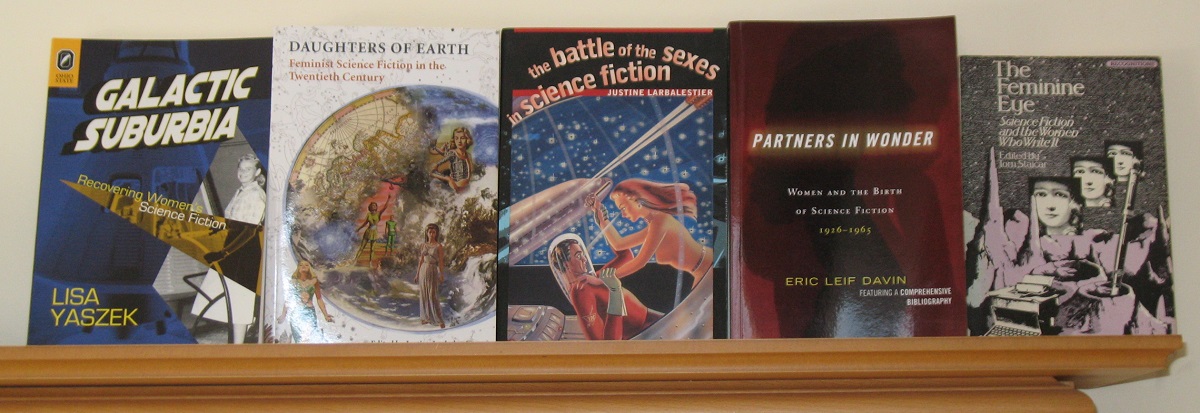
Five books on women science fiction writers, most of which I used as a research for All That Outer Space Allows. Galactic Suburbia discusses pre-feminist sf and demonstrates that it was in fact feminist. Daughters of Earth is an anthology, in which each of the female-authored stories is discussed in a following critical essay. The Battle of the Sexes in Science Fiction is about, well, the title pretty much says it all. Partners in Wonder is a history of women writing in genre magazines from 1926 to 1965. The Feminine Eye I found on eBay and contains nine critical essays on authors such as CJ Cherryh, CL Moore, Suzette Haden Elgin and Suzy McKee Charnas.

2016-09-18-12-23-35

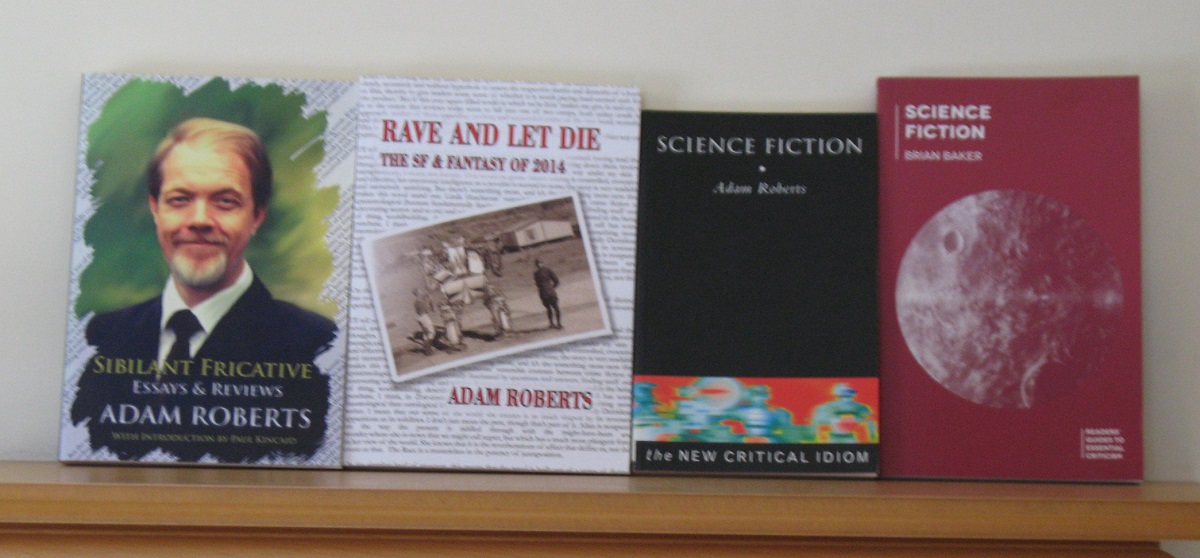
Three critical works by some British chap who, I believe, also writes fiction. Sibilant Fricative was shortlisted for the BFS Award, but Rave & Let Die won the BSFA Award. Science Fiction (Roberts) I bought in Stockholm at Fantastika 2016. There is a second edition now available. Science Fiction (Baker) I bought from Amazon. I’m mentioned in two of these critical works.

2016-09-18-12-25-04

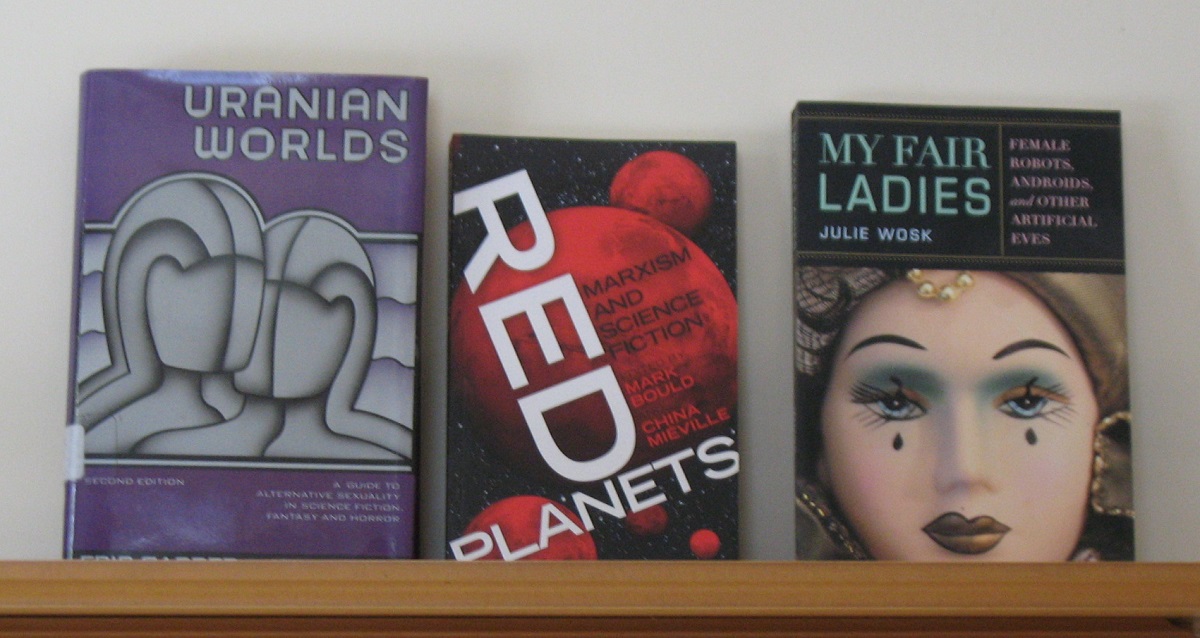
Uranian Worlds is an annotated list of genre works which feature LGBT themes or characters. My copy is an ex-library one I bought cheap from a reseller on Amazon. Red Planets is, as the title explains, about “Marxism and”Science Fiction”. I’ve yet to read it, though I’m interested in left-wing sf. My Fair Ladies discusses the depiction of artificial women in genre, although it seems to focus more on media genre than written.

2016-09-18-12-29-53

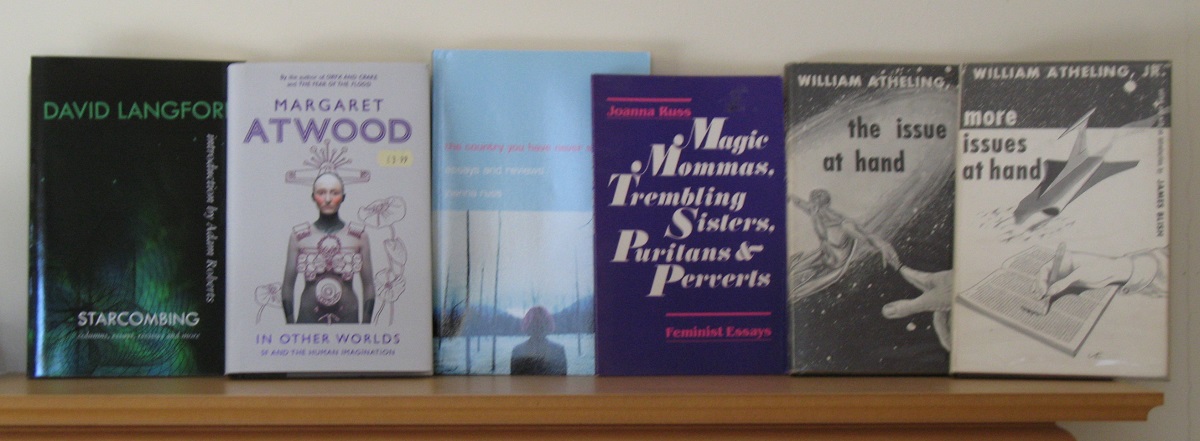
Some critical works by writers: Starcombing I reviewed for Interzone (I later posted the review on my blog here). In Other Worlds was a lucky find in a remainder shop. The Country You Have Never Seen is apparently now as rare as rocking horse shit, so I was lucky to pick a copy up when I did (there’s a secondhand copy on Amazon for £693.49!). Magic Mommas. Trembling Sisters, Puritans & Perverts I found on eBay. The Issue at Hand and More Issues at Hand I bought from Cold Tonnage. William Atheling, Jr, was, of course, James Blish.

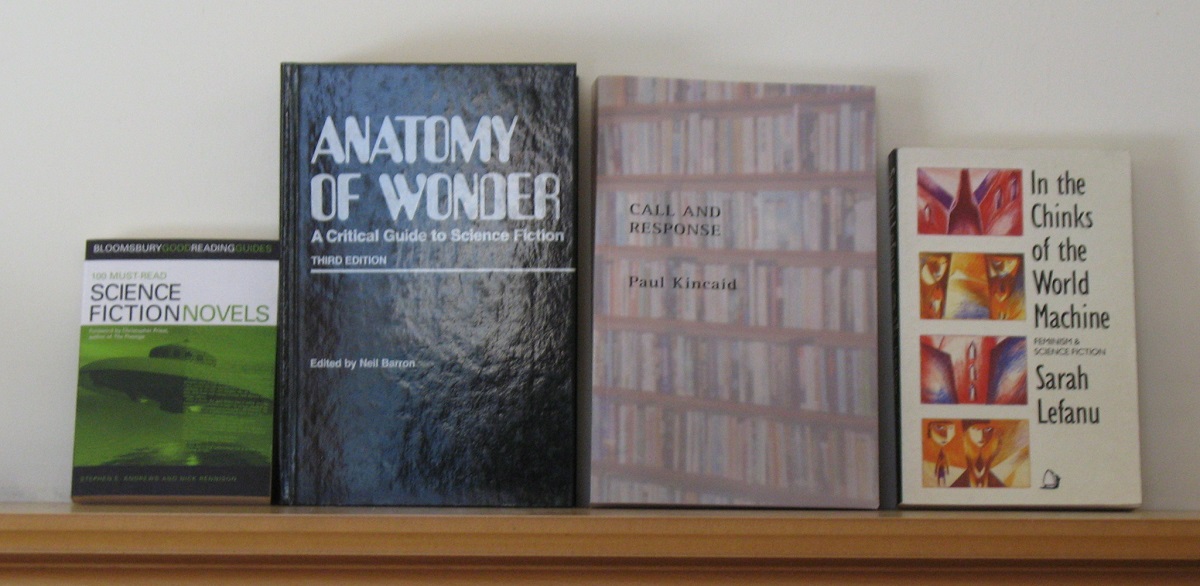
2016-09-18-12-32-25

Every now and again, science fiction throws up these annotated listicle books, ususally with contentious titles like 100 Must Read Science Fiction Novels. I wrote a blog post after reading this, which morphed into a correspondence with the author – see here and here. Anatomy of Wonder is currently in its fifth edition and costs £55 new, so I bought an earlier edition for consierably less. Call and Response is Paul Kincaid’s second collection of essays and reviews. And In The Chinks of the World Machine was one of two non-fiction works published under The Women’s Press sf imprint (the other was LeGuin’s The Language of the Night, and I’ve yet to find a copy).


6 Comments

Moving pictures, #46

Yet more movies… All but one are from the 1001 Movies You Must See Before You Die list, but two of them I’d seen previously.

solarisSolaris*, Andrei Tarkovsky (1972, Russia). I first saw Solaris back in the early 1980s when I was at school. It was a Sunday afternoon and it was on, I think, BBC2, and the junior common room had a single television set but I somehow managed to persuade a half a dozen of my fourteen-year-old peers to sit and watch three hours of Russian sf film. Whatever leadership qualities I had then which allowed me to manage that have long since gone. But I’ve treasured Solaris ever since. In fact, it was one of a handful of films I was determined to own once DVDs appeared on the market (I never liked VHS, and refused to buy videocassettes). I’ve watched it few times since buying it on DVD back in 2002, but this most recent rewatch was triggered by upgrading my copy to Blu-ray. And I still love the film, although it’s not my favourite Tarkovsky. Despite the odd moment which is wildly implausible – such as when Kelvin’s launches Hari in an escape rocket from the station, and Kelvin survives being in the same chamber as the launch – the entire film looks astonishingly believable. There’s something about the production design (rocket launch notwithstanding) that makes the space station look like a real place. The story is loosely based on Lem’s novel of the same title, so loosely Lem was apparently unhappy with the adaptation; but, to be frank, when having someone of the calibre of Tarkovsky adapting a work it seems churlish to complain it’s not especially faithful. And it’s true the film does mostly ignore the Solaris organism, which is the focus of the book, and instead spends its time documenting the effects of the organisms on the scientists aboard the space station. But it looks gorgeous, and even the moments of black and white – Tarkovsky ran out of colour film stock – seem to fit in with the overall look and feel of the movie. Solaris works so well because it doesn’t do the science-ficiton thing and focus on the novum, the Solaris organism, as the book does, but focuses instead on Kelvin’s relationship with Hari. In the book, the Solaris organism manifests fantastical cathedral-like islands; in the film, it manifests a single enigmatic woman from Kelvin’s past. I know which story I prefer.

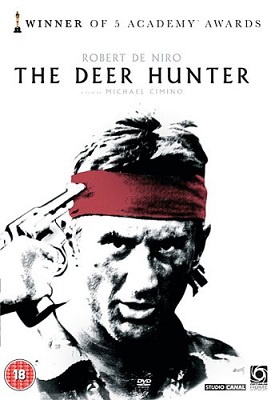
deer_hunterThe Deer Hunter*, Michael Cimino (1978, USA). I’d seen this many years ago, but other than it being about Vietnam, and containing a scene featuring Russian roulette, remembered pretty much nothing of it. I’m not sure if that’s good or bad. Because, to be honest, I thought The Deer Hunter merely okay. Robert De Niro and Christopher Walken are two of a group of steel workers who regularly go hunting in the mountains and generally behave like swaggering macho working-class Americans. And then they sign up to fight in Vietnam and, well, there are a million films about that, in fact until 9/11 it pretty much defined a big part of the US psyche… But things don’t go well in Vietnam and they’re captured together – in one of those coincidences that plots require – and tortured by the Viet Cong… before escaping. But all of them have been damaged by their Vietnam experiences. Well, all except De Niro. Although perhaps he is, as he can no longer no shoot defenceless deers when hunting. Christopher Walken forgets who he is and begins playing Russian roulette for money… and winning. John Savage loses both legs and the use of an arm, and ends up in a VA hospital. I can see how at the time this movie took a number of chances, and they paid off. But from forty years later, there’s little in it to impress all that much. It concerns a topic which is the hangup of a nation that is not my own and a generation which is not my own. I have to judge it as a film and only that. There is no baggage. And in that respect, it has its moments – Cimino’s ambition is plain, and it mostly pays off; but the characters are thinly-drawn and there’s too much reliance on the cast to bring them to life (some, notoriously, weren’t even scripted but had to improvise). It’s a good cast, of course, and they mostly went on to greater things – but this is early in their careers. The Vietnam scenes do not compare well with those in other films (my only comparison, of course), and there’s little subtlety in the war’s effects on the characters. I’m in two minds whether this belongs on the 1001 Movies You Must See Before You Die list. There are better Vietnam War films, there are better war films… but it captures something – even if it’s only its director’s ambition – that might be worth preserving.

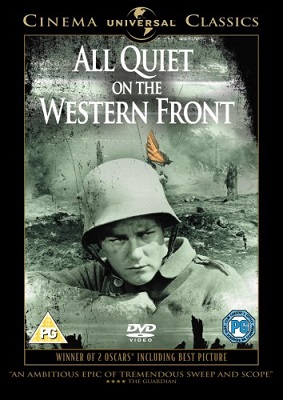
all_quietAll Quiet on the Western Front*, Lewis Milestone (1930, USA). The most surprising thing about this film, I guess, is that it’s a US film with US actors who play Germans fighting for Germany during World War I. Has Hollywood ever made a movie about Wehrmacht or Waffen-SS soldiers? I don’t think so – at least not where they’re playing the heroes (and we’ll nip the “good Nazi” discussion in the bud right now, thank you very much). All Quiet on the Western Front is essentially a “war is hell” story, and it happens to be written by a German and set during WWI. Which clearly wasn’t seen as a commercial obstacle by Hollywood – although, to be fair, Hitler didn’t seize control of Germany until 1931, but surely it was obvious what was going on in Germany at the time (for a start, half of Britain’s aristocracy were supporting Hitler by then). Despite all that, All Quiet on the Western Front is a fairly unexciting war film, if that doesn’t sound odd. What I mean is, it doesn’t offer any astonishing insights – perhaps it did in 1930, although I find it hard to believe; perhaps it did in 1928 when Remarque’s novel was first published in the Vossische Zeitung, although given the effects of WWI on the German population away from the Front (especially given the blockade by the British Grand Fleet), so maybe not… True, it humanises the enemy of WWI, and that may have been something new to US audiences, which I guess makes it anti-propaganda and not something which Hollywood normally does. And, after all that, the trench warfare it depicts seems a little sanitised compared to the reality as documented, or indeed in later films set during the war.

rivetteDuelle, Jacques Rivette (1976, France). I’ve watched this twice now and I’m still no clearer as to what it’s about. There are apparently two women, the Queen of the Night and the Queen of the Sun, and they fight a magical battle in mid-1970s Paris over a magical diamond. I tweeted while watching this that in most films there’s always a sense the director is playing to the gallery, but that sense was completely absent from Duelle (as indeed it was in Rivette’s Merry-Go-Round too). You feel like a Peeping Tom, watching something without knowing the context. I was, I admit, beguiled by the “limited edition” status of the collection in which this appears, and having been impressed by La belle noiseuse; but two films in and I’m beginning to question my purchase. It’s not that Duelle is a bad film – it’s not, it’s well-shot and well-acted… but, well, it’s a bit like watching someone’s home movie (with extremely high production values, that is). If the synopsis given on Wikipedia is the story Rivette thought he was telling, the film is a little too confused for it to stand as a description of its plot. I quite liked Merry-Go-Round‘s inability to resolve itself – it was very L’Avventura, and I admire Antonioni’s film, and indeed his oeuvre. But Duelle often feels like assorted episodes from an incomplete series. I’m going to have to watch it again, I think; but I’m convinced I’ll never make real sense of it.

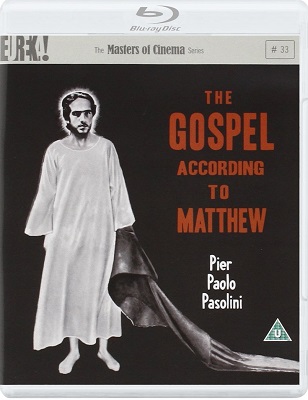
gospelThe Gospel According to Matthew*, Pier Paolo Pasolini (1964, Italy). I was looking for something on Amazon Prime to watch on a Sunday afternoon, and stumbled across this, which is on the 1001 Movies You Must See Before You Die list. It wasn’t quite the easy watching I was hoping for, but never mind. It’s a pretty much straight-up telling of the eponymous gospel, its southern Italy locations making a good fist of standing in for Biblical Palestine. I’m not entirely sure why the film exists, to be honest. It’s not a new spin on the gospel, and as commentary it’s remarkably thin. The neorealist style works well with the material, but we’re still talking about a 2000-year-old fantasy that a substantial portion of the world’s population think is historical fact. Here are a few facts: Jesus was Jewish; he spoke Aramaic; Jesus is not an Aramaic name, so he can’t have been called that; he probably wasn’t born in Nazareth either, because there’s no archaeological evidence the town existed before the third century CE. But then Pasolini’s film tells it as it’s presented in Matthew’s gospel, which was written at least two generations after the Crucifixion, and has undoubtedly been rewritten many times since. But that’s the source material, this is the film. And it, well, it tells a story, and it does it well. But the source material is always going to overshadow it, and while I salute Pasolini’s bravery in tackling it, and I admire the understated way he told the story, it does all feel a bit unnecessary. Does it belong on the 1001 Movies you Must See Before You Die list? I honestly don’t know.

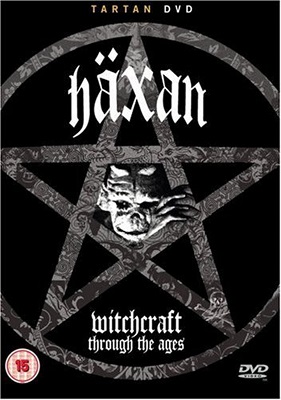
haxanHäxan*, Benjamin Christensen (1922, Sweden). Um, I could perhaps have better planned my viewing… to go from saying I have no interest in a movie about Christ straight into one about Satan and witchcraft… Especially when Häxan proved well-made and fascinating. I’ve no idea what prompted Christensen to make it – surely Sweden in the 1920s wasn’t that bad a place? Häxan opens with a history of witchcraft, before then illustrating that history with a series of re-enactments. One part involves the trial of an old woman for witchcraft, and the final part of the film attempts to give modern explanations to behaviour classed in less enlightened times as witchcraft. And this is in a film made in the 1920s. Though it may be difficult for some to believe, I was not around at the beginnings of cinema. Silent movies were very much a thing of the past when I was born. And, I suppose, I inherited the general response to them that my generation had – sound was better, so why bother watching silent films? Of course, I’ve seen quite a number of them since then. Indeed, I’ve become a fan of Murnau’s films, and Dreyer’s The Passion of Joan of Arc is a bona fide classic, as is Pudovkin’s Storm Over Asia, not to mention Ponting’s The Great White Silence, Vertov’s Man with a Movie Camera or Dovzhenko’s Zemlya. Okay, I’m not a big fan of the Keystone Cops, and while I’ll happily watch Buster Keaton, Harold Lloyd or early Laurel & Hardy, they’re pretty much watch-once-and-enjoy experiences; and that’s even true of early Hitchcock… but there are silent films – and I don’t just mean Metropolis – that every cinephile should have in their collection… and yes, Häxan is probably one of them. Happily, there’s a good edition from Tartan readily available in the UK.


Leave a comment

Culture vulture

I could really do with another bookcase, but I don’t have a free wall to put it against. But then, pretty much every bookshelf I have is double-stacked… which I guess means I actually need more than one bookcase. Oh well.

2016-09-11-10-19-18

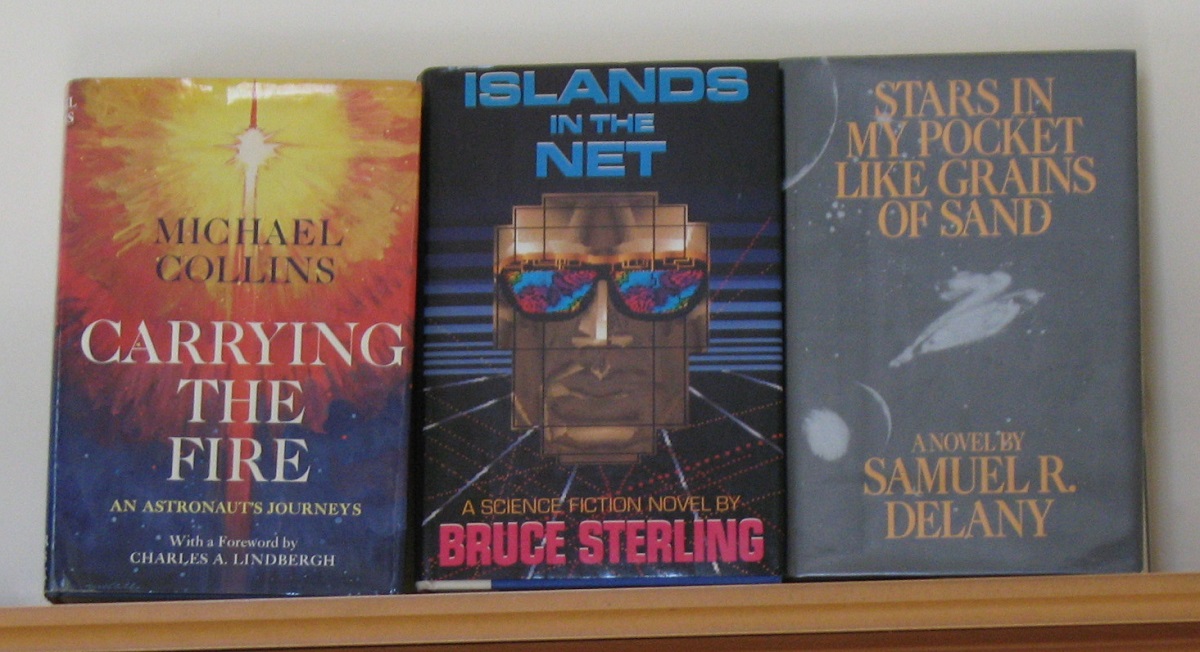
Some for the collection. Carrying the Fire is the best of the astronaut (auto-)biographies I’ve read – I reviewed it here – but first editions are usually very expensive. This a lucky reasonably-priced find ($25!) on eBay. Another signed first edition by Bruce Sterling, Islands in the Net. And I stumbled across this first edition of Stars in My Pocket like Grains of Sand for $20 on eBay and thought it worth getting.

2016-09-11-10-18-13

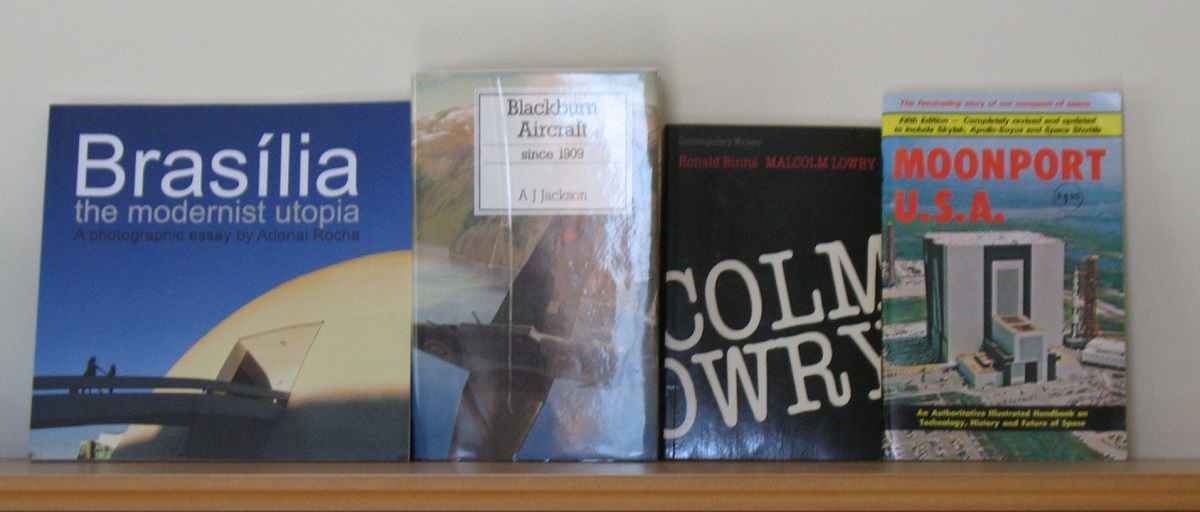
Some non-fiction. Moonport U.S.A. is not the Moonport book from the NASA History series, but a chapbook published by the Air Force Eastern Test Range Public Relations Association. This is the fifth edition. Malcolm Lowry (Contemporary Writers) is one for the criticism bookshelf. And Blackburn Aircraft since 1909 means I now have 15 of these books, and only 5 more until I have all of the UK ones. Brasília: The Modernist Utopia is a collection of photographs of the eponymous city, a place I would love to visit. Unfortunately, it’s a POD book and the print quality of the photographs is not very good.

2016-09-11-10-16-40

One for SF Mistressworks, Murray Constantine’s (Katherine Burdekin’s) Swastika Night. I thought Blixen’s Anecdotes of Destiny so good, I decided to try another of her collections and picked Winter’s Tales. I’m not sure where I stumbled across mention of Nocilla Dream, but it sounded intriguing so I put it on my wishlist… and bunged it on my last order. Finally, a pair of charity shop finds: Perfidia, and Ellroy’s novels are enormous and I’ve no idea when I’ll find the time to read them, and The Spire, the third of the four Goldings I found in a charity shop (I bought two on my first visit, but when I went back a week later someone had gone and bought the fourth, I think it was Lord of the Flies; oh well).


3 Comments

Moving pictures, #45

More movies!

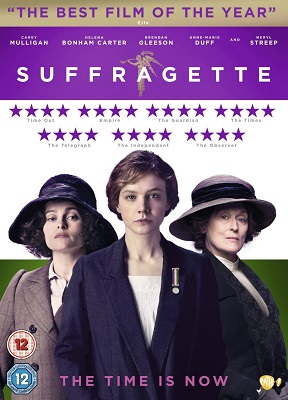
suffragetteSuffragette, Sarah Gavron (2015, UK). I’m surprised it’s taken until 2015 to make a film like this. Actually, I’m not surprised, just disgusted. True, this film is bsed on fictional characters, and real historical people such as Emmeline Pankhurst and Emil Davison do make brief appearances (the former is, in fact, played by Meryl Streep). The film tells the story of the women’s suffrage movement in the UK through a pair of invented characters – a working-class laundress played by Carey Mulligan, who more or less accidentally becomes a suffragette. Well, inasmuch ,as she rebels a clear injustice and that brings her into contact with the suffragettes and so she reluctantly joins their campaign. To me, it seems incredible that women should ever have been denied the vote, but I’m not stupid, I realise that historically men have been complete scumbags, and many still are today. I remember thinking while watching Suffragette that most social progress has come about because of violent action, and that decades of insistence on “peaceful demonstration” has only slowed the rate of social progress – if not driven it backwards, as twenty-first century culture seems in many ways less progressive than that of the twentieth century. I have to wonder sometimes if the twentieth century was only a social experiment, and now it’s over. But I suspect what’s more likely is that WWI killed off great swathes of the upper classes and so opened up management of society to the middle classes, but now the upper classes are back in charge once again. But Suffragrette… An important film, I think, because of its subject, but not a great film; and though played well by its cast and directed well, it did all feel a bit meh. Recommended because of its subject, if not as a film per se.

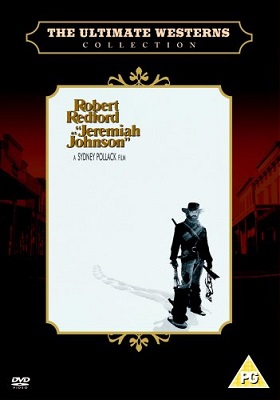
jeremishJeremiah Johnson, Sydney Pollack (1972, USA). I’m not a big fan of Westerns, but I find myself liking several Western films that don’t follow the usual Western story-lines. Like this one. Not a brilliant film, by any means; but there’s lots of lovely scenery in it, and the story is sufficiently distant from your typical Western story that I found it interesting… but I’m not convinced Robert Redford was suitable for the title role. He looks too, well, urbane. The title character heads off into the mountains for a new life. Fortunately, he stumbles across an old timer before he dies of starvation, and the old timer teaches him how to survive. Taking his leave after learning all this is to learn, he finds a homesteader family that had been attacked by Blackfoot. The wife has been driven mad with grief and she insists Johnson take her young son with him. So he does. He then comes across a trapper who had been buried neck-deep in sand by Blackfoot, and rescues him. They track down the Blackfoot who attacked the trapper and steal back his possessions – and killed the Blackfoot braves. This apparently makes Johnson something of a hero among the other Native American tribes of the area. He ends up married to the daughter of a Flathead chieftain, and they and the boy start to make a life for themselves. But the US Cavalry asks for Johnson’s help to resuce a wagon train, and this requires a ride, against Johnson’s better judgement, through a Blackfoot sacred burial ground. The Blackfoot respond by killing his wife and adopted son. There then follows many years of Blackfoot sending young braves to test their mettle against Johnson, all of whom, of course, he kills. We like to think of the Wild West taking place in the scrub and desert of south-west USa, but there’s other scenery which falls within the genre – the Rocky Mountains in this case. And it’s hard to film such landscapes badly… but when they’re filmed well, they’re gorgeous. Pollack had always struck me as a Hollywood stalwart – a director of commercially successful films, with the odd critical success thrown in, but by no means an auteur. And while Redford may not convince as the title character in Jeremiah Johnson, Pollack does a really good job at presenting the landscape (I can’t say “capture” but I have no personal experience of it). The end result is a superior Western, albeit perhaps high second-tier rather than first-tier. But worth a watch.

uchoUcho*, Karel Kachňya (1970, Czech Republic). I wanted to like this film more than I did. For many reasons. For the fact it was banned for many years in its home country, and only shown for the first time after the Velvet Revolution. For its subject: the lives of people in a totalitarian state. For its story: the paranoia endemic in totalitarian states is heightened for a couple after they return from a party and find their front door unlocked, and that tears their marriage apart. And for its use of New Wave cinematic techniques to tell its story. But something about it didn’t quite click for me. Possibly because I have a positive view of the trappings it presents as totalitarian, which I’ve taken from films like Eolomea and Wings. If that makes sense. This is not to say what happened to the Czech Republic – Czechoslovakia as was – at the USSR’s hands is in any way condonable. But in the Eastern Bloc the signifiers they presented for success and happiness I actually find quite appealing, and though they’re all utopian surface, cleverly hiding the totalitarian reality underneath, it’s hard not to be beguiled by the dream. Which is a bit of a long-winded way of saying that Ucho reveals that horrible reality underneath as a commentary by someone who actually lived it. In terms of technique, Ucho has much to recommend it – the use of ambient light, the tight focus on the central charaters… a variety of New Wave techniques, in fact. But the shifting of focus of totalitarian depradations to married-couple dynamics feels at times like diminuation of what should be a major dramatic point. There is, for example, a point in the film when the doorbell rings and the husband and wife work themselves up into such a frenzy believing the secret police have come to take him away that he walks down to open the gate carrying a suitcase of overnight things. But it turns out it’s only a bunch of drunken colleagues from the minsterial party which opens the film. The threat remains – and the movie is clear on that – but the decaying relationship between husband and wife seems to be used a little too often to ratchet up a more existential fear than is deserved by the story. Ucho is an important film, but it is somewhat disappointing as a piece of cinema. Worth seeing – once, at least.

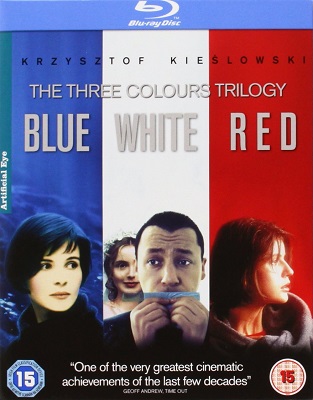
three_coloursThree Colours: Red*, Krzysztof Kieślowski (1994, France). And so the Three Colours trilogy, and my rewatch of it, comes to a close; and Red is generally considered the best of the three… and so it is, but by considerably more of a margin than I’d remembered. Yes, yes, that final scene where all the major characters from all three films are paraded across the screen is silly and unnecessary; but there’s still a focus and tightness to the story of Red which is so much stronger than that of the other two films. Irene Jacob, who was so good in The Double Life of Veronique, plays a model in Geneva with an absent boyfriend. One night she hits a dog in her car, and it turns out the dog’s owner is ex-judge Jean-Louis Trintignant, who cares nothing for the dog. So Jacob pays for the vet bills and adopts it as a pet. But it turns out Trintignant is a bit of a misanthopric oddball, who listens in on the phone calls of his neighbours… and he draws Jacob into his obsession. But she also has problems of her own. I’d started watching Red expecting something similar to my rewatches of Blue and White, so I was surprised to discover how much better than them it is (final scene notwithstanding). There is, now I think back on it, not much that stands out in terms of cinematography – a lot of use of the titular colour, and some nice photography of night-time Geneva. And, to be fair, the cast in all three films have been excellent – but I think it’s the dynamic between Jacob and Trintignant that works so well and lifts the film above Blue and White. The film is supposed to represent fraternity, yet most of the relationships in it have failed by the end – Jacob and her absent boyfriend, a neighbour and his girlfriend… And the strongest relationship in the film, between Jacob and Trintignant, is between two characters who have nothing in common, in fact Jacob is vehemently opposed to Trintignant’s practice of phone hacking. But when Jacob leaves to visit friends in the UK, Trintignant is the only one to wish her good fortune. This rewatch has amended my opinion of the Three Colours trilogy. They’re undoubtedly good films, but having watched so much more non-Anglophone cinema since I first watched them I find them more excellent examples of a particular type of film than merely excellent films. Kieślowski was a gifted film-maker and left an enviably impressive body of work, but I find myself thinking better of his earlier Polish films than I do his later French ones. Go figure.

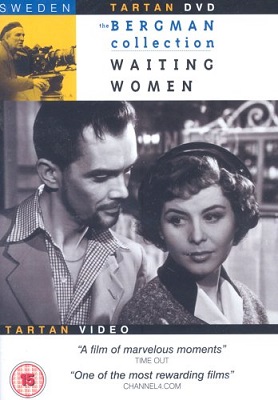
waiting_womenWaiting Women, Ingmar Bergman (1952, Sweden). Bergman wrote a number of films about women, and while I don’t know enough to call his attitude to women into question, I do wonder sometimes. In Waiting Women, we have a group of women reminscing about the situation which led to their current state of affairs. And it’s all about relationships. The movie opens with a group of women preparing a meal together, before then flashing back to stories of their relationships, the longest and most memorabe of which is that featuring Gunnar Björnstrand and Eva Dahlbeck – although it does also include a nasty line in misogynistic cracks from Björnstrand. And the infamous elevator scene. Which is, to be honest, one of the highlights. The two are trapped in a lift, and over the course of some ten minutes their rancour turns to humour. The flashback structure at least meant Waiting Women didn’t feel like a televised play, which a lot of Bergman’s films do (even those with scenes that take place outdoors). Not great Bergman by any means, but even his sub-par films are still a cut above most film-maker’s best.

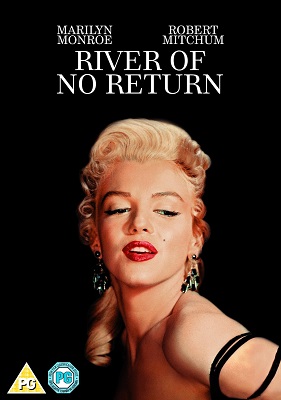
riverRiver of No Return, Otto Preminger (1954, USA). I mentioned in a previous post that Preminger only made one Western… and this is it. And it’s a curious beast. It has many reasons to like it, and yet to fails to, well, impress. The story is an adaptation of The Bicycle Thieves, which is a point in its favour; and the landscape in which the film is set is gorgeous, and often extremely well-photographed… but it’s the things that make it a Hollywood film which spoil it. The close-ups are done in a studio, not on location, and it shows – badly. Marilyn Monroe was a big draw at the time, but she doesn’t bring anything special to this film. In fact, she’s a bit crap – and only seems to really shine when she’s at her most artless (although I guess that was part of her talent as an actress; having said that, by all accounts, she was pretty insufferable during this shoot). Mitchum turns up to a gold-diggers’ camp to pick up his ten-year-old son, who had been left there by arrangement. It turns out the son had been looked after by saloon singer Monroe. Mitchum and son go off to Mitchum’s homestead beside the eponymous river… only for Monroe and fiancé gambler to turn up on en route to stake a claim at Council City. Their raft founders, but Mitchum rescues them. Gambler responds by stealing Mitchm’s horse to continue his jounrey, but Monroe remains behind. Gambler never returns so the three of them make their own way, by raft, to Council City. The location shooting ias lovely, the studio shots anything but. In fact, it seems for much of the film the continuity people were given the day off, as close-up shots often seem to take place in completely different environments. River of No Return is an odd beast. Preminger was a skilled director, and he manages a solid narrative with (mostly) good turns from his cast. But the mix of location shooting and studio shots never quite match and the discrepancy jars badly. One for completists.

1001 Movies You Must See Before You Die count: 796


Leave a comment

The future we used to have, part 30

It’s been a while since I did one of these, so I thought it about time I added to the series. Photos are now easier to find on the internet, but finding just the right one has become somewhat harder. For some reason, it all appears to be Soviet this time…

air

Tupolev Tu-95 Bear

Tupolev Tu-95 Bear

Yakovlev Ya-28 Brewer

Yakovlev Ya-28 Brewer

Beriev Be-42 Albatross

Beriev Be-42 Albatross

Sukhoi Su-15 Flagon

Sukhoi Su-15 Flagon

sea

An Alfa Class submarine

Alfa Class submarine

A port bow view of a Soviet Kara class guided missile cruiser underway.

Kerch, Kara Class cruiser

kirov

Pyotr Velikiy, Kirov Class battlecruiser

smetlivy

Smetlivy, Kashin Class destroyer

land

ss-15

RT-20 (SS-15 Scrooge) ICBM and mobile launcher

ss-16

RT-21 Temp 2s (SS-16 Sinner) ICBM and mobile launcher

ss20

RSD-10 Pioneer (SS-20 Saber) and mobile launcher

ss-23

OTR-23 Oka (SS-23 Spider) theatre ballistic missile and mobile launcher

wibbly wobbly ætheric thing

1RL134 (P-19 Danube) radar

1RL134 (P-19 Danube) radar

SNR-75 (Fan Song ) radar

SNR-75 (Fan Song) radar

Saturn (P-35 Bar Lock) radar

Saturn (P-35 Bar Lock) radar

1S12 (P40 Long Track) radar

1S12 (P-40 Long Track) radar


5 Comments

The art of brewing fiction

At the end of 2014, I sold a space opera trilogy to Tickety Boo Press. I’d written the first two books a few years before, but had never got around to writing the third. This wasn’t a problem, however. I saw it as an opportunity to prove I could write a big commercial novel in a reasonable timeframe, despite never having tried it before. Unfortunately, I hadn’t factored in two important things: a) real life, and b) even when I start writing commercial science fiction it turns into something else.

Anyway, the first book, A Prospect of War appeared in March 2015, and the second book, A Conflict of Orders, six months later. Everything seem to be going well… Until, in early 2016, the day job dumped a major project on me… and the writing on book three, A Want of Reason, ground to a halt. But – and this is, I hope, the point of this piece – the months off from writing space opera will, I think, make A Want of Reason a stronger and better novel. I may not have been banging out the words, but I’ve never stopped thinking about the story; and I’ve jotted down notes when ideas occurred to me.

When two chargers are set at an angle of 23.7 degrees to each other, they cause a catastrophic distortion in reality: an implosion.

One of my objectives when I set out to write An Age of Discord (the trilogy’s overall title) was to explore the structure of commercial fantasy trilogies. I chose to do this using space opera because I much prefer science fiction to fantasy. A Prospect of War is based on the hero’s journey template, in which a young man of humble birth is elevated to leader of a powerful military force pledged to defend the throne against the evil usurper. (There are a few narrative loops and detours thrown in there too, of course.) For A Conflict of Orders, I wanted to avoid “middle book syndrome”, in which the author just shuffles pieces around the board for the epic final battle in book three. So I made the epic final battle the centre-piece of my second novel. The second half of A Conflict of Orders then covers the lifting of the siege of the Imperial Palace and the aftermath of the attempted coup.

The angle must be precise. A fraction of a degree either way and the two chargers will simply bounce apart, like magnets of the same pole.

But when it came to writing A Want of Reason, some five years after I’d completed A Conflict of Orders… The first thing I did was throw away the original synopsis. I’d planned the novel to have two main narratives: one set in the days following A Conflict of Orders, in which the main characters prepare the Imperial capital for the final act of the 1000-year-old conspiracy which has been driving the trilogy’s plot; and another narrative set 1000 years in the past and describing the events which led to that conspiracy forming. But I decided I didn’t like the idea – for a start, it felt like too much work to create a version of the empire as it was 1000 years earlier, given all the work I’d put into world-building for the empire of the time the main story is set. Instead, the novel would follow on directly from A Conflict of Orders, but I’d take the story in an entirely different direction…

The exact angle is, of course, a closely-guarded secret, known only to a few hundred academicians and munitions artificers.

But I don’t want to write too much about A Want of Reason, because things might still change as I get further into the writing of it. And I don’t want to spoil people’s enjoyment of the novel when it does finally appear. It’s just that recent thoughts I’ve had about the book have led to me thinking about the creative process and how it relates to A Want of Reason and the trilogy. For example, a major part of the first third of A Want of Reason is two characters, Dai and Finesz, each investigating a minor mystery. While it had been clear in my mind right from the start what the answer to those mysteries were, I’d not quite figured out how they linked into the plot of the novel and the story-arc of the trilogy. Later, not only did I come up with a way of fitting them in, but a way of using them to actually advance the plot and add to the world-building.

Marla Dai could not remember when she had originally come across the information, but she was making good use of it now. It had been easy enough to find an unused aerocraft at Kukoi Aerodrome, likely belonging to some noble with more money than sense. It had not flown for months. Less than an hour later, Dai had removed a pair of chargers from its underside and concealed them nearby.

I chose the word “brewing” for this blog post deliberately, because for me ideas often feel like the product of fermentation. I envy those writers who can start writing and ideas just come to them; as well as those who sit down and plan out their writing like a military campaign. But creativity is a subconscious process – I don’t know how many times during the writing of An Age of Discord I’ve come up with what felt like a neat idea, only to find several chapters later it served as an excellent hook for an even neater idea

justi_imagine

There’s that old saw of the writer being asked, “where do you get your ideas from?” There are as many answers as there are writers. For me, it’s lying in bed at night, thinking, “Shit, I’ve got Finesz hunting for Azeel now, so how does she go about tracking her down and what does she discover when she does find her?” And it all has to work within the universe of the book, it has to be rigorous. I know where the story is going, of course; I have a general direction in mind – and sometimes a quite detailed idea of the end – and I know what sort of things I want to write about. I suppose it won’t come as much of a surprise to those who know me, but A Want of Reason is primarily about the fascistic character of space opera empires. I admit a lot of it was about the uniforms when I was writing A Prospect of War, but now, some 350,000 to 400,000 words later, and however many years, and one of the major points I want to make in An Age of Discord is the way space operas always default to the right, and the easy acceptance of same by readers of the sub-genre. And the best way to comment on that, I decided, was to push the empire of the story even further rightwards. It’s there in the final pages of A Conflict of Orders, the forced closing of the civil government and a crackdown on what little political freedom already exists…

The troopers had already subdued most of those inside by the time Inspector Sliva Finesz of the Office of the Procurator Imperial entered the premises. This was not her operation, she had been roped in to help, although no one had bothered to fill her in on the details. She strode into the building, pulling her gloves onto her hands, and found herself in a large workshop room, two storeys high, with a sharply-raked roof supported by narrow iron pillars, and filled with large mechanisms… Printing-presses? The air stank of hot oil overlaid with the acrid tang of some chemical she did not recognise. Troopers held a group of proles at the back of the room. Some of the proles were injured—bruised and bloodied. Above them, half a dozen yeomen peered out of office windows on a mezzanine floor, while a couple of low-ranking OPI officers stood by in attendance.

Although it was not planned, the last six months of fermentation have proven beneficial to A Want of Reason. Last year, I decided the Involutes’ main headquarters would be called the Fastness. But all I had was a name. A couple of months ago, as I lay in bed, natch, an idea occurred to me… and a number of things just started slotting together, not just the Fastness, but the Involutes’ masks, things that had happened in the earlier books… It was like watching a Transformer, er, transform. It may be a dilettante-ish way to write, but it works for me. I once said that if the half-story ever became an art-form, I’ve a body of work ready and waiting. Because that’s how it goes for me. I have an idea, I start on a story… I give up after a few hundred words because it’s not working… And then the story sort of sits there in the back if my mind, brewing away, until one day I pretty much bang it out fully-formed. That’s what happened with ‘Geologic’.

They met an hour after dawn in a secluded corner of a park beneath the wall of jagged hills which separated Gahara from the rest of Toshi. Dew lay heavy on the grass and bowed the thin branches of the trees surrounding the spot they had chosen. A faint mist lay a ceiling across the sky some two or three hundred feet up, the sun a hot diffuse dot of orange above the hills. Despite this, the air smelled cool and fresh, with a faint hint of the sea from the bay below. A young lieutenant from the Honourable Basilisk Company, with more decency than most of the nobility Casmir Ormuz had met in Toshi, acted as second. Ormuz’s opponent, a viscount and the son of an earl, who had not expected a challenge but had responded to it with alacrity, appeared both composed and quietly confident. He either discounted the stories he might have heard about Ormuz, or he had never heard them. His equally doltish second smirked at what he clearly expected to be a quick and victorious bout.

I’d wanted to write a story about saturation diving in a science-fictional context for a while, and had decided that a world with high atmospheric pressure was the best setting. And there’d need to be some sort of alien ruin or something to justify explorers spending so much time in such an inimical environment. But that’s as far as I got. I wrote a few hundred words… and there it sat for several months. Brewing away Until one weekend I sat down and wrote it. A read-through by my beta readers, some cleaning up, and I submitted to Interzone. The magazine bought it, and it appeared in issue 262.

Unfortunately, it’s not always so easy. The final story in Dreams of the Space Age, ‘Our Glorious Socialist Future Among the Stars!’ may have gestated and been born in a similar fashion – “I’m writing a story about Yuri Gagarin crash-landing on Mars and I’m going to pastiche Robinson Crusoe on Mars… and, I know, I’ll have all the dialogue in Russian! And… this is a great idea… I’ll throw in lots of references to Soviet sf!” – but I never managed to sell it to a magazine. Was it the title? The Russian dialogue? The quotes from The Communist Manifesto? Who knows. Although most comments about Dreams of the Space Age single out ‘Far Voyager’ as the best story; and that was originally published in Postscripts, was in fact the title story in Postscripts 32/33: Far Voyager.

People like to ask, what’s the best writing advice you’ve received, and all I can think of is Bob Shaw’s admonition in his How to Write Science Fiction to “read lots of books”. Example and self-experimentation are powerful learning tools. But I’d go one further, and say, read lots of books from lots of genres and modes of fiction. Read too widely outside sf and there’s a danger of being disillusioned with the genre, but that can also feed back into your writing. Science fiction should never be given special dispensation; instead, we writers of sf should strive to lift the genre up to the level where it is taken as seriously as any other mode of fiction. Which is why writers should read widely. (I don’t get that thing about writers who refuse to read other books when working on a project, I really don’t.)

Of course, this is merely in reference to the prose and story-telling. Don’t get me started on research. Assume at least one of your readers is an expert in the subject you are writing; assume they will mock you for getting it wrong. So get it right. Don’t make it up as you go along. In the past, the writer might never have learnt that some people thought him or her an idiot for getting simply physics wrong in a sf novel, but these days, with social media, someone is sure to “helpfully” let the writer know… (Or even bully them over it – it’s scumbag behaviour, but it happens.) But that’s a discussion for another day…

[This post contains some lines from the opening chapters of A Want of Reason.]


Leave a comment

Moving pictures, #44

More viewing, only one from the 1001 Movies You Must See Before You die list this time, and it’s an American film… although, once again, half of the films below are from the US. I need to increase the number of non-Anglophone films I watch.

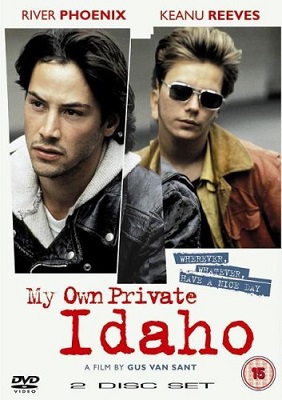
idahoMy Own Private Idaho*, Gus Van Sant (1991, USA). The only thing I knew about Gus Van Sant prior to deciding to work my way through the 1001 Movies you Must See Before You Die list was that he’d made a shot-for-shot remake of Hitchcock’s Psycho. Which sounds like an interesting exercise, except, well, that’s pretty much what a play is, the same story with a different cast. And since I’d seen Hitchock’s film a number of times and was familiar with it, Van Sant’s experiment proved even more disappointing. Van Sant’s most-famous film, however, is My Own Private Idaho, which, okay, I may have heard of before, but knew nothing about. And it turns it’s about a pair of street hustlers, played by River Phoenix and Keanu Reeves, except Phoenix has narcolepsy, and Reeves’s father is rich and the mayor of Portland. Oh, and the story is roughly based on Shakespeare’s Henry IV plays… which is fine as far as it goes, but when Van Sant starts using Shakespeare’s dialogue it really doesn’t work. Having Reeves call the Falstaff figure, Bob Pigeon, “a horseback-breaker, a mountainous tub of lard”, just sounds really silly in 1990s Oregon. In fact, it’s the Shakespeare-isms which spoil My Own Private Idaho. Okay, so Reeves’s character is not entirely believable (make him actual royalty, though, as Shakespeare did, and it weirdly seems okay), although it does make for an effective ending. But it’s that mix of Rechy’s City of Night and old Bill’s Henry IV Part 1, etc, which doesn’t gel. It’s like oil and water, or even a lava lamp. It’s just too obvious when Reeves et al start spouting the Bard’s couplets, and it upsets the balance of the film. I can see how My Own Private Idaho might appeal to some, but it wasn’t a movie I rated highly.

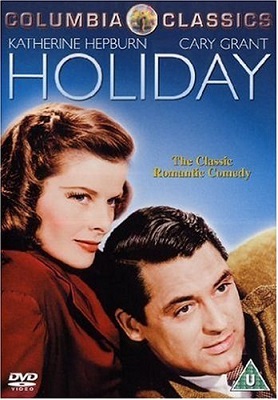
holidayHoliday, George Cukor (1938, USA). An early screwball romance starring Cary Grant and “box-office poison” (as she was at the time) Katharine Hepburn? What’s not to like? Quite a bit, according to audiences when it was released. Grant plays a man who plans to quit his job as soon as he can afford to and do nothing, and Hepburn plays the sister of his fiancée, who is stinking rich. This was during the Great Depression. Hollywood: super-sensitive, as usual. Grant meets Doris Nolan while on holiday in Lake Placid, and the two get engaged. He doesn’t realise she is filthy rich and the youngest daughter of an eminent New York banker. He turns up to the family home, learns the truth, but manages to charm the father and so get permission to marry. But it seems Nolan is a bit of a stuffed shirt, and it’s her libertine sister, Hepburn, who’s a better match for Grant. This one is early in Grant’s career, so he hasn’t got the polished urbanity of later films. If anything, he’s a bit of a galumpher, more of a tail-wagging puppy. Hepburn is Hepburn – did she ever change? – and it’s hard to believe she was ever box-office poison. By all accounts, this film did much to rehabilitate her. Edward Everett Horton and Jean Dixon provide excellent comic relief as Grant’s best friends, a pair of cycnical academics. Both stars, and director, made much better films, but Holiday has its moments. It’s not great, but if you’re into films from the era, it’s probably worth seeing. But I can understand why it flopped at the box office.

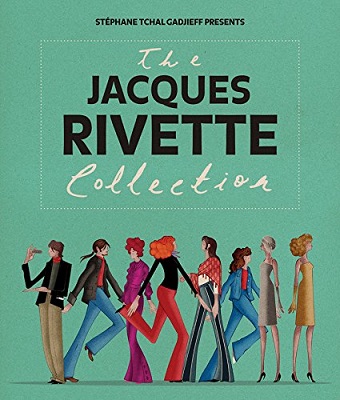
rivetteMerry-Go-Round, Jacques Rivette (1983, France). I watched Rivette’s La belle noiseuse, because it was on the 1001 Movies you Must See Before You Die list, and I thought it very good; and then Arrow Academy released a limited edition Blu-ray collection of some of Rivette’s films, none of which I knew anything about… but the collection was a limited edition, and I’ve learnt to my cost previously it’s best to buy things like this straight away because when you finally come to realise you want a copy they’re either not available or cost silly money. So I bought The Jacques Rivette Collection. On the basis of having seen a single film by the director. So it goes. And yet there’s nothing in Rivette’s movies that immediately appeals to me. They’re well-crafted, certainly; and very French. And, er, very long. Especially the centre-piece of this collection Out 1 – 12 hours and forty minutes! fucking hell – which I admit I have yet to watch. In fact, I’m working my way through the the collection in installments, beginning with Merry-Go-Round, which clocks in at a mere 2 hrs and 40 mins. And I’m not entirely sure what to make of it. A woman sends a telegram to her sister in Rome, Léo, and an ex-boyfriend in New York, Ben, asking them to meet her at a hotel in Paris. But when they turn up, she’s not there. They follow a series of clues and end up at her old home, where she tells them that her father, who died two years previously after embezzling $4 million, isn’t dead. And then she’s kidnapped and taken away in an ambulance. There then follows an almost dream-like quest, in which Ben and Léo try to track down the not-dead father and his millions. Much of this involves running through woods. Including being chased by a knight on horseback. Or exploring empty houses, particularly ones where doors give onto different landscapes – breaking that compact between director and viewer in which the spaces depicted on screen connect in a logical and plausible manner. (Sokurov does something similar in Faust, by having characters enter the frame from parts of the space the camera has already shown do not have entrances.) So the world of Merry-Go-Round doesn’t quite follow the “rules”, but then neither does the quest narrative. There are long extended scenes which do nothing to advance the plot. There are also plot-holes. And interludes in which two odd-looking blokes play noodley jazz on double bass and bassoon. In parts, Merry-Go-Round feels like an early-1980s L’Avventura – or rather, it sets up an expectation of being a 1980s L’Avventura, perhaps on little more than its lack of plot momentum. I am, on balance, glad I bought The Jacques Rivette Collection (it’s still in stock! Get it now while you can! Only 3,000 copies!), and I think they’re films which will bear rewatching, if not demand it; but I’ve a way to go yet before I call myself a Rivette fan.

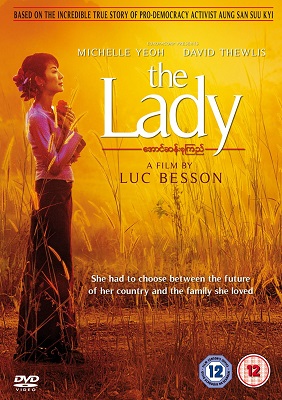
ladyThe Lady, Luc Besson (2011, France). Of all the subjects about which Luc Besson might make a film, I must admit a biography of Aung San Suu Kyi is not one I’d ever have guessed. But then, in many respects, The Lady doesn’t feel much like a Besson film. There’s a moment of almost cartoon-like violence when paramilitaries of the former prime minister assassinate the Executive Council (ie, the government-in-waiting for when the British withdraw), including Suu Kyi’s father. But in most other respects, The Lady is pretty restrained. Michelle Yeoh is especially good in the title role, and if David Thewlis was a bit too thespian as her husband, it didn’t detract overly much from the film. I will admit to knowing only the broadest details about Suu Kyi and Myanmar, and so films such as The Lady are eye-openers. Seriously, military juntas are not governments. The UN could surely make a legal, ethical and moral case for overthrowing such governments. But, of course, military juntas are excellent customers for arms dealers, and selling weapons is what it’s all about in the twenty-first century. The UK is now second only to the US as a seller of armaments. Mostly to the same countries we bomb or which have created the current refugee crisis. If you truly did reap what you sow, this country would neck-deep in salt.

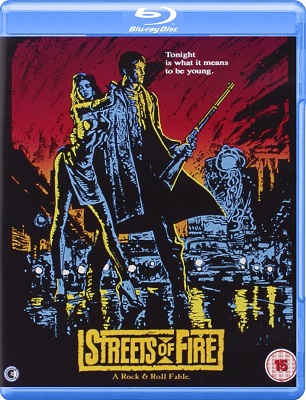
streets_of_fireStreets of Fire, Walter Hill (1984, USA). I had vaguely fond memories of this, after seeing it back in the 1980s, so despite its somewhat negative reputation I thought it might be worth watching. And having now seen it… I think my memories were a little imprecise. It looks great, mostly, no doubt about that; and the music, while of its time, is quite listenable. But that script. It’s fucking awful. It’s totally misogynistic, and it puts words in the mouths of its cast – Rick Moranis, especially – they should have been embarrassed, if not fucking offended, to speak. Diane Lane plays a rock star who is kidnapped by a bike gang led by Willem Dafoe. A young woman persuades her ex-soldier brother, Michael Paré, an ex-boyfriend of Lane’s, to come home and rescue the rock star. And it pretty much goes as you’d expect. I’d hoped time had been kind to Streets of Fire, that it’s 1980s macho posturing might seem more like kitsch thirty years later. It hasn’t. Rick Moranis snarling misogynistic comments at the camera is still a horrible thing to see. Paré does his best with a bad part, Dafoe does even better with a worse part, but Lane does nothing with a nothing part. Visually, the film still scores, and its influence on later films is easy to see. But the reasons why it flopped it 1984 are also obvious, and not even thirty years is going to make it a cult hit.

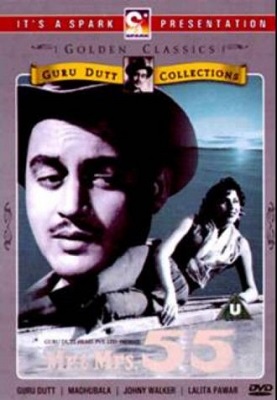
mr55Mr & Mrs 55, Guru Dutt (1955, India). The more of Dutt’s films I watch, the more I appreciate them. Admittedly, this was not a good transfer – BFI, why are you not all over Dutt’s films? – and the plot was pretty much a Hollywood staple (never mind a Bollywood staple), but even so… Rich playgirl Anita is living the high life but then discovers she has to marry before the age of 21 in order to inherit seven million rupees. And she only has a month to do it. She approaches her friend, tennis pro Ramesh, but he’s off to Wimbledon. In desperation, her mother pays cartoonist Dutt Rs 10,000 to marry Anita, with the promise of a quickie divorce soon after. Of course, the two fall in love after the ceremony. But then careful lying by the mother ensures each thinks the other doesn’t really love them, so the divorce goes through… But they get together and realise they do actually love each other after all. It’s all keyed off American signifiers of success – not just Anita hanging around a posh tennis club and worshipping pro Ramesh at the beginning – but also the trappings of wealth enjoyed by Anita’s family are familiar to Western audiences. And yet, there’s also something indefinably Indian about it – and I don’t mean the fact it breaks into song at assorted moments. It feels like an Indian film based on a Hollywood template, by someone who was quite aware of, and more than capable of using, the story patterns of both Indian and Hollywood cinema. Dutt makes good films. He really needs transfers worthy of his work.

1001 Movies You Must See Before You Die count: 795


2 Comments

Moving pictures, #43

Well, 2016 is definitely turning into the year of movies. To date, I’ve seen 431 movies, mostly on DVD and Blu-ray, mostly my own or from LoveFilm or Cinema Paradiso or on Amazon Prime. Some of them have been very good indeed, and I will probably watch them again (if I haven’t done so already). Some were rentals I liked so much, I went and bought a copy of my own. And some… well, best not mention them…

Anyway, on with the next half-dozen adventures on the silver screen wot I have partaked:

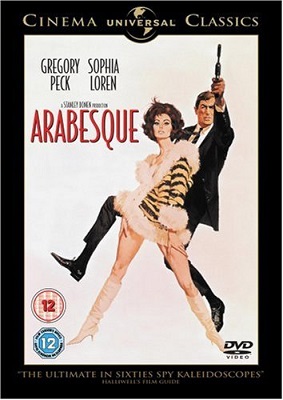
arabesqueArabesque, Stanley Donen (1966, USA). Who remembers Charade? Cary Grant and Audrey Hepburn in Paris. Lee Marvin as the villain. Missing millions. Which turned out to be a rare stamp on an innocuous envelope. It’s a film with bags of 1960s charm – with a pair of leads like Grant and Hepburn, how can it not have charm? Arabesque was apparently Donen’s attempt to hit the same sweet spot again. Unfortunately, while Donen wanted Grant, he got Peck. And Grant’s dialogue doesn’t work when coming from Peck. Sophia Loren manages to hold up her end, however. But both are hampered by a convoluted plot that’s almost impossible to follow. Donen apparently remarked that the film could only succeed if he made it “so visually exciting the audience will never have time to work out what the hell is going on”. And having now seen it, I can certainly vouch for the second half of that statement. Peck plays an Eygptologist who is asked to translate a message in heiroglyphics by head of an Arab state. It’s all to do with some big oil develoment deal and a plan to assassinate the ruler, but most of the plot consists of Peck getting beaten up by the villain’s henchmen or Peck and Loren chasing around London after the scrap of paper with the heiroglyphics on it. Not a high point on all three cvs, to be honest.

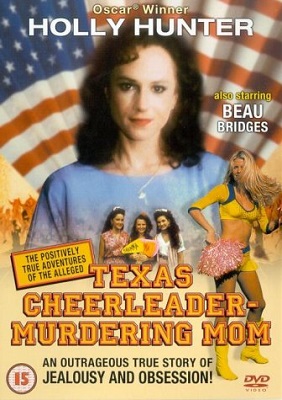
texasThe Positively True Adventures of the Alleged Texas Cheerleader-Murdering Mom, Michael Ritchie (1993, USA). In the normal course of events, I’d not give this film a second look, or indeed even a first one. But a film blog I read, Antagony & Ecstasy, wrote a long semi-approving piece on it, and a week or two later I stumbled across a copy in a charity shop… But, well, I guess this is not a movie that travels well. I’ve never seen the appeal of, or humour in, films depicting US white trailer trash or working class, and that’s pretty much what this is – although it’s based on a true story. Holly Hunter plays the title role, a mother who was so determined to see her daughter succeed she sort of agreed when her drunken brother-in-law (Beau Bridges) tried to entrap her into paying him to off a rival mother. The film is framed partly as Hunter preparing for an interview after the fact, and partly a dramatisation of events, and the whole thing seems mostly motivated by stupidity because the actual character motivations are somewhat opaque. Which makes Hunter’s character come across like a sociopath. Which, to me, sort of ruins the whole desperate housewife story. It’s not very funny film, either. I gave my copy to David Tallerman, so we’ll see if he makes anything of it.

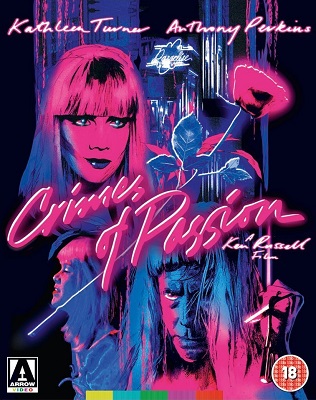
crimesCrimes of Passion, Ken Russell (1984, USA). I don’t think I’d ever call Russell an “interesting” director – he made a handful of solid films, one or two near-classics, and a lot of self-indulgent crap. From the write-up, I suspected Crimes of Passion fell on the border between “solid work” and “self-indulgent crap”, so watching it was a bit of a gamble. And having now watched it… yes, it pretty much straddles the two groups. Kathleen Turner plays a fashion designer who moonlights as a prostitute, using the name China Blue. A surveillance expert is asked to spy on her because her employer suspects her of selling designs to competitors, and he becomes obsessed with her. There’s Anthony Perkins, in full frothing-at-the-mouth mode, wandering around as preacher, who alternately demands to “save” China Blue or have sex with her. He also frequents peep shows. And then there’s China Blue’s customers, with their fetishes… It all looks a bit cheap (and I mean that in its pecuniary sense), and with Perkins drooling and spraying spittle one minute, and then Turner chewing the scenery in the next, it makes it all look like a shoestring exploitation flick with bizarrely high production values. An odd film.

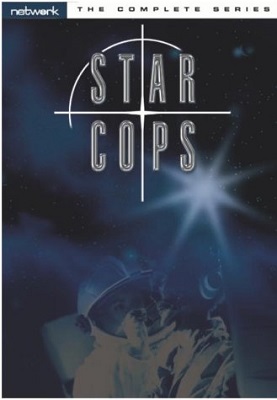
star_copsStar Cops (1987, UK). Many thanks to Paul Cornell for tweeting that a third-party seller on Amazon had clearly found a stash of these somewhere and was selling them at a decent prize (around £20, if you must know). I’d missed buying myself a copy of Star Cops before it was deleted, and by the time I wanted one the price had reached silly money. But now I have one. I remembered the series from its original broadcast back in 1987, although having now seen all nine episodes on the DVD I think I might have missed one or two of the episodes. Anyway, I remembered it as smartly-written, with slightly dodgy production design and cheap effects. What I’d certainly forgotten was the vastly irritating theme song by Justin Hayward, which, while not quite as bad as Enterprise‘s, does have the added horror of getting stuck in your head for days afterwards. David Calder plays a British police officer on 2017 who distrusts the computers and continues to investigate a case the computers have ruled a suicide. It turns out he’s right, of course; but it makes him enough enemies, and leads to the murder of his girlfriend, so he accepts a position as the new head of the International Space Police Force, based on a station in LEO. After a coupleof episodes there, the ISPF moves to an office at a base on the lunar surface (which was obviously a relief for the actors and the budget as it meant no more wires). One of the star cops is presented as a bit of an old-school dimwit, but he also does a nasty line in racist and sexist remarks. The other star cops are an Australian engineer, a US engineer, and a Japanese doctor. Most of the stories are pretty good, although the final one, ‘Little Green Men and Other Martians’, despite having a neat premise, does suggest the lunar base is wide open to whoever turns up – which I wouldn’t have thought all that likely. I’m glad I finally got hold of a copy. These days, sf television series may have fancy special effects, but they rarely have writing as good as this.

vidas_secasVidas Secas*, Nelson Pereiras dos Santos (1963, Brazil). This is generally reckoned to be the first film in Brazil’s Cinema Novo movement. I wanted to watch it because it’s on the 1001 Movies You Must See Before You Die list – and because I’d become a fan of Glauber Rocha after watching three of his Cinema Novo movies – but Vidas Secas is almost impossible to find on DVD (as I type this, there’s one copy available on Amazon for… £101.95). Fortunately, I managed to get a copy from another source, for no more than the price of a typical DVD. And yes, it was worth it. It’s an adaptation of a novel of the same title, by Graciliano Ramos, and tells the story of a poor family in north-east Brazil. It was entered into the Cannes Film Festival and won the OCIC Award. Its plot isn’t easy to summarise, as it’s really just a series of incidents in which the family move from one place to another, try to scratch a living, are preyed on by those more powerful than themselves, and so move on elsewhere. In one village, a local policeman drags the husband into a card game, but when the husband leaves after losing his money, and so the policeman loses even more, the policeman goes after him, beats him up, and then arrests him for resisting arrest. The husband is thrown into jail and whipped. It’s a grim film, althugh not unaffecting – near the end, the family are so hungry the husband tries to shoot their dog, but it takes him ages to work up the courage to do it, and then he botches it and the dog crawls away to die slowly. This is not a film to watch if you’re not in a cheerful mood. It definitely belongs on the 1001 Movies you Must See Before You Die list, though.

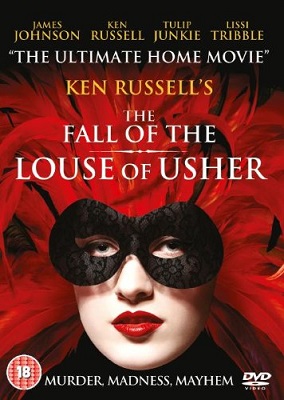
usherThe Fall of the Louse of Usher, Ken Russell (2002, UK). Well, I mentioned Russell’s self-indulgent crap earlier, and I hadn’t watched this. Which is absolutely awful. It’s Russell’s last film, was shot on his own property, and features himself and friends as the cast. A rock-star, Roddy Usher, played by James Johnston of Gallon Drunk, is consigned to a mental institution after killing his wife and walling up her body. His doctor is played by Russell himself. He gives Usher shock treatment and, well, lots of things happen, few of which I can, thanksfully, remember. It all looked horrible and cheap and amateurish, and I’m surprised it ever saw a general release. The DVD, released by Final Cut, calls it “the ultimate home movie”, but even that fails to convey how crap it is. This is definitely a film to avoid. It was Russell’s last feature film, and a poor epitaph for a man who did make some good stuff during his long career.

1001 Movies You Must See Before You Die count: 794


Leave a comment

Reading diary, #35

As a general rule, I try to spread my reading across genders and genres, but it doesn’t always work out that way. So far this year, around forty percent of my reading has been science fiction, I suppose chiefly because when I fancy an easy read it’s my go-to mode of fiction. Which might tell you something about recent sf, except that quite a bit of my sf reading has been twenty- or thirty-year-old sf novels by women writers for review on SF Mistressworks…

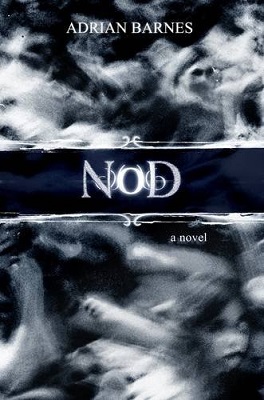
nodNod, Adrian Barnes (2012). We’ve just had a somewhat controversial Clarke Award – but then, when hasn’t the Clarke been somewhat controversial? It was back in 2013, when Nod was shortlisted. From what I remember, Nod was seen as a quite baffling choice; although the same could also be said for The Dog Stars, also shortlisted that year, and which I read a year or two ago and thought not very good at all. Whereas NodNod is one of those books written with a strong, idiosyncratic voice – not idiosyncratic like Riddley Walker or Engine Summer – but the first person narrator is chatty and irreverent and likes to pepper his story with witticisms and snide remarks and it’s really fucking annoying. The central premise is nicely done – suddenly no one can sleep, except for a handful – and the breakdown of civilisation as sleep deprivation psychosis kicks in, as seen in the narrator’s home town of Vancouver, is well-handled… But the way the book is written, the prose style, is like fingernails on a blackboard for me. I hated it. It was a test of endurance to read it. This is one of those books which illustrates the difference between “this book is good” and “I enjoyed this book”. I hated it, didn’t enjoy it at all, but could see it was put together with skill. My response to it is entirely personal; the book’s quality is intrinsic to it. The two should not be confused.

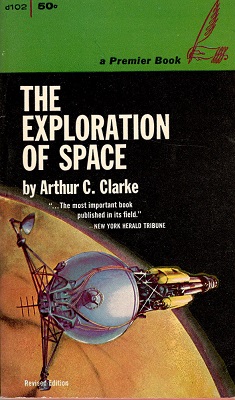
exploration_space_smallThe Exploration of Space, Arthur C Clarke (1951). Why did I read a book about space exploration written more than half a century ago, when the appropriate science and engineering was in its infancy, I hear you ask? Er, I don’t know. But I thought it might be interesting to see what Sir Arthur had got right – the edition I read was an updated one published in 1960, so pre-Gagarin and -Apollo – and the answer is… not all that much, actually. His explanation of freefall, for example, is sort of right but doesn’t explain it very well. Astronauts at the ISS (which, of course, didn’t exist when the book was written, so Clarke’s example is hypothetical) are not experiencing zero gravity because the gravity in Low Earth Orbit is exactly the same as it is on the ground. The astronauts are falling toward the ground, and so is the ISS, at exactly the same speed; but the ground is rotating away from them, also at the same speed. So, to paraphrase Douglas Adams’s description on how to fly, they’re throwing themselves at the ground… and missing. True, science and engineering didn’t know then what we now know, and the stuff Clarke gets right is the stuff that had been known for decades, if not centuries. The chapter on ‘The Lunar Base’ speculates the Moon would be exploited solely for minerals – thus ignoring the US Army’s Horizon lunar base study from 1959 – and that spacesuits would have to be hard-shelled. A later chapter on space stations claims their chief role would be in communications – and this from the man who “invented” the communications satellite… although first active repeater communications satellite wasn’t launched until 1960. The Exploration of Space is mostly good on the basics, and it has that weirdly unrealistic optimic take on its subject, much like those famous Colliers Magazine articles. But it’s very much an historical document, and no different in that respect to a science fiction novel published during the same year.

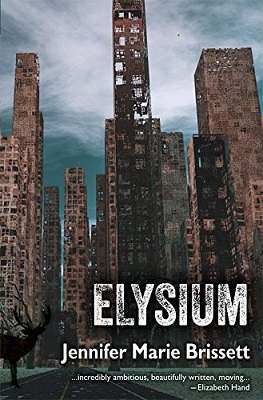
elysiumElysium, Jennifer Marie Brissett (2014). I must be getting jaded. I mean, I know I apparently don’t see science fiction in the same way as many others do – for instance, I thought The Book of Phoenix a terrible book, and yet it received a huge amount of praise (and was even tipped by many to take the Clarke). Elysium is another sf novel which has received lots of praise, but has a much lower profile than the Okorafor. It is also a better novel than The Book of Phoenix, but… The book opens with a series of vignettes depicting Adrian/Adrianne and Antoine/Antoinette, in each of which the two are of different genders – male/female, male/male, female/female; as are also some of the supporting characters. This section (sections) reads like mimetic fiction, but breaking them up is what appears to be output from a computer program (in the form of error messages). The novel then takes an abrupt swerve into alternate history, in which Adrianne is a Vestal Virgin in a modern-day Western city, before then heading into post-apocalypse territory as off-stage alien invaders release some form of dust which mutates human beings and brings about the collapse of civilisation. One of the two main characters becomes one such mutant herself and develops wings. Another shift, and now Adrian is the chief designer of an underground city – a geofront, from the description – in which some of humanity plan to survive, safe from the mutagenic dust and the alien invaders. They’re also building starships to take them to another world. It is at this point in the story that the novel reveals a plan to use the atmosphere to store an archive of human civilisation, and it is the operating system of this which is genersating the computer messages and actually “telling” the story of Elysium. In the final section, Adrianne is a prisoner in a concentration camp run by the alien invaders, and when one of the aliens is imprisoned with them, she learns from it that the aliens had killed all the humans who had not escaped Earth, and that she is no more than a simulation run by the archive in the atmosphere (as, indeed, were all the other narratives in the novel). While Elysium certainly has its moments, the writing is rough to begin with – “The water of sorrow ran like a river down the curve of Adrianne’s cheek”? – but soon improves, or at least becomes less of a barrier. The gender- and sexuality-switching in the opening sections is also neat and cleverly-done, and I thought the Vestal Virgin part especially good… but the post-apocalypse section, and the geo-front section, were a bit dull, and the novel only picked up again with Adrianne in the prison camp, a section which pretty much seems to serve no purpose other than to explain the entire book. In many respects, Elysium reminded me a lot of Sue Thomas’s Correspondence, although I thought Correspondence a much more difficult, but more rewarding, read (see here). I bought Elysium at the end of last year, along with Jackie Hatton’s Flesh & Wires, Deb Taber’s Necessary Ill, and a pair of novellas, Lisa Shapter’s A Day in Deep Freeze and Lori Selke’s The XY Conspiracy, from Aqueduct Press (and I cannot recommend Aqueduct Press enough). The Shapter I thought good enough to nominate for the BSFA Award. I’ve yet to read the Taber; but of the other two novels, I think Hatton’s may just be the better one.

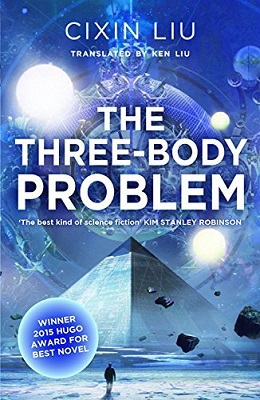
3bodyThe Three-Body Problem, Cixin Liu (2008). So the puppies managed to fuck up the Hugos in 2015, but one of the novels on their slate was pulled by its author, and The Three-Body Problem was promoted onto the shortlist… and went on to win the award. I don’t normally read books because they’ve won a Hugo – if anything, that’s a good indication I won’t like it – but the premise of The Three-Body Problem sounded interesting, and Liu is a big name in Chinese sf. (I have a collection of his three novellas, The Wandering Earth, knocking around somewhere, but have yet to get around to reading it.) So, anyway, The Three-Body Problem… I wasn’t expecting much: old school sf, but set in China, and with a clever premise. And so it initially seemed. The writing was serviceable at best, although the info-dumps were often intrusive and clumsy… but this is sf, this is what it looks like a lot of the time. However, when protagonist Wang Miao stumbles into the conspiracy at the heart of the novel, and the “end of science” is demonstrated to him through, first, a countdown mysteriously appearing on photographs he has taken, then in his actual vision, and then he witnesses the cosmic background radiation of the universe flicker… Well, this was a fascinating puzzle. Throw in a MMORPG set on a world orbiting three suns and in which players have to figure out a solution to the three-body problem – not that there is one, but the game proved an interesting illustration and history of the issue. It was all going so well: mysterious secret project, the end of science, clever VR game… And then Liu whips away the curtain to reveal what’s really going on and… big disappointment. It’s like a sf novel from the 2010s and a sf novel from the 1950s were welded together. Even that thing with the countdown proved to be a massive letdown. The Three-Body Problem is the first of a trilogy, followed by The Dark Forest and Death’s End. I won’t be bothering with them. But I will dig out that collection of novellas and read that, I think.

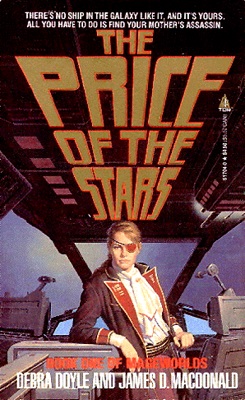
price_starsThe Price of the Stars, Debra Doyle & James D Macdonald (1992). This is the first book of the Mageworld series, as the cover helpfully explains. There are seven books in the series, the last in 2002 (the blurb for which does not read like it’s the final book of a series). Initially, I wasn’t all that impressed – The Price of the Stars wears its inspirations – kof kof St*r W*rs kof kof – far too openly, and even the changes it rings are overshadowed by that media behemoth. But I sort of got into it, and began enjoying the read… so I’ll probably end up tracking down the rest of the series and giving them a go, despite their faults.  I reviewed it on SF Mistressworks here.

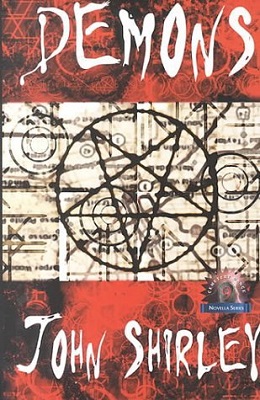
demonsDemons, John Shirley (2000). For some reason I have yet to figure out, I cottoned onto John Shirley as an author worth collecting… despite not being a fan of horror. I think it was partly because in the early 1990s, he was producing some exciting stuff – Wetbones, Heatseekers, Eclipse, A Splendid Chaos – and, like Lucius Shepard and Lewis Shiner, two genre writers I admire, he began publishing limited edition novellas through small presses. Anyway, I have a number of his books in those signed limited editions, and yet most of them are, well, pretty forgettable. Demons – not to be confused with the Ballantine collection of the same title which includes this novella/short novel (and which I’ve had to link to on Am*z*n because the Cemetery Dance limited edition is apparently very rare) – is fairly typical of Shirley’s output. The gonzo horror inventiveness, the slightly off-kilter approach to the world, nailed into place with the careful use of details, the often slapdash prose, and a story that’s usually more than it appears. In Demons, er, demons start to appear, all over the world. And they kill people, without rhyme or reason. There are seven specific types of demons, which a glossary before the story helpfully describes, and which artwork in the book depicts. Ira is an illustrator for an occult magazine and a bit of a slacker. He’s love with Melissa, the daughter of Dr Paymenz, an occultist professor at a California university. And he’s with them when the demons appear. The three manage to hook up with a symposium of like-minded academics, where Ira learns of the Conscious Circle of Humanity, a group of 23 psychically-gifted people who keep humanity safe, and about a conspiracy which prepared the world for the demons’ arrival. Eventually, they figure out that various large-scale industrial accidents were triggered to usher in the demons, so that a small group of men can use the ensuing slaughter as “sacrifices” to gain immortality. Cliver Barker would probably have made a 900-page epic out of this plot, but in Shirley’s hands it doesn’t outstay its welcome. Better than I had initially thought. But I’m still not sure why I collect Shirley’s books.

1001 Books You Must Read Before You Die count: 126


3 Comments

Awards, rewards and self-publishing

Adrian Tchaikovsky’s Children of Time won the Clarke Award, which was a surprise – but a pleasant one. At least the book I’d expected to win didn’t take the prize; but, sadly, neither did the book I wanted to win. I had Children of Time pegged more as a BSFA Award book than a Clarke Award, but when I wrote about it in August last year I predicted good things would happen to it. And I’m happy for Adrian, who is a thoroughly good bloke (and scarily prolific). Children of Time is one of the very few books I started reading on the day of purchase – and it was completely by accident. I’d bought the book at Edge-Lit 4, but during the journey home I finished the novel I’d brought to read on the train and so turned to Children of Time. I wonder if it’s repeatable…

I’ve written about the Clarke Award shortlist elsewhere, and about the individual books on it in scattered Reading diary posts on this blog. It was – and I’m not the only person to use this word – a lacklustre shortlist. The Clarke has always been a boundary-pushing sort of literary award, but the last few years it seems to have been circling its metaphorical wagons. There has been surprisingly little commentary about the books on the shortlist this year, despite it being the award’s thirtieth anniversary, despite the extended period between the announcement of the shortlist and the announcement of the winner. But when most commentary on sf these days seems to consist of brainless hyperbole on social media, having all the criticial insight of marketing copy, it’s plainly a problem much wider than an award shortlist. In today’s genre conversation, books receive either five stars or one star. It’s a piss-poor excuse for a conversation, and it’s poisoning the genre. Not only is sf blanding out, we seem to be actively encouraging it to do so…

110962_web

Which makes the award’s decision to allow self-published works to submit baffling. The vast majority of self-published books are derivative commercial sf, space opera or military science fiction. It’s precisely the sort of sf you’d hope the Clarke Award would avoid. Of course, there are also self-published works which are anything but commercial – and may well have been self-published for that very reason. But the award director cites the examples of Becky Chambers’s The Long Way to a Small, Angry Planet and Jeff Noon’s Channel Skin (which I’ve not read) as good reasons for including self-published works. Of course, the Chambers was already eligible because it had been picked up and published by Hodder. I’m a bit annoyed the award bent the rules to allow me to submit All That Outer Space Allows – which was also selected for the Tiptree Award’s honour list – but then hasn’t seen fit to hold it up as an example of a self-published novel that was worthy of submission.

I deliberately set out when writing each book of the Apollo Quartet to upset the expectations of readers, something I had the freedom to do because I was self-publishing. And while that has seen the books win one award, be nominated for a further two, and appear on the honour list of another… I’ve sold only 3700 copies since April 2012. And Dreams of the Space Age, a collection of short stories set in the same, er, space as the Apollo Quartet, published in April of this year… well, I can barely give them way – 86 copies sold since its launch. However, I don’t have the marketing clout or the distribution channels of a major publishing imprint, so this was hardly unexpected. To be honest, I’d actually expected Adrift on the Sea of Rains to sink without trace.

Because I self-published, because I had no expectations of commercial success, so I was free to write something challenging. The fact that some people appreciated that enough to nominate the books for awards was a huge surprise. And I saw that as grounds to write even more challenging sf. Which at least might have stood me in good stead for some awards. Except now the Clarke Award appears to prefer more commercial works, and by opening itself up to self-published books, is likely to become yet more commercial. I’m guessing, of course; but you can’t get more commercial than the Firefly fanfic that is The Long Way to a Small, Angry Planet

It’s an inevitable conclusion, and one that has plainly occurred to Adam Roberts, who has gone on record as saying he will no longer write challenging science fiction novels as he would sooner not have his books ignored. And I think to myself I would sooner write more difficult sf. On the other hand, success brings its own acclaim, and it’s astonishing how popular books become “awesome” and “amazeballs” and “the best book ever written”. Which is not to say challenging works can never be popular, nor commercial works possess literary quality, nor literary works enjoy commercial success… But we’re in danger of losing what’s best about science fiction if the only game in town is “most popular kid in the playground”… And I was going to write something about lone voices in the wilderness being the only ones to carry the flame, but that really is a mixed metaphor too far… But it’s not unrealistic to expect, to hope, that the Clarke Award is skewed toward challenging science fiction novels, and not the dull, and often juvenile, meat-and-potatoes/bread-and-butter sf which sells by the yard (and is likely written by the yard too), and which appears to comprise the vast undifferentiated mass of self-published science fiction.

But I’m speculating – and we shall see next year how the Clarke Award implements its expanded remit. A juried award at least has the advantage of not being bent out of shape by eligibility posts, or fan and tribe affiliations; and for that reason I look to the Clarke as a truer picture of what the word “best” means in science fiction in any given year. I would hate to lose that…