It Doesn't Have To Be Right…

… it just has to sound plausible


2 Comments

2017, the best of the year: books

2017 has been a bit of a parson’s nose of a year – or do I mean a curate’s egg? One or the other. Both the UK and the US continued their downward spiral into fascism and economic ruin, and as a result social media became really quite depressing at times. But it’s not like I have alternative sources to find out what’s going on – I gave up on newspapers years ago, and I’ve not knowingly watched a news broadcast since the 1990s.

I made a few attempts at starting writing again, but they came to nothing. I stopped reviewing too – so SF Mistressworks went on hiatus; and I’ve not had a review in Interzone since early 2016. That was down to the day job. Things have improved there over the last few months, so I hope to start reviewing again in 2018.

On the other hand, during 2017 I attended three Nordic conventions – in Uppsala, Helsinki and Copenhagen. One of them was even a Worldcon. I had a great time at all three. I plan to attend more next year.

One area in which 2017 was much like 2016 was in the culture I consumed. More films, but less books – in fact, this blog pretty much turned into a series of Moving picture film posts during the year (68 of them to date). As in previous years, I signed up to the Goodreads challenge, but I lowered my target by ten books to 140… and it looks unlikely I’ll make it. Ah well. However, I did read some very good books and watched some very good films, and discovered a few excellent writers and directors new to me.

This year I’ve decided to split my best of the year into three parts: books first, then films, and finally music. So, moving on…

books
As of the time of writing, I’ve read 123 books, down on last year’s 149. I’ll blog the actual stats on the books I read in a later post, as this post is about the best books I read during the year. Two are science fiction, and four are by female writers. There are also five nations represented – I think that might be a first for me. The figure in square brackets is the book’s position in my best of the half-year post here.

1 Chernobyl Prayer, Svetlana Alexievich (1997, Belarus) [1]. During a discussion on Twitter early this year about female literature Nobel laureates, I realised I’d read very few. So I decided to pick up books by a couple. Alexievich, who was awarded the Nobel in 2015, writes non-fiction composed from interviews with those affected by the topic she is writing about. As the title indicates, in this book it’s the Chernobyl disaster. Alexievich spoke to those who lived in the area, and those who stayed, as well as people who worked at the power station, or were involved in fighting the disaster or cleaning up afterwards. Despite its subject, Chernobyl Prayer is a very poetic book. It’s also frightening, heart-breaking and affirming. It”s not without its detractors, people who claim Alexievich has not been entirely accurate in representing her interviewees, although I have to wonder how many of those critics only spoke up after she was awarded the Nobel. I’ve since picked up a copy of Alexievich’s Second-Hand Time, but I’ve yet to read it; and I certainly plan to read more by her.

2 Go, Went, Gone, Jenny Erpenbeck (2015, Germany) [-]. Erpenbeck has been a favourite since I read her The End of Days last year (and that book took my number one spot in 2016’s best of the year). Go, Went, Gone is not genre, as that one was, but straight-up mainstream (or literary fiction, whatever label you prefer). It’s about a retired professor in Berlin, who decides to interview some refugees being housed near him and so gets dragged into their lives and stories. It’s a subject important to our time – there are refugees flooding into Europe from the Middle East and Africa, many from situations in their homelands we Western nations have created with our warmongering and economic plundering, and the least we can do is treat them like human beings, with dignity and compassion, and show that we have built societies that welcome all. While Go, Went, Gone documents Berlin’s failings in this regard, Germany still manages a fuck load better than the UK, which puts immigrants in detention centres and treats them worse than criminals. What I love about Erpenbeck’s fiction is her distant and yet clinically sharp prose, and it’s on fine form here. An important topic, beautifully written.

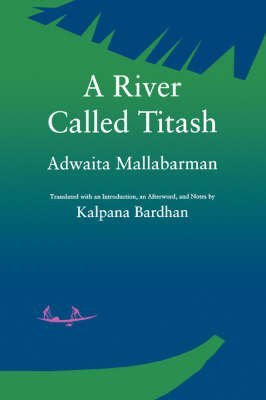
3 A River Called Titash, Adwaita Mallabarman (1956, Bangladesh) [2]. Ritwak Ghatak’s A River Called Titas is one of my favourite films, so I was keen to read the novel from which it was adapted. And it’s every bit as good. However, unlike the film, it tells several stories about the Malo fisher folk of the Titas river (in what is now Bangladesh). The movie follows one particular story, that of Kishore, whose young bride is kidnapped the day after their wedding. She washes ashore at another village, but cannot remember the name of her husband’s village. Many years later, with son in tow, she tracks down her husband – only to discover he had gone mad as a result of her kidnap. The novel weaves this story in and around many others, from several villages along the Titas, a tributary of the Meghna River, one of the three rivers which forms the Ganges delta. A River Called Titash is also an ethnographic document – Mallabarman was born on the Titas, although he worked as a literary editor in Kolkata, so he knew what he was writing about. The book is as good as the film – and that’s high praise from me.

4 Dreams Before the Start of Time, Anne Charnock (2017, UK) [-]. I’ve been impressed by what I’ve read by Charnock, but this one, despite its unwieldy title (yes, I know), I thought especially good. It follows a family through the next century or so as they each decide how to have children and treat their offspring. It’s not the most dramatic of plots, but I’m frankly fucked off with science fiction insisting brutality, genocide and mega-violence are necessary in every story. It’s possible to write dramatic genre fiction that doesn’t have a high body-count, or normalise fascism or villanise certain ethnic groups… And this novel is the perfect example of how to do it. It’s not even as if it’s optimistic, although I’m not sure such an adjective applies. It just is. It’s not only that I thought Dreams Before the Start of Time a very good book, but also that it’s a type of science fiction I think we need more of. Why not tell stories that do not create false enemies of the Other, or slaughter the Other, or in any way demonise the Other? Instead, let’s have stories like Dreams Before the Start of Time. Oh, and make them as well-written as it too.

5 Necessary Ill, Deb Taber (2013, USA) [3]. Friends had recommended this a couple of years previously, and I’d added it to an order from publisher Aqueduct Press not too long afterward. But it took me until 2017 to get around to reading it, and then when I opened it I was hooked. Okay, it posits a post-catastrophe world and it advocates genocide – per se – for certain groups, which does seem to contradict my comments above. But in Necessary Ill, Taber creates a group of villains – the neuts – who are way more sympathetic than the people they target – ie, American men prone to, or capable of, violence. On the other hand. the novel is clear that the plan is flawed and that those who prosecute it are also flawed. The society of the neuts is really well drawn, and while the prose in Necessary Ill is no more than slightly above average for genre fiction, the world-building is cleverly done. Despite its premise it proved to be one of the most optimistic sf novels I read in 2017. More, please.
Honourable mentions: The Opportune Moment, 1855, Patrik Ouředník (2006, Czech Republic) [4] off-kilter story of an anarachist utopia founded in Brazil, and its failure; Europe in Winter, Dave Hutchinson (2016, UK) [5], third book in the sf/spy thriller trilogy that isn’t a trilogy anymore, won the BSFA Award this year; Proof of Concept, Gwyneth Jones (2017, UK) a piece of characteristically smart but grim sf from a favourite author; The Possibility of Life’s Survival on the Planet, Patrick Keiller (2012, UK) an accompanying text for an exhibition related to Keiller’s documentary, Robinson in Ruins; Lila, Marilynne Robinson (2014, USA) the third of Robinson’s Gilead novels, following the wife of the narrator of GileadParty Going, Henry Green (1939, UK) a party heading for the South of France are trapped in a London railway hotel by the weather, characteristically sharp prose from Green; Angel, Elizabeth Taylor (1957, UK) the story of  a young woman who becomes a best-selling romantic novelist but never manages to live in the real world; This Brutal World, Peter Chadwick (2016, UK) excellent book of photographs of Brutalist buildings; The Amazing Adventures of Kavalier & Clay, Michael Chabon (2000, USA) epic history of comics told through the lives of a US Jew and a Czech Jew who escapes to the US prior to WWII; Nocilla Experience, Agustín Fernández Mallo (2008, Spain), the second book in Mallo’s trilogy of fiction cleverly mixed with fact.


Leave a comment

Moving pictures 2017, #68

Not an especially interesting spread of films in this post, although I did enjoy some of them.

Gold Diggers in Paris, Ray Enright & Busby Berkeley (1938, USA). The Gold Digger series had legs, at least during the 1930s. The first two installments in the series are apparently lost, but it managed a number of films before vanishing into obscurity – although I’m not sure if the series was a casualty of declining audiences or the imposition of the Hays Code. But some of the Gold Diggers films are better than others, and the fact this one is in the second of the Busby Berkeley Collections at least gives a clue as to which it might be… Which is sadly not wrong. France is putting on an exposition and decides to invite ballet companies from several countries. So they send a comedy incompetent to the US, who is tricked into inviting a dance troupe from a nightclub instead of an actual ballet troupe. And, er, that’s it. The US academy of ballet learns they were robbed of the invite and set out to fix things. Meanwhile, the manager of the nightclub dance troupe – and the lead singer of its routines – has to keep the French authorities unaware of his his dancers’ true nature. It’s mildly amusing, and not at all probable, and some of the dance routines in the final act are okay. And the Schnickelfritz Band, who perform several numbers, are actually pretty good. I do like these Busby Berkeley musicals, but some of them are so much better than the others. I’d love to see them in colour. But you take what you can get, and what you can get is worth seeing at least once.

Festival Express, Bob Smeaton, (2003, UK). I don’t really know enough about documentaries to put together a rental list of ones I should watch, so I picked a bunch whose subjects sounded like they might be interesting. And one of the subjects I like is music of the 1960s and 1970s. The title of this film refers to a train hired by a concert promoter in 1970 to transport several bands across Canada to appear at gigs in Toronto, Winnipeg and Calgary. The promoter provided a carriage with all the equipment for jam sessions, and the idea was the various bands would play music as they travelled. Which they did. They also drank a lot. A lot. And it was all filmed. But the film was held up for years by rights disputes, and then lost, before resurfacing early this century, and all the parts put in place to release the 1970 footage as part of Festival Express. The documentary consists of interviews from 2003 with those who were on the train and are still alive, as well as film shot at the time of the jam sessions, events on the train and at the gigs at the various cities. If you like the music of the time – Janis Joplin, Buddy Guy, Grateful Dead, The Band, and so on – it’s a pretty good documentary. There’s some good concert footage – and more in the special features – and some of the jam sessions are especially good. The “let’s put a groupie’s chest on the cover” art is less good. But don’t let that put you off. Worth seeing.

Valerian and the City of a Thousand Planets, Luc Besson (2017, France). I’ve been reading Jean-Claude Mézière and Pierre Christin’s Valerian and Laureline series since the 1990s – one or two in French initially, but then in English as Cinebook began publishing translations of each volume. So when I heard Luc Besson was making a film featuring the two characters – it could hardly be described as an “adaptation” of a 21-volume science fiction bande dessinée – I was pretty stoked. Besson may be a bit and miss as a director, and, to be honest, more miss than hit, but his previous attempt at space opera, The Fifth Element, had been lots of fun. But then the reviews of Valerian and the City of a Thousand Planets began to roll in and… oh dear. It sounded like he’d made a right pig’s ear of it. But I was famliar with the source material, and most reviewers apparently were not, so I decided to reserve judgement until I’d seen Valerian and the City of a Thousand Planets for myself. And… oh dear. Let me say straightaway, it looks gorgeous. It’s a total CGI-fest, and shows a great deal of imagination in the CGI creatures and aliens it presents. But. The Valerian and Laureline series is about, well, Valerian and Laureline. And that’s where Besson’s movie mostly falls flat. In the bande dessinée, Valerian mostly resembles Belmondo (with maybe a soupçon of Lazenby thrown in) and Laureline is basically Bardot with red hair. So the casting of DeHaan and Delevingne is absolutely mystifying. The two characters’ relationship also develops over the course of the series, with Valerian the competent Galaxity agent and Laureline the unsophisticated young woman he rescues from Earth’s past… only for Laureline to turn out to be much more competent of the two, and her use of Valerian as “muscle” becomes a running joke. There are flashes of that relationship in Besson’s movie, but mostly it seems to be Valerian as a hormonal fifteen-year-old boy and Laureline as a seventeen-year-old girl who has already seen it all. And both played by actors that are plainly in their twenties. There are other weird bits. Like the bizarre appearance of an Apollo CSM in the final sequence – but it’s not a real Apollo CSM, as it has a glass cockpit. So what’s that about? And the actual plot, where an area in the centre of Galaxity, sorry Alpha Station, is impervious to sensors, but turns out to hide the Pearls who survived genocide in the opening sequence… Well, it’s all a bit confused and the timelines don’t really add up. But then French films, and especially Besson’s films, are infamous for leaving important elements of the plot on the cutting-room floor. Pace, apparently, is everything in France. The band dessinée series, on the other hand, is very very big on common sense and narrative logic. It is one of its virtues. Valerian and the City of a Thousand Planets has lots of pace. It is indeed headlong. It does not have much continuity or common sense. I can only hope this film persuades the film-making world that Mézière’s and Christin’s series is a good property for adaptation. And that whoever attempts it next does a better job.

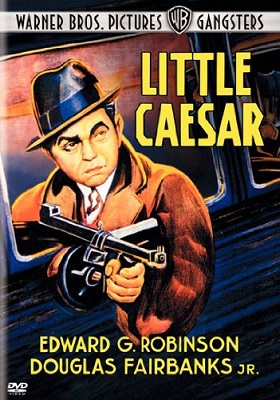
Little Caesar*, Mervyn LeRoy (1930, USA). This was apparently Edward G Robinson’s first appearance on film as a gangster, a role he would occupy for much of his career. Which is, I guess, mildly interesting, but not a good reason for the film to be on the 1001 Movies You Must See Before you Die list. Because as far as I could tell, that seemed to be the only thing about Little Caesar that was notable. Especially when you compare it to contemporary gangster films like Scarface. Robinson is keen to claimb the gangster ladder, which is what he does. He works his way up to top dog, but then things start to go wrong and he goeson the run and ends up a drubk living in a doss house. Until the DA starts making public statements calling him a coward, and because these sorts of characters are so one-dimensional all it takes is threatening their manhood to force them out of hiding, so Robinson makes an attempt on the DA’s life and is defeated. Yawn. There are some seminal gangster movies from the 1930s, but I fail to understand why this is considered one.

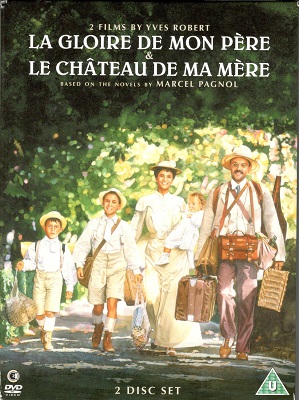
Le château de mère, Yves Robert (1990, France). This is the sequel to Robert’s La gloire de mon père and, like that film, is also based on an autobiographical novel by Marcel Pagnol, and is in fact the adaptation of Pagnol’s sequel to La gloire de mon père. So, the same characters, the same general situation, roughly the same period, certainly the same place… and a slightly different plot. The boy, who’s the narrator of the films, is put forward as the school’s representative in some sort of academic competition, and so needs to study hard. Meanwhile, the family decide to return to their holiday home, but this entails a 3-hour walk from the railway station. Until, one day, they’re surprised by a canal guard, who has access to all the gardens through which the canal runs and so provides a shortcut which makes it a 30-minute walk. So the family start using the shortcut. They’re accosted by one of the property owners, but he’s happy for them to trespass. A guard on another property is less forgiving and reports them. La chaâteau de ma mère is more of the same, pretty much. A rose-tinted version of Provence during the 1920s, a soupçon of social commentary, lots of nostalgia, and lots of shots of Provençal landscape. It was every bit as dull as La gloire de mon père, although some of the humorous scenes were better. Not being French, I don’t understand the appeal of these films – but then I don’t understand the appeal of Heartbeat or Last of the Summer Wine and I live in Yorkshire…

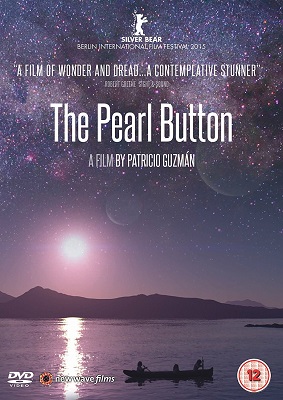
You’ll Never Be Alone, Álex Anwandter (2016, Chile). I’ve no idea where I came across mention of this film. I suspect I added it my list because it was a recent drama from Chile and available for rental. Given that my previous experience of Chilean cinema is Patricio Guzmán’s documentaries (and if you’ve not seen them, you must), I had no real idea what to expect. What I got was… surprisingly brutal. A man is the manager of a factory that makes shop window dummies. He has worked there for 25 years and feels he should be a partner in the business, and so has been persuaded by the owner to invest some of his own money in order to buy partnership. His son is openly gay. One night, his son is attacked by some local youths who know him – including one who has been fucking him – and put into a coma. The man has to spend the money he planned to invest in the company on his son’s medical bills. And then, the factory owner sells the mannequin factory to a rival company. His son is racking up expensive medical bills – millions of pesos – and his twenty-five years of loyalty are apparently worth shit. So he does something about it. This is a grim film, and the gaybashing which is its most dramatic moment is horrible and brutal. And, of cource, because that’s how these things go, the perpetrators are not even charged as there are no other witnesses than the victim, even though everyone knows who did it. When the father confronts one later in the film, the youth seems more scaredof being caught than ashamed of what he has done, even though he took advantage of the gay son by having sex with him. You’ll Never Be Alone is worth seeing, but for god’s sake, watch something cheerful after seeing it.

1001 Movies You Must See You Die count: 894


Leave a comment

Moving pictures 2017, #67

I seem to have built up another backlog of these again. Cracking on…

Passion, Jean-Luc Godard (1982, Switzerland). Some people consider this one of Godard’s best, although he seems fixed in the minds of the general cinema-going public only as the Nouvelle Vague director of films such as À bout de souffle, Bande à part and Une femme est une femme. Of course, he’s made many more films than that, and is still making them. Passion marked Godard’s return to mainstream cinema after a period making experimental pictures. A Polish film-maker in Switzerland is exasperating his backers by staging huge, and expensive, tableaux based on famous paintings, none of which suggest a commercial narrative movie. Meanwhile, Isabelle Huppert is fired from her job at a local factory, and subsequently tries to organise a strike. The film-maker, played by Jerzy Radziwilowicz, is in a relationship with Huppert; he’s also in a relationship with the wife, played by Fassbinder favourite Hanna Schygulla, of the owner of the hotel where he is staying. It’s an odd mix of a film. The Huppert narrative is very much realist social drama, but the Schygulla elements feel a bit like a bedroom farce and the tableaux scenes are more Peter Greenaway than anything Godard has done previously. It works, because Godard is good at this stuff. And he also has an excellent cast – Huppert, probably the best actor currently making films, is on top form, even with the stutter with which her character is lumbered. The tableaux are… odd. As I said, more Greenaway than Godard. But unlike Greenaway, Passion shows how they are constructed – their existence is part of the narrative, rather than them actually being the narrative. I rate other films by Godard higher than Passion (although I’m not that much of a fan of his Nouvelle Vague movies). Um, thinking about my favourite Godard films, they’d probably look like this: 1. Le mépris, 2. 2 or 3 Things I Know About Her, 3. Je vous salue, Marie, 4. Week End, and 5. either Passion, Détective or Film Socialisme.

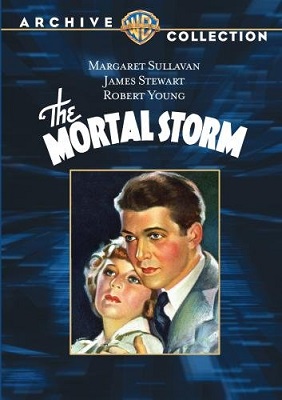
The Mortal Storm*, Frank Borzage (1940, USA). A write-up of this film somewhere – Wikipedia? imdb? – states that it rarely mentions the country in which it was set in order not to offend German audiences. Except that’s completely untrue. It makes it abundantly clear it’s about Germany and the average Germans’ complicity with Hitler and the Nazis. The whole point of the film is a relationship between a non-Nazi and the daughter of a Jewish intellectual. No effort is made to disguise this. Jimmy Stewart is friendly with the daughter of college professor Frank Morgan, who is Jewish. She’s already engaged to a Nazi party member, but when her step-brothers start spouting the party line, she realise her mistake. This is a good film because it’s totally not subtle. It’s not a great film – some of the opening shots have that sort of artificial grandeur Hollywood managed every so often with its studio shots… but once the plot gets into gear they disappear. Given its subject – even more timely now than it has ever been – The Mortal Storm probably deserves its spot on 1001 Movies you Must See Before Die list, even though technically there’s nothing that’s special or important about it.

Gold Diggers of 1937, Lloyd Bacon (1936, USA). A theatre owner wants to put on a new show but his partners have spent all on his money on the stock market. So they get his life insured, planning to bump him off and then collect to make good on their debts. But the insurance salesman – Gold Diggers regular Dick Powell – who sold him the policy is keen on him staying alive. So the corrupt partners try to kill the theatre owner, but Powell has to keep him alive in order to earn his commission. Cue hilarity. There are some entertaining set-pieces, but the humour is all a bit obvious and some of the acting closer to mugging. There’s one of Berkeley’s big routines at the end, but the way the final act gives everyone the happy – or not, in the villains’ case – ending does feel over contrived. I don’t know if the Gold Diggers series was killed by the Hays Code or the declining quality of the films, but they’re not bad examples of their time and type, and they’re usually entertaining. If you find copies of these two Busby Berkeley collections, they’re worth having, although volume one much more so than volume two.

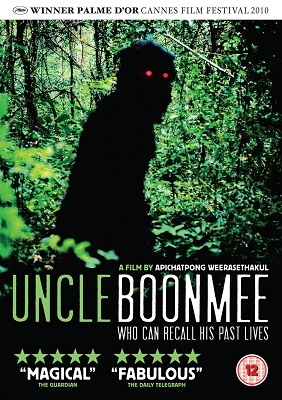
Uncle Boonmee Who Can Recall His Past Lives, Apichatpong Weerasethakul (2010, Thailand). I’d known Weerasethakul’s name originally as the director of The Adventures of Iron Pussy, a film I’ve never seen, but a spoof of 1970s Thai action films and musicals didn’t sound like it would appeal. But then earlier this year I came across mention of the film he made after that, Tropical Malady, and it seemed much more like the sort of movie I enjoy watching. So I stuck it on my rental list (see here). And followed it with Syndromes and a Century (see here). And then it turned out Martin Scorsese’s World Cinema Project No. 2 included Weerasethakul’s first film, Mysterious Objects at Noon… So I’ve now seen four films by Weerasethakul, and they’re very good. They’re slow and elliptical and often beautifully shot. Sort of my thing, really. Okay, so sometimes the parts don’t quite fit together, but I really like the fact Weerasethakul ignores the three-act structure. Uncle Boonmee Who Can Recall His Past Lives consists of six linked stories about the title character. They’re odd, but odd in a way that is presented as completely normal. The dead  sister of Uncle Boonmee’s wife joins them for dinner and they treat her appearance as completely unremarkable. A nephew who disappeared returns as a forest spirit – covered head to toe in fur and with red eyes that glow in the dark – and they treat him as if he were just a lost nephew. It’s beautifully laid-back. True, not much, if anything, happens; but Weerasethakul presents worlds in which strange things take place and they are treated as completely ordinary. And the slow dead-pan delivery not only makes their ordinariness within the world of the film more believable but also makes them even more extraordinary to the viewer. I think I’m becoming a bit of a Weerasethakul fan. And yes, now I want to see The Adventures of Iron Pussy.

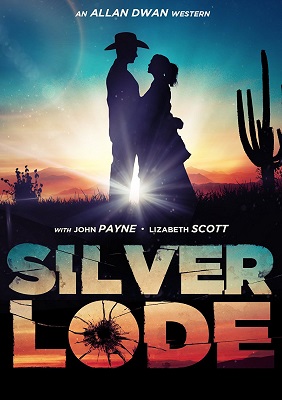
Silver Lode*, Allan Dwan (1954, USA). That’s some cover art. Silver Lode is actually a relatively ordinary 1950s Western, and that cover art looks more like some twenty-first century Western romance, with its artfully-designed typeface and artfully-placed lens flare. A US marshal and three marshal deputies ride into the eponymous town with a warrant for the arrest of John Payne, a pillar of the local community. The marshal tells everyone that Payne killed his brother – shot him in the back during a poker game – and stole the pot of $20,000 dollars. At first, the people of Silver Lode are on Payne’s side and are keen to ensure he is conveyed safely to California, where the warrant was issued, in order for his innocence to be proven. But then one of the marshal’s deputies admits to Payne that it’s all a fake – the marshal is no marshal and the warrant is forged – and it’s all for revenge… but the marshal kills the deputy and pins it on Payne… Public opinion turns and Payne finds himself hiding from the mrshal and his deputies and the townsfolk. It’s an interesting spin on your usual Western story, and it’s handled well – Payne’s actual guilt is left in the air until the very end – but in terms of presentation there’s nothing special about Silver Lode. I’d sooner its position on the 1001 Movies You Must See Before You Die list went to a better non-Hollywood film.

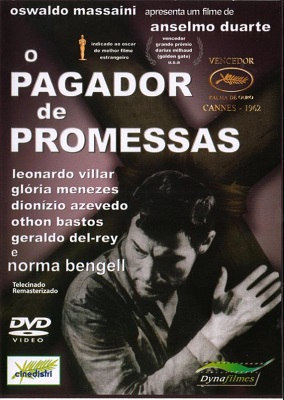
O Pagador de Promessas*, Anselmo Duarte (1962, Brazil). Another highly-regarded film that doesn’t seem to have ever had a DVD release – at least not in the UK – so I ended up having to buy a rip on eBay from a US seller. O Pagador de Promessas, variously translated as Keeper of Promises and The Given Word, is the only Brazilian film to win the Palme d’Or. Like some of the other Brazilian films I’ve seen, it’s on the 1001 Movies You Must See Before You Die list, and I do wonder if I’m seeing the cream of the crop – Vidas Secas, the films of Glauber Rocha… These are excellent films and it’s criminal they’re not better known in the Anglophone world. But O Pagador de Promessas… A poor farmer promises to carry a crucifix from his farm to a church in Salvador (like those other excellent Brazilian films, O Pagador de Promessas is set in Bahia) if his donkey survives its illness. But the church are unhappy with the farmer’s “pagan” promises, and various other groups try to use him to promote their own anti-Catholic causes. From my limited exposure to Brazilian culture, Bahia seems to be fertile ground – Vidas Secas is set there (see here), as are Rocha’s Black God, White Devil and Antonio das Mortes (see here and here), not to mention Mario Vargas Llosa’s excellent novel, The War of the End of the World (see here). It’s not all carnivals and football. Duarte made half a dozen feature films between 1947 and 1967 – I’d like to see them all. And watch the rest of Glauber Rocha’s oeuvre, of course. I should make more of an effort to track these films down.

1001 Movies You Must See Before You Die count: 893


Leave a comment

Moving pictures 2017, #66

I managed to knock a few off the 1001 Movies You Must See Before You Die list and despite them both being US films – one Hollywood, one independent – I thought they earned their place on it.

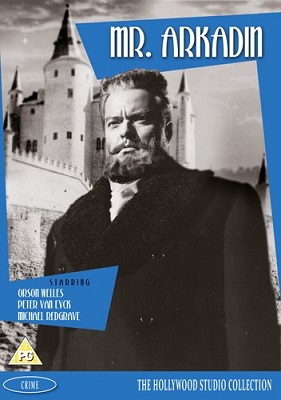
Mr Arkadin, Orson Welles (1955, Spain). After making Macbeth, most of Welles’s remaining films were made in Europe with international financing. It’s perhaps a bit of a cheat to describe Mr Arkadin as a Spanish film, given it was English language, had an American director, and featured a cast including Americans, Italians, Germans, Brits and Spaniards, among others… but it was shot mostly in Spain, and Welles was resident there at the time, so… The story opens with a private plane flying into Spain with no one aboard and presents it newsreel-fashion as a mystery, which the film will then solve… by telling the story leading up to that moment. Robert Arden is an American knocking about in Spain, who inveigles himself into the affections of the daughter of reclusive billionaire Arkadin, played by Welles in a bad wig and beard. When Arden finally meets Arkadin, he’s offered a job – Arkadin cannot remember his life before 1927, and wants Arden to research it for him (the reason given is so that no nasty surprises turn up when Arkadin bids for military contracts). So Arden tracks down past associates of Arkadin, ending up in Mexico, where he discovers the truth about the man. And the truth about why he was asked to research the man’s past. Arden heads back to Spain to tell the daughter, Arkadin charters a plane in an effort to stop him. He fails. Apparently, there are several cuts of the film knocking about, some better than others, and none what Welles really intended. The end result is something that tries to be The Third Man, with bits of Shakespeare thrown in, all shot in Welles’s inimitable style, and then edited so it teeters on the edge of sense. Welles overplays his role, Arden is not a sympathetic hero, and the supporting cast  are more like circus performers than actors. But it’s Welles, so it’s worth seeing.

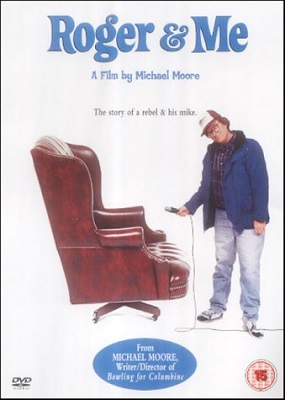
Roger & Me*, Michael Moore (1989, USA). I know of Michael Moore, of course, and the career he has carved out for himself. I’ve seen seen a couple of his films. But I’d never seen the one that started his career, and since it was on the 1001 Movies You Must See Before You Die list… So I bunged it on the rental list. I wasn’t expecting much of it – Moore has tackled much more contentious subjects in later films, and given that this was his first too, I expected it to be crude and simplistic. And while it was certainly the latter, it was never the former. It’s a surprisingly polished piece of work. Unfortunately, recent events have pretty much underminded it. Flint, Michigan, was the town where the automobile production line was invented, and it has relied heavily on car manufacturing ever since. But in the 1980s, the automobile corporations decided to cut costs by closing down plants in the USA and opening them in much cheaper countries. This is known as “making the product cheaper while taking away the spending power of the market which buys it so your business eventually collapses and oh look guess what happened…” Around a third of Flint’s carworkers found themselves out of a job. This is painted as devastating to the community, well, some parts of the community, the country club set are completely oblivious of course… which is why Moore wants to beard GM chairmain Roger Smith and ask him to defend his decision. In the film, the workforce is cut from 80,000 to 50,000 over slightly more than a decade. True, this is bad for any community which relies on a single industry. But as of 2015, GM has 7,000 workers in Flint. And, of course, the city is better known now for its poisoned water supply. A city in the US without fit drinking water for much of its population the three years and counting. And the US still think it’s a world leader. Ha.

Zardoz, John Boorman (1974, Ireland). I think I last saw this back in the 1980s, but it’s one of those sf films you tend to know a lot about if you’re into sf without actually having to have seen it all that often. I mean, you either absorb the plot – or major points of it – through osmosis, or it’s extremely memorable. I’m noty entirely which is the case. Okay, so Sean Connery in a Zapata moustache and red nappie is pretty memorable. And so is the flying head which appears on the Blu-ray cover-art. Connery is Zed, an Exterminator, whose job it is to, well, exterminate Brutals, who are the debased remnants of the population after some catastrophe (although they seem to wear 1970s clothing). Meanwhile, there are the Vortexes, safeguarded by forcefields and in which live the Eternals, the immortal descendants of a group of scientists who chose to safeguard all human knowledge. Zed hides away in the floatibng head and is taken to one of the Vortexes. During the flight, he kills Arthur Frayn, the Eternal who controlled the floating head and looked after the Exterminator/Brutal programme. In the Vortex, Zed is studied, and discovered the be more intelligent than the Eternals. Because they’re sort of Eloi, they’re weak and decadent and many of them have drifted into catatonia. But Zed shakes them up. And they needed it, because they were going nowhere. I know plenty of sf fans count this as a favourite, and it has sort of dippy 1970s charm to it – and I’m a fan of many things from the 1970s – but it’s hard not to reach the conclusion Zardoz is more style than substance. Bits of it are borrowed from all over, not least the book/film it directly references. And asking the viewer to believe Sean Connery is more intelligent than Charlotte Rampling or John Alderton… Well, suspension of disbelief only stretches so far. On the other hand, some of the shots of the Irish countryside are really impressive, and the production design does a lot with very little – although does a look bit like a BBC production at times. I’m glad I watched it again – and can do so whenever I want, as I bought the Blu-ray in the eureka! sale – and it’s certainly true there are shitloads of worst sf films. But there are also a lot of better ones, and it’s never going to make it into my top ten.

Varsity Show, William Keighley (1937, USA). So  I tracked down a copy of the Busby Berkeley Collection Volume 2 on eBay, and it was cheap – and, when it came, it has to be said, a bit battered, but never mind. It’s also not as good as the first collection. But I knew that going in. In Varsity Show, Dick Powell is a washed-up Broadway writer who is co-opted into helping out his alma mater with their annual variety show. He’s doing it because he needs the money, and they want him to running things because the fuddy-duddy in charge is sure to produce a piss-poor show. Powell is on form, and some 0f the female cast shine, but it’s also one of those films where twenty-somethings are referred to as “kids” and the musical numbers aren’t especially memorable. The “kids” rebel, of course, and end up occupying a theatre in New York in order to put on their show. Which is where it turns into your typical Busby Berkeley number. And they really were astonishing. Okay, there’s a leap of imagination required when a dozen dancers on a tuny stage suddenly turns into hundreds of dancers on a massive soundstage… but the way it does that kaleidoscope thing with the dancers is often mind-boggling. Equally mind-boggling is the final scene, in which the theatre’s owners send the police, who sit down to listen to the show, and then the National Guard, who takes seats to watch the show, and, well, you can guess the rest. Varsity Show has a weak story but it manages a good Busby Berkeley extravaganza at the end.

The Phenix City Story*, Phil Karlson (1955, USA). This was a hard film to track down. Despite being on the 1001 Movies You Must See Before You Die list, it doesn’t appear to have ever been released on DVD, and certainly not in this country. But I found a copy on eBay, from one of those sellers who sell DVD rips of out-of-copyright movies, and it proved to be a pretty good transfer. And a pretty good film. There are two cities either side of a river: Columbus, Georgia, and Phenix City, Alabama. There is a street in Phenix Citty lined with casinos and brothels, and the gangs who run them pretty much control the town. That is, until they inadvertently convince a popular lawyer to run for state attorney general on a ticket to clean them out. And when they kill him, his warhero son takes them on instead. Interestingly, the film opens as a documentary, with a journalist interviewing people involved in the clean-up of Phenix City. It’s only about 15 minutes in that it becomes a traditional narrative cinema film. The gangsters aren’t very convincing, and it’s all a bit Wild West in places – although apparently it’s based ona true story. It’s also pretty brutal, far more than you’d expect from a mid-1950s movie. That aside, and despite a somewhat sensationalist tone, The Phenix City Story proved a lot better than expected, and might just about deserve its slot on the 1001 Movies You Must See Before You Die list.

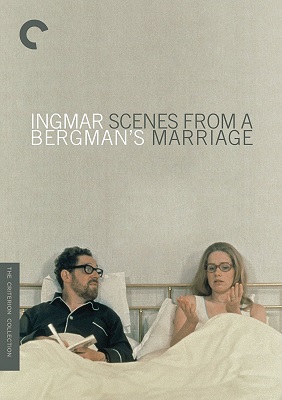
Scenes from a Marriage, Ingmar Bergman (1973, Sweden). I bought the Criterion edition of this a while ago, which includes both the international movie release and the original Swedish television series. And it was the latter I watched. Of course. Liv Ullmann and Erland Josephson are a happily-married couple. He’s an academic, she’s a family lawyer. At least, they’re happy when the series opens. They’re being interviewed by a magazine and they discuss their marriage openly. And later, when friends comes round for dinner, the friends’ unhappy marriage is contrasted with that of Ullmann and Josephson. Except, as the following five episodes show, it’s not all sweetness and light. There are several shocking incidences of violence, which really should not have been acceptable even in 1974. Josephson leaves Ullmann for another woman, but then tries to rekindle his marriage – and he’s really quite horrible about his girlfriend. Eventually, the two separate, and then meet up years both married to other partners… and they have an affair. Josephson’s character is quite a nasty piece of work, and Ullmann seems far too accepting of his actions – although she does use them to advantage when they agree to divorce. Scenes from a Marriage was apparently blamed for the rise in divorce rates in Europe, although it was most likely coincidence. The film/series is highly regarded, and it does seem in places like the epitome of Bergman, but I can’t really say I liked it. It looked bland – perhaps deliberately so – but neither of the main characters were pleasant, or sympathetic, enough to hang a 281-minute TV miniseries on. There were some good bits, true, and it times the marriage did actually feel genuine. But it was a bit like a gory autopsy, and unpleasant to watch more than it was intertaining.

1001 Movies You Must See Before You Die count: 890


Leave a comment

Moving pictures 2017, #65

Some lucky finds in this batch. I don’t know how many TV channels I get via Virgin Media, but there are so many repeats and so much crap on them it’s near impossible to find anything worthwhile to watch. So I don’t usually bother. The same is true of Amazon Prime, although I’ve managed to find an occasional gem. The advantage of Amazon Prime, or indeed any streaming service, is that when you find something worth watching, you can watch it whenever you want, you don’t have tune in at a specific time. Not all free-to-air channels have apps or players, after all.

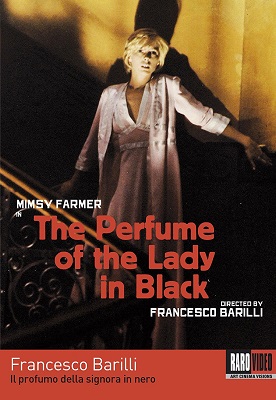
The Perfume of the Lady in Black, Francesco Barilli (1974, Italy). As I’d enjoyed the gialli I’d seen, when I found this one on Amazon Prime, I stuck it on my watch list. It was more of a supernatural thriller than the others I’ve watched, but despite being cheap and cheerful was really quite effective. Mimsy Farmer plays an industrial chemist who has mysterious visions of a young girl, and it turns out they’re sort of flashbacks, or rather manifestations from her repressed memories, especially those surrounding her mother, who committed suicide in mysterious circumstances. Not all films made in the 1960s and 1970s in Italy are giallo, and although many of them take their inspirations from the cheap comics after which they’re named, some managed to rise above their genre. True, most of the ones I’ve seen have managed that, but I suspect I’m seeing the cream of the crop. The Perfume of the Lady in Black was another good one – not the cheap giallo its title promised, but an atmospheric supernatural thriller that even the Italian film industry’s cheap production values could not completely destroy. Worth seeing.

200 Pounds Beauty, Kim Yong-hwa (2006, South Korea). There was that Farrelly brothers film years ago, famous chiefly for Gwyneth Paltrow in a fat suit, in which Jack Black is hypnotised to see the “inner beauty” of people – well, women – and so sees Paltrow as really hot rather the fat-suited character she plays. And while there’s almost nothing to recommend the film, other than its overall message of not judging people by their appearances, it manages better than this recent and highly successful South Korean rom com. Hanna Kang is a ghost singer for pop star Ammy. She is also very overweight. But she fancies the svengali behind Ammy’s career, and mistakes his kindness for interest (human, rather than financial). When she learns the truth, she walks away. And undergoes extensive plastic surgery to reduce her weight. She auditions for her old job, pretending to be a Korean-American called Jenny, but is instead groomed as a pop star in her own right, so eclipsing Ammy and winning the heart of the man of her dreams… Of course, no rom com can end happily on false pretences, so Hanna comes clean but still gets her man and her career. The comedy is quite good, but I’m really not sure about the message of the film. The same actress plays Hanna and “Jenny”, and the make-up is extremely effective. But it all feels very old-fashioned and fat-shaming,

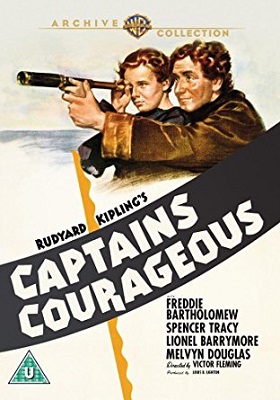
Captains Courageous* Victor Fleming (1937, USA). I watched this because it was on the 1001 Movies You Must See Before You Die list, and I wasn’t truthfully expecting all that much from it. An early Hollywood film, one of those mystifying choices they stuck on list because it’s so, well, Hollywood-centric, but never mind, I’ll watch it. And… it was actually a good film. Not at all what I expected. It’s based on a Rudyard Kipling novel, but there are significant changes from the book which, to me, make the film a great deal better. (Er, not, I hasten to add, that I’ve read the book. I’m going on the Wikipedia plot summary.) Harvey is the spoilt son of a billionaire, and if the film had been about his adventures at school it would have been irritating as shit… But, yes, while he’s painted as an annoying little manipulative prick, his last attempt goes awry and he’s rusticated. So his father – his mother had died years before – decides to take him to Europe on a business trip in an attempt to bond. But the lad falls off the cruise liner just off the US coast… and is picked up by a fisherman out of Massachusetts. But the fishing schooner will not return to port for another three months so Harvey is forced to work for his passage. And it makes a decent person of him. It’s typical Kipling, and the Hollywood treatment is manipulative as hell, but it’s actually quite affecting. Having Spencer Tracy play a Portugese fisherman with poor English is appalling casting. and if they’d wanted him that desperately in the role they could have rewritten it, or done the right thing and cast a Latino actor… But this was 1937, and Hollywood was busy making sure only white people got to do anything. As they are still doing today. I’ll be honest: I was expecting another forgettable Hollywood film from the 1930s for this entry in the 1001 Movies you Must See Before You Die list, but I actually thought Captains Courageous done quite well. Worth seeing.

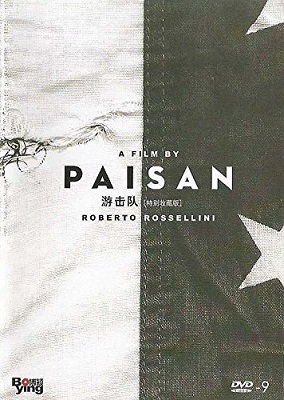
Paisan*, Roberto Rossellini (1946, Italy). I’m not a big fan of Italian Neorealism, although I’ve seen plenty of films that qualify as it. I have, to date, watched three of Rossellini’s films, although plenty more by his contemporaries, such as Fellini, De Sica, Pasolini… Paisan, or Paisà, comprises six unrelated stories set during the Allied liberation of Italy. It’s done on the cheap – with a mostly non-professional cast – but it actually works quite well for the stories the movie tells. As the Germans move out, the Americans move in.  But only some of the Italians welcome them. The rest expect the Germans to return and defeat the Americans, and uphold the rule of fascism. Even though this film was made 70 years ago, immediately after a long war against fascists, there were still those who’d sooner follow Mussolini or Hitler. and yes, they were just as stupid back then as they are now. Because there’s nothing remotely intelligent in the right-wing world-view – but, as someone astutely pointed out on Twitter recently, common sense and/or logic is no antidote to thirty years of brainwashing that liberalism/socialism will destroy civilisation. Paisan is set, in effect, at the end of civilisation – ie, a country torn by a long global war… and for those who lived there it’s easy to imagine how liberators could be seen as invaders. Which is somewhat ironic, given that in the twenty-first centry invaders tend to be presented as liberators anyway… I’m not a big fan of Italian Neorealist films, nor of many of those made in Italy in the immediate aftermath of WWII (and let’s not forget, they were Axis), but Paisan was actally pretty damn good. It deserves its place on the 1001 Movies You Must See Before You Die list.

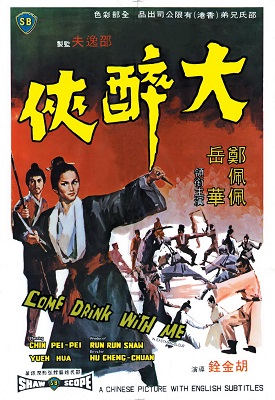
Come Drink With Me*, King Hu (1966, China). I’d had trouble finding a copy of this to watch as it seems it has never been released in the UK… and then it pops up on Amazon Prime. So there you go. It’s a Hong Kong historical martial arts/wu xia film, by the director of A Touch of Zen, and notable chiefly because its lead is female. And, er, that’s it. It’s a fun film, in much the same way wu xia films from the 1960s are fun films. The lead character, Golden Swallow, played by Cheng Pei-pei, is referred to as “sir” throughout, but I don’t know if that’s because others are meant to take her as male – and they profess to know the name Golden Swallow, and her reputation – or because treating her as male is a sign of respect. Which is odd. Other than that, Come Drink With Me‘s plot is pretty straightforward and little different to that of other films of its type and time, or indeed of other King Hu films. I enjoyed it, but then I do like a good wu xia… but I’m not convinced it belongs on the 1001 Movies you Must See Before you Die list. If its one claim to fame is having a female lead, then the film should be celebrated, but it seems a bit hypocritical to put it on the list for that for Hong Kong cinema and not do the same of Hollywood cinema. Call it a film that fans of martial arts or wu xia films should watch, and leave it at that.

Utopia, James Benning (1998, USA). I’m pretty sure my favourite form of art is the video installation – and I’ve explored these in a number of  cities’ museums – but such installations generally comprise looped films of no more than 30 minutes in length. Benning’s films are often long – this one is nearly 90 minutes. And yet, they’re not non-narrative cinema either, as that would be Koyaanisqatsi or Baraka. Benning’s films are art. But they’re a moving picture, and, unlike video installations, the installation itself is the same as that of narrative cinema. (Mostly, although some of Benning’s works are actual installations.) The really interesting thing about Benning’s films, or at least many of them, is that they resemble non-narrative films but present a narrative in non-traditional ways. In Casting a Glance, it’s a recreation of the water levels throughout the lifetime of Spiral Jetty; in El Valley Centro, it’s the position of the horizon in each 2.5 minute shot; in Deseret, it’s excerpts from the New York Times, read out over short static footage of the state of Utah; and so on… I like the fact some of these “narratives” are extra-textual; I like that they are not obvious; and I certainly like that they require work by the viewer to make sense. In Utopia, a female voice describes the life of Che Guevera, while the camera shows static shots – I’m not sure of the exact length, or if it is indeed exact, but it seems to be about two minutes each – of desert countryside from the southern US, including some industrial landscapes. It is a story told through voices, in which the pictures extend that story, a reverse if you will of the common approach to cinematic narrative. As a creator of video installations, Benning would reign supreme, but his films are too long. He is a unique talent, and his films are amazing works of art. But his works are difficult to see, with only half a dozen or so released on DVD and assorted other ones appearing every now and again on Youtube. And yet… when I consider a painting, a reproduction of it gives me access to that painting, but I would often still like to see its original, in a museum or gallery. Video installations are very much a product of their, well, installation, and so must be seen in situ to appreciate best. But Benning’s films? Is watching one at a film festival any different to watching it at home on DVD or Youtube app? Given that the presentation of video installations is an element of the art, but for Benning’s films that’s not true, I suspect not. Where you watch Benning is unimportant. Given that, I’d urge him to make all of his works freely available. These are important works, they need to be as visible as prints of famous artworks.

1001 Movies You Must See Before you Die count: 888


1 Comment

Moving pictures 2017, #64

Six films from three countries – two of each. Odd, how it works out sometimes.

Two Women, Vittorio De Sica (1960, Italy). I found this on Amazon Prime which, in among the populist crap and, well, the just plain crap, throws up the odd gem. This is no gem per se, but it’s De Sica so it’s quality Italian cinema. It’s also typical De Sica fare. Loren plays a mother who attempts to save her daughter from the invading Germans by travelling out into the country. But none of her relatives are keen to harbour the two of them. Jean-Paul Belmondo plays, bizarrely, an Italian-dubbed male lead, although Italian cinema alway preferred to film without sound and add it later through looping, which certainly helped with foreign markets but also explains why so many non-Italian-speaking stars appeared in Italian films, such as Burt Lancaster in The Leopard. I will freely admit I had initially thought Sophia Loren one of those European actresses adopted by Hollywood chiefly because of their looks, but she was a talented actress and a great deal better than many of her contemporaries, Italian or otherwise. Belmondo, on the other hand, is… Belmondo. Even in an Italian film, he smoulders. His character is a teacher with communist sympathies, which leads to several political arguments. There’s a brutal scene in which both Loren and her daughter are raped by German troops, and it’s quite harrowingly shot. Given how lightly commercial media treat rape, it always dismays when it appears. True, in Two Women it’s a vital part not only of the plot but of the protagonists’ character arcs, which is more than can be said of the vast bulk of commercial media, but that doesn’t mean I have to like its presence. Two Women is a good film… but it’s not a pleasant film, and I’d sooner people knew that before they started watching it.

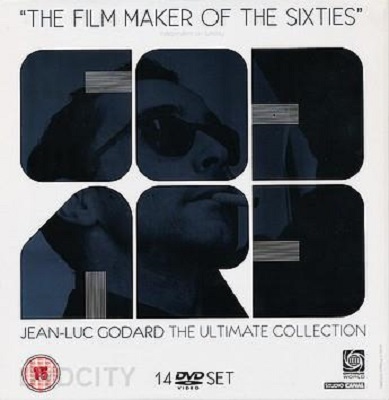
Le petit soldat, Jean-Luc Godard (1963, France). When I bought the 10- DVD Godard box set, I also bought this 13-DVD one. Unlike the other, it was a UK release, not a France release; but, like the other, it did include many films I’d seen before. In fact, Le petit soldat was the first of its 13 films I’d not seen before. There are identifiable phases to Godard’s films – to an outsider, at least – although I suspect I’m missing some subtle distinctions. But, to my eye, his early films were very much influenced by US noir movies, so much so he actively spoofed the genre several times, such as in Made in U.S.A. (see here), but in earlier films the homage was much more straightforward… As it is in this one, which is pretty much a French take on a US noir film but filmed in Switzerland. Bruno Forestier plays a French agent in Geneva, who is asked to murder someone. But he meets Anna Karenina, and, well, so much for principles. The more Godard I watch, the more I appreciate Godard as a film-maker. In his early days, he was one of the Nouvelle Vague, and perhaps a little more in love with US cinema, especially noir, than his peers. Except… how then to explain Le mépris, made only three years after this. Huh. I don’t think Godard was ever as technically proficient as Truffaut, but I think he had a better handle on the medium’s possibilities – and a fondness for narrative experimentation, which definitely appeals to me. Le petit soldat is pretty straightforward – the twists and turns of the plot are there in the noir playbook, so I’m not really convinced any changes Godard rings are all that innovative. It’s a more disciplined film than, say À bout de souffle, and it works best as a Nouvelle Vague than a noir/thriller film. Worth seeing.

La note bleue, Andrzej Żuławski (1991, France). I’m a big fan of Żuławski’s films, although probably On the Silver Globe more than others; but his idiosyncratic approach to film-making, even if the results are, well, odd, appeals to the curmudgeon in me. And it’s for that reason I’ve been picking up the Mondo Vision releases of Żuławski’s films – six  to date, the first they released was Possession, which took me a while to track down… And it was finding a copy of that which reminded a Mondo release of La note bleue was due in 2017… So I checked, it’d been released, and I ordered myself a copy. La note bleue covers the last days of Chopin, during which many of his friends visit. He apparently had a somewhat odd family situation. And many famous friends – oh, and his wife was famous too, George Sands. Among those who appear in this film are Dumas, Turgenev and Delacroix. They visit Chopin’s villa in the countryside, only to discover all the staff have left and they have to help with the cooking. Chopin’s two children – played by Sophie Marceau, Żuławski’s partner after appearing L’amour braque (see here), and Benoît Le Pecq – worship and cosset their father. And… things happen. The performances, as in most Żuławski films, are OTT, some a great deal more than others. There are also, well, personifications, I guess, of aspects of the human personality, such as “demogorgon”, “spirit of fire”, and 8-feet-tall masked figures in gauzy cloaks, which appear in scenes but are ignored by the cast (some even have dialogue). Despite the seriousness of its topic, La note bleue is as mad as Żuławski’s other films. It’s also an especially good-looking film, more so than others of his, I think, and Mondo have done an excellent job on the restoration and transfer. Żuławski is an acquired taste, but La note bleue is worth seeing nonetheless.

Samsara, Ron Fricke (2011, USA). Fricke was director of photography on Koyaanisqatsi (see here), which I loved, and he obviously decided to have a go of his own. Which resulted in two films – Baraka and Samsara… but I could initially only find Samsara for rental, which was a bit weird, but I think it was sort of between releases, and Baraka is now available and on my rental list. None of which is entirely relevant, because this is a gorgeous film and I want them both. I want Blu-ray editions of them both. They’re just like Koyaanisqatsi, non-narrative cinema shot around the world, with the focus on the cinematography, which is, well, gorgeous. Samsara is, like Koyaanisqatsi and its sequels, is pretty much just footage of different places, which I hesitate to call “exotic”, because I believe the word has been so abused it should be considered in the same light as “oriental”, but Samsara does include beautifully-shot footage of assorted parts of the world not otherwise seen in cinema. I loved it, I want my own copy. I will buy one too, see if I don’t.

Wonder Woman, Patty Jenkins (2017, USA). This is the one film in this post that most people will want to read about. Which is a bit sad. Because it’s probably the worst of the six films in this post. Okay, so the giallo below, Death Walks at Midnight, is no masterpiece, but it’s arguably better at being what it is than Wonder Woman is. I’d heard a lot of comments about Wonder Woman, so I was keen to see it. I was, and still am, very much for a female-led tentpole movie, superhero or otherwise. Initial commentary on Wonder Woman praised its feminist content. And so I stuck it on my rental list, and went it arrived I stuck it in my player and… it had me for the first thirty minutes or so. A functioning all-female society – hand-wavey as fuck, but who cares, it’s presented entirely without comment and it looks like it works – but then a man appears and mega-warrior Diana suddenly turns into a battlefield liability. He pretty much saves her, which is not the message up to that point. Later, the writers have fun with that particular aspect of her character – but, to be honest, it’s the 21st century, and even for stories set in the 1910s, having a woman save a man from peril should not be a plot point, espcially not one that’s player over and over and over again. I mean, for fuck’s sake, grow up. And that’s the biggest problem with Wonder Woman: once she leaves Paradise Island, she’s treated like some sort of clothes horse, even by those who know of her powers; and then, when she does use them she becomes some sort of sexless super-being. Not to mention that by the end of the film her powers are stupidly OTT. I loved the first half-hour of this film, I wanted to give it a fair shake, so I watched it twice. But it really does fall apart once Diana arrives in London. It doesn’t help that the villains are weak, but that’s a common failing with superhero movies. They were at least well-placed in the period, which is something superhero movies don’t always do well. There has been some fuss online recently on the change in Amazon armour between Wonder Woman and the new Justice League movie. How difficult is it to design costumes for women that look plausible? I mean, if I were leading an army I wouldn’t be concerned with whether they looked like sexy women but whether they looked like fucking kick-ass fucking warriors and capable of winning the battle. This is not rocket science. Wonder Woman is not a great film, it’s not even a good film, but for superhero films it’s a welcome step forward. Hollywood should a) put out a shitload more female-fronted tentpole films, and b) give those films to female directors. Then we might start getting actual good superhero films.

Death Walks at Midnight, Luciano Ercoli (1972, Italy). There was a sale on the Arrow website recently, and among the DVDs and Blu-rays I bought was this, the sequel to Death Walks in High Heels (see here), which I’d bought earlier this year and enjoyed. And this is more of the same – also starring Susan Scott, AKA Spanish actress Nieves Navarro Garcia, the wife of Ercoli, although she appeared in many Italian films of the 1970s and 1980s. In Death Walks at Midnight, she plays a model who experiments with LSD and hallucinates the murder of a young woman by a man using an armoured fist with nails. Except there really was such a murder. But six months earlier. And when her experience appears in a low-rent magazine, those involved in the crime are keen to silence her. This is giallo, so it’s cheap and cheerful, and sense is one of the first things to end up on the cutting-room floor. But it does actually hang togehter, albeit only just, as Scott’s character maintains a solid forward trajectory, even if not everything in the film actually adds up. It struck me while watching Death Walks at Midnight, and based on a number of other giallo films I’ve seen, both horror and thriller, that many of their plots rely on gaslighting their female leads. Throughout this film, Scott is misled as to what she has seen and knows, by someone very close to her. It makes for a suspenseful story, and Scott eventually overcomes, despite all the men with which she interacts offering either scepticism or threats. I don’t know that this was a defining characteristic of giallo, and it seems odd that such a feminist take on the thriller/horror genre would come from Italy. If anything, I suspect it’s an accidental consequence of a genre which sought to put women front and centre in order to titillate a male audience. Films like this, Footprints on the Moon, much of the oeuvres of Mario Bava and Dario Argento, and numerous titles from both Shameless and Arrow Video… But then there’s all those Italian Neorealist films which featured strong female leads, not all played by Sophia Loren (see above), it has to be said, by the likes of Robert Rossellini, Vittori De Sica and Federico Fellini… And then I remember there are many many more Italian films like Spaghetti a mezzanotte, and I realise it’s foolish to generalise…

1001 Movies You Must See Before You Die count: 886


3 Comments

Moving pictures 2017, #63

I think this post pretty much brings me up to date with these film posts, although I’ve still got about eighty DVDs/Blu-rays on the pile to watch (some of them are rewatches, however, of films I’ve seen before). My last Moving pictures was a bit US heavy, and this one is a bit UK heavy. It also includes a film from the 1001 Movies You Must See Before You Die list, the first from the list I’ve seen for a while.

The Reckoning, Paul McGuigan (2003, UK). Another one lent to me by my mother, and about which I knew nothing. It’s set in late fourteenth century England. Paul Bettany, a priest, flees his parish after being caught bonking the wife of a parishioner. He meets up on the road with a troupe of mummers, and persuades them to let him join them. A broken bridge forces them to take a detour en route to their next gig and they end up in one of those sorts of places where everyone goes quiet when the mummers walk into the room and the big castle on the hill is still in the process of being built. Oh, and there’s a court in the village square sentencing a deaf-mute woman for the murder of her own son. The mummers’ play isn’t a big hit, so Bettany persuades them to create something new – a play not based on the Bible. In fact, it will be a play based on the murder of the woman’s son. So they look into it a bit, so they can get the details right… and discover it doesn’t add up. It’s a put-up job. The woman is clearly innocent. And all the clues point to someone else altogether… As murder-mysteries go, it’s well laid out and the clues all point in a very obvious direction. The twist isn’t so much whodunnit, as it is howthefuckdowemakesurejusticeisdone, which is a surprisingly relevant subgenre in the second decade of the twenty-first century. Willem Dafoe, the leader of the mummers, was perhaps too intense, and not helped by a wandering accent that managed not to convince as any form of regional English accent. Bettany, on the other hand, seemed a bit too modern. But the mise-en-scène was generally good. And it all hung together entertainingly. You could do much worse.

Kelj fel, komám, ne aludjál, Miklós Jancsó (2002, Hungary). I’m really glad I bought these films, even though I have zero clue what’s going on in them. But at least I can watch them again… and again… and again… until I do. Unfortunately, I’m not there yet. Like the previous three films in the series, Kelj fel, komám, ne aludjál stars Zoltán Mucsi and Péter Scherer as Kapa and Pepe respectively, both of whom are some sort of combination of protagonist, exposition, commentary and comic foils, in a film that is about Hungary without being about Hungary. If that makes sense. The title translates as “Shut up, mate, don’t go to sleep”, but I’m not entirely sure how that relates to the plot – or rather, the narrative, as there isn’t much of a plot. The film opens with a man being told how he will be moulded into a pop star – it’s deeply cynical, all the more so for seemingly being filmed in a derelict house. The man appears several times throughout the film – as an actual rock star, singing deeply cynical songs about life in Hungary. In fact, music features more heavily in Kelj fel, komám, ne aludjál than I remember it doing in the earlier films, even though all four have included live musical performances. Kapa and Pepe first appear being led to a firing squad, but it’s all a joke. Except they’re playing Jews. And there are Nazis invading Poland, some of whom are keen to evade the liberating Soviets – and Kapa and Pepe are sort of go-betweens and freely offer useful advice. Nonetheless, they’re not impressed by the film, as they explain to Jancsó, who appears as himself, and writer Gyula Hernádi, who also appears as himself. Like the other Kapa and Pepe films I’ve seen, it’s all every cheap, but there are plenty of crane shots. The music is modern, with rock, rap and punk. One actor plays a US WWII officer, although he might have been British – he starts off by reading an excerpt from James Joyce, but later drives a Jeep and puts on a US accent, although it’s about as good as Dafoe’s regional English accent in The Reckoning… When I’ve watched all six of these films, I will watch them again. And I suspect I will still never really understand them. Rather than find that frustrating, it strikes me as a challenge.

Glastonbury Fayre, Nicolas Roeg & Peter Neal (1972, UK). I don’t know if I stuck this one my rental list because it was directed by Roeg, or simply because I was looking for documentaries for my documentary rental list and I quite enjoy documentaries abut music from 1965 – 1975. Glastonbury Fayre was shot at the 1971 Glastonbury Fair, the second festival held there but the first to be called a Glastonbury festival… and it couldn’t have been more different to the Glastonbury Festival of today. Lots of hippies. Most of them spaced out, on their own naivete if not on drugs. And performances by bands such as Fairport Convention, Family, Gong, Traffic, Tonto’s Expanding Head Band… As footage of a concert, Glastonbury Fayre is not great – you don’t get to see full performances, and what’s shown is only a selection of what appeared on stage. Roeg, and co-director Neal, seem more interested in the festival-goers, and there’s plenty of footage of them doing their, um, thing over the weekend. I do like music like this, and documentaries about this sort of music, although I don’t generally buy them. (But I will admit owning a few albums by early 1970s bands.) Worth seeing.

Muriel, Alain Resnais (1963, France). Resnais I know chiefly for Last Year in Marienbad, which straddles that fine line between pretentious self-indulgent crap and profound film-making, and I’m still not entirely sure on which side it falls; and Hiroshima mon amour, which, despite me being too squeamish to enjoy much of the film, I found surprisingly affecting. So Muriel came as something of a surprise: a subtle drama, filmed in colour, that plays as much with the forms of its narrative and it does with the narrative itself. The title refers to a woman the stepson of the protagonist was complicit in torturing and killing while serving in Algeria. The protagonist is Hélène, a widow who sells antiquies from her flat, and who takes up with an old lover, Alphonse. It’s all very domestic – except for the flashbacks of the stepson’s service in Algeria, which are presented as degraded film – and very subtle. The film takes its time to introduce the main characters and their relationships, only to present parts of the subsequent chronology out of sequence and with few clues to link them. It looks very drab and realistic, Resnais is not above staging scenes which embarrass his characters or call their, er, character into question. Resnais maide nineteen feature films in total. Muriel was his third – after Hiroshima mon amour and Last Year in Marienbad – and I’m now quite keen to explore his oeuvre. Having looked at the titles – both in French and English – of the films he made subsequent to Muriel, I’ve not heard of a single one. I am not, I freely admit, majorly au fait with French cinema, but I knew of several of Godard’s films before I watched them, and the same for Truffaut, Renoir, Demy, Rohmer, Chabrol, Varda…

A Brighter Summer Day*, Edward Yang (1991, Taiwan). I bought this Criterion Blu-Ray (some, it seems, they’ve started releasing in Region B) because it’s on the 1001 Movies you Must See Before You Die list, I thought the two Yang films I’d seen previously were excellent, and it doesn’t appear to eb available for rental. Which is just as well. As the film is 237 minutes long! That’s nearly four hours. WTF. A Brighter Summer Day is, like the other two Yang films I’ve seen – Yi Yi (see here) and Taipei Story (see here) – concerned chiefly with Taiwanese people trying to make sense of living in Taiwan. In this case, the film is set much closer to the split with China and the exodus to Taiwan by Kuomintang members and sympathisers in 1949. The story is based around the senseless murder of a schoolgirl by her putative boyfriend, but much of the film’s four hours are involved in setting up the background, characters and relationshipsd which eventually lead to the – in the film’s original Mandarin title – titular murder. It opens with two boys spying on a film being made from the catwalks high up in the roof of a studio… which proves to be next-door to their school. And it transpires that Si’r, one of the boys, is something of a loser, neither good at school nor a member of one of the gangs which control the area. And it is a war between the two gangs, brought briefly to a halt by the planning of a pop concert, which eventually leads to Si’r murdering Ming, who was not really his girlfriend. This is a long, involved movie. It’s beautifully filmed – and the Criterion Blu-ray transfer is amazingly good – and it lokos gorgeous throughout. But it’s not the most compelling of narratives, and its mix of domestic drama and teenage delinquency, with occasional elements of political subversion, are not particularly dramatic when played out over four hours. It’s a bloody good film, there’s no doubt about that, but it’s also a slow burning one, and something of an endurance test. I seriously need to see more of Yang’s films, although Yi Yi was apparently his last. Definitely worth seeing.

Lady Macbeth, William Oldroyd (2016, UK). I found this on Amazon Prime, which does occasionally throw up interesting films to watch for free. The film is based on a novella by Nikolai Leskov from 1865, in which the wife of  a rich Russian merchant, has an affair with one of his slaves, and then murders her father-in-law and then her husband. And that’s pretty much the plot of Lady Macbeth, except the story is relocated to the north-east of England, and it all smells like Brontë rather than Shakespeare. In fact, it feels much like a film by Andrea Arnold, although less, dare I say it, sympathetic to its female characters, especially the title character. The acting is uniformly good, the look and feel is very much Brontë, the plot is very much Shakespeare, and the cinematography and mise-en-scène has that static camera positioning, few jump cuts, and staginess that seems to be the vogue in art house cinema these days. I ike the style, I admit, although at least Peter Greenaway has the courage of his convictions and stages pretty much everything as if it were set on a, er, stage. However, as far as British cinema goes, I’d sooner this country were churning movies more like Lady Macbeth than Victoria & Abdul

1001 Movies You Must See Before You Die count: 886


1 Comment

Christmas come early

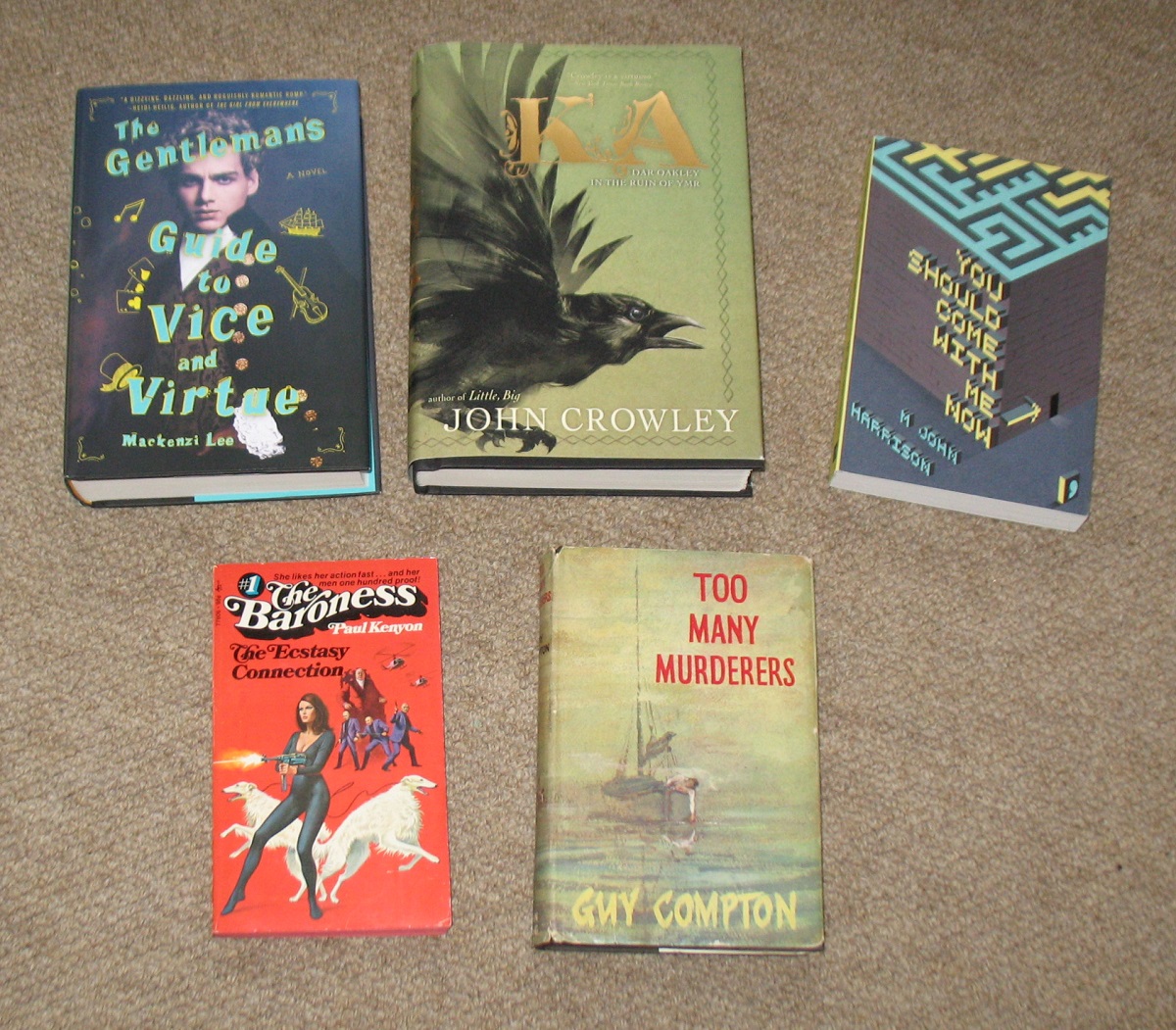
Well, not really – I mean, it is early for Christmas, not that it’s stopped the shops selling mince pies and Christmas puddings and all the other stuff you’re supposed to eat to celebrate Santa Claus’s birth in a manger, or whatever it is. I don’t listen to the radio, but I expect they’re already playing carols. That was one of the things I liked about living in the UAE, an Islamic country: there was no mention of Christmas until the day before, and it was all over by Boxing Day. Anyway, here are some recent finds which have joined the collection. I recently worked out I could probably get another four bookcases into the flat, but since a book collection expands to double-fill the bookshelves available, I’m not sure they would be a wise purchase… Although it’s not like the collection is shrinking…

Some charity shop finds to start with – these generally go back to a charity shop when I’ve read them, so they only clutter up the flat temporarily: I’ve read Oryx & Crake and The Year of the Flood (the latter only recently), and now I can finish off the trilogy as I’ve got MaddAddam. I’m still not convinced by Atwood’s sf, however. I also recently read Chabon’s The Amazing Adventures of Kavalier & Clay (see here), so Gentlemen of the Road and Wonder Boys were timely finds. The Tales of Hoffmann just looked interesting. I always pick up Lessing’s novels when I see them – Martha Quest was one I’d not read. And I’m pretty sure I read Lord of the Flies at school, but that was many years ago and a read of Golding’s Rites of Passage earlier this year (see here) highly impressed me, so I thought it worth a try as an adult.

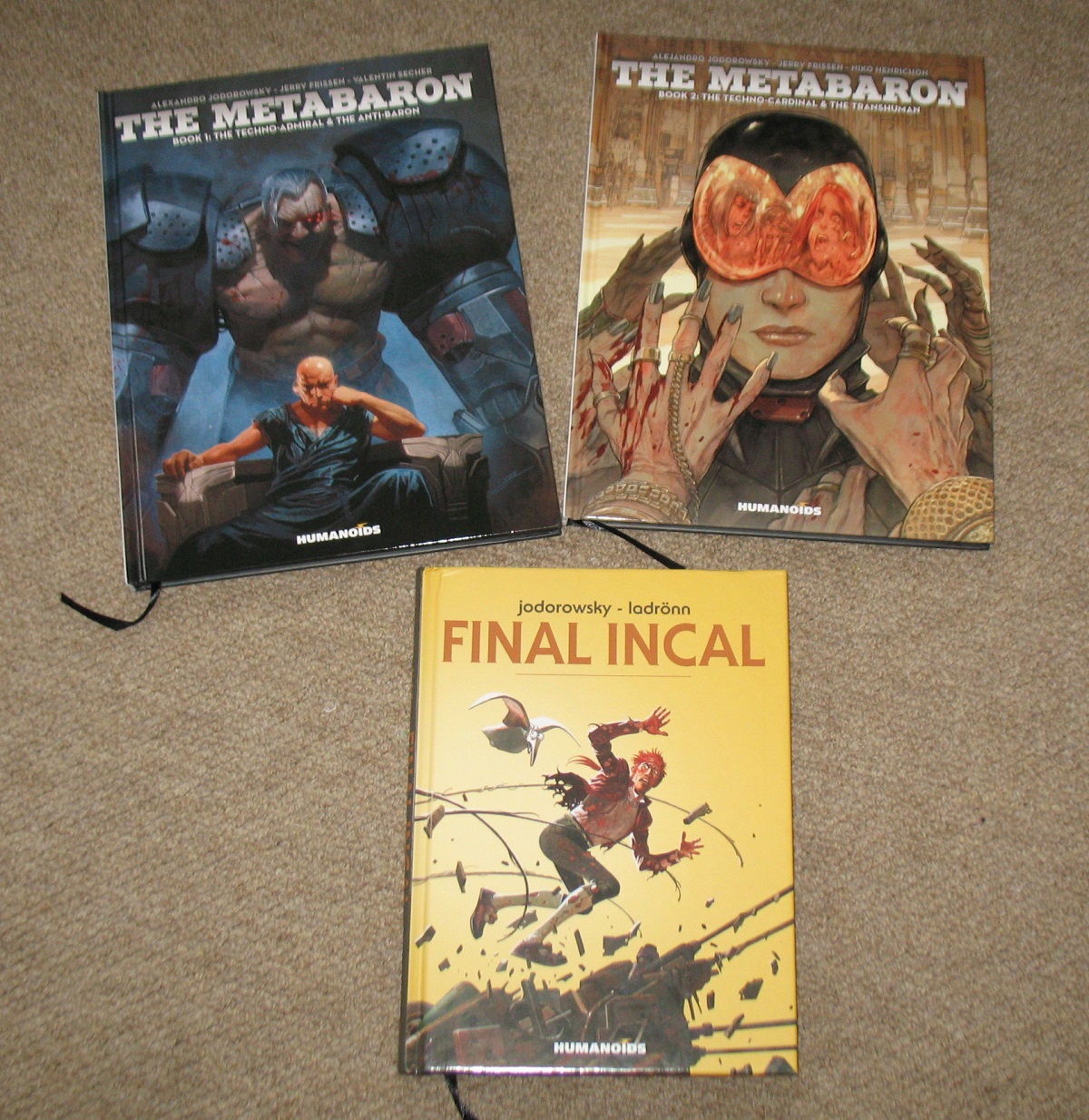
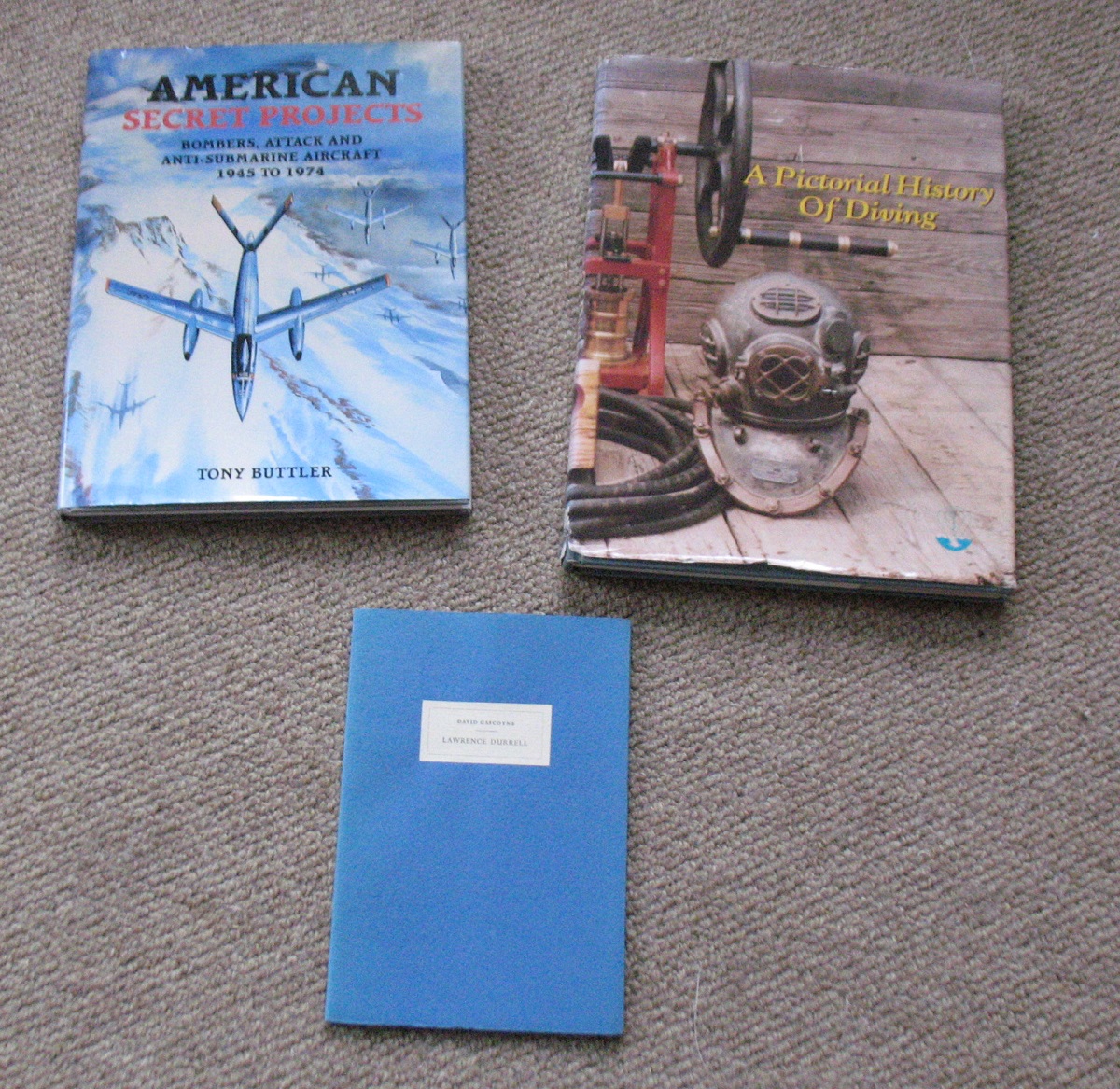
Some non-fiction. I’m a big fan of The Incal, so I’m looking forward to reading Deconstructing the Incal. Stuck on the Drawing Board is about civil aircraft that never made it into production. And who can resist a book titled Holidays in Soviet Sanatoriums?

I’ve been collecting the Phoenix Editions of Lawrence’s books for a couple of years now, and The Plumed Serpent now means I have sixteen of, I think, twenty-six volumes. I saw Bodies of Summer mentioned on someone’s blog and it sounded interesting, so I bunged it onto an order from a large online retailer. After watching The Loneliness of the Long Distance Runner (see here), it occurred to me I’d never read anything by Alan Sillitoe, so I had a look on eBay for one to try, and found a cheap hardback of Travels in Nihilon, which sounds quite similar to Jan Morris’s Hav, so, you, know, science fiction, right?

Speaking of science fiction… I didn’t pick up a copy of Gardens of the Sun when it was published, and later discovered first editions were extremely hard to find. I’ve been looking for several years, and found this one from a US-based seller on eBay. I’ve also been picking up copies of the Newcastle Forgotten Fantasy collection when I can find good condition copies. Golden Wings is the eighth book of the series.

The Faber Book of Modern Verse was 29p from a charity shop. It’s a 1960 edition, so nearly sixty years old “modern” – and the introduction states that all the poems in the book date after 1910. But that’s fine, because I actually prefer poetry from the first half of the twentieth century. Such as If Pity Departs, published in 1947. This has been on my wish list for a long time and, to be honest, I’ve forgotten why I put it on it. I suspect I came across Atthill’s name while reading about the Cairo poets – the group of British poets who were based in Egypt during WWII and include, among others, Lawrence Durrell, Keith Douglas, Terence Tiller, GS Fraser, Bernard Spencer and Olivia Manning (her The Levant Trilogy is a fictionalisation of her time there). I have several books on the subject, including a copy of the Personal Landscape anthology, and three of the Oasis anthologies published by the Salamander group. On the other hand, I could have comes across Atthil in one of the 1940s poetry anthologies I own. One of these days, I’ll have to do a post about my poetry book collection…


2 Comments

Moving pictures 2017, #62

Let it not be said I don’t watch a variety of films, as this post should demonstrate. Okay, half are from the US, but from the 1930s and 1990s and the current decade… and the last is a spoof a 1970s exploitation film…

Animal Crackers, Victor Heerman (1930, USA). There were two films on one Blu-ray disc I was sent from this collection, and I wasn’t especially impressed by the first, The Cocoanuts (see here). But I had at least heard of Animal Crackers; if someone had asked me to name a Marx Brothers films, it’s one of four titles I could have given. And, after all that, I liked it even less than The Cocoanuts. It’s based on a musical play of the same title, which also starred the Marx Brothers. Groucho plays a renowned explorer who has been invited as guest of honour to a weekend party at the house of a wealthy socialite. An art collector, also invited, plans to unveil a painting he has recently acquired by a famous French rococo painter as a treat for the guests. Cue Groucho insulting host and guests, a running joke in which two groups of people try to steal the painting and replace it with a copy, leading to total confusion over which is the original, and a mildy amusing gag in which Chico asks Harpo for a “flash” (he means a torch, but the gag wouldn’t have worked if he’d said flashlight) and Harpo pulls out a succession of incorrect items – a fish, a flush, a flute… Given their stature, I’ve been surprised at how unimpressed I’ve been by the Marx Brothers films I’ve seen so far. I’ll keep them on my rental list, and hope they improve.

Raising Cain, Brian De Palma (1992, USA). I don’t get De Palma. I get that he makes thriller films, and quite effective ones… but they’re so, well, rubbish. I mean, they’re not in the least bit plausible or convincing, although they’re presented with an absolutely straight face, impressively straight faces by the cast in fact. In Raising Cain, John Lithgow plays twins, one of whom is a child psychologist who needs volunteers for his pioneer child psychologist father’s experiments in Norway… and so ends up kidnapping a kid from a playground, with the help of his twin, who is, well, evil. Except they’re not twins. There’s only one of them, and he has multiple personalities. Lithgow also plays the father, who turns up halfway through the movie. And he’s like some sort of Mengel figure, but in child psychology. And it turns out he deliberately gave his son multiple personality disorder because reasons. It was all very silly, even if it started out quite well – which is something De Palma’s films do, I seem to recall. I don’t remember why I put this one on my rental list, but at least I won’t have to watch it again. Meh.

Crisis, Ingmar Bergman (1946, Sweden). According to my records, I’ve now seen 34 films by Bergman, which makes him my second most-watched director after Hitchcock. (The figures look like this for the top ten: 1. Hitchcock (44), 2. Bergman (34), 3. Herzog (33), 4. Sokurov (28), 5. Jennings (27), 6. Godard (25), 7. Lang (23), 8. Preminger (22), 9. Ozon (21) and 10. Hawks (19).) Crisis is actually the first film Bergman directed. He also wrote the screenplay. And it’s very, well, Bergman-esque. A young woman in a small village finds herself torn between her foster mother, a piano teacher, and her real mother, the glamorous owner of a beauty salon in the city… Not to mention exploring her own power over the young men of the village. The bulk of the film seems to be about generational conflicts, with the young people of the village, egged on by Jack, a dodgy friend of the young woman’s real mother. At a recital, where all the elders of the village are gathered, Jack kicks off an impromptu jazz party in the next room, and incenses all the village worthies. Bergman spreads his conflict widely – across generations, city versus village, men versus women… For all that it was his first film, Crisis feels like a solid piece of Bergman work. But then Bergman wasn’t new to drama, having been involved with film-making since 1941. Even so, that demonstrates a notable talent, which he more than demonstrated over the next fifty years. Ingmar Bergman is not just a giant in Swedish film, but globally. It’s a shame he’s considered a bit fringe by most Anglophone cinema-goers.

Taipei Story, Edward Yang (1985, Taiwan). This is the last of the films on the Martin Scorsese’s World Cinema Project No. 2, which includes DVD and Blu-ray (sadly, region A) copies of six movies, from the Philippines, Thailand, Kazakhstan, Brazil, Turkey and Taiwan. Having now seen several – well, three – of Yang’s films, and having thought all three of them excellent, I think I have a handle on his film-making. His films are about people trying to make sense of their lives in Taiwan. In Yi Yi (see here), it’s initiated by the preparations for a marriage. In Taipei Story, it’s a young woman and her relationship with her boyfriend, an ex-baseball player, whose finances are precarious. Hou Hsiao-hsien, whose films I love, plays the male lead, the female lead is a Taiwanese pop star who ended up marrying Yang. There is something about Yang’s films that appeals greatly – and not just to me, judging by the plaudits he has received. They seem almost documentary-like in their starkness, a likeness only heightened by their use of real locations, rather than sets, and handicams. In fact, on reflection, one of the appeals of Chinese and Taiwanese cinemas, especially sixth generation Chinese cinema, is its lack of soundstage footage and the fact much of it is location shooting. Hitchcock was a master of soundstage shooting, and I do love it in my 1950s melodramas, but Taiwanese and Chinese cinemas’ seeming insistence on less artificial staging is very much in its favour. I don’t know enough about the cinema tradition in the two countries to know if this was an artistic choice, or a result of the constraints on film-making in the country, government or otherwise – but The Goddess, made in 1934, was plainly made on a set, although that was a world away historically and politically; on the other hand, Jia Zhangke’s first three films were made illegally as he did not have government permission… None of which is entirely relevant. Anyway, Taipei Story is indeed excellent, and I plan to watch more of Yang’s films.

The Love Witch, Anna Biller (2016, USA). I want to make a film, I know, I’ll make a pitch-perfect spoof of a 1970s exploitation B-movie… I’m not sure it’s a thought process I’d have followed, had I the talent, skills and resources to make a feature film – although I can think of many bad films I’d like to remake (sf ones, of course). But I can also think of a number of sf novels I’d sooner adapt, rather than remake or reboot an earlier film… And I think my first choice for such a novel would be AE van Vogt’s The House That Stood Still, a hackity mess of California noir and pulp sf, and for which I have a completely unjustifiable love… And okay, I guess I see why Biller made The Love Witch. And it’s so beautifully done you’d swear you were watching a 1970s movie – except, that is, for the feminist lecture in the middle. Which is well deserved, I might add. Because it’s all very well aping the forms of 1970s exploitations cinema, but aping the sensibilities requires a tone-deafness to present day society that is, well, strictly Hollywood. Biller, happily, is not Hollywood. This may be a note-perfect spoof of a 1970s film but it’s also a 2017 film and that’s undeniable. I watched The Love Witch expecting a guilty pleausure and ended up becoming a fan of Biller.

The Loneliness of the Long Distance Runner, Tony Richardson (1962, UK). I picked this up from a charity shop for £1.99, which isn’t bad for a dual-format BFI release. I’d certainly heard of the film before, and while Tony Richardson was not a name I knew particularly well – see Joseph Andrews here – my knowledge of the film was enough to lead to high expectations… which it failed to meet. Tom Courtenay plays a youth – although he looks his age, twenty-five, rather than the youth he’s supposed to be – who is sent to a borstal, Ruxton Towers. The borstal’s governor spots that Courtenay is a good runner, and so encourages him. The film ends with the borstal boys running against the pupils from a nearby public school (for non-British readers, that’s a private school). Their best runner is James Fox. Courtenay beats him, but refuses to cross the finish line. Throughout the film, Courtenay’s life is told in flashbacks. He lived in Nottingham – so it’s very much Saturday Night, Sunday Morning territory (also adapted from an Alan Sillitoe novel) – and was arrested for stealing a cashbox from a bread van. I’d expected more of The Loneliness of the Long Distance Runner, which is often held up as a classic of 1960s UK cinema, especially its kitchen-sink realism side. But it all felt a bit put-on, like a cross between a BBC play for today and a Northern soap opera. Meh.

1001 Movies you Must See Before You Die count: 885


Leave a comment

Moving pictures 2017, #61

I’m still not sure what to make of Ken Russell and his oeuvre – as a film-maker that is; his sf novel, Mike & Gaby’s Space Gospel, was fucking dreadful. Valentino was, at least, a very Russell film, but in good Russell ways rather than bad Russell ways. Welles, I am becoming something of a fan of (and there’s a construction us writers just love), and Puenzo too is proving a name to watch. Guzmán, on the other hand, just makes brilliant documentaries.

Valentino, Ken Russell (1977, USA). The title is the plot – it’s the life of Rudolph Valentino, silent movie star, played by Rudolf Nureyev. But it’s also a Ken Russell film. So it opens with Velentino’s funeral, and the invasion of the funeral parlour by the hordes of fans waiting outside. There’s a artificiality to the staging which spoils it a little, but when the mourners manage to barricade themselves in the parlour, and each tells their story about Valentino, it starts to make sense. Valentino started out as a dancer at a dance-hall, then toured the country in a dance act, before catching the eye of an actress out carousing with Fatty Arbuckle, and so being introduced to Hollywood. Valentino’s sexuality is addressed in the film – by all accounts, he was straight, but his dandiness (is that a word?) led people to suppose he was gay – in as much as Russell has others characterise Valentino as gay despite presenting ample evidence he wasn’t. Those who loomed large in Valentino’s life loom large in the film, especially his original Hollywood patron, over-played by Leslie Caron, and both the staging and acting give much of the film a sort of fevered intensity that makes the subject seem, well, pure fiction. Having read the Wikipedia article on Rudolph Valentino, he seems to have had a more interesting life and career than is laid out in Russell’s film, but I suspect Russell had other concerns. Of the films Valentino actually made, I’ve only seen The Eagle… and I couldn’t really see what all the fuss was about. As for Valentino the movie… I’d put it in Russell’s top ten, but then he only made twenty-one feature films…

Macbeth, Orson Welles (1948, USA). After my comments on Welles’s Othello (see here), I feel a little embarrassed because his Macbeth is pretty much a rehearsal for Othello. This is how Welles did Shakespeare and, it seems, Othello, rather than being a unique perspective on the play, is actually just a follow on from Macbeth. It has the same stark black and white cinematography, the same brutal scenery, the same use of intense close-ups… but it doesn’t do it quite as well as Othello, for all that Macbeth is, arguably, the more powerful play. Unfortunately, Macbeth does suffer from a cast putting on bad Scottish accents, and that’s a major distraction. (Welles blacking up as Othello is offensive, but not distracting per se.) I’ve never been a fan of “the Scottish play”, and I much prefer Shakespeare’s ludicrous comedies (and the occasional romance). But Macbeth has a presence in popular culture that Shakespeare’s other plays cannot match, and I can understand why Welles might have staged it. (But, let’s face it, Falstaff – Chimes at Midnight, a film whose narrative is a combination of Falstaff’s appearances in Shakespeare’s plays is a much more interesting idea. It’s also a great film (see here).) Welles’s Macbeth, crap accents aside, is a pretty good staging of the play. Although, to be honest, I’ve only seen it twice before – the BBC adaptation, and a school trip to the Crucible back in the late 1970s, about which the only things I remember are: everyone in the cast wore Edwardian uniforms. the sets consisted of giant grey sheets of metal with holes in them, it starred Cally (Jan Chappell) from Blake’s 7, and our headmaster fell asleep during the play and snored loudly.

The Girl Who Leapt Through Time, Mamoru Hosoda (2006, Japan). Since I couldn’t find a copy of the original movie adaptation of the novel, I put the anime remake on my rental list and, in the way that sometimes you’re convinced rental firms like Cinema Paradiso take the piss, they sent it out the week after I’d watched the sequel (see here). And, after all, that it seems the anime film takes a few liberties with the source novel and isn’t much of a prequel to Time Traveller: The Girl Who Leapt Through Time, despite their shared origin. For a start, the leaping through time bit here seems mostly accidental and unconscious. It starts when a teenage girl loses control of her bicycle and and is pitched in front of a train at a level crossing. Once she learns how to do it consciously, she uses it for small trivial things. It’s all down to a small device she found at school, and which prioves to be a time-travelling device from the future… which she is abusing. I really like Time Traveller: The Girl Who Leapt Through Time, it was a fun poke at 1970s youth culture in Japan, but The Girl Who Leapt Through Time seemed more like bland anime fodder for the international market. The animation was high quality, but nothing stood out. And the story is hardly memorable. From the cover alone, comparisons with Studio Ghibli’s output are inevitable, but if you’ve seen all the Ghibli films you’d be better off checking out Makoto Shinkai than The Girl Who Leapt Through Time.

The Pearl Button, Patricio Guzmán (2015, Chile). If you’ve not seen a Guzmán documentary, then you really should. And The Pearl Button is as good a place as any to start. In the UK, we know Chile chiefly because Maggie Thatcher was chummy with its dictator, Pinochet, and we knew Pinochet was a Bad Sort. But then, that’s the sort of fingers-in-ears la-la-la we’re so very good at in the so-called Western world. Pinochet was a monster and his regime was appalling. And yet he was not unique in the history of Chile. Guzmán riffs on water, its ubiquity, its presence in the universe, its uses on Earth, to tell a story about Pinochet’s regime, what happened to supporters of Salvador Allende, and Chile’s shameful history when it comes to the indigenous peoples of Patagonia. The Disappeared, the politicial prisoners who were tortured to death and their bodies dropped in the ocean from helicopters… these are horrible but not entirely unexpected given Pinochet’s regime. But the way the Chilean government of the nineteenth century treated the peoples of Patagonia… They “Christianised” them and gave them disease-ridden clothing… and if that didn’t kill them, they put a bounty on their heads: so much for a man’s genitals, a woman’s breast, a child’s scalp… Of the four peoples mentioned in the film, only one survives, and that only in a handful of old people in a reservation. And yet the photographs of all four from the eighteenth century, before they were killed off, show vibrant and fascinating peoples, with abilities, in navigation especially, that merited study. The Pearl Button is a fascinating meditation on Chile and its history and a horrific condemnation of certain aspects of the country’s past. There are, I suppose, two types of documentary: those which make you a fan of the human race, with good reason; and those which make you wish for an asteroid strike, with good reason. The Pearl Button definitely falls in the latter category, but it is nonentheless required viewing.

The Fish Child, Lucía Puenzo (2009, Argentina). I first came across Puenzo several years ago when I watched XXY, but it wasn’t until I watched Wakolda (see here) and thought it very good that I decided to explore her oeuvre… And now I’ve seen The Fish Child, which means I’ve seen all of her feature films, and which I didn’t enjoy as much as the other two. A young woman from a well-off family in Argentina is having a love affair with the young woman who has worked as a maid for the family since her early teens. The two plan to run away to the maid’s home in Paraguay. So they steal some jewellery, but the maid is caught and imprisoned. The other woman goes to Paraguay, and meets the maid’s father, a television star, and learns of the legend of the Fish Child in the lake near their home. The climax of the film is a prison-break, but there’s plenty going on in and around that. The narrative jumps backwards and forwards in time – using that old trick of signalling different time periods through hairstyles – and it takes a bit of getting used to. It felt a bit cnbfused in places, which undermined its thrillerish plot. But Puenzo is definitely a director worth watching, and I hope she has something new out soon.

The Idealist, Christina Rosendahl (2015, Denmark). My mother lent me this one; she found it in a charity shop – and she’s keen on anything Danish as we have family there. The Idealist is dramatisation of a true story, about a journalist who investigated the high incidences of cancer among men who had worked at the Thule USAF base during the 1960s… and ended up uncovering an abuse of government power by the then prime minister. In the late 1950s, the Danes had voted to refuse nuclear weapons on their territory, and HC Hansen’s government had been voted into power on that platform. In 1968, a USAF B-52 carrying four hydrogen bombs crashed. The US and Denmark instituted a clean-up operation, and it is cancer among the Danish men involved in this that journalist Poul Brink investigates. The Danish government refuses to acknowledge the crash site was contaminated enough to cause the cancer, despite evidence to the contrary. But while looking into the events of 1968, including clues that one of the bombs did not break apart on impact but fell through the ice and still lies on the ocean floor, Brink learns that Hansen secretly allowed the US to store nuclear weapons on Danish territory in Greenland. When the Danish government threatens him with jail if he reports what he has learned, he goes ahead and reports it – and spends several months in prison. It’s an interesting story, but when you consider what journalism was like then – the film is set in the 1980s – compared to what it is now… Newspapers stopped being fit for purpose several years ago – and the term “investigative journalism” is now starting to sound like an oxymoron. Worth seeing.

1001 Movies You Must See Before You Die count: 885