It Doesn't Have To Be Right…

… it just has to sound plausible


1 Comment

Moving pictures 2018, #39

I should stop trying to explain my choices in film-watching. It is what it is. Yes, mostly obscure movies, but there’s also the occasional crowd-pleaser, and a classic or two…

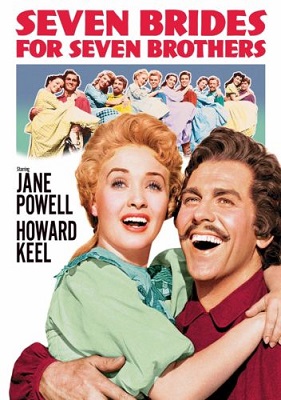
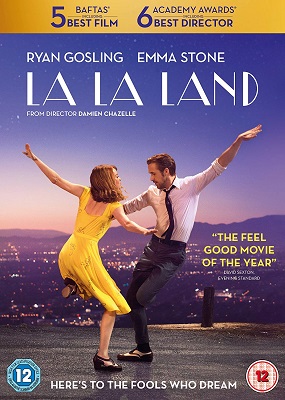
La La Land, Damien Chazelle (2016, USA). I’m not a big fan of musicals and, aside from half a dozen Busby Berkley films, the only ones I really like are High Society, Les Girls and Gentlemen Prefer Blondes. On the other hand, I did watch Seven Brides for Seven Brothers recently and was surprised to find myself enjoying it… Anyway, La La Land, a musical, surprised everyone by winning shedloads of awards a couple of years ago, although Hollywood movies about making movies in Hollywood, musical or otherwise, always seem to do well at awards time. The film follows aspiring actress Emma Stone and jazz pianist Ryan Gosling as they each try to make a success of their chosen careers, which, naturally, involves doing things they don’t want to do simply in order to put food on the table – well, in Gosling’s case it means joining a successful jazz fusion band. The musical numbers are completely forgettable, and even the flights of fancy, despite their Technicolor palette, aren’t that interesting. In fact, the only interesting thing about the film is the bittersweet ending, in which the two split up and are subsequently successful. I have no idea why this film won all the awards it won.

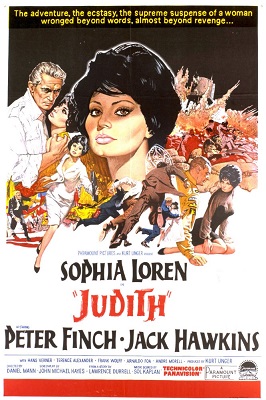
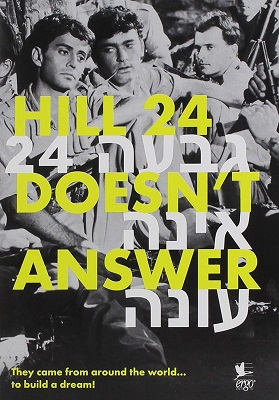
Judith, Daniel Mann (1966, Israel). Lawrence Durrell was not well served by the film industry. The first book of the Alexandria Quartet was adapted as Justine by George Cukor, but it was a financial and critical flop (it had been Joseph Strick’s project but he fell foul of the studio, and they replaced him with Cukor). This is not necessarily a bad thing, as Durrell’s novels would be very difficult to adapt – not that this has prevented Hollywood before with other properties. However, Durrell did provide a story for a movie made by the Israeli film industry, Judith. It was also turned into a novel, which remained unpublished until a couple of years ago. I’ve yet to read it. The story is set in Palestine, just before Israel’s unilateral declaration of statehood. The Jews are worried about the Syrians massing on the border, and have information that a tactical genius Wehrmacht tank commander is now working for the Arabs. But no one knows what he looks like. So they smuggle Sophia Loren into Palestine, since she was married to him and can identify him. But Loren doesn’t fit into the kibbutz where she’s pretending to be a member, arousing the suspicions of the other kibbutz members and the British authorities. Given the way Hollywood framed her career, it’s easy to forget that Loren was a bloody good dramatic actress, streets ahead of her contemporaries also imported from Europe. This is the second early Israeli film I’ve watched this year, and the second whose plot is based around the country’s creation. In this one, however, the threats are chiefly external, although it’s clear there’s an internal organisation more than qualified to investigate and, if necessary, prevent. Perhaps the scenes at the kibbutz tend to reinforce the popular, and hugely incorrect, image of hardy settlers building a homeland in an inhospitable wilderness, but the thriller elements of the story at least show that Palestine was a country under occupation – except, of course, it wasn’t the Jews that were being occupied (although they were certainly the most policed by the British). I’ve yet to read Durrell’s novel – but from the Alexandria Quartet alone, it’s clear where his sympathies lay – but on the whole I’d have to say I thought Hill 24 Doesn’t Answer (see here) the better film.

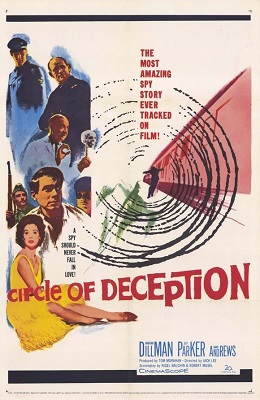
Circle of Deception, Jack Lee (1960, UK). And from watching a film because of the writer who provided the story to watching a movie because of its star. Which I don’t do very often. But Suzy Parker made only a handful of films, and she’s the best thing in them. Most people will probably remember Cary Grant and Jayne Mansfield in Kiss Them for Me, but Parker played the female lead. The Best of Everything is a superior 1950s film, and Parker is better than her fellow leads, Hope Lange and Diane Baker, although not as good as Joan Crawford… Anyway, Circle of Deception is a hard-to-find British film set during WWII starring Suzy Parker, who plays a Brit… and I think it’s her voice, although she was dubbed by Deborah Kerr in Kiss Them for Me, and her accent is pretty much spot-on for much of the film, although it does occasionally drift (which is what persuades me it’s her own voice). Anyway, Parker is the assistant of military intelligence captain Harry Andrews. They need to feed disinformation to the Germans, so they decide to parachute into France someone they know will break under interrogation. They feed their patsy – played by Bradford Dillman – with misinformation, then shop him to the Nazis. Everything goes as planned. Well, except for Parker falling for Dillman during his training. But she remains professional, and sends him off to his doom. The film actually opens several years after the war has ended, when Parker wants to track down Dillman and apologise to him. He’s now living in Morocco, and still suffers after his war experiences. There’s a nasty thread of expediency running through the film, which is I guess the whole point of it, and while both Andrews and Parker are good in their roles, Dillman struggles to keep up. Circle of Deception is an interesting, if minor, British WWII drama, but I suspect its story was seen as more shocking in the decades before 9/11 and Gitmo and extraordinary rendition.

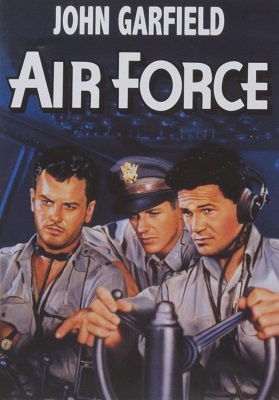
Air Force, Howard Hawks (1943, USA). I don’t know why Hawks didn’t serve during WWII – he was 45 in 1941, was that considered too old for combat duty? – although he did apparently serve as a flying instructor during WWI. Anyway, he spent the war years doing what he had been doing before the war: making films. Five between 1941 and 1946. Three of which were explicitly military: Sergeant York in 1941 (which is actually about WWI; see here), and Air Force and Corvette K-225 in 1943 (see here). Air Force – it was, of course, the Army Air Corps at the time – is about the crew of a B-17 in the Pacific theatre. It’s apparently based on a true story. A crew are ferrying a B-17 from San Francisco to Hawaii when they get caught up in the Japanese attack on Pearl Harbour. Pretty much all the external shots of the B-17 are model work, and not entirely convincing model work either. And the scenes set inside the Flying Fortress… well, I had thought the aircraft’s interior much more… utilitarian than is shown. I like feature films set on and about military aircraft – Strategic Air Command is one of my favourites – but nothing in Air Force felt especially convincing. Which is ironic, given it’s a true story. There are a couple of interesting scenes featuring state of the art computing in 1943, and the film features all of Hawks’s trademark dramatic elements… But it’s a minor work in his oeuvre, and probably only worth seeing for completeness’s sake.

Cute Girl, Hou Hsiao-Hsien (1980, Taiwan). Hou has said that he doesn’t consider his film-making career to have really begun until his third feature, The Boys from Fengkuei (see here), which makes you wonder why eureka! chose to include his two earlier films, Cute Girl and The Green Green Grass of Home, in this new Early Hou Hsiao-Hsien blu-ray box set. Especially since both Cute Girl and The Green Green Grass of Home are really just vehicles for Taiwanese pop star Kenny Bee, and actually not very good films. With extremely annoying soundtracks. The signature pop song from Cute Girl ended up stuck in my head for at least a week after watching the film. The plot is some rom com gubbins about a wealthy young woman who falls for a penniless young man (Bee) who pursues her relentlessly. There are, I seem to recall, a couple of good set-pieces, but the whole thing is so lightweight it’s a wonder it doesn’t blow away. And that fucking annoying song… Hou is a brilliant director but I can understand why he’d sooner this film was quietly forgotten.

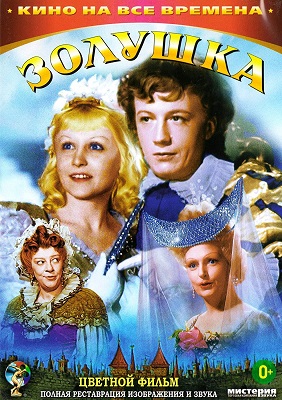
Cinderella, Nadezhda Kosheverova & Mikhail Shapiro (1947, Russia). I found this one Amazon Prime, and thought it worth watching. Which it was. In an odd sort of way. It’s a musical and, strangely enough, Soviet musicals in the 1940s were not much like, say, Meet Me in St Louis (1944, see here). So the songs weren’t exactly memorable, or exactly a pleasure to listen to. But the plot pretty much follows Charles Perrault’s version, although it’s explicitly set in a magical kingdom. But otherwise, it all goes down just like the pantomime. What was interesting, however, was the mise en scène, in which the setting resembled some sort of toy town, with overtly designed scenery that gave the whole film a fairy tale atmosphere. The colourful costumes did the same. Some the choreography was quite balletic, and the big set-pieces were effectively staged, but it was definitely the set design where the chief appeal lay. Worth seeing.

1001 Movies You Must See Before You Die count: 923


1 Comment

Summer bounty

One rule I always try to follow is to not buy more books each month than I read. That way, the TBR gradually reduces. Unfortunately, I’ve been failing more often than not so far this year – plus one in April, plus three in May, plus two in June… On the other hand, I’m four books ahead of schedule in my Goodreads reading challenge of 140 books in 2018.

Anyway, below are the latest additions to the collection, not all of which will stay on my shelves once read.

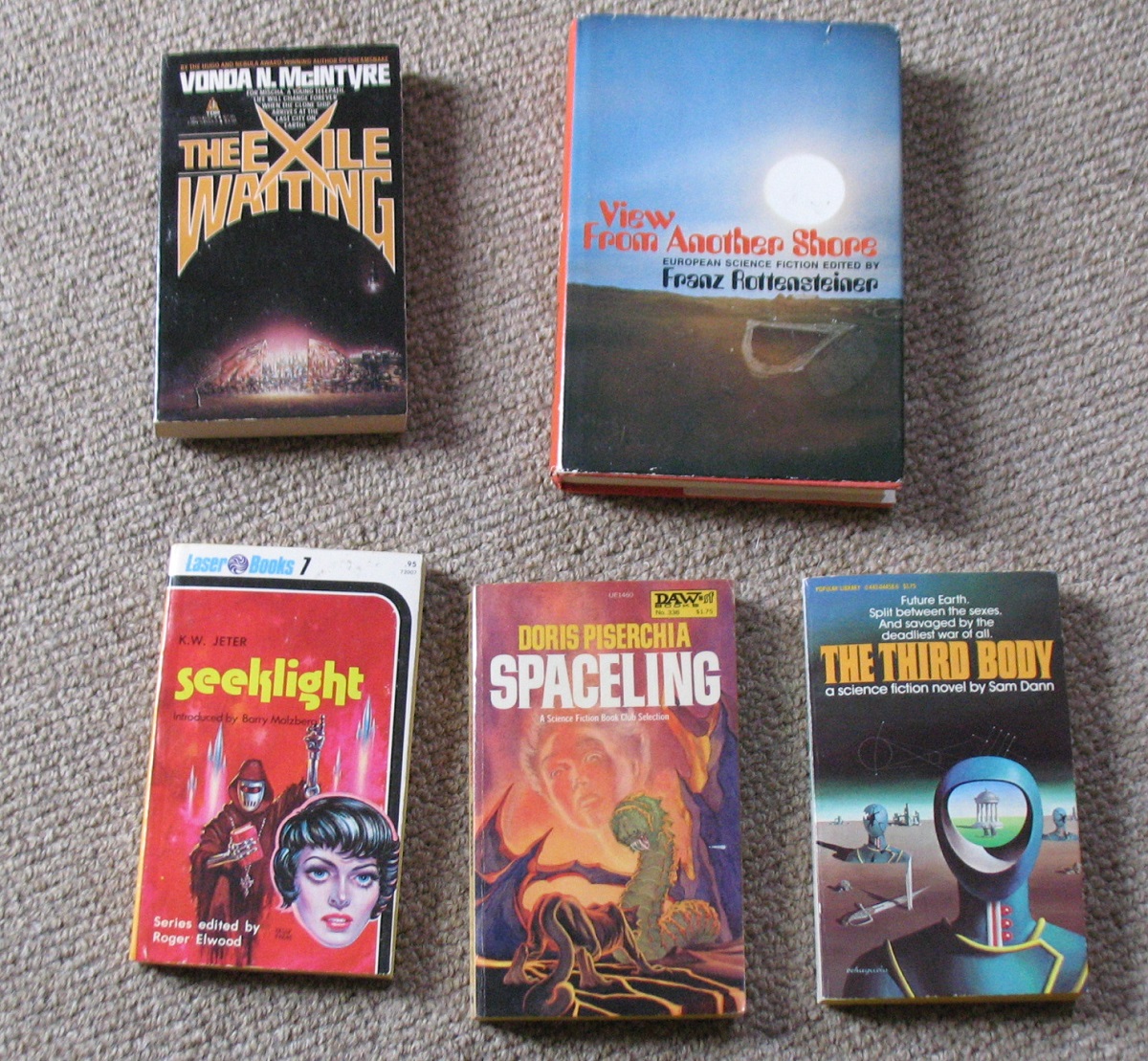
The last couple of years, Swecon has had a better dealers’ room than the Eastercon. In respect to secondhand books, that is. Secondhand book dealers no longer seem to have tables at Eastercons anymore, but the Alvarfonden (and there’s that “the the” again) is always present at Swecon. I am, of course, loath to buy too many books at Swecon, because of carrying them back from Stockholm in my cabin baggage… but half a dozen paperbacks – or in this case: four paperbacks and one hardback – is more than manageable. Spaceling and The Exile Waiting I bought to review for SF Mistressworks, although I’ve enjoyed work I’ve previously read by both authors. The Third Body I purchased after reading the blurb: “The conflict between men and women begun in the nineteenth and twentieth centuries long since had flowered into naked hatred and complete separation. Now both sexes had their own nations, each a passionate enemy of the other. Now sexual pleasure was taboo, and the act of coupling for reproduction was part of a contest for domination, with death to the loser”. Um, yes. I usually pick up Jeter’s novels when I find them, and Seeklight, an early work, is hard to find in good condition and for a reasonable price. This copy was both. The View from Another Shore is a 1973 anthology of non-Anglophone science fiction. I read it way back in the early 1990s, a paperback copy lent by a friend, but when I saw it in the Alvarfonden I thought it worth having a copy of my own.

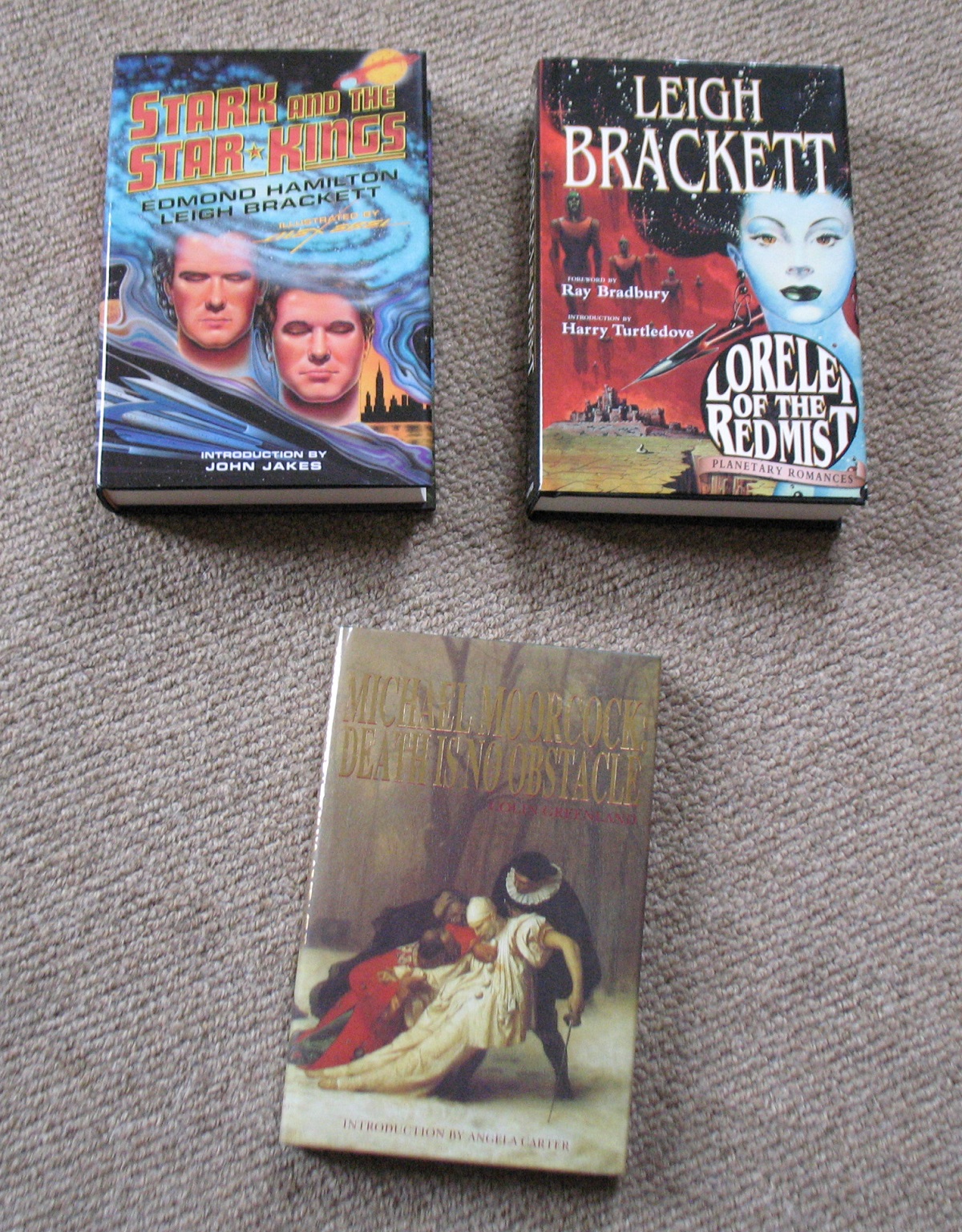
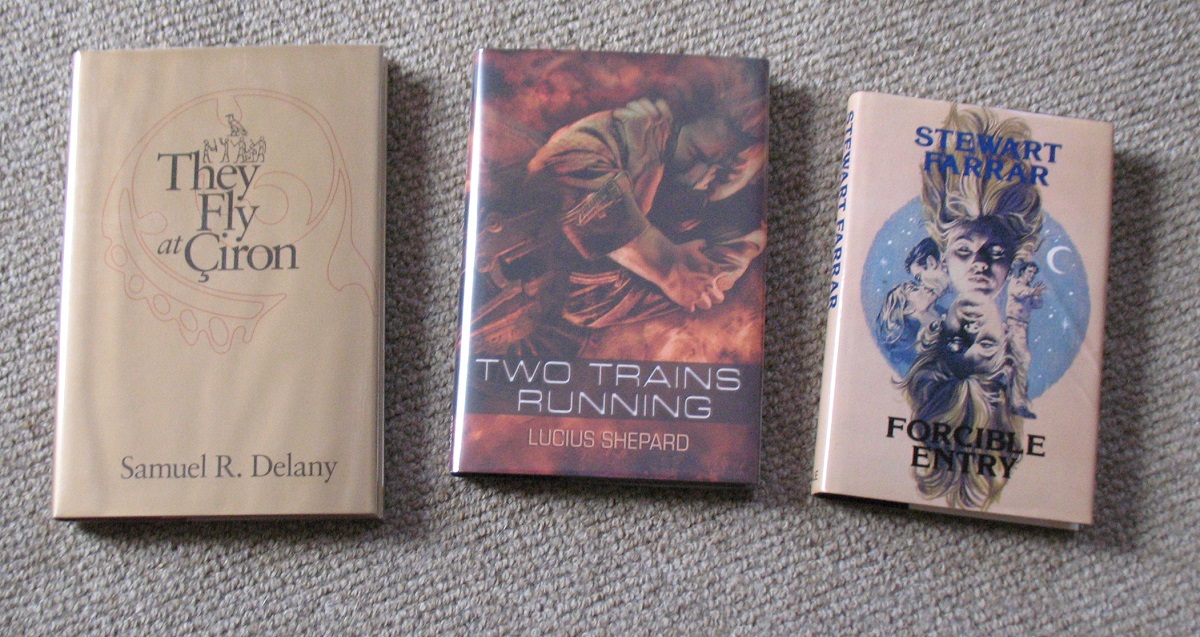
Three for the collectibles. They Fly at Çiron I found on eBay for a good price. Two Trains Running is a not an especially hard book to find, but I wanted a signed copy… and eventually found one on Abebooks. And Forcible Entry I’ve been after for years, but it seems it never made it to paperback and the hardback was published by Robert Hale, the bulk of whose sales were to libraries, making copies of their books really hard to find. (There’s currently a copy of Forcible Entry on Amazon priced at £590!) But a few weeks ago three books by Farrar popped up on eBay from a single seller. I ended up in a bidding war for Forcible Entry, but then discovered a copy had also appeared on Abebooks – from a different seller, obviously – so I bought that one… and the one on eBay went for more than I’d paid for my copy. One of the other Farrar novels looked quite interesting, but I was sniped on that too. Bah.

The Delany is The Jewel-Hinged Jaw. I already have this in a tatty paperback, but I couldn’t resist a nice hardback edition. Nasa has been churning out histories of its various programmes for years, and I have several of them – This New Ocean (Mercury), On the Shoulders of Titans (Gemini), Apollo Expeditions to the Moon (Apollo), Living and Working in Space (Skylab), Stages to Saturn (Saturn V) and now Moonport, about the launch facilities at Cape Canaveral. Most of the books are now available as POD paperbacks but, of course, I want the original hardback editions. Some aren’t that difficult to find in hardback, but Moonport is one of the really difficult ones. Previous copies I’ve seen were priced around $400 or $500. This one I bought on eBay for… £25, from a charity shop somewhere on the south coast. Result.

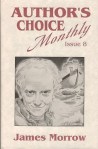
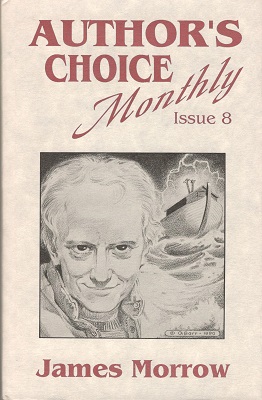
Three collections. I don’t have much time for Kevin J Anderson’s fiction, but under the imprint WordFire Press he has over the last few years published a bunch of stuff by Frank Herbert that was previously unpublished. I’ve no idea what the stories in Unpublished Stories are like, or if any of them are also included in the comprehensive Herbert collection published by Tor four years ago (which I own and have yet to read). Ad Statum Perspicuum by F Paul Wilson and Legacy of Fire by Nina Kiriki Hoffman, volumes 13 and 14 in Pulphouse Publications Author’s Choice Monthly, bring the total I now own up to twenty. Only nine more to go.

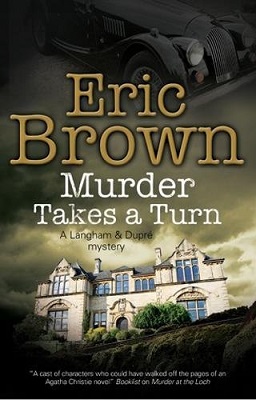
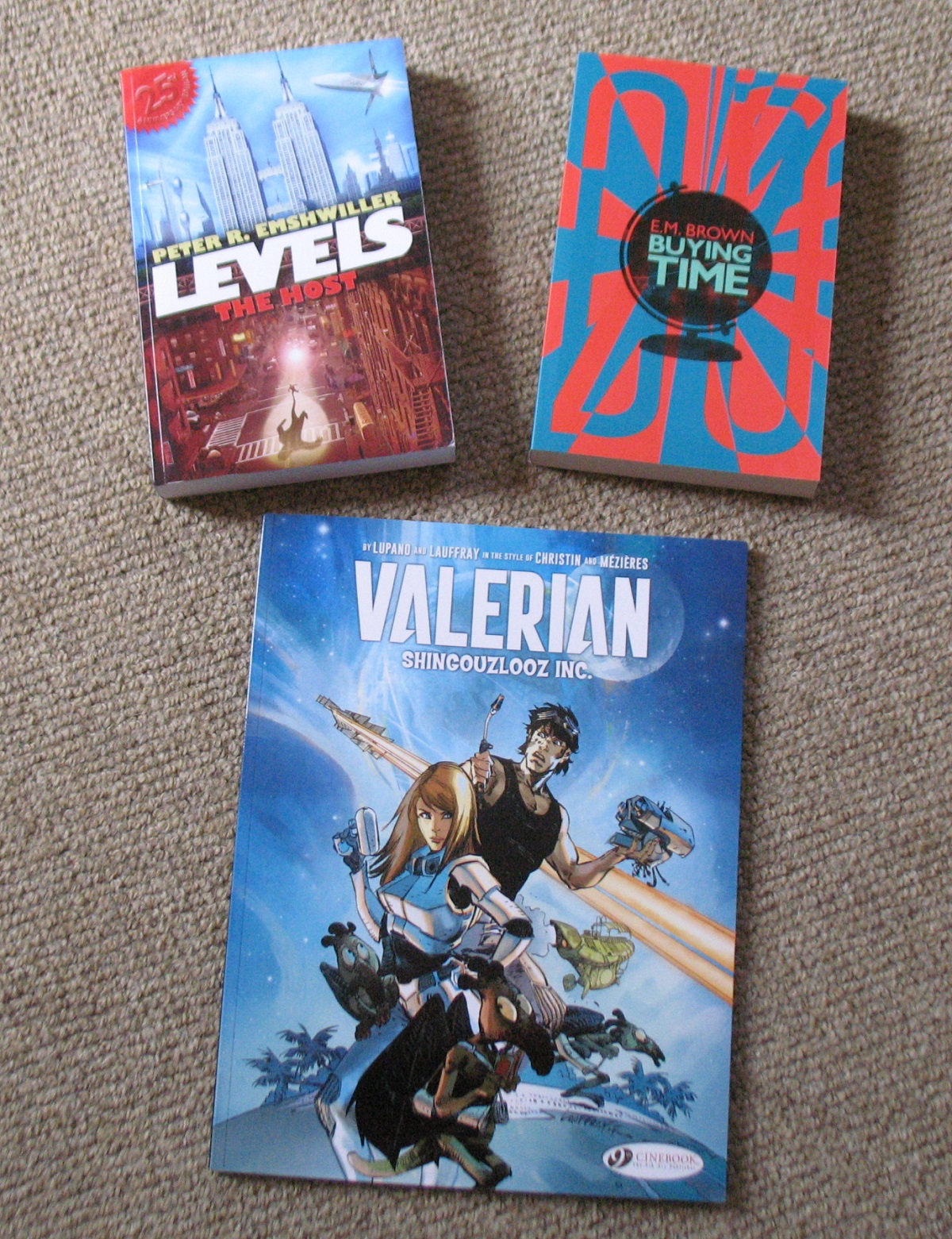
Some new releases. It seems Mézières and Christin have allowed someone else to continue their Valerian and Laureline series, and Shingouzlooz Inc is, I hope, the first in a new series. I liked it (see here). Buying Time is a pseudonymous work by Eric Brown, although plans to keep his identity a secret pretty much fell at the first hurdle when the publisher plastered his real name all over the publicity material. I forget why I had Levels: The Host on my wishlist, althuogh I bought it because the price had dropped below £2. I believe it’s a rewritten version of an early nineties sf novel,  republished by a small press, perhaps even Emshwiller’s own imprint. Emshwiller is the son of Ed and Carol Emshwiller, both well-known names in twentieth-century science fiction.


1 Comment

Moving pictures 2018, #38

Bit of a UK-fest this time around. Which is just how it sort of fell out. The one US film is a Roger Corman-produced rip-off of Alien. He made two – one I like very much, but this one was absolutely terrible. Oh well.

Wild Reeds*, André Téchiné (1994, France). One topic I’m pretty much cold to in both literature and film is “the sensitive passage into adulthood and the awakening of sexuality”, as Wikipedia describes this film. Basically, it translates as late teens or early twentysomethings acting like arseholes, and then stopping as it slowly occurs to them that they’ve been behaving like arseholes. And the “awakening of sexuality” bit often involves a great deal of sexism, as said teens suddenly discover that the people they’ve been treating as human beings are female and so society (ie, the patriarchy) tells them they shouldn’t actually be treated like human beings. Which is not say this film does either of these, because I don’t much recall what actually did happen as it was all rather dull. The action take places around the time of the end of the Algerian War, and one of the four youths the film focuses on was born in Algeria. Another is gay, but is treated badly by the others. I watched Wild Reeds because it’s on the 1001 Movies You Must See Before You Die list, but I can’t say anything in it especially grabbed me or persuaded me it belonged on the list. Meh.

Denial, Mick Jackson (2016, UK). I had a conversation with someone about David Irving at Fantastika in Stockholm last month, and then this film popped up on Amazon Prime… Not that I took it at face value. I read up on Irving on Wikipedia as I watched the film. Anyway, Irving is a piece of shit Hitler apologist who has had several of his books on the subject challenged – and in one case withdrawn after publication – who decided to sue a US academic, Deborah Lipstadt, whose area of study is the Holocaust, after she accused him of being a Holocaust denier. He sued her for libel in the UK, which has antiquated libel laws which were designed to protect the names of established shitbags rather than arrive at a truthful verdict. In order to win her case, Lipstadt had to prove that Irving had knowingly lied in presenting his thesis. Which her legal team did. So Irving lost. He probably still hasn’t paid off what he owes and the court case took place in 1996. For the record, the Holocaust happened, Irving is a Holocaust denier and his bending of history to serve a right-wing agenda makes him a piece of shit. The film presents the story relatively straightforward, although it does tend to minimise the timescale of events. I also suspect Timothy Spall plays Irving as more of a charmer than the real article, although he certainly manages to convey oleaginous arrogance. If the film has one flaw, it does feel a bit as though Lipstadt and her legal team are all paragons of humanity, and while their motives may have been pure in real life, the film does make it seem a little too good. But a good, entertaining film about an important event, and worth seeing.

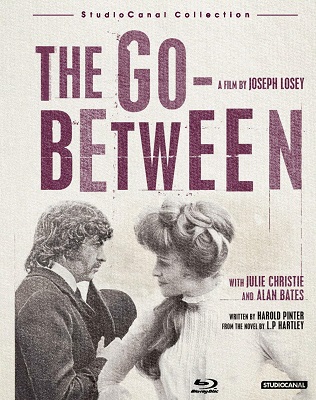
The Go-Between, Joseph Losey (1971, UK). I have one of LP Hartley’s novels on the TBR – actually, it might be an omnibus of a trilogy of his. But his best-known work, The Go-Between, isn’t it, or one of them, er, which ever it is. The story of The Go-Between is set in 1900, although confusingly it’s mostly flashback from, I think, the novel’s date, around 1950, so every now and again cars appear on the screen, which seems odd in something that it mostly seems to predate DH Lawrence… And it’s DH Lawrence it mostly seems to want to be, with the nubile daughter of minor gentry, Julie Christie, engaging in no-commitment rumpy-pumpy with hunky farmer, Alan Bates, on the side. And it’s almost as if the two leads were cast because of their connection to Lawrence adaptations – Bates in Women in Love, a great novel and a great film, and Christie in, er, well, no Lawrence adaptations, although she was the female lead in Dr Zhivago. Anyway. The title refers to a young boy, a school friend of the family’s youngest, who has been invited to spend their summer in their stately home. He ends up carrying messages between Bates and Christie, because he has a schoolboy crush on Christie, not realising he is enabling their affair. And when he finds out, he reacts badly. The Go-Between is the third film Losey made with playwright Harold Pinter and, like the other two, class plays an important part, although it feels in the film like the shadow of something that occupies more of the narrative of the source novel (I’m guessing as I’ve not read it). Apart from the obvious class difference between Christie and Bates, and a series of events which position the title character as lower class than Christie’s family, there’s not actually all that much there as commentary on class. Losey and Pinter’s The Servant was much more effective. Which is not to say The Go-Between was a bad film. It’s very good, it just strike me a bit as Lawrence-lite and I have to wonder if Ken Russell might have made a better fist of it…

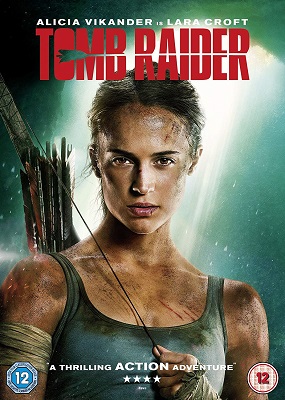
Tomb Raider, Roar Uthaug (2018, UK). I remember when the Tomb Raider game was released – a friend of mine at the time was a big fan of it. And it seemed unremarkable that a film adaptation be then made of the property. But twenty years later, and you have to wonder why someone felt a reboot was needed. In the first version of the franchise, Brit Lara Croft and her father were both played by Americans – father and daughter too, as it happens – and they made a pretty good fist of it. In this new version, they’re played by… a Swede and a Brit. Who are unrelated. Although, to be fair, Alicia Vikander, does a good job as Lara. Dominic West, who I always get confused with Dougray Scott, plays her father. The film opens with Lara getting a pasting in a boxing-ring. It then quickly establishes that she is highly-educated, has no money, and works as a bicycle courier… because her father disappeared seven years earlier and she refuses to admit he is dead and so cannot touch his fortune until she does so. He disappeared on a trip to a mysterious island in the sea of Japan where an ancient evil Japanese queen’s tomb allegedly can be found. And its fabulous treasure. Lara is eventually persuaded to sign the papers declaring her father dead, but before she does so the solicitor gives her an envelope only to be opened after his death. A cryptic phrase on a piece of paper sends her back to the family estate – papers unsigned, of course – where she finds her father’s secret laboratory. The second act is Lara following her father’s research to the island… which she finds far too easily. Only to be shipwrecked after a violent storm. And then she discovers there is a secret organisation dedicated to ripping off mysterious ancient artefacts with special powers to advance their agenda of world domination. Or something. Anyway, they take Lara prisoner, she escapes, they break into the tomb, she helps them through its various traps, they discover the secret of the ancient Japanese queen, but she manages  to stop the baddies from profiting from it. Oh, and she finds her father, and he’s still alive. Albeit not for long… I enjoyed this more than I expected, to be honest. Vikander is good in the title role, and the excessive CGI is only mildly annoying. The risible plot is redeemed by an opening that actually feels like it’s set in the real world, although the introduction of the vast Croft wealth knocks it off track. And the conspiracy aspect has its moments, although it does feel like a feeble copy of Assassin’s Creed. I’ve still no idea why someone felt a reboot was required – has the game been revamped or something? – and while the original movie at least felt like a part of the moment back then, this one now smells not so much like it missed the boat as it is in actual search of a boat in the first place. But I sort of enjoyed it.

Forbidden World, Allan Holzman (1982, USA). Roger Corman’s New World Pictures was known for a number of things, and one of them was ripping off successful genre properties with low-budget straight-to-video (as was) releases. Ridley Scott’s Alien inspired two such rip-offs – Galaxy of Terror, which is actually not bad; and this one, the considerably more risqué, and considerably inferior, Forbidden World. Which opens with a robot waking its captain as their spaceship is under attack by marauders, who have nothing to do with the plot but do allow Holzman to re-use some model shots from, I think, Battle Beyond the Stars. After seeing them off, the hero lands on the planet of Xarbia, which is the location of a secret biological laboratory base. Which has accidentally managed to create a monster. Which then grows and kills everyone off, one by one. And, er, that’s it. Well, that and the gratuitous nudity. Like when one of the base’s young female staff members decides that what she really needs, despite all the carnage, is a naked sauna… The monster, when it’s eventually revealed, is not at all convincing, looking like it belongs in a much worse film. I’m told the soundtrack is held in high regard, but then it’s the only thing in the film that is at all original. Galaxy of Terror was a rip-off of Alien, but it did something very science-fictional with its premise. Forbidden World doesn’t. There’s some scientific bollocks intended to justify its plot, but it’s substandard writing. New World Pictures produced the odd gem during its time, but this isn’t one of them.

Genius Party/Genius Party Beyond, various (2007/2008, Japan). This is a pair of anthology anime films by various hands, put together chiefly, I think, as a portfolio for a newly-launched animation studio in Japan. Obviously, it was recommended by David Tallerman. There are seven short anime films in Genius Party and five in Genius Party Beyond. None are especially typical of Japanese anime – one, on fact, reminded me of the work of Jodorowsky and Moebius more than anything else. A lot of it is just plain weird. There’s an excellent one on Genius Party Beyond with a Juno Reactor soundtrack, which is probably the best of the lot. The problem, however, is that both films feel like what they are: over-extended showreels. It’s good stuff – excellent animation and some really inventive design… but it’s the sort of thing that works better in 5-minute segments rather than 20-minute segments. Especially since the stories of many of the segments feel like they’re stretched well past their natural length. On the other hand, both films are a showcase of inventive animation and, stories aside, demonstrate that very well. I don’t think either are necessarily for fans of anime, more for people interested in animation and its various forms.

1001 Movies You Must See Before You Die count: 923


Leave a comment

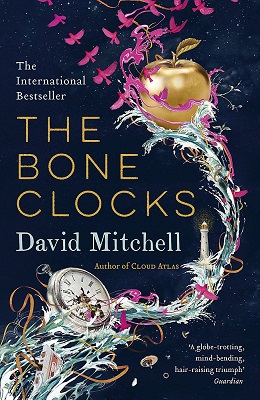
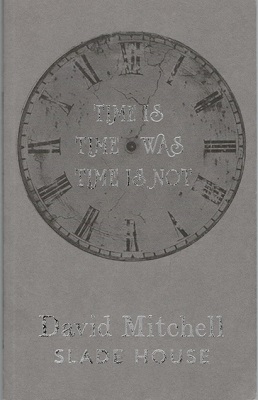
The Bone Clocks and Slade House, David Mitchell

Despite being shortlisted twice for the Booker Prize, David Mitchell’s novels are not like most other literary fiction novels for two reasons: first, characters from one book often appear in other books; and secondly, many of his novels feature genre tropes and situations. In his debut, Ghostwritten (1999), one of the narrators proves to be a disembodied spirit who can move from body. Cloud Atlas (2004), has two of its six sections set in the future: one a near-future dystopian Korea, the other a post-apocalyptic Hawaii. While it’s not unusual for literary fiction authors to visit genre shores, Mitchell has shown a greater appreciation of, and a better facility with, gene tropes than most of his peers. But then he is a fan and has publicly said as much. And in The Bone Clocks, and its pendant novel, Slade House, he has for the first time told an actual genre story, albeit in the language of literary fiction.

The Bone Clocks is structured as six novellas, most of which are told from the point of view of Holly Sykes. The novel opens in 1984, Holly is a teenager, grief-stricken at the recent death of her younger brother. She decides to run away from home, and makes it halfway across Kent before running afoul of the story’s villains. These villains harken back to earlier novels by Mitchell, particularly The Thousand Autumns of Jacob de Zoet (2010). That novel introduced the idea of secret immortals amongst us, and it is a war between two such groups which forms the backbone of The Bone Clocks. (You wait for a novel about secret immortals, and three come along at once: as well as The Bone Clocks, 2014 also saw the publication of Claire North’s The First Fifteen Lives of Harry August, while Kate Atkinson’s Life After Life appeared in 2013.) The Horologists are body-hopping serial reincarnators. Their enemies, however, the Anchorites of the Chapel of the Dusk of the Blind Cathar, “decant” souls in order to extend their lives. The process is fatal to the decanted souls. Over the course of The Bone Clocks Holly has a number of run-ins with the Anchorites, beginning with that trip across Kent as a fifteen-year-old, and finishing in a post-Crash Ireland in 2043.

Unlike Cloud Atlas, the six sections of The Bone Clocks are not nested, but follow on chronologically one from the other. Like that earlier novel, however, they also display an excellent control of voice. The Bone Clocks is Holly Sykes’s story and she’s an engaging and convincing character. Having said that, the Anchorites are a bit pantomime, enfant terrible literateur Crispin Hershey initially reads too much like a pastiche of a well-known UK author but soon rounds out, and the immortal Marinus never quite convinces. But these are minor gripes. The Bone Clocks handles its settings with impressive assurance and, more than any other of Mitchell’s novels, this is an insightful book.

Mitchell has said he intended each section of the novel to be a different genre – such as, 1980s social realism, war reportage, fantasy and dystopia, among others. It’s a given most of the really interesting genre fiction is being written in the area where genres meet, and Mitchell makes good use of the interfaces – the sudden irruption of fantasy into Holly’s adventures in Thatcherite Britain creates a shockingly effective introduction of The Bone Clocks’ underlying fantastical plot. In fact, those sections featuring this violent introduction of genre into literary fiction actually work better than those sections which are pure genre. Perhaps it’s a consequence of expectation; perhaps it’s simply the stark contrast between the two modes.

Slade House, on the other hand, makes no secret of its melding of genre and non-genre, although it tries to wrongfoot the reader by presenting its genre elements as “dream-like”. If the novel were a film or television series, it would be called a “spin-off”. Less than half the size of The Bone Clocks, Slade House echoes that novel’s multi-part structure – each set at nine-year intervals from 1979 to 2015 – but takes place entirely in and around the eponymous residence. Each section is told from the point of view of a different person. The eponymous house is home to Norah and Jonah Grayer who, while not associated with The Bone Clocks’ Anchorites, have been using a similar method to extend their lives. Slade House’s narrators are the pairs’ victims.

In each section, the narrator investigates Slade Alley (for a variety of reasons), discovers a small iron door – an interdimensional “Aperture” – which gives entry to Slade House’s grounds, is initially taken in by the illusion woven by the Grayer twins… and is then consumed by them. This act is usually presaged by the sight of a portrait of the narrator at the end of a line of portraits on the main staircase – which is, to be honest, a somewhat cheesy horror film cliché. Slade House presents enough detail to invoke the year in which each section is set, but given that Slade House itself is timeless, this makes for an odd disconnect, often making the detail feel superfluous. Nor is it helped by the last but one section – 2006 – consisting chiefly of a history lesson of Norah and Jonah Grayer, and an explanation of the workings of the house and its grounds. It comes as no surprise to learn that the final section, set in 2015, is about the defeat of the Grayer twins – after the explanation, where else could the narrative go?

Fans of Mitchell’s fiction will have fun spotting characters from other of his novels, a number of which make an appearance in Slade House (as indeed do several in The Bone Clocks). I’ve yet to be convinced this actually adds value, given that the “shared universe” in which all of Mitchell’s novels are set is not a shared universe as the term is understood in genre fiction, but a much less rigorous use of the technique. In other words, they feel more like “Easter eggs” than a structural part of each book’s universe.

Unlike some genre fans, I have no problem with literary fiction authors “dabbling” (not my choice of word) in science fiction and fantasy. On the contrary, the more the merrier – and the lack of knowledge of genre traditions and history can actually prove an advantage to a writer. True, the results often feel a little old-fashioned to veteran readers of genre fiction, and a lack of confidence in deploying genre tropes can lead to unnecessary and clumsy exposition… David Mitchell, however, is a genre fan, he knows what he’s doing. And it shows.

Mitchell also knows what he’s doing when it comes to non-genre fiction. Genre writers make few concessions to their readers – they assume they know how to parse their stories and how genre tropes operate. They also trust their readers to understand the need for exposition. But there’s a limit. Up to this point, the writer needs to explain; and no further. Literary writers usually miscalculate this point and feel a need to explain those things which genre readers either already know about or are happy to take on trust. Likely this is because such writers are not entirely confident with how genre stories and tropes work, and they’re also unsure their readers will understand.

It’s clear Mitchell trusts his readers, both non-genre and genre – evident not only from his oeuvre, but also from his level of success. We need more writers like him. Both inside and outside the genre.

This review originally appeared in Interzone #261, November-December 2015.


1 Comment

Moving pictures 2018, #37

This is what my film watching looks like pretty much – one in six films is from the US. That’s not one in six is Anglophone, as the Israeli film is mostly in English, and One Way was entirely in English as it was set in the US. But there are two excellent Chinese films.

Zhou Yu’s Train, Sun Zhou (2002, China). A woman is on a train between Chongyang and Sanming. She is carrying a vase. A man asks her about it and she admits she made it. He insists on buying it, but she refuses. He introduces himself, he is a vet (a man collapsed earlier on the train and he denied being a doctor because a doctor of human medicine would have been preferable). The woman is on her way to visit her lover in Sanming, a poet. The film follows the woman, and her encounters with the vet and the poet, and that of another woman, played by the same actress, Gong Li. But the narrative is cut up and presented non-chronologically, which means it’s often a bit of a puzzle trying to figure out what’s going on, especially when the same actress plays the two female leads. It all looks great, and the cast are excellent. I’m reminded of Wong Kar-Wai’s films, especially In the Mood for Love and 2046, although without the arthouse cinematography, just the unadorned faux-documentary style used by Sixth Generation directors. I liked this film, but it really needed a rewatch. I’ll have to try and arrange one.

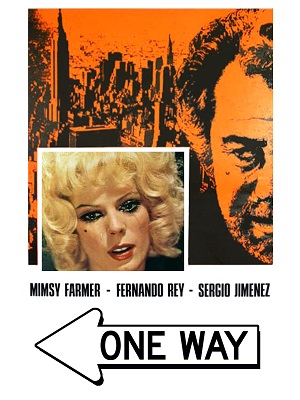
One Way, Jorge Darnell (1973, Mexico). The blurb for this film on Amazon Prime explains it is about an illegal immigrant in the US and declares it is still relevant today. In other words, the US is just as racist as it was in 1973. Probably more so. Although not as bad as the 1960s, when it practiced segregation and lynching. We’re no paragons of virtue here in the UK, but when it comes to racism the US is definitely a world-leader. And this forty-five year old film is ample proof. A farmer from Mexico moves to New York, illegally it must be said, but when someone gives me a good logical reason for secure borders then I’ll start believing “illegal immigration” is a thing. He finds himself subject to racism, but he can’t do anything because he’s there illegally. In one scene, he’s beaten up by drunk Americans at the bowling alley where he works restacking pins. In order to stay in the US, the farmer gets in deeper with criminals, as situation not helped by his desire – reciprocated – for the gangster’s girlfriend (I think she was his girlfriend). Unsurprisingly, it’s all about hiding from the authorities and so being driven into the arms of criminals, which only feeds into the myths surrounding illegal immigration in the first place. It’s like junkie culture – decriminalise drugs and there’s no reason for junkie culture to exist. Welcome immigrants, streamline them into becoming members of society and there’s nothing there for criminals. But then, there’s always the racism. That’ll remain as long as the establishment condones, and practices, it, and until there are real consequences for being a racist arsehole.

Hill 24 Doesn’t Answer*, Thorold Dickinson (1955, Israel). According to the Wikipedia page, the plot of this film “revolves around the personal stories of a number of soldiers who are on their way to defend a strategic hill overlooking the road to Jerusalem”, which is true but completely misses the point of the film. It is also Israel’s first home-produced feature film. Edward Mulhare plays an Irishman in the British occupying forces, who returns after Israel’s unilateral declaration of independence (the film says it was “sanctioned” by the UN, but that word has two meanings and the film is clearly hoping one will prevail). Anyway, Mulhare fancies a Jewish settler, and returns to help her in the fight for Israel. The problem with any film about the early days of Israel is framing their enemy. Who were they fighting? The Palestinians they had displaced? The British who had already left? That there was fighting is beyond doubt. Parts of Palestine were mandated to the Jews by the UN, the rest was won by blood. And what they were mandated was defended with blood. Let’s be fair here – the Israeli state has a right to exist, but so does the Palestinian one. And when you have two nations sharing the same territory, what do you do? China Miéville’s solution in The City & the City is obviously untenable, but neither can you privilege one group over the other as both have legitimate claims – after the fact, if not before. Making Jerusalem an international city is a step in the right direction, but hardliners will block that, and have. Wars are not going to resolve anything, especially when one side is funded by the US. But I’m not about to solve the Israeli-Palestinian problem as it requires someone with bigger guns than me. As early Israeli film culture goes, this isn’t too bad – the Arabs are mostly treated fairly, as are surprisingly the British. The latter are the architect of Israel’s woes, that much is made clear, through their repressive control of the region after WWII. But they’re not demonised. The main focus seems to be on the burgeoning romance between Mulhare and Israeli lead Margalit Oved. It’s a film that deserves to be better known, even if it doesn’t fit the current narrative about Israel. It’s home-grown, it makes a good fist of its story, and any challenges it might make to the current narrative are welcome.

2036 Origin Unknown, Hasraf Dulull (2018, USA). Sometimes you can find hidden gems among independent sf films, and with the sophistication of present-day CGI they can look every bit as good as big studio sf films. But without the zillion-dollar budgets, something has to give… and it’s usually either location or cast. This film takes place almost entirely in a single room, so that it’s not that one. And while Katee Sackhoff is a good actress and reasonably well-known, I should think her price-tag is pretty modest. Plus, the entire cast of 2036 Origin Unknown is single figures. A mission to Mars crashes mysteriously on landing. Years later, Sackhoff, on her own, is running an AI-controlled follow-up robot mission to investigate that crash. They discover a huge cube covered in alien carvings. It vanishes. And reappears in Antarctica. They trick it into returning to Mars. It is apparently some sort of instantaneous interplanetary or interstellar vessel. Some point during all this, the AI – which was put in charge over Sackhoff’s objections – decides to exterminate all life on Earth. Oh, and Sackhoff’s father died in that original Mars mission, so she has an emotional stake in the investigation. Sackhoff tries gamely to carry the film, but the plot has too many ludicrous moments and slowly unravels under the weight of ambitions it can’t meet. It’s a sight more original than many other independent sf films I’ve seen, but even original ideas need to be rigorously worked through.  Meh.

Part-Time Spy, Kim Deok-su (2017, South Korea). Gang Ye-Won is 35 and has spent most of her adult life trying to get a job with the Korean civil service, occupying a wide range of positions before she finally lands a job. In a state intelligence department. But then her boss is phished for $500,000 and he tasks her, secretly, with recovering the money. But the company responsible for the fraud – a call-centre that runs a number of phishing scams – has also been infiltrated by an undercover police agent. So this is basically a buddy movie, where the buddies came together through circumstance rather than choice, and the drama comes out of their interactions. Because neither has much time for the other. Gang is an accident-prone nerd but proves to have a gift for talking punters out of their hard-earned cash, and so gets in with the senior management. The undercover police officer, Han Chae-Ah, is skilled at unarmed combat, a maverick and arrogant. But, of course, they learn to like each other and work together to bring down the evil mastermind behind the phishing scam, not to mention Gang’s inept boss who lost the money in the first place. The comedy is broad, and the fight scenes aren’t that good… but then it would be churlish complain about a female buddy movie that actually has fight scenes. Entertaining. And it makes a good point about the human cost of phishing too.

Here, Then, Mao Mao (2012, China). I seem to remembering stumbling across this one on Cinema Paradiso’s website. Certainly the director is not a name I knew, and I’ve been exploring the oeuvres of both Fifth and Sixth Generation Chinese directors. But I like modern Chinese cinema – both the commercial films and the film festival ones, although the latter much more than the former. Here, Then, Mao’s debut feature, not only does the things I like about Sixth Generation films, but also the things I like about cinema from other countries. It tells a story about a group of twentysomethings in a provincial town, using the sort of faux-documentary style, with minimal dialogue, used by Sixth Generation directors. But it also uses long, often static, takes, and equally often pulled back so that the action takes place only in a small area at the centre of the screen. There are other tricks in there too – in one scene, two young women waiting for a bus dance to music, and the camera zooms in toward one until she is staring out of the screen, suggesting she is breaking the fourth wall. Characters move in and out of focus as the dynamic changes in other scenes. It’s a polished debut, displaying a facility with cinematic language unusual in a first film. I’d like to see it again, so I guess I’m going to have to pick up a copy. I suspect it might make my top five by the end of the year, although it has stiff competition. Highly recommended.

1001 Movies You Must See Before You Die count: 922


Leave a comment

Moving pictures 2018, #36

Managed to knock three films off 1001 Movies You Must See Before You Die list, and they weren’t bad films either.

Genghis: The Legend of the Ten, Zolbayar Dorj & U Shagdarsuren (2012, Mongolia). I found this on Amazon Prime. Incidentally, when I refer to Amazon Prime, I mean the free movies it offers… and it’s an odd mix: straight-to-video crap, poor transfers of early twentieth-century films, occasional blockbusters available for a limited time, forgotten films from the seventies and eighties and nineties… and some very recent films from further afield, such as the Chinese and Taiwanese films mentioned in previous Moving picture posts, and like this Mongolian historical epic and the Russian comedy below. Genghis: The Legend of the Ten is the sort of nonsense title given to foreign movies for the US market. The actual title is Aravt, which is the term for the groups of ten into which the Mongol warriors of Genghis Khan’s time would organise themselves, as helpfully explained by an opening voiceover. The movie is about one such aravt, or group of ten. It is, unsurprisingly, historically accurate – as far as my limited knowledge can tell, but this is no Hollywood re-imagining of history. It’s also quite brutal. The battle scenes are well-staged, but the back-stabbing does get a bit complicated in places. It’s a polished piece of work, and if Mongolia has to mine the better-known elements of its history to make foreign currency, then they did a good job with this and I wish them the best of luck in their industry. It’s only the second Mongolian film I’ve seen – the other was Joy, and it did not live up to its title (see here) – but both are very good. A cinema to keep an eye on, so to speak.

Hold Me While I’m Naked*, George Kuchar (1966, USA). I’d not realised until I started watching this that it was a short, only 15 minutes long. Kuchar was an underground film-maker in New York and San Francisco, active from the late 1950s through until his death in 2011. He made over 200 films, including video diaries. Hold Me While I’m Naked is generally reckoned to be the best of them – certainly it was the only one to appear in the Village Voice’s Critics’ Poll of the 100 best films of the twentieth century. I’m not sure I understand the appeal. There’s a distinct Woody Allen-ish tone to the piece, not helped by Kuchar’s voiceover with its NY accent, and I loathe Woody Allen’s films. The whole thing is resolutely cheap, shot on 16 mm in real locations, with much of the “story” (and I use the term loosely) carried by Kuchar’s voiceover lament in which he complains about his two stars as they perform a steamy shower scene for him (it’s implied the scene is for another film, but it’s not of course; it only only appears in this film). As a commentary on film-making, the meta-narrative is quite effective but seems naive to modern eyes , and it’s hard to see how it could have been all that innovative in 1966 given that Modernism had been around for half a century.

Gun Crazy*, Joseph H Lewis (1950, USA). From the title and poster, I had thought this was a cowboy film, although a closer look at the poster would have clearly shown it was a gangster film. Except it isn’t that either. A boy is fascinated with guns, steals one from a store, is caught and sent to reform school. Later he joins the army. The story picks up after he’s left the army. He’s now a crack shot and, at a travelling fair, takes up a challenge to a shootout against the fair’s resident trick shooter. He wins. The fair owner offers him a job, and he teams up with the trick shooter. They also enter into a relationship (it’s her on the poster). But she’s a bad sort and persuades him to help her rob stores and banks. They go on a Bonnie and Clyde style crime spree. The film is presented all very matter-of-fact, and I especially liked the back-seat camera during the car chases – I’d not seen that used before, and I don’t recall any films using it since. For a film of its time and type, it was a superior example, but I don’t know if that’s enough to warrant a spot on the 1001 Movies You Must See Before You Die list. It wasn’t noir, more like a 1950s spin on a 1930s gangster movie, much like The Phenix City Story, although without the latter’s true story to fall back on. Worth seeing, but not one, I suspect, that belongs on the list.

Mind Game, Masaaki Yuasa (2004, Japan). When this dropped through the letterbox from Cinema Paradiso, I should have guessed it had been recommended by David Tallerman. Not just because it’s anime, but because it’s weird anime. And, to be honest, a week or two after I watched it, I can remember almost nothing of it. Reading the plot summary on Wikipedia doesn’t help, because all I can remember is a really unappealing style of animation, realistic and so not the exaggerated features of much anime, but sketchily drawn. I remember a section set inside a whale, and some of the film took place inside a moving vehicle, but I’m otherwise completely blank. In such cases, I normally watch the film again before writing about it in a Moving pictures post, but this was a rental and I sent it back before I could rewatch it. I wanted to get the DVDs set back before I left for Sweden, so I put them in my bag to post at the railway station… but couldn’t find a post box… or at Manchester Airport… but couldn’t find a post box… and so ended up carrying them to Sweden and back, and posting them in the post box opposite my house the day after I got home. Sigh. Not that it made any difference as I wouldn’t have been able to watch and return any new DVDs before the weekend anyway. None of which is especially relevant, and I suspect I will have to watch this film again although what I do remember of it doesn’t exactly tempt me to do so. Oh well.

The Spider’s Stratagem*, Bernardo Bertolucci (1970, Italy). When you look at non-Anglophone directors, and which particular films from their oeuvres are available on UK sell-through DVDs or Blu-rays… not including films they might have made for Anglophone studios such as, in Bertolucci’s case, Last Tango in Paris, The Sheltering Sky and The Last Emperor… especially a director as highly-regarded as Bertolucci… Well, besides the aforementioned three, there’s Before the Revolution, The Conformist and 1900, although not a couple of English-language international co-productions, Stealing Beauty and Little Buddha (both currently deleted)… And certainly not The Spider’s Stratagem, the third of four films by Bertolucci to make the 1001 Movies You Must See Before You Die list (and the other three are readily available). Why is this? If those other films have found a market, then surely this one would. These days, however, it could be some streaming service hanging on to the rights in order to attract customers. For £9.99 a month, you can have access to the exclusive library of films they’ve managed to prevent being made available on sell-through… I know of a film from 1966 that’s never been released on DVD or Blu-ray, but a restored version is available from a streaming service. Anyway, that’s all by the bye. In this film, a young man returns to his hometown, where his father died a hero of the resistance. But as he asks people about what they remember of his father, so he hears different stories, and eventually realises his father had bottled out of his plan to assassinate Mussolini on his visit to the town and informed on himself to the authorities. But, the son comes to realise, the town needs its hero, so he says nothing, and so is caught up in the mythology they have created around his father. There are half a dozen or so world-class Italian directors, and I’ve watched films by all of them: Bertolucci, Fellini, Rossellini, De Sica, Visconti, Pasolini, … but I’m not sure I could call one out above the others. I love Fellini at his most self-indulgent, I’m a big fan of Pasolini, and both Visconti and De Sica made some excellent dramas… Rossellini never really worked for me, and Bertolucci I find too variable to admire that much – I loved The Sheltering Sky but Last Tango in Paris was awful. I think I’m starting to like Bertolucci’s films more, and I did like this one, but I’m not there yet.

O Lucky Man!, Edouard Parri (2017, Russia). This is not the Malcolm McDowell British film, obviously, which I have not seen and so cannot compare. It is instead a polished piece of Russian action/comedy/drama about a young man who is talked back from jumping off a bridge by a mysterious camp couple, who tell him they can give him the life he feels he deserves. Which they do. He is hired into some ill-defined high management position at a prestigious company the next day. He has a platinum credit card to use. But things start to go wrong, and when his fairy godfathers (a reference only to their role) try to fix things, it ends up worse. So when he misses an important business meeting and is fired, they arrange for him to save a woman from a pair of violent muggers and become a popular hero. Only it then turns out the woman had just ripped off a gangster and the muggers were his enforcers. And now he wants his money back. Then a British secret service agent, in an Aston Martin, turns up, and it’s a bit weird having James Bond speak Russian but there you go. I enjoyed this. It was a pretty obvious comedy, but it rang a few small changes, and I can’t say if they’re down to the Russian worldview or the scriptwriter, but it was enough to make it different. Even the spoof 007 was fun.

1001 Movies You Must see Before You Die count: 921


1 Comment

Reading diary 2018, #10

The reading has been a bit all over the place for the past few months – Clarke Award shortlist reading notwithstanding (see here) – and pretty much comes down to me grabbing whatever book looks like it won’t be too taxing. And that’s despite having half a dozen reading lists from which to choose… Oh well. And I really ought to start reading more classics.

Unlocking the Air, Ursula K Le Guin (1996, USA). This is a collection of Le Guin’s mainstream stories, and though it pains me to say it, I think her genre fiction is much better. Which is not to say her mainstream stories are bad, because they’re extremely well-crafted. And it’s not as though I only appreciate genre stories… because I find a lot of current genre short fiction unreadable, and I like the mainstream short fiction of Helen Simpson, Malcolm Lowry, Rose Tremain, Karen Blixen, and many others. But I didn’t much enjoy another of Le Guin’s mainstream collections, Orsinian Tales, which are linked stories set in an invented town. There is no such linkage in Unlocking the Air. The stories originally appeared in a variety of publications, from The New Yorker to Playboy to, er, Asimov’s, between 1982 and 1995. The one from Asimov’s, ‘Ether, OR’, is borderline genre. The title refers to a town in Oregon, which seems to change location at random intervals, on the coast some times, inland at others; and the story is told from the viewpoints of a number of the residents of the town. Another story is pure mainstream and recounts a daughter taking her mother to an abortion clinic. The stories are feminist, which comes as no surprise; most are told from a female point of view, although not all: ‘The Professor’s Houses’ is about a male professor and the doll house he works on ostensibly for his daughter. The collection all feels very… worthy – well-written stories making important points, but just a bit dull. Ah well.

Author’s Choice Monthly 9: Heroines, James Patrick Kelly (1990, USA). I don’t know if I’ve ever read any of Kelly’s fiction before. None of his novels, certainly. But didn’t he write some stories about toy dinosaurs or something – was that him? They were quite good, I seem to recall. But then, they might not have been by him. Anyway, the four stories (it also includes three poems) in this collection were deliberately chosen, Kelly explains in his introduction, because they have female protagonists. He points out that although there were many women writing genre fiction in the first half of last century, not all of whom disguised their gender, but almost all of whom wrote stories and novels with male protagonists. This isn’t actually true, of course, and though Kelly namechecks CL Moore as one who didn’t – he mentions ‘No Woman Born’ – there were plenty who used female protagonists. Anyway, Kelly presents these stories in honour of those writers. In ‘The Curlest Month’, a divorcée has an affair with her therapist, trying to recover from the death of her little daughter, and who seems to watch to contact her… In ‘Faith’, a single mother puts an ad in the paper and meets a man who can talk to plants. ‘Crow’ is set after some sort of apocalypse – an epidemic, IIRC – in which a young boy and girl meet a woman who plans to use an old ICBM to reach the Moon. She’s clearly deluded. Of the books in this series I’ve read so far, this is definitely one of the stronger ones. I’m not going to dash out and hunt down something else to read by Kelly, but neither will I go out of my way to avoid his fiction. Sometimes, that’s enough.

Summerland, Hannu Rajaniemi (2018, UK). With the disaster that is Brexit looming over the UK, some popular culture has been harkening back to those rose-tinted good old days when we all pulled together like in, er, World War II… Er, WTF? How exactly does WWII map onto Brexit? Anyway, the fact Brexit is bending UK culture, as well as the economy, out of shape is a given, but it seems to have manifested a bit oddly in genre fiction, Yes, I know Rajaniemi is Finnish, but he’s been a resident of the UK for a number of years, and his career has been chiefly with English-language publishers. And if he’s a Finnish writer, then Geoff Ryman is a Canadian writer, Lisa Tuttle and Pat Cadigan are both American writers, Tariq Ali is a Pakistani writer, Leila Aboulela is a Sudanese writer… Um, that’s starting to fall apart. But never mind. Anyway, with Summerland and Simon Ings’s The Smoke, we have two very strange, and not so very different, approaches to science fiction, a very British form of science fiction, in fact, that owes much more to HG Wells than it does to the US tradition. Explicitly so in Summerland, as the man who looms over the entire plot, Prime Minister Herbert Blanco West, is in fact a thinly-disguised HG Wells. The novel is being sold as a science fiction spy story, and it’s true that its central plot could have come from a Le Carré novel, but, as a spy novel, I don’t think it’s entirely satisfactory. Fortunately, the rest of it is very satisfactory indeed. The world-building is especially good, and Rajaniemi has cleverly worked out not just the technological ramifications of Summerland‘s central premise but also the social ones. I think this one will do much better than The Quantum Thief; it’s much more approachable, for a start.

Valerian and Laureline: Shingouzlooz Inc, Wilfrid Lupano & Matthieu Lauffray (2017, France). The creators of Valerian and Laureline, Mézière and Christin, ended the series in 2013 with the twenty-second volume, Memories from the Futures (see here). Then there was Luc Besson’s disappointing film adaptation. But now we apparently have the pair’s – that’s Valerian and Laureline, of course – further licensed adventures, which makes a point of attempting to be as much like the original as possible. And they pretty much succeed. Except, like the Edgar P Jacobs Studio picked up The Adventures of Blake & Mortimer from Jacobs himself, and actually starting to do a better job of it, with cleverly-plotted stories based on secret history instead of 1930s racist techno-fantasies, so this new Valerian and Laureline is much more twenty-first century than the later volumes by Mézière and Christin. For a start, the two are on a mission to apprehend a robot who is running multiple virtual tax havens in his main processor and so enabling rich people to break no end of Galaxity laws. But then the plot quickly complicates, with the Shingouz turning up having accidentally sold the Earth of three billion years ago to a voracious water pirate, Laureline having her likeness pirated and sold across the galaxy, and Valerian having to supply meat from an endangered species to a chef for a gangster’s banquet in order to… Lupano, the writer, manages to keep all his balls up in the air, and then deal neatly with them one by one. Lauffray’s art is a little more kinetic than Mézière’s but just as detailed. I like this a lot, and I hope it’s the first of a long series.

Passing for Human, Jody Scott (1977, USA). I was, when I started this, expecting something not unlike Josephine Saxton’s Queen of the States, a novel I like very much (see here). However, Passing for Human is a decade older, and it reads like it. If anything, the one book it reminded me of was Gore Vidal’s Myra Breckinridge – and it even explicitly references Vidal’s novel at one point. There’s a pair of sequels, I, Vampire and Devil-May-Care, only the first of which was published by The Women’s Press (but since the third book wasn’t even published until 2016, nearly a decade after Scott’s death, that’s hardly surprising). All three books are about Benaroya, an alien who uses a number of different bodies to infiltrate Earth, well, Los Angeles, in order to defeat an evil alien entity bent on destroying the planet. But Benaroya doesn’t have much idea intially on how to be human… There’ll be a review up on SF Mistressworks some time soon.

1001 Books You Must Read Before You Die count: 131


2 Comments

Moving pictures 2018, #35

A good mix, nothing too populist, but instead some good films from a number of different countries… Well, okay, maybe not all of them are that good…

Caravaggio*, Derek Jarman (1986, UK). That’s the last of the Derek Jarman box set and it’s a film I first saw many years ago – not at school, as it was released two years after I sat my A Levels, but perhaps when I was a university student. I don’t remember, I just remember the film itself… and this rewatch did not in that respect provide any surprises. There were a few scenes I had forgotten, but much of the film had remained in memory. Which I guess means something. Jarman’s use of deliberately anachronistic set dressing I’d certainly remembered, so the appearance of trucks and such in some scenes did not seem as shocking as perhaps intended. Which is not to say they did not perform their purpose – perhaps even more so, because the shock value no longer applied, I could see them for what they were. Which was elements of an idiosyncratic retelling of the life of Michelangelo da Caravaggio, which used his paintings – or those that have survived – as inspiration to document parts of his life. The  title role is played by Nigel Terry, who has never been better, but there are plenty of other familiar faces in there. Also in the cast is Sean Bean, in his first major role, as is Tilda Swinton, whom he snogs. Which was weird. The film is mostly told from Caravaggio’s death-bed, using it to jump back to incidents in his life. It works as well inasmuch as it allows for commentary. The film’s aesthetic, anachronisms and all, I thought especially effective, and I ended up liking the film more than I had expected. I bought this box set on a whim, and because I’d not seen Jubilee but some recent watches on Jarman’s films had persuaded me it might be worth a punt. And it was indeed. It’s even turned me into a sort of fan of Jarman’s films, which I wasn’t before. I’m now eagerly awaiting the Volume 2 box set.

Black Rose Mansion, Kinji Fukasaku (1969, Japan). Fukasaku, who is best known these days for his film of Battle Royale, made two films with famous Japanese female impersonator Akihiro Miwa (AKA Akihiro Maruyama) – this one and Kurotokage (see here). Having seen both, I can definitely say Kurotokage is the better of the two. Which is not to say Black Rose Mansion, AKA Kuro bara no yakata, is bad. It has its moments. Miwa plays the mysterious singer in the titular roadhouse. Not only is Ryuko’s past a mystery, but it also seems wildly inconsistent, as a series of men turn up claiming to be her lover and she refuses to admit whether she had affairs with them. It is, to be honest, all a little over the top, especially given that some of them profess their undying love by killing themselves and the deaths are presented with all the technicolor relish of B-movies. The whole thing began to pall after a while, it must be said, given that Miwa’s character remained stubbornly mute on her past and the parade of past lovers didn’t seem to prove anything. If you must watch a camp 1960s Japanese thriller, then I’d recommend Kurotokage over this one.

Okja, Bong Joon-ho (2017, South Korea). This was recommended by a number of friends, both those who watch Korean cinema and those who don’t. And having now seen it, I can understand why, as it sort of feels like a Korean film without actually being one. Although it certainly opens like a Hollywood movie. A US company has a bred a super-pig and sent super piglets around the world to be reared by indigenous farmers. Ten years later, they will be assessed and the best will win a prize. There’s a problem right there – not just the genetically-engineered pig, but the idea of using subsistence level farmers to grow it, given that the governmental and corporate world have been trying to wipe out subsistence level farmers for decades. Anyway, the one in South Korea, called Okja by the young woman who cares for it, wins and is shipped to New York for the ceremony. But an animal rights group try to prevent this, as they’re convinced the corporation’s motives are not as advertised. And it’s all the slightly off-kilter approach Boon brings to a story married to the usual Hollywood glib depiction of corporatisation and the near-future, sort of like cyberpunk with its raison d’être surgically removed so smoothly it hasn’t even noticed… It didn’t help that the titular super-pig looked more like a hippo, or that Tilda Swinton, playing the twin sisters who ran the corporation chewed the scenery more than the super-pig… It all felt like a fun movie that was trying so hard to appeal to a Hollywood market it had lost whatever charm it might have had. It looked very nice, but it was not very likeable.

Xala, Ousmane Sembène (1975, Senegal). Xala, pronounced khala, means “temporary impotence” in Wolof, and is also the title of the novel by Sembène from which this film was adapted. The film opens with a voiceover describing Senegal’s independence, with actors playing the parts of the new Senegalese government. One of these, a minister, is congratulated on his upcoming nuptials. To a woman less than half his age. And she’s his third wife. I’m sorry, I don’t give a shit what your religion is, but there’s no justification for polygamy. Women are not property. Sembène is making the same point, although he’s also setting out an allegory about independence, in which the new wife is the country’s new-found freedom. Which results in impotence – the minister can’t get it up despite the manifold attractions of his new wife. He is not only too wedded to the old ways, he prospered too well under them. Now he has control, he doesn’t know what to do with it. So to speak. I have to date seen five films by Ousmane Sembène and I think they’re all pretty damn good. It’s not that they’re polished pieces of work, because they’re not – there are no special effects, no studio sets, most of the cast are non-professional, Sembène’s lack of resource as usually there to see on the screen… But they’re so well-presented. Not just as depictions of life in Senegal – in Dakar – at the time of filming, but also as drama and as political statements. Sembène made 13 movies (four of them shorts) and wrote ten novels. I want to see all his films, and have a bash at some of his novels.

Winter Kills, William Richert (1979, USA). This film is allegedly a forgotten classic, and “forgotten” certainly applies to it as I’d never heard of it until I stumbled across it on Amazon Prime. And yet it received many positive reviews on its initial release. It also had a troubled production history, and I wonder if that has added to the film’s reputation… because as a straight-up thriller it leaves something to be desired, and as a comedy, black or otherwise, it fails dismally; although it nevertheless manages to mostly entertain. The plot is a thinly-disguised reference to the assassination of JFK. Twenty years after the death of the president, his brother is approached with evidence demonstrating the commonly-accepted narrative is wrong. So he investigates further, and follows a chain of anecdote and interview to… I’m not sure if it’s worth the spoiler. I can’t honestly see what was so good about this film it gained the label “forgotten classic”. The cast are pretty good, true, but the plot stumbles from the obvious to the inane, and its so-called humour falls flat more often than not. Its production history is actually more entertaining – look it up on Wikipedia. The version I watched was the director’s cut, which is not always the best cut. But, to be honest, it’s hard to see how any cut could make this film a classic unless there were thousands more feet of film left on the cutting-room floor. Best avoided.

Not One Less, Zhang Yimou (1999, China). More Chinese cinema, from a well-known Fifth Generation director. The teacher in a countryside village has to leave for family reasons, so a substitute teacher is sent… but she’s thirteen-years-old and hardly qualified. And it shows initially. When one of the boys runs away to the city to earn money to pay off his mother’s debts, she follows him. But he’s not where he’s supposed to be, so she tries to persuade the radio station manager to broadcast a message to him. Instead, a local TV station take up her story and interview her on air – or at least try to, as she clams up from nervousness. But the boy, who’s living on the streets, sees the broadcast, the two are united, and they’re returned to the village with money and school equipment – chalk, basically – by the TV station, who smell a better story. Everyone in the movies is a non-professional actor, and many filled roles they hold in real life. It gave the whole thing a very documentary air, something I especially like about Sixth Generation movies, and I have to wonder if this is one of their touchstone works. Zhang, from the films of his I’ve seen, has had a varied career, but Not One Less so much resembled the sort of Chinese film I really like that I couldn’t help but love it. The cast of mostly children are really good, especially the two leads, and the whole thing is both excellent commentary and excellent drama. Apparently, the Chinese authorities made Zhang change the text at the end which claims one million children drop out of school due to poverty because the real figure – three to five times that – was too embarrassing. The poverty of the schooling actually shown on the screen should be embarrassment enough. An excellent film.

1001 Movies You Must See Before You Die count: 918


Leave a comment

Summer night city

This last weekend I visited Stockholm for the third time for my fourth Swecon (last year’s was in Uppsala). I think that now makes me a regular… at least, I’m starting to feel like one. And even though attending the convention involves flying 1400 kilometres, with a bit of planning it doesn’t really cost that much more than an average Eastercon (assuming you stay in the convention hotel for an Eastercon). Since I started attending Nordic sf cons five years ago, I’ve been keep track of the cost… and Fantastika 2018 did indeed cost me more than Kontur 2017. The flight was cheaper, but the hotel was more expensive – because the one nearest the venue, Quality Hotel Nacka, which I had stayed in previously, was fully booked. So I ended up in the Hotell Anno 1647 in Slussen, which was more expensive.

Anyway, early Friday 15 June, I catch the train to Manchester Airport. Which is in fucking chaos. The normal security check area is blocked off – for use of “fast track passengers only” – and everyone else has to use temporary facilities in the basement… So it takes nearly 40 minutes to get through. When I do finally get to the front, the security guy asks me if I’m wearing a belt. “It’s plastic,” I tell him. “Doesn’t matter. It’s not metal detectors, it’s all body scanners now, so no belts.” So I put it through the X-ray, and am directed to walk through… a metal detector. Sigh.

And then the flight is delayed. I flew Norwegian. I’ve now flown them four times and three times the flights were delayed. I doubt I’ll be using them again. Delay aside, the flight is smooth and quick. There is a massive queue at passport control at Arlanda Airport as we seem to have landed at the same time as a couple of large international flights. I catch the Arlanda Express – 280 SEK! – to the Central Station, and from there walk to Sergels Torg to meet Tobias Bodlund for lunch. We eat in the Kulturhuset. (You can’t really say “the Kulturhuset”, of course, because Kulturhuset means “the culture house”, so that would be “the” twice.. But “we ate in Kulturhuset” sounds daft in English, and “we ate in the Kulturhus” sounds odd to Swedes.)

After lunch, Tobias heads back to work and I catch the Metro to Slussen and my hotel. I check in, and then go looking for the Saltsjöbanan, which I’d been assured was now running, as it hadn’t been due to renovations at Slussen in 2016. It isn’t running. Well, it is. But only as far as Henriksdal, the stop before Slussen. So I have to catch a bus out to Sickla. There is no replacement bus service, as there was in 2016, just normal bus service. I ask a staff member, and learn there are several bus numbers which run past Sickla Bro, the stop I need. I’d bought myself a travel card, so using Stockholm’s public transport proves very easy. And Sickla Bro is only the third stop after Slussen, a ride of around ten minutes.

At the Dieselverkstaden, the venue for Fantastika 2018, I register, say hello to a few friends, then buy myself a beer in the bistro and sit down to chill out a bit after the journey. I’m reading Kazuo Ishiguro’s The Buried Giant, and have only been reading for about half an hour when a Swedish fan, Wolf von Witting, asks me about the novel, as he’d read and admired both Never Let Me Go and The Remains of the Day. I tell him he could have my copy of The Buried Giant when I finish it. Which I do the next day. And I give it to him. (I liked it – more at the end than I had done halfway through. Review to follow soon.)

More people begin to turn up, including Tobias, and at eight o’clock we all attend the opening ceremony, where they release the previous spirit of Swecon, and the three guests of honour – Kij Johnson, MR Carey and Ian Watson – are introduced and, immediately following, interviewed, well, it’s more of a moderated conversation.

By the time that’s finished, the “gang” is pretty much all assembled, and we sit in the Dieselverkstaden bistro, drinking beer and chatting until the bar closes. Then we move across to the Quality Hotel Nacka, and carry on until that bar closes. I catch a taxi back to my hotel in Slussen.

I should say something about Hotell Anno 1647, which is apparently named for the year it was built. Not as a hotel, obviously. As a private residence. As a result, it has no lifts, just wide spiral stone stairs between floors. I had the smallest hotel room in the world. At least it felt like it. There was room for a single bed and a narrow desk. The en suite was even smaller – you had to slot yourself under the sink to sit on the toilet. There was no air-conditioning – but with the window wide open at night, the room was cool enough, despite being June. My room also overlooked a quiet alley, so there was no noise. If the facilities were hardly “mod con”, and the decor perhaps a bit tired, the hotel did lay on a good breakfast, the staff were very friendly, and it was ideally located – within five minutes walk, you had both the Slussen Metro station and bus station, and a handful of excellent craft ale bars (more on which later).

I’m up early on the Saturday morning as I have a programme item at 10 am. Ugh. The topic is “I want to read good books!”, moderated by Sini Neuvonen, and including Jukka Halme, Oskar Källner, Jenny Bristle and myself. We’d discussed the panel on email in the weeks leading up to Fantastika – my initial list of 15 books had been rejected as too many, so I’d whittled it down to four. Oskar had put together a PowerPoint presentation of the cover art, and as they appear on the screen behind us, we discuss them. For the record, my choices were: Necessary Ill, Deb Taber; The End of Days, Jenny Erpenbeck; The Thing Itself, Adam Roberts; and The Smoke, Simon Ings.

I have three panels on the Saturday. The second is at three pm, “Ethics of generation ships”, moderated by Tomas Cronholm, and including Tommy Persson, Eva Holmquist, Peter Ekberg and myself. It is in the big room, Stora Scen, and seems to go well. I manage to get in a Brexit joke.

For lunch that day, myself, Tobias and his son, Eric, try the Lebanese restaurant next to the Diselverkstaden (it was an  Italian on my previous visit in 2016; I approve of the change), and so inadvertently start up a new Swecon tradition, as the first meal out I’d had with other Swecon attendees the year before in Uppsala had been at a… Lebanese restaurant. This is definitely a tradition I am happy to follow.

My final panel of the day, and of Swecon for me, is at seven o’clock, “Where is the borderline?”, moderated by Nahal Ghanbari, and featuring Linda Carey, Patrik Schylström, Flemming Rasch and myself. The discussion centres around last year’s Clarke Award winner, The Underground Railroad by Colson Whitehead, which I haven’t read. But I think I get away with it. The discussion is quite wide-ranging, but I have to disappoint one audience member who complains about David Mitchell’s The Bone Clocks, saying the author clearly knows nothing about sf. Mitchell has been a sf fan for decades, I point out, he’s even a member of the BSFA (or certainly was).

When not in panels, or wandering around the Alvarfonden collection of secondhand books (I bought six), I’m in the bistro, chatting to friends. At one point on the Saturday, I’m sitting outside the bistro, when I look up and spot an unexpected face – Tracy Berg, who I know from UK cons as she’s a member of the Glasgow Writers Circle. It turns out she’s moved to Sweden, doesn’t know anyone, and has come to the con in the hope of making friends. So, of course, I introduce her to everyone. After the bistro closes we all move across to the Quality Inn Nacka, and carry onto until it closes. Anders Holm enters into discussion with the barmaid over which beer to buy. In English. “You’re both Swedish,” I point out to them. “You should speak Swedish.”

After the bar closes, the inimitable Bellis invites a bunch of us to his room for a room party. Which lasts until about 2 am. I believe there are photos. I then catch a taxi back to Slussen. Anders also needs a lift into town, so he shares the taxi. But the hotel must have assumed we need a taxi each, because they order two, and the second taxi driver is not happy to discover he’s lost his fare. It gets quite heated at one point, and I don’t know whether to be amused or afraid.

At one point during Saturday, I was sitting outside chatting to Fia Karlsson, when she noticed her phone, which had been sitting on the table in the sun, was hot. So was mine. Red hot. It ran out of power late afternoon, and when I had it fully charged the following morning, most of the apps on it no longer worked. After an hour or so of fiddling, I got some of them working again, but I was looking at a factory reset to get it fully functional. Happily, a full Android update dropped on the Monday – I installed it on Tuesday – and that fixed everything. But, annoyingly, I didn’t have access to a lot of apps from Saturday night until Tuesday.

On the Sunday evening, after the closing ceremony, which once again features the Tolkien Society choir, we’re sat in the bistro discussing the con, and we all feel it has been the most social Swecon so far. Yet we can’t understand why. True, it’s the third time in that venue. And a group of Swedish, Norwegian, Danish and Finnish fans (and a few from further afield, such as myself) who regularly attend Swecons has begun to gel… Perhaps it was that. Perhaps it was because the three GoHs are themselves very sociable. Ian Watson is a sf institution these days and needs no introduction, but Kij Johnson proves to be just as approachable and engaging. Which is not to say Mike Carey, or his partner Linda, are not. In fact, during the closing ceremony, Mike mentions it has been a long time since he’d been at a convention where people actually discussed the genre, rather than conventions that are little more than merchandising expos (the price of success, I suppose).

Sunday night is an odd night. The dead dog party takes place in the bistro, and there are plenty present. But I want to visit some Stockholm real ale bars, so Anders and I catch the bus into Slussen. I have a pint and dinner – gravad lax – in the Oliver Twist, then we have another pint in Akkurat, before heading back to Sickla. Only to discover the bar in the bistro has closed. Everyone remaining heads across to the Quality Inn Nacka, where we all manage to get another beer or two in. But I’m not working the following day, and not flying back to the UK until the evening, so I’m up for more. Anders looks online and it seems Akkurat is open until 1 am. So the two of us, plus Bellis, jump into a taxi to Slussen. Except Akkurat is closed. Bellis calls it a night. But myself and Anders make our way to Omnipollo’s Hatt, which is still open. We get chatting to a US student who is moving to Stockholm later this year to study. It’s my T-shirt – I’m wearing a Dark Tranquillity one, and several people comment on it during the night. Must wear more Swedish metal band T-shirts when in Sweden.

I check out of the hotel Monday. Tobias has invited me to his place for lunch since I’m not flying out until late afternoon. I catch the Metro out to Sundbyberg, and follows his directions to his flat. Not entirely successfully, it must be admitted. I’m also regretting not leaving my bag in a locker in the Central Station, as it’s quite a trek and it’s a warm day. However, it turns out an airport bus stops near Tobias’s apartment – and it’s less than half the price of the Arlanda Express. So that works out really well.

At Arlanda Airport, I’m queuing up for security, when I abruptly remember I have a bottle of mead in my bag. Sanna Bo Claumarch bought me two bottles (small bottles!) as part of a running joke. I drank one, but forgot to drink the other (and when I tried, it had a cork and I had no corkscrew). I dump the bottle. As it is, the metal detector goes off anyway. I’m told it’s a random check, but later I find a 20p piece buried in a trouser pocket and wonder if that set it off. The flight back to Manchester is delayed. At first by 20 minutes, but it’s an hour late by the time we take off. Just like the flight to Sweden. Norwegian clearly have a problem keeping to their schedule. At Manchester, I’m met by the taxi I ordered, and driven home. Oscar is pleased to see me. He has not destroyed his robot feeder this time. I’m glad to be home, but also glad I attended Fantastika 2018.

It was probably the best Fantastika yet, the three GoHs were excellent, I hung out with a bunch of good friends – and all in a city I like and would like to visit more often. A quick shout-out, for those I’ve not already mentioned, to Marianna Leikomaa, Hanna Hakkarainen, Johan Anglemark, Jukka Särkijävi, Cristina Macía, Saija Kyllönen, Jerri Määttä, Johan Jönsson, Barbara-Jane, Kristin Thorrud, Erik Andersson, K Lennart Jansson, Thomas Årnfelt, Lally, Gwen, and if I’ve missed anyone I sincerely apologise. There were a few faces missing, however, and I was sorry not to see them.

Next year’s Swecon was announced at Fantastika. It’s Replicon in Västerås, on the weekend of 14 June next year. I suspect I’ll be there.


2 Comments

Moving pictures 2018, #34

Not a single US film in this bunch, although two are still Anglophone – British and Australian.

Ju Dou, Zhang Yimou (1990, China). Although I’m a big fan of films by Chinese Sixth Generation directors, such as Jia Zhangke, Wang Xiaoshuai and Lou Ye, that doesn’t mean I’m not interested in earlier generations – and I don’t just mean early classics like Wu Yonggang’s The Goddess (1934, see here) or Fei Mu’s Spring in a Small Town (1948, see here). There was also – obviously – a Fifth Generation, to which Zhang Yimou belonged, and those films of his I’ve seen I’ve thought very good. He also has two entries on the 1001 Movies You Must See Before You Die list: Red Sorghum (see here) and Raise the Red Lantern (not currently available on DVD). Ju Dou is Zhang’s third film (he’s better known these days for films like Hero, House of Flying Daggers and The Great Wall), and had I not read in the movie’s Wikipedia entry that it was filmed in Technicolor – in 1990! – I’d not have known it from the copy I watched. So can we have a restored edition, please? Because this is an excellent film, irrespective of the motion picture process used. The title refers to a young woman, played by Zhang favourite Gong Li, who is married to a cruel dyer. The dyer’s adopted nephew returns after a weeks-long trip to discover his uncle has remarried… and he begins to obsess over Ju Dou, who is being abused by her husband. It doesn’t end well, these things never end well, especially when Ju Dou has a son, and the dyer is confined to a wheelchair after a stroke and learns the son is not his own… It was clear watching this that colour had been uppermost in Zhang’s mind, and yet the DVD transfer had made a mockery of the Technicolor, washing out many of the colours and, in some scenes, giving the whole frame a faint tint. Now I love Technicolor, especially Technicolor landscapes – the New England autumnal landscape of All That Heaven Allows, the wide open spaces of Shane – and since much of Ju Dou took place in a dye works, there was no shortage of colour. Which, sadly, wasn’t especially obvious on this transfer. A good film, but I’d like to see a restored copy.

Outskirts, Boris Barnet (1933, Russia). I forget where I came across mention of this, and having now seen it I’m surprised it’s not on the 1001 Movies You Must See Before You Die list. A Soviet film from 1933 that covers the period prior to the October Revolution via the lives of ordinary Russian villagers? Barnet made several early Soviet films, but only Eisenstein, Vertov and Vsevelod make the list. Which is not to say they shouldn’t. But Barnet belongs on there too. More so than some early Hollywood films anyway. It’s not just that Outskirts documents the lives of villagers in early twentieth-century Russia, which it does very effectively, but also that it is dramatically impressive too. Part of it is set at the front during WWI, or Second Patriotic War, against the Austro-Hungarian Empire. And it’s the equal of any other WWI movie of the time, if not better. Barnet, by all accounts, was in the top rank of Soviet directors, but seems to be pretty much forgotten these days. Eisenstein’s oeuvre is readily available, but I can find only three of Barnet’s twenty-seven films, including this one, on DVD. A shame. On the strength of Outskirts, I’d say his films are definitely worth seeing.

The Man Who Had His Hair Cut Short*, André Delvaux (1966, Belgium). Govert Miereveld is hired to replace a departing teacher at a school. He begins to obsess over a female student, played by Polish actress Beata Tyszkiewicz (dubbed into Flemish?). He leaves the school and enters the law. Some years later, he accompanies a colleague who needs to attend an autopsy of a body washed ashore in another town. They suspect the body of being a suspect in a case, but in the event it turns out to be a completely different man. At the hotel, Miereveld bumps into the student he had obsessed over, who is now a famous opera singer. She remembers him from school and is surprisingly open to his, er, overtures. He spends time with her and she admits she knew of his obsession at school. She also admits the teacher he replaced had been asked to leave because he had been in a relationship with her. And her father, who had disappeared shortly after she left school, well, his description matches that of the body in the autopsy… The first time I watched this, I liked its focus on its protagonist – including the scene which lends the films its title – but I hadn’t realised how vital to the plot that focus was. Because Miereveld is badly affected by what he learns, and the final third of the film shows the aftermath. If the film has a flaw, it’s that it’s not entirely clear for much of its length what sort of film it is. It opens as an introspective drama, turns into a thriller, and then becomes something completely different. I liked it so much on second viewing, I considered picking up a copy of the book from which it was adapted… which is, of course, almost fucking impossible to find…

Brick Lane, Sarah Gavron (2007, UK). This is an adaptation of the novel of the same name by Monica Ali, set among the Bangladeshi community in London on, er, Brick Lane. I’ve not read the book, so I’ve no idea how the film differs from it. Nazneen is the wife of Chanu Ahmed, a man who seems convinced he can succeed in the UK, and is equally blind to the country’s racism – the film opens with him convinced he is about to be promoted, only to learn he has been fired. He’s keen on improving himself, and is evidently a voracious reader, but his wife is not happy, and his two kids seem to have little in common with him. Except Brick Lane is not about him, it’s about Nazneen, who has an affair with an Anglo-Bangladeshi (ie, born and bred in the UK, unlike Nazneen) who is part of a local group agitating for Muslim solidarity. And this is around the time of the 9/11 attacks. I was resident in the UAE when 9/11 happened, and working for a government-owned oil company… so the only version of events I heard was that told by Arabs who had been affected. So I can sympathise with the Bangladeshis depicted in Brick Lane and even understand the drivers which lead to the film’s more dramatic elements. White people are racist. That’s a simple fact. Sometimes it’s ameliorated by experience, sometimes by education, and sometimes by both. I like to think I fall into that last category, thanks to my years in the Gulf. But I also accept that all white people are racist, it’s merely a matter of degree and constant self-policing. And I try my best to self-police. So films like Brick Lane are important, if not the most compelling drama ever. On the one hand, Tannishtha Chatterjee is compelling in the lead role and Satish Kaushik makes her husband seem a lot more sympathetic than he deserves to be… But not much of it feels like it connects with Islam, despite an impassioned speech by Chanu Ahmed; and Nazneen’s lover, Christopher Simpson, comes across more as a paper-thin wide boy than anything else… I don’t know; maybe I was expecting more than the film was prepared to deliver, than the original novel was prepared to deliver. But it all felt a bit shallow and glib to me.

The Last Wave*, Peter Weir (1977, Australia). Richard Chamberlain is a corporate lawyer in Australia – the reason for his American accent is never explained, although his parents are introduced as his adoptive parents – who is assigned by legal aid to defend an Aboriginal man from the charge of murdering his friend. Something about the Aboriginal man Chamberlain finds striking, an inexplicable connection the two seem to have. The crime itself remains a mystery – five men in a bar, they’re thrown out for being Aboriginal, one ends up dead. The barrister assigned to the defence resents Chamberlain’s naivete – he can’t claim tribal murder for non-tribal Aboriginal people, ie, those living in the city. But Chamberlain is convinced it’s tribal murder, and through his dreams becomes swept up in the life  of his defendant, and the crime for which he was charged. There’s an obvious use of Dreamtime here, and Aboriginal beliefs, and perhaps the framing narrative is somewhat banal – it even has the “strange black man” outside the house, which was never an acceptable trope – but Weir handles the way Chamberlain gets sucked into the Aboriginal world-view quite effectively, so much so in fact that the final scene, to which the title refers, remains ambiguous. The Last Wave feels like a film with good intentions that has not aged well. It’s overlong, it’s choice of Chamberlain as the protagonist weakens its story, and its borderline positioning of Aboriginal people as “magical negros” only just manages not to be racist. The fact it has subsequently proven hard to find seems almost fitting. I’d say it was worth seeing, but only for those willing to track it down.

The Whispering Star, Sion Sono (2015, Japan). Another random film that looked interesting so I bunged it on my rental list. I suspect I may have thought it was anime and, from the title, sf anime, like 2001 Nights or Voices of a Distant Star. It’s sf, alright, but it’s not anime. It’s filmed in black and white. The director’s partner, Megumi Kagurazaka, plays an interstellar delivery person, although it’s not clear how real this is. Her spaceship resembles a house from the outside, and the opening scenes feature her repeating both a number of simple household tasks and her dialogue. It turns out she is delivering items to survivors of the Fukushima nuclear incident, played in the film by real life survivors. I don’t know if The Whispering Star was filmed in the areas abandoned as a consequence of the nuclear meltdown, but it certainly looks like it. To add to the strangeness, all the dialogue is looped, and delivered in whispered tones. Almost as if it were intended to represent telepathy. There’s no plot as such. The end result is an experimental film that overstays its welcome, and reminds me in many respects of Lukas Moodysson’s Container (there is also something container-like about Kagurazaka’s spaceship), but nonetheless makes a number of valid points about Fukushima. As a result of seeing The Whispering Star, I looked into Sono’s other films, and it looks like he has an oeuvre worth exploring…

1001 Movies You Must see Before You Die count: 918