It Doesn't Have To Be Right…

… it just has to sound plausible


4 Comments

I Did This So You Don’t Have to

Several months ago, I purchased two 50-movie boxed sets of crap sf films. And no, I don’t know why I did. I have now watched all of the films in the first set, SciFi Classics. First of all, I should point out that not all of the films are actually science fiction. Neither are they all crap. Some are… well, “interesting”. Describing them as “good” might be a bit of a stretch. The quality of transfers was also uniformly bad.

But at 25p per film, I’m not going to complain.

Gamera the Invincible – Gamera is a giant turtle, who can fly. He can withdraw his legs into his shell, and the leg openings become rockets. How he manages to fly forwards when all four rockets are firing is beyond me. Sometimes Gamera is good, sometimes he’s not. In this film, the turtle is a rampaging monster, only prevented from causing total destruction by a small boy who has an empathic link with him.

Hercules Against the Moonmen – what do they call these sorts of films? Spaghetti and sandals epics? Something like that. During the 1960s, Italy churned out thousands of them. In this one, some random bodybuilder plays Hercules. He ends up fighting the evil queen of Samar and her alien allies, the Moonmen. Lots of feats of strength… and strange rock-like monsters which are far too slow to actually catch people… so those being chased by them have to trip or fall so they can be caught and crushed. I’ll admit I’m no expert on Greek mythology, but I don’t recall rock creatures from the Moon in Hercules’ twelve tasks. I suspect the ancient Greeks were right to leave them out.

Assignment: Outer Space – the interestingly named Rik Van Nutter plays a loud American reporter on an assignment aboard a rocket crewed by English-dubbed Italians. When a runaway spaceship threatens to destroy the Earth, he pitches in with the rest. This film’s transfer was so bad, I’d watched half of it before I realised it was supposed to be colour. Interesting production design, though – a mix of Destination Moon and Space: 1999.

Laser Mission – this wasn’t sf by any stretch of the imagination. Brandon Lee stars as a secret agent who must rescue a kidnapped scientist from some African dictator. It’s the sort of film Channel 5 would broadcast on a wet weekday afternoon. Ernest Borgnine was in there somewhere too. I think he was supposed to be Russian. It was hard to tell from the accent he put on. I’m fairly sure the villain was South African, though. Brandon Lee is accompanied by an attractive woman who proves to be an excellent shot and very good at evasive driving. It comes as no surprise to learn she’s a CIA agent sent to assist him on his mission. A mission in which, strangely, no lasers feature…

Cosmos: War of the Planets – ah, now this is the sort of film I was hoping to find when I bought this boxed set. It’s a 1970s Italian sf film, and it’s completely incoherent. The spaceships appeared to be made out of Lego and egg-cartons. The plot is incomprehensible. Star John Richardson thumps his superior and is sent on a mission. Someone has disappeared on a planet, where there are green bald people and a huge robot controlling them. At least I think that’s what it was about. I vaguely recall a sex scene in there somewhere too. One of the green bald men ends up as a crew-member aboard Richardson’s spaceship. Then everyone gets killed. I think.

Destroy All Planets – another Japanese film featuring Gamera the flying rocket-propelled turtle. An alien spaceship attacks Earth, but Gamera sends it on its way. Meanwhile, two boy scouts rewire a miniature submarine so that forwards becomes reverse, etc. The alien spaceship returns, Gamera fights it, and… I lost the plot somewhere about then. It ended up underwater I seem to recall, but I may be mistaken. Gamera destroyed the alien spaceship anyway.

Eegah – a young woman driving through the California desert is confronted by a seven-foot caveman. She returns the next day with her father and boyfriend. The caveman is called Eegah, and he’s played by Richard Kiel (Jaws from James Bond) in one of his earliest film roles. They take Eegah to Palm Springs, but he goes on a rampage and smashes things. So they hunt him down and kill him. Any resemblances to King Kong are probably intentional.

The Astral Factor – also known as Invisible Strangler, because it’s about, well, this invisible bloke who strangles women. A prisoner on death row develops psychic powers, which he uses to make himself invisible. He escapes from prison in order to have his revenge on the five women who testified against him. I’m surprised Stefanie Powers and Elke Sommer haven’t had all copies of this film destroyed. Perhaps they tried – certainly the transfer in this boxed set was terrible. The picture was all scratched and faded, as if it had been dug out of the bottom of a bin.

Battle of the Worlds – oh dear, how the mighty have fallen. Claude Rains stars in this as an astronomer who discovers a planet which is fast approaching Earth. Actually, he doesn’t discover it, although he did predict its appearance. He also predicted the fleet of flying saucers which then attack Earth. What a shame he didn’t predict that his career would come to this. Definitely not the start of a beautiful friendship…

The Brain Machine – there’s this facility somewhere in the middle of nowhere, and a group of volunteers who are having experiments performed on them. And a powerful computer – well, a wall of flashing lights. This is 1977, after all. It all goes badly wrong because one or two of the volunteers are evil, and the experiment itself is pretty unethical. I think a Brain Machine is required to actually watch this film.

Wild Women of Wongo – the boxed set says “SciFi” on the cover, but there’s nothing in this film which qualifies as science fiction. It’s set in some primitive Polynesian village called Wongo. A prince from a neighbouring kingdom visits and asks for help to repel raiders. The king of Wongo refuses. The raiders attack Wongo, but the women manage to escape. They make their way to the neighbouring village, and discover that the raiders have not attacked there. The Wongo women are more attractive than that village’s women; and the men of the village are more handsome than the Wongo men. I suspect this film was more fun to make than it was to watch.

They Came From Beyond Space – the title may sound like the worst kind of B-movie, but this one is actually pretty good. Some meteors have landed in the south of England, but the scientists sent to investigate have begun behaving strangely. One man – an astronomer, American, with a steel plate in his head – suspects foul play. Especially when the scientists recruit more people, put up barbed wire around the meteor site, and all the American’s colleagues and friends start treating him like an enemy of the state. It’s aliens, apparently – they’re using mind control. They have a giant rocket underneath a pond, and they use it to send enslaved humans to the Moon to help fix their spaceship which crashed there. Despite the silly plot, this is actually a good Sunday afternoon sf film.

Prehistoric Women – a bunch of prehistoric women – well, women in make-up and furs – overpower and enslave their men. But one man escapes. He discovers fire and returns to use it to drive off a giant pterodactyl which has been attacking the tribe. As a result, the women release their men as they can’t all be bad. So if your relationship is in trouble, all you have to do is fight off a giant pterodactyl…

The Phantom Planet – this one started quite well. A rogue planet has entered the Solar System, so a rocket is sent to investigate. But it crashes on the planet. Which is actually quite small. One of the crew survives and discovers… a race of tiny people. They even shrink him to their size so he can talk to them and fall in love with the daughter of the leader of the little people and save the day, etc. Apparently the tiny people can steer their planet too, but they still live in caves. Any sufficiently advanced technology, I suppose, is indistinguishable from authorial bollocks.

More films to follow in another post…


Leave a comment

Bargain of the Month

I was in a charity shop a couple of days ago, and I saw a copy of Paul Scott’s The Jewel in the Crown, the first book of the Raj Quartet, for sale. I thought I’d have a go at reading it – I have vague memories of the television series, and I suspected I’d enjoy the book.

Then I spotted the other three novels – The Day of the Scorpion, The Towers of Silence and A Division of the Spoils – and decided to get the entire Quartet.

Then I saw the price. Paperbacks 69p. And it was also “buy one get one free.”

The entire Raj Quartet for £1.38.

Result.


2 Comments

An Unexpected Challenge

The last Friday of the month, and the sf group decided to have a literary evening for the monthly meeting. We had to take along something we’d read in the last six months which impressed us. This proved harder than I’d thought it would be. The most impressive books I read during 2007 were rereads (my 2007 reading challenge). And while some others might have fit the bill, they didn’t do so in a way that I could get across by reading out a short excerpt. Besides, most sf writers aren’t great stylists, so there’s not much that’s going to wow people at a sentence-level.

After much thought, I picked a short story by Keith Roberts: ‘The Lake of Tuonela’. It was first published in 1973 in New Writings in SF 23, edited by Kenneth Bulmer, although I’d read it in Roberts’ collection, The Grain Kings. I chose the story because I think it has some lovely prose in it. It’s not Roberts’ best-known story – that would be ‘Weihnachtsabend’ – but I feel it is a better one.

Mathis is a member of the Terran colony on Xerxes. Although the Terrans (Brits in all but name) have only been on the world for a generation, the technology they have brought has completely changed the natives’ way of life. For example, the ancient and extensive canal network they previously used for transport has fallen into disuse. And the culture of the Boatmen, or Kalti, who lived and worked on the canals is in danger of disappearing.

Mathis gets permission to traverse the continent by canal boat – to both experience the Kalti culture firsthand, and to demonstrate that the canals are still viable. The trip is not a success, although Mathis finds himself at peace for the first time at its conclusion.

Obviously, I can’t quote the entire story, much as I would like to. However, here are a couple of very short extracts. This first one describes the entrance to the canal tunnel system beneath the Antiel range:

The opening itself was horseshoe-shaped, its throat densely black. From fifty yards he smelled its breath, ancient, and chill. Mathis rubbed his face, then swung to the cabin top to start the generator.

This was the Tunnel of Hy Antiel.

This next one is within the tunnel, through which they travel for two days:

For some time now a deeper roar had been growing in intensity. He saw its source finally; a curtain of clear water, sparkling as it fell from the roof. At its base the surface boiled and rippled, throwing up wavering banks of brownish foam.

This was the fourth airshaft he had seen.

Roberts’ description of the canal boat’s journey through the long tunnel of Hy Antiel to the titular lake is very effective. He manages to evoke both the claustrophobia of the tunnel and the boredom of travelling through unrelenting darkness. When the boat enters the lake, Roberts successfully evokes both its great age and the marvel of its construction.

Like Paul Park’s Coelestis (see here), I would call ‘The Lake of Tuonela’ post-colonial science fiction. There is that same sense of Empire’s fading light, as sensitivity to other cultures begins to chip away at the ruthless expediencies of keeping an empire running. And, in common with many British sf stories and novels of the 1960s and 1970s, there is a considered and literate feel to the prose. Mathis, for instance, does not gurn or grimace. His emotional state is not told to the reader; it is instead conveyed through his thoughts, actions, and dialogue.

I don’t know that I’ve done ‘The Lake of Tuonela’ much justice in this post. Judging by the sf group’s reactions, I don’t know that I did it much justice at the meeting. But perhaps that’s just me. It’s an excellent story, and worth seeking out.

This is unrelated to Keith Roberts’ story but… the day after the meeting, I received an email telling me a message was waiting for moderation on the writing group mailing list. The subject was “glasshouse”, which was the title of the book (Charles Stross’ Glasshouse) I was reading and had had with me at the sf group meeting. Except the message was… spam.

They’re getting fiendishly clever those spambots, you know…


Leave a comment

Award Frenzy

Gosh. I’ve been a member of the British Science Fiction Association for nearly twenty years. And… they’ve just announced their shortlist for the 2007 BSFA Awards. Plenty of others have already repeated the lists below, and/or commented on it. But I thought I’d do it anyway.

Best Novel:

Pretty much all of the above I’d planned to read anyway. The Execution Channel and The Prefect I’ve already read. My sister gave me Black Man for Christmas, and I bought her Alice in Sunderland. The rest… I suppose I’ll have to buy copies before Eastercon. I was going to buy them anyway.

Could this be the first time I’ll have actually read all of the BSFA shortlisted novels before the award is handed out? I’m not sure what that says about the sf novels published in 2007. Normally, I’ve heard of every title on the shortlist, but there are one or two I’ve no desire to read.

Best Short Fiction:

And, bizarrely, I have all of the stories on this shortlist except Ian Whates’, which was published online anyway. I suspect Chiang will win, although I thought ‘The Merchant and the Alchemist’s Gate’ was weak for him. But that may have been because I read it after finishing Robert Irwin’s The Arabian Nightmare.

And uniquely this year, there is also:

BSFA Fiftieth Anniversary Award: Best Novel of 1958:

I believe I’ve actually read all of these, although many years ago. Three of them, I notice, are in the SF Masterworks series – A Case of Conscience, Non-Stop and A Clash of Cymbals (as part of the Cities in Flight omnibus).

Having seen what else was published that year (see here), I think the best was shortlisted. I mean, half a dozen pseudonymous novels by Robert Silverberg, and the same number under his own name… Eric Frank Russell’s The Space Willies (!)… The Languages of Pao is not one of Jack Vance’s best. Mind you, Equator is one of my favourite Brian Aldiss novels – it’s a fun sf thriller with little or no pretensions. It’d probably make a great film. Wilson Tucker’s The Lincoln Hunters was, I thought, well-regarded, although I’ve never read it. Given some of the names on the BSFA list of eligible novels, I suspect there are either a few hidden gems there (Edward Eager? Hugh Walters? Mervyn Jones?), or a lot of deservedly obscure novels. Now, there’s a reading challenge for another year…

Update: Interzone have now made Alastair Reynolds’ ‘The Sledge-Maker’s Daughter’ available on-line, so I’ve added the link.


Leave a comment

Had To Think Twice Before Posting This…

As I grew older, I always expected my taste in music to mellow. In fact, it’s done the opposite. At age eleven, I was listening to ELO and the Eagles; now, I listen to death metal – bands such as Opeth, Dark Tranquillity, Morbid Angel, Mithras, etc. I also go to metal gigs (I’m off to see Dark Tranquillity for the fourth time in a couple of weeks), and last year I went to my first metal festival (and I’m going again this year).

But.

There is one genre of extreme metal whose appeal completely escapes me: gore metal or gore-grind. I just don’t get it. The bands have silly obscene names, the album titles are also obscene (and the album artwork is worse), and the lyrics would probably be highly offensive if you could actually make out what the singer is saying.

I need only give the names of a few gore-grind bands in illustration…

WARNING: don’t click on the links if you’re faint of heart or easily offended.

(PS: normal service will be resumed shortly on this blog.)


2 Comments

The Inaugural Post of the 2008 Reading Challenge

Bah. It seemed like a good idea. There are plenty of highly-regarded writers I’ve yet to read, so why not pick a dozen of them to try during 2008? Not contemporary authors, but a mix of classic and early Twentieth Century.

This is not as much of a break from my usual reading habits as previous entries on this blog might suggest. I’m a big fan of Lawrence Durrell (as should be obvious from this) and Anthony Burgess (and this). I also like a great deal the works of Nicholas Monsarrat, Helen Simpson and David Lodge. When I lived in the United Arab Emirates, I was a member of the Daly Community Library – in fact, I joined it during my first week there. Since the Library had only a small selection of sf novels, I was forced to widen my reading. Abu Dhabi was not well-served by book shops, either. All Prints seemed to buy in new stock only once a year. Isam Bookshop sold just remaindered books – as a result, while there were quite a few sf titles, they weren’t very good ones. And Al Mutanabbi Bookshop sold chiefly text books. Paperbacks were expensive too, typically costing amost double their Pound Sterling RRP.

Since returning to the UK, science fiction has continued to be my first choice of reading material. But I also read a lot of mainstream fiction. Unfortunately, as I now read mostly books that I purchase, I tend to stick to authors I have already read, and only really try new authors within sf. Hence this year’s challenge…

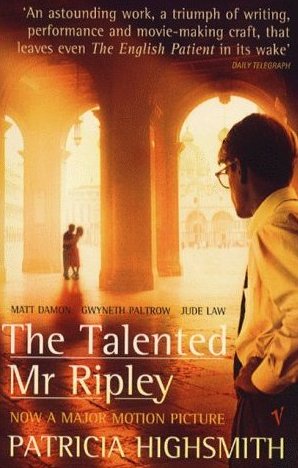
Anyway, I’ve so far picked up books by Ernest Hemingway, Joseph Conrad, Katherine Mansfield, DH Lawrence, Marcel Proust and Virginia Woolf… And the first book I chose to read for my 2008 challenge was… The Talented Mr Ripley by Patricia Highsmith.

I suppose it was a bit of a cheat, given that I’ve seen the film. My previous experiences of reading novels from which films were adapted hadn’t been entirely successful. Marnie by Winston Graham and The Commitments by Roddy Doyle spring to mind: I liked the films a great deal but didn’t enjoy the novels.

And so it was with The Talented Mr Ripley.

In fact, other than the unconventionality of having a sociopath as the protagonist, there’s little that strikes me as especially noteworthy about The Talented Mr Ripley. Highsmith seemed to want to suggest there’s an inevitability to Ripley’s murders, as if the story is a tragedy. But there was nothing I saw that’s unavoidable about them. Even Ripley’s self-justifications fail to convince on that note – he spends very little time on the reasons for the killings, and a great deal more on how he plans to profit from them.

That’s perhaps the chief weakness of The Talented Mr Ripley. The story is Ripley. It stands or falls as Ripley as a character stands or falls. Of course, he’s an unsympathetic protagonist – a sociopath and an opportunistic killer. But is it his character, or Highsmith’s skill in depicting it, which keeps you reading? I suspect it’s merely a desire to see how it all comes out in the end. You expect Ripley to be caught and to pay for his crimes… but you also have a feeling he’ll get away with it. It’s that seesawing expectation which pulls you along to the story’s climax. And as plot-engines go, it’s not a very powerful one.

In some respects, The Talented Mr Ripley is not unlike an episode of Star Trek – no matter what happens, you have to end with the principals safe and sound for next week’s installment. Ignoring the fact that Highsmith did write more Ripley books, you still get that same feeling throughout The Talented Mr Ripley. It’s as if she decided early on that he’s too good a character to throw over a waterfall.

Ah well. Perhaps I started The Talented Mr Ripley with too high an expectation. The film promised more than the book delivered. I should know better, of course. We’ll have to see what happens with February’s choice…


1 Comment

The Naming of Parts

Call it what it is.

Science fiction: that genre of literature spawned from the community of writers and readers based about the magazine Amazing Stories, first published in 1926. Often abbreviated to sf, but never to sci-fi.

Sci-fi is considered a pejorative by science fiction fans. Perhaps because it’s used to put down sf works by some outside the genre. It might well be time we claimed the term back for ourselves.

It’s not speculative fiction. All fiction, irrespective of genre, is essentially speculative. Calling something speculative fiction (or spec fic) is just a feeble attempt at disguising its true nature. Why be embarrassed about enjoying science fiction? You can call them pommes frites, but they’re still bloody chips.


4 Comments

The Survival of Artistic Modes…

In an interview at Focus on Science Fiction and Fantasy, author Jack Campbell (AKA John G Hemry) says: “I think SF has a good future as long as it doesn’t take itself too seriously. By that I mean it has to remain focused on telling the story, rather than trying to be Literary.”

Which is where I do my impression of Ben Kingsley from Sexy Beast (here: warning – not for the easily offended or faint of heart.)

Rather than refuse to take itself seriously, science fiction needs to grow up. The word “literary” (capitalised or not) is not an insult, and should not be used as such. It is an aspiration. As long as sf continues to trivialise itself and its ambitions, then it will be seen as the province of children and sad nerds in anoraks. And that’s an image those of us who are serious about the genre having been trying to throw off for decades.

Just because mainstream critics and readers sneer at science fiction, that’s no reason for reverse snobbery. That’s no reason to take the complaints levelled at sf by mainstream critics and proudly claim them as the genre’s defining characteristics. We shouldn’t celebrate crap characterisation. We shouldn’t claim that lumpen “transparent” prose is superior to any other form. We shouldn’t privilege “idea” because it’s unique to the genre – and so that’s a competition we’ll always “win”. Neither should we privilege world-building, just because that’s an area in which we’ve had so much more practice…

I’m not saying we should dispense with story, or no longer consider it important. But neither should other aspects of fiction be ignored. Science fiction is not exempt from the rules of good fiction. If anything, it’s harder to do well because there is so much more which must be done well to succeed.

Also, it’s not about the genre surviving. Genres evolve, and that’s how they survive. It has nothing to do with taxonomy, or what letters publishers put on the spine of a novel. It’s about individual works surviving. A century from now, will people still be reading supermarket bestsellers? Or will they be reading the “serious” works? The history of literature so far suggests the latter. I don’t see any penny-dreadfuls still in print… but Dune is, 42 years after its first publication.

Science fiction is capable of so much more than trivial action-adventure tales dressed up with spaceships, aliens and robots. Why limit ourselves? I mean, isn’t that the whole point of sf? That there are no limits?


8 Comments

Last of the Favourites Challenge – Dhalgren, Samuel R Delany

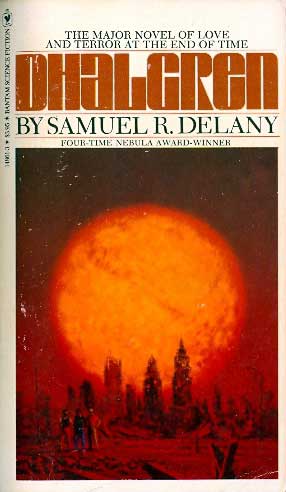
People either love or hate Dhalgren. This is not all together surprising – it’s an experimental novel, it’s pornographic in parts, and it’s only peripherally science fiction. On its publication in 1975, some sf commentators hated and condemned it. Harlan Ellison said, “When Dhalgren came out, I thought it was awful, still do… I was supposed to review it for the L.A. Times, got 200 pages into it and threw it against a wall.” (Ellison hating it is a good reason to like the book, if you ask me.) And yet Dhalgren proved to be Delany’s biggest-selling novel, finding a huge audience outside the genre.

The plot, what little of it there is, is simple: a young man who cannot remember his name enters the city of Bellona. Some catastrophe has taken place there, and only there, reducing the city to a post-apocalyptic urban wasteland. In this wasteland live a few hundred anarchic survivors. There is a commune of do-gooders in the park, gangs of scorpions roaming the streets, and Roger Calkins, publisher of the Bellona Times freesheet, lording over it all from his walled mansion. The young man – who is quickly named Kidd, the Kid, or Kid – meets various of Bellona’s residents. He helps the Richards move apartments. They are trying to continue their lives as if everything were normal, but it’s proving very difficult. Kid enters into a relationship with harmonica-playing Lanya. Eventually, he ends up as the leader of a nest of scorpions. And he becomes a poet, and has a book of poetry published by Calkins.

The prose operates at a very detailed level, with almost every itch, breath, or passing thought documented. Occasionally, it’s clumsy. Sometimes, it’s serviceable. Mostly, it’s good, but never quite brilliant. The characters are, by their very nature, chiefly ciphers. Bellona itself is probably the best drawn character in the novel. Some of the cast are merely mouthpieces. The prize-winning poet, Ernest Newboy, for example. The name itself is a giveaway. At several points in Dhalgren, Newboy discusses poetry with Kid – both the writing of it and people’s responses to it. I haven’t read enough of Delany’s non-fiction to spot if Newboy is reiterating Delany’s own theories. I doubt it, because Newboy’s theories are pompous twaddle. For instance, he tells an anecdote about how his appreciation of two writers was changed by personally meeting them. The work of one he found bland and dull, but after interviewing the writer, revised his opinion – he could now hear the author’s voice when he read, and what was anodyne he now saw was ironic and incisive. And vice versa for another writer, whose work he had always admired, but found near unreadable after getting to know the author. It’s complete and utter rubbish, of course. You might as well expect a soap opera star to behave in real life the same as the character they play on television…

Dhalgren is only peripherally science fiction. No explanation is given for the catastrophe which has befallen Bellona. The various hints Delany gives are not rational – a second moon in the night sky, a day when a vast sun fills the sky, the way the city seems to randomly change, the unreliable nature of time within the city… I’ve seen it suggested that much of this can be explained through Kid being schizophrenic. But there are other sfnal elements in the novel. The scorpions are so called because they wear holographic “light shields”. These were initially holograms of scorpions, although by the time Kid arrives in Bellona they’re all manner of colourful and mythical creatures. This use of science fiction ideas, without the underlying process, is what angered some sf commentators – Delany was breaking the “rules”.

But it’s not just the “rules” of science fiction that are broken in Dhalgren. Many of the “rules” of fiction are also carefully broken. The voice is third person, but occasionally lapses into first person. The final section “The Anathemata: A Plague Journal”, is presented with interlinear comments, and in parts reads like an edited manuscript. Kid’s character too is very different to that presented in the rest of the novel. The novel’s opening line, “… to wound the autumnal city” is actually the latter half of the novel’s last line. The narrative’s chronology is confused and confusing – Kid loses entire days at a time, and yet the novel’s timeline never quite adds up.

One of the interesting aspects of Dhalgren is not that you find something new every time you read the book, but that you consider the book itself anew. Each reread changes how you think about the novel as a whole. This time, I found many of the characters less appealing than I’d remembered. Newboy was a pompous arse, astronaut Captain Kamp (based on Buzz Aldrin? in places, he seemed to be) was patronising, George Harrison was almost a caricature, and most of the scorpions were unlikeable yobs. And yet, on this read, I learnt something new about Dhalgren: it is filled with references to Greek and Roman myths. Such as the opening scene, in which Kid has sex with a woman and then visits a grotto and finds a strange chain of prisms and lens – a reference to Daphne. In many parts of the novel, Kid’s story references that of Apollo. Dhalgren is more myth than literature, and in some respects its construction reflects that.

I still find the novel fascinating. There’s something primal in the story which appeals to me. As post-apocalyptic novel, it’s completely different to George R Stewart’s Earth Abides. Dhalgren is never dull. It hasn’t even dated, because it’s one of those sf novels – like van Vogt’s Undercover Aliens – which carries the time it was written around with it, irrespective of, and in addition to, the time in which the story is set.

So, that’s it – I read one of my favourite science fiction novels in each month of 2007. I’m glad I did. It went something like this…

January: Undercover Aliens, AE van Vogt (1950)
This one remains a favourite. Every time I read it, it never disappoints – perhaps because it has no pretensions, so my expectations are always met. It’s a lot of fun.

February: The Ophiuchi Hotline, John Varley (1977)
Whereas this one did disappoint a little. This time, I found the characterisation thinner than I’d remembered it, and the multiple copies of Lilo a little unnecessary. There are still a lot of great ideas in the book, though – even if the best one is thrown away in the last couple of pages. All the same, it’ll stay a favourite.

March: Stations of the Tide, Michael Swanwick (1991)
The first one to get demoted. I remember being blown away when I first read Stations of the Tide back in the early 1990s. Sadly, I wasn’t this time. Refusing to name the protagonist now seemed like a gimmick, parts of the story were lifted straight from a Southern Gothic, and the sections set in the Puzzle Palace were confused and confusing. A very good book, yes; but not a favourite any more.

April: Where Time Winds Blow, Robert Holdstock (1981)
I was in two minds about this one. The central conceit – Kriakta Rift, where strange winds blow through time, depositing unknowable artefacts from past and future – is a stunning invention. The central triumvirate of characters are handled with skill and compassion. But. But. But. It’s that last section, where the time winds are “explained”. It sort of spoiled it for me. On balance, however, I think it remains a favourite – because the first three-quarters overshadow the final quarter.

May: Soldier, Ask Not, Gordon R Dickson (1967)
Another book gets relegated. I bunged this one on the list to make it up to twelve, and chose it chiefly from fond memories of the trilogy and a recollection that this was the best of the three. And so it is. Unfortunately, those fond memories were a little rosier than I’d guessed. Dickson seemed more concerned with his historical theories than he was with his story, and the end result reads like a pulp sf action-adventure tale wrapped around some oddball lecture.

June: Kairos, Gwyneth Jones (1988)
This novel was once described to me as “a beautiful book badly written, or a bad book beautifully written”. The remark impressed me at the time – I was a callow youth then. Kairos is actually neither. Like many literary sf novels, there are sparkles of beauty and brilliance in its prose. But more than that, it is tightly plotted and the characterisation is superb. The story unfolds with the same remorselessness with which the eponymous drug unravels the world of the story. A favourite it is and a favourite it shall remain.

July: Against A Dark Background, Iain M Banks (1993)
Like Undercover Aliens, this one appeals because it’s fun. And every time I read it, it’s still fun. Not content with charging headlong through space opera tropes, Banks also subverts the standard fantasy quest template. Each time Sharrow wins a new plot coupon, she goes and loses it or has it taken from her. And yet Against A Dark Background is not in the least bit a frustrating read. Still a favourite.

August: Metrophage, Richard Kadrey (1988)
I’ve maintained for many years that the publication of Metrophage locked and bolted the door on cyberpunk. There was nothing more that needed to be said. Neal Stephenson’s piss-take of cyberpunk, Snow Crash, was only a bit of fancy icing on the cake – all sugary colour and no substance. And yet, rereading Metrophage, it occurred to me that what Kadrey had actually done – as I wrote in my original post on the book – was fold cyberpunk back into science fiction. Still a great novel, still a favourite.

September: Coelestis, Paul Park (1995)
There’s no doubt in my mind about this one. Each time I read it, it impresses me more. It stays a favourite.

October: Dune, Frank Herbert (1965)
I had to add two titles to my original list to make it a year’s worth of reading. And while I’ve read Dune many times, and enjoyed it each time, I’ve never really held the book in high enough regard to consider it a favourite. For one thing, it’s the start of a series, but not the strongest book in that series. But I decided to add it to my favourites challenge and… my opinion on it remains unchanged. I read it, I enjoyed it, I’ll likely read it again. I like Frank Herbert’s writing a great deal… but he’s written better books than Dune, and has written books with better writing in them than in Dune… Unfortunately, the Duniverse overshadows all his other creations. For the time-being, Dune will remain on the list. But at the bottom, ready to be relegated should another sf novel really take my fancy.

November: Take Back Plenty, Colin Greenland (1990)
I’d forgotten how good this novel really was. I’d remembered the too-pat ending, though. But that’s minor. An engaging heroine, a clever homage to pulp sf, and some lovely prose. This books deserves to back in print. It remains a favourite.

December: Dhalgren, Samuel Delany (1975)
See above. Yes, Dhalgren remains a favourite.

So there you have it. Of the twelve books, two didn’t make the grade, and one is ripe for relegation. I still have that list of also-rans, which I may work my way through. Having said that, the few from it I did read last year weren’t good enough for promotion. But then the list was chiefly put together from nostalgia, which is never a good indicator…


Leave a comment

One Year Ends…

… and another one begins.

2007 was a bit of a mixed bag. Book-wise, I read 175 books, but bought more. Both figures are up on last year. I need to spend less money on eBay. Mind you, I’ve been saying that for years. However, new to 2007 were books on the Apollo programme and mediaeval Arabic literature. Hopefully, those two “enthusiasms” should keep me going through 2008, and so limit my book purchasing…

Of those 175 books read, around half were science fiction. Brian Aldiss and Lawrence Durrell tied as most-read authors (5 books each), closely followed by Eric Brown with 4 books. Actually, Alan Moore was most-read, but that was graphic novels (11, in fact). Prior to 2007, all I’d read by Moore was Watchmen (excellent) and Batman: Killing Joke (meh). But last year I discovered Tom Strong, and loved it. Other authors new to me in 2007 were John Jarmain (see here and here) and Leigh Brackett. I can’t read more of the former – I’ve read everything of his that has been published – but I will read more Brackett. There were other writers new to me, but those two are the notables ones.

On the music front… myself and a friend, Craig, resolved in January last year to attend one gig a month during 2007. That plan fell flat – the first band we saw live was Mostly Autumn in April. But by the end of the year, I’d managed seven gigs and a metal festival. Not counting those at the festival, here are all the bands I saw perform in 2007: Glow, Mostly Autumn, Ted Maul, Cephalic Carnage, Akercocke, Kramer, Blind Ego, Pallas, Engel, Amon Amarth, Dimmu Borgir, Sonic Syndicate, Caliban, Dark Tranquillity, Soilwork, Ella, Fell Silent, The Final Sigh, Opinicus, Asuras, Coliseum, Pelican and High on Fire. The festival was Bloodstock Open Air… and I enjoyed it so much I’ve already booked tickets for 2008.

Films – since leaving the United Arab Emirates in 2002, I’ve been really crap about visiting the cinema. Admittedly, it was easy there. I lived around the corner from the best cinema in the city, and finished work at 3 o’clock, so it was easy to catch the afternoon showing. I usually had the auditorium to myself, too. With the exception of The Golden Compass, seen at a cinema in Leeds on 23 December, every film I watched in 2007 was on DVD or telly. Last year, I also became a fan of the films of Elia Suleiman, Werner Herzog and Ingmar Bergman.

I started writing short stories again in 2007. Not many – I was never prolific. In fact, that’s one of my resolutions for 2008 – be more prolific. One story racked up five rejections – including the dumbest rejection ever. Another one… I’ve still not heard back from the magazine. Fingers crossed. I also had a bash at poetry in 2007. Not something I’ve ever done before. One last buff and polish, and I think I’ll submit it somewhere this year. And, of course, there’s the novel… (It’s almost done, John.) Book two of a trilogy, and better than the first one, I think. Could this be the year? If I kick the writing into high gear, then perhaps it might be…