It Doesn't Have To Be Right…

… it just has to sound plausible


2 Comments

Lies, Damned Lies and… Lesson Plans

They say history is written by the winners. We’ve hardly “won” the war in Iraq, but the government is already trying to get their own version of it down in the history books. According to a lesson plan commissioned by the Ministry of Defence, Iraq was invaded because it had not curtailed its WMD programme. The invasion was also, apparently, “necessary to allow the opportunity to remove Saddam, an oppressive dictator, from power, and bring democracy to Iraq.”

Let’s see… the WMD claim was flimsy before the invasion, and subsequently proven unsurprisingly bogus. And regime change as a justification for invasion is illegal under international law, so it was never used. Bush and Blair have both claimed that history will show they acted for the best. Could this be the first step in their plan to ensure that this will be the case?

There are enough lies and distortions in the history books already. What do a few more matter? We live in a fictional world anyway – the future exists only in sf; the present is increasingly becoming the product of propaganda and spin, and so might as well be invented; and the past has always been open to interpretation, distortion and fabrication. At the very least, it adds an interesting dimension to consensus reality.


2 Comments

Black Man / Thirteen

When I started this blog, it was not my intention to post reviews of the books I read. Well, not unless they were part of some annual “challenge” I’d set myself – and where I’d be charting my response to the challenge as much as writing about the books themselves. There are plenty of other places to find book reviews – both on and off the tinterweb. (Including my other blog, A Space About Books About Space, which is specifically about non-fiction books about the Space Race.)

However…

At some point during the Easter weekend, I’ll likely be voting on the novels shortlisted for the BSFA Awards. Unusually for me, I’d read half of the shortlist before it was announced. And I’ve now read another two from it – Black Man by Richard Morgan and The Yiddish Policemen’s Union by Michael Chabon. And here’s what I thought of them…

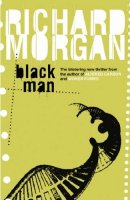
When a novel opens with a man on a spacecraft travelling between Mars and Earth eating the other passengers in order to survive, you know it’s not going to be an easy read. And so Black Man proves. Morgan‘s premise is that some 20,000 years ago humanity bred some sort of super alpha male out of the gene pool as the type was not suited to the newly-created mode of agrarian civilisation. But during the late Twenty-First Century, various nations genetically engineered a generation of these “variant thirteens” to be super-soldiers. In the UK, they were known as Osprey, and in the US as Project Lawman. Later the programmes which had created them were outlawed, and the surviving variant thirteens restricted to secure reservations.

But not all of them.

Some were exiled to Mars. One of them, Carl Marsalis, went to Mars but returned. He now works as an agent for the United Nations, tracking down and killing rogue variant thirteens. One such rogue has escaped from Mars – the cannibal mentioned earlier – and is now on a killing spree in the US. Marsalis is co-opted by COLIN (Colony Initiative), the pan-national agency responsible for the settlement of Mars, to find the killer.

Morgan pulls no punches. His US of the Twenty-Second Century is a grim, corrupt and selfish place. It’s two parts American history to three parts a European’s view of the country as it is now. The North and South have split, and the South is now a backward Bible-bashing regime cynically known as “Jesusland”. The Western seaboard has also seceded, and remains the economic and industrial powerhouse of the continent. From this side of the Atlantic, it seems all too frighteningly plausible a future.

Black Man is also an extremely violent novel. You have to wonder what Anthony Burgess would have thought – the forty-year-old A Clockwork Orange‘s “ultra-violence” seems tame in comparison to that in Black Man. Of course, the violence is there because the variant thirteens are sociopathic killers. I’m not quite convinced such behaviour would have been useful 20,000 years ago, never mind during the late 21st Century. And to have one as a sympathetic protagonist and another as an immoral villain is a difficult balancing act. Morgan pulls it off – just about. He perhaps uses the fact that Marsalis is a Brit a little too much as justification for his more sympathetic character. No reader, of course, would identify with a true variant thirteen – although I’ve seen blustering reviews by one or two on the Web who seem to think they’re kindred alpha male souls. It’s all bollocks, of course (no pun intended). Marsalis might as well be an alien – and as any sf writer knows, make your alien too alien for your readers… and you’ll have no readers. Morgan is a smart enough writer to know that Marsalis can’t carry the story if he hews too close to the line of his central premise.

There are other viewpoint characters – such as Sevgi Ertekin, a Muslim Turkish-American COLIN detective; her partner, Tom Norton; and even a believer from Jesusland working illegally in California, Scott Osborne, who gets caught up in the plot (and later disappears from the story, only to pop up near the end). To me, Ertkin seemed more like a stereotypical NYPD cop, and not that much different from Olivia Benson in Law & Order: Special Victims Unit. Her background struck me as one of Black Man‘s few weak notes – as well as the unfortunate inspiration for some unnecessary and over-long info-dumps when the story takes the characters to Istanbul.

World-building and premise aside, Black Man is a tautly-plotted thriller. Morgan is in control of his material throughout the story. Perhaps one or two of the clues necessary for resolution are a little too peripheral, making the scenes in which they appear seem somewhat unnecessary. But that’s a minor quibble. The writing is strong, with several nice turns of phrase. I wasn’t entirely convinced by the central premise – or rather, I wasn’t convinced that variant thirteens would ever be useful or necessary. I suppose that’s little different to believing time travel will ever be possible, but I’m not sure I can let it go enough to choose the novel above Alastair Reynold’s The Prefect or Michael Chabon’s The Yiddish Policemen’s Union.

My thoughts on The Yiddish Policemen’s Union to follow soon…


Leave a comment

Game Over

Gary Gygax, co-inventor of Dungeons & Dragons, and thus the concept of the role-playing game, has died. I was introduced to D&D in 1980, although I never became a big fan of the game. Its rules were torturous and overly complicated, and its background was little more than a mix and match of high fantasy clichés.

I was a big fan of role-playing games, however, throughout my teens and twenties. But the science fiction ones – especially GDW‘s Traveller. And later their Space: 1889 and 2300AD. I still own a substantial collection of rulebooks for those three games – including all of Traveller‘s incarnations.

During my late-twenties, I was a member of a role-playing games club in my home town. We’d meet every Sunday in a room belonging to a parish council’s community centre. Usually, a number of campaigns in different RPG systems were being played on any one Sunday – Runequest, Pendragon, AD&D, Tunnels & Trolls, Champions, Traveller… But we didn’t always play RPGs.

One Sunday, most of us actually playing a WWI aerial dogfighting game, using model biplanes on sticks on a table-tennis table. Two blokes walked into the community centre, and asked by name for the organiser of the club. They then told him that they believed role-playing games were “bad for our spiritual well-being” and they were planning on asking the parish council to refuse us the use of the community centre. We tried to explain that they were wrong, but they wouldn’t listen. It was clear they’d been expecting to find a bunch of sixteen-year-olds worshipping Satan, instead of a group with an average age of twenty-six playing with aeroplanes on sticks. But even that didn’t change their minds.

The two bigots – there’s no other word for them – did as they’d promised. The club was banned from the community centre, and subsequently split up.

Soon after, I stopped playing RPGs. And years after that, I learnt that GDW, the games company whose products I’d liked the most, had gone bust. Killed, ironically, by a game invented by Gary Gygax.

This was Dangerous Journeys. Which, to tell the truth, was actually pretty good. I have the six rulebooks published for it. I also have the six issues of Journeys, the GDW-published magazine dedicated to it. The game was intended to take place in a multiverse, covering multiple genres, but GDW went under after only the fantasy mileu had been published.

Gygax also wrote a trilogy of novels set in the game’s world – The Anubis Murders, The Samarkand Solution and Death in Delhi. Gygax‘s prose is barely serviceable, but I found the background quite interesting. PlanetStories have now republished these, plus a previously-unpublished fourth novel in the series, Infernal Sorceress. One of these days, I’ll see what it’s like – I owe that much to the inventor of the hobby that kept me entertained throughout my teens and twenties…


2 Comments

The Future’s So Bright

A couple of nights ago, I watched Wim Wenders’ Until the End of the World for the first time in many years. I first saw this film back in, I think, late 1993 or early 1994. I thought then its depiction of 1999 was one of the most realistic and plausible depictions of the near-future I had ever seen.

But that was before the year in which film is set. I’ve now watched it again almost a decade after the year in which it is set…

Wenders apparently wrote Until the End of the World to be the “ultimate road movie”. It’s set in the months leading up to the start of the new millennium. An Indian nuclear-powered satellite is out of control, and could fall from orbit, causing widespread contamination. Claire Tourneur (Solveig Dommartin) is returning to Paris from Venice when a traffic jam prompted by the impending crash of the satellite forces her off the beaten track. As a result, she is involved in an accident with a pair of friendly bank robbers. After giving them a lift to the nearest town – her car survived the crash, theirs didn’t – they ask her to take their ill-gotten gains to Paris for a 30% cut. En route, Claire then meets Trevor (William Hurt) and gives him a lift to Paris… but he steals some of the money.

The film then develops into a chase, with Claire and her boyfriend Gene (Sam Neill) following Trevor to retrieve the stolen, er, stolen money. Trevor is also being chased by bounty hunters, since he apparently stole an expensive prototype camera from a US lab. This camera records the brainwaves associated with seeing. Trevor is using the camera to record his relatives for his blind mother (Jeanne Moreau). The film finishes up in the Australian Outback, where Trevor’s father (Max von Sydow), the inventor of the camera, has a secret lab.

Then the Indian nuclear-powered satellite explodes, causing an electro-magnetic pulse which wipes out all unshielded electronic equipment…

When I first saw Until the End of the World, I was very taken at the way in which it showed technology integrated into everyday life. Cars had electronic maps on their dashboards, computers were small and portable, videophones were the norm, software programs had animated avatars as user interfaces and could search global data… And yet other aspects remained unchanged. Cars looked a sleeker but a lot of old models were still being driven. Cities appeared to have changed very little – more neon and glass, perhaps, but no real substantial changes. And the way in which people lived their lives had not altered…

Science fiction has never been about predicting the future – that’s futurism. But watching Until the End of the World now, eight years after it was set, seventeen years after it was made… it’s interesting seeing just how close Wenders was.

Cars do indeed have electronic maps on their dashboards – GPS. Desktop computers have not changed greatly in appearance in ten years (unless you include the introduction of TFTs), but laptops certainly have. They are a great deal smaller and more powerful than they were in 1991 – the Asus EEE, for example, is 22.5 x 16.5 cm. Admittedly, the animated GUI for the search programs shown in the film are crude; modern CGI is far more sophisticated and realistic. But the search through global data itself is not so far from Google and the like – don’t forget that when Until the End of the World was released, the WWW did not exist. And while videophones have yet to really catch on, mobile phones with cameras are common, as are webcams.

Despite this, the film still doesn’t feel like it was actually made in 1999. There are enough near-misses to indicate its true age. And, of course, the central conceit, the camera which records brainwaves, is pure science fiction.

It’s still a damn good film, however. I’m not sure I’d call it a favourite – the plot feels a little like two stories badly-welded together, and both William Hurt and Solveig Dommartin seem curiously blank throughout. And the edition released in the UK has no subtitles, despite there being a lot of French dialogue (which is a little too fast and fluent for me). But I’ll certainly watch it again.


8 Comments

The Heart of Matter

NOTE: THIS POST INCLUDES SPOILERS

Matter is Iain Banks‘ first Culture novel since Look to Windward in 2000. So there was a great deal of eagerness – and not just by myself – when it was announced. Orbit clearly realised that Matter‘s publication was an event – Waterstone’s has been selling the hardback at half price since a week or so before the official publication date.

There are, it has to be said, a certain number of things you expect to find in a Culture novel. And one of those things is a Big Dumb Object. In Matter, this is the Shellworld called Sursamen, which consists of a series of vast concentric spheres, each of which is in effect a planetary surface. Shellworlds were built for reasons unknown by a race which has long since vanished.

The Sarl, a human race, live on Sursamen’s Eighth level. They are at war with the Deldeyn, another human race, from the Ninth level. Ferbin is heir to the throne of Hausk, a cod-mediaeval Sarl kingdom. He’s more of a playboy prince than a suitable candidate for ruler, however, so when Ferbin inadvertently witnesses his father’s murder after a battle, he flees for his life. He determines to seek help from Xide Hyrlis, a Culture representative who had been a friend of King Hausk many years before. He also decides to track down his sister, Djan Seriy, who left to join the Culture, and now works for Special Circumstances.

There are three main narratives in Matter, centred on the three surviving offspring of King Hausk. Ferbin and his manservant Holse escape Sursamen and track down Hyrlis. Djan Seriy returns to Sursamen to learn the truth of her father’s death. And Oramen, youngest son and now prince regent, follows the invading Sarl army to the Ninth level and the Nameless City, an ancient metropolis slowly being revealed by the great Falls of Hyeng-zhar.

King Hausk’s murder, the war against the Deldeyn of the Ninth level… these are all part of a conspiracy orchestrated by Hausk’s trusted adviser, friend and murderer, tyl Loesp. He is working for the Oct, the alien race which control part of Sursamen. Their objective is not revealed until a good three-quarters of the way into the story, and its result is certainly not the intended one.

The Oct are mentored by the Nariscene, who are in turn mentored by the Morthanveld. Whose civilisation is equivalent in technology and advancement to the Culture. This civilisational hierarchy is important to the plot of Matter.

Iain Banks is one of the most interesting writers currently working in science fiction – but only in the sense of science fiction as a branch of literature. He’s not really an ideas man. Yes, the concept of the Shellworld is pretty impressive… but it’s been done before – in Colin Kapp’s Cageworld quartet. In fact, if anything, Banks has a tendency to pick up current ideas and slot them into his fictions, whether they fit or not. Look to Windward introduced nanotechnology to the Culture; and Matter introduces cyberspace. Neither had been mentioned prior to their appearances in these novels, and yet they are treated as if they had always existed. Which does make their sudden inclusion seem a little odd.

In some respects, the hierarchy of civilisations mentioned above also has the feel of an add-on required for Matter‘s plot to function – it’s not only reminiscent of David Brin’s Uplift novels, but it all seems so much busier a universe than earlier Culture novels had suggested. But denying the possibility of such additions and changes does smack a little of the “clomping foot of nerdism”. Fictional universes are as flexible and adaptable as required by the story.

What makes Banks really interesting is that his sf novels are not just simple action-adventures in a space opera setting. There’s enough detail in there to attract those who want immersion in a made-up universe, but he’s not one to slavishly follow genre story templates. Use of Weapons features two narratives running in opposite directions chronologically; Against A Dark Background has a quest plot, in which the protagonist loses every plot coupon shortly after winning it… but still manages to finish the course (but I’m not convinced that was done knowingly).

Having said that, Banks is less adventurous with the structure of Matter. It is, for much of its length, relatively traditional – something of a picaresque travelogue, albeit juxtaposed with high fantasy wargames on Sursamen’s Eighth and Ninth Levels… However, Matter ends with an appendix – a completely unnecessary dramatis personae and glossary. And after that, an epilogue. Which changes the final shape of the story. The appendix is there to hide the epilogue. Now, that is an interesting choice.

Banks usually has something interesting to say, too. Matter is no different in this respect. And, if I’m reading the novel right, it’s about Iraq, about whether so-called “developed” nations have the right to meddle in the affairs of other nations. The parallels are clear – should the Culture interfere in Sursamen? Unfortunately, Banks’ message is muddled. Matter‘s prologue shows one such intervention by Special Circumstances, and that later proves mostly successful. But the Culture’s refusal to interfere in the situation in Hausk – especially given how it progresses; and they are watching it, after all – leads to a situation which could destroy everything. The epilogue shows the Culture changing its policy.

This, then, is the message from the writer who chopped up his passport over the invasion of Iraq. According to Matter, he’s now saying it is good to interfere – if the interference prevents slaughter and destruction. Or perhaps he means only to interfere in the interference of the Oct, which has caused slaughter and destruction? Banks has pre-built the moral high ground into his universe – the more evolved civilisations, the Involved, are more advanced and therefore more moral. That’s part of evolution, after all. So it’s okay for moral – or advanced; or, perhaps, “developed” – civilisations to interfere, Matter seems to be saying, but not for less evolved ones. That’s not a good message. Because Banks’ universal hierarchy is a cheat – morality is treated as if it were a physical law, as if a civilisation accrued some kind of wavicles of morality as it progressed and aged.

Other areas of Matter worthy of comment… It is very talky. Characters waffle a lot. They often repeat themselves. The novel also suffers from a sudden flurry of small resolutions as the end approaches. Banks’ digressions are often his best bits – and some of the digressions in Matter are among the best he’s done – but it does mean that his climaxes frequently feel rushed. It does here. And, there is throughout the novel odd verbings of nouns and nunation of adjectives. Banks in part explains this, having Djan Seriy say the Sarl sometimes use “words oddly” – “we guilt you”, “he has been jealoused”. But there are occasions where even that is no defence – the neologism is neither in dialogue, nor even in a narrative set on Sursamen or featuring a Sarl character.

Oh, and why does Matter have double quotes for dialogue throughout, when normal British practice is single quotes?

One of the reasons Banks is an excellent writer is that despite all the above I liked Matter a great deal. It’s likely to be one of the most interesting sf novels published in 2008. Whether that makes it one of the best, I don’t know. Depends what else I read, of course. Unlike The Algebraist, Matter did not disappoint.

1 Comment

I Did This So You Don’t Have To – Part 2

Here’s the next set of films from the SciFi Classics 50-Movie Pack.

Attack of the Monsters – another Japanese monster movie. Three kids find a flying saucer, two of them climb aboard and are whisked away to another world. They see a giant monster with a sword on its head fight a giant pterodactyl. Then they’re rescued by two women in futuristic costumes, and taken into the women’s base. But the women are evil, and want only to conquer Earth. Happily, Gamera the giant flying turtle arrives, kills the monster with the sword on its head, and saves the day. If you want to watch a Japanese sf film, watch The Mysterians. Not this.

Voyage to the Prehistoric Planet – this film was created from a re-edit of the Russian film, Planeta Burg, with English dialogue recorded over it and a couple of scenes featuring Basil Rathbone added. A US spaceship arrives in orbit about Venus, but the first landing mission crashes. So a second one is launched to rescue them. While the film is badly-paced, and the story doesn’t make a great deal of sense, it all looks pretty cool. Well, except for the dinosaurs, which look like men in rubber dinosaur suits.

Voyage to the Planet of Prehistoric Women – this one uses the same footage as Voyage to the Prehistoric Planet, with the mystifying addition of several scenes featuring Mamie van Doren and a bevy of beautiful women in bikinis who are apparently the telepathic inhabitants of the planet. Their scenes don’t actually seem related to the rest of the film. Much of the movie is narrated by “director” Peter Bogdanovich. Voyage to the Prehistoric Planet was interesting but a bit dull; Voyage to the Planet of Prehistoric Women is near unwatchable.

Blood Tide – another one that wasn’t sf at all. James Earl Jones hams it up as a poet-turned-treasure-hunter on some Greek island. There’s an ancient temple accessible only via a sea cave, but it has some horrible guardian. Newcomers try to horn in on Jones’ treasure-hunting, the sea monster awakens, and the ancient temple is destroyed. A better transfer would have greatly improved this film. It didn’t actually appear that bad – although it was hard to tell at the time as the picture and sound were so poor.

First Spaceship on Venus – this is actually a badly-dubbed version of the East German film, Der Schweigende Stern (The Silent Star). Scientists analyse the debris of huge meteor impact, and discover a recording from a crashed spacesuit. They determine the spaceship was from Venus, and so send a mission to that planet. En route, they decode the recording. It’s an invasion plan… The production design is really good, with some excellent model work and some truly weird sets. I plan to get a copy of the original version – happily, it’s available on DVD.

Buck Rogers: Planet Outlaws – not the grinning beefy loon in a spandex girdle of the 1980s television series, this is the original one: Buster Crabbe. His prototype airship crashes on its maiden flight at the north pole, and he is frozen… and woken up centuries later. He ends up helping the inhabitants of an invisible city in their war against the evil Killer Kane. This involves such cunning ploys as hiding behind rocks, and jumping out at Kane’s men as they pass by. If you like Flash Gordon serials, then this is, well, exactly the same.

Killers from Space – Peter Graves of Mission Impossible stars as a scientist whose plane crashes during an atom bomb test. When he turns up later, no one believes his story of alien abduction and invasion. Unlike Whitley Strieber, it seems he’s telling the truth. This one wasn’t as bad as it sounds.

She Gods of Shark Reef – when the box cover says “SciFi Classics”, that’s what you expect: science fiction. By no stretch of the imagination could this film be considered that. Two gunrunners are shipwrecked on a Hawaiian island populated only by attractive women. When one of the women is chosen for the annual sacrifice to the shark god, the gunrunner who is in love with her tries to rescue her. Another film I suspect was more fun to make than to watch.

The Atomic Brain – a scientist experiments with brain transplants, including transplanting a woman’s brain into a cat, and vice versa. You can’t help but wonder how a human brain would fit into a cat’s skull, or what he used for padding when he put the cat’s brain in the woman’s skull. Judging by the woman’s acting, it was probably blancmange or something. This is the sort of film that gives B-movies a, er, bad name.

Son of Hercules: The Land of Darkness – another spaghetti sandal epic, and yet another random bodybuilder in the title roll. Except he’s not a son of Hercules, he’s actually Hercules himself. Although, for some bizarre reason, the English language dubbing calls him Argolese throughout. The blurb on the CD pack says, “Hercules falls for the daughter of a deposed king whose kingdom is held in thrall by an evil queen.” I know I’ve watched this film, but I can’t remember what actually happened in it.

Rocky Jones, Space Ranger: Crash of the Moons – this is a compilation of two episodes of a 1954 television series. It shows. Rocky’s sidekick, Winky, is annoyingly stupid. The female, Vena Ray, might prance about in a miniskirt, but she’s surprisingly assertive for the early 1950s. The special effects – apparently expensive for the time – are a little better than Flash Gordon from two decades earlier, but not much. Forbidden Planet this isn’t.

Santa Claus Conquers the Martians – the theme-tune to this film is great, a perfect piece of 1960s bubblegum pop. Sadly, it’s all downhill from there. Green-skinned Martian kids are addicted to Santa Claus on Earth television, so their parents decided to kidnap him. But Santa sets up shop on Mars, and wins everyone over with sacks full of cheap toys. I suspect that seeing the film as an allegory for the rise of Japan after World War 2 might be reading a little too much into it. Especially since it’s, well, crap.

Part one is here.


1 Comment

2008 Reading Challenge – A Surprise for February

I tried, but I couldn’t do it. In what has to be a turn up for the books (pun intended), I couldn’t finish the novel I’d chosen for February for my 2008 reading challenge. I read about a quarter before giving up. And it’s supposed to be the author’s best book too.

The book was For Whom The Bell Tolls by Ernest Hemingway. And given his stature, I never expected to dislike Hemingway’s prose so much. But… the incessant repetition annoyed me, the Spanish syntax used throughout for the dialogue annoyed me, and when the book went into an extended flashback narrated by one of the characters, I couldn’t face any more.

Ah well, I suppose it means the challenge is doing what I intended it to. I may have expected it to introduce me to authors I would like, but I never meant that it had to. Perhaps one day, I’ll watch the film, or try another novel by Hemingway. But for now, it’s time to move on…


Leave a comment

Irony in Action

They say Americans suffer from an “irony deficiency”, but I think recent events have proven that untrue.

While the neocons are busy trying to redefine fascism as left wing in order to distance their own right wing politics from such jackbooted nastiness, Bush is demanding that travellers to the US ask nicely for permission to visit from Homeland Security before booking tickets. He also wants information on passengers over-flying the US – not landing in the US, just flying over US territory.

So there you go. With each passing year, it seems the US drifts further towards the left –

No, wait.


4 Comments

Jackboots in Space

I’ve always believed that Paul Verhoeven’s response to Robert Heinlein’s Starship Troopers was the only sane one. He made a satire of it. (He also never bothered to finish reading it either, which is probably even more sane.) I saw nothing wrong in holding this opinion even though I’d never read the novel myself.

Recently, however, I decided I was being unfair, if not hypocritical. I “knew” the book was crypto-fascist, despite every mention of it on the tinterweb claiming that it isn’t.

Well, I’ve now read it. And…

Starship Troopers isn’t even a novel. It’s a lesson in military operations and Heinlein’s crypto-fascist politics wrapped in the thinnest of stories. Rico is a stand-in for the dumb reader, who is lectured in every chapter on how fair and democratic is the Federation, and how effective a military force is the Mobile Infantry. We know this because we’re told it. Repeatedly.

The plot, such as it is: Johnny Rico graduates from high school, and follows a friend into Federal Service. He is assigned to the Mobile Infantry. Earth goes to war against the Bugs. Rico fights a number of battles and rises up the ranks.

That’s it.

Military sf Starship Troopers almost certainly is. But does that make it crypto-fascist? Let’s examine the evidence (all page numbers and quotations from the 1998 NEL film tie-in paperback).

Exhibit 1:
Only veterans of the Federal Service of the Terran Federation have the vote. Heinlein apologists claim that Federal Service is not necessarily military, but this is not true. When Rico signs up, and is given a physical, the doctor says to him:

“No offense. But military service is for ants … And for what? A purely nominal political privilege that pays not one centavo and that most of them aren’t competent to use wisely anyhow.” (pp 32)

Further, the recruiting sergeant on duty when Rico signs up has no legs and only one arm. Because, he explains:

“… suppose we do make a soldier out of you. Take a look at me – this is what you may buy… If you don’t buy the whole farm and cause your folks to receive a ‘deeply regret’ telegram.” (pp 30)

Exhibit 2:
According to Heinlein, spanking produces well-mannered moral children. After a page or two discussion on the best way to raise puppies – when they make mistakes, scold them, rub their noses in it, and spank them – Rico’s “History & Moral Philosophy” teacher, Mr DuBois, explains that the same methodology should be applied to children. Because not doing this led to the lawlessness of the Twentieth Century:

“Back to these young criminals – They were probably not spanked as babies; they certainly were not flogged for their crimes … This incredible sequence could go on for years while his crimes increased in frequency and visciousness…” (pp 101)

Exhibit 3:
Heinlein directly references fascism. Once again, Rico – and thus the reader – is being lectured in “History & Moral Philosophy”. During this, the instructor explains the actual meaning of the vote:

“Force, if you will! – the franchise is force, naked and raw, the Power of the Rods and the Ax.” (pp 155)

The Rods and the Axe, of course, is the fasces, the word from which Mussolini derived the term fascism.

Exhibit 4:
Any society which is authoritarian, elitist, militarist and nationalist fits the characteristics of a fascist state. The Terran Federation as described in Starship Troopers certainly meets that description. As Mussolini himself said, “Anti-individualistic, the fascist conception of life stresses the importance of the State and accepts the individual only insofar as his interests coincide with those of the State, which stands for the conscience and the universal will of man as a historic entity.” True, Rico is in the military and at war, and so his interests are firmly aligned – by training and indoctrination – along the lines demanded by the Terran Federation. But that continues to hold true should he leave the Mobile Infantry, because only someone who has served is part of the political process.

It’s been said that just because Heinlein posits a fascist state in Starship Troopers that doesn’t necessarily mean it’s his own personal politics. For most novels and novelists, this is certainly true – Robert Harris, for example, wrote Fatherland, set in an Europe in which Germany won WWII, but that doesn’t make him a Nazi. But in Fatherland‘s case, Nazi Europe was the setting for the plot. Starship Troopers is not a story, it’s a poorly-disguised lecture. Which suggests to me that Heinlein adheres to the politics described in Starship Troopers.

I have now read Starship Troopers. My opinion on its politics remains unchanged. Paul Verhoeven’s film adaptation< is greatly superior to the book.


Leave a comment

Så får vi önska våra lyssnare, god natt och tack för i dag

I saw one of my favourite bands perform live last night, Dark Tranquillity. It’s the fourth time I’ve seen them, and I’ve no intention of it being the last. This time it was the official tour for their latest album, Fiction (I picked it as one of my best albums of the year – see here). Um, we’ve had Fiction, and before that Character… What’s next? Plot? Exposition?

Anyway, while the set obviously focused on material from the new album, they did play songs from earlier releases. Including, for the first time for me, a track from Projector, ‘ThereIn’. They also played a song from their 1995 album, The Gallery. I don’t know of many bands who will happily play old material, and introduce it with “this is what we sounded like ten years ago”.

Anyway, here’s a video from Dark Tranquillity‘s Youtube page for you to enjoy. Or not.