You want to be a writer, you want to write. But why science fiction? Of all the modes of fiction you could write, why choose sf?
You’re not going to be hip, you’re not going to be relevant. Even during the Apollo programme, sf wasn’t relevant. In 1969, Neil Armstrong was the first human being to step onto the Moon; the following year, the Hugo Award for best science fiction novel was awarded to… The Left Hand of Darkness by Ursula K Le Guin. It’s an excellent novel, but it has nothing to do with space travel. Even the year before, the Hugo went to Stand on Zanzibar by John Brunner, a novel about over-population.
You’ll not get any critical plaudits – not from outside the genre, anyway. Science fiction has been accused of cardboard characters, lumpen prose, in-yer-face exposition, and idiot plotting and, to be fair, it’s not an entirely unfair accusation. Nor is it wholly accurate. Those who claim characterisation and prose style are unimportant in sf because it’s all about the ideas, they’re nincompoops. That’s like saying eating food is not about the taste, it’s about the calories.
Sf doesn’t sell very well – in fact, you’ll probably never be able to give up the day job. And the nearest you’ll get to a jet-setting lifestyle is gazing longingly at contrails in the sky. You might get free trips every now and again, but it’s more likely to be to Derby than Rio de Janeiro. If you’re really lucky, you might be asked to appear on a television programme. It’ll be on BBC4, however, so no one will watch it.
Then there’s that blank look you’ll get when you tell people you’re a writer and they ask what sort of books you write. As soon as you say “science fiction”, the smile will congeal on their face and they’ll wander off to watch some paint dry. Unless it’s a sf fan who’s asked you, of course. In which case, they’ll probably tell you exactly what was wrong about your last story or novel. Assuming, that is, they’ve a) heard of you, and b) read it. Neither of which is guaranteed.
Then there’s all that stuff you need to be an expert in. Yes, you can just Make Shit Up, but readers’ credulity only stretches so far. And they all have different thresholds – some will just wow at the ringworld, others will (famously) work out that it’s inherently unstable. And there’s definitely a level of knowledge, especially in the sciences, below which you cannot drop. No -300 degrees Celsius on your icy moon, for example. No supernovas visible in nearby star systems at the exact moment they occur. No, er, breathable atmosphere and water oceans on Venus. The closer you get to the real world, the more you have to make sure it’s right (or, at the very least, highly plausible). Aliens, artificial intelligences, faster-than-light travel, time travel… they’re not real, so no one’s going to cavil if they don’t operate as they do in other authors’ novels. It’s often seen as an advantage if they don’t, if their workings are entirely original to your story.
Because you have to continually struggle to be original and inventive. You have to write as though everyone who reads your story or novel has read every other sf story or novel that’s ever been published. There are no shortcuts. You’ve got build an entire world, or universe, and it’s got to be entirely off the top of your head. Yes, there are tropes you can recycle, used furniture, characters from central casting, but unless you’re being deliberately knowing you won’t be forgiven for making use of them. Well, you might get away with using some, providing there’s plenty that is original in your story or novel.
But.
You probably want to write science fiction because you’ve been reading it since you were a kid. You’re a fan. You can’t even imagine writing anything else. That may well be the best reason in the world to write anything. But there are lots of other wonderful things science fiction can do. It’s a wide genre, there’s room for a whole universe of things. There’s even space in there for things that – ssh, don’t tell anyone – for things that are not really science fiction. You can pretty much set the boundaries yourself. There are all those sub-genres, for a start: space opera, cyberpunk, hard sf, alternate history… In fact, there are so many, people have been arguing about them since 1926.
Also, let’s face it, world-building is fun. You can do as much or as little as you like; you can show as much of it, or as little of it, as you like. You have a level of power over your creation no other genre can match. Many of the visuals are pretty cool too – all those eyeball kicks and special effects on the page. This is stuff you’re never going to see in real life. After all, sf is as big as your imagination. It’s only limited by what you, the writer, can’t conceive. Sort of like a reverse strong Sapir-Whorf Hypothesis. Writing sf, you not only broaden your readers’ horizons, you stretch your own as well. You can’t help it – it’s the nature of the genre.
Then there’s the whole community that comes attached. It’s a vocal community, and it can be as condemning as it can be approving. But on the whole sf readers are a friendly bunch, and they’re not afraid to make their opinions known. I don’t know if sf has the largest online presence of all the modes of fiction, but I suspect it has the largest in comparison to the size of its market.
On the whole, I think the pros outweigh the cons. It’s not just the vast canvas available for stories, but the breadth and variety of the genre itself. There’s not much you can’t do. There are no other modes of fiction which offer the same openness to different approaches or different styles. You can be as relevant as you desire. And sf has permeated popular culture so much you can even be hip, if that’s your thing.
As a writer, that kind of freedom is liberating.
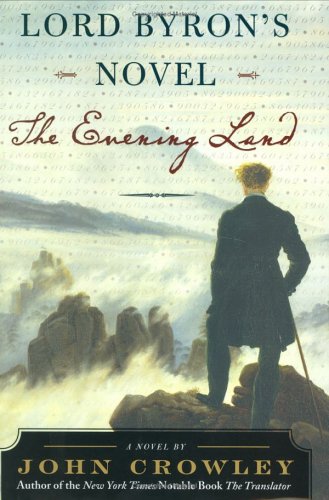 Lord Byron’s Novel: The Evening Land, John Crowley (2005). I wouldn’t be at all surprised if this makes the final best of the year list – it’s one of those novels which leaves you with an itch to reread it. Not only is it a cleverly-plotted historical detective novel, but Crowley performs an astonishing piece of literary impersonation (not, I hasten to add, that I’m an expert on Byron; but Crowley certainly convinced me).
 Troy, Simon Brown (2006). Another collection of genre-ish short stories. The book’s title is descriptive: each of the ten stories is inspired by a character from the Trojan Wars. They are literary fantasy and science fiction, and very well-written. I wouldn’t mind reading more by Brown. Most of the stories in Troy originally appeared in Eidolon, an Australian sf magazine, and the collection was published by Ticonderoga Publications, an Australian small press.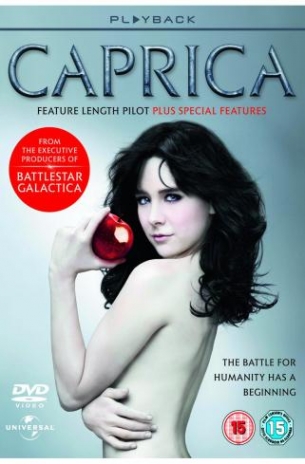
 is the new series from the makers of the re-imagined
  , and
, and 


 a few too many times. Bits of
  , starring Claire Goose of
  (review is
  , which stars, er, no one famous (review is
  It Doesn't Have To Be Right...