It Doesn't Have To Be Right…

… it just has to sound plausible


2 Comments

The Marching Morons

To all the people who read Liz Bourke’s review on Strange Horizons of Michael J Sullivan’s Theft Of Swords, and didn’t like the review because:

a) historians should not review epic fantasy
b) “intellectuals” should not review epic fantasy
c) women should not review epic fantasy
d) a negative review will upset the author
e) a negative review will negatively impact the author’s sales
f) popularity and quality are the same thing, as any fule kno
g) bad prose is better than good prose, as is demonstrated by any best-seller list
h) taking quotes from the novel “out of context” would make any author’s prose look bad
i) you read the book and enjoyed it so it can’t be bad
j) the book is meant to be “fun” and “light reading” so it can’t be bad
k) a negative review is obviously not objective since you disagree with it

Congratulations. You are officially stupid. If you want to know why genre fiction is not taken seriously, go and look in the mirror.


5 Comments

How to write a good review

First, see this review of Michael J Sullivan’s Theft Of Swords on Strange Horizons. See its long comment thread. This post is not aimed at Liz Bourke, who has written an excellent review of what is plainly a bad book. This post is for some of the commenters on that thread, who clearly don’t understand what a review is for, or how a book is reviewed.

1 A dishonest review is a bad review.
2 Not all books are good.
3 It’s not just good books that deserve reviews.
4 If a book is a bad book, it’s dishonest not to say so.
5 If a book is not a good book, it’s dishonest to refuse to review it.
6 Books can be bad for a number of reasons; most of those reason are a result of failure of craft.
7 Reviews are not written for the author of the book being reviewed; their audience is potential readers of the book being reviewed.
8 A good review is not opinion because it will contain evidence supporting its assertions.
9 Whether or not a reviewer enjoyed a book is completely meaningless, since enjoyment is unrelated to quality and is entirely subjective.
10 A review does not have to meet the expectations of people who have read the book being reviewed.
11 A review is based on a critical read of a book; this means the reviewer has probably put a lot more thought into their reading of it than you have.
12 If you come across a negative review of a book you thought was good but you did not read the book in question critically, then you are not qualified to comment on the review’s findings.


11 Comments

Your world will not be my world

I think it was Orson Scott Card who wrote in an essay in Asimov’s back in the 1990s that any future of consequence would be American. That assertion was debatable then – if not offensively arrogant – but the world has changed a great deal in the past twenty years, making’s Card’s boast even less likely. And yet still I see contemporary sf novels in which Planet Earth seems to be either monoculturally US-ian, or contains worlds extrapolated from present US society.

Science fiction is chiefly a white, male, middle-class genre and is dominated by the USA, and so its sensibilities and concerns are typically those which confirm the prejudices of that demographic. But not always, of course – back in 1991, William Barton and Michael Capobianco’s Fellow Traveler was set in a future Soviet space programme; in 2012, Alastair Reynolds’ Blue Remembered Earth opens in a future where “Africa is the dominant technological and economic power” and follows the fortunes of an African family. (There is no mention in the blurb, however, of which African nation the family are from – Africa is, after all, as monocultural as Europe: ie, not at all; and since we’d say French or German or Polish or Swedish, we shouldn’t be saying “African”.)

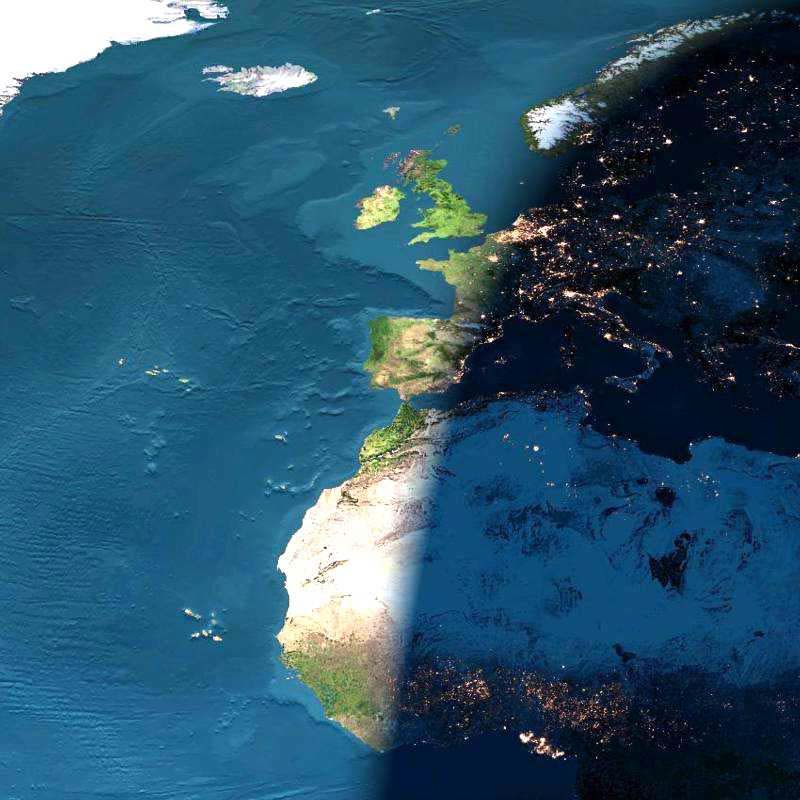
Photo taken by Columbia Space Shuttle

In reference to the near-future, sf has maintained some degree – though it could be greatly improved – of diversity of setting and cast. But anything set further hence usually devolves to the white, Western, Anglophone, vaguely US, vaguely right-wing default world carried over from the genre’s early beginnings. There’s no good reason for this. True, the US still performs much of the tentpole science, but not exclusively. The LHC is in Switzerland; the Soviets had a space station before the Americans; the Chinese may well be the first to set foot on Mars. Many nations have space agencies – indeed, out of the twenty-two past and present ESA astronauts, only one speaks English as a first language.

Even looking at the cyclical nature of empires suggests that US hegemony will no longer exist in any recognisable form by the middle of this century. Then there’s everyday technology and its uses. Such as surveillance. The US provides no good model for any future society in this regard. If anything, looking at the UK would be more useful. Twenty-five percent of the world’s CCTV cameras are in the UK. It is the most-surveillanced nation on the planet. Yet we don’t especially much care about the fact we’re always being watched. US ideas of privacy exist only in the US, and the US attitude to video surveillance does not map onto British sensibilities. It is likely that, as surveillance becomes more pervasive and ubiquitous, it is the UK attitude to it which will prevail.

Europe is also, of course, defiantly not monocultural. Its twenty-seven member states speak twenty-three official languages. Back in the day, Harry Harrison may have thought Earth, and hence any subsequent interstellar polity, might uniformly adopt an artificial language, but even the language he chose, Esperanto, has never been used routinely by more than an estimated one million people. India, a single nation, has no national language but recognises twenty-two regional languages (although the SIL Ethnologue lists 415 spoken throughout the country). History has shown that languages come to dominate areas as a result of conquest, religion, trade, or cultural imperialism; and often from a combination of all four. But that, obviously, does not mean that their dominance remains eternal: Arabic is no longer spoken in Spain, for example.

All of which suggests that science fiction has changed very little from the days of Amazing Stories, especially in regards to its in-built attitudes and sensibilities. The tropes it has developed over the generations have become shortcuts and defaults. It’s not just those galactic empires of whitebread worlds, but the technology and science and their uses. Can’t be bothered to figure out how spaceflight really works? Bung in some “thrusters” and “inertial compensators”. Can’t be bothered to design a plausible future? Just make it like the US, but with neat toys. It’s authorial laziness. Writing stories that not only cater to the prejudices of a perceived market but actively reinforce those prejudices is not something a genre which boasts of its inventiveness and transgressive achievements should be doing.

Mundane SF was seen by many genre fans as throwing the baby out with the bathwater – it’s the wildly improbably stuff like aliens and time travel which can be the most fun. But at least Mundane SF required its adherents to focus on the basics. You couldn’t just make shit up, you couldn’t just slot in those neat ideas from Tropes  R Us, you couldn’t just pretend that interstellar travel was like air travel of today or sea travel of earlier decades. You had to think about the world of your story, not just pin a few baubles on the default setting. Sadly, Mundane SF is little more than a Wikipedia entry these days, but let’s hope it had some effect on the genre.

And let’s hope that Blue Remembered Earth, the first of a trilogy, is the start of a new movement in science fiction to break away from white middle-class Anglophone futures, a move towards more plausible and more representative world-building. Let’s hope Alastair Reynold’s new novel helps pave the way to a more adult and thoughtful genre. After all, if we want to take be taken seriously by non-genre writers, we shouldn’t bitch and moan about being ill-treated, we should show them that we can be as good as they are. We’ll only ever be taken seriously if we up our game.

And we need to start doing that right now.

2 Comments

The year in my own words

In 2011, I had six stories published, and published one of my own on this blog. That makes it a slightly better year than 2010. The stories were:

– ‘Barker’ in BFS Journal: New Horizons, January 2011
– ‘Disambiguation‘ on the Alt Hist website, May 2011
– ‘The Contributors‘ on It Doesn’t Have To Be Right…, July 2011
– ‘Words Beyond the Veil’ in Jupiter 33: Euanthe, July 2011
– ‘A Light in the Darkness’ in Alt Hist #3, November 2011
– ‘Dancing the Skies’ in The Monster Books for Girls, edited by Terry Grimwood [theExaggeratedPress], December 2011
– ‘Wunderwaffe’ in Vivisepulture, edited by Andy Remic & Wayne Simmons [Anarchy Books], December 2011

For someone who characterises themselves as a science fiction writer – and appears to be seen chiefly as a writer of hard sf – that’s a varied selection. ‘Barker’ is one of my alternate takes on the Space Race, ‘Dancing the Skies’ is dark fantasy. ‘A Light in the Darkness’ and ‘Disambiguation’ are alternate history; and ‘Wunderwaffe’ is, well, it’s Nazi occult science, which is probably a genre all its own. ‘The Contributors’ is a sort of New Wavey anti-capitalist story. Only ‘Words Beyond the Veil’ is your actual hard sf – and it’s also the world’s first death metal hard sf story that quotes from the lyrics of a real death metal album.

But, of course, the big project in 2011 has been Rocket Science. I’ve taken a break from it over the past few weeks, but I shall be cracking away at it in earnest in the New Year. I think I’ve got an excellent table of contents, and anyone expecting a one-note ultra-hard sf anthology is in for a big surprise. Rocket Science will be launched at Olympus 2012, Heathrow, London, in April.

I’m also planning to launch ‘Adrift on the Sea of Rains’, the first book of the Apollo Quartet sequence of novellas, at Olympus 2012. The text is currently being edited, but an advance reader has already described the level of detail as “insane”. I took that as a compliment…

Still, I have so few laurels that resting on them would make for an uncomfortable seat, so in 2012 I plan to write and submit much more. I already have four stories due to be published during the year, but if I’m to beat 2011’s record I need more. I have several currently in progress – again, a varied selection of genres and modes – and I need to get them finished and start sending them out.

So here’s to 2012. And let’s hope it’s a good year for all.


4 Comments

The shiny new

Every now and again, a news story pops up about cameras in public – or even private – places. The latest is Aldwych Tube Station, which has been opened to the public as a museum. The owners of the museum have banned the use of DSLRs inside. They claim this is due to the cameras’ “combination of high quality sensor and high resolution”, which is patently stupid.

But then it doesn’t matter what is the reason for the ban.

It’s the same as concerts refusing entry to people with “professional” cameras or video-cameras. The owners of the event are trying to preserve their revenue stream. If someone with a camera is going to make money from the sale of photographs or video, then they want a slice of it. Or they want to make money from the sale of photographs they’ve taken themselves.

Unfortunately, that’s a horse that has long since bolted.

The technology now exists to take high-quality photographs using compact cameras, or even mobile phones. The distinction between “professional” and “own use” no longer exists, and hasn’t done for many years. Money-makers, of course, refuse to recognise this. Their inability to understand the technology, or how it is changing, and how it is changing the way people use it, is making them look increasingly dumb.

So how long before someone somewhere decides to roll back that technology?

Yes, there’s money to be made in the new shiny tech toys. But when those same toys impact on the revenue-generating ability of intellectual property – as they currently do – then someone somewhere is going to realise they were better off without them. I am not, I hasten to add, a photographer, not even as a hobby. I prefer words to pictures. But the same argument also applies to book piracy and music piracy. DRM is plainly ineffective. Each year new tools appear which make the ability of intellectual property to generate revenue more problematical.

The world this will create is already an established fact. I’m not especially interested in extrapolating how the world will change as that technology becomes more pervasive, more sophisticated and more ubiquitous. But imagine a world where the plutocrats and oligarchs introduced technological regression, a world where each new generation of a gadget had less functionality than the preceding one.

Even now, it’s easier to write stories set in earlier decades simply because some plots fail if set at the present time. Many crime stories, for example, don’t work when everyone has mobile phones, or when DNA profiling can identify a perpetrator from the tiniest amount of trace evidence. But a story about a world in which the functionality of technology, rather than technology itself, was tightly constrained… That might make for an interesting read. I mean, it’s not enough that plutocrats are gradually reducing our financial stability and purchasing power, but what if they also did the same to the uses to which we could put things? It’s not entirely implausible. While the technology can’t be un-invented, it does require expensive and sophisticated manufacturing facilities, and closing those down would do the job quite effectively.

Fortunately, it’s an arms race. Everyone is too afraid to give the advantage to a competitor. But if you believed in all those conspiracies theories – not so much the Gnomes of Zürich as the Bilderberg Group – then you could quite happily believe a technological rollback might be agreed upon.

Assuming, of course, the rate of technological progress has not been cleverly controlled for centuries…


6 Comments

The agency model of genre

The Ancient Greeks attempted to explain the world about them by applying human agency to it. Why does the sun cross the sky? Because some bloke in a chariot is pulling it. And since such feats required abilities above and beyond those normally attributable to humans, so those who performed them were deemed gods. Over time, the use of these gods as explanations became a narrative and so accreted history, politics, romance, symbolism, etc. But they still didn’t really explain what caused the sun to rise and set.

And so for fantasy. It does not seek to explain, it applies agency to something which does not, in the real world, possess it. Sometimes that agency cannot be wielded by humans – the supernatural, demons, gods and demi-gods. Or it gives humans agency over things not normally open to their use, via magic systems or supernatural talents. And those magic systems may be as structured and fractal as the laws of physics.

Science fiction, however, assumes the real world is explainable. The sun crosses the sky because the earth is turning, and the earth turns due to the action of its core. The universe operates according to a structure of interlocking principles and rules, which are not only parsable but fractal.

The worlds in science fiction stories are implicitly reachable, either by traversing time or space or both. This is not true for fantasy worlds. Yes, there are those where people from our world find themselves in the world of the story – The Chronicles of Narnia, The Fionavar Tapestry, or The Chronicles of Thomas Covenant, for example – but those are not journeys, they are magic portals. To some extent, it might be argued that similar travel to alternate dimensions, worlds or histories in science fiction might well treat such methods as magic portals, but the possibility of an explanation still underlies it. More than that, it is driven by an element of a rule-set which underlies the entire universe. The same cannot be said of fantasy.

That, I think, is the fundamental difference between science fiction and fantasy. That is why they are different modes of fiction, for all that they may share similar trappings or often use a shared toolkit. In sf, the universe is a rational and impersonal place, which operates independently of, and with no regard for, those who inhabit it (though they may engineer it for their own uses). In fantasy, everything has motivation because everything has some degree of agency, and the world exists for the benefit of its inhabitants. Their existence is part of the same act of creation which created the world. Without inhabitants, there would be no world. And everything in it is open to use by at least some of the inhabitants.

By the same token, neither genre is a subset of the other. Though they may be lumped together for marketing purposes and because the fanbases have traditionally overlapped, they have entirely different histories. The first science fiction came from electronics magazines in the 1920s; the first fantasies are a great deal older, perhaps even as old as civilisation itself. The current situation is an accident of the creative and production process for fantasy and science fiction. This doesn’t mean, of course, that they two should be sundered. Each benefits from its supposed relationship to the other. But there is a distinction, and to discuss either, or both, without recognising that benefits neither.


1 Comment

Nanowrimo: fail

Oh well. The nanowrimo novel stalled at 15,715 words a week or so ago. It was the wrong month for it. Not only was I putting together the TOC for Rocket Science, but I also had a 650-page anthology to read for review. Plus spending a weekend in Nottingham at Novacon. And November seems to be an especially good month for gigs, with four bands I want to see playing locally during the four weeks.

Also, the novel needed structure and, well, a bit more of a plot. I still think Into The Dark is a workable prospect, but writing it from the top of your head is not the way to go about creating it. Too many people – and nanowrimo fosters this attitude – think writing is about words. It’s not: it’s about the right word. I like to live with my story and my characters during the writing process – and “writing process” doesn’t always mean sitting in front of the computer and banging on the keys. If you know what you’re doing, if you have it all plotted out, if you’ve done your research, if you’ve got your notes ready… then yes, bashing out the words is what you need to do. And should I attempt nanowrimo again, I’ll make sure I’m clear in my head what I’m writing.

For the time-being, those 15,715 words of Into The Dark will go into the bottom-drawer while I think about how I want to structure the story. And, given that it was intended to be the first in a series, I shall also think about the next book and the series’ story-arc. Meanwhile, I have plenty of other stuff to be getting on with – not just the aforementioned review, or line-editing the contributions to Rocket Science, but also some other writing projects I’ve been working on for considerably longer than a month. And I really need to get those finished.


1 Comment

Getting there

On 8 November, Phobos-Grunt, a Roscosmos mission to a moon of Mars, launched. Unfortunately, soon after achieving orbit the rocket engine designed to boost the space probe out of Earth orbit and on its journey to the Red Planet failed to fire. Engineers are working hard to fix the problem. They have until 12 November. After that, the space probe will not have enough fuel to make the trip.

Phobos-Grunt is an interesting mission. Yes, it’s a robot, and a crewed mission would have been much more exciting. But. It is a sample-return mission. Phobos-Grunt will land on Phobos, scoop up some of the regolith, and then a small section of the space probe will return the sample to Earth. The trip to Mars will take almost a year. And the same back again. In order to return some 200 gm of soil from a moon only 26.8 by 22.4 by 18.4 kilometres in size. It will be the first space probe to return an extraterrestial sample to Earth since Luna 24 in 1976.

Phobos

Mars at its closest approach to Earth is 56 million km, when Earth is at aphelion and Mars at perihelion. John Carter might be able to travel there in the blink of an eye – and lose all his clothes in the process – but Phobos-Grunt is having to make the journey the non-magical way using a Hohmann Transfer orbit. That puts the distance it needs to travel closer to 200 million kilometres. Phobos-Grunt will leave most of itself behind on Phobos and only a small capsule will return to the surface of the Earth.

Perhaps a detail or two there need to be stressed. 200 million kilometres. That’s roughly the same as travelling from London to New York about 36,000 times. If you did that continuously, refueling in the air, you’d be flying constantly for around 30 years. And then, once you’d completed your journey, you’d present scientists with a handful of dust. This is not to stress the inefficiency of the Phobos-Grunt mission, but its difficulty. Or rather, the near-impossibility of space travel to other planets. Which is something science fiction has traditionally ignored. Unless, of course, you count arriving stark naked at your destination a “difficulty”…

Looking closer to home, there are places which present real challenges to explorers. Such as, er, Challenger Deep. It’s considerably closer than Phobos, but it’s still 10,900 metres beneath the surface of the Pacific Ocean. That’s more than the height of Everest (which is 8,848 m). Challenger Deep has only been visited three times, and only once by human beings (see here). Two subsequent visits by robotic vehicles, in 1995 and 2009, took samples from the ocean floor. But Challenger Deep presents its own difficulties. The trip there might be relatively trivial. You just sink. But the pressure down there is something else. It’s over 1000 atmospheres, or 1250 kilograms per square centimetre. For Phobos-Grunt, the reverse is true: though extreme heat and cold, and radiation may cause problems, the vacuum of space is almost benign by comparison. On the other hand, whatever you send to Phobos has to survive a year-long trip…

It sometimes seems to me that the point of science fiction is to show how science and/or technology could overcome such problems. Not render them trivial, or even completely ignore them. But overcome them. Solve them. When Hugo Gernsback started Amazing Stories in 1926, he saw the genre as chiefly didactic. I don’t think it needs to be that – or rather, it doesn’t need to be overtly didactic. When Anthony Burgess wrote A Clockwork Orange, he intended for the novel to “brainwash” its reader into understanding Nadsat. That’s what sf should do. And while I don’t subscribe to Kim Stanley Robinson’s “the infodump is just another narrative technique”, I do think a reader should put down a sf text knowing more about something than they did when they picked it up. But as long as the genre continues to ignore the issues which science and technology can address, as long as it turns a blind eye to the obstacles which actually prevent its plots from occurring, then readers will not learn anything new from a sf text.

Does that mean science fiction should comprise only “improving” texts? Yes, why not? It’s not as if learning is a bad thing, after all.


Leave a comment

Going with the flow

So that’s the first week of Nanowrimo over. Seven days of trying to write 1,667 words – at least – a day. Of a novel about which I had nothing but the title and a vague idea on which to base it. By the end of Day 7, I had managed 11,666 words, which is pretty much on target.

But are they 11,666 good words? Well, no; not really. So far, Into the Dark, as it’s titled, is not very coherent. It’s not quite automatic writing, but it’s not far from it. But then it’s not as if I decided to do Nanowrimo expecting there to be a complete polished novel at the end. I’m doing it more to discipline myself into writing on a daily basis more than anything else. Though I do hope there will be something salvageable come the end of November.

The idea for the novel was simple. It would recount the first stage in humanity’s first mission to another star. Initially, this was going to be the preparations for the launch of the rocket which would take the crew of six up to their spacecraft waiting in orbit. The style would be very literary, but also hard sf.

Then I decided to move it back a bit. To before the launch. Instead, the crew would be coming to the end of a simulated mission in a copy of the spacecraft on the ocean bed. A bit like NASA’s NEEMO, but much deeper. The protagonist is a project director sent down to tell the crew that for reasons of politics they need to get them up into orbit as quickly, and covertly, as possible. But what this project director finds in the underwater habitat is not at all what he expected…

It’s nothing Deep Star Six or anything like that. No monsters, or psychopaths. Instead, all of the crew have converted to Fedorovism. And the project director, Beeney (yes, I named him after my cat), is convinced this is not good for the years-long mission. He finds it troubling and possibly dangerous.

At which point, Into the Dark has sort of gone all Heart of Darkness on me. Which may be a good thing.

Some things about the novel have proven happy accidents. I only have a cast of seven, and the story is told from only one point of view. It’s set entirely in the underwater habitat, which is small and limited. The plot has allowed me to throw in research I did for other stories – yes, the descent of the Trieste (see here) is in there; also stuff about the Mercury, Gemini and Apollo programmes. Nothing about Spitfires yet (see here), but give me time…

But mostly I’ve been completely winging it, and I suspect the chapters written so far are riddled with repetitions, inconsistencies, complete nonsense, and wild improbable swings in story-logic. But perhaps there are also one or two gems buried in the midden heap.

As for what I plan to do with manuscript once it’s finished… well, that remains to be seen. For now, it’s teetering on the edge of rescue.


Leave a comment

Prolificity

Well, not really. However, Alt Hist #3 was published yesterday and is currently available on Kindle here and from Smashwords here. I mention this because it is a good magazine, and because it contains my story ‘A Light in the Darkness’ about Wilfred Owen and Nikola Tesla. It’s alternate history, of course. One of these days I’ll have to have a go at a straight historical story. But for now, go out and buy Alt Hist #3. It’s a good thing.