It Doesn't Have To Be Right…

… it just has to sound plausible


1 Comment

The serendipity of writing

This weekend, I’ve been working on the second book of the Apollo Quartet, which will now be titled The Eye With Which The Universe Beholds Itself. It’s a line from the final verse of Percy Bysshe Shelley’s ‘Hymn of Apollo’ (1824):

VI.
I am the eye with which the Universe
Beholds itself and knows itself divine;
All harmony of instrument or verse,
All prophecy, all medicine is mine,
All light of art or nature;—to my song
Victory and praise in its own right belong.

Not only does the poem title link to the quartet title, but the quote I’ve used also sort of explains the plot.

Apollo Quartet Book 2 is partly about a colony on an exoplanet… and in my researches, I discovered that Apollo is the god of colonisation. Which is a pleasing link.

But, even better – the story requires a form of faster-than-light travel, and for reasons I no longer remember, I decided that the story’s FTL spacecraft were actually repurposed asteroids. This was because they needed an “anchoring mass” of – and I plucked this figure completely out of thin air – five gigatonnes. So I went googling for real asteroids with masses in the region of 5 x 10¹² kg. And the first one I found was… 1862 Apollo.

I love it when shit like that happens.


9 Comments

How science fiction works

Let’s be reductive and say science fiction refers only to those subgenres which occupy what is generally considered the genre’s heartland – hard sf, space opera, soft sf, first landing, first contact, military sf, etc. Let’s call all the rest “speculative fiction”, a term I dislike, but since they seem not to bother with the science aspect it is perhaps more appropriate.

Let’s say there are two types of science fiction as defined above. There is the type of science fiction that appeals to people who would happily read supplements for a role-playing game. And there is the type for people who would prefer to read a physics text, or a book about the engineering involved in building the Saturn V. Both types, at heart, operate by adjusting a reader’s sense of scale and turning that which cannot be conceived into something which can. Or vice versa. For example…
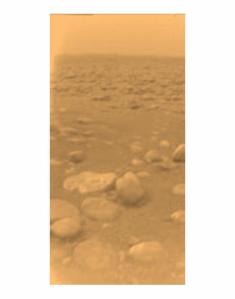
Credit: ESA/NASA/JPL/University of Arizona

Look at the photograph above. That’s the surface of Titan, a moon of Saturn. The photo was taken by Cassini-Huygens, a space probe which launched in 1997, and the Huygens part of which descended to Titan’s surface in 2005. Saturn orbits between 1.3 billion and 1.5 billion kilometres from the Sun. Earth orbits between 147 million and 152 million kilometres from the Sun. If you could travel to Titan in a straight line (which you can’t), it’d be a journey of around 1.2 billion kilometres… That’s equivalent to flying from London to New York and back over 108,000  times, or 6.5 million circuits of the M25 (at an average speed of 120 kph, that would take you about 1,150 years).

Numbers. They define our world – what we can directly see and experience, and what we can’t see or experience. As those numbers increase in size, so our sense of place in our world is increasingly diminished. Using science we can investigate, and gain an intellectual understanding of, this feeling of diminution. Science fiction, however, postulates situations in which we can experience it directly. It also gifts us with agency in this new world being explored. It is a visceral, albeit vicarious, manifestation of what science can show us.

Science fiction is scale, its uses and abuses. It can take something huge and beyond direct human experience, and by giving it the purpose of something within the reader’s real-world frame of reference, render it unfamiliar:

Planets. Seven of them. Armed and powered as only a planet can be armed and powered; with fixed-mount weapons impossible of mounting upon a lesser mobile base, with fixed-mount intakes and generators which only planetary resources could excite or feed. (p 40, Second Stage Lensman, EE ‘Doc’ Smith (1953))

It can directly manipulate the human frame of reference, and make of it something which would otherwise be strange and impossible to fathom:

It was not clear what had happened to the man for the next million years or so. One line of argument held that he had expanded himself to encompass a massive swathe of galactic space – swallowing hundreds of thousands of systems, across thousands of lights. (p 239, House of Suns, Alastair Reynolds (2008))

Or, it can simply map parts of the real world we cannot experience, and allow us to compare the scale of our frame of reference with that being described:

It took an effort to remember that the distance to the horizon was more than ten times that on Earth. That the storm was two thousand kilometres across. That the sky was hydrogen and helium a thousand kilometres deep, with cloud layers of ammonium ice above and decks of ammonium hydrosulphide and ammonium-rich water-ice and water-droplet clouds below, endlessly blowing around this vast world. (p 215, The Quiet War, Paul McAuley (2008))

There are a number of rhetorical tools and literary devices science fiction uses to manipulate scale and the reader’s perception of it. Analogy is a particularly common one – by directly referencing something known, and of a size encompassable by the reader’s mind, the sf text can make manageable the scale of something normally beyond comprehension. This is not always a good thing, as it can have a trivialising effect.

There is a great deal of implication in the findings of science. The photograph earlier in this post does not in and of itself present a particularly impressive-looking picture. It’s a stretch of orange ground littered with pebbles. But it’s on Titan. Which means… the launch of the space probe, the journey there, the distance the probe travelled, the mechanisms which comprise the probe and the science behind them, the descent into Titan’s atmosphere, Titan’s surface conditions… the real and true fact that it is an alien world.

Science fiction not only gives us the orange photograph, but it also shows us how it was achieved. It makes explicit the wonder. And since wonder is central to science fiction, then to define wonder is to define science fiction:

…where:
W = wonder
lg = greatest distance mentioned in the text
tg = greatest length of time mentioned in the text
Nn = number of ideas/nova in the text
Nf = number of ideas/nova reader has encountered previously
ir = closeness of the viewpoint character to the reader as a function of background, worldview, attitudes, etc – ie, an indicator of their ability to identify with the character
jn = number of situations of jeopardy for point-of-view character(s)
ja = amplitude of situations of jeopardy for point-of-view character(s), where 1 is fatal
Cn = size of cast in the text
Br = bandwidth of the reader (calculated from educational level, number of books read, age)
Dr = willingness of the reader to suspend disbelief


4 Comments

Where critics come from

From DH Lawrence’s ‘Pornography and Obscenity’, first published in 1929:

The only positive effect of masturbation is that it seems to release a certain mental energy, in some people. But it is mental energy which manifests itself always in the same way, in a vicious circle of analysis and impotent criticism, or else a vicious circle of false and easy sympathy, sentimentalities.

So, if you hate a book, you’re wanker. And if you like a book, you’re a wanker. Sounds about right to me…


1 Comment

Fragment

So a year or two ago I had this idea for a postmodern planetary romance, a Leigh Brackett-style story as much about story as it was about the events in its strange and implausible world. But like most such projects – and I have an embarrassingly large number of them – it never got beyond some vague ideas and a couple of hundred words. I had a great title, ‘Gods of Saturn’, and what I thought was a pretty cool opening, but then other new shiny ideas captured my attention and my postmodern planetary romance got filed away in a forgotten folder. Until now. Maybe one day I’ll do something with it, actually finish it off perhaps, but for now it qualifies as one of those “stories that never were”, of which I have far more than I care to enumerate. But rather than let it go totally to waste and, in part, to perhaps prompt me into actually working on it and maybe finishing it, here’s the opening of ‘Gods of Saturn’ for you to enjoy…

Of all the winds which blow across the sand seas, an easterly is the most disagreeable. From that quarter, the town of Kumpara boasts no defence against the scouring grains of sand. The western wall of Pu Chou rises behind Kumpara’s tumbled blocks, and curves enfolding arms to north and south. But to the east: nothing.

There was, however, much which could be said about the couple who strolled along Kumpara’s long stone jetty one day in the Age of Helium, as small wisps of easterly wind whipped up dancing devils of sand.

Kumpara had seen better years, but had yet to reach the nadir of its decline; or its subsequent rise to quiet gentility. See it now, and perhaps you would find it hard to picture the narrow streets thick with blinding red dust, the sand whipped into fountains fifty feet high, and every house shuttered and doors firmly bolted. Those who lived there knew better than to risk the wind’s wrath.

A local spy – and there was one – who watched the young couple will have deduced they were strangers to Kumpara. The wind was not yet dangerous, but only the foolhardy or ignorant remained out once it began to blow. So too did their garments advertise their origins. The young lady was dressed in a fashion yet to be seen in the town. The eye in the telescope might have glimpsed the split skirt which was common at that time in the capital city, Xu; the high-collar, with its arcane symbols of rank and allegiance; the long gloved sleeves. Her companion was equally well-dressed.

As they turned to stroll back along the jetty, some feeling or whim caused the young woman to look back. She halted, head turned and, as if conjured into being by her gaze, features formed on the face of Saturn. The lemon and orange and tan stripes swirled like the ingredients of some decadent cocktail. It was a vast face, a face which filled the planetary canvas on which it appeared, and it caused the spy to drop his telescope and scramble from his vantage point.

As a result, he did not see the reactions of the Xuan lady and her companion. He did not see her turn her back on the face in disdain.

If such an occurrence sounds remarkable but the couple’s reaction does not, it is because at that time the gods of Saturn would often manifest on the face of the gas giant. From their celestial vantage point, they would gaze on each of the moons and on each of its civilisations. Their impact depended very much on the moon’s distance from Saturn. Here on Janus, where Saturn occupies a significant portion of the horizon, the gods held sway more than on, say, distant Iapetus.

When a god appears, all see him or her. When a god speaks, only those to whom they direct their instructions hear.

Lady Eresu turned to Captain Quradu and took his arm. She gently pulled him about. “Ignore him, Quradu,” she said softly. “He cannot harm us.”

The captain dropped his hand from the butt of his tantalum-pistol. That looming face – its presence alone in the sky suggested great power. Quradu looked up at Lady Eresu – as befitted her rank, she was a head taller than he – and noted her lack of concern.


12 Comments

You don’t know… what you just went and looked up

There’s an excellent review of Stina Leicht’s Of Blood and Honey on Martin McGrath’s blog here. Of Blood and Honey is an urban fantasy set in Northern Ireland during the Troubles, and it’s been widely praised. Martin finds much that’s troubling in the book regarding its setting – details which ring untrue to someone who grew up in the time and place in question.

And then there’s the Hugo Award-winning Blackout/All Clear by Connie Willis, whose claim of historical accuracy has been met with howls of derision on this side of the Atlantic. Not to mention the historical blunders perpetrated in earlier novels, such as those in Doomsday Book outlined by Adam Roberts here.

How much trouble would it have taken Stina Leicht to discover that the Royal Military Police wear red berets – and not the Parachute Regiment, who wear maroon berets? Or that the British Army has never been referred to as the “BA” by anyone? BA is an airline, of course; and it was founded in 1974, three years before the time during which Of Blood and Honey is set.

How much trouble would it have taken Connie Willis to discover that the Jubilee Line of the London Underground was opened in 1977, in celebration of Queen Elizabeth II’s Silver Jubilee, and so wouldn’t have existed during World War 2? Or that people burned wood and not coal in their fires in 14th Century England? Or that no one has used the phrase “trunk call” in the UK since the 1970s?

True, most readers will either miss these errors, or let them slide. Providing the mistakes don’t pull them out of the story, many readers don’t much care. But there are those who will notice – and they will not only be unimpressed, they might be also be offended.

Without drifting into a discussion on cultural appropriation or First World Gaze (to coin a phrase), I believe a writer has a responsibility to their readers, and to themselves, to get the details right. Writers need to strive for verisimilitude (not authenticity). Research is vital in all areas – not just setting, but also science; technology; language… Anything which exists in the real world and which affects the story in any way, no matter how seemingly trivial.

In these days of the Internet, there’s no excuse. Readers can go and look something up online – and frequently do. Wikipedia has made expert knowledge available and convenient for everyone. Writers should not only be prepared for that, they should armour their writing against it. The old days of genre writers getting away with the most egregious bollocks because they didn’t know better, because their readers were unlikely to know better… they’re over. There is no excuse for sloppiness. Writers must fact-check. Everything.

Because they’ll look very, very foolish if they don’t.


86 Comments

You don’t know good

I’ve lost count of the number of times I’ve been told “good is subjective” or “best is subjective”. Every time I hear it, it makes me howl with rage. Because it is wrong.

If there is no such thing as good – because if it’s entirely subjective and personal, then it’s completely useless as a descriptive term – then how do editors choose which books to publish, how do judges choose which books to give prizes to, how do academics chose which books to study? And why don’t they all choose completely different books?

They can do all this because the quality of a book can be determined objectively. It is not an exact science, and it is subject to changes in taste and/or re-evaluation in light of changes in attitudes and sensibilities. But there are certain key indicators in fiction which can be used to determine the quality of that piece of fiction. It’s what makes one writer more talented, more skilled than another writer. It’s what makes one story worthy of study and another not worth giving away for free. It’s why we have classics of literature, andwhy some books are still in print two hundred years after they were first published.

If good is subjective, then awards are completely pointless. And studying literature, well, that’s a complete waste of time too. After all, how can you be an expert in a topic in which one individual’s value judgment is worth exactly the same another person’s? There’d be no such thing as an expert. All books would have exactly the same artistic value.

This is patently nonsense.

Perhaps it’s easier to describe what is bad – if good is subjective, then by definition bad must be too. Except, strangely, everyone seems to agree that the following do indeed indicate that a piece of fiction is bad: cardboard cutout characters, idiot plotting, clumsy prose, tin-earred dialogue, lack of rigour, graceless info-dumping, unoriginality, bad research…

So if we can determine with a reasonable degree of accuracy what constitutes a bad book, then it logically follows we can do the same for a good book. And since this is a scale of sorts, then there must be an objective element to determining a piece of fiction’s position on the scale. Which means it is not subjective.

And “best”? It means “of the highest quality”, “most excellent”. It is the superlative form of “good”. Go and look it up in a dictionary. If good is not subjective, then best cannot be either.

If you want to describe a book in entirely subjective terms, then tell people how much you enjoyed it, how much you liked it. That’s your own personal reaction to it. It appealed to you, it entertained you. That’s the book directly affecting you. Another person may or may not react the same way, the book might or might not do the same to them.

Because that’s subjective, that is.


10 Comments

Science fiction is dead, long live science fiction

You can almost set your watch by the regularity with which claims that “science fiction is dead” appear. Except, of course, that wouldn’t be a very science-fictional metaphor in these days of atomic clocks and NTP. The latest iteration of this moan appears here. Certainly it’s true that fantasy outsells category science fiction, but to also claim that “half … of what is being sold as sci-fi is actually fantasy with some sci-fi elements” is risible.

Science fiction still lives but, more than that, it has also colonised the mainstream. In the cinema, sf is the genre of choice for tentpole releases. On television, it may have a less successful track-record, but many sf series have proven popular with non-genre audiences: Dr Who and Life on Mars, for example. Literary writers have in the last decade quite happily appropriated ideas from the sf toolbox for their novels – just look at this year’s Clarke Award winner, The Testament of Jessie Lamb by Jane Rogers. (Though Roger’s usual publisher refused to take the book because it was sf; I bet they feel like complete plonkers now.) But even this is hardly new: John Fowles did it back in 1985 with A Maggot; Lawrence Durrell did it even earlier with Tunc (1968) and Nunquam (1970). There are plentiful other examples.

Science fiction is changing, that much is true. But it has been doing that since Gernsback published that first issue of Amazing Stories back in 1926. For one thing, he called it “scientifiction”, which happily never caught on. The genre has undergone numerous irruptions and make-overs during the course of its ninety-year history, and the fact it is now so widespread and so varied only demonstrates its rude health.

True, we’re not living in a science-fiction world. If we were, we’d have food-pills and jet-packs, there’d be a colony on the Moon, and most people would be wearing tinfoil jumpsuits. Or something. Instead, we have a dozen tin-cans strung together in Low Earth Orbit, only robots have gone further than cislunar space, and pills invented to replace food tend to get repurposed as recreational drugs and then criminalised… On the other hand, we do have smartphones, the internet, digital cameras, cars that cost as much as the turnover of a medium-sized company, pre-cooked bacon available in supermarkets, a climate we are slowly destroying so that multinationals can continue to make profits greater than most nations’ GDPs, and television shows more fatuous than anything George Orwell at his most cynical could ever have imagined.

The problem is that the dreams of science fiction from past decades have proven either unachievable or unsustainable. Is it any wonder then that the genre has turned increasingly escapist? This doesn’t make it fantasy, by any stretch of the, er, imagination; it does mean, however, that sf is no longer predicated on dreams of a better tomorrow created by science and engineering. Genre writers now – and those literary writers who dabble in genre – are putting the tools of science fiction to other uses.

Samuel Delany once said that one of the beauties of sf was that it could literalise metaphors. The example he used was “her world exploded”. You won’t find much in the way of metaphors in sf of the 1950s and earlier. Those so-called classic stories are pretty much straight up and straight down. WYSIWYG. But that doesn’t work anymore. What was designed to be plausible has become implausible. Such optimism in scientific solutions is now unconvincing. We know that science is only a tool, and not always used with the best intentions. “Now, I am become Death, the destroyer of worlds”, so to speak. We also know that even the laws of nature are apparently open to interpretation when there’s enough money involved.

I admit I am fascinated by the optimism inherent in science and engineering of past decades. That’s why I put up my irregular The future we used to have posts. I’ve explored that optimism in some of my own fiction – Adrift on the Sea of Rains is perhaps the best example so far. I am fascinated by the achievements made using raw engineering in the twentieth century: putting twelve men on the Moon, sending two men to the deepest part of the ocean in a steel ball, the numerous attempts to go faster and faster in wheeled vehicles or boats…

The one thing science fiction initially refused to acknowledge, and which we’re only belatedly beginning to accept, is that there is no escape. The universe is too vast and too inimical. We can only populate it using our imaginations. The fact that sf now uses more and more imaginative and fantastical inventions to do so doesn’t invalidate the genre. Sf may not reflect the real world as often as it should, but by ignoring the limitations placed on us in the real world the genre is responding to those limitations. Sf hasn’t forgotten the science, it’s just finding different ways to incorporate it into its stories.


8 Comments

Looking backwards to the future

Science fiction is an American mode of fiction. It was born in the white-hot enthusiasm for technology which prevailed in the electronics and mechanics magazines of the US during the 1920s. A prosperous future was imprinted on every page as new devices, new inventions, new scientific breakthroughs improved the standard of living of the USA’s technophilic middle class. It was the beginning of the age of the mod con, better living through engineering. The centre could not only hold, it was invulnerable. Even from internal threats. External enemies were defeated by technological mastery (and overwhelming force).

The American Dream was the only desirable and sustainable narrative of the future.

Even then, sf’s visions were problematical. The hopes and aspirations of these Americans, the mores and sensibilities of the US middle class, provided the culture in which sf blossomed and grew. Achievements were embodied in those who were first, not in those behind the scenes who made it possible. Neil Armstrong conquered the Moon, not NASA. Indeed, NASA was seen as a brake on the exploitation of space – private industry was the best vehicle for progress. And it was powered by the most powerful engine of all: the profit motive. Profit led to riches which provided the freedom to self-actualise – and so profit came to trump all other considerations. Riches became an end, not just a means to an end. Since governments curbed such headlong growth in the name of society and not individuals, they were characterised as obstacles. Humanity – well, man – could not reach his true destiny unless his growth were unfettered.

And yet…

Progress should lead to a world which is fairer and more just. The futures we narrate should reflect this. If we look back at the history of our world, we see a clear, if somewhat irregular, progression toward a more moral and socially-improved present day. So why should we base our visions of the future on the sensibilities of the past? Why should we embody in our science fictions the aspirations of a generation ninety years ago? Their present is not our present. Some of their dreams have already been achieved, some have already been discarded as unattainable, some of them have been determined to be undesirable.

These are not thought-experiments, stories in which the world itself provides some object lesson to those unable to look up from the page. These are action-adventure stories set on alien worlds, in galactic empires, in corporate-dominated futures, in urban wastelands and plutocratic societies. And in every one, many of those freedoms and rights painfully won over the past 250,000 years have been reversed to give us… Sexism. Racism. Slavery. Endemic violence. Brutish behaviour. Rape.

Of course, science fiction is the fiction of the privileged. It’s the culture of the privileged displaying their mandate in the most naked form imaginable. Only in this way can civilisation be wrested from savagery – or so their carefully-doctored history books tell them. They have the right to kill and maim and rape and impoverish those who do not accept their dominion because they will better off for it… whether they want to be or not.

This dominion extends into the realms of the imagination, into the worlds of the yet-to-be and the never-to-be. New science leads to new forms of life and, almost universally in sf, such new people are treated as non-people, as slaves, as property. Though our science fictions demand we present them as human as ourselves, their origins tell them against them. New science leads to new scientific bigotry.

Even worse, it’s not just these new people we have invented whom sf mistreats. Women are often no better off in sciencce fictions than they were during the genre’s golden age. Other cultures are blithely ignored, or pillaged in a quest for the “exotic”. Invented worlds are always monocultural – and that culture is the culture in which sf was born and grew to squalling infanthood. But then sf is designed to explore the desires and concerns of this culture. The only Others who appear are either aliens or enemies. Foreigners need not apply.

Too many of us refuse to look too closely. We are blinded by the wonder, our gaze is captured by the shiny toys. We privilege the “idea” and forget it is only one aspect of the stories we tell. We allow our assumptions and preconceptions and prejudices to validate our fictional futures. We forget to challenge. We want our future to be comfortable for us to visit, even if it is a dystopia. So we populate it with things we will unthinkingly accept, and never question its likelihood, its rigour, its plausibility, or the effects it might have on others.

Were such Randian technowank fantasies what Hugo Gernsback had in mind when he first published Amazing Stories?

I keep on finding myself circling around a pair of genre movements from recent years: Mundane SF and Optimistic SF. I was a fan of neither when they originally appeared. They seemed unnecessary restrictions – in fact, Mundane SF felt like it was throwing out of sf all the best toys. But when genre becomes defined by its toys, perhaps it is time to re-evaluate their usefulness.

And what should we replace those toys with?

The real world of the twenty-first century, of course.


1 Comment

It’s the way I tell ’em

I’ve been thinking this week about how I set about writing fiction, and it struck me that I do most of it in my head long before I sit down and start typing. Once I’ve decided what I want to write about, I start thinking about plots and worlds and characters and scenes and themes… It’s only when I have enough of those clear in my head that I start to put the sentences together using a word processor…

And once I begin the actual physical process of writing, then I start the research. The two feed into each other. Things I find in my research prompt changes in the story; the way the story develops opens up areas I need to research. Even then, everything is mutable: that first draft is mostly a brain dump larded with research. After that comes the actual shaping of the text. And revision. Lots of revision.

A case in point is the next book of the Apollo Quartet. Even before I started Adrift on the Sea of Rains I knew what the second book, Wave Fronts, would be about. It would have two narratives – call them A and B. A would be set in the present of the story, but B would be set some 100 years later. The combination of the two would explain the resolution (with supporting arguments in a glossary).

But while fleshing out the synopsis a week or so ago, a detail I added to the background of narrative A’s protagonist struck me as something worth expanding. In fact, the more I thought about it, the more I realised it provided a better dramatic counterpoint to narrative A than narrative B did. So I decided I would now tell the story using narrative A and narrative C. Narrative B would be incorporated into the glossary.

I was happy with this. Then I saw Lavie Tidhar’s review of Adrift on the Sea of Rains here. And it gave me an idea, a way to add more drama to narrative C. I already had a thematic link between the two narratives, but this new idea not only reinforced that, it also strengthened other areas of the story. It made the choice of protagonist much more plausible – in fact, it made him the only choice of person as the protagonist.

So it’s a good job all this had happened in my head. If I’d had to rewrite a 20,000-word document, I don’t think I’d have been so quick to completely re-invent the story. But the end result is, I believe, a now much stronger novella. With glossary.

Unfortunately, the original title no longer fits quite so well…


29 Comments

Whores in Spaaaace

I am currently reading a big fat space opera which was published last year. It has received a number of positive reviews – George RR Martin himself even describes it as “kickass space opera” on the front-cover.

Part of the story is set in the Asteroid Belt. In the future of the novel, a number of asteroids have been settled – there are, in fact, some 150 million people living in the Belt – and the largest such settlement is the hollowed-out dwarf planet Ceres (approximately 480 km in diameter, six million population). The society in Ceres, and by implication in other colonised asteroids, is essentially US, capitalist, corporatist, with a few touches of foreign colour. This is neither especially convincing nor especially unusual in space opera – even one set in the relatively near-future as this one is. Ceres also has organised crime, gangsters, protection rackets, corruption, bent cops, poverty, drugs… And prostitution.

So, basically, the author is saying that he wants one half of the human race to exist for the gratification of the other half. He can’t claim “realism” because this is an invented world. He made it up. This is an artistic decision he made. He has put the women in his universe in that position. He includes a few named female characters – with and without agency – and thinks he’s covered his bases. His detective, for example, has a female captain – there, that must be good enough. But. Prostitution. Underage prostitution. Human trafficking. All three are mentioned. All three are taken as givens in this future universe.

FFS.

Is that the best an intelligent person living in the twenty-first century can do? Create some sort of Randian frontier-town society and think the presence of spaceships and AIs and some big melodramatic space-hopping plot makes it alright? It doesn’t. If you have prostitutes in your sf story, you’d better think damn hard why they’re there. If you have a rape in your fantasy story, you’d better think even harder why it’s there. Neither are acceptable. They are not genre tropes. You have no excuse for creating universes in which women are treated in this way.

Science fiction was created by (mostly) inadequate teenagers who grew up to become (mostly) dirty old men. But the bulk of sf writers these days fit neither of those descriptions. And yet those pioneers set the tone of the genre. After eighty-five bloody years, isn’t it long past time we got rid of that? Isn’t it about time we started treating half of the human race like, well, like human beings in our science fictions? Isn’t it about time we started giving them respect on the page? (Respect in the real world is a given.) It’s not like it’s difficult, it’s not going to hurt, it’s not going to cost you money. You have no excuse for not doing it.

But you know what’s worse than that? The fact this is only one of many battles that need to be fought.