It Doesn't Have To Be Right…

… it just has to sound plausible


8 Comments

More self-publishing home truths

Adrift on the Sea of Rains has been in print for just over six months and has so far sold around two hundred copies in all three formats. I didn’t set up Whippleshield Books and self-publish because I thought it was a sure-fire route to riches and success. I’d much sooner someone else had published the book. But I did it myself because a) I wanted it done quickly, and b) I didn’t want to compromise on my vision. Happily, I got the book out on time, and no one has had a problem with the way I structured the novella.

However, being a self-publisher and starting up a (very, very) small press has definitely taught me how difficult the entire process is. Basically, it’s a numbers game. If one hundred people know of your book and ten percent buy a copy, that’s ten sales. If one million know and ten percent buy a copy… well, you get the picture. But how to get your book in front of a million pairs of eyes? Every time someone buys a book by someone they’ve never read before, they’re taking a chance. How to convince them it’s a chance they won’t regret taking?

One of the myths of the American Dream and, by extension western society, is that hard work leads to success. It’s utter bollocks, of course. People work hard all their lives and still die owing thousands of dollars, pounds, euros, etc. Bosses expect workers to put in unpaid overtime, even though the workers don’t actually profit from those unpaid hours. But when you do work hard for yourself, you often find obstacles thrown up in your way – partly because the system is set up to protect established businesses, but also because the only methods open to you as an entrepreneur have been so widely abused they poison everything that uses them…

1 Most forums have indiscriminate zero tolerance spam policies
When is a self-published sf novel like a pair of Nike trainers, or Louis Vuitton luggage, or even Viagra capsules? When mention of it is classified as spam. It seems eminently sensible to limit the amount of spam subjected to members of forums, and many self-published authors have used the tactics of spambots in getting their title in front of as many people online as possible. As a result, most forum moderators categorise any kind of promotion as spam. Typically, there’ll be a ring-fenced thread or group, in which authors can promote their books. But outside of that – nope, not allowed. Even if the poster is a member of good standing, even if it’s relevant to the discussion. Verboten. The offending post, or link, gets removed, and you receive a patronising message from the moderator. You’d think a sf forum, for instance, would be interested in sf books. Self-publishers, or indeed small presses, of course, can’t rely on the presence of their books in book shops to spread knowledge of their titles. They have neither the print-runs nor the coverage to be able to do so. So they have to promote. But most of their intended audience is routinely blocked from getting the message.

2 It’s not a level playing field, and Amazon has its thumb on the scales
Amazon does not typically stock small press print titles. It will show them as “out of stock” or “unavailable”, even though the book is readily available from the small press’s own website. But when a person sees mention of a title and considers purchasing it, they will be often go and look on Amazon. They see “out of print”. Result: sale lost. If they’d known of the small press’s website, they could have gone there and bought a copy – but there’s no link from Amazon, and most people won’t bother to google for it. Which means that whenever you mention your small press or self-published title, you’re going to need to attach a link to your website. But that’s not allowed, that’s spam. It’s catch-22. Having said that, since Amazon takes a 60% discount – there’s no negotiation involved – any sale through Amazon will likely mean a loss. Amazon is a good platform selling ebooks, but for small presses without the economies of scale it’s completely useless for print books. Sadly, it’s also most people’s first port of call for print books.

3 Never mind the quality, feel the weight
I read somewhere of an established author who self-published a novel on Kindle and made $1250 of sales in ten days. He complained that was a poor result. But the vast majority of self-published novels on Kindle won’t make that in a year. The market does not have perfect information (which is one reason why capitalism can never really work), and so every reader out there for whom your novel might be a perfect fit is likely unaware of its existence. Instead, most readers will stick with what they know – they’ve read author A before and they like their books, imprint Z publishes good books so they’ll take a punt on their latest title, and so on. As a self-publishing small press, I need to get my name and the name of my press out there. My name doesn’t have sufficient weight to make much of dent in my intended market’s ignorance. The only way that will likely change is if… I get a contract with a major imprint.

4 Reviews are better for the ego than the bank balance
To date, Adrift on the Sea of Rains has been reviewed more than two dozen times on blogs, review sites and in print magazines. That’s a remarkable number for a self-published novella. On Amazon, it currently has eight customer reviews, which is not especially high – even for a self-published ebook. All of the reviews so far have been positive. The most negative comment I’ve seen about it is “it wasn’t too bad” by someone on GoodReads. Of those two dozen reviews, most of the people who wrote them received review copies – electronic or print. Reviews are good, they get word of the book out and about. People see the reviews and are sufficiently intrigued to buy the book. But only two or three of those reviews actually resulted in an uptick in sales. And I suspect there were several incidents of prospective buyers going to their preferred suppliers – Amazon, for example – not finding copies, and promptly giving up.

5 Once tarred, that’s you forever that is
I didn’t want Whippleshield Books to be a purely self-publishing venture, so I made it open submission. In six months, I’ve received a single query. I admit to being picky, but the guidelines are quite clear on what I want. I didn’t want to be spammed with inappropriate submissions – space opera, for example – but I’ve not even had that. Authors complain there aren’t enough venues to sell to, that those which do exist don’t like the sort of fiction they write… Perhaps there really is no one else writing the sort of fiction I want to publish. I find that hard to believe. Maybe it’s because Adrift on the Sea of Rains is self-published – I’ve made no secret of it. I know some book bloggers and review sites won’t touch it because it’s self-published – though they’ll happily review crap books by established imprints. Maybe the same also holds true for submissions?

Okay, perhaps not “forever”… I can think of two small presses originally set up to publish their founder’s own fiction. Both are now reasonably successful, with large catalogues of books by many different authors. Perhaps a decade from now, Whippleshield Books will be in the same situation. But in the years since those two small presses were established – and it’s less than a decade for both – much has changed in the publishing world. While new channels on the internet have made distribution and promotion much easier over a much wider area, the low barriers to entry have also significantly decreased the signal to noise ratio. The market is far bigger, but there are now so many traders that people can only hear you sing out your wares when they’re actually standing at your stall.

In a month or so, the second book of the Apollo Quartet should see in print. Having a second book out might change the game entirely for Whippleshield Books. It’ll be interesting seeing if it does. We shall have to see how it goes…

9 Comments

NEED MOAR SCIENCE!

Science fiction was born in the white-hot enthusiasm for the future found in the electronics magazines of the 1920s. Electronics – engineering – was going to build a better future for everyone, and science fiction would show the way forward. But there was also the pulp tradition as well, and that quickly polluted the pure-strain “scientifiction”, adding escapism and implausibility to the didactic rationality of the new genre.

Ninety years later, it looks like pulp won the battle for the hearts and minds of science fiction readers. In other words, there is very little science in science fiction. But then a lot of people think the acronym formed from the genre’s name, sf, should really mean “speculative fiction”. Ugh.

It’s true that that much sf could be placed on a sliding scale – at one end it would read “scientific content” and at the other “literary merit”. But scientific content and literary merit are not mutually exclusive. You can have both in a fiction. The fact that those who have tended to one have been poor at the other, and vice versa, is an historical accident. It’s neither a law nor a defining characteristic of the genre.

But taking the science out of science fiction does invalidate it. Sf is not some big amorphous playground in which you get to leave your grubby fingerprints over all the cool toys. Just because a fiction appropriates the trappings of sf – the spaceships, the robots, the Singularity, etc – that doesn’t necessarily make it sf. There is an underlying philosophy to the genre, a consequence of its beginnings, and to ignore that and treat sf like just another branch of fantasy is to ignore the genre’s history and its character. Which is why claiming sf pooh-poohs categorisation and boundaries is to miss the point of what it is.

When an author of mainstream fiction writes a story set in, say, the 1950s, or Budapest, or featuring a cellist, they do the research. They ensure their fiction has verisimilitude, that their 1950s isn’t just 2012 with hats, or Budapest isn’t a middle-American city with funny accents. Why do sf authors refuse to do that same? True, their invented worlds may not obey the same rules as the real world, but even when it does they blithely wave their authorial hand and magic allows the story to progress. That’s not science fiction. Treating the world as if it were some magical woowoo sort of place is anathema to science fiction. And, more than that, it’s entirely pointless.

Science fiction certainly needs the science putting back in, but perhaps it also needs to think about being didactic again. Don’t hide the science, don’t pretend you’re really writing woowoo futuristic fantasy. If there’s science in there, take pride in it.

Show your reader, I did science.


33 Comments

Toward working definitions of science fiction and fantasy

I’ve mentioned these thoughts in passing in other posts, but I decided it was time to put them together and see what happens. I have said in the past that science fiction makes explicit the wonder in the physical universe – see here; yes, with an equation too – but perhaps that’s also true of fantasy. Maybe instead of the horrible “speculative fiction”, or the equally awful “strange fiction”, we should use the term “wondrous fiction”. Though I believe Yes beat me to it.

Unfortunately, “wf” is a pretty naff acronym, especially if you use it as one and not an initialism. Would it be “wif” or “wuf”? “I am a wuf writer.” Ugh. Would bad wondrous fiction be known as “wiffy”? Um, and “wifi” has already been taken. Ah well, perhaps not.

However, it strikes me there are two defining loci for science fiction and fantasy. One is wonder, the other is agency. And while wonder identifies both genres, agency differentiates them:-

fantasy – stories in which agency, or power over the natural world, is given by authorial fiat to things, including human beings, which in the real world do not have such agency or power, or do not exist.

science fiction – stories in which agency, or power over the physical universe, is given by human beings – systematically – to things, including human beings, which in the real world do not have such agency or power, or do not exist.

No doubt everyone will now immediately think of exceptions which disprove these definitions. That seems to be the way this sort of thing works…


14 Comments

Turn that frown upsidedown

I’d sort of promised myself I wasn’t going to post anything negative here any more, because everyone likes the upbeat, everyone likes the happy. But then I went and spoiled it with a whinge about the Hugo Awards – but then I’ve whinged about them every year since starting this blog. However. Positive, er, stuff. I mean, I’ve read some excellent novels so far this year, I’ve seen some bloody good films, I’ve heard some damn fine albums and even watched some amazing live performances by bands. There’s good stuff there to celebrate. It doesn’t always have to be a total downer.

Except…

So much of the positive shit you see plastered across the Internet is just so brainlessly uncritical. Certainly praise where praise is due – but I see so much of it that’s just plain undeserved. I don’t see myself as a negative person (stop laughing), just a realistic one. Sturgeon’s Law may be glib, asinine and way too easy to overuse / misuse, but it wouldn’t have survived this long if there wasn’t some truth to it. But you’d think it was the 10% that was shit sometimes from the way people carry on…

As a result, it’s easy to over-react and be overly negative. And, sometimes, doing that means the important stuff gets overlooked. It’s good that so many on the Hugo shortlists were not white males. But don’t pat yourself on the back just yet, Hugo nominators; because you also put a stupid April Fool fantasy story on the shortlist.

Having said that, it’s not like I don’t celebrate the good stuff when I encounter it. See, here’s a positive review of Kim Stanley Robinson’s 2312. And here’s an even more positive one of Gwyneth Jones’ The Universe of Things. And here’s a few words about my choices of the best books, films and albums I encountered during the first six months of the year. My tastes are perhaps not entirely mainstream – science fiction! death metal! weird Polish and Hungarian movies! – but I like to think I value quality and can recognise it when I see it (stop laughing).

There is no recipe, no programme of umpteen steps. Changing things takes stick and carrot. And occasionally a bloody great huge cluebat. It doesn’t happen overnight. When, that is, it happens at all. I like to think I’m doing my bit – not just on this blog, or in reviews on SF Mistressworks and Daughters of Prometheus. But in my fiction too. Not that I’ve been entirely successful – I’ve yet to break into any of the big short fiction markets (except for Postscripts). And a common response to my stories is “what happens next?” Er, nothing. It’s finished; the rest is up to you. Anyway, resolution is so bourgeois. Just like quotation marks around speech (small joke there).

I had a point to this post but I can’t for the life of me remember what it was. It wasn’t “be nice”, because being nice to everyone and about everything only devalues it. Nor was it “be negative”, because if the wind changes you’ll be stuck like that and then no one will be your friend. Be honest – that’s certainly important. Yes, above all, be honest. But I think I shall, as my pulled-out-of-thin-air point to this post, use something said by astronaut Gus Grissom, though it later proved to be horribly ironic:

Do good work.


57 Comments

The Hugos are broken, science fiction is broken, everything is broken

Last Sunday saw Hugo Awards handed out to several people for producing, or so the award would have us believe, the “best” of their category in the previous year. It’s complete nonsense, of course. The Hugos, despite half-hearted changes implemented over the years, are based on a model of fandom which hasn’t existed since the 1960s. What are “fan writers”? What are “fanzines”? Once, the profiles of these might have been high enough in the sf community for worldcon members to know what they are and vote intelligently on them. There’s a reason pro writers are winning the fan writer Hugo now – people know who they are. And despite having a World Wide Web for twenty years, the Hugos still have no idea how to deal with online content.

I’ve never understood why there are Hugos for best dramatic presentation. Television and movies have seperate fandoms and their own set of awards, genre or otherwise. I’ll concede that television show writers are more likely to value a Hugo win than a Hollywood director – but neither use the award in their marketing, or make any mention of it. Besides, the best dramatic presentation -short form award has turned into a best episode of Dr Who award. This year it went to Neil Gaiman for added squee.

The magazine Hugos are completely broken and have been for years. They’ve tried to patch it up, with their ever-mutating definition of semiprozine, but the whole award is based on a concept that hasn’t pertained since the early 1970s. There is no real market of pro genre magazines. There are a tiny handful of titles, with greatly shrunken circulations. But there is a thriving scene of non-pro magazines. Why should the Hugos exclude those venues that don’t pay for submissions? They might still publish excellent fiction. And then there’s the whole print vs online thing. But then, why should a magazine deserve an award? For publishing the best fiction? There are the three short fiction categories for that. To reward the editor for consistently picking the best fiction? There’s an editor – short form Hugo for that. For the magazine’s design? There are no Hugos for design.

Then there’s the short fiction categories. What is the point of the novelette? There’s the short story, and that’s pretty obvious. There’s the novel, likewise an obvious category. And something in between, longer than a short story but not as weighty as a novel: the novella. Back in the day, some novels were as short as novellas – the only distinction was that they were published as if they were novels, as separate paperbacks referred to in their marketing as novels. With the increasing growth in the ebook market, some of these distinctions are beginning to blur anyway. The category is at the discretion of the publisher or self-pubbed author – they’ll decide whether the $1.99 30,000-word story they’ve written is a novel or novella. And I see no reason to ignore their decision.

It doesn’t help that the Hugo Awards claim to be global yet are clearly only American. The worldcon, the membership of which nominates and votes on the awards, takes place in the US four out of every five years, and even when abroad the shortlists are often dominated by American works. Works published globally are eligible for the Hugo (now; it wasn’t always the case), but it means little as the voters are chiefly US-based. Online publication of short fiction has confused matters somewhat – so much so that the BSFA Awards, which are for works published in the UK, have given up insisting on British-only publication for their short fiction category. As for ebook-only publication…

This week also saw the publication of an excellent review of the annual best of science fiction anthologies in the LA Review of Books by Paul Kincaid. See here. Paul makes a number of interesting points, but the chief one is that the genre has become so inward-looking that it’s now more concerned with trope mining than it is with the real world. Sf has locked itself within its own toy box, and is happy to just play with the toys it finds there. The review led to an excellent discussion on Twitter, with Paul, Jonathan McCalmont, Rose Fox, Paul C Smith and myself (there may have been others – we didn’t hashtag the discussion and I’m having trouble finding the tweets).

From what I remember, the chief point made was that sf seems to have lost confidence in the future because it has lost confidence in the present. Certainly there’s very little to celebrate in the present – climate change, climate change denial, rampant neoliberalism, oligarchism, the increasingly anti-science bent of public discourse, etc. – but should we really be celebrating as the best that sf which refuses to acknowledge it? Science fiction has always had a place for escapism, thanks to its pulp origins, but to elevate such stories above those that actually comment on the real world is pure cowardice. But then look at what won the Hugo for best novel this year – Jo Walton’s Among Others, a book whose message appears to be “sf fans are special people”…

I don’t actually agree that sf has chiefly been a tool for commenting on the real world – there’s no way in hell you can fit EE ‘Doc’ Smith’s works into that – but some of the best works of the past were clearly more about the time they were written than they were about the time they were set. Such as Joanna Russ’ The Female Man. And not just the good ones either – cf Robert Heinlein’s The Puppet Masters. It’s often been said there’s a steep learning curve to science fiction, that it’s a difficult mode of fiction to begin reading. Being self-referential only makes it worse, far worse. When literary writers have a go at sf, their efforts often appear old-fashioned, because they’re working from first principles, they’re not basing their works on the genre’s past use of tropes. It also makes their books much more accessible to non-genre readers – Rogers’ The Testament of Jessie Lamb, Ishiguro’s Never Let Me Go, Litt’s Journey into Space, James’ The Children of Men, Jensen’s The Rapture, Mitchell’s Cloud Atlas, etc.

One of the nicest things to appear in a review of Adrift on the Sea of Rains was the comment “while the story is science fiction it is written as if it were not” (see here). True, the novella is not about the future but about an alternate past, but it doesn’t make use of science fictional tropes per se. The Apollo programme was real (although my extension of it is invented, of course); the Bell is a well-known element of Nazi super-science mythology. I’ve positioned the novella as sf because I think of myself as a sf writer – or rather, someone who writes in a sf mode. Perhaps I shouldn’t have done.

In one respect, I’m as guilty as those writers on the Hugo shortlists in that I’m not inventing futures which are about the present. That’s because I’m fascinated by the technological achievements of the mid-twentieth century, so they’ve been appearing more often in my fiction. Not just the Apollo programme, but also the bathyscaphe Trieste‘s descent to Challenger Deep, Project Manhigh, the submersible Ben Franklin‘s 2300 kilometre underwater journey in 1969… Despite the Cold War and Mutually-Assured Destruction, the optimism of those times I find very striking. (See also my The future we used to have posts (snarky captions notwithstanding).) All that invention and engineering was going to make the world a better place. In the US, they believed they had the better toys and so would eventually defeat, or cow into submission, the Soviets. In the USSR, they believed they had the better political system and so would eventually subsume all other nations. Neither was proven correct. But the time and money and effort they spent improving their lot was phenomenal. Better living through engineering. We don’t do that anymore. And so our science fictions reflect that lack. Or rather, they should. Complain that sf is all escapism these days, and readers will respond, “what’s wrong with escapism?” Well, it doesn’t fix anything, for a start. That was one of sf’s characteristics in the past, that it posited thought experiments, that it could show the impact of something – good or bad – happening, that it could inspire people to do things.

Sf can use the past, or alternate versions of it, to discuss the present. Saying “we could have done this” is as valid as saying “why did we do that?”. And, at least, it has the benefit of being more realistic – the Bell, notwithstanding. True, readers would have to be of a certain age to remember the Apollo missions, but at least most people are aware of them and their achievements. (Though not everyone, as indicated by an astonishingly stupid Twitter exchange which did the rounds when Neil Armstrong’s death was announced.)

Sf seems to be not only ignoring the real world of people and politics and economics and society and such, but also the real world of science. It invents universes about which we can flit in a matter of moments. Perhaps it takes hours, weeks or months, but we can reach other stars and other worlds. Which are, of course, habitable – if not already inhabited. The real universe is not like that, of course. There is only one place in the entire universe where we will ever be at home, and we are there now. Even Low Earth Orbit, less than 200 kilometres straight up, is about the most benign environment for humans not on Earth, and we can’t survive there without technological assistance, and not for long even with it. Trips beyond LEO are technologically possible – we did it once, we have the engineering to do it again and go further – but they will never be safe or comfortable or timely. And when we get where we going, will it have been worth the trip?

This is not to say all sf is like this. It’s a wide field, with many books and many writers in it. Two novels this year, for example – Kim Stanley Robinson’s 2312 and Alastair Reynolds’ Blue Remembered Earth – have made a point of treating the universe realistically. Ken MacLeod’s recent novel, Intrusion, and Bruce Sterling’s The Caryatids from a couple of years ago, made a real effort to engage with the world as it might be in the near-future. Kelley Eskridge’s Solitaire and Gwyneth Jones’ Life did something similar. Adam Roberts uses the genre to satirically comment on the present. There are doubtless others…

But then I look at the award winners of recent years… A bloated paean to a theme-park vision of the Blitz… the infamous Mormon whale rape novella… a novella about a man who built a bridge which, for no apparent reason, is written as fantasy… a TV series based on a re-imagining of the War of the Roses…

Sf is broken, it refuses to acknowledge we’re in the twenty-first century – yes, I put my hand up, I’m guilty; but at least I write about the real twentieth century. And then I look around and see that not all science fiction is broken. But the non-broken sf… the various awards seem to be ignoring it.

So something is clearly broken somewhere.


41 Comments

5 tropes science fiction and fantasy should really stop using

These speak for themselves, I think.

1. rape as lazy characterisation
You want to show your villain is a Bad Man, so you have him rape a woman. You want your fluffy princess to become a feisty amazon, so you have someone rape her. No no no no no no no. Do not treat women like this, not even in fiction. And when Mr Fantasy Author responds, “that’s what it was like in the Middle Ages, you moron”, but also quite happily replies with “it’s a made-up fantasy land, you moron” when the accuracy of his Middle English has been questioned, then I would suggest that Mr Fantasy Author is the real moron. If you’re going to make shit up, don’t make up regressive sexist shit.

2. the lone gunman
Thousands have died, perhaps millions, and it’s all the fault of one man (it’s almost always a man). He deliberately gave the order, or pressed the button, that resulted in all those deaths. He’s a monster, and he acted in a vacuum, according to motives of his own. He’s not part of a political or religious movement, he’s not the general of a conquering army. He is the lone gunman, the lone psycho. Like the corporate executive, in a Hugo-shortlisted space opera, who hires gangsters to seal the exits of an asteroid city with a population of 1.5 million, and then subjects them to a fate worse than death by infecting them with an alien virus… just to see what will happen. If your plot depends on one person acting like an inhuman monster, you need to rethink your plot.

3. post-catastrophe man is an animal
Thirty years ago, we were waiting for them to drop the big one and then we’d all be scrabbling for survival among the radioactive ruins. Now it’s more likely that climate crash, or nation-state failure, will do for us. Either way, our current way of life will be toast. So, of course, once this happens the men will all run rampant, rape all the women, steal everything, and kill anyone they don’t like the look of. This, at least, is what fiction tells us. We will not try and rebuild our communities, we will not recognise that cooperation increases our chances of survival. It’s every man for himself, and the women are chattel. Of course, our present ruling classes want us to believe this – they need law and order to maintain their rule, so they want us to believe that without law and order we will turn into brainless animals. In Davide Longo’s The Last Man Standing, a middle-aged couple break into the protagonist’s house and steal all his food and clothing. Regressive, but relatively plausible. They also shit all over his furniture. Why? Why would anyone stealing food to survive also shit on their victim’s furniture? If you have characters in your post-apocalypse novel raping women and shitting on beds, do “select all”, followed by “delete”.

4. the tart with a heart
It’s not just that it’s a horrible cliché centuries past its sell-by date. Think what it says about your invented world. If prostitution exists, or even flourishes, then it is not an equal society. It is patriarchal. And that makes it sexist. Is the human race – one half of it, at least – doomed to be sexist until the heat death of the universe? Biological apologists are no better than creationists. Leave regressive crap like this where it belongs – in religious books.

5. artificial people are not people
Humanity finally manages to create a race of artificial human beings. And promptly enslaves them. No no no no no no no no no. If they’re human, they’re human. They will have the same rights as everyone else. We did the slavery thing centuries ago, it was wrong and we know it was wrong… so why would we do it again? This goes for AIs too. If it’s sentient, it’s not a tool. And if you should find yourself writing a sex slave character, take your manuscript and burn it. And do not write another word until you know better.

ETA: I have added “as lazy characterisation” to the first point as it was rightly pointed out to me that it originally read as though I felt rape should never appear in fiction, when it was my intention that its use as lazy shorthand characterisation should be avoided. Rape should be written about, and as a man I am not in a position to say otherwise. I apologise for any confusion, and take to heart everything written by Kari Sperring in her response here.


6 Comments

Science fiction traces

I firmly believe that a reading diet of only genre fiction is bad for you. It’s the equivalent of trying to live off junk food. For a writer, it’s even worse, perhaps even dangerous – certainly, it’s detrimental to their career. I used to break up my consumption of genre with modern literary fiction novels, though I’ve increasingly found I much prefer postwar fiction, especially British – Lawrence Durrell, Malcolm Lowry, Paul Scott, and the like. But I do still read some of the better-known modern literary fiction authors, even if their novels have proven somewhat samey in recent years.

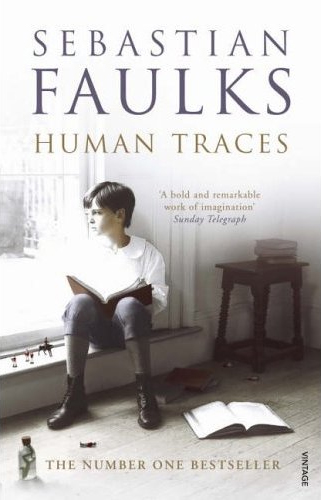
One of those literary fiction novelists is Sebastian Faulks. I recently finished his Human Traces (2005), which is about the early years of psychiatry. Sort of. It begins in 1876, with the introduction as boys of its two main characters, Jacques Rebière in France and Thomas Midwinter in England. The two meet when in their early twenties, become great friends, qualify in medicine, and open a sanatorium in southern Austria. Later, the two disagree over the direction the nascent science of psychiatry should take, beginning a feud which only ends after the First World War.

Human Traces is historical fiction. Its characters are invented but a number of real historical figures make appearances. It is about a variety of mental conditions, their historical diagnoses, and what we now know them to be. (Most asylums in the nineteenth century, for example, were filled with syphilis victims.) But Human Traces also contains at its core a very science-fictional idea.

Some three-quarters of the way through the book, Midwinter proposes a theory to explain why some people hear voices. It is his theory that psychosis is inextricably linked to self-awareness, and that it is the advent of self-awareness which created human beings. Early humans, he contends, heard voices as a matter of routine. In a speech given at his sanatorium, he outlines his theory:

… of how man, after he had learned language, had been able to conjure instructive voices in his head; and of how, after the invention of writing and under the influence of huge population upheavals, the ability to summon such voices had become rarer. (p 497)

This theory had been inspired by a number of things – not the least of which was Midwinter himself hearing voices when younger – but it was on an expedition to Africa that it began to gel:

But how could men without consciousness – a modern sense of time, and cause and other people – have done this? Picture your shepherd far away in the hills with no sense that he is a man, no idea of time in which he can visualise himself and his situation… How does he know he must keep tending his sheep? Why does he not forget what he is meant to do – as an ape would forget? Because under the anxiety of solitude, under the pressure of fear, he releases chemicals in his brain that cause not sweating palms, or racing heart, though perhaps those as well – but the voiced instructions of his king. He hallucinates a voice that tells him what to do. (p 450)

Midwinter contents that language was not a development of self-awareness, that self-awareness did not lead to civilisation; but that language and civilisation both came into being before humanity had consciousness. It was only the development of writing which led to self-awareness. He references a number of mythologies in proof – the Ancient Greeks in conversation with their gods, God speaking to Abraham in the Bible, and so on…

It’s not a conceit which sits well as the core of a realist novel. Nor is it one which really stands up all that well to scrutiny. It’s an interesting idea, certainly, but perhaps better suited to the sort of thought experiment for which science fiction is best suited. We know that writing developed in Mesopotamia around 8000 BCE. It has been estimated that Abraham lived around 1800 BCE, and the Greek pantheon has been traced back to sixth century BCE Greece. So writing had been around for several millennia before the examples Midwinter gives to demonstrate his thesis. And for those thousands of years, if his theory is correct, humanity had not been wholly self-aware…

It doesn’t really work. The weight of history stands against it. However, it would make for an interesting creation myth for a fantasy novel; or, perhaps, first contact could be the trigger from one state to the other for an alien race in a science fiction novel. Aliens of differing degrees, or variable degrees, of self-awareness have been used in sf before – in Peter Watt’s Blindsight, the aliens are not conscious; in the GDW role-playing game 2300AD, one of the alien races increased their intelligence from normally very low levels as their fight/flight reaction.

Having said all that, there’s perhaps an interesting idea to explore at the intersection of Midwinter’s theory and the City Burners. Between 1200 and 1150 BCE, the Late Bronze Age civilisations around the Eastern Mediterranean collapsed. From what little documentary evidence that has been found, raiders from the sea – known as the Sea Peoples or the City Burners – invaded a number of city-states and destroyed them, propelling civilisation back to illiteracy. Imagine if those Sea Peoples had been Midwinter’s unconscious humans, driven by the voices in their heads to destroy those civilisations who, through the widespread use of writing, could no longer hear the voices…

There’s a novel in there somewhere, if someone wants to write it.


2 Comments

The numbers game: addenda

Colum’s comment on my previous post, The numbers game, prompted me to wonder how quickly I’ve placed stories – ie, how many submissions has it taken for each story I’ve written before I’ve sold it. So I went back to my trusty spreadsheet, wrangled some numbers and produced this neat little bar chart:

A couple of the stories I sold to the first place I submitted them were written specifically for anthologies. The ones which took seven or eight goes are the older stories… which does suggest I’m getting better at this lark.

Having said all that, I’ve yet to sell stories to any of the big venues, such as Interzone, Strange Horizons, Clarkesworld, or the Big Three US paper mags (though I’m not especially bothered about submitting to the last).


3 Comments

The numbers game

I was thinking yesterday about how much I hate writing first drafts. I much prefer rewriting. Once I’ve got the bones of the story down on paper, I have something to shape – and it’s that process I enjoy doing. And this got me thinking about how many stories I’ve started but never finished. So I went digging through my various spreadsheets and lists of submissions, and I managed to cobble some numbers together…

started finished submitted published
flash 5 4 3 2
novel 8 5 5 0
novella 8 1 0 1
poem 21 21 8 1
short story 40 34 23 19

This may make me look quite prolific, but I’m a complete dilettante compared to some people I know. There are those who have submitted in one year more stories than I’ve ever actually finished. These numbers incidentally are mostly for the past few years. I did write and submit some short stories during the early 1990s, but my records from then are patchy so I’ve not included them. I spent much of that decade focusing on writing novels – which landed me an agent in 2005. It was only in 2008 that I started seriously writing and submitting short fiction, and year or so after that I tried my hand at poetry.

I seem to be much better at starting novellas than I am at finishing them – the only completed one is Adrift on the Sea of Rains, which I published through Whippleshield Books. Most of my poems I’ve posted on sferse, but I’ve only tried submitting a handful (without much success, it has to be said). And, while I’ve finished five novels, I’ve only submitted two complete ones to my agent; the remaining three were proposals. The above figures do not include the short stories, novellas or novels I plan at some point to have a go at but presently have nothing more than a one-line description in my ideas book.

The past six to nine months I’ve been focusing on Rocket Science, Adrift on the Sea of Rains and The Eye With Which The Universe Beholds Itself, so I’ve not had much chance to write any new short stories, or even finish off any of those I’d previously started. I really need to get back into that. So, of course, only a couple of days ago I had a good idea for a novel and I want to get some of that down on paper…


14 Comments

What I learned self-publishing my book

There were two chief reasons why I self-published the first book of the Apollo Quartet, Adrift on the Sea of Rains: timing and control. I wanted to launch it on the back of Rocket Science at the Eastercon this year, and only by doing it myself would I make that deadline. I also took some chances with the book that most self-respecting editors would have baulked at: not using speech marks for dialogue, writing the flashback sequences in long discursive passages in italics, and using a list of abbreviations and an extensive glossary. I could have just formatted the book for Kindle, and loaded it up onto Amazon. Which is what a lot of self-published authors do. But – if only for my own self-respect – I decided that if I was going to self-publish I was going to do it properly: paperbacks, hardbacks, ISBNs, a proper small press…

And that’s what I did.

To be honest, the hardest part was writing the book. Typesetting it and getting it printed were not difficult. Likewise buying ISBNs. Or setting up the online shop. The launch at Eastercon went well, and I sold a good number of copies – and not just to people who knew me, or who had read other fiction I’d written (sadly, the latter number is lower than the former). And yes, I did have to do a bit of a “hard sell” at times.

But once the Eastercon was over, and I was back home, the really hard part began. They say the average self-published book sells less than a hundred copies, and those are mostly to family and friends. I’d gone past that number by selling my book at Eastercon and alt.fiction. But if I wanted sales to continue to grow, I needed to make them online. My next priority might well be writing book two of the Apollo Quartet – the working title is currently The Eye With Which The Universe Beholds Itself – but I also needed to work on promoting Adrift on the Sea of Rains.

And having now spent two months trying to do that, I’ve learnt a few home truths:

1. breaking out of your community is hard
There are about a dozen reviews of Adrift on the Sea of Rains online. Quite a few were done by friends of mine. I value their opinions, so the fact they thought the book good makes me happy. Some of the reviews were done by people unknown to me. But if I want to sell more copies of Adrift on the Sea of Rains, I need more of the latter than the former. I need people who have never heard of me to buy copies of the book. Reaching them is hard – they have no reason to listen to me. I’m an unknown quantity. I don’t even have the benefit of a known imprint on the spine of my book -ie, a logo which indicates a history of publishing science fiction a buyer knows they like.

2. there is no secret place online which will lead to sales
I have started threads promoting Adrift on the Sea of Rains on a handful of forums. I’ve watched the number of views of those threads climb up into the hundreds, but only a few people have actually posted comments. Even less have actually followed the links and purchased a copy. Again, it comes down to being an unknown. I’ve been a member of some forums for several years; people there know me. On others, I’m pretty much a drive-by spammer. People in the former situation are more forgiving of my promotional posts; but in neither case has it proven especially effective at generating sales.

3. quality is immaterial
I made sure Adrift on the Sea of Rains was a quality product – a well-made paperback and hardback, with striking cover art, and properly-edited text. None of that is obvious online. The same is true for the quality of the writing. Amazon provides a preview for the Kindle edition, but is that really enough to get an idea of how good the book is? You read the previews for some self-published authors, and the prose is semi-literate. Yet they seem to sell hundreds of copies a day. I suspect it’s the number of books such writers have available which is the chief factor in driving sales.

4. promoting your book will often lead to you defending your choice to self-publish
The fact that I chose to self-publish Adrift on the Sea of Rains will damn it in many people’s eyes. It’s true the vast majority of self-published titles are complete rubbish – even the successful ones. People will choose to believe I self-published because my story wasn’t good enough for a commercial publisher. (For some reason, small presses never seem to factor into this argument.) I could have pretended Whippleshield Books was not my press, and created some separate online identity to promote it. But that’s a lot of trouble to go to for a lie that would be quickly seen through. I’m operating an open submissions policy for Whippleshield Books, so it’s not a true self-publishing venture, it’s not solely for my books. But that’s a distinction many critics of self-published books consider irrelevant.

5. the internet allows you see how badly you’re failing in real-time
If you publish for Kindle, the Kindle Direct Publishing website displays how many copies you’ve sold on a monthly basis. Other sites, like goodreads.com or librarything.com, tell you how many people on those sites own copies of your book, or have seen fit to review it or comment on it. Very few casual readers will bother to write a short review of a book they’ve read. And when the number of readers is still in double-figures… Unsurprisingly, it can be very disheartening.

I came up with the idea for the Apollo Quartet partly because I’m a big fan of Lawrence Durrell’s Alexandria Quartet and partly because I had a couple of ideas for stories which I felt could be thematically linked (a third has changed greatly to fit into the quartet, and another was entirely replaced). I’m hoping that the appearance of each book will increase sales of the preceding volumes. And if, as some of the reviews have stated, Adrift on the Sea of Rains is good enough to appear on an award shortlist or two (providing people remember to nominate it, of course), then that too can only help.

None of this, however, alters the fact that Adrift on the Sea of Rains is a self-published book, a fact which will be seen to define it far more than its story or the quality of its prose. And while I can bemoan that, I can understand why it happens. Because, bar very rare exceptions, self-published books are typically pretty damn poor. Evangelists for so-called “indie” publishing may get all offended when this is pointed out – no, they’re not the future; yes, ignoring self-published books is entirely reasonable – but I’m not interested in promoting the means I used to get Adrift on the Sea of Rains out into the market, I’m interested in promoting my book. I may have self-published it, but that doesn’t mean I automatically support every self-published author on the planet. Nor am I convinced it is the best way to publish a book, or the only way which is economically sustainable in the mid-term. I support those books and authors I like and admire, irrespective of how their books were published.

And I would hope others apply the same to me and Adrift on the Sea of Rains.