I first read Bold As Love back in June 2002, a year after its publication. While it was very different from Jones’ previous novel, Phoenix Café
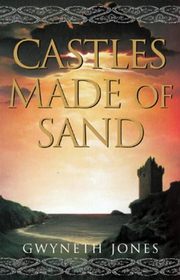
 (the third book of the Aleutian trilogy), I enjoyed it and thought it very good. I wasn’t the only one – it was shortlisted for both the BSFA Award and the Arthur C Clarke Award, and won the latter. I started the sequel, Castles Made of Sand
 , shortly after finishing Bold As Love, but ground to a halt about halfway through it. Another three books in the series were published over the following years: Midnight Lamp
 (2003), Band of Gypsys
 (2005) and Rainbow Bridge
 (2006). I bought each one as they came out and put them on the bookshelves… but, after my experience with Castles Made of Sand, I never actually got around to reading them.
It had always been my intention to read the five books, preferably one after the other. But like many people who suffer from my condition – procrastination – I’m more likely to do something if it becomes part of my routine, or I make a project of it. This summer I did the latter. Jones’ Bold as Love quintet became a Summer Reading Project (along with L Timmel Duchamp’s Marq’ssan Cycle and Doris Lessing’s Canopus in Argos quintet; see here). The start of the project was delayed somewhat, for a number of reasons, but in late August I started rereading Bold As Love… and by 15 September had finished all five books.
It was well worth doing. And this is how it went…
Shape is important to a story. It is even more important to a story which stretches over several novels. Gene Wolfe’s The Book Of The New Sun is one novel split into four books (see here); Paul J McAuley’s Confluence trilogy is one novel split into three books; EC Tubb’s Dumarest series has no shape, merely a direction (ie, Dumarest is seeking the location of his home world, Earth). Gwyneth Jones’ Bold as Love series is neither one novel split into five, nor is it a quintet possessing direction only. It has a five-book shape, which is itself comprised of five one-book shapes. The novels can be read individually, but are richer if read in order as a quintet.
The overall story of the quintet is the near-future of the world. It begins in the UK, but over the course of the five books encompasses Europe, the US and China. It begins during the dissolution of the union of England, Scotland, Wales and Northern Ireland. For reasons not completely explained, the English government puts together a think tank, comprising members of the “Counter Cultural Movement” (CCM) – rock and pop stars, in other words. This goes horribly wrong when one such rock star, Pigsty Liver, machine-guns members of the government and seizes power. This is not, it has to be said, especially convincing. But Jones is busy setting up her “Rock n Roll Reich”, and the authorial hand-waving is forgivable. I mean, counter-cultural types are generally anti-authoritarian, government types are generally all about authoritarianism – there’s an obvious conflict of philosophies. But that’s neither here nor there, because the world as Jones wants it – and gets – is an England effectively ruled by the Triumvirate.
The Triumvirate is the three protagonists of the five books: Ax Preston, guitar hero; Sage Prender, AKA Aoxomoxoa, frontman and driving-force for a techno group; and Fiorinda, daughter of rock god Rufus O’Niall, and his incestuous victim in her early teens. That incestuous incident is important – both for what it does to Fiorinda, and for what it nearly did to Gwyneth Jones.
The opening chapter of Bold As Love was published in Interzone’s July 2001 issue, under the title ‘The Saltbox’. Apparently, someone bought that issue of Interzone in a shop, decided ‘The Saltbox’ was obscene (paedophilia and incest), and reported the magazine to the police. Who promptly descended on the editorial address and carted away several copies of the issue. Happily, nothing came of it. Gollancz published Bold As Love as planned, and Interzone is still going strong today.
But Ax, Sage and Fiorinda: the Bold as Love cycle is the story of these three, the world they create, the world in which they find themselves after they lose control of it, their accommodations with the future which results, and a final game-changing event which rewrites geopolitics for the future.
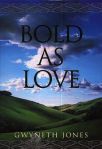 Bold As Love
Several things about Bold As Love struck me on this reread. I’d noticed the first time I’d read the book that it was structured more as a series of vignettes than it was a linear connected narrative. This is not necessarily a bad thing, but I was surprised that I’d remembered the story as less episodic than it actually was, almost as if I’d confabulated something into the gaps in the chronology. I said in a review of Jones’ Flowerdust in Vector back in 1994 that the worlds she created felt so complete it felt as though they continued to live on after you’d finished the book. The same is true of Bold As Love.
Ax and Sage often came across as very similar, which was occasionally confusing in dialogue. The same cannot be said of Fiorinda, who is in many respects a typical Jones heroine – i.e., broken. The story-arc, and especially the plots of Bold As Love and Castles Made of Sand – seem driven as much by the need to “fix” her as it is by the unfolding of the future-history of the series’ world.
The musical dimension to the series I never found wholly convincing, perhaps because my own taste in music is defiantly niche (ie, extreme metal). While I could map Aoxomoxoa and the Heads onto Prodigy and their like, and there are plenty of female singer-songwriter analogues for Fiorinda, I could never quite figure out how Ax’s band, the Chosen Few, might sound, what position they might occupy in the rock universe. They felt out of time – too modern for the 1960s or 1970s, too old-fashioned for the 1980s and 1990s. The fact that three such acts might appear at the same festivals, sufficiently often for them to know each other, also seemed to me to depict the UK music scene as a curiously small world. The music is important, of course – Jones even provides a soundtrack to the novel (see here) – and plays its part during a national tour in which the country tears up the old to usher in the new.
As an introduction to the five chief elements of the Bold as Love series – the three members of the Triumvirate, the world of the novel, and the music – the novel Bold As Love works extremely well. And the prose, as is usual from Jones, is very, very good indeed.
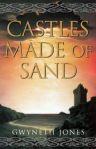 Castles Made of Sand
This I expected to be a less satisfying read – I’d bounced out of it once before, after all. And the somewhat inelegant précis of Bold As Love which opens the novel didn’t bode too well. The first third of the story focuses on the Triumvirate’s relationship, depicted in a strange Delanyesque-Heinleinian fashion – character dynamics by Delany, dialogue by Heinlein. This may be why I bounced out of the book the first time I tried reading it. I’m not a big Heinlein fan. However, once Ax steps out of the relationship, things start to improve. In fact, the sub-plot concerning human sacrifice is very good indeed, and the way it slowly introduces magic to what has chiefly been a near-future sf story is cleverly done.
It is this last which eventually lifts Castles Made of Sand above what those early chapters had promised. The near-future of Bold As Love is slowly contaminated by magic – and yet, all the clues were there in the first book (not least the aforementioned saltbox). Castles Made of Sand is a darker book than its predecessor, and it’s the introduction of magic which is the cause.
This is especially obvious in the book’s finale, the magic duel with Rufus O’Niall. It recasts the story arc of the five books completely – the story-arc which starts to take shape in the second half of Castles Made of Sand is not the story-arc of which the first book offered misty glimpses.
To be honest, I found Castles Made of Sand a less satisfying read than Bold As Love. And yet, thinking about the books to write this post, I find that I remember more of Castles Made of Sand than I do Bold As Love. It’s a more impactful novel, I think, partly because it builds on the promise of the first book and partly because it warps and twists that promise into something very different. Which may be why I feel I want to reread the books more so after finishing this one than I did Bold As Love.
The remaining three books I’ll cover in another post, side B (of course). There may even be a third post of bonus tracks.



 , was shortlisted for the Philip K Dick Award in 2001, but has never received a UK edition. It wasn’t until her second novel,
  , that she had a novel published in the UK. And yet, despite writing more than a novel a year since then, and even being shortlisted for the Arthur C Clarke Award in 2006 for
  , she’s not a writer who seems to have impinged much on my map of the genre. I’m not entirely sure why. As far as I could tell, her science fiction was of a variety that would appeal to me. Yet I never bought or read one of her books. Perhaps it was because she seemed focused on her Detective Inspector Chen series of Chinese fantasy novels, which don’t interest me in the slightest.
 is the first book in a planned trilogy. It was first published in 2008, although no sequels have yet to appear. It is set on a far-future Mars which bears very little resemblance to the Mars of science fact. Parts of the story take place on Earth, which is also greatly changed.
 by Rosemary Kirstein. It was in the last year or so, although the book was originally published in 1989. I do know that it’s not well known in the UK. But whenever, and whatever, I read about it, I decided it might appeal, and so determined to keep my eyes open for a copy. Which I found several months later in a local charity shop.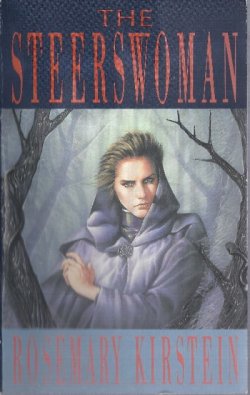
 ).
).
 , which opens up its story’s universe in a series of appendices and so becomes almost a space opera; or even the hints dropped regarding the Age of Legends in Robert Jordan’s bloated Wheel of Time series.
 ,
,  and
and  . All four are available in an omnibus volume,
  . I shall have get me that omnibus volume. (Edit: apparently the omnibus only contains the first two books. Ah well. I shall try to find all three books, then…)
 , Octavia Butler (1979)
 , Elizabeth Hand (1988)
 , Maureen McHugh (1992)
 , Melissa Scott (1996)
 , Chris Moriarty (2003)
 , Tricia Sullivan (2003)
 , Steph Swainston (2004)
 , Karen Traviss (2004)
 , Marianne de Pierres (2007)
 , Lauren Beukes (2008)
 , CJ Cherryh
 , Mary Gentle
 , Liz Jensen (my review
  , Gwyneth Jones (my review
  , Ursula K LeGuin
 , Susan R Matthews
 , Justina Robson
 doesn’t make it. It’s an excellent novel, and everyone should read it. But, while I own but have yet to read
  It Doesn't Have To Be Right...