It Doesn't Have To Be Right…

… it just has to sound plausible


56 Comments

Toward 100 Great SF Short Stories by Women

In my review of Women of Wonder, a women-only sf anthology edited by Pamela Sargent, on SF Mistressworks here, I mentioned the anthology 100 Great Science Fiction Short Stories, edited by Isaac Asimov, Joseph D Olander and Martin H Greenberg. It occurred to me it would be a good idea to put together a list, of meme-like properties, of 100 great sf stories by women writers. I can’t do this on my own – I’ve simply not read enough short fiction to pick out enough good stories. So I’m asking for suggestions. There was a bit of a conversation of Twitter today, using the hashtag #100WomenSF. Feel free to suggest there too.

The rules are simple – written by a woman, science fiction only, published in any year up to and including 2012, any length (ie, novelettes and novellas allowed). The list will feature only one piece of fiction per author but don’t let that stop you. Some authors are going to be easier than others, but may well present different problems – everyone can probably name a suitable story by Ursula K Le Guin off the top of their head, but which is her best one?

I had a quick go and managed just over fifty – including some authors appearing more than once (such as Le Guin) because I’ve yet to decide which story belongs in the final list…

Stories I’ve read that I think belong on the list
‘The Conquest of Gola’, Leslie F Stone (1931, short story)
‘No Woman Born’, CL Moore (1944, novelette)
‘That Only a Mother’, Judith Merril (1948, short story)
‘Brightness Falls from the Air’, Margaret St Clair (as Idris Seabright) (1951, short story)
‘The Last Day’, Helen Clarkson (1958, short story)
‘The Heat Death of the Universe’, Pamela Zoline (1967, short story)
‘And I Awoke and Found Me Here on the Cold Hill’s Side’, James Tiptree Jr (1972, short story)
‘When It Changed’, Joanna Russ (1972, short story)
‘Of Mist, and Grass, and Sand’, Vonda N Mcintyre (1973, novelette)
‘Scorched Supper on New Niger’, Suzy McKee Charnas (1980, novelette)
‘Bloodchild’, Octavia E Butler (1984, novelette)
‘All My Darling Daughters’, Connie Willis (1985, novelette)
‘Webrider’, Jayge Carr (1985, short story)
‘Out of All Them Bright Stars’, Nancy Kress (1985, short story)
‘The View from Venus: A Case Study’, Karen Joy Fowler (1986, novelette)
‘Reichs-Peace’, Sheila Finch (1986, novelette)
‘Rachel in Love’, Pat Murphy (1987, novelette)
‘Tiny Tango’, Judith Moffett (1989, novella)
‘Identifying the Object’, Gwyneth Jones (1990, novelette)
‘The Road to Jerusalem’, Mary Gentle (1991, short story)
‘Coming of Age in Karhide’, Ursula K Le Guin (1995, novelette)
‘The Avatar of Background Noise’, Toiya Kristen Finley (2006, short story)
‘Arkfall’, Carolyn Ives Gilman (2008, novella)
‘Legolas Does the Dishes’, Justina Robson (2008, short story)
‘Immersion’, Aliette de Bodard (2012, short story)

Stories I’ve read that maybe should be on the list
‘Cassandra’, CJ Cherryh (1978, short story)
‘Abominable’, Carol Emshwiller (1980, short story)
‘Symphony for a Lost Traveller’, Lee Killough (1984, short story)
‘Forever Yours, Anna’, Kate Wilhelm (1987, short story)
‘Stable Strategies for Middle Management’, Eileen Gunn (1988, short story)
‘California Dreamer’, Mary Rosenblum (1994, short story)
‘The Lady Astronaut of Mars’, Mary Robinette Kowal (2012, novelette)

Stories I’ve not read
‘Captivity’, Zenna Henderson (1958, novella)
‘Lord Moon’, MJ Engh (as Jane Beauclerk) (1965, short story)
‘Weyr Search’, Anne McCaffrey (1967, novella)
‘The Steiger Effect’, Betsy Curtis (1968, short story)
‘Nightlife’, Phyllis Eisenstein (1982, novelette)
‘Her Furry Face’, Leigh Kennedy (1983, short story)
‘The Mountains of Mourning’, Lois McMaster Bujold (1989, novella)
‘The Power and the Passion’, Pat Cadigan (1990, short story)
‘Suppose They Gave a Peace…’, Susan Shwartz (1991, novelette)
‘Protection’, Maureen F McHugh (1992, novella)
‘Danny Goes to Mars’, Pamela Sargent (1992, novelette)

Duplicate stories
‘Souls’, Joanna Russ (1982, novella)
‘Over the Long Haul’, Martha Soukup (1990, novelette)
‘Nekropolis’, Maureen F McHugh (1994, novelette)

Are these sf? I don’t know
‘The Warlords Of Saturn’s Moons’, Eleanor Arnason (1975, novelette)
‘Stone Circle’, Lisa Tuttle (1976, short story)
‘Red as Blood’, Tanith Lee (1979, short story)
‘Spidersong’, Susan C Petrey (1980, short story)
‘Sea Changeling’, Mildred Downey Broxon (1981, novelette)
‘Dog’s Life’, Martha Soukup (1991, short story)
‘The Nutcracker Coup’, Janet Kagan (1992, novelette)
‘All Vows’, Esther M Friesner (1992, short story)
‘Alfred’, Lisa Goldstein (1992, short story)
‘The Good Pup’, Bridget McKenna (1993, short story)

New additions
‘The Fate of the Poseidonia’, Clare Winger Harris (1927, short story)
‘Space Episode’, Leslie Perri (1941, short story)
‘The Putnam Tradition’, Sonya Dorman (1963, short story)
‘Automatic Tiger’, Kit Reed (1964, short story)
‘The View from Endless Scarp’, Marta Randall (1978, short story)
‘War and Rumours of War’, Candas Jane Dorsey (1988, short story)
‘Patient Zero’, Tananarive Due (2000, short story)
‘Knapsack Poems’, Eleanor Arnason (2002, short story)
‘State of Oblivion’, Kaaron Warren (2003, short story)
‘Inside Out,’ Michaela Roessner (2004, short story)
‘Griots of the Galaxy’, Andrea Hairston (2004, novelette)
‘The Bride Price’, Cat Sparks (2007, short story)
‘Tideline’, Elizabeth Bear (2007, short story)
‘Infinities’, Vandana Singh (2008, novelette)
‘Spider the Artist’, Nnedi Okorafor (2008, short story)
‘Chica, Let Me Tell You a Story’, Alex Dally MacFarlane (2008, short story)
‘Cold Words’, Juliette Wade (2009, novelette)
‘Eros, Philia, Agape’, Rachel Swirsky (2009, novelette)
‘Non-Zero Probabilities’, NK Jemisin (2009, short story)
‘Blood, Blood’, Abbey Mei Otis (2010, short story)
‘The Other Graces’, Alice Sola Kim (2010, short story)
‘Agents of Repair’, Rosie Oliver (2010, short story)
‘Amaryllis’, Carrie Vaughn (2010, short story)
‘I’m Alive, I love You, I’ll See You in Reno’, Vylar Kaftan (2010, short story)
‘Six Months, Three Days’, Charlie Jane Anders (2011, short story)
‘Nahiku West’, Linda Nagata (2011, novelette)
‘The Cartographer Bees and the Anarchist Wasps’, E Lily Yu (2011, short story)
‘Silently and Very Fast’, Catherynne M Valente (2011, novella)
‘Jagannath’, Karin Tidbeck (2011, short story)
‘The Green’, Lauren Beukes (2012, short story)
‘Significant Dust’, Margo Lanagan (2012, novelette)
‘Black Box’, Jennifer Egan (2012, short story)

More new additions
‘Water Pirate’, Leigh Brackett (1941, short story)
‘Fireship’, Joan D Vinge (1978, novella)
‘The Missionary’s Child’, Maureen F McHugh (1992, novelette)
‘All the Birds of Hell’, Tanith Lee (1998, novelette)
‘Riding the White Bull’, Caitlín R Kiernan (2004, novelette)
‘Sinner, Baker, Fabulist, Priest; Red Mask, Black Mask, Gentleman, Beast’, Eugie Foster (2009, short story)
‘Flying in the Face of God’, Nina Allan (2010, short story)
‘A Vector Alphabet of Interstellar Travel’, Yoon Ha Lee (2011, short story)

So, more suggestions needed, please. Especially of twenty-first century sf, but also by authors who are not represented here – what is Margaret St Clair’s best story, for example? And tell me about the stories I’ve not read – how good are they? The stories in the last section, are they sf or fantasy? I can’t tell from the title. I picked them from the shortlists of the Hugo and Nebula awards, neither of which actually differentiates between the genres.

Let’s see if we can do a good representative meme-list of 100 pieces of sf short fiction by women writers. I’ll post the final list here and on both SF Mistressworks and Daughters of Prometheus.

ETA
Have added Leslie F Stone and Margaret St Clair to the first list. Have also settled on ‘Out of All Them Stars’ for Nancy Kress and ‘Coming of Age in Karhide’ for Le Guin. Likewise, ‘And I Awoke And Found Me Here On The Cold Hill’s Side’ has always been a favourite story of mine so I’m going to choose that as Tiptree’s contribution.

ETA #2
Added New additions section, from comments here and on Twitter. Some of them I’ve read. Of the ones I’ve not read, some might not be sf – I need to check that. Also moved a couple of stories to Stories I’ve read that maybe should be on the list since I found copies and read them.

ETA #3
More new additions added. I don’t want the list to be too twenty-first-century heavy, but it is sort of leaning that way. At present, it breaks down by decade as 1920: 1; 1930: 1; 1940: 4; 1950: 3; 1960: 6; 1970: 8; 1980: 20; 1990: 15; 2000: 19; 2010: 17, which adds up to 94 (and still includes more than one entry by a couple of authors). I think the list needs a few more suggestions for the 1950s, 1960s and 1970s. And it would be helpful if anyone can confirm if all of the stories actually are science fiction and not fantasy. Nonetheless, a list is starting to come together…

2 Comments

200 Significant Science Fiction Books by Women

Yesterday someone tweeted the following list from the New York Review of Science Fiction – 200 Significant Science Fiction Books by Women, 1984–2001, by David G. Hartwell. The list was published on 15 February this year and was apparently put together for a panel at a convention or something. And what a peculiar list it is too. A selection of the best-known women sf writers leavened with a handful of obscure names. Every book published by CJ Cherryh during the period, for instance, is apparently significant. There are some YA titles, and some which are not science fiction by any definition of the term – Sheepfarmer’s Daughter, which is a straight secondary world fantasy, for example; or The Silver Kiss, a YA vampire novel. Hartwell’s decision to exclude books “published out of genre” means no Clarke Award-winning The Handmaid’s Tale, but he still includes The Journal of Nicholas the American, which wasn’t published by a genre imprint. Neither was Sarah Canary, but that’s also on the list.

There are indeed many good books on the list, but it’s a baffling piece of work nonetheless. It doesn’t give a true indication of the contribution made by women writers to science fiction as it focuses only on those who won awards or appeared on “best of the year” lists during the seventeen years in question. Exceptionalism is not representational. Vast swathes of genre fiction have been overlooked and ignored because it was written by women, and Hartwell’s list does nothing to address this.

It doesn’t help that the choices appear so random – no The Sparrow or Children of God, nothing from Tepper between 1990 and 2000, the first two books of Jones’ Aleutian trilogy but not the third, no Mary Gentle or Tricia Sullivan or Josephine Saxton, and all but a couple of the titles which appeared under The Women’s Press sf imprint completely ignored… Hartwell’s decision to include collections also skews the list, since many likely include stories written before 1984. James Tiptree Jr is a case in point: she’s represented by one novel and three collections, and yet only two of the books listed were actually published during her lifetime.

I’ve re-sorted the list alphabetically, which better shows how some writers dominate it. (And I’ve corrected the mispelling of Susan M Shwartz’s name.) I’ve also asterisked those books which have  been reviewed by SF Mistressworks (some more than once). Still, at the very least, any self-respecting sf fan should be aware of, or have read, most of the books on this list. In that respect it should make quite a good meme. I’ve had a go and done the usual – bold for read, italics for TBR…

Brother Termite, Patricia Anthony (1993)
A Woman Of The Iron People, Eleanor Arnason (1991)
Ring of Swords, Eleanor Arnason (1993)
Primary Inversion*, Catherine Asaro (1995)
The Last Hawk, Catherine Asaro (1997)
The Quantum Rose, Catherine Asaro (2000)
Unwillingly to Earth, Pauline Ashwell (1992)

Crash Course, Wihelmina Baird (1993)
In the Garden of Iden, Kage Baker (1998)
Sky Coyote, Kage Baker (1999)
The Best of . . ., Marion Zimmer Bradley (1985)
The Warrior’s Apprentice, Lois McMaster Bujold (1986)
Borders of Infinity, Lois McMaster Bujold (1989)
Falling Free, Lois McMaster Bujold (1988)
The Vor Game, Lois McMaster Bujold (1990)
Mirror Dance, Lois McMaster Bujold (1994)
Cetaganda, Lois McMaster Bujold (1996)
Dreamweaver’s Dilemma, Lois McMaster Bujold (1996)
Memory, Lois McMaster Bujold (1996)
A Civil Campaign, Lois McMaster Bujold (1999)
Falcon, Emma Bull (1989)
Bone Dance, Emma Bull (1991)
Dawn, Octavia Butler (1987)
Adulthood Rites, Octavia Butler (1988)
Imago, Octavia Butler (1989)
Parable of the Sower, Octavia Butler (1994)
Bloodchild and Other Stories, Octavia Butler (1995)
Parable of the Talents, Octavia Butler (1998)

Mindplayers, Pat Cadigan (1987)
Patterns, Pat Cadigan (1989)
Synners, Pat Cadigan (1991)
Home by the Sea, Pat Cadigan (1992)
Dirty Work, Pat Cadigan (1993)
Promised Land, Pat Cadigan (1999)
Dervish Is Digital, Pat Cadigan (2001)
The Furies, Suzy McKee Charnas (1994)
The Conqueror’s Child, Suzy McKee Charnas (1999)
Chanur’s Venture, CJ Cherryh (1984)
Voyager in Night*, CJ Cherryh (1984)
Cuckoo’s Egg, CJ Cherryh (1985)
The Kif Strike Back, CJ Cherryh (1985)
Chanur’s Homecoming, CJ Cherryh (1986)
Visible Light, CJ Cherryh (1986)
Cyteen, CJ Cherryh (1988)
Rimrunners, CJ Cherryh (1989)
Heavy Time, CJ Cherryh (1991)
Hellburner, CJ Cherryh (1992)
Foreigner, CJ Cherryh (1994)
Invader, CJ Cherryh (1995)
Rider at the Gate, CJ Cherryh (1995)
Inheritor, CJ Cherryh (1996)
Precursor, CJ Cherryh (1999)
Defender, CJ Cherryh (2001)
Mainline, Deborah Christian (1996)
Mutagenesis, Helen Collins (1993)
Beholder’s Eye, Julie Czerneda (1998)
In the Company of Others, Julie Czerneda (2001)

A Paradigm of Earth, Candas Jane Dorsey (2001)

Native Tongue*, Suzette Haden Elgin (1984)
Jaran, Kate Elliott (1992)
City of Diamond, Jane Emerson
The Start of the End of It All and Other Stories, Carol Emshwiller (1990)
Rainbow Man, MJ Engh (1993)

Infinity’s Web, Sheila Finch (1985)
Artificial Things, Karen Joy Fowler (1986)
Sarah Canary, Karen Joy Fowler (1991)
Black Glass, Karen Joy Fowler (1998)
In Conquest Born, CS Friedman (1987)

Halfway Human*, Carolyn Ives Gilman (1998)
The Dazzle of Day, Molly Gloss (1997)
A Mask for the General, Lisa Goldstein (1987)
Queen City Jazz*, Kathleen Ann Goonan (1994)
The Bones of Time, Kathleen Ann Goonan (1996)
Mississippi Blues, Kathleen Ann Goonan (1997)
Crescent City Rhapsody, Kathleen Ann Goonan (2000)
Flesh and Gold, Phyllis Gotlieb (1998)
Ammonite*, Nicola Griffith (1993)
Slow River*, Nicola Griffith (1995)

Winterlong*, Elizabeth Hand (1990)
Æstival Tide*, Elizabeth Hand (1992)
Icarus Descending*, Elizabeth Hand (1993)
Glimmering*, Elizabeth Hand (1997)
Last Summer At Mars Hill, Elizabeth Hand (1998)
Midnight Robber*, Nalo Hopkinson (2000)

Divine Endurance, Gwyneth Jones (1984)
Escape Plans*, Gwyneth Jones (1986)
Kairos*, Gwyneth Jones (1988)
White Queen*, Gwyneth Jones (1991)
North Wind, Gwyneth Jones (1994)
Bold as Love*, Gwyneth Jones (2001)

Hellspark, Janet Kagan (1988)
Mirabile, Janet Kagan (1991)
The Journal of Nicholas the American*, Leigh Kennedy (1986)
Polar City Blues, Katherine Kerr (1990)
The Silver Kiss, Annette Curtis Klause (1990)
Trinity and Other Stories, Nancy Kress (1985)
An Alien Light, Nancy Kress (1988)
Brain Rose, Nancy Kress (1990)
The Aliens of Earth, Nancy Kress (1993)
Beggars in Spain, Nancy Kress (1993)
Beggars & Choosers, Nancy Kress (1994)
Beggars Ride, Nancy Kress (1996)
Beaker’s Dozen, Nancy Kress (1998)
Probability Moon, Nancy Kress (2000)
Probability Sun, Nancy Kress (2001)

Dreams of Dark and Light, Tanith Lee (1986)
Night’s Sorceries, Tanith Lee (1987)
Always Coming Home, Ursula K LeGuin (1985)
Buffalo Gals and Other Animal Presences, Ursula K LeGuin (1987)
A Fisherman of the Inland Sea*, Ursula K LeGuin (1994)
Four Ways to Forgiveness*, Ursula K LeGuin (1995)
Unlocking the Air and Other Stories, Ursula K LeGuin (1996)
The Telling, Ursula K LeGuin (2000)

Arachne, Lisa Mason (1990)
Summer of Love, Lisa Mason (1994)
An Exchange of Hostages*, Susan R Matthews (1997)
The Chronicles of Pern: First Fall, Anne McCaffrey (1993)
The Girl Who Heard Dragons, Anne McCaffrey (1994)
China Mountain Zhang*, Maureen McHugh (1992)
Mission Child*, Maureen McHugh (1998)
Nekropolis, Maureen McHugh (2001)
Murphy’s Gambit, Syne Mitchell (2000)
The Ragged World, Judith Moffett (1991)
Remnant Population, Elizabeth Moon (1996)
Once a Hero, Elizabeth Moon (1997)
The City, Not Long After*, Pat Murphy (1989)
Points of Departure, Pat Murphy (1990)
Sheepfarmer’s Daughter, Elizabeth Moon (1988)
Lunar Activity, Elizabeth Moon (1990)

Deception Well, Linda Nagata (1997)
Vast, Linda Nagata (1998)
Limit of Vision, Linda Nagata (2001)

Becoming Alien, Rebecca Ore (1987)
Being Alien, Rebecca Ore (1989)
Alien Bootlegger and Other Stories, Rebecca Ore (1993)
Gaia’s Toys, Rebecca Ore (1995)

The Annunciate, Severna Park (1999)

Little Sisters of the Apocalypse, Kit Reed (1995)
Silver Screen*, Justina Robson (1999)
Synthesis and Other Virtual Realities, Mary Rosenblum (1996)
Chimera, Mary Rosenblum (1993)
The Drylands, Mary Rosenblum (1993)
Alien Influences, Kristine Kathryn Rusch (1994)
Extra(Ordinary) People*, Joanna Russ (1984)
The Hidden Side Of The Moon, Joanna Russ (1988)

Venus of Dreams, Pamela Sargent (1986)
The Best of . . ., Pamela Sargent (1987)
The Healer’s War, Elizabeth Ann Scarborough (1988)
The Game Beyond, Melissa Scott (1984)
Trouble and Her Friends*, Melissa Scott (1994)
Shadow Man*, Melissa Scott (1995)
Night Sky Mine, Melissa Scott (1996)
The Shapes of Their Hearts, Melissa Scott (1998)
Reef Song, Carol Severance (1991)
Heritage of Flight, Susan M Shwartz (1989)
Legacies, Alison Sinclair (1995)
A Door into Ocean, Joan Slonczewski (1986)
The Children Star, Joan Slonczewski (1998)
Code Of Conduct, Kristine Smith (1999)
Other Nature, Stephanie Smith (1995)
The Arbitrary Placement of Walls, Martha Soukup (1997)
Alien Taste, Wen Spencer (2001)
Chance and Other Gestures of the Hand of Fate, Nancy Springer (1987)
Larque on the Wing, Nancy Springer (1994)

After Long Silence, Sheri S Tepper (1987)
Grass*, Sheri S Tepper (1989)
Raising the Stones, Sheri S Tepper (1990)
The Fresco, Sherri S Tepper (2000)
Virtual Girl*, Amy Thomson (1993)
The Color of Distance*, Amy Thomson (1995)
Through Alien Eyes, Amy Thomson (1999)
Brightness Falls from the Air, James Tiptree Jr (1985)
Tales of the Quintana Roo, James Tiptree Jr (1986)
Crown of Stars, James Tiptree Jr (1988)
Her Smoke Rose Up Forever, James Tiptree Jr (1990)
Lost Futures, Lisa Tuttle (1992)

World’s End, Joan D Vinge (1984)
Phoenix in the Ashes, Joan D Vinge (1985)
Catspaw, Joan D Vinge (1988)
Opalite Moon, Denise Vitola (1997)
The Silent City*, Élisabeth Vonarburg (1988)
In the Mother’s Land, Élisabeth Vonarburg (1992)
Reluctant Voyagers, Élisabeth Vonarburg (1995)

Whiteout, Sage Walker (1996)
Mother Grimm, Catherine Wells (1997)
Children of the Wind, Kate Wilhelm (1989)
And the Angels Sing, Kate Wilhelm (1992)
The Ghost Sister, Liz Williams (2001)
Sea as Mirror, Tess Williams (2000)
Fire Watch, Connie Willis (1985)
Doomsday Book*, Connie Willis (1992)
Impossible Things, Connie Willis (1993)
To Say Nothing of The Dog*, Connie Willis (1998)
Passage, Connie Willis (2001)
Looking for the Mahdi*, N Lee Wood (1996)

Sister Emily’s Lightship and Other Stories, Jane Yolen (2000)

Reclamation*, Sarah Zettel (1996)
Fool’s War, Sarah Zettel (1997)
Playing God, Sarah Zettel (1998)
Busy About the Tree of Life, Pamela Zoline (1988)

I make that 48 read and 5 on the TBR. Not a good showing out of 200. But there are several authors with multiple entries that I don’t normally read – like Nancy Kress, Pat Cadigan, Connie Willis or Lois McMaster Bujold. A lot of the books were also never published in the UK. A large number of the titles, however, are on my wishlist, and I will eventually find copies and read them. And review them on SF Mistressworks, of course.


39 Comments

The other POV

A couple of days ago on Twitter, Requires Hate tweeted that she would no longer read science fiction with male protagonists. Not a problem, you would have thought – there must be plenty of sf with female protagonists. And so there is. But not as much as you’d expect. The majority of science fiction novels are told from a male point of view. Some might have female POV characters – Gareth L Powell’s The Recollection, for example – but the story is shared with a male character. Sf novels, whether by women or men writers, with a single female protagonist are not that common.

So I tried to come up with list of some:

By women writers:
Spirit, Life and Kairos, Gwyneth Jones (SF Mistressworks reviews of Kairos here and here)
Alanya to Alanya and sequels, L Timmel Duchamp
Ash: A Secret History, Mary Gentle
Arkfall, Carolyn Ives Gilman
Angel At Apogee, SN Lewitt (SF Mistressworks review here)
City of Pearl, Karen Traviss (my blog post here)
God’s War and Infidel, Kameron Hurley (my blog post on God’s War here, review of Infidel here)
Debris, Jo Anderton
Dancer of the Sixth, Michelle Shirey Crean (SF Mistressworks review here)
Correspondence, Sue Thomas (SF Mistressworks review here)
Solitaire, Kelley Eskridge (my review here)
Zoo City, Lauren Beukes (my blog post here)
The Female Man, Joanna Russ (SF Mistressworks review here, here and here)
Winterstrike, Liz Williams (my blog post here)
The Steerswoman’s Road, Rosemary Kirstein (SF Mistressworks review here)
The Handmaid’s Tale, Margaret Atwood (SF Mistressworks review here)
Keeping It Real and sequels, Justina Robson

By men writers:
Take Back Plenty, Colin Greenland (my blog post here)
400 Billion Stars, Paul McAuley
Stealing Light, Gary Gibson
The Restoration Game, Ken MacLeod (my review here)
Synthajoy, DG Compton (my blog post here)
Never Let Me Go, Kazuo Ishiguro
The Caryatids, Bruce Sterling
The H-Bomb Girl, Stephen Baxter
The Ophiuchi Hotline, John Varley (my blog post here)

I may have got some of these slightly wrong as I’m going on my memory of the books – they might not be as exclusively female POV as I remember them. It’s unsurprising that I can think of more women writers who use female protagonists than men writers. I suspect this would be true for most people. Second, most of the books I could think of were relatively recent. Back in the Golden Age even the likes of Leigh Brackett and CL Moore wrote books with male protagonists.

Anyone else have any suggested titles?


2 Comments

International Women’s Day

Today is the 101st International Women’s Day, a celebration created by the Socialist movement in 1911. The poster below is not actually for the Day, but it seemed appropriate.

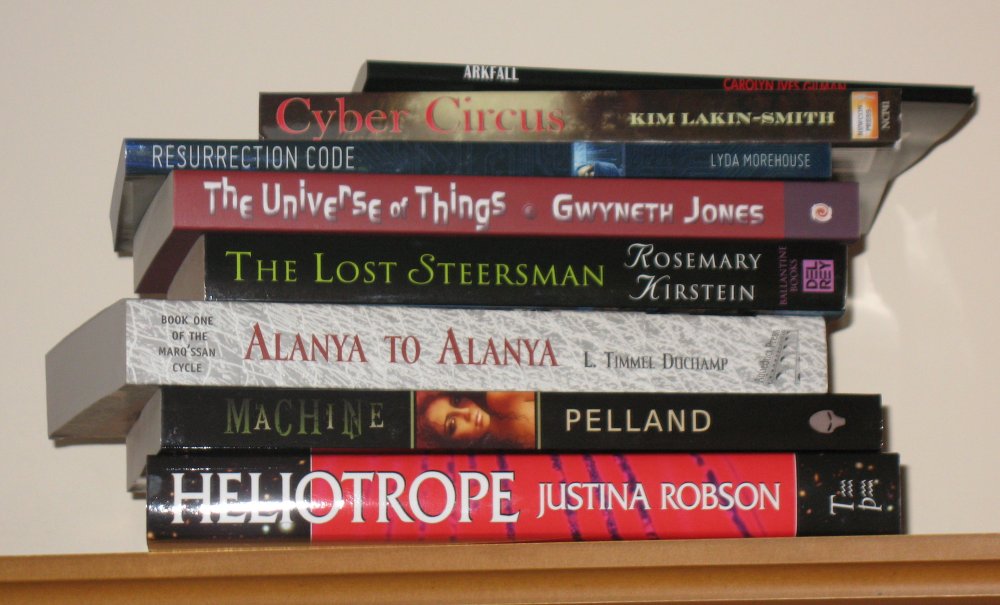
In recognition of International Women’s Day, here are eight recent science fiction novels / collections by women writers I will read / reread and then write about on this blog some time during the next few months (as they’re all too recent to qualify for reviews on SF Mistressworks).

The books are: Arkfall, Carolyn Ives Gilman; Cyber Circus, Kim Lakin-Smith; Resurrection Code, Lyda Morehouse; The Universe of Things, Gwyneth Jones; The Lost Steersman, Rosemary Kirstein; Alanya to Alanya, L Timmel Duchamp; Machine, Jennifer Pelland; and Heliotrope, Justina Robson. All of them except the Kirstein are small press.


2 Comments

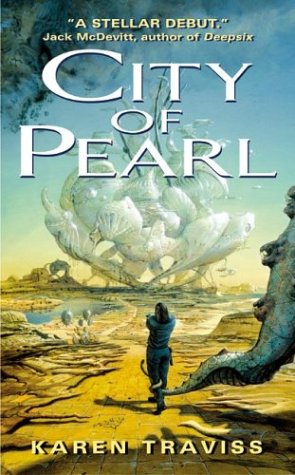
Women in sf reading challenge #10: City of Pearl, Karen Traviss

To be honest, I had not really expected to enjoy City of Pearl by Karen Traviss. From what I’d heard about the novel, it seemed the sort of science fiction I don’t especially like. And Traviss is known as an especially mercenary writer. No matter how talented she may be, such an attitude is unlikely to create works I would find appealing. Nonetheless, I picked the book as one of my dozen for my 2011 reading challenge, and though I may have slipped a little towards the end of last year, I had every intention of reading and blogging about the twelve listed novels.

And so I came to City of Pearl with, I admit, a few preconceptions. Some of them were indeed met, but I was surprised to find myself enjoying the novel more than I had expected.

Shan Frankland is a hard-as-nails police officer in a near-future in which corporations dominate ineffectual governments. All crops are genetically-engineered and trademark, such that no foodstuff can be grown without paying a license fee to a company. When Frankland is offered command of a mission to Earth’s only interstellar colony on Cavanagh’s Star’s second planet, she accepts the mission. But she doesn’t know exactly why, because whatever was told to her to persuade her to accept was part of a Suppressed Briefing, which only releases information into her memory in response to certain triggers.

The mission arrives at Cavanagh’s Star 2 and finds a situation it had not expected: a small low-tech human colony with an extremely small environmental footprint living under the aegis of an alien race, the wess’har. The aliens are actually native to Cavanagh’s Star 2’s twin planet, and are on Cavanagh’s Star 2 to protect that planet’s native squid-like aquatic race, the bezeri. Who had been almost polluted to extinction by a third alien race, the isenj, who had colonised the world. The wess’har wiped out the isenj colony, but now allow the humans to stay on sufferance. Aras is the wess’har responsible for the planet and its ecosystem, and he has been given this role because he has been infected by a native parasite, the c’naatat, which has made him immortal and almost impossible to kill.

Though Frankland tries to keep a tight leash on the scientific team she has brought to Cavanagh’s Star 2, they cavil at her restrictions and continually seek to subvert them. This makes tensions high within Frankland’s mission, a situation not helped by her high-handed and take-no-prisoners attitude. When a second starship from Earth turns up, having departed fifty years after the first, it seems Earth has formed an alliance with the idenj, who determined to take back Cavanagh’s Star 2. During a skirmish with the isenj, Frankland is mortally wounded, but Aras, who has come to value her, infects her with c’naatat. Now she can never return to Earth.

I liked Frankland, and the best parts of City of Pearl were the parts which focused on her. Unfortunately, the aliens are all single-note: the wess’har are literal and unbending, the bezeri are enigmatic, and the isenj are numerous. The scientists are all characterised as venal and selfish, and only the military characters appear to possess any redeeming virtues. The human colonists on Cavanagh’s Star 2 are treated like simple back-to-the-land peasants, and the novel makes little or no judgment on them or their way of life. A lot of City of Pearl is in Aras’ point of view, and he’s neither convincingly alien nor especially interesting.

There’s a fixity of views throughout City of Pearl which I found a little off-putting. The wess’har are very literal and do not compromise. Frankland is very much convinced her own opinion is always correct. The entire cast – with the exception of those Traviss villanises – are straight from the US mode of science fiction, with its Rational Competent Men. Though many in City of Pearl are actually women. Or alien. There’s no subtlety or complexity in the novel. The scientists are wrong, the isenj are wrong. And that’s it. I can see how such binary views might appeal to some readers, especially genre readers, since populist genre fiction seems incapable of psychological depth.

There are apparently a further five Wess’har books, but I’ll not be bothering to read them. While City of Pearl managed an interesting meld of near-future sf and space opera, it was too much like military sf in tone to really appeal to me. Traviss’s prose is readable and well-paced, though to be honest I kept reading more because I liked the character of Frankland than anything else.

Oh, and the titular city is the wess’har capital on their world, and it makes perhaps a half dozen appearances in the novel. Frankland visits it toward the end in order to seek permission from the wess’har elders to stay with Aras. It’s a somewhat peripheral element of the story with which to title it.


8 Comments

Women in sf reading challenge #9: Shadow Man, Melissa Scott

If I’ve had trouble reading the books for my challenge in their proper months, it’s not because reading them is proving a, er, challenge. On the contrary, it’s because I’ve made a change in my reading patterns which makes the books I chose for the challenge less of a conscious or deliberate act of selection of reading material. I now read more books by women writers, and so the dozen books of my reading challenge are just twelve among many. In that respect, the challenge can be counted a success – and only nine months in, too. Nor have any of those nine books been bad books, though a couple I didn’t enjoy as much as the others.

Which brings me to Shadow Man by Melissa Scott, September’s book for the challenge. I was aware of the book’s reputation before choosing it – in fact, it was that which likely led to its selection. However, that reputation had not really prepared for what I found when I started reading it. Because what Shadow Man is, is Ursula LeGuin’s The Left Hand of Darkness through a funhouse mirror. It is also a more political novel than the political The Left Hand of Darkness. Comparisons are inevitable, even though LeGuin’s novel takes place on a world with one gender and Shadow Man takes place in a universe with five genders. Both novels have placed the treatment of gender – culturally and legally – front and centre.

In the universe of Shadow Man, the use of a drug to offset “FTL shock” has resulted in a far greater than normal incidence of intersex and hermaphrodite births (miscarriages are also correspondingly higher). The Concord Worlds now recognise five genders – woman, man, fem, mem and herm; respectively, she, he, ðe, þe and 3e. (Unfortunately, I kept on reading the pronouns referring to herms as if they used the Arabic ﻉ (‘ayn) rather than the numeral 3.) These five genders have led, in turn, to nine sexual preferences, and this has bearing on the plot of the novel.

On the world of Hara, a colony planet re-contacted 100 years previously after several centuries of independent development, the law and society only recognise two genders – man and woman. So the herms, mems and fems must take on the role of one or the other – though there is apparently a facility for herms at least to legally change gender. The Traditionalist Harans feel that true humans have only two genders, and they do not want to join the Concord. The Modernists want the other three genders to be recognised in Haran law. It is the battle between these two groups which drives the plot of Shadow Man.

Warreven is a herm, but legally male, and works as an advocate in the Haran legal system. Years before, 3e almost married the son of the Most Important Man – the de facto ruler of Hara – but 3e refused to change legal gender. Now, 3e fights for gender rights in the courts. Mhyre Tatian is the manager of a middle-sized Concord pharmaceutical company’s operations on Hara. The world’s biggest export is its drugs, all derived from the local flora. Also important is “trade”, which is prostitution, mostly involving the three genders not recognised on Hara.

Warreven is involved in a court case which looks set to play a major role in the fight for gender equality. But the Most Important Man doesn’t want that to happen, because as long as things muddle along as they presently are doing, a delicate balance between the Traditionalists and the Modernists is maintained. But his son, Tendlathe, is a staunch Traditionalist – a blinkered, chauvinist and conservative Traditionalist of the worst kind. In an effort to keep Warreven from the courts, the Most Important Man has him elected as his clan’s seeraliste, the person responsible for selling off the clan’s surplus crops. Meanwhile, the Interstellar Disease Control Agency, the organisation responsible for preventing the spread of diseases – a variety of HIVs were also created by the FTL drug – also wants to prevent that case from going to court for their own reasons. Tatian is caught in the middle as one of his employees is a key witness. When Warreven offers Tatian the entire clan surplus in return for the employee’s testimony, it kicks off a series of Traditonalist attacks on the Modernists and the “odd-bodied”.

Scott makes no concessions when introducing the world of Shadow Man. It’s straight in at the deep end. There are one or two info-dumps streamlined into the narrative, but they provide little more than local colour. The story is told from the points of view – alternating – of Warreven and Tatian. From Warreven, we see what it’s like to be a herm in a society that does not recognise it as a gender, and we get the politics which affects that. Tatian provides an outsider’s view of Hara and its culture. Though both mention at various points some physical attraction between them, it never amounts to anything.

As a sf novel set in a strange and interesting world, with a pair of likeable protagonists, Shadow Man succeeds. There’s an air of exploration to the story, as it spends a great deal of time savouring the culture of Hara before the somewhat abrupt final confrontation. Yet the action never moves outside the capital city, though places elsewhere on the world are often mentioned. It makes for a languid read, a story in which the politics of the climax seems to page by page subsume the story of Warreven and Tatian – in fact, for at least half of the book, they’re barely acquaintances.

But it is the gender politics for which Shadow Man is known, and I found them a little problematical in places. For a start, the thing driving the gender politics in the story is “trade”. It’s almost as if the odd-bodied genders are defined by the roles they play in prostitution. There’s a level of prurience implicit in the Traditionalist response to herms, mems and fems, and given the focus on trade it’s not hard to understand why they might hold such an opinion. Perhaps Shadow Man needed to show a Concord world’s society as contrast, because all the reader has with which to compare it is the situation in the real world. It’s also worth noting that the genders in Shadow Man are defined by biology – it’s the secondary sexual characteristics and equipment which determine which gender a person is. And while the book’s glossaries helpfully explain the nine sexual preferences – there is a glossary of Concord terms and one of Haran words – those sexual preferences make only a few appearances in the story. Haran society is dual-sexed, and the story treats all interactions as such, acknowledging the existence of sexual preferences beyond woman-man but not really exploring them. And this is in a novel whose story describes the start of a sexual revolution comparable to the fight for gay rights in the real world. In fact, Shadow Man‘s penultimate chapter is very much an analogue of Stonewall.

Literalising a metaphor is not uncommon in fiction, and is an excellent tool for commentary. I’m not entirely convinced that literalising sexual preferences as biological gender necessarily helps discussion, though in Shadow Man it has resulted in an interesting universe. It’s a pity Shadow Man doesn’t explore more of it. Which is not to say it’s a bad novel by any means. I enjoyed it and thought it good. I’d happily recommend it. I am somewhat surprised it has never been published in the UK. It seems to me it would fit in quite happily with a number of sf novels which have been available here over the years – not just the aforementioned LeGuin, but also books by Storm Constantine, Samantha Lee, Mary Gentle, or even Gwyneth Jones’ Aleutian trilogy…


5 Comments

Women in sf reading challenge #8: Spin State, Chris Moriarty

There are those who believe science fiction is a predominantly pessimistic genre, and certainly many of the futures that sf novels posit can hardly be called utopias. Of course, much of this depends upon your personal politics – a neoliberal fantasy, for instance, would likely appeal to a plutocrat, or to someone so deluded they think they actually stand a chance of becoming one. Yet such futures are common in science fiction, and often the protagonist – ie, the character with whom the reader is asked to identify – is a victim of this society, a person whose agency does not stretch much beyond what they can actually grasp with two hands. Frequently too they are fighting on two fronts: both against the enemy, and against those for whom they are ostensibly fighting.

Personally, I don’t think such futures are either desirable or inevitable, nor do I think they’re especially necessary for dramatic purposes. Perhaps it’s a peculiarly US perspective, that general antipathy towards anything smacking of state or state apparatus, whereby, by definition, a protagonist must battle their own government as much as they fight the enemies of their nation.

Spin State by Chris Moriarty is a case in point. It was my August read for this year’s reading challenge (see here), and, above caveats aside, I found it an intriguing blend of hard sf, cyberpunk, coal mining and quantum physics.

Catherine Li is a soldier for the UN; she is also a genetic construct. She has hidden the latter fact, claiming only descent from a genetic construct grandmother, otherwise she would not be able to serve in the UN military. After a raid on a secret Syndicates laboratory goes slightly wrong, Li is assigned to Compson’s World to look into the death of genius physicist Hannah Sharifi. Shortly after her death, an encrypted file was sent by Sharifi to UNSec, the UN’s military. Li’s commanding officer wants her to find the private key to the file – Sharifi was working on a way to artificially culture Bose-Einstein condensate, and if she discovered a means of doing so it would have profound effects on the balance of power between the UN and the Syndicates.

In the future of Spin State, Earth has spread out to a number of exoplanets, mostly using STL transport. However, by the use of quantum entanglement, information can be sent FTL. As can some people – most typically UNSec soldiers. But this process requires Bose-Einstein condensate, a mineral with pre-entangled qubits. There is also a side effect to such FTL travel: decoherence. Memories must be backed up or they disappear. And for soldiers, those memories are often edited to remove sensitive or classified information.

There is one source of naturally-occurring condensate: Compson’s World. Where Sharifi was running her experiment. And, incidentally, Li’s home world. But more than that: like Li, Sharifi is a genetic construct – in fact, they are clones from the same template. On arrival at the station in orbit about Compson’s world, Li immediately finds herself thrown into the middle of what appears to be a corrupt satrapy. The importance of the condensate means Compson’s World is entirely corporate-owned, and its workers are treated like the meanest of slaves. Because harvesting the condensate is a dangerous and dirty job: it has to be dug out of coal seams in deep underground mines.

It was in a chamber in one of the mines that Sharifi had been performing her mysterious experiment. She also died nearby. Though her death has been ruled an accident, Li soon learns it was murder. But what exactly was the physicist doing in the chamber in the mine, why would that lead to her murder, and what is in the encrypted file sent to UNSec?

Spin State is an unholy mixture of cyberspace, military sf, murder-mystery and coal-mining. And I use the term “unholy” approvingly. That mix shouldn’t work, but it does. Extremely well, in fact. Perhaps the big secret driving the mystery element of the plot is not difficult to guess, but Moriarty loads up her story with more than enough in the other areas. At one point, there is a covert infiltration by Li of Alba, UNSec’s headquarters in orbit about Earth. There is the jockeying for power and control ofthe mines amongst the various factions on Compson’s World. There’s the Cold War between the UN and the Syndicates. There’s Li’s relationship with the AI, Cohen. And there’s Li’s own somewhat corrupted identity, built upon redacted and lost and rewritten memories. Also many of the population of Compson’s World are ex-IRA and have fought in the (re-ignited?) Troubles.

There is as much going on in the universe of Spin State as there is in the story. The novel opens shortly after the UN defeated its enemies, the Syndicates. Li was instrumental in this victory during fighting on the Syndicate world of Gilead. But those memories have been redacted, so she’s not entirely sure what she did to become a decorated hero. The Syndicates, worlds populated entirely by genetic constructs, each of whom are treated as little more than components in a vast system, sounds like a place worth exploring, but in
Spin State they are little more than ersatz Commies in the Cold War of the novel’s universe.

Then there are the AIs, which are not just hugely-sophisticated and sentient computer programs but networks of AIs, some of which are only semi-sentient and some of which have been added in what were effectively hostile take-overs. These AIs live in the novel’s version of cyberspace, streamspace (also referred to as the spinstream), an interstellar FTL network. I’ve never been convinced by cyberspace as a sf trope – it was built upon a computing metaphor, and the link between it and its operations and implementation has never struck me as especially plausible. In Spin State, Moriarty uses a full-on VR-style cyberspace and, Matrix-like, Li often “dives into the numbers” beneath the actual metaphor.

But these are minor quibbles. Spin State is a novel dense with ideas, dense with plot. Li is an engagingly cynical heroine, although perhaps a little too often she is blown hither and thither by the machinations of more powerful players. Not to mention she is sometimes a little too slow on the uptake. Compson’s World is a nasty place, and the coal-mining aspect is handled extremely well (although the industry as described is surprisingly crude, given that the novel is set more than a century hence). I really liked the idea of the Syndicates, and thought they were worth exploring more. The AIs I found less convincing, and the concpet of “shunts”, by which AIs “borrow” the bodies of humans, felt a little 1980s to me. I also was very much intrigued by the UNSec practice of redacting the memories of its soldiers. There is, I think, more than one novel there in that concept alone. It’s certainly to Moriarty’s credit that she’s filled a single novel with several novels-worth of ideas.

And speaking of Moriarty… There are no clues to the writer’s gender anywhere on the Bantam trade paperback I read. Even the “About the Author” at the end is careful not to use any pronouns in reference to the writer. But was disguising the author’s gender enough? The main character in the novel is female, and there are anecdotes a-plenty about editors telling writers that female protagonists do not sell (the classic example being Stephen Donaldson’s Mordant’s Need). Certainly Spin State was never published in the UK, and yet the recent success of Gavin Smith’s Veteran proves there is a market in this country for this particular type of science fiction. True, this is now, and Spin State was originally published in 2003, when things might very well have been different. And, of course, there are those references in the book to the IRA…

While Spin State is a type of science fiction I find it hard to truly enjoy, it’s plainly a skilfully put-together novel. I’m tempted to have a go at the sequels, Spin Control (2006) or Ghost Spin (due next year), and I’m very much surprised these books are not better-known.


Leave a comment

reading & watchings 6: the women-only month

As promised, during July I limited my reading to only books written by women. A dozen, in fact, which is about average for me; as are the subjects covered – science fiction, mainstream, crime, space, and autobiography.

The Year of Our War, Steph Swainston (2004), was June’s book for my reading challenge, though I didn’t read it until July. I wrote about it here.

Hav, Jan Morris (2006), I’d been meaning to read for ages – ever since it was shortlisted for the Arthur C Clarke Award, in fact. But, well, I never got around to buying a copy. And that despite reading and very much enjoying Morris’ Fisher’s Face back in 2000. I found a copy of Hav on bookmooch.com last year, and picked it up this month to read as the book is actually an omnibus of two books, and the first was originally published in 1985 and so could be reviewed on SF Mistressworks. Which is what I did – see here. The more recent section, ‘Hav of the Myrmidons’, I found less successful. It takes place after the “Intervention”, in a state now booming under the control of a secretive council of Cathars. Quite what is driving the economy is never really revealed, though Morris suggests it may not be entirely legal. Morris visits old sights (almost all gone) and old friends (almost all changed). Progress has been good to Hav – it is now prosperous – but Morris mourns the old Hav, with its rich mélange of culture and history. Which does sort of make the piece read like a paean to nostalgia.

Bluebeard’s Egg , Margaret Atwood (1983), is a collection of short stories. Some I like more than others. The title story especially stood out. I also liked ‘Significant Moments in the Life of My Mother’ a great deal. One of my favourite mainstream short story writers is Helen Simpson, because her stories seem to capture real experiences. Her stories are about the quotidian, but they are written with intelligence and a lightness of touch which belies their content. Atwood in Bluebeard’s Egg , by contrast, seems more focused on the emotional landscapes in her stories and that, perversely, often makes them seem less real. True, the stories in this collection are chiefly focused on relationships and sexual politics, but even so, some of them felt more like plays than attempts to depict slices of life. There was a studiedness to the situations they describe, and I found that a little distancing. I have yet to make up my mind about Atwood’s fiction, though I’ve only read three of her books. The Handmaid’s Tale is superb, and I remember enjoying The Blind Assassin. I still have plenty more by her on the TBR (for a while, it seemed every local charity shop had one of her books), so we shall see how it goes…

Cloudcry, Sydney J Van Scyoc (1977), I reviewed for SF Mistressworks – see here. I’ve been a fan of Van Scyoc’s writing for many years, and have collected all of her books.

Packing for Mars, Mary Roach (2010), I bought because I’d heard good things about from several people. They were wrong. I reviewed it on my Space Books blog here.

Beirut Blues, Hanan al-Shaykh (1992), is al-Shaykh’s second novel. I thought her first, Women of Sand & Myrrh, very good indeed, but this one was, to be honest, a bit of a slog. It’s structured as a series of letters by a woman called Asmahan – to her childhood friend, to an ex-lover, to her mother, to Billie Holliday – in which she recounts incidents, and feelings, of life in war-torn Beirut. Some of the writing is lovely, some of the story is quite heart-breaking, and al-Shaykh is extremely good at getting across the realities of the life she describes. In that respect, Beirut Blues provides an excellent window on a place, its people and events that readers in the West probably know little about – and certainly very little about what it was actually like for those who suffered through those times. The format unfortunately does distance the reader somewhat and nothing has quite the impact it feels it ought to. Despite this, worth reading.

The Goda War, Jay D Blakeney (1989), I reviewed for SF Mistressworks – see here. The Goda War was, I think, the first book I read by Blakeney. I vaguely remember looking her up afterwards on The Encyclopaedia of Science Fiction, which reccommended her The Children of Anthi / Requiem for Anthi duology. I hunted down copies of those two books, and they are indeed good. The Goda War, unfortunately, isn’t. She wrote a fourth novel, The Omcri Matrix, which I will no doubt reread and review for SF Mistressworks sometime.

Desert Governess, Phyllis Ellis (2000), is a slim autobiographical book about the one year spent in Saudi by the writer. Originally a dancer/actress, Ellis turned to TEFL as a career after the death of her husband. She spent a year in Hail, in the centre of the Arabian peninsula, as English teacher – not really a governess – to the son and two daughters of HRH Prince Muqrin bin Abdul Aziz Al Saud, the youngest son of ibn Saud. Ellis seems eager to learn and understand Arab/Muslim culture, but equally unwilling to accept some of its elements – resulting in incidents which caused offense and could have been avoided. She is homesick for much of the time and, unsurprisingly, finds the life too restricting. To some extent, Desert Governess provides an interesting insight into the lives of Saudi princesses – particularly the sections set in Jeddah. The writing is mostly acceptable, and there are some mistakes in the transliteration of the Arabic (though they might have been typos). The book is a quick easy read, spoiled somewhat by Ellis’ reluctance to either accept or respect the culture in which she found herself.

Resurrection Code, Lyda Morehouse (2011), is actually a prequel to Morehouse’s AngeLINK quartet, which I’ve not read. I think Amazon recommended it to me when I purchased Kameron Hurley’s God’s War (see here), and it looked sort of similar so I bought it. It’s an interesting mix of cyberpunk and, er, angels, set in a post-apocalyptic Cairo. Odd, but in a good way. I plan to write about it here soon-ish. Meanwhile, I plan to hunt down copies of the original AngeLINK books: Archangel Protocol, Fallen Host, Messiah Node and Apocalypse Array..

City of Veils, Zoë Ferraris (2011), is her second crime novel set in Saudi, featuring the same two characters from her first, The Night of the Mi’raj: Nayir Sharqi, Palestinian desert guide, and Katya Hijazi, forensic scientist. I thought that first book interesting, though somewhat flawed – and I wasn’t convinced by some of the details. City of Veils is a much better book – perhaps because it has a larger cast and a much more satisfying central mystery (most of which proves to be a sub-plot, but never mind). A young woman’s body is found washed up on a Jeddah beach. She is later identified as Leila Nawar, a young film-maker who seemed determined to court controversy by filming subjects certain to offend the Saudi authorities. Meanwhile, Miriam Walker, an American, has returned to Jeddah after a month’s leave back home, and hours after she arrives home with her husband, he vanishes. Miriam doesn’t live on a camp, and can’t speak Arabic. Ferraris weaves the two incidents together into a mystery, one which drags in both Katya and Nayir. The characters seem better-drawn in this novel, but the plot does get wrapped a little two quickly. Still, I enjoyed it and I’ll read the next one when it’s published.

Zoo City, Lauren Beukes (2010), was July’s book for this year’s reading challenge, and I wrote about it here.

Solitaire, Kelley Eskridge (2002), I found in a charity shop, though it’s a US paperback. I read and enjoyed Eskridge’s collection, Dangerous Space, back in 2008, and Solitaire is a novel that had been much praised. I’m surprised I didn’t read it earlier. Because it is very good indeed. In a nearish-future in which Earth has finally acceded to a single global government, Ren ‘Jackal’ Segura is a Hope – i.e., a child born in the first second of the EarthGov era, and trained from birth to be a credit, ambassador and example to the new age. She works for Ko, the planet’s only nation-corporation, and so is under more pressure to succeed than other hopes. On a visit to Hong Kong, she inadvertently causes the deaths of a group of people – an elevator fails in the city’s tallest tower, killing all those in it – including a Chinese senator, and Jackal’s circle of friends or “web”. When a terrorist group claims responsibility for the sabotage, Jackal is arrested and charged. Her Hope status is revoked and, so that her parents are not fired by Ko, she does not contest the charges. She is put in experimental Virtual Reality solitary confinement – eight months real-time, eight years VR elapsed time. Somehow, while in VR solitary, she discovers how to edit her environment, and creates a simulation of her home on Ko’s sovereign island. So when she finishes her sentence and comes out of “prison”, she is less damaged psychologically than others who had served sentences in the same fashion. The title of the book refers to a bar Jackal discovers some weeks after her release, which caters to “solos” – i.e., those who have served VR solitary confinement sentences. And is the events, and the people, there which lead to the story’s resolution. Solitaire is beautifully-written – this is not the prose you expect to find in a genre heartland novel. There are a few hand-wavey moments here and there, but they’re minor and in no way spoil the story. Eskridge’s knowledge of motivational studies comes across as extremely authoratitive (I believe that’s her day-job). Highly recommended.

Unfortunately, even after a month of women-only writers my reading is only 32% female and 68% male. So I need to do more. From now on, I’m going to try and alternate with each book I read, though I’m not going to be obsessive about it.

Oh, and no watchings this time, I’m afraid. I’m saving them up for the next readings & watchings post.


7 Comments

Women in sf reading challenge #7: Zoo City, Lauren Beukes

I had originally picked Beukes’ Moxyland as one of my twelve books for this year’s reading challenge, but then I met the author at the Eastercon back in April, and Zoo City won the Arthur C Clarke Award… So I swapped one out for the other, even though the latter says on the back, “File Under URBAN FANTASY”. Although, of course, there was that Clarke Award win, which meant the jury at least felt Zoo City could be read as science fiction. Besides, last month’s book for my reading challenge was Steph Swainston’s The Year of Our War (see here), and I failed to find a way to read that as sf…

Which is all pretty much beside the point, as I’ve now read Zoo City, and I’m happy to count it as one of the twelve books of my reading challenge – and also one of the twelve books by women writers I read during July, my women-only month.

While Zoo City may display the trappings of urban fantasy, it reads chiefly like a cyberpunk novel, a near-future dystopia told from the point of view of a have-not. Who, in this case, is Zinzi December, a recovering addict and ex-journalist who caused her brother’s death, served her sentence, and was “animalled”. In the world of Zoo City, those who have committed crimes find themselves lumbered with animal familiars as manifestations of their guilt. For Zinzi, it is a sloth. In the world of Zoo City, magic also exists – though it’s not the magic of Dungeons & Dragons or your standard identi-kit heroic fantasy. Mashavi feels more like some sort of extra-sensory talent than it does spell-casting or thaumaturgy (although African styles of magic do make several appearances in the book). Zinzi’s mashavi is finding lost things, and it’s what she now does for a living – because the animalled are the dregs of society, and forced to live in derelict buildings in slum areas of the city. The city in this instance is Johannesburg, and there is a very obvious South African flavour to the novel (Beukes is South African).

After her last client is murdered, Zinzi is forced into accepting a type of job she normally avoids: finding a lost person. The missing person is teenager Songweza Radebe, one half, with her brother S’busiso, of pop twins iJusi . The Spector/Cowley-like figure who controls iJusi, Odi Huron, wants Song back without anyone learning of her disappearance. Zinzi may be reluctant to take on the case, but it soon proves to be even more complicated and darker than she had imagined. The climax of the novel, however, is not Song’s re-appearance but the discovery of a heinous plot to which the disappearance was peripherally linked. While the clues were there, that final twist does come as a bit of a surprise. The plot which drives the story for much of its length ends on a positive note, only to kick off another related, and darker, end-game. This, or its reverse,  is a technique I’ve noticed in other crime novels of recent years.

Zoo City reads like noir. It’s a crime novel which happens to be set in an alternate South Africa in which felons have animal familiars and magical talents. Beukes does throw in the odd “found document” which attempts to put a science-fictional gloss on these aspects of her world, but their success is immaterial. The book doesn’t need to be read as sf, and can enjoyed for exactly what it is. Zinzi’s voice dominates the story and, despite Zinzi’s background and some of her more unsavoury activities, Beukes does an excellent job of making her sympathetic. Zoo City is a fast read, but it’s by no means fluffy. I enjoyed it a lot more than I expected to (I would normally run a mile, very quickly, from anything labelled “urban fantasy”).

On the front of the paperback edition of Zoo City I bought is a quote from William Gibson: “it feels effortless, utterly accomplished”. He’s right. Zoo City is a polished piece of fiction. For a second novel, it is astonishingly good. I can’t say whether it is better than the books it beat for the Clarke Award, as I’ve not read any of the others. (They were: Monsters of Men, Patrick Ness; The Dervish House, Ian McDonald; Generosity, Richard Powers; Declare, Tim Powers; and Lightborn, Tricia Sullivan.) But certainly Zoo City is a very good book, and not at all an embarrassing winner – which is more than the Nebula Award can say this year…


1 Comment

Meme! Women sff writers of the 1980s

Following on the from the previous meme, women sff writers of the 1970s, here’s a list from James Nicoll of women writers whose careers began in the 1980s. Again, italicise those you’ve heard of, bold those you’ve read at least one work by, and underline those whose work you own an example of.

Marcia J. Bennett
Mary Brown
Lois McMaster Bujold
Emma Bull
Pat Cadigan
Isobelle Carmody
Brenda W. Clough
Kara Dalkey
Pamela Dean
Susan Dexter
Carole Nelson Douglas
Debra Doyle
Claudia J. Edwards
Doris Egan
Ru Emerson
C.S. Friedman
Anne Gay
Sheila Gilluly
Carolyn Ives Gilman
Lisa Goldstein
Nicola Griffith
Karen Haber
Barbara Hambly
Dorothy Heydt (AKA Katherine Blake)
P.C. Hodgell
Nina Kiriki Hoffman
Tanya Huff
Kij Johnson
Janet Kagan
Patricia Kennealy-Morrison
Katharine Kerr
Peg Kerr
Katharine Eliska Kimbriel
Rosemary Kirstein
Ellen Kushner
Mercedes Lackey
Sharon Lee
Megan Lindholm*
R.A. MacAvoy
Laurie J. Marks
Maureen McHugh
Dee Morrison Meaney
Elizabeth Moon
Paula Helm Murray
Rebecca Ore
Tamora Pierce
Alis Rasmussen (AKA Kate Elliott)
Melanie Rawn
Mickey Zucker Reichert
Jennifer Roberson
Michaela Roessner
Kristine Kathryn Rusch
Melissa Scott
Eluki Bes Shahar (AKA Rosemary Edghill)
Nisi Shawl
Delia Sherman
Josepha Sherman
Sherwood Smith
Melinda Snodgrass
Midori Snyder
Sara Stamey
Caroline Stevermer
Martha Soukup
Judith Tarr
Sheri S. Tepper
Prof. Mary Turzillo
Paula Volsky
Deborah Wheeler (Deborah J. Ross)
Freda Warrington
K.D. Wentworth
Janny Wurts
Patricia Wrede

* She had one story published in the 1970s but, as James Nicoll says, “what the hell”.

Several of the names seem vaguely familiar, and I suspect I may have read short fiction by them. I’ve only marked those I’m sure about, however. I did own books by a number of those I’ve read, but they went in the last purge of the book-shelves.