It Doesn't Have To Be Right…

… it just has to sound plausible


2 Comments

The cost of doing business

During the Bank Holiday weekend, while working on Apollo Quartet 3: Then Will The Great Ocean Wash Deep Above, I stumbled across a book I’d not known about and which would prove very useful for research. So I promptly tracked down a copy on abebooks.co.uk and ordered it. As I added it to the bibliography, it occurred to me that I’d spent more on research books for Then Will The Great Ocean Wash Deep Above than I had for the previous two novellas of the quartet.

It’s a somewhat unfair observation as both Adrift on the Sea of Rains and The Eye With Which The Universe Beholds Itself were written chiefly using books I already owned – books I’d collected for my A Space About Books About Space blog over a number of years. But because Apollo Quartet 3 is partly based on something about which I don’t already own reference books… I had to buy them. But exactly how much had I spent?

Totaling up the cost of all the books, and DVDs, mentioned in each of the Apollo Quartet books’ bibliography proved a bit of an eye-opener. It looked like this:

AQ1 £480.02
AQ2 £452.81
AQ3 £477.77
Grand Total £1410.60

That’s a hidden cost of writing, that is. Yes, I write science fiction, so I could just make it all up. And it would cost me nothing. Or I could just rip off ideas from other science fiction novels (I have quite a few of them too). On the other hand, maybe I could borrow books I need from the library – although I suspect at least 80% of the ones I used wouldn’t be available, even through inter-library loans. However, if I include only the books I bought specifically as research for the three novellas, then the figures are considerably reduced:

AQ1 £9.86
AQ2 £62.52
AQ3 £262.93
Grand Total £335.31

That’s not to say that reading all those books for research has been a chore. Having said that, don’t read about the Mercury 13 unless you need more anger in your life. But, on the whole, everything I’ve read for research has proven very interesting. Who knows; I’ve read books on women aviators before – such as Diana Barnato Walker’s Spreading My Wings – and so I might well have sooner or later ended up reading about the Mercury 13 anyway. I’ll certainly be hanging onto the books, and perhaps even re-using some of the research in later fiction… So it’s not like they were a waste of money.

Besides… books.


Leave a comment

Affiliatification

According to a piece on the Bookseller website here, authors should not link to Amazon because by supporting the tax-evading giant they are contributing to the slow death of independent booksellers. The article names a number of authors, and the books they are linking to are their own – which is something that doesn’t apply to me since I’m both the publisher and author of the Apollo Quartet, so of course I link to my own Whippleshield Books online store. Except for the edition I published on Kindle, that is.

However, I do write about books, films and music here on this blog, and I link the titles through to Amazon. I’m a member of their affiliate scheme, and each sale from a link nets me about 2% of the purchase price. It’s not, in the grand scheme of things, a massive earner – typically about £50 a year, but that’s £50 I can spend on MOAR BOOKS. I initially joined Amazon’s scheme for a number of reasons – they stock books, DVDs and CDs on the one site, it costs nothing to join, and it’s very very simple to use (you just cut and paste a link into your blog). I did at one point swap over to using Book Depository’s affiliate scheme, which was more complex; but when Amazon bought Book Depository the whole point of changing over was lost.

The thing is, I don’t actually want to support Amazon. I don’t like their business practices, I don’t like their tax evasion, and I don’t like their routinely poor treatment of their employees. On the other hand, they are often the only people who have particular items in stock, their customer service is excellent (Nook take note), and they are usually the first port of call for online shoppers. I have sold more copies of Adrift on the Sea of Rains through Amazon than I have through my own online shop, even though the prices are identical. (Which is especially annoying as Amazon gouge a 60% discount from me on the books they sell, so I make a loss on every sale.)

There are plenty of online sellers I could use instead of Amazon: Waterstones, HMV, The Hive, ABEBooks, Foyles, even specialist booksellers such as Cold Tonnage, Porcupine Books, etc. (Having said that, it has always been my policy on this blog to link small press titles directly to the small presses themselves.) If I’m going to drive traffic to an online seller such as Waterstones, then I would like some reward for doing so. But no online seller that I’ve found so far operates an affiliate scheme as simple to use as Amazon’s. Foyles and Waterstones use a scheme run by Zanox, The Hive uses one from Japanese internet giant Rakuten, and both of those demand a £5 sign-up fee. And they have to approve you (which takes 10 working days). AbeBooks runs a scheme based in the US – yes, even the UK site – which means your earnings will be taxed by the US government unless you jump through a bunch of stupid bureaucratic hoops to prove that, like most of the fucking planet, you’re not actually a citizen of the USA…

I could, perhaps, link to my local independent book shop. But my local book shop is unlikely to be the local book shop for a reader of my blog. So that’s not going to work either. If there were a central site listing independent booksellers which I could link to, and which would determine a reader’s local book shop from their IP address… that would be pretty cool. But that doesn’t exist. And we’ve only had the World Wide Web for twenty years… Perhaps publishers could run some sort of affiliate scheme, then I could link in-print titles directly to their online catalogues. Except publishers’ website often contain incorrect details, not all them actually sell the books they publish, and such a scheme wouldn’t cover out-of-print titles.

Nonetheless I’m going to try a couple of affiliate schemes run by other booksellers, just to see how easy they are to use. And I’ll blog about what happens. On Saturday, I signed up for Foyles’ scheme, but I can’t use it until my application is approved. I’m going to limit my trials to UK-based schemes because I’ve no desire to be fucked about by the American IRS.

If I don’t find a suitable alternative, then I’m pretty much stuck with Amazon.


11 Comments

Self-publishing – one year on…

Whippleshield Books is now just over one year old and has to date published two books, one of them an award-winner. Although I started up the press in March 2012, and published Adrift on the Sea of Rains on 9 April 2012, Whippleshield Press’s online presence didn’t happen until 25 May 2012. So that’s a handful of days over twelve months, plus or minus a month or two. It has been… an interesting year.

Any discussion of self-publishing is sure to be over-shadowed by the likes of Hugh Howey and Amanda Hocking. They have been amazingly successful at it – and, to be honest, I can’t see why. I’ve read Wool, it’s not very good. Which pretty much demonstrates there is no magic formula to success at self-publishing. Something in Wool clicked with a large number of people, but whatever it was it’s far from obvious. What this means is that Howey is not an expert on self-publishing, and has very little that’s useful to add to the debate. And, in all fairness, he has admitted as much: this is what worked for me, he has said, but it doesn’t mean it will work for you. The media, however, are only interested in success stories, as if somewhere in every one of them is an obvious recipe for success. There has been some discussion recently of such “survivor bias”, and to anyone with any common sense it’s plain that luck is not a transferable skill. If one ticket wins the lottery, buying the ticket with a number one up from it does not mean you will also win.

Commercially, Whippleshield Books has not been a “winner”. I’m okay with this – I didn’t set it up to make me pots of money. If anything, I expected it to be a financial burden for much of its life. Happily, it went into the black in March this year… but then the ecommerce annual fee came due and I also had to reprint Adrift on the Sea of Rains. But it’s been back in the black since the beginning of May and seems likely to remain there. Whether it’ll have earned enough to pay the cost of producing book three of the Apollo Quartet is a different matter, however. I’ve been funding Whippleshield Books out of my own pocket so far, so if it doesn’t it won’t affect my planned publishing schedule.

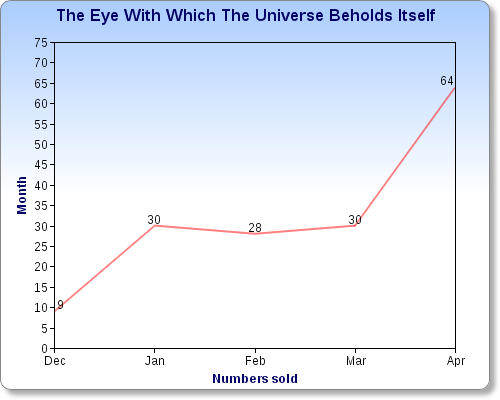
Speaking of which, I’ve received three submissions in the past twelve months. One I bounced immediately as not meeting the guidelines. The other two I rejected after requesting the full ms. To be honest, I had expected to be sent more, even if most would prove completely unsuitable. I can only surmise I’m the only person writing the type of fiction I want to publish. Happily, I’m not the only person who wants to read it, as sales for the first two books of the Apollo Quartet have shown:

AQ1

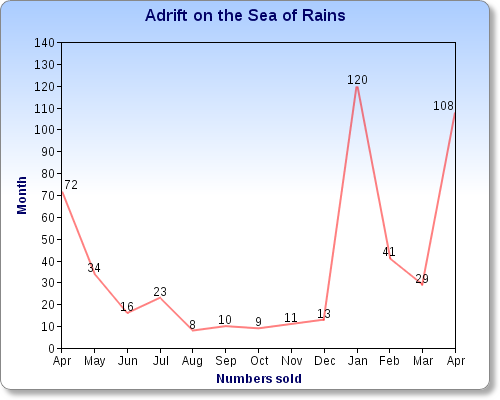
The two spikes are due to mentions in the Guardian (here and here). The second one coincided with Adrift on the Sea of Rains winning the BSFA Award, so the win may also have contributed. But given that the full novella was published in the BSFA Award booklet for members, I suspect it didn’t have that much effect. I’ve added “WINNER OF THE 2012 BRITISH SCIENCE FICTION ASSOCIATION AWARD” to the product description on Amazon, but I’ve no idea if that has had any impact.

Adrift on the Sea of Rains continues to sell well on Kindle – better in the UK than in the US, it must be said. The number of Amazon paperback orders has also picked up, typically now around one a week. Of course, I’d sooner those sales took place on the Whippleshield website, but I know of no way to drive customers there from Amazon. When I mentioned in a previous blog post that Kindle sales were “more or less pure profit”, someone on a forum responded: “I had to laugh at this one. Shows a real lack of understanding of the costs involved in running a successful website. Electronic files take up disk space which has to be paid for. The transfer of electronic files uses bandwidth that has to be paid for”. To which I can only say, if you’re paying for storage of a single electronic copy of your book, and can actually work out the cost of uploading that file to Amazon, then I suspect other people are laughing at you.

AQ1format

The Eye With Which The Universe Beholds Itself has not been selling quite as well. Nor has it been reviewed as extensively as Adrift on the Sea of Rains (review e-copies of The Eye With Which The Universe Beholds Itself are still available, incidentally), though the genre venues that have reviewed it seem to have taken to it slightly better than Adrift on the Sea of Rains. But then I did write it in such a way to force a reading protocol more tuned to sf readers.

AQ2

Of course, The Eye With Which The Universe Beholds Itself has only been available since late January this year, so around four months in total. And word about Adrift on the Sea of Rains is still making its way throughout the genre landscape – such as making an appearance on SF Squeecast here, courtesy of Paul Cornell. Two books is a slim presence, especially given that they’re novellas too. I’ve had no short fiction published in genre venues with large audiences, at least not yet. So my platform remains small, and still chiefly confined to the UK.

Interestingly, Wunderwaffe, a short story of 9000 words which originally appeared in Anarchy Books’ Vivisepulture anthology, and which I produced as a chapbook limited to 12 copies before publishing it on Kindle, has been selling surprisingly well in the US. This may due to its low price. The $1.16 price-point, and the clearly stated length of 27 pages, however, hasn’t prevented a couple of people from leaving one-star reviews complaining that it isn’t a novel. I’m especially impressed by the review which states “stick to established authors that don’t give short stories under the cover of a book”. I think you’ll find “established authors” have also been known to publish short stories on Kindle too. In fact, John Scalzi’s latest novel was serialised, with each chapter sold as a separate ebook (not entirely the same thing, I know, but you know what I mean).

So there you have it – Whippleshield Books after twelve months. More or less. Plans for world domination may have to be put back another year or so. I believe Adrift on the Sea of Rains is the first self-published work to win a BSFA Award – although there are a couple of self-published works in this year’s Hugo shortlists. The stigma attached to the word “self-publishing” is slowly being eroded, but that doesn’t mean the self-published market is still not full of badly-written and poorly-edited derivative rubbish. But the good stuff is getting easier to find. I like to think that Whippleshield Books is, and will be, seen as a purveyor of that “good stuff”.


1 Comment

My trip into space

Well, into the National Space Centre, that is…

I may have been involved in science fiction for 25 years, but I’m relatively new to this “author” thing. I’ve done plenty of panels at conventions, but I’ve never given a reading, and I’ve certainly never spoken about something I’ve written to a bunch of complete strangers who may or may not have come to hear me talk or indeed have any clue who the hell I am.

But that’s what I did last Sunday.

The National Space Centre in Leicester had organised a two-week celebration of “Space Fiction”, beginning on 9 February and lasting until 24 February. I was asked if I’d like to contribute on one of those days as one of the clients of the John Jarrold Literary Agency. Since Adrift on the Sea of Rains and The Eye With Which The Universe Beholds Itself are proper hardcore realistic space fiction books it struck me they’d be well-suited to a reading in the National Space Centre… And so it was arranged: Philip Palmer, Chris Beckett and myself would each give a 30-minute talk/reading on Sunday 17 February.

As you approach the National Space Centre, the first thing you see is a giant pupa pointing up into the sky above Leicester. That’s the Rocket Tower. The rest of the building looks more like something you’d find on a university campus or science park. I’m not sure what I was expecting – something like a museum, I suspect – but it’s far more resolutely modern than my dim memories of visits to museums as a child suggested. I was immediately taken with the Soyuz on display in the main foyer. And it really is a tiny spacecraft. I’d known that, of course – I’ve researched this stuff, after all. But you have to see it in the flesh, so to speak, to realise quite how small and makeshift and fragile it is. The Soyuz is apparently only one of two on permanent display in the West.

I was collected from the foyer by Charlie, who was wrangling the three of us that day. She did an excellent job of looking after us, so much thanks. The actual venue for the talk proved to be a small lecture area just off the main concourse, with rows of benches facing a small stage backed by a large screen. There was another screen above the stage. Most of the National Space Centre is one big open space, partitioned into display areas by walls no more than three metres high, so there was a lot of background noise. But we had microphones.

Phil Palmer’s talk began at 12:15. He talked about science fiction and extrapolation, and it was obviously something he had spoken about before. He then read from both Debatable Space and Hell Ship. The audience was mostly families with small children – about twelve to fifteen people in total. Chris Beckett arrived during Phil’s talk.

Afterwards, we had a thirty-minute gap before Chris’ session started at 13:15, so we went to get a bite to eat from Boosters Restaurant. It was sandwiches and soup, so my face fell when I saw it. I asked one of the staff if they had anything that was dairy-free. He told me they’d make me any sandwich I wanted in a dairy-free version. That level of service and helpfulness still impresses me – it shouldn’t do, not in the twenty-first century; but it’s still unusual enough in the UK to be a pleasant surprise.

Chris’s talk was not as well attended as Phil’s had been. He spoke about rogue planets and how they’d been scientifically proven about he’d written Dark Eden. He also described the inspiration for the novel, and then read one of the chapters.

There was then another thirty-minute gap until my talk at 14:15. Phil had booked a ticket for the planetarium show, so he shot off to that while Chris, his wife Maggie, and myself went for a wander round. We headed for the Rocket Tower, though I was a little worried about suffering from vertigo on the top deck. But I was fine as long as I didn’t get too close to the railing. The LM simulator looked more like a computer game than an actual copy, but the 1960s living-room was good. The three of us recognised several items in it from our own childhoods. There was a piece of moon rock in a globe of the Moon, and one wall gave an illustrated timeline of the Space Race. The next deck down celebrated Soviet achievements, though from what I could see the Soyuz simulator was just a little room with a plastic seat in it. I didn’t linger as I needed to get back to lecture area.

Then it was time for my talk. I’ve not done public speaking since I left school decades ago, and I knew this was going to be nothing like being on a panel at a convention. For one thing, my audience would be just walk-ins, who had likely wandered across to see what was going on. My name will have meant completely nothing to them. (In the event, beside Phil and Chris, at least two members of the audience knew me – Will Ellwood, who I know via Twitter, and Dave Caldwell, who was a member of an APA I was in back in the 1990s.)

As soon as I was ready to begin, I hit my first snag. I only had two hands. I was using a PowerPoint presentation, so I needed to hold the clicker to advance the slides. I also needed to hold a microphone. And then there was the script of my talk, which I hadn’t learned off by heart. Damn. I’d need three hands. Charlie happily lent me her hands-free mike. She then introduced me and I started babbling…

I thought it went quite well. I managed not to speak unintelligibly fast, and I clicked through the slides in mostly the right places. I spoke about realistic space travel and science fiction’s poor record in depicting it, using ocean liners as spaceships rather than actual real spacecraft (such as the Soyuz in the foyer), and how I came to write the Apollo Quartet. I cut down the excerpts from Adrift on the Sea of Rains and The Eye With Which The Universe Beholds Itself I’d planned to read, and that proved to be a wise decision. I finished it pretty much exactly in thirty minutes. And the entire audience stayed throughout the entire talk. Afterwards, a couple of people came up and thanked me and said they had found it interesting.

Phil, Chris and myself then moved across to a table in the main concourse, where people could buy copies of our books and we would sign them. We were actually approached by more people asking for directions than we were people who wanted to purchase our books. But never mind.

It was a fun day. I’d liked to have taken the time to explore the National Space Centre more fully, and I certainly think it’s an interesting place to take children. Personally, perhaps, I’d have preferred more hardware and less science, but that’s what fascinates me. All the same, I could happily spend a day there.

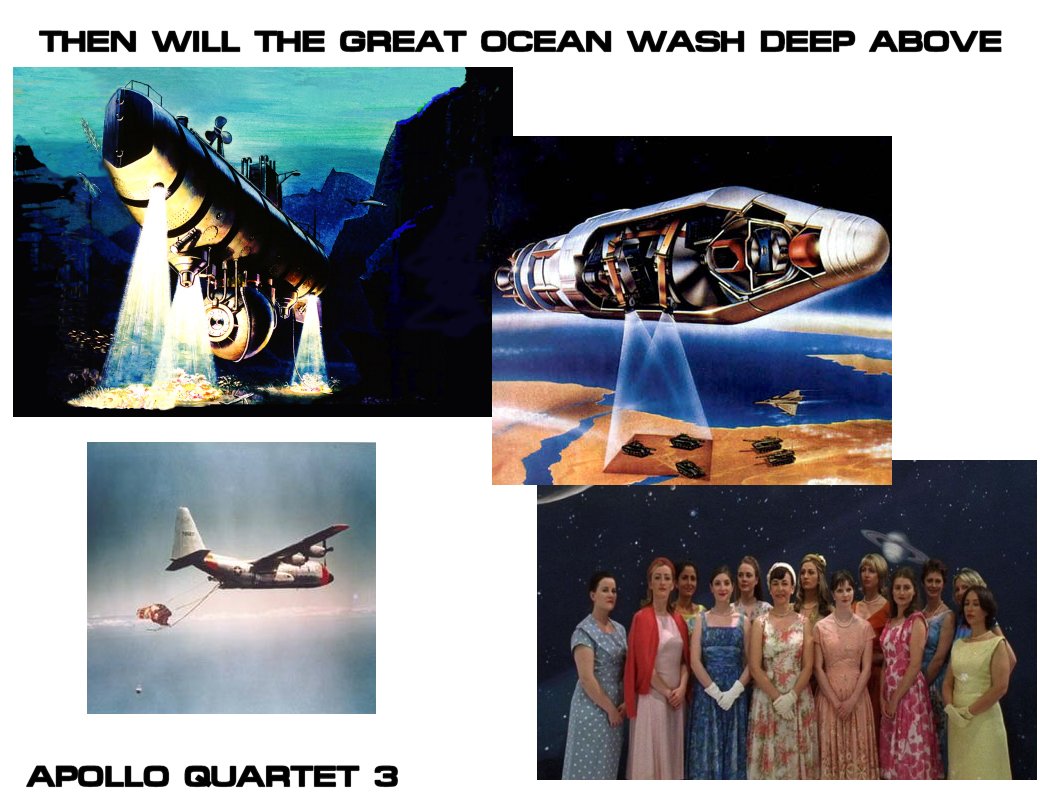
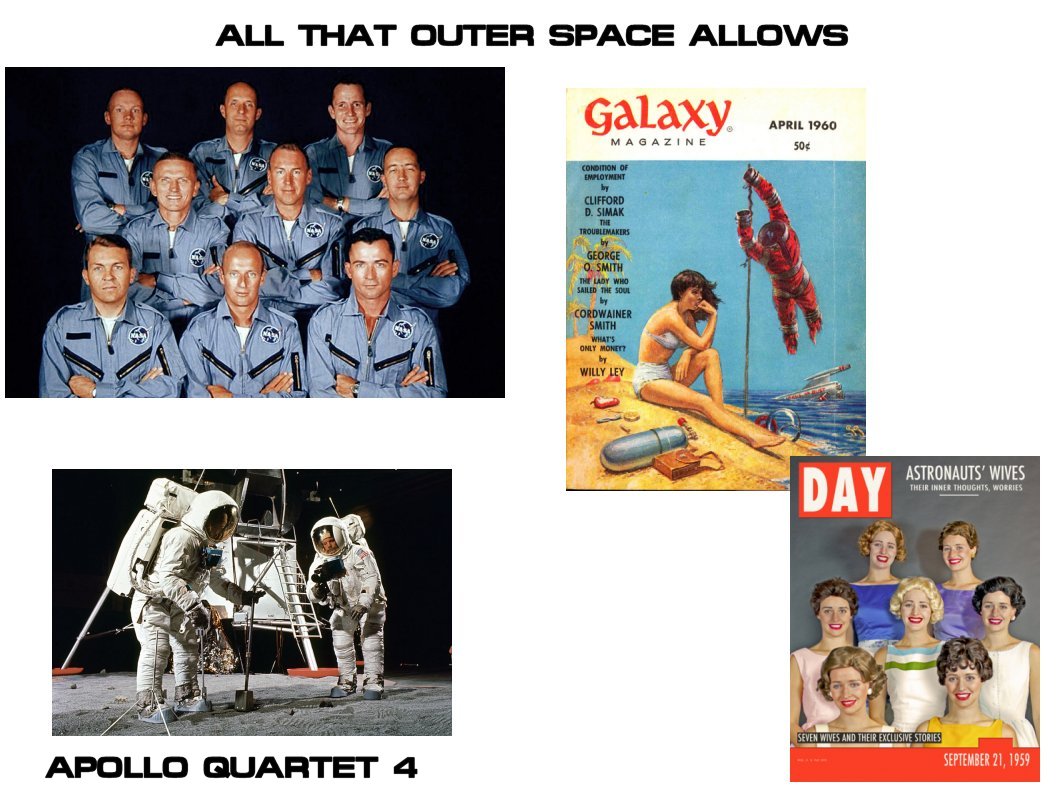
Finally, the last two slides of my presentation were hints to the stories of the final two books of the Apollo Quartet. And here they are…

aq3

aq4


3 Comments

Self-publishing for fun and profit

Some people have made a lot of money very quickly through self-publishing; some people have won big prizes on national lotteries. I’m not sure which has the better odds, but I suspect there’s little difference in it. You can, of course, increase your chances of doing the former – write something derivative that plugs into an existing fanbase, and self-promote to such an extent you’re indistinguishable from spam. If, on the other hand, you self-publish because you have a vision and you want to get it out there, but no one else is interested in publishing it for you… Well, in that case, don’t give up the day-job just yet…

I’ve made no secret of my reasons for self-publishing the Apollo Quartet. I didn’t want to compromise on my vision for Adrift on the Sea of Rains – a vision that has been happily vindicated, since the novella has been shortlisted for the BSFA Award; and I wanted to launch the book at the same time as Rocket Science, and no existing small press, had they chosen to publish it, could have done so in time.

I also chose to publish the book as both paper and ebook. I could, of course, have just released it on Kindle, as so many self-published authors do. But instead I paid a printer – MPG Biddles – to do me hardback and paperback copies.

I have learnt much about writing and publishing over the past ten months…

1 the elephant in the room
It’s actually a huge South American river, not a pachyderm, but it certainly dominates book-selling. And it treats us small fry very badly. If I hadn’t signed up for Amazon Advantage, my books would be shown as unavailable on the Amazon website (I’ve only signed up for the paperbacks, so the hardbacks are indeed shown as “currently unavailable”). Signing up for Amazon Advantage, I have to accept the 60% discount Amazon takes. So every sale I make through Amazon is at a loss. If they ordered 100 copies tomorrow, I’d have to refuse the order. I can’t afford to fulfil it. As it is, the orders Amazon has placed for single copies in dribs and drabs over the months are costing me more as I have to pay postage for each copy I send them.

Incidentally, I’d be happy to cut all my ties to Amazon, but I see no alternatives. I use the Amazon affiliates scheme on this blog, and I had planned to drop it. So I investigated a few alternatives. The Book Depository one is simple enough to use, but they’re owned by Amazon anyway. The Waterstone’s one is a joke. It’s run by a third party, you have to apply for approval first, and I couldn’t find out how to link to individual titles on the Waterstone’s site. They should sort that out – they’d get a lot more business.

2 it doesn’t have to be ebook all the way
Publishing on Kindle is trivial. You format the document, knock up a cover, and then upload it to Amazon through the Kindle Direct Publishing website. Easy. Publishing paper books is harder, but not that much more so. And it does cost money, which publishing on Kindle doesn’t – but even then, it’s not that much. For The Eye With Which The Universe Beholds Itself, I formatted the document as PDF, and had the cover-art done the same way. I got an estimate from MPG Biddles, then placed the order, uploaded my PDF files to their website… and weeks later boxes of books were delivered to my house. It cost me £202 for one hundred 80pp paperbacks.

Of course, selling paper books is more difficult than ebooks. You have to hold stock of a physical item, and ship it to customers when they order copies. For Kindle ebooks, Amazon does all the work for you. You just watch the sales mount up (or not). And selling around the world is trivially easy. Except Amazon US pays you in US$, which is a problem.

3 what’s the bottom line?
Amazon offers 35% and 70% royalty rates on books published on Kindle. You chose the price at which you sell the book. It’s best, of course, to look at the price of comparable ebooks. Too high and no one will buy it, too low and people will think it’s not worth reading. The ebook market is still in flux at the moment, with huge numbers of low-priced self-published books, and ebooks from major imprints priced roughly the same as hardback copies. So there are as many pricing models as there are publishers. I chose to price my ebook editions at about two-thirds of the paperback price – £2.99. That seems to be working quite well.

For self-published paper books, there is no royalty. There is only sale price minus unit cost. I priced Adrift on the Sea of Rains at £3.99, because I felt that was a fair price for a 80pp paperback novella. Unfortunately, I was thinking like a buyer not a seller. It was too low, and I’d have to sell the entire print-run of 100 to cover my costs. So for The Eye With Which The Universe Beholds Itself I increased the price to £4.99. Which means…

Cost per unit: £2.02
Cover price: £4.99
Profit per unit sold: £2.97

Except…
For copies sold over the internet, I include p&p in the £4.99, so that’s –
£4.99 – (£2.02 + £1.10*) = £1.87 per sale

For copies sold by hand, I only charge £4.00, so that’s –
£4.00 – £2.02 = £1.98 per sale

(* I don’t include the cost of envelopes as I re-use as much as I can; but if I did, it would be an additional 20p)

If I sold copies only over the internet, I’d have to sell 52 copies to break-even; if I sold only by hand, it would be 51 copies. The true figure is probably slightly higher as I sell using both methods, and there’s those copies I sell through Amazon Advantage. Nor do I factor in the cost of the copies I give away for review.

Of course, this is only the manufacturing cost. There are a host of unpaid contributions which create the final product – not just myself as writer, designer, promoter, publisher and book-seller; but also the cover artist and the editor. At present, I’ve been lucky enough to receive all that for free (though I plan to pay once Whippleshield Books is more established). There are also peripheral costs which have to be included – ISBNs, the ecommerce website – so it’s going to be a while yet before Whippleshield Books climbs out of the red.

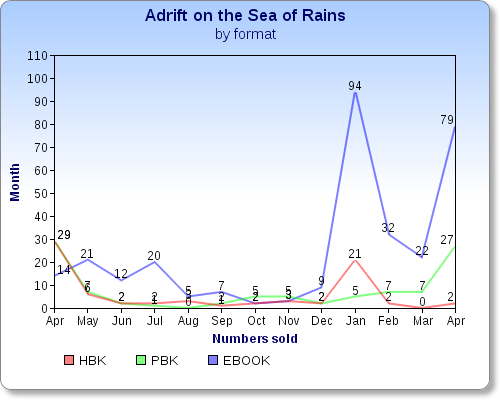
However, those £2.99 Kindle ebooks are more or less pure profit (less Amazon’s cut, the VAT they charge but do not pay, delivery cost, etc.). The money from Kindle sales helps finance the paper versions of the books. I’ve also sold more copies on Kindle than I have paperbacks or hardbacks. In fact, it’s been interesting watching sales uptick when Adrift on the Sea of Rains gets mentioned online. There was small jump in sales when SF Signal reviewed it. And a considerably larger one when the book was mentioned on the Guardian’s book blog“one of the most outstanding self-published books of the year”. More copies were bought on Kindle as a result of that mention than in the preceding nine months.

Having said all that, there is one advantage to publishing a book as a paperback or hardback rather than just on Kindle: you get taken seriously. If I’d gone for the low-cost option – ie, ebook only – I very much doubt I’d have sold as many copies, seen the books reviewed so many times, or even had one shortlisted for the BSFA Award. The future of publishing may lie in self-publishing – I hate the term “indie author”, incidentally – but, with the exception of a handful of outliers, the rewards are proportional to the effort, and money, you put into it…
3 Comments

Going into space

Well, the National Space Centre in Leicester. Which, for a fortnight in February, is putting on a “Space Fiction” special event. Between 9 February and 24 February, a number of authors will be giving talks at the National Space Centre. The full schedule is here.

I’ll be there on Sunday 17 February, with fellow John Jarrold Literary Agency clients Chris Beckett and Philip Palmer. Since Adrift on the Sea of Rains and The Eye With Which The Universe Beholds Itself are your actual bona fide proper hardcore space fiction, I’ll be talking about, and reading from, them. There’ll also be copies available to buy.

I guess I’d better start making notes on what I’m going to say…


Leave a comment

Apollo Quartet 2 on Kindle

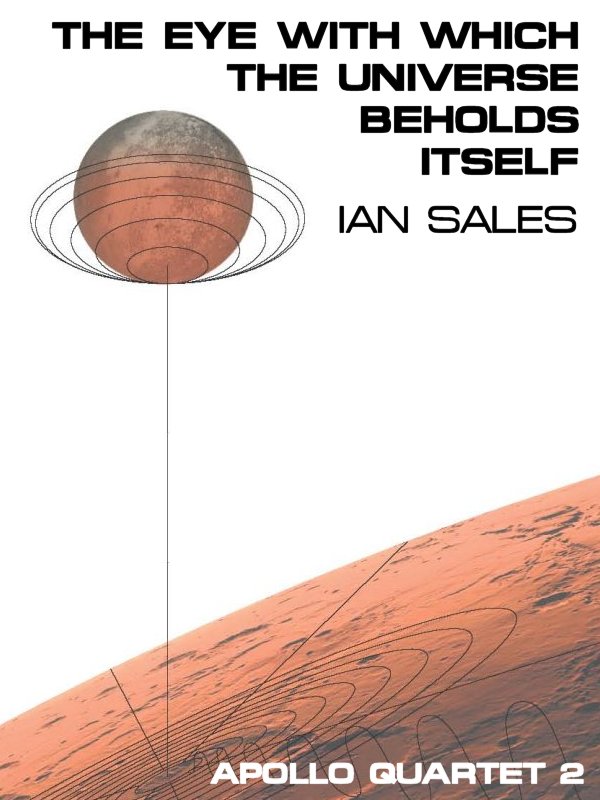
The second book of the Apollo Quartet,The Eye With Which The Universe Beholds Itself, is now available for Kindle on Amazon. It’s priced at £2.56, which is a bit odd as I did set it a little higher than that. But then Amazon probably included VAT in that price since it’s an ebook, and then took it off the listed price as they don’t pay it because they’re based in the Channel Islands. Not that they pay much tax anyway. But that shouldn’t stop you buying a copy of The Eye With Which The Universe Beholds Itself for your Kindle, of course.

the_eye_with_which_ebook_cover

On the other hand, you could buy the EPUB or MOBI ebook editions direct from the Whippleshield Books website here.


12 Comments

BSFA Awards shortlist announced

And it’s a bloody good set of shortlists – and I don’t just say that because I’m on the short fiction shortlist for Adrift on the Sea of Rains. (Which astonishes and pleases me.) I’m also on the non-fiction list in spirit via Karen Burnham’s ‘The Complexity of the Humble Spacesuit’ from the anthology I edited, Rocket Science.

It is all together a strong set of shortlists. Unusually, I’ve read more of the shortlisted items than for most years – three of the five novels (and the other two are on the TBR); two (well, three) of the short fiction; and four of the five non-fiction nominees (if you can be said to “read” an entire website).

Anyway, the shortlists goes like this…

Best Novel
Dark Eden by Chris Beckett (Corvus)
Empty Space: A Haunting by M John Harrison (Gollancz)
Intrusion by Ken Macleod (Orbit)
Jack Glass by Adam Roberts (Gollancz)
2312 by Kim Stanley Robinson (Orbit)

Best Short Story
‘Immersion’ by Aliette de Bodard (Clarkesworld #69)
The Flight of the Ravens by Chris Butler (Immersion Press)
‘Song of the Body Cartographer’ by Rochita Loenen-Ruiz (Phillipines Genre Stories)
‘Limited Edition’ by Tim Maughan (1.3, Arc Magazine)
‘Three Moments of an Explosion’ by China Mieville (Rejectamentalist Manifesto)
Adrift on the Sea of Rains by Ian Sales (Whippleshield Books)

Best Artwork
Ben Baldwin for the cover of Dark Currents (Newcon Press)
Blacksheep for the cover of Adam Roberts’s Jack Glass (Gollancz)
Dominic Harman for the cover of Eric Brown’s Helix Wars (Rebellion)
Joey Hifi for the cover of Simon Morden’s Thy Kingdom Come (Jurassic London)
Si Scott for the cover artwork for Chris Beckett’s Dark Eden (Corvus)

Best Non-Fiction
“The Complexity of the Humble Space Suit” by Karen Burnham (Rocket Science, Mutation Press)
“The Widening Gyre” by Paul Kincaid (Los Angeles Review of Books)
The Cambridge Companion to Fantasy Literature by Edward James and Farah Mendlesohn (Cambridge University Press)
The Shortlist Project by Maureen Kincaid Speller
The World SF Blog, Chief Editor Lavie Tidhar


22 Comments

Artistic license reviewed

I review books – for Interzone, for Vector, for SFF Chronicles (though not as often as I should), for SF Mistressworks, for Daughters of Prometheus, even here on my blog. I have been reviewing books since the late 1980s.(My first published review was of CJ Cherryh’s The Tree of Swords and Jewels in the BSFA’s review magazine, Paperback Inferno, in October 1988. I vaguely recall not liking the book.) I am not a critic, nor do I consider my writings about books to be criticism. I leave that kind of in-depth analysis to those who have the necessary tools to do it.

I have also been on the receiving end of reviews – more so this past year than in any other. In two capacities: as the writer of the text being reviewed, and as the editor of the book under review. On the whole, it’s been very informative. I knew when I wrote Adrift on the Sea of Rains that it was atypical and possibly difficult. I suspected its appeal was limited. Happily, it seems to have transcended that and the vast bulk of reviews have been positive and very complimentary. Many of them have also been quite insightful, pulling out things I’d hadn’t realised I’d consciously put in the story. But that’s what happens with good reviewers.

Which is not to say that good reviewers can sometimes get it wrong. Martin McGrath felt Dan Hartland’s review of his story in Rocket Science on Strange Horizons missed an important point, and so he responded to it in a blog post. Dan’s review is, in the main, a good, insightful review. I think it’s clear he and I differ on what science fiction is and needs to be – for one thing, I don’t feel Rocket Science is “weirdly old-fashioned”. If anything, the current fashion for hand-wavey sentimental sf harkens back to an older form of the genre, although the current form is generally far better written. Dan also comments on diversity in his review, pointing out that only five of the twenty-two contributors to the anthology are female. Rocket Science was open submission, so there wasn’t much I could do about that. But it’s bending the point a little to present the contents as being wholly male-centric, especially when the review fails to mention, for example, Deborah Walker’s ‘Sea of Maternity’, a story about a single mother and her unruly teenage daughter. In point of fact, as this post shows, 23.53% of the stories featured female protagonists.

But that’s a minor quibble, and I think Dan’s review of Rocket Science is a good and useful review.

Which is more than can be said for this review of Adrift on the Sea of Rains

Yes, there is a typo on the first page of the book: “sussurus” should be “susurrus”. There’s nothing I can do about that in the paperback and hardback editions. I’ve not bothered fixing it in the ebook edition, but I will do when I publish the second book of the quartet, The Eye With Which The Universe Beholds Itself. Typos happen, and while I should have caught that one, it did slip by a lot of other people as well.

I can understand someone having trouble with the prose style of Adrift on the Sea of Rains – no quotation marks! – and as a result not liking it. And so bailing before finishing it. I can comprehend a reader finding the subject not to their taste and so choosing not to read to the end. But, come on, giving up after a page because there are three (far from wildly obscure) words you don’t understand? That’s no excuse.

And to further suggest that it’s bad craft is insulting.

I do not believe in dumbing down my prose. I am not writing for people with limited vocabularies. I am writing for intelligent adults, because that’s what I consider my peers to be. I will not insult the intelligence of my readers because, as a reader, I loathe writers (or film-makers) who insult my intelligence. I may not always be successful in communicating precisely what I intended to communicate, but recasting it in words of one syllable is not a solution. I like writing “difficult” fiction, just as much as I enjoy reading “difficult” fiction. That difficulty, to my mind, adds value. It’s not just some slick superficial entertainment, but also something that makes you think, makes you reconsider your views and knowledge. Science fiction is particularly well-suited to that task – though the bulk of it fails to do more that bolster existing prejudices. I write about things that interest me and try to shine a new light on them. I don’t do “idea”. In fact, I’m becomingly increasingly convinced that the focus on idea is what continues to cripple science fiction. As long as you privilege idea, your fiction will not be taken seriously outside genre circles. And success within the genre is a poisoned chalice…

Science fiction is a small field, struggling to survive within the shadow cast by its history. There is also a very large elephant in the room of science fiction. (And I’m mixing metaphors, but never mind.) Past masters continue to provide topics within the genre conversation, despite no longer being relevant, of generally poor quality, and less available than in the past. Media sf is so popular the entire genre is believed to be the same as it – but science fiction is far from homogeneous. The sf works which receive general acclaim these days are ones that are not published as sf. Far from breaking down the walls of the ghetto, the tools of sf have leaked out but most of the readers and writers have refused to leave. This is not a healthy state of affairs.

There have been attempts in the past to re-engineer science fiction. While each ultimately failed, they did shift the genre in its course a little. Myself, I’d like to see science fiction stripped back to its roots and rebuilt for the twenty-first century, but that’s never going to happen. People are too happy with their tropes, no matter how old they are or how little sense they make in the current day.

I wrote the first two books of the Apollo Quartet as science fiction, and I set up Whippleshield Books as a science fiction small press. I consider myself a writer who writes in a sf mode. I use science fiction in my writing, I don’t actually write science fiction.

Perhaps the difference exists only in my head, but it’s enough for me.

EDIT: the review of Adrift on the Sea of Rains was also posted on Amazon.com with the heading “Artistic licence revoked!”. Hence, er, the title of this post… But I see now that’s he’s changed it… And reduced it to one-star. Yay, my first one-star review!

EDIT 2: “JL Dobias” has removed the “review” of Adrift on the Sea of Rains from his blog, so the link now points at some random blog post on “Gee Wiz” and “Wiz Bang” sf. The review on Amazon has also been removed, and the Goodreads review has been rewritten and now gives the book three stars rather than the original one. Dobias has thoroughly covered his tracks, so now only his comments here on my blog – all of which were from an email address belonging to a “Luci” – are all that remain of the whole farce. Given my dealings with Jerry/Luci, I suggest they’re best avoided.


1 Comment

Writerly bloggy hoppy thing

I got nominated for this by RJ Barker and apparently bad things happen to you if you don’t answer the questions and pass it on. So, fingers crossed, here goes…

What is the working title of your book?
I’m currently putting the finishing touches to the second book of my Apollo Quartet, The Eye With Which The Universe Beholds Itself. It needs a little more work in places, but my beta readers all think it is a stronger work than the first book of the quartet, Adrift on the Sea of Rains, which pleases me.

Where did the idea for the book come from?
I blogged about this in a series of post on the Whippleshield Books blog – Genesis of Apollo parts one, two and three.

What genre does your book fall under?
Literary hard sf. Or “art house hard sf”, as one person has described it.

Which actors would you choose to play your characters in a movie rendition?
If Steve Forrest were a couple of decades younger, he’d be perfect for the lead role.

What is the one-sentence synopsis of your book?
A scientific station on an exoplanet, humanity’s only presence outside the Solar System, has vanished and they send the first man on Mars to find out what happened to it.

Will your book be self-published or represented by an agency?
It will be published by Whippleshield Books, which is, er, my own small press.

How long did it take you to write the first draft of your manuscript?
About four months. It’s a 22,000-word novella, but it required a lot of research.

What other books would you compare this story to within your genre?
I’m not sure there are any. Outside the genre, Ascent by Jed Mercurio, perhaps.

Who or what inspired you to write this book?
The 40th anniversary of the Apollo 11 lunar landings – see Genesis of Apollo parts one, two and three. But elements of the plot of The Eye With Which The Universe Beholds Itself were specifically inspired by Lavie Tidhar’s review of Adrift on the Sea of Rains (see here).

What else about your book might pique the reader’s interest?
It suggests a reason for the Fermi Paradox.

Nominate five people to roll this onto
I shall cheat as RJ Barker did, and nominate a single person – Neil Williamson, who writes excellent short fiction and has even been known to enjoy an Opeth song or two on occasion.