It Doesn't Have To Be Right…

… it just has to sound plausible


1 Comment

Walking the Same Road?

One of the things which really annoys science fiction fans is non-sf authors writing science fiction novels but refusing to admit they have done exactly that. There have been plenty of examples – PD James’ The Children of Men, Maggie Gee’s The Ice People (of which Jeremy Paxman said it couldn’t be science fiction because it was good), and pretty much anything by Margaret Atwood which doesn’t feature “squids in space”…

Of course, the reverse is also true to some extent. We fans of science fiction are happy to claim for the genre works which we feel fit the genre’s remit, even though they were not written by sf writers, or even identified as sf by their authors. Such as George Orwell’s Nineteen Eighty-Four or Anthony Burgess’ A Clockwork Orange. Admittedly, Burgess was not unfriendly to sf – albeit not as friendly as Kingsley Amis or Michael Chabon – but he preferred to think of it as “futfic”.

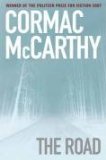
Which brings us to Cormac McCarthy’s The Road.

It’s a mainstream novel by a mainstream author. Literary fiction, if you will. It won the Pulitzer Prize for Fiction, and the James Tait Black Memorial Prize. And yet comparisons with sf novels are inevitable – George R Stewart’s Earth Abides and Walter M Miller’s A Canticle for Leibowitz, especially.

Incidentally, I dislike the term “literary fiction”. It’s mis-used too often as a genre tag, a handy way to label fiction some people don’t like. So rather than being descriptive, or perhaps even aspirational, it becomes a barrier, a shorthand for “I won’t read this book because I read a book once that wasn’t a simple escapist tale and I didn’t like it, so all books like it must be rubbish”.

I prefer to think of fiction as occupying a scale similar to food. At one end you have fast food – junk reading, intended to entertain but doesn’t require much thought. At the other end, you have gourmet reading – prose to savour, books to think about after you’ve finished them, products of great talent and skill. And, of course, there’s everything between those two extremes.

But The Road… Comparisons to sf are inevitable because of The Road‘s subject. It is a post-apocalypse novel. Something destroyed civilisation, and most of the life on Earth, years before. A man and his son walk from somewhere in the north of the United States towards warmer climes at the coast. En route they encounter other survivors – some have turned to cannibalism, others to violent tribalism. But there is no hardy community of back-to-nature survivors.

Few sf novels, even ones about the end of the world, are as bleak as The Road. Perhaps that’s because science fiction – despite much discussion of late claiming the contrary – is an inherently optimistic genre. It takes as axiomatic that problems can be solved, that phenomena are open to explanation. It’s pure optimism to assume – to operate on the assumption – that the universe is explicable. And malleable. And part of the bleakness of The Road stems from its refusal to explain the cause of the apocalypse.

In fact, there’s very little in the way of explanation in The Road. The man and the boy are not even named. The man also displays knowledge from a variety of fields – medicine, engineering, woodcraft – but his background is never described.

And then there’s the prose. Which is a great deal better than that you’d expect to find in a sf novel. There are indeed well-written (gourmet, so to speak) sf novels, but the genre is not known for the quality of its writing for good reason. McCarthy’s prose is spare, often stark – frequently forgoing even verbs – and is as responsible for the novel’s sense of bleakness as its dour premise. Some of it works really well:

The soft black talc blew through the streets like squid ink uncoiling along a sea floor and the cold crept down and the dark came early and the scavengers passing down the steep canyons with their torches trod silky holes in the drifted ash that closed behind them silently as eyes.

Some is less successful: the occasional odd verb, such as “… glassed the valley below them with the binoculars” or bizarre terms like “the snow lay in skifts all through the woods” and “the snow stood in razor kerfs atop the fencewires”. Skifts? Kerfs?

McCarthy’s punctuation is also… odd. Paragraphs are formatted as they would be on-line, with no indents and a line or two of space between them. But dialogue in a single paragraph is indented, and does not use inverted commas. This lack of quotation marks does somewhat distance the speech, which may have been the intent. McCarthy clearly doesn’t want the reader to get too close to the man or the boy. Or he would have named them.

I can think of no good reason, however, why he chose not to use apostrophes for certain constructions. The apostrophe is there in “there’s” and “they’re”; but not in “wont” or “cant” or “wouldnt”. I don’t understand the logic in not using it only for the elided “o” in “not”.

The Road is a very good novel indeed. But, despite its prizes, despite its acclaim, despite the film being made of it, The Road is not an important novel. It will not alter the way we think of post-apocalypse novels, it will not affect the relationship between sf and mainstream literature. At least, it will certainly not do that within the genre. Perhaps non-sf readers might think differently, but I suspect not.


10 Comments

Ahead of His Time?

Since one Stephenson has been reviewed and interviewed just about everywhere recently, I thought I’d be deliberately perverse and post an old review of a novel by an entirely different Stephenson.

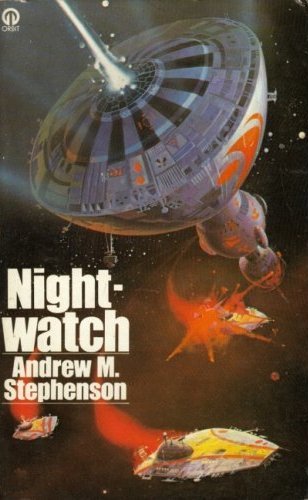
In the late 1970s, Orbit published two novels by Andrew M Stephenson. The first of these was Nightwatch in 1977. While it initially seems very much a British science fiction novel of its time, it did promise a career to watch.

Dan Frome is a British engineer sent to Dvornik Moon-base in 2006 to oversee the installation in Jupiter probes of the artificial intelligences he’s invented, the Golems. But this, it transpires, is just a cover story. An alien spaceship has been detected en route to Earth. Frome’s Golems will actually be going into weapons platforms sent out to intercept the alien craft. And everyone on the Moon is stuck there for the duration. The inhabitants of Dvornik are not happy about this involuntary exile, especially since Earth itself is on the brink of war. By the time the weapons platforms are ready and in place, their homes could well have gone up in smoke.

Various secret factions within the Moon-base try to recruit Frome. Or kill him: he narrowly escapes one attempt on his life. Making matters more complicated is Frome’s belief that his Golems are not capable of the job for which they are being used. There is a fundamental flaw in their thought processes. Frome manages to persuade his superiors that someone has to accompany the weapons platforms, and be there with them to oversee the Golems. He is the only man for the job.

At which point, the narrative of Nightwatch abruptly shifts from its earlier first-person to third-person. Frome is sent out with the weapons platforms to Jupiter orbit. The alien craft draws near. One by one, the Golems malfunction. Frome brings them back on-line, and succeeds in returning enough functionality to them so they can attack the alien. But the weapons platforms seem to have no effect.

Up to this point, Nightwatch could best be described as 1970s hard science fiction. Perhaps more literate than others of its ilk – as testified by its first-person narrative, and the switch to third-person – there was little in Nightwatch‘s story which differentiated it from similar novels of its time. But the aftermath of the attack on the alien craft marks an abrupt change in science fiction mode. The alien, Frome learns, is a trader, and it carries a portal linking it to a vast galactic transport network. Frome passes through this portal… and discovers a galaxy rich in life, with a civilisation so old that its beginnings are long forgotten. No one, in fact, remembers who built the original transport network. There are echoes of 2001: A Space Odyssey in this, but there is also something about the concept which reminds me more of late 1980s and early 1990s science fiction by the likes of David Brin, or William Barton and Michael Capobianco.

Frome returns to Earth in the alien craft. The narrative returns to first-person. Earth has destroyed itself, but Dvornik Moon-base still survives. However, the planet can be rebuilt with the alien traders’ help.

I’ve no idea what reception Nightwatch received in its year of publication, but I would guess that it didn’t compete well with much of what was being published at that time. Compared to The Mote in God’s Eye, or Ringworld, it is too considered a novel, too British in tone, too dour, to have proven popular. Where US authors were writing shiny happy futures, infused with can-do optimism and an almost combat-engineering approach to problems and difficulties, Nightwatch is a story set in a decaying future, the end of Empire, where solutions are cobbled together from bits and pieces that used to be parts of something else that once upon a time worked…

Until that odd shift to space opera and pan-galactic civilisation.

While this shift fits within Stephenson’s story, it’s certainly not signalled by anything which has gone before. The mix of dour hard SF and optimistic space opera works well – and there’s a nice dichotomy at work, in the appearance of these galactic saviours as Earth bombs itself into oblivion – but only a persistent reader would get far enough to discover this.

Perversely, I think Nightwatch probably reads better now than it did thirty years ago. With a little updating, Nightwatch would not appear out of place on the science fiction shelves of today’s book shops. Which may be why Stephenson wrote only a pair of novels before falling silent. He was ahead of his time.

A shame.


10 Comments

Days of Future Past

A couple of weeks ago Niall Harrison wrote about Gwyneth Jones’ Kairos on Torque Control. Since I’ve long admired Jones’ fiction, I thought I’d do something similar and post a review of her 1986 novel Escape Plans. This review is actually a few years old, but never mind.

I consider Gwyneth Jones one of the best British science fiction writers currently being published. So it shouldn’t really surprise me to discover how good her novels are whenever I reread them. Escape Plans I first read in the late 1980s, probably soon after reading and falling in love with Kairos. When I came to this reread, I had not forgotten the story – a member of an orbital-based elite is trapped amongst the Nineteen Eighty-Four-ish drones of the “underworld” (Earth) – and I’d remembered the invented acronymic language which peppered the text. What I had forgotten was how well-written the novel was, how well-designed its background, and how… well, perhaps “clumsily-plotted” is too strong a term: but the story does seem to bounce from incident to incident, revelation to revelation, without actually come to anything more than a purely personal resolution.

ALIC (apparently a computer acronym, but it’s not in my OUP Dictionary of Computing) is a VENTURan, a member of a space-based society. VENTUR had originally been set up to colonise other star systems, but it never left the Solar System. And then the VENTURans ended up saving the Earth’s population from itself. ALIC (pronounced “Aeleysi”) is enjoying a holiday on Earth at SHACTI, Surface Habitat Area Command Threshold Installation, a planetary facility for the VENTURans. It is located on the Indian subcontinent. At a party, ALIC meets Millie Mohun, a bonded labourer jockey, who appears to be wearing a forged identification tag. The Earth’s population are, bar a minority of ruling “enableds”, all bonded labourers or “numbers”. Millie spins ALIC some story about being blackmailed into wearing the false tag; ALIC decides to help her. To this end, she infiltrates the numbers in SHACTI’s Sub Housing (the numbers’ underground hive-like city). Unfortunately, she soon finds herself trapped as a number, her VENTURan identity lost to her. And then a portion of the Sub number population rebels against their masters and the systems that maintain their habitats…

The plot of Escape Plans seems initially inspired by the story of Orpheus, who ventured into the underworld to rescue his wife Eurydice from Pluto. It is, after all, the vague feelings of desire for Millie which motivate ALIC to set out on her ill-considered journey. However, not content with this, or with Escape Plans‘ departure from the myth when ALIC (now Alice) finds herself trapped as a number, Jones adds a further twist to the plot. Millie Mohun, many of the numbers believe, is immortal. As the story progresses, yet another myth takes this one’s place: Millie Mohun is an alien, come to Earth to deliver the multitudes from servitude. The VENTURans had already discovered that Earth is trapped in a bubble-universe, and the only world in it with life. Millie, the numbers claim, is from outside, and part of her message is to lead humanity to the galactic confraternity which exists beyond the bubble-universe.

It is perhaps an unnecessary complication of a story which is not all together easy to parse in the first place. The setting, the use of an acronymic language, the mentions of the myriad systems, the deliberate confusion between the systems’ real and virtual locations, and the metaphors used by the Earth’s populace in explanation of this… all serve to richen and partly obscure the story. Happily, the prose is so well written, it pulls you along with the plot.

That Jones is familiar with India (I believe she’s visited the country several times) shines through Escape Plans. For one thing, the novel’s matriarchal society strikes me as a deliberate irony. In rural Indian society, females are considered a drain on family resources: girl children must be married off and dowries paid. Boy children, on the other hand, will grow up to become contributing members of the family. In Escape Plans, it is the men who are entirely useless. The Earth culture is based upon the use of humans as processors in the pervasive computer systems which run life support, law and order, communications, etc. But only women can perform this role. Men cannot do it. This is a motif Jones has used many times: the society of her Divine Endurance and Flowerdust is matriarchal; and she also turns the tables on gender roles in her Aleutian trilogy.

Having read Jones’s later works, it seems to me that her depiction of technology in Escape Plans also echoes her use of it in later novels. The acronymic language used in Escape Plans disguises this somewhat, but the systems of the book are based upon a computing model which is probably more familiar now than it would have been in the mid-1980s. Escape Plans‘ systems are distributed and pervasive. Their real location, as opposed to their virtual location, is an important plot-point. They interconnect in a fashion not unlike the Internet – which predates Escape Plans by a couple of decades, but did not really become ubiquitous until the early 1990s.

I opened this piece on Escape Plans by stating my high regard for Jones’s writing. It’s an opinion I’ve continued to hold with each book of hers I’ve read – or re-read. Escape Plans was certainly worth a second look.


1 Comment

Why Am I Still Doing This…? Part 3

It’s been a while since I last did a round-up of the films from my Nightmare Worlds 50-movie DVD set. This is because I’ve seen all the watchable ones, and the ones which are left are really bad. So I’ve been a bit slow in watching them. Anyway, here they are:

The Manster – an American reporter in Japan makes friends with a Japanese scientist, is wined and dined by him, introduced by him to the best of Japanese culture, falls for the scientist’s glamorous assistant despite being married… but it’s all a plot by the scientist so he can experiment on the reporter. Which turns him into a two-headed monster. It was all something to do with the scientist’s wife who had turned into a monster years before. More interesting as an early 1960s depiction of life in Japan than a monster movie.

They – AKA Invasion From Inner Earth. A bunch of Canadians have been holidaying up in the mountains, and when they return to civilisation they discover everyone has died of some strange plague. The only thing I remember from this film was that one of the characters was really annoying, and I was glad when he died. It was only a shame it took so long.

How Awful About Allan – Anthony Perkins is the eponymous Allan. A fire at home blinds him, kills his overbearing father, and scars his sister. Some time later, his sight partially returns – he can see blurred shapes, but little else. He moves back home with his sister. But there’s a stranger in the house, a lodger who creeps about and whom Allan never gets to actually meet. The sister claims there’s nothing unusual going on. Of course, it’s all a cunning revenge plot. A made-for-tv Monday afternoon psychological thriller from the early 1970s. Watch it while doing the ironing.

The Phantom Creeps – I suspect the title is verb-noun, rather than adjective-noun. The Phantom – or is that one of the Creeps? – is Bela Lugosi, a mad scientist with a secret laboratory hidden in his basement. He invents lots of useful gadgets, including a belt that makes him invisible, and sets about taking over the world. Well, California. Muahaha. This is another serial edited down to a feature. It shows.

Panic – I’m pretty sure I watched this one, but I have no memory of it. It must have been that good. Something to do with a model, and an old woman who’s a serial killer. Who said watching these films was into turning into a chore, eh?

Purple Death from Outer Space – another Flash Gordon serial chopped up to make a feature film. The dastardly Emperor Ming has spread some sort of dust across Earth, so Flash, Dale and Zarkov head off the Mongo to whip up support for an attack on Ming to stop his dastardly plan. I can’t honestly remember how this one differs from other Flash Gordon serials I’ve seen. They all seem to be played like pantomimes, the rocketships would look more convincing if the effects people just lobbed them through the air, and there’s a silliness to them which will strike you as either charming or risible. Oh yes, one of Ming’s dastardly henchmen in this one is called Lieutenant Thong.

The Return of Dr Mabuse – Gert Fröbe (i.e, Auric Goldfinger) is a police inspector. An Interpol agent is murdered, and Fröbe investigates. All the clues suggest the murderer is a man who was in prison at the time. And is still in prison. It never occurs to Fröbe that someone might have let the murderer out. When further clues suggest criminal mastermind Dr Mabuse is behind it all, it doesn’t occur to Fröbe that the prison warden might be Mabuse in disguise. This film was dubbed into English, and its setting moved to Chicago. Which strangely appears to have everywhere signposted in German…

Radio Ranch – gosh, kids, it’s the Singing Cowboy himself, Gene Autry. This film is like a 1930s thinly-disguised product-placement fest, except the brand they’re selling is Autry himself. At the eponymous ranch, the kids of his fanclub, the Thunder Riders, tangle with, well, the real Thunder Riders. Who live in a scientifically advanced city deep under California. And every now and again, they ride en masse through a valley near the ranch. For some unexplained reason. It’s The Coming Race meets Hollywood star vehicle meets some kids’ club film.

Ring of Terror – this was more like one of those terribly earnest US government information films from the 1940s than a horror film. Remember kids, sex can give you diseases that make your brain rot. Or something like that. A terribly earnest medical student suffered a childhood trauma involving a corpse. As you do. So when his frat brothers dream up an initiation ritual involving a ring for his girlfriend, and a corpse in the mortuary that isn’t really a corpse… well, it all goes horribly wrong. Yawn.

Robot Pilot – an inventor invents a remote-control kit for normal-sized aeroplanes – so, not “robot”, then. He demonstrates it to the company CEO, but it fails. So he hies off to the desert with the test pilot to work on it some more. Enemy agents get wind of the invention and try to steal it. Oh, and the CEO’s spoilt daughter decides to drive from somewhere to somewhere along a route which takes her and her aunt close by the desert ranch where the inventor and test pilot are living. Their car breaks down, and they’re rescued by the two men. Who decide to teach the spoilt daughter a lesson – with the CEO’s collusion – by treating her as a slave for a bit. But she and the test pilot fall in love, and I can’t really see why this film is science fiction or even included in a DVD set called Nightmare Worlds.

Terror at Red Wolf Inn – there’s this inn, called the Red Wolf Inn. And it’s terrible. Oops. Terrifying, I mean. A young female student wins a holiday at the titular hostelry, and is surprised when, one by one, the other young female guests disappear. But there’s always plenty of food. Meat, that is. And it’s no good running away, because the local sheriff is in on it.

UFO: Target Earth – this opens with “members of the public” discussing UFOs, as if it were a documentary. They’re actors, of course. The scene then shifts to a laboratory… Apparently, this filmed was touted as a highly-realistic study of ufology. In actual fact, it’s an extremely dull, cheap, and badly acted film about a UFO which has landed at the bottom of a lake. I remember very little else about the film, and I don’t consider that a bad thing.

Star Odyssey – Italian space opera nonsense. I thought StarCrash was bad, and Cosmos: War of the Planets worse. But this one definitely beats both of them. There’s a villain who looks like someone has scribbled all over his face, a pair of really irritating robots (male and female – you can tell which is which because the female one has eyelashes), an actor who thinks he’s a hero (or was it vice versa?) and camps it up something terrible, and… and… It’s one of those films you put on if a guest has overstayed their welcome. If they don’t leave after watching the first ten minutes of it, you only have to wait until they start frothing at the mouth and fall over, and then you can drag them outside and leave them.

Prisoners of the Lost Universe – I suspect Richard Hatch leaves this one off his c.v. He, and two others, are accidentally transported to a parallel world inhabited by fur-clad barbarians ruled by John Saxon. Hatch must defeat Saxon before he can return to Earth. So he does. That’s about it. Best avoided.

Sadly, the boxed set is not yet finished. There are still a few more to watch. However, I can say this much already: the next time I see a boxed DVD set of 50 sf films going for around ten quid, I’ll think twice before buying it…

Oh yes – earlier reviews of the boxed set here (part one) and here (part two).

5 Comments

Shiny Happy Science Fiction

Back in July I listed 20 British SF Novels You Should Read. One of the titles on that list was Chronicules by DG Compton. Here is a review of it, offered in part as an antidote to all those blog posts about science fiction being doomy and gloomy. If miserable sf gives us books such as this, and happy optimistic sf gives us the likes of, well, Asimov… then I know which one gets my vote. Read it and wince.

DG Compton’s Chronicules has one of the all-time great opening sentences:

About twenty years before this story begins – give or take a few years, the Simmons s.b. effect being untried and seriously (not that it mattered) inaccurate – the desolate silence on Penheniot Village, at the top of Penheniot Pill which is a creek off the small harbour of St. Kinnow in the county of Cornwall, was shattered by the practised farting of young Roses Varco.

But then the book was originally published under the title Hot Wireless Sets, Aspirin Tablets, the Sandpaper Sides of Used Matchboxes, and Something That Might Have Been Castor Oil, so this is not entirely unexpected. Neither title – the original unwieldy one, nor the later more science-fictional one – actually provides much clue to the story. If anything, both are somewhat misleading. (Weirdly, the later title was slightly altered for publication in the US to Chronocules.)

According to the blurb, Chronicules is a grand adventure through time. It isn’t. Nor is it a cutting-edge discussion of temporal research. The time travel bookends the actual story, which is more concerned with life in an artificial research village in a Britain slowly falling apart. Further, there’s a nastiness to Chronicules of which only the British seem capable. Americans don’t do it, don’t cut and belittle their own creations. Irony may be a high-minded alternative, but it doesn’t have sarcasm’s scalpel-like edge: wielded inexpertly, irony is at best blunt-force trauma.

A lack of sarcasm in a novel is not necessarily a bad thing: a writer being unnecessarily cruel to his or her own characters often seems like torturing defenceless children. And in Chronicules, Compton has loaded the odds in his favour: his chief protagonist is mentally retarded. Which only emphasises the novel’s intrinsic cruelty. Further honing the blade is the setting’s custom of public nudity: Compton dwells cuttingly on the physical unsuitability of various characters showing their sagging flesh and dangly bits. There are some quite disturbing images, certainly enough to turn you off nudism.

The characters are well-drawn, and wholly unlikeable. Varco, the central character, is entirely ineffective, and those characters which do have some impact on the plot have more hang-ups than positive qualities. Compton’s future UK is miserable and reads almost prophetically like the Britain of the Tories during the eighties. While some science fiction novels may attract through their settings – Banks’s Culture, or Varley’s Eight Worlds, for instance – Compton’s near-future UK only repels. In fact, the only thing to really like about Chronicules is its writing. The prose is a joy to read.

Finally, the last page of Chronicules, after the end of the story, in the Arrow paperback edition I read is headed “Other Arrow Books of interest:”. It is otherwise blank…


4 Comments

The Best SF Novels Since 1990

My feelings on “classic” science fiction should be obvious by now, so perhaps this post won’t come as much of a surprise. Anyway…

I recently saw a Locus Magazine poll from 1998 of the best “all-time” sf novels before 1990. I can’t say I’m surprised at the results. The books listed are pretty much the “accepted” canon of science fiction. The Foundation trilogy. Half a dozen by Robert Heinlein (including the execrable Starship Troopers). Ender’s Game. The Mote in God’s Eye. Startide Rising. Ringworld… And yet, few of them, I believe, stack up all that well against the best the science fiction of today has to offer. I’m not saying there are no good books on Locus’ list – with or without caveats. Dune remains a compellingly immersive read, The Stars My Destination is still the best version of The Count of Monte Cristo on crack, there are few sf novels to match The Dispossessed as a readable and intelligent thought-experiment, and Dhalgren is as avant garde and powerful now as it was on publication… To name but a few.

But.

I still believe that when non-sf readers think of sf, they should be thinking of recent books and not something that’s over fifty years old. The perception of sf has to change, it has to be brought into line with the current state of the genre. So, to that end…

I thought it only fair to present my own list of best sf novels. From after 1990. That’s eighteen years ago, so I’ve made my list a bit shorter. Fifteen books. That’s the Fifteen Best Science Fiction Novels Since 1990. IMHO.

1. Take Back Plenty, Colin Greenland (1990)
2. The Difference Engine, Bruce Sterling & William Gibson (1990)
3. The Mars trilogy, Kim Stanley Robinson (1992)
4. A Fire upon the Deep, Vernor Vinge (1992)
5. Somewhere East of Life, Brian Aldiss (1994)
6. Coelestis, Paul Park (1995)
7. The Time Ships, Stephen Baxter (1995)
8. The Sparrow<, Mary Doria Russell (1996)
9. Ash: A Secret History, Mary Gentle (2000)
10. Light, M John Harrison (2002)
11. Absolution Gap, Alastair Reynolds (2003)
12. Life, Gwyneth Jones (2004)
13. River of Gods, Ian MacDonald (2004)
14. The Marq’ssan Cycle, L Timmel Duchamp (2005)
15. Black Man, Richard Morgan (2007)

Obviously the list is biased. It only includes books I’ve read. And it’s to my taste. It’s also Brit-centric, but then I’m a Brit. And no doubt, seconds after I’ve posted it, I’ll think of a novel I should have included… I also wanted a good spread of sub-genres – the above list shows the best the entire genre has to offer.

Here are some interesting statistics about the list:

Male: 11 (73%) / Female: 4 (27%)
UK: 9 (60%) / US: 6 (40%)
In print: 11 (73%) / Out of print: 4 (27%)

(Note: Sterling & Gibson have been counted as a single “author”, and the two series on the list were also only counted once.)

“Out of print” simply means not available on Amazon – not counting the Aqueduct Press titles, Life and the Marq’ssan Cycle, which are readily available from their web site. It’s not just the oldest of the books which are no longer in print, and while critics might think that fact says something about some of my choices, I don’t think I’m the only who believes it’s time for a new edition of Take Back Plenty.

But as a starting point… well, I think it’s a good list. I suspect others might disagree.


2 Comments

And A Thousand Words More…

When I wrote Worth a Thousand Words, I promised a second instalment. So here it is.

This time it’s science fiction graphic novels. Now, I could have just written about the various titles by Alexandro Jodorowsky – The Incal, Metabarons, Technopriests and Megalex. They’re originally published in French, of course; but some have been translated into English. But not all of them, not yet. Still, I do have a French – English dictionary…

Jodorowsky’s graphic novels are a bit, well, weird. Like his films. The Incal is a knockabout sf satire, in which a fool (called John DiFool) must protect a crystal of enormous power, the Light Incal, from various evil factions. All of the characters are based on Tarot cards. Some commentators have likened parts of The Incal to Dune, but I can’t see the resemblance. The story of the Metabarons, a family of superlative mercenaries, is framed as one robot telling a story to another robot, who already knows it. The Technopriests is presented as the reminisces of an old man, describing how he turned his back on a career making cheese and became instead a creator of videogames. It’s actually a space opera, just in case that’s not clear. And Megalex is just as strange – a clone fights to defeat the eponymous planetary city, using the forces of nature. Each series was illustrated by a different artist: Moebius, Juan Giménez, Zoran Janjetov and Fred Beltran respectively.

I could have written this piece just about Jodorowsky’s work, but I won’t…

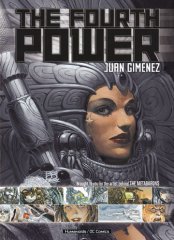
The Fourth Power, Juan Giménez – a young space fighter pilot escapes certain death when attacked by an enemy patrol, and discovers that she is linked to a new weapon of enormous power called “the Fourth Power”. Spaceships… aliens… and that slightly-odd way of looking at science fiction the French do so well.

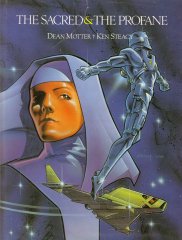
The Sacred and the Profane, Dean Motter and Ken Steacy – I remember first reading this serialised in Marvel’s Epic Illustrated magazine back in the 1980s. Unfortunately, I only bought issues when flying to or from the Middle East, which was about four times a year. So I only read parts of it. A couple of years ago, I decided to buy myself a collected edition, only to discover it was quite hard to find. But then one popped up on eBay. A signed numbered edition. Result. The Sacred and the Profane is about a Jesuit mission to another star which encounters alien life in an asteroid. It’s pretty intense stuff for a sf graphic novel from the 1980s.

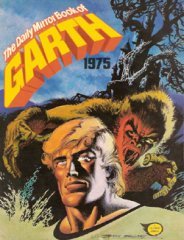
Garth, Frank Bellamy – this was a strip in the Daily Mirror, and ran from 1943 to 1997. I remember it from the late 1970s and early 1980s, when it was written and drawn by Frank Bellamy. Garth was an adventurer, stronger and smarter than most men, who would occasionally travel through time. He was involved in some sort of fight between Good and Evil, and his various adventures were often couched as episodes in this eternal battle. Fleetway published two Daily Mirror Garth annuals in 1975 and 1976, and Titan Books later published a pair of books in 1984 and 1985.

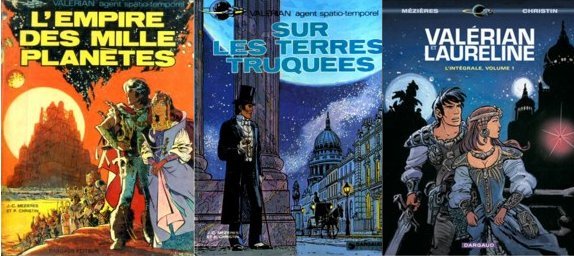
Valérian: Spatio-Temporal Agent, Pierre Christin and Jean-Claude Mézières – Valérian is a long-running French series, with twenty volumes published to date in France. Only a handful have been translated into English. The most recent of these is the trilogy in The New Future Trilogy published by iBooks, but the few earlier volumes published by Hodder-Dargaud are worth hunting down. It’s no-frills space opera done with wit and invention, with Valérian and his sidekick Laureline getting involved in various adventures.


7 Comments

New Sun – Old SF?

Over the past couple of weeks, I’ve been rereading Gene Wolfe’s The Book of the New Sun as part of a group read on LibraryThing. I first (and last) read the tetrology back in the mid-1980s.

It’s been an interesting experience.

The Book of the New Sun comprises four novels – The Shadow of the Torturer, The Claw of the Conciliator, The Sword of the Lictor and The Citadel of the Autarch – all published between 1981 and 1983; and a later sequel, The Urth of the New Sun, published in 1988. The Shadow of the Torturer won the World Fantasy Award in 1981, and The Claw of the Conciliator won the Nebula Award in 1981. All five books were nominated for the Nebula, and The Claw of the Conciliator, The Sword of the Lictor and The Urth of the New Sun were all shortlisted for the Hugo Award. There are also at least three critical analyses of The Book of the New Sun: Lexicon Urthus, Solar Labyrinth and Shadows of the New Sun. The first four books have also been published as two omnibus editions in the Fantasy Masterworks series.

In other words, this is a very highly regarded series of sf novels.

When I first read The Book of the New Sun, I think I was vaguely aware of its reputation. I didn’t, however, know that the story contained a large number of riddles and puzzles – such as the identity of protagonist Severian’s mother. I do now. In fact, I also own copies of Michael Andre-Druissi’s Lexicon Urthus and Robert Borski’s Solar Labyrinth. The first is a dictionary and compendium of characters, places, and unfamiliar terms from The Book of the New Sun; the second is an analysis of the story’s various puzzles. Neither are necessary to enjoy the five books – they’re for those interested in learning more about them.

Even though it had been a couple of decades since I’d last read The Book of the New Sun, I’d not forgotten its plot. I had forgotten many of the details, however. Severian is a torturer, a member of the Seekers for Truth and Penitence guild, and lives in the Citadel in the city of Nessus. When a noble lady from the Autarch’s palace, the House Absolute, is sent to the guild for “excruciation”, Severian is tasked with looking after her. He falls in love with her and, expressly against his training and the wishes of his guild, provides her with a knife which she uses to kill herself. The guild masters decide not to expel him from the guild, but instead send him to the northern city of Thrax to become that city’s lictor (i.e., prison warden and executioner). En route, he has several adventures and meets many people. In Thrax, he once again fails his guild – the archon asks him to kill a woman whose serial adultery has become an embarrassment to her husband, a prosperous noble; but Severian instead aids her escape. So he flees further north, experiencing further adventures… before becoming the Autarch himself. The Book of the New Sun is phrased as his memoirs, written years afterwards from his eidetic memory while he is Autarch.

The above is only a very brief outline of the plot. I’ve glossed over much of it – the “adventures”, his meetings with the rebellious Volidarus, his time with the Autarch’s army fighting the invading Ascians – all of which are important to Severian’s growth, his eventual assumption of the autarchy, and the many riddles in the story.

Regular readers of this blog will remember my recent post on “classic” science fiction, Don’t Look Back in Awe. While The Book of the New Sun is only twenty-seven years old, it’s still considered a classic of the genre. Some even consider it one of the best science fiction novels ever written. I was surprised, on this reread, to actually find that, well, to find that I didn’t like it very much. Perhaps I shouldn’t have been surprised, since I’ve always been conflicted about Wolfe – I have a high regard for his novels, but at the same time I hate his short fiction. And yes, that includes this year’s Hugo Award nominated novella, ‘Memorare’.

I should add that I didn’t like The Book of the New Sun because it’s a classic. I still think it’s a very good book. But. One of its defining characteristics is its use of archaic, obsolete and arcane words for various objects and concepts, the conceit being that Wolfe is “translating” the manuscript and uses such words because Severian does. So there are no swords mentioned in The Book of the New Sun, there are hangers and falchions and spadroons (among others). The fauna includes merychip, hesperorn and arctother. Ships are caiques or feluccas or xebecs. While this does give a feeling of exoticism and great antiquity to the story, it also felt in many places intrusive. But perhaps that was because some of the vocabulary was not obscure to me. I know what a dhow is (well, I did live in the Middle East). I know what cuir boli is (I spent my teen years playing Dungeons & Dragons). The words felt obfuscatory rather than clever.

There’s also an uncomfortable thread of misogyny running throughout the four books. Severian is a torturer, which immediately calls his morality into question. But almost all of his victims are women. When he eventually arrives at Baldander’s laboratory, he writes,

“… I saw what remained of a young woman who might have been a sister of Pia’s lying beneath a shimmering bell jat. Her abdomen had been opened with a sharp blade and certain of her viscera removed and positioned around her body… Her eyes opened as I passed…”

Later, he adds,

“I was acutely conscious, as I spoke, of the eviscerated woman mumbling beneath her glass somewhere behind me, a thing that would not have bothered the torturer Severian in the least.”

This, we are meant to realise, means Severian has grown, become a more moral person. Yes, Severian is a product of his (invented) world, and must be true to it if the fiction is to have any rigour. But that shouldn’t prevent a reader questioning the writer’s artistic decisions when creating that world.

The Book of the New Sun is a very clever book. It can’t, however, be read as an example of a less convoluted high fantasy narrative, which its outward appearance might initially suggest. This is not A Song of Ice and Fire or The Malazan Book of the Fallen by another name. It’s a book which requires full engagement by the reader – it’s all, or nothing. It’s not a book to be read lightly.

All of which is not, to me, a bad thing. But I came away from this reread not liking The Book of the New Sun for several reasons. The intrusive vocabulary. The misogyny. The seemingly random leaps in internal chronology. The fact that some of the plot elements seemed to exist only in order to present a puzzle.

Do I think The Book of the New Sun is a classic? Yes. But I suspect decades from now that Wolfe’s The Fifth Head of Cerberus is the one that will still be seen as a classic, but The Book of the New Sun won’t.


2 Comments

Asking for Trouble

Among the many, many, many comments on various sites and blogs to my classics-bashing post, Don’t Look Back in Awe, I was taken to task by one or two for recommending only male writers of modern science fiction.

The topic of women writers in sf is one which has had a bit of an airing of late. With comments on Aqueduct Press’s blog, Paul Kincaid’s Science Fiction Skeptic column, and this blog here. Not to mention the fuss a few months ago when Jonathan Strahan revealed the contents of Eclipse Two.

Of course, the person(s) who made the original comment about the authors I recommended was quite correct. I should have named some female sf writers. And for a number of reasons. Not the least of which is that science fiction is not an exclusively male genre, of readers or of writers. But – and this is the most important reason – because there are writers I would happily recommend who happen to be female. When I post a list of “books you should read” on this blog, the titles I list are ones I myself have enjoyed and admired. I would never recommend a book to someone if I didn’t have a high regard for it myself, no matter who or what the author is.

So I had a browse through my book collection, looking for contemporary novels (or collections) by female sf writers I could stick in a list, and… Oh dear. I could manage a list of about six or seven books, but that included a couple of cheats (a novel due to be published at the end of this year, and a recent collection of stories originally published in the 1950s). It’s not that I own so few books by female sf writers, just that many of them aren’t exactly contemporary. Which is a bit embarrassing.

I will happily insist people read anything they can find by L Timmel Duchamp, Mary Gentle, Gwyneth Jones, Justina Robson, or Susan R Matthews – all of whom currently have books in print. I’d also point out that you can’t go wrong with Ursula K Le Guin or CJ Cherryh. And while they’re considerably older – but there are a couple of recent collections in print – I’d also point people in the direction of Leigh Brackett‘s planetary romances. There are a couple of writers whose books I suspect I’d like, among them Jo Walton, Élisabeth Vonarburg, Kay Kenyon, and Kathleen Ann Goonan. I’ve yet to read anything by them, although I do plan to. But I won’t recommend a book I’ve not read.

Ignore the “contemporary”, and the list looks a little healthier: Sydney J van Scyoc (her last novel, Deepwater Dreams, was published in 1991), Shariann Lewitt (Rebel Sutra in 2000), Carolyn Ives Gilman (1998’s Halfway Human), Jane Emerson (City of Diamond from 1996), Jay D Blakeney (I’ve recommended before)…

I’ve read many more, of course. But I wouldn’t pick any of their books as ones to recommend.

So, no Ten Contemporary Novels by Female Science Fiction Writers. Not today, anyway. All those mentioned above are worth reading. I’d also welcome suggestions for more authors to try – but please bear in mind those I’ve named, as I’d obviously be more open to writers similar to them.


3 Comments

The Future of Science Fiction?

My last post seems to have caused a bit of a fuss, with responses, agreements and commentary appearing in a surprisingly huge number of different places. At last count, it was about 22 separate blogs and sites. It was the Great August Bank Holiday Blog Storm.

I was amused by the various “facts” about me which appeared in some of the comment threads. I’m apparently a kid, who has read none of the classics. I’m also a published author, who is trying to promote his own books, or is jealous of classic writers’ success.

For the record, I’ve been reading science fiction for about 30 years (so not a kid, then), and that includes most of the classics. I didn’t write Don’t Look Back in Awe to boost sales of my own book or short stories. That would be difficult because I’ve not been published yet – although I do have an agent, John Jarrold, and I have sold some short fiction.

You know what they say about assumptions: they make you look like a complete idiot.

Ah well. Debate is good. Or so I’m told.

I think my favourite comment from the whole affair was the incredulous bleat of some fan who couldn’t understand why Foundation was out-of-date as it’s set 20,000 years in the future…

Here, however, is a topic which follows on quite nicely from the aforementioned infamous post: what do I actually want science fiction to be?

I want it to be… a toolbox.

I want science fiction to be seen as a set of tools that writers – of whatever stripe – can use to tell a story. Action-adventure, “literary fiction”, thriller, satire, romance… it doesn’t matter. Sf is called a genre, but it’s characterised by its furniture. Thrillers aren’t. Romances aren’t. They have their conventions, yes; but their setting doesn’t actually define them.

I’m not saying we should throw away the label “science fiction”, or remove the marketing category and hide all the sf books in amongst the general fiction. Nor am I saying we should stop thinking of ourselves as sf readers or fans.

But as writers and commentators, I would like to see the tools of science fiction be recognised as tools of writing. Good science fiction, after all, still has to be good fiction. Too many people seem to forget that. They focus on the idea as paramount. Foregrounding the idea is not an excuse for bad writing.

Science fiction should be good writing using the tools of the genre. It should be judged as writing which happens to use the tools of the genre. It gets no special dispensation because it’s science fiction, because it has this great big flashing idea going bang in your face.

If you look at a lot of modern sf, then you can sort of see this approach in action. Not just the military action-adventure of David Weber and Jack Campbell, fighting various historical wars with spaceships. But also in excellent novels such as Richard Morgan’s Black Man, which uses the tools of science fiction to hoist a near-future thriller into a position where it can ask the sort of questions, and make the kind of commentary, we demand of good science fiction. And that we often can’t get, in fact, from other genres.

I’m going to leave this here for now. I suspect it needs more thought – if only to determine whether or not I’m reinventing some kind of wheel. Or pointing out something that’s bleeding obvious.