It Doesn't Have To Be Right…

… it just has to sound plausible


2 Comments

Relaxestcon

I spent last weekend at Satellite 2, a small sf con in Glasgow. Actually, it wasn’t just about science fiction; it was also about spaceflight, falling as it did just after the 40th anniversary of Apollo 11. The guest of honour was Iain Banks.

It was a very quiet convention – at least it was inside the Crowne Plaza hotel. Outside was the Glasgow River Festival, so there were many thousands of Glaswegians wandering up and down either side of the Clyde by the SECC. Satellite 2 was chiefly confined to the rear entrance / bar area of the hotel (the one that looks onto the Armadillo’s rear, for those who know the SECC).

Highlights of the weekend included…

… meeting up with the usual suspects; an interesting presentation on the Apollo Guidance Computer by Frank O’Brien – he has a book out on the subject early next year, so that’s gone on the wants list (unfortunately I missed the other panel items about Apollo); six-year-old Emma Steel saying in the dealers room, “I like books but I can’t read”; the discussion about the Puffer Fish Chain Gun on the Saturday evening; discussing NewSpace with Charlie Stross; being present when Mike Cobley was asked to sign a copy of his Seeds of Earth by a fan of, he admitted, Banks, MacLeod and Stross; starting up a discussion on the Roberts vs Scalzi Hugo novel shortlist debate after forgetting that Charlie Stross was sitting at the table…. And no doubt other conversations and incidents that I’ve forgotten.

Satellite 2 was an unusual con for me on two counts. I spent more money getting there than I did at the con. And my bag was lighter coming home than it had been going to the con. Well, it was a small con, and the dealers’ room reflected that. In other words, I didn’t buy anything.

In all, a good weekend. Many thanks to the redoubtable Steels for putting me up. The con programming was an interesting mix, and I wish I’d managed to attend more items. That may usually be the case after a con, but there were more I’m sorry I missed at Satellite 2 than at an eastercon. If there’s a Satellite 3, then I’d seriously consider going.


1 Comment

Favourite SF Stories

SF Signal today posted a couple of Mind Melds on “Memorable Short Stories to Add to Your Reading List” parts one and two. An excuse, in other words, to ask a bunch of people to name their favourite genre stories.

So I thought I’d do the same – list my favourite stories, that is. And here they are in chronological order of publication (where copies exist online, I’ve linked to them):

‘Aye, And Gomorrah’, Samuel R Delany – first appeared in Dangerous Visions (1967), edited by Harlan Ellison, and while much of the contents of that anthology weren’t exactly memorable, Delany’s story has stuck with me through the years. It’s very 1960s, very lyrical, and notably thin on plot. But I think it’s the evocativeness of the prose which appeals most.

‘And I Awoke And Found Me Here On The Cold Hill Side’, James Tiptree, Jr – was originally published in Fantasy & Science Fiction‘s March 1972 issue, although I read it in Tiptree’s collection 10,000 Light-Years From Home. This story is a classic, a simple idea approached using an entirely original angle of attack. It’s bleak and a perfect antidote to most space opera. Everyone who likes space opera should read it.

‘The Lake of Tuonela’, Keith Roberts – was a more recent discovery for me (see here). It first appeared in New Writings in SF 23 (1973), edited by Kenneth Bulmer, but I read it in Roberts’ collection The Grain Kings. Roberts’ prose is impressive, and in this story he manages to evoke the titular lake, and the long tunnel to it, with some beautiful writing. If the story had actually done more, and had managed to really evoke its alien setting, then it would have been very nearly perfect.

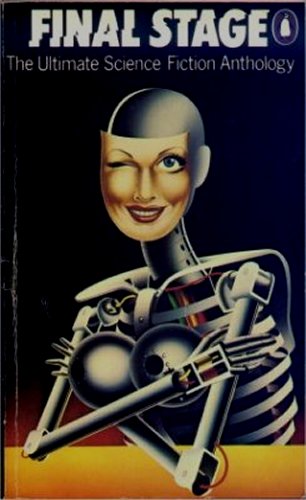
‘A Little Something For Us Tempunauts’, Philip K Dick – I first read in the anthology in which it was first published, Final Stage (1974), edited by Edward L Ferman & Barry N Malzberg; and which was, I think, one of the first sf books my parents bought for me. It also contains one of the few Harlan Ellison stories I remember liking, ‘Catman’. Like the Delany above, this is another story which is very much of its time – it feels very early 1970s to me, all Apollo and Grateful Dead and the like. But that works very much in its favour.

‘Air Raid’, John Varley – was originally published under the name Herb Boehm in Isaac Asimov’s SF Magazine Spring 1977 issue, because Varley already had a novelette, ‘Goodbye, Robinson Crusoe’, in the issue. ‘Air Raid’ was adapted as film, Millennium, and Varley later expanded his own screenplay into a novel, also titled Millennium. The story’s premise is certainly original – people from the future snatch passengers from planes just before they crash in order to repopulate their own time – and the pace never lets up from start to finish. The later novel rounds out the background and characters, and adds an interesting twist in that the different narratives follow the events of the plot in a different order, but the original story’s brevity gives the central idea greater impact.

‘The Gernsback Continuum’, William Gibson – was first published in Universe 11 (1981), edited by Terry Carr, but also appears in Mirrorshades: The Cyberpunk Anthology, edited by Bruce Sterling. Elegiac is not a word I’d normally associate with Gibson’s prose, but it’s certainly one that fits this story. For all its insistence of looking forward, sf has a curious tendency to gaze fondly at its past, and at the futures of its past. ‘The Gernsback Continuum’ is an excellent description of that tendency.

‘A Gift From The Culture’, Iain M Banks – is the first of three Interzone stories on this list. Interzone is probably my chief source of short sf, and has been since I first subscribed to the magazine back in the late 1980s. ‘A Gift from the Culture’ appeared in #20, Summer 1987, but can also be found in Banks’s only collection to date, The State of the Art. Banks’s Culture is one of the great sf invented universes, and ‘A Gift from the Culture’ is one of the few pieces of short fiction set in that universe. It’s also quite a sad story and, like ‘A Little Something For Us Tempunauts’, there’s an inexorable quality to its resolution – although it’s driven by character and emotion, rather than the laws of physics.

‘Forward Echoes’, Gwyneth Jones – is another Interzone story, this time from #42, December 1990. A slightly reworked version was also published three years later as ‘Identifying the Object’ in a chapbook collection of the same name from Swan Press. ‘Forward Echoes’ introduced the two main characters of Jones’s novel White Queen, and the Aleutians, the alien race of that novel and its sequels North Wind and Phoenix Café (and, of course, the recent and excellent Spirit: The Princess of Bois Dormant – see my review here). I think what first appealed to me about this story was its strangeness. It’s one of the most sfnally-evocative (to coin a phrase) stories I’ve ever read.

‘FOAM’, Brian Aldiss – was later expanded into a section of Aldiss’s 1994 novel, Somewhere East of Life. In 1991, Gollancz relaunched the magazine New Worlds as a paperback anthology edited by David S Garnett (in those days, Garnett was almost ubiquitous), and the story first appeared in that. Aldiss manages to layer strangeness upon strangeness in a somewhat picaresque plot set in the central Asian republics in the near-future (as was). This is another story, like the Jones, which makes something peculiar and sfnal of our world.

‘The Road To Jerusalem’, Mary Gentle – is the third and final Interzone story, from #52 in October 1991. It’s also the only alternate (alternative) history story in the list. In it, the knights templar have continued to exist to the present, and the world is a very different place. But it’s only as the story progresses does it become clear exactly how different.

The most recent story of the ten above is nearly eighteen years old. Which means it’s probably about time I brought the list up-to-date. I’ve certainly read some excellent stories published since Mary Gentle’s ‘The Road to Jerusalem’, but none seem to have stuck with me as much as the above ones have done. Perhaps I need to read stories a couple of times before they grow on me enough to be tagged as “favourites”. Perhaps that’s an exercise for another day – looking back over the short fiction I have access to which was published after 1991, and seeing if any of them have the same impact on me the above ten did.


3 Comments

Thoughts on Space and Fiction

There is a story, no doubt apocryphal, about a European company which signed a contract with a Japanese manufacturer of televisions. The contract allowed for 1% wastage, or 1 in 100 defective televisions sets. Come the day the first batch was delivered, and the CEOs of the two companies stood and watched as ninety-nine brand-new televisions were transported into the warehouse. The Japanese then presented the European CEO with a box containing a smashed up TV. When asked what it was, the Japanese CEO explained that it was the one defective television set from the hundred, as stipulated in the contract.

With CNC robots and CAD/CAM, manufacturing in the 21st Century is a sophisticated, precise and cost-efficient process. Back in the early 1960s, the Apollo command modules were built by hand by North American Aviation. The first one, CM 012, contained so many faults, Apollo 1 commander Gus Grissom intended to hang a lemon from the control panel. No more than a few days later, Grissom was dead, along with his crew, Ed White and Roger Chaffee, killed by a fire inside the command module during a plugs-out test.

In order to navigate to the Moon, much of the course calculations for Apollo were performed by rooms full of computers at Mission Control in Houston, Texas. Aboard the spacecraft, there was only the Apollo Guidance Computer, a device considerably less sophisticated than an average mobile phone of today. The AGC required the astronauts to enter “verbs” and “nouns” using a DSKY (display/keyboard) in order to start programs. It had a vocabulary of around 38,000 words. In Carrying the Fire, Michael Collins’ autobiography, he describes having to make 850 key-strokes in order to enter the necessary data and program calls for Columbia and Eagle to rendezvous on the Lunar Module‘s return from the lunar surface.

Even cruder was Gemini’s radio-control “encoder” for the Agena target vehicles, which used a “little box topped by two concentric wheels and a lever”. All instructions “ended in either a one or a zero, and were formed by setting up the first digit on the outer wheel and the second digit on the inner wheel, and transmitting all three by turning the lever from center to either the left (for zero) or the right (for one)” (also from Carrying the Fire).

The technology to return to the Moon not only exists, but is a great deal more sophisticated and effective than it was in 1969. True, the same laws of physics still apply, and the solutions to the problems those laws present have not changed. But in the tools and instruments used to implement those solutions, there is really no reason why Project Constellation should not be able to put one or more astronauts back on the lunar surface in relatively short order. In the 21st century, the hardware can be built to better engineering tolerances, with less faults, for less cost and in shorter time. The entire trip can be managed by computers onboard the spacecraft, using software which does not require data to be read out over the radio to the crew and then laboriously inputted by them.

But it’s not the hardware and software which have prevented return trips to the Moon. Some might say it’s the lack of public will – and yet, there were still those criticising and demonstrating against Apollo when Neil Armstrong and Buzz Aldrin landed on the Sea of Tranquility. There are many since who have complained that the money spent on Apollo could have been better spent on other things. Perhaps it’s the lack of political will. When President Kennedy gave his famous speech, “we choose to go to the Moon in this decade and do the other things, not because they are easy, but because they are hard…”, he may have been motivated by a desire to win the Cold War in at least one area, but he made it happen. I see no reason why a later president could not have managed something similar – providing they had the will, their motivation is irrelevant.

Money is often cited as another stumbling block. The Apollo programme up to Apollo 12 cost $16.1 billion in 1969 dollars – about $112 billion in 2005 dollars (figures from Return to the Moon by Harrison Schmitt). By 1969, the US Administration had spent approximately $83 billion on the Vietnam War, and $214.4 billion in Iraq by 2005. So money is clearly not a problem.

What about expertise? The Mercury, Gemini and Apollo programmes were designed, managed, built and staffed by young people, who frequently put in long hours to get the job done. It’s been said that no equivalent workforce exists today, and that people now are unwilling to work the necessary hours. Which is plainly rubbish. Look in any large corporation and you’ll find a workforce which often puts in ridiculous – and unpaid – hours to finish projects and meet deadlines. There is certainly enough expertise throughout the world in computing and information technology for a return to the Moon – after all, the bulk of the work in the 21st century version will lie there and not in hand-engineering hardware.

There is perhaps one element of the Apollo programme which no longer holds true, and might in part explain why it has never been repeated. NASA at that time was dominated by a large number of strong-willed and charismatic leaders – not just the astronauts, but also the administrators and chief engineers. Many of them were ex-military, or had fought in World War II. The entire organisation’s culture was very much based on personal leadership. People’s careers could be ruined by saying the wrong thing to the wrong person in a meeting. It could be argued this mindset had been forged during half a decade of global war; certainly no such comparable event happened in the second half of the 20th century. NASA is now a bureaucracy, with systems and procedures and checks and balances. Many critics have complained that it this which is holding back Project Constellation – take the recent decision by NASA to convert from Imperial to SI units… which they subsequently abandoned because it would have been too difficult and costly to implement. I don’t necessarily agree that the leadership/organisational model used by NASA during Apollo is necessary for a return to the Moon, but it’s certainly clear that the compromises foisted on the organisation in the decades since then have severely jeopardised its operations.

Yes, I think we should return to the Moon. And then travel onwards to Mars, and the planets, dwarf planets and moons beyond. It doesn’t matter if there is no immediately obvious benefit to doing so. Not all of the benefits of Apollo were plain at the time. I’m not much bothered whether the next set of astronauts on the Moon are American, Chinese, Indian, Russian or European. But it is a little embarrassing to see NASA floundering as it tries to implement a programme they have already implemented once before and which should be so much easier to do now. Even worse, they’re failing in other areas – the International Space Station will likely not last much longer than 2016.

It’s been said that landing on the Moon killed science fiction. I suspect the reverse is true. The Apollo programme demonstrated that space is not the benign environment advertised by science fiction short stories, novels and films. Far from it. As a result, one branch of sf turned inwards – the New Wave – while another slid further into fantasy – Star Wars and its ilk. Space has become a place of dreams and fancy, and so unreachable. There is a hardy few dipping their toes in the water, so to speak, in the International Space Station and aboard Shuttle missions. But, by and large, space is an environment, a setting, which exists chiefly in books and films.

Not so long ago we had the Mundane sf Manifesto, which insisted on “stories set on or near the Earth, with a believable use of technology and science as it exists at the time the story is written”. It was, and remains, controversial. Perhaps now, on the 40th anniversary of the first landing on the Moon, we should re-introduce the sub-genre of Space Fiction, stories set in space which treat the setting honestly and accurately. Perhaps the sub-genre could be used to re-introduce space as it actually is to the public, perhaps it might even rekindle interest in it as something achievable and conquerable – because only when you have identified the problems, can you start working on solutions…


7 Comments

Sexy Sci-Fi

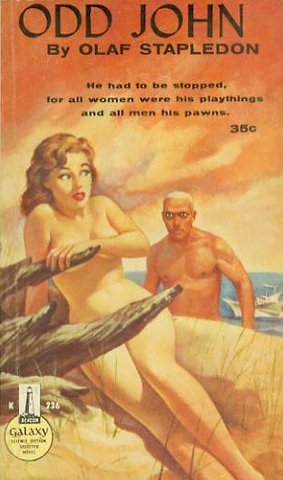
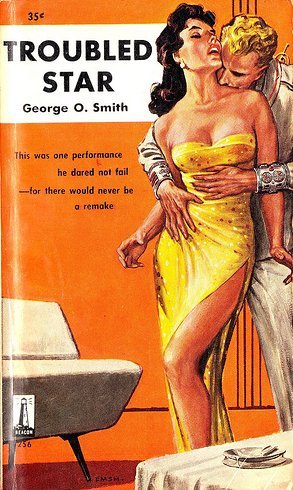
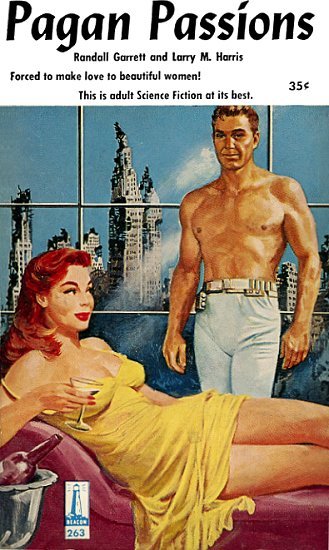
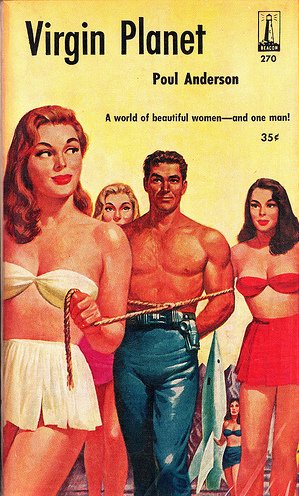
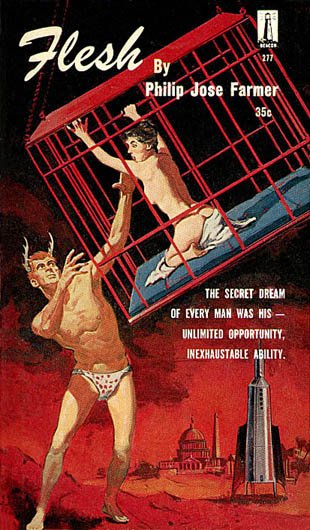
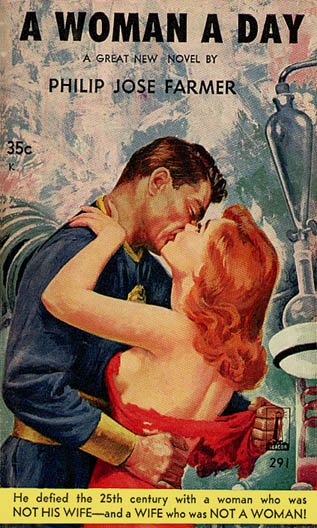
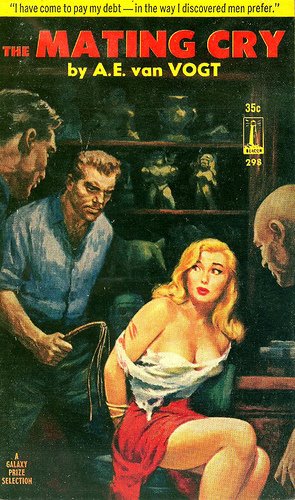
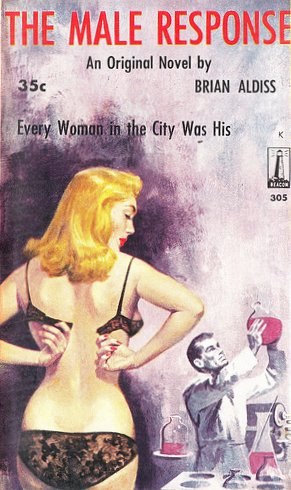
Back in the 1950s, Galaxy Science Fiction began a series of reprint paperback novels which they gave away with issues of the magazine. After 35 issues, the novel series was sold to Beacon Books, who were known for publishing mildly pornographic romance paperbacks. As a result, the Galaxy novels issued by Beacon were “edited” to add sexual content.

I first came across these books when I learnt of The Mating Cry, a variant of one of my favourite sf novels, AE van Vogt’s The Undercover Aliens. So I tracked down a copy and read it. It made for a somewhat bizarre reading experience – I blogged about it here. I’ve subsequently picked up (most of) the others in the series at various conventions. I had the vague idea of reading them and the novels on which each one was based, and then comparing the two. To date, I’ve not really got started on it, for a couple of reasons: one, some of the original novels are difficult to find; and two, given the Beacon books’ cover art, I’ve always felt they’re a little too embarrassing to read during my daily commute.

The titles were:

Odd John, Olaf Stapledon (1959). This had already been published by Galaxy in 1952. As far as I’m aware, both editions were identical – i.e., the Beacon one was not “edited”.

The Deviates, Raymond F Jones (1959). This was a spiced-up version of Jones’s novel The Secret People. I have the Beacon one but not the original.

Troubled Star, George O Smith (1959), was originally published under the same title as a serial in Startling Stories in 1953, and later as a novel in 1957. The Beacon version had added sexual content. I’ve yet to find a copy of the original novel.

Pagan Passions, Laurence Janifer and Randall Garrett (1959), was, as far as I can determine, original to the Beacon series.

Virgin Planet, Poul Anderson (1960), was a spiced-up version of a novel of the same title published the year before.

Flesh, Philip José Farmer (1960), probably didn’t need any sexual content adding. It was original to the Beacon series.

The Sex War, Sam Merwin, Jr (1960), was an expanded version of ‘The White Widows’, originally published in Startling Stories in 1953. A book version appeared the same year. I’ve not found a copy of the original novel yet.

A Woman a Day, Philip José Farmer (1960), was an expansion of ‘Moth and Rust’, originally published in Startling Stories in 1953. It has also been published as a novel with the titles The Day of Timestop and Timestop!. I have both versions, so I could do this one.

The Mating Cry, A.E. Van Vogt (1960), was a revised version of The House That Stood Still from 1950. It was later published as The Undercover Aliens. See here.

The Male Response, Brian Aldiss (1961), is another book which I think was original to the Beacon series.

Sin In Space, Cyril Judd (1961), is a spiced-up version of Outpost Mars. Although I’ve yet to read the Beacon edition, the original is a fairly ordinary tale of settlers on Mars, which might as well be set in any new town in the American Midwest. I really should get around to reading the Beacon version, so I can compare the two.


22 Comments

Reading Challenge #6 – Second Stage Lensman, EE ‘Doc’ Smith

I don’t know who to be more embarrassed for: myself, for liking this book when I was young; or the genre, for continuing to revere the series and its author. Because, let’s face it, Second Stage Lensman is not a novel we should be holding up as indicative of the genre. A person who has a low opinion of science fiction is only going to have it confirmed by this book.

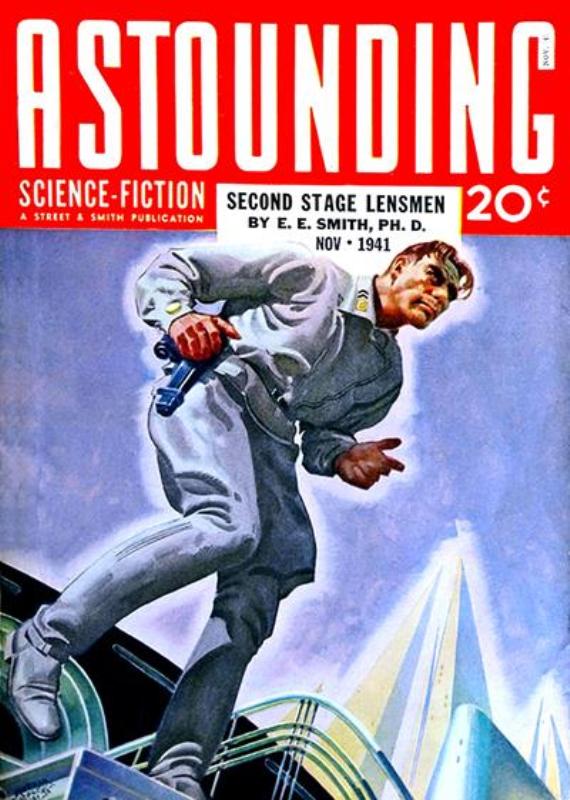
Second Stage Lensman is the fifth book in EE ‘Doc’ Smith’s well-known Lensman series. Which was shortlisted for the Hugo Award for Best all-Time Series in 1966 (it lost out to Asimov’s Foundation series). Second Stage Lensman was originally published in Astounding Stories between November 1941 and February 1942. In book form, it was not published until 1953.

It hasn’t aged well.

The hero of Second Stage Lensman is Kimball Kinnison. He is a member of the Earth-based Galactic Patrol, and the Lensman of the novel’s title. (Incidentally, it’s not “Earth” in these books, nor “Terra”. For reasons best known to himself, Smith uses “Tellus”.) A Lensman is someone who carries a Lens, a biological jewel created by the noble, but aloof, Arisians. A Lens gives its wearer great psionic powers, such as telepathy and “perception” (a form of clairvoyance). The corps of Lensmen are one of the weapons the Arisians have created in their ages-long war against the evil Eddorians.

Second Stage Lensman opens with a foreword, describing in broad strokes the events of the earlier four books. Since the story-arc of the series covers the Arisian vs Eddorian war, there’s a lot to get through. The novel then dives straight into the story, following immediately on from the events of the preceding book, Grey Lensman. In fact, Second Stage Lensman opens with a vast space battle in the Solar system between the forces of Tellus and those of the Eddorian conspiracy. This conspiracy is called Boskone, and the Galactic Patrol had thought it destroyed. Second Stage Lensman follows Kinnison as he works his way up another branch to its leaders.

The books of the series are framed as historical documents written by Smith. He refers to himself throughout as “your historian”, at one point writing “your historian is supremely proud that he was the first person other than a Lensman to be allowed to study a great deal of this priceless data”. Despite this conceit, there’s very little rigour to the narrative – the focus pulls in and out with dizzying speed, events not witnessed by the cast are dropped omnisciently into the story, and there are even assorted lecturettes: one chapter opens with, “This is perhaps as good a place as any to glance in passing at the fashion in which the planet Lonabar was brought under the aegis of Civilization“. At one point, Smith writes “… the appallingly horrible sensations of inter-dimensional acceleration. For that sensation is, literally, indescribable”. And then promptly goes on to describe it.

Far worse than this is the novel’s outright sexism. All women – with the exception of Kinnison’s fiancée Clarissa McDougall, the product of a millennia-long breeding programme – are beautiful and brainless. They frequently admit to being unable to “think”. Certainly none, except McDougall of course, are capable of becoming Lensmen. She is given a Lens, despite her protestations that as a woman she has less brains and willpower than a man. Even the alien Lensmen are male. When Kinnison’s investigations lead him to a planet with an entirely female population of humans, they are, of course, all beautiful. And all naked. And they despise men.

Then there’s the dialogue…. The frequent “as you know” moments are perhaps forgivable. But since most of the speech is written in a cringingly-dated slang, it makes it difficult to take the story at all seriously. It’s not just that Smith uses his invented “QX” in place of “okay”, but lines such as, “Save it!” he ordered. “Jet back, angel-face, before you blow a fuse.”

Of course, Kinnison is an absolute paragon. Not to mention a genius. And the most powerful Lensman in all the galaxies. His colleagues are no slouches either. One, Nadrek of Palain, a non-oxygen-breathing alien from a frigid world, often describes himself as “cowardly”, but it’s put forward as something admirable in his case.

There’s very little invention displayed in the book. The various worlds chiefly resemble early Twentieth Century USA but for one or two futuristic details. There are spaceships, of course – ranging from tiny “speedsters” to huge “super-dreadnoughts”. All use an “inertialess” space drive for interstellar, and inter-galactic, travel. However, Smith describes everything that is not inertialess as “inert”, which is not what that word means. He also has a computer working for weeks on plotting courses for all the ships in a fleet, and a communications centre comprising a “million-plug board”.

So why are these books still revered nearly seventy years after they were first published? They’re badly written, the attitudes in them are offensive, they show very little rigour in voice or narrative or world-building, and they’re wildly implausible. But people still read them. Why?

When they were first published in Amazing Stories and Astounding Stories, each new installment introduced a greater and more powerful threat. The story expanded as it progressed. I can understand the appeal of that. Not to mention opening a story with a space battle between fleets containing millions of ships each. It’s the sheer ever-expanding scale of it all. But scale alone is not sense of wonder, and it’s a mistake to confuse the two. In fact, scale can work against sense of wonder – make everything simply too big and it either loses its wonder or becomes implausible. There’s a fine line to be walked between disbelief and wonder. Using planets as mobile fortresses is sense of wonder. A fleet comprising over a million ships is too much to be entirely plausible (where did all the people to crew the ships come from? how long did it take to build the ships?).

I can, sort of, understand why a cast of paragons battling pantomime villains might also appeal to an unsophisticated reader. But. The genre has moved on since then, it has progressed. And the likes of EE ‘Doc’ Smith’s novels are now embarrassments. They are perhaps indicative of the genre at a particular point in time – the 1940s – but they’re not science fiction classics and they are not typical of science fiction as it now is.

Some sf novels remain historical documents, of interest only to historians. Second Stage Lensman is one such sf novel.


11 Comments

Crucial British

SFX has posted a list of the “10 Most Crucial British SF Novels” here. They define crucial as “the books that pull off the apparently paradoxical trick of defining the genre by revolutionising it”. Their list goes as follows:

Frankenstein, Mary Shelley (1818)
The War of the Worlds, HG Wells (1898)
Brave New World, Aldous Huxley (1932)
Nineteen Eighty-Four, George Orwell (1949)
The Day of the Triffids, John Wyndham (1951)
Crash, JG Ballard (1973)
The Hitchhiker’s Guide To The Galaxy, Douglas Adams (1979)
Consider Phlebas, Iain M Banks (1987)
Light, M John Harrison (2002)
River of Gods, Ian McDonald (2004)

So, let’s see… I’ve read all of them except The Day of the Triffids and River of Gods – but the latter is on the Olympus Mons that is my TBR pile. I didn’t like Brave New World and I no longer think The Hitchhiker’s Guide To The Galaxy is very good. As for the rest – yes, they’re excellent novels.

But how “crucial” are they?

Well, it’s a very… traditional choice of titles. The first five are all novels claimed by the genre, but many non-genre fans don’t even consider them science fiction. And while The Hitchhiker’s Guide To The Galaxy is unabashedly sf, it’s as popular outside the genre as it inside. So it’s not until 1987 and Banks’s Consider Phlebas that we have a true genre novel, one that was published as science fiction by an author who self-identifies as a science fiction author (when he has that middle M, of course).

I also question the “defining the genre” and “revolutionising” credentials of some of the books. Frankenstein was certainly seminal, as was The War of the Worlds. But Nineteen Eighty-Four is by no means the first dystopia – Zamyatin’s We predates it by nearly three decades, for a start. Ballard was one of several writers – the New Wave – who revolutionised the genre, and Crash is an excellent example of that movement’s works – but what makes it more “crucial” than, say, one of Moorcock’s Jerry Cornelius novels?

Banks’s Consider Phlebas was an early New British Space Opera novel, but as a defining movement New British Space Opera didn’t really kick off until the publication of Colin Greenland’s Take Back Plenty in 1990. As an indication of this, Take Back Plenty won the Arthur C Clarke Award that year; Consider Phlebas wasn’t even nominated when it was published. Of course, New British Space Opera later morphed into New Space Opera and is still going strong.

Much as I like and admire Light, I can’t quite see what’s so defining or revolutionary about it. It’s not like it kicked off a slew of fiercely literary space operas. And opinion on it among genre readers is sharply divided. An important book, yes. Just like Harrison’s 1975 space opera The Centauri Device. But crucial?

And finally, River of Gods… which I haven’t read. And is set in and about India. But unlike British novels such as The Raj Quartet is not about Brits in India. There has not been, as far as I’m aware, any sort of post-colonial movement in science fiction, either started by River of Gods or in which River of Gods squarely belongs. Perhaps there should be.

Certainly SFX’s list is a list of books worth reading. But I think my “crucial” list would look a little different…. Like this, in fact:

Frankenstein, Mary Shelley (1818)
The Time Machine, HG Wells (1895)
Last And First Men, Olaf Stapledon (1930)
The Death of Grass, John Christopher (1956)
The Cornelius Quartet, Michael Moorcock (1968 – 1977)
Desolation Road, Ian McDonald (1988)
Take Back Plenty, Colin Greenland (1990)
Fairyland, Paul J McAuley (1995)
Revelation Space, Alastair Reynolds (2000)
Bold As Love, Gwyneth Jones (2001)

Now discuss.


10 Comments

Doing the Hugos, Part 3d

I was a bit busy last week, with four deadlines all landing on the last day of the month. So I didn’t get the chance to read, or write about, the next novella on the Hugo 2009 shortlist. Which is ‘The Tear’ by Ian McDonald. This was published in Galactic Empires, edited by Gardner Dozois and published by the Science Fiction Book Club.

I actually have a problem with stories from SFBC-published books being eligible for the Hugo Award. You have to be a member of the club to buy the book. It’s not freely available, it cannot be bought in your local Borders, Waterstone’s, Walden Books, or Internet retailer of choice. Hugo Awards should only be given to fiction which can be purchased or read by all.

Even more worrying, for a novella such as ‘The Tear’ to have been nominated, it suggests that SFBC members cast sufficient votes for it to appear on the shortlist. The intersection of Worldcon members and SFBC members must be therefore be disproportionately large. Or the number of nominations disproportionately small.

But that is all – for the moment – irrelevant. And, I suppose, somewhat ironic, given that ‘The Tear’ is best of the novellas I have so far read from the shortlist.

‘The Tear’ shares it setting with ‘Verthandi’s Ring’, McDonald’s story from 2007’s excellent The New Space Opera anthology. It is baroque space opera, full of big numbers, big vistas, and big ideas.

The water world of Tay has been visited by the 800 shatterships of the Anpreen Commonweal, post-humans who have taken the form of nano-motes. A human from Tay, Ptey, learns that the Anpreen are fleeing an enemy. And when that enemy appears on the outer edges of Tay’s planetary system, he leaves his world aboard one of the Anpreen shatterships. He returns alone millennia later to discover Tay has been incinerated. The story then takes an abrupt swerve as it explains the reason why the Anpreen were being hunted.

Looked at from a great height, ‘The Tear’ appears somewhat thin on plot. Ptey leaves, Ptey comes home again, Ptey works out why it all happened. It’s tempting to compare ‘The Tear’ to a painting by an Old Master, rich in colour and detail, but depicting only an old man sitting in a chair. Some have said there’s too much detail in it for a novella, that it would be better-suited to novel-length. I disagree: the story is the details…

Which in turn leads to ‘The Tear’s one major failing. McDonald has created so rich a background he can’t help but stop his plot every now and again and unload exposition on the reader. In that respect, ‘The Tear’ is even moreso heartland sf than it actually presents: it displays in full the unique vision of the genre, yet fails to overcome its greatest handicap.

In other words, ‘The Tear’ full of eyeball kicks. For instance, in the Anpreen shattership, Thirty Third Tranquil Abode, there is a waterfall: “Feet down to world-sea, head up to the roof, it was a true fall, a cylinder of falling water two hundred metres across and forty kilometres long.” This is not true of the other novellas I’ve read from the shortlist.

There’s also some lovely writing in it – “… the catboat ran fast and fresh on a sweet wind across the darkening water” on the very first page, for example. There is also writing which is somewhat over-ornamented, which only just manages to avoid falling flat on its face. But then that is McDonald’s skill as a writer: taking his prose to the edge of ostentation, and then pulling it back from the brink before it collapses into a jumbled heap of over-written prose.

‘The Tear’ is one of those stories which reminds you why you read science fiction. Not everything in it is convincing – not just the ideas on display, but also the dénouement – but it doesn’t matter. It is as big as the universe and full of fireworks-explosions of ideas, and that’s what good sf is.


11 Comments

Fighting Talk…

We all know what arguing on the Internet is like, but none of us can stay away when someone is wrong. Here are a few opinions I hold which often provoke a response in sf forums:

1. Paul Verhoeven’s Starship Troopers is an excellent film, but the novel on which it was based – by Robert Heinlein – is right-wing rubbish.

2. The sequels to Frank Herbert’s Dune do not decline in quality. In fact, the sequels are better-written books than Dune. (Until, that is, you get to the ones written by Brian Herbert and Kevin J Anderson, which are appalling.)

3. The Wrath Of Khan is not the best Star Trek film. Its sequel, The Search For Spock, is a much better film.

Now discuss.


6 Comments

50 Essential SF Films

Time Out have put together a very strange list of their 50 essential sf films here (with nods to here and here). It does not include dystopias, for some completely arbitrary reason – so no Blade Runner or Fahrenheit 451. Their list is… silly. Cherry 2000? Howard the Duck? Battlefield Earth? If shiteness is an essental quality of sf cinema, then perhaps they do belong on the list. I, however, believe otherwise.

So I shall do the blog-worthy thing, and present my own list. And I will include dystopias. For as good a reason as Time Out excluded them from their list: because I want to.

Here then is my list of 50 essential sciencefiction films – in alphabetical order. Oh, and it is exactly 50 films. Rather than cheat and feature an entire franchise – Star Wars, Star Trek – I’ve picked the best of each. There is some overlap with the Time Out list.

2001: A Space Odyssey, dir. Stanley Kubrick (1968) – still a high-water mark for sf films. It possesses a grandeur unmatched by few other genre movies.
A Clockwork Orange, dir. Stanley Kubrick (1971) – it’s essential because it shows that sf is not all spaceships and robots; it’s essential because it shows that sf can be brutal (not violent, brutal) ; it’s essential because it shows that sf can be also for adults.
Abre los Ojos, dir. Alejandro Amenábar (1997) – ignore inferior remakes, this is an original piece of sf film-making.
Alien, dir. Ridley Scott (1979) – the first and still the best of the franchise.
Avalon, dir. Mamoru Oshii (2001) – perhaps the central premise is not the most original in the world – but then what sf film does feature an entirely original premise? – but in parts of this film, the presentation of it is jaw-dropping.
Back to the Future, dir. Robert Zemeckis (1985) – sf can be family entertainment too. And without being brainless.
Battle Beyond the Stars, dir. Jimmy T Murakami (1980) – although clearly made to cash in on Star Wars, the plot was ripped from The Seven Samurai by way of The Magnificent Seven (Robert Vaughan even reprises his role). It manages to transcend its origins just a tiny little bit.
Blade Runner, dir. Ridley Scott (1982) – I need say nothing about this film. Its presence here is a given.
Brazil, dir. Terry Gilliam (1985) – if George Orwell had not been so po-faced, he would have written Brazil. Ironic that it took an American to make a more English version of 1984 – totalitarianism is not frightening, it is absurd. See, sf doesn’t need to ignore politics, either.
Children of Men, dir. Alfonson Cuarón (2006) – the book was mediocre, the film is very good.
Close Encounters of the Third Kind, dir. Steven Spielberg (1977) – this film is too iconic to ignore it, although it has not aged entirely gracefully.
Dark City, dir. Alex Proyas (1998) – oh dear, what happened? Proyas went from this great little film to… I, Robot.
Delicatessen, dir. Jean-Pierre Jeunet & Marc Caro (1991) – sf can be very funny too, without being like Spaceballs. Poking fun at sf for humour’s sake is easy: it’s a huge target. But making something humorous and sf is much harder. Delicatessen does it superbly.
Destination Moon, dir. Irving Pichel (1950) – before the Americans went to the Moon for real, they went to the Moon on celluloid. They got quite a bit wrong in this film, but it’s a fascinating look at the thinking of the time on the subject.
Dune, dir. David Lynch (1984) – as adaptations of novels go, this one isn’t good. But as a realisation of the Dune universe, it beats all. Frank Herbert’s series of novels will forever be coloured by this film’s production design. And yet it could have been so good: there are moments of true greatness in it. And some really dumb bits, too.
Fahrenheit 451, dir. François Truffaut (1966) – the book is dull, but the film is weirdly engrossing.
Flash Gordon, dir. Mike Hodges (1980) – everything that sf fans hate about the public’s perception of the genre is in Flash Gordon. It’s as camp as a row of tents. It has stupid costumes and stupid lines and a universe that makes no sense. It is full of British thesps hamming it up so much Brian Blessed’s performance doesn’t even stand out as over-the-top. And yet… it’s great fun.
Forbidden Planet, dir. Fred M Wilcox (1956) – if you dismissed this as just another 1950s studio cash-in on sf, like This Island Earth for example, you’d be doing it a disservice. It’s a clever story, put together with state-of-the-art (of the time) effects. Okay, so the robot is silly, and Altaira’s wardrobe looks like it belongs in a bad B-movie… but it’s definitely an essential classic.
Galaxy of Terror, dir. Bruce Clark (1981) – sometimes cash-in films transcend the profit motive. Forbidden Planet did. And so does Galaxy of Terror. The sfx are a bit ropey, but the climax of the story makes up for it.
Independence Day, dir. Roland Emmerich (1996) – some films are events. This one was. Even though it’s brainless family entertainment, and everything a sf film doesn’t have to be.
La Jetée, dir. Chris Marker (1962) – some films transcend the media, and that’s what this one does. It is narrated; it is composed of black & white still photographs. And yet its power is undiminished.
Metropolis, dir. Fritz Lang (1927) – I shouldn’t need to explain or defend this film’s inclusion.
Naked Lunch, dir. David Cronenberg (1991) – it could be argued that William S Burrough’s work is not sf, but never mind. As adaptations of unfilmable novels go, this is one of the best.
Nineteen Eighty-Four, dir. Michael Radford (1984) – sometimes it was hard to tell the 1970s and 1984 apart; sometimes it was hard to tell the early part of this century and 1984 apart. Happily, we have this film to do it for us.
Pitch Black, dir. David N Twohy (2000) – a taut little sf movie, and so unlike its bloated sequel. It’s one of those films where the one-sentence, er, pitch tells you everything you need to know about it. More sf films should be made with that as an objective.
Planet of the Apes, dir. Franklin J Schaffner (1968) – too iconic to ignore.
Possible Worlds, dir. Robert LePage (2000) – another film that bucks the sf as brainless family entertainment trend, and so deserves to be on any self-respecting list.
Primer, dir. Shane Carruth (2004) – sf does not have to have multi-million dollar sfx budgets. Nor does it have to be heroically stupid. Admittedly, you can go too far in the other direction – certainly Primer‘s plot is likely to cause sustained bouts of head-scratching….
Queen of Blood, dir. Curtis Harrington (1966) – cobbled together from footage from Soviet sf film Nebo Zovyot, with inserts filmed in the US with a US cast (plus Basil Rathbone), this still manages to be a surprisingly modern film. I wrote about it here.
Repo Man, dir. Alex Cox (1984) – before there was guerilla film-making there was this: a cheap and cheerful movie that manages to celebrate its ideas in every frame.
Rollerball, dir. Norman Jewison (1975) – the future we deserved but never got: all those mainframe data centres and architecture by Oscar Niemeyer, not to mention the corporate oligarchy and plebian bread and circuses. Well, we got some of it. Ignore the silly eponymous sport, look at the world Jewison shows us.
Sky Captain & the World of Tomorrow, dir. Kerry Conran (2004) – another film with a future we deserved – airships, giant rockets, giant robots…. This film looks fantastic, but perhaps marrying its astonishing visuals with pulp story-telling was not the best way to do it. Nonetheless, it’s essential.
Solaris, dir. Andrei Tarkovsky (1972) – ignore inferior remakes. Tarkovsky is, I admit, an acquired taste and perhaps unsuited to the modern multiplex moviegoer, but this remains a powerful piece of film-making.
Stalker, dir. Andrei Tarkovsky (1979) – and Tarkovsky’s Stalker – an adaption of a novel by Boris & Arkady Strugatsky – is arguably even better than Solaris.
Star Trek: The Motion Picture, dir. Robert Wise (1979) – received wisdom would have it that Star Trek 2: The Wrath of Khan is the best of the franchise. It’s not, it’s a bloated television episode. Unfortunately, The Motion Picture is not the best either. But it is the most outright cinematic of them, cunningly hiding its television origins. Its pace may be glacial, but the presence of two Tarkovsky films on this list should have told you I don’t consider that necessarily bad.
Star Wars 5: The Empire Strikes Back, dir. Irvin Kershner (1980) – easily the best of the lot, thanks to a sharp script by Leigh Brackett. And Kershner, unlike Lucas, managed to get good performances out of his cast.
Starship Troopers, dir. Paul Verhoeven (1997) – a superb satire of Heinlein’s novel. The sight of Doogie Howser in a Nazi greatcoat has to be one of the biggest sensawunda moments of 1990s sf cinema.
The Abyss, dir. James Cameron (1989) – there’s an earnestness to this film which still appeals today, and the special effects still – ahem – hold water. Perhaps the ending is somewhat difficult to swallow, but this remains one of the best first contact films made.
The Day the Earth Stood Still, dir. Robert Wise (1951) – back in the day, they used to make thoughtful sf films with little in the way of gosh-wow special effects. Okay, so perhaps the story is a little simplistic and implausible, but it’s considerably closer to the people in it than your average modern-day soulless blockbuster.
The Fifth Element, dir. Luc Besson (1997) – this is not so much a film as a moving comic. It’s very colourful, it’s very silly, it doesn’t make a great deal of sense, and the characters are painted with the same bright palette as the backgrounds. But it’s still a lot fun. And you can’t go wrong with a space opera with European sensibilities. More space operas should have European sensibilities, in fact.
The Man Who Fell to Earth, dir. Nicolas Roeg (1976) – also too iconic to ignore, if only for Bowie in the title role.
The Matrix, dir. Larry & Andy Wachowski (1999) – ignore all inferior sequels. This was an astonishing film when it was released and we should remember it for that.
The Mysterians, dir. Ishiro Honda (1957) – a Japanese sf film from last century which is not structured around some recurring hero or monster is deserving of note. In all other respects, this is as strange as the many Gojira, Gamera or Starman films.
The Silent Star, dir. Kurt Maetzig (1960) – the second sf film produced by the East German DEFA studios, and it’s clearly not the product of western capitalist minds. The production design is amazing. I wrote a bit about it here.
The Terminator, dir. James Cameron (1984) – ignore all inferior sequels. This is a taut action sf film, with little pretensions and little need for any.
The Thing, dir. John Carpenter (1982) – the original had an earnest silliness about it; this one translated that into gore. It made aliens on Earth just as scary as the ones in spaceships.
The Time Machine, dir. George Pal (1960) – another iconic film, although it’s scuppered a little by 1960s sensibilities – silly lines like “How do the women of your time wear their hair?”
Things to Come, dir. William Cameron Menzies (1936) – not to be confused with the similarly-titled The Shape of Things to Come from 1979 which a) bears no resemblance to HG Wells’ novel, and b) is astonishly crap. Menzies’ version, however, is just an astonishing piece of early cinema.
Twelve Monkeys, dir. Terry Gilliam (1995) – Back to the Future proved that audiences could follow twisted time-travelling narratives; Twelve Monkeys pushed it even further, and still remained entertaining drama.
Until the End of the World, dir. Wim Wenders (1991) – this was the first film which for me made the future seem like a real place. Admittedly, its future is a little quaint these days, and the actual story feels like two stories badly welded together, but it is still as Wenders intended it: the “ultimate road movie”. I wrote about it here.


7 Comments

Reading Challenge #5 – The Stainless Steel Rat, Harry Harrison

I don’t know why I thought the books on my reading challenge for this year could ever be considered sf classics. They’re not. They’re just sf novels I really enjoyed as a young teenager. So it shouldn’t really come as a surprise to me that this challenge is turning out to be little more than me poisoning the well of my own early years as a science fiction fan. I’m older now and a more discerning reader. And these books I’ve been reading, which have sat on my book-shelves for nearly thirty years… well, they’re proving to be not very good at all. I can sort of understand why I liked them as a kid, but that doesn’t make them good books.

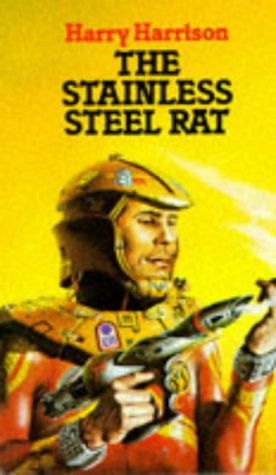
After all, what kid can resist a character like Slippery Jim diGriz in Harry Harrison’s The Stainless Steel Rat? He’s a master thief who’s been co-opted by the Special Corps, the interstellar organisation which catches master thieves. Set a thief to catch a thief. There is something appealing about a hero who not only marches to a different drum but, once made a member of the band, still takes advantage of his new position. Well, perhaps it wouldn’t appeal to schoolyard bullies and the like. But to impressionable young sf fans….

So it’s a shame that The Stainless Steel Rat fails on so many other levels. The genre is so much more rigorous now than it was back in the 1960s. DiGriz’s universe is pretty much the West of the mid-20th Century with added spaceships and robots. All the characters smoke like chimneys, computers use punched cards, records are made on paper and stored in filing cabinets, cameras use film…. There’s almost no invention on display. Harrison has just wheeled out a couple of sf tropes in order to call his book science fiction.

After all, diGriz could have been caught by some secret branch of Interpol. And the plot of The Stainless Steel Rat could be easily translated into present day (as was). The story goes something like this:

During a bank robbery, diGriz is captured and recruited by the Special Corps. Chafing to escape from his training, he trawls through the Corps’ records and discovers that someone is building a banned battleship, cunningly disguised as a giant freighter, on a backwater world of the federation. DiGriz is tasked to discover who the ship-builder is. It transpires that all those on the world involved in the construction is an innocent dupe, except one man and his female assistant. But they manage to escape in the battleship before diGriz can stop them. So diGriz sets off in pursuit….

Instead of a space battleship, make that some sort of missile destroyer or something, and you could pretty much tell the same story set in 1961 or 2009. So why bother to make it science fiction? There’s no central idea, there’s no exploration of a central idea.

As if that weren’t bad enough, the gender politics in the book appear to resemble 1921 more than 1961. The villainess of the piece is Angelina, a beautiful psychopath. The reason for her psychopathy, it is explained, is that she was originally ugly:

To be a man and ugly is bad enough. What must it feel like to be a woman? How do you live when mirrors are your enemies and people turn away rather than look at you? (p 138)

The horror of it: an ugly woman. Clearly it’s enough to twist the most stable of minds. And yet, throughout the book, both diGriz and Angelina frequently change their appearance. Sometimes it’s merely disguise; other times it requires surgery. Which suggests such techniques are relatively common. So why was Angelina ugly long enough for it to trigger her psychopathic tendencies?

It’s a silly quibble because Harrison’s stated explanation for Angelina’s murderous nature is offensive tosh. And to add further insult, Angelina is now beautiful but still has to work through men – cf the mention of “female assistant” above. The same happens later in the book – diGriz’s universe is clearly a man’s universe, and women only get to play secretaries, wives, whores and manipulative mistresses.

Oh, and did I mention that diGriz falls in love with Angelina? Because she’s beautiful, intelligent and a “stainless steel rat” like himself. Never mind the fact that she kills people for no reason at all, she’s gorgeous and clever…. If there’s an argument for sf being a young boy’s genre, then The Stainless Steel Rat provides plenty of ammunition.

After reading Alan Dean Foster’s The Tar-Aiym Krang last month (see here), I wondered why I’d bother hanging on for so long to the five Pip & Flinx books I own. But The Stainless Steel Rat is much worse. And I own seven of the books from the series. They’ll be going on eBay, then.

Incidentally, Harry Harrison was this year made the SFWA’s “Damon Knight Grand Master”.