It Doesn't Have To Be Right…

… it just has to sound plausible


5 Comments

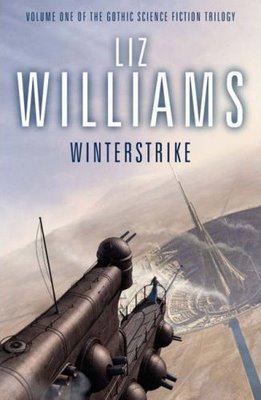
Women in sf reading challenge #2: Winterstrike, Liz Williams

Liz Williams is one of those British sf writers who was first published in the US. Her debut novel, The Ghost Sister, was shortlisted for the Philip K Dick Award in 2001, but has never received a UK edition. It wasn’t until her second novel, Empire of Bones, that she had a novel published in the UK. And yet, despite writing more than a novel a year since then, and even being shortlisted for the Arthur C Clarke Award in 2006 for Banner of Souls, she’s not a writer who seems to have impinged much on my map of the genre. I’m not entirely sure why. As far as I could tell, her science fiction was of a variety that would appeal to me. Yet I never bought or read one of her books. Perhaps it was because she seemed focused on her Detective Inspector Chen series of Chinese fantasy novels, which don’t interest me in the slightest.

Whatever the reason, it’s a lack I’ve now rectified. Winterstrike is the first book in a planned trilogy. It was first published in 2008, although no sequels have yet to appear. It is set on a far-future Mars which bears very little resemblance to the Mars of science fact. Parts of the story take place on Earth, which is also greatly changed.

There’s a lot of praise for Winterstrike and Liz Williams reproduced on the covers of the paperback edition I read. So it would not have been unrealistic to have high expectations of the book. Perhaps they were too high. While I enjoyed Winterstrike, and thought parts of it very good, it left me overall feeling a little underwhelmed. It may well be that the misleading back-cover blurb didn’t help. It claims the novel is about Hestia Mar who has been sent to Caud, an enemy city-state, “to recover details of an ancient weapon”. Which she finds and passes to her home city of Winterstrike, an act which “has virtually guaranteed the use of the weapon”. Her cousin Essegui, meanwhile, “discovers a plot by creatures who hold the secrets of the Martian past, and its future”. Which all sounds very exciting and science-fictional, but is no real preparation for what the story actually describes.

Hestia is indeed a spy for Winterstrike, looking for data on an ancient weapon in Caud. But when she finds it and passes the data back to her handler, the effects of the weapon’s use are not described until near the end of the novel; and even then it’s peripheral to the main plot. Hestia’s story meanwhile goes off on an entirely different path: while returning to Winterstrike from Caud, she finds herself in the ghostly city of the Noumenon, and stumbles across the army of Mantis, a clone of an ancient despot. Essegui, on the other hand, is searching for her sister, Shorn, who has escaped after being imprisoned in her room for consorting with a man-remnant. But Shorn is not really Eseegui’s sister, nor in fact is she really human. Also important is Earth’s Centipede Queen, who has come to Mars to find Shorn, for reasons not fully disclosed, but which result in Hestia travelling to Earth to tell them their queen has gone missing…

The two main narratives of Winterstrike, Hestia’s and Essegui’s, frequently come close to touching but never quite meet. But they do overlap, often taking place in the same parts of Mars. Such a carefully-braided plot is not especially unusual, but the voices of the two characters are so similar it is sometimes hard to distinguish between them. It’s only when Hestia reaches Earth that the locales differentiate the two threads sufficiently to keep them separate in the mind of the reader. Even then, the novel never quite reveals what’s going on. When Shorn is revealed as a bio-engineered experiment, it comes as a surprise because there’d been no foreshadowing in her character, nor had the existence of the technology to do it been mentioned earlier. Admittedly, this does remain true to the points of view of the narrators, but the revelation still feels abrupt.

As indeed do many of the book’s other revelations. It’s difficult to sense the shape of the story because Hestia and Essegui are in thrall to forces they don’t understand, and their narratives do not allow for an omniscient viewpoint to give the reader greater knowledge. This is not as claustrophobic as it might suggest, but it does mean much of the story has to be read on faith.

Throughout Winterstrike, Williams uses an invented vocabulary to describe many elements of the world,  her word-choices often giving the novel a flavour similar to Gene Wolfe’s The Book Of The New Sun. Unlike Wolfe, Williams has not used real obsolete or antique terms. For example, the Changed, the bio-engineered races of humanity on Mars and Earth, include vulpen, kappa and demothea. I googled the last word, wondering if it had any mythological meaning… and discovered that  it’s apparently a boy’s name from the Wild West and means “one who talks while walking”. Which, I suspect, was not the intended meaning in Winterstrike. None of Williams’ invented terms are glossed, or entirely clear from context; and it often takes a while for their precise meaning to come clear.

I wanted to like Winterstrike more than I did. The Mars Williams has created is bizarre and fascinating, but, while described as a matriarchy, there didn’t seem much that was, well, especially female about it. In fact, for much of the story, Mars might well have been an alien world and its inhabitants entirely unrelated to humanity. I’d like to read the next two books in the trilogy, but I shall not be waiting with bated breath for them. This is not to say Winterstrike is a bad book, just that I didn’t take to it as much as I had expected. But I may very well try Williams’ other sf novels should I come across them.


2 Comments

It’s not rocket science

Perhaps television science fiction is too easy a target. Perhaps the demands of television drama are incompatible with the demands of good science fiction. Good prime-time television drama, that is: a television series that doesn’t want to appeal solely to fans of television science fiction.

I am, of course, speaking of Outcasts, BBC1’s new science fiction drama. It’s currently being shown at prime-time on Monday and Tuesday nights, but in March will be moved to late night Sunday. I have so far watched the first four episodes, and I can’t decide which is worst: the plotting, or the world-building.

To be fair, the programme looks good and is mostly well-acted. And those television series which have clearly spent a lot of time and effort on world-building have ended up with (relatively) small but loyal fanbases among media sf fans – Battlestar Galactica, for example; or Firefly. But perhaps such an investment was thought too much for an eight-episode drama aimed at general television viewers, and which just happened to be science fiction.

But, you know, the world-building is important. It’s one of the pillars holding up suspension of disbelief. And without suspension of disbelief, you have a television drama that’ll shed viewers and end up being moved to a graveyard slot. You don’t need to create an entire world’s worth of back-history, you don’t need to invent new swearwords. But you do need to apply a little common sense to the world you’ve created for the story. No giant starships, for example, which are plainly not built to make planetary landings, but do anyway – despite previous attempts by other giant starships often proving catastrophic. Or re-introducing slavery, which is morally abhorrent no matter how you try to justify it, and simply wouldn’t happen in a story set no more than handful of decades from now. Or possessing sophisticated technology, but ignoring the way it is used in the real world – for communications, for instance; or GPS.

Granted, these may be considerations which are only going to exercise the minds of science fiction fans; perhaps general viewers, unused to, or unconcerned with, the demands of genre television, will ignore them. A lack of them won’t spoil their viewing experience. But is that any reason not to take the trouble to get it right? Their inclusion can only improve the story, and they’re unlikely to turn off non-sf viewers. There’s no need to turn Outcasts into Battlestar Galactica, with an entire universe invented from scratch, but throwing in a little rigour will surely make the programme better viewing for all.

Because when you skimp on the world-building, the plot stops making sense. Since many of those dramatically-tense scenes wouldn’t exist if you’d used a bit of common sense. So, for example, you have lots of sophisticated comms gear on your colony world, but people go off into the outback without any means of being contacted, so no one knows when they encounter trouble. It’s dramatic; but it’s also pretty dumb. And when you abandon common sense in world-building, you end up with idiot-plotting, a story that can only progress if the characters make pretty dumb decisions.

Battlestar Galactica proved that science fiction television can tackle grown-up themes in a grown-up fashion. It doesn’t always have to be juvenile. Outcasts could have demonstrated that rigorous intelligent science fiction doesn’t only appeal to fans of media sf. Instead, it seems Outcasts‘ writers ran from that particular fight. A shame.


3 Comments

Not a failure of the imagination

I love research. I take a nerdish delight in it. When I’m writing, I want everything in my story to be right. If that means digging through books, or searching the Internet, to find the information I need, then I’m more than willing to do so. I should be writing, of course. Except I can’t write if I don’t know what I need to know, if I can’t make sure it’s absolutely spot-on.

I don’t think I’m capable of writing a story in which I can “make it up as I go along”. I have come to accept that. The nearest I managed, ‘Killing the Dead’ in Postscripts 20/21 Edison’s Frankenstein, was set on an entirely invented generation starship. But I couldn’t let it go there. I had to pick a real destination for the ship, and calculate the length of time the journey would take. But even that didn’t do the trick. So I structured the story according to Dante’s Inferno, and borrowed imagery from it; which gave me a topic to spend hours happily researching.

I have in the past bought a copy of a long-out-of-print and scarce book – see here – so I could read up on something that appeared in a story I was writing. My story ‘Barker’ (see here) required a lot of research into the history and personalities of the early decades of the Space Race. Because everyone in the story except the title character was a real historical person. Fortunately the subject fascinates me and I already own a large number of books on it. See my Space Books blog. And yes, the flash fiction I posted there, ‘The Old Man of the Sea of Dreams’, also required a great deal of research too.

The story I’m currently working on – ironically, a fantasy – has had me researching Supermarine Spitfires and Vickers Wellington bombers. The protagonist is a RAF pilot during World War II, and I wanted to make sure I had all the details of flying those aircraft correct. I could have finessed it, I suppose – a few general piloting terms, perhaps, and then on with the story. But that would be cheating. It wouldn’t convince me.

And, without that research, how else would I have learnt that the the first item in the Vickers Wellington Pilot’s Notes Check list before landing is “Auto-pilot.. .. .. cock–OUT”? I kid you not. See page 25 here.

Another story, as yet unpublished, has one section featuring an Alvis Scorpion Combat Vehicle Reconnaissance (Tracked), so I hunted around until I found a copy of a book about the vehicle. Because I needed to get the terminology right.

Amanda Rutter of Floor to Ceiling Books asked on Twitter today “What book do you wish you had written?” She gave The Last Unicorn by Peter S Beagle, for its “simply gorgeous prose”, as her answer. I could have named something by Lawrence Durrell, whose prose I certainly admire the most. Or perhaps a science fiction novel that blew me away when I first read it. Or something by one of the my favourite sf writers. Instead, I picked Ascent by Jed Mercurio, because his intense and immediate, and closely-researched, style is how I’d like to write myself.

As a reader I want to know what it’s like, what it feels like, to be there. I want details. I am, after all, reading these books to explore other places, people and times – real or invented. And the last thing I want is glib one-line descriptions, or the distracting blur of authorial hand-waving. I feel novels should have bibliographies – and many novels do include a page of “Further Reading”. I have a work-in-progress which currently has twenty-five titles in its bibliography. It has, I admit, taken a long time to write. I hope it’ll be worth the effort.

I’ve wittered on about this subject before, but that’s because it’s something dear to me. True, fiction is not non-fiction. Nor should it try to be. But neither is it a failure of the imagination to research something heavily before writing about it.


10 Comments

I write science fiction, me

I don’t write speculative fiction, I don’t write fantastic fiction. I write science fiction. Occasionally, I write fantasy. I use the so-called “marketing categories” because I expect my readers to understand what I am trying to do in my short stories, and readers that will understand are more likely to read fiction labelled as “science fiction” (or “fantasy”). They have an expectation of a certain mode of fiction when they see the label; and I have an expectation that my readers will appreciate what I am trying to achieve.

Which is not to say that science fiction is opaque to non-genre readers; nor should it be. But my primary audience is pretty much those readers who like the same sort of stuff I do. And I like science fiction. I like science fiction with rigour, deep characterisation and good prose – and just because common wisdom has it the genre is incapable of those, that does not mean it needs to be relabelled with some new and entirely arbitrary term. Because all fiction, of whatever mode or genre, is essentially “speculative”. It’s only in the nature of the speculation that differences obtain. “What if?” can be asked in many diverse ways; and there are probably more answers to each variant than there are indeed variants.

The label “science fiction” is just as much a part of the compact between writer and reader as the author’s name, the blurb, even the cover-art. Science fiction as a label may have received more than its fair share of abuse in the decades since 1926, but it remains a fairly well-understood term. To replace it with something even more nebulous, something which seems to want to disinherit the genre’s history, is neither helpful nor useful.

I want to see an end to science fiction’s bad press. This will not happen by side-stepping the criticism through renaming the genre. It will happen when it is commonly acknowledged that science fiction, like all modes of fiction, encompasses both populist escapist tales and complex literary stories. Perhaps then I will not need to label my stories as science fiction. Perhaps then labels will be irrelevant. Nor do I need literary authors slumming in the genre to improve it – whether they acknowledge that they are writing sf or not. I need only write the best science fiction I can write.

And that is exactly what I do.


20 Comments

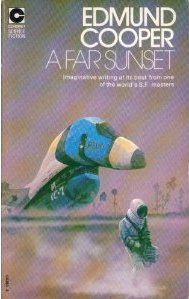
British sf masterwork: A Far Sunset, Edmund Cooper

Between 1954 and 1980, Edmund Cooper published thirty novels and collections. None of his books remain in print, none have been considered for Gollancz’s SF Masterworks series. The Encyclopedia of Science Fiction says of him, Edmund Cooper “died with his reputation at a low ebb; but he was a competent and prolific writer”, which is hardly fulsome praise. In the decades since his death in 1982, Cooper has been almost forgotten. Secondhand copies of his novels are not hard to find, although it seems nothing of his was ever reprinted after 1980. Unlike many of his contemporaries, he wasn’t published much in the US (during the 1960s and 1970s, DAW had lots of UK sf writers on its list). Of Cooper’s novels, the one which is perhaps mentioned most often approvingly is A Far Sunset. This was first published in 1967, but stayed in print throughout the 1970s.

In 2032 AD, the Americans, Russians, and “United States of Europe” each built an interstellar spacecraft. The American ship was the biggest, the Russian the fastest, and the European the cheapest. This last was named the Gloria Mundi, and her destination was Altair. After twenty years of travel, spent chiefly in hibernation, the crew of twelve arrived in the Altair system… and discovered an inhabitable and inhabited world. They landed. Six went out to explore, but never returned. Three went looking for them, and also disappeared. The remaining trio had no choice but to follow… and were promptly captured by the humanoid Bayani. Only one of the three survived captivity, Paul Marlowe, the ship’s psychiatrist. As Poul Mer Lo, he went native.

The Bayani are described throughout A Far Sunset as possessing a “mediaeval” society, but it seems much more ancient than that. From the description of Baya Nor, the Bayani city, Angkor Wat was plainly an inspiration. As was early Polynesia. The Bayani are ruled by a god-king, always called Enka Ne, who rules with absolute power for one year. He is then sacrificed, and a new Enka Ne is chosen.

The current Enka Ne is intrigued by Marlowe, and visits him in disguise as Shah Shan. He asks to learn English, and Marlowe is astonished by Shah Shan’s fierce intelligence and the speed with which he learns what Marlowe has to teach. Emboldened by this, Marlowe tries to introduce the wheel to the Bayani. The priestly order are immediately against it, but only accept it reluctantly after Enka Ne kills over a hundred of them. Change, then, is not going to be easy. And the current Enka Ne’s reign is not long.

Sure enough, after a new Enka Ne becomes god-king, the school Marlowe has set up is destroyed. Determined not to give in, Marlowe decides to travel a distant mountain which may hold the secret to the Bayani’s origin. This he does, and, yes, he does find the secret of the Bayani. But it’s not enough to effect change.

But on Marlowe’s return to Baya Nor, he learns that Enka Ne has died. And the Bayani oracle has chosen Marlowe to be the new god-king…

Cooper evokes his invented world with skill, and Marlowe is a well-drawn character. A Far Sunset has not aged gracefully, but neither is it as embarrassing as many other books of its time. Some of the science and technology feels a bit 1960s, and the gender politics are definitely from that decade; but the Bayani and Baya Nor are mostly timeless. The writing throughout is solid, and occasionally good without being flashy. While the secret of the Bayani is not obvious – so the reveal does come as a surprise – the existence of a secret is perhaps introduced too late in the story to have much dramatic impact.

Having said all that, there’s not much in A Far Sunset that is actually science fiction. It could be the story of a European explorer cast adrift on a Pacific island whose inhabitants who have lived the same way for centuries. Even the secret behind the origin of the Bayani, and their god Oruri, doesn’t really need to be sf. And that makes A Far Sunset ultimately a disappointing read. It’s by no means a bad book. It’s well-written, with a well-drawn world and protagonist, but it could just have easily been a “European marooned in the South Seas” story. I suspect I shall have to find another novel by Cooper to take its place on my British SF Masterworks list.

ETA: comments have been closed, and the exchange between members of Cooper’s family and literary trust removed. This is not the venue for such a discussion, and I’ve no desire to be held responsible for what might or might not be said by either party. Please air your differences elsewhere.


4 Comments

Spotting the next big thing

There was a conversation this morning on Twitter about collecting and collectible authors. Lavie Tidhar has already given his thoughts on the subject here. I collect books by certain authors myself – just see my irregular book porn posts on this blog – but I collect those authors because I like and admire their prose. Any future value is an unlooked-for bonus. And given my taste in fiction, a not very frequent bonus…

Who knew back in 1991 that Stephen Baxter’s first novel, Raft, would one day be worth around £300? I was fortunate in that I was sent a free copy. And of his next two books, Timelike Infinity and Anti-Ice, which are also worth about £200 each.

Around the same time, I bought a first edition copy of Michael Blumlein’s first, and only, short story collection, The Brains of Rats, from Scream Press. (And it was harder in those days to buy books from US small presses.) That book is worth approximately the same now as it was twenty years ago.

Other authors whose books I collect, and own in first editions (often signed), are often worth little more than I paid for them. When it comes to choosing authors to invest in, I’m rubbish.

But then I tend to avoid popular authors – and it’s authors who have small print runs for their first few books, but then pick up a large following, whose books tend to be worth something. Authors that are hyped from the start could conceivably prove good buys – although such marketing campaigns usually involve huge print-runs of the book in question. Like Justin Cronin’s The Passage. Which isn’t very good, anyway.

For the true collectible author, you need someone whose first few books were recognised by the cognoscenti – a few approving reviews here and there – but didn’t make much of a splash. They need to be regularly published – Baxter has churned out one or two novels a year since Raft, while Blumlein has managed three novels in twenty-two years. As novelists grow in popularity, so people start to seek out those earlier disregarded works. And are willing to pay good money for them.

Paolo Bacigalupi – well, The Windup Girl caused too much of a splash, I think, and his abrupt jump to YA might have scuppered his chances. Hannu Rajaniemi’s debut may also have landed with too much noise. Though I’m not a fan of fantasy, NK Jemisin is a possibility; her first two books seem to be very popular.

Unfortunately, thanks to the success of some marketing campaigns I can’t think of other new authors whose books might prove collectible at a later date. Because, by definition, not much fuss was made about them. I’m trying to think of a few authors whose debuts were published in the past two years, garnered a few positive reviews, but didn’t otherwise set the blogosphere alight. Ian Whates, perhaps? Gareth L Powell? Chris Beckett? Aliette de Bodard? Two paperback originals, one small press, and one that’s actually a reprint of a small press edition. Perhaps that’s the problem, perhaps the blogosphere has changed things such that it’s a rare debut which can slip under the radar.

And now I’ve said that, no doubt people will think of lots of examples…


4 Comments

A beginner’s guide to science fiction and its subgenres

Genre fiction can be confusing, especially given the plethora of sub-genres. Here are some handy definitions, for the next time you find yourself out of your depth when contributing to the conversation about science fiction.

science fiction we can’t solve problems in the real world, so let’s invent a world and fail to solve its problems

space opera the universe is a very dangerous place… especially when human beings are around

military science fiction war is bad, and we shall demonstrate this by glorying in it

planetary romance slavery is okay if their skins are a different colour, like green

hard science fiction science and technology can be dehumanising, so we will replace everybody with computers and robots

cyberpunk corporations with the power of life or death over individuals are bad, so I shall take all that power for myself

alternate history if science fiction didn’t exist, someone would have had to invent it

steampunk the Victorian era was repressive, racist, sexist and imperialist, but at least they had giant airships

science fantasy any sufficiently advanced technology is indistinguishable from authorial wish-fulfilment

And it’s a subgenre of fantasy, but…

urban fantasy vampires are a metaphor for sexual predation, so we will make it all about sex


27 Comments

Is science fiction becoming more politically polarised?

Last week, this post, Is Science Fiction Getting More Conservative?, appeared on pajamasmedia.com. The writer contacted four right-wing genre authors, and asked their opinion. The article has, at the time of writing, more than 350 comments. Almost none are dissenting opinions.

I’m not going to debate the rightness or wrongness of the article. (They’re wrong, of course.) It just strikes me as interesting how politicised commentary about the genre has become in recent years. Back in the 1970s and 1980s, when I was discovering science fiction, an author’s politics didn’t seem especially important to me. Perhaps it was just my age. I devoured Heinlein’s novels and, while I was never convinced by his bizarre politics, it didn’t put me off his books. Not that I understood quite why they were considered so good, however. The same was true for other works – all those demonisations of the Other, all that libertarian new frontier hogwash – none of it seemed to affect my enjoyment of the sf books I read. Back in the 1960s, I believe, Donald Wollheim polled sf readers and discovered that their preferred form of government was a “benevolent dictatorship” – which tells you more about the immaturity of the genre’s readers than it does their politics.

Later, after I’d discovered fandom and started attending conventions, I remember conversations about authors’ politics – laughing at rumours that David Drake wore a belt with a swastika buckle, for example. But it didn’t seem to have any bearing on the fiction I read (not that I read Drake anyway). Even when Iain M Banks started writing his – famously left-wing – Culture novels, it scarcely seemed relevant. The Culture would be a nice place to live in, yes. So too would John Varley’s Eight Worlds – the fact that Earth is forbidden, notwithstanding – and Varley is often quoted as the successor to Heinlein.

But now, the debate over politics within sf texts, and without, seems to taking up more and more bandwidth in the genre commentary space. Perhaps it’s simply because what were once private conversations have become public – it’s an artefact of the Internet. Or maybe the US’s drift further to the right over the past twenty years has made previously extremist views more mainstream. Certainly the Internet has meant that US voices are now among the loudest in genre conversations in other countries, conversations that were once protected by the Atlantic Ocean.

What makes this worse – to me – is that the right seems to be dominating the conversation. Declare that sf is becoming too “conservative” (ie, right-wing, rather than its old meaning of “reactionary”), and right-wing fans will jump in to agree. Say it’s becoming too left-wing, and they’ll jump in to disagree. It’s almost a war – except only the right are fielding troops. They’ll tell you the left is just as guilty of spreading propaganda and lies, but… where? I can’t see it. I look at the genre landscape, and the loudest voices are often those of the right. Don’t forget it’s only the right that has its own version of Wikipedia (and anyone who claims Wikipedia itself is left-wing is an idiot).

I don’t have an issue with the personal politics of authors. They are, after all, personal. If those politics flavour their output, and I disagree politically, then I probably won’t read them. It doesn’t mean I categorically won’t, however. There are some tropes in sf which seem a natural fit for right-wing sentiments – autocratic galactic empires, libertarian space pioneers, etc. – although I suspect that “fit” is more a matter of custom than the result of any real thought or speculation.

There are few consciously left-wing sf texts, and most of those are dystopian. Even Banks’ Culture is a bit of a cheat as it’s a post-scarcity civilisation. There are also few near-future novels which show a happily socialist Earth (Ken MacLeod’s springs to mind as excellent examples). It often feels like Reaganomics has cast a shadow over the next fifty years as far as science fiction is concerned. Perhaps this disparity is why conversations about science fiction often seem to gravitate rightwards – there isn’t enough critical mass on the left to counter it.

Surely it’s time to redress the balance? We live in a science-fictional world, after all, and it’s certainly not a monocultural one-party state. I would, of course, prefer to see more sf which met my own political preferences. And I’d like to see such sf discussed intelligently. By both sides. I don’t think it’s doing the genre any good to have two antagonistic camps – one of which is armed; guess which – and one is not.

But then I also believe utopias are possible. But maybe that’s more a result of my politics than my taste in literature…


15 Comments

Awards fixing

It’s that time of year again when blogs fill up with pimp posts for the Hugo Awards. I disagree with such pimping in principle – it becomes about personalities and not works. Nor do I really consider the Hugo Award especially significant. After all, the winners are chosen by popular vote by a small number of people of broadly similar tastes. For example, despite being an international award, the Hugo for Best Novel was been won by only nine non-US authors throughout its fifty-seven-year history. This is not unexpected – the great majority of Worldcons, at which the Hugos are voted for, have taken place in the US.

Having said all that, I suspect it may be time to retire the Hugo Award for Best Fan Writer. Make it Best Blog, or something. Drag it into the twenty-first century, at least. Even as a catch-all term, Best Fan Writer is near-meaningless: most will take it to mean “nicest / most entertaining person related to writing about science fiction in some vague ill-defined way”. In other words, they’re voting on personalities, not writings.

The British Science Fiction Association Award, on the other hand, I hold dear. For a start, I am a member of the BSFA, and have been for more than twenty years. (The only time I have been eligible to vote for the Hugo was when I attended the 2005 Worldcon in Glasgow.) I also find that the BSFA Award shortlists align much better with my tastes in sf. However, I still think there is room for improvement.

As pimping is beginning to distort what is actually “best”, perhaps BSFA members should only be allowed five nominations per category. Given a limited number of nominations, members might be more discriminatory with them. It would certainly prevent occurences of “nominate me and I’ll nominate you”. On the other hand, this could lead to a wide spread of nominees with only small numbers of nominations, leading to difficulty in putting together short-lists.

All works, not just novels, should be UK-published only. For online fiction, non-fiction and art, this would mean the venue should to have a publication address in the UK; or, if no publication address exists, an editorial address. So, Strange Horizons – current editor-in-chief Niall Harrison is resident in the UK – is eligible. But Clarkesworld – editorial address in New Jersey, USA – is not. For non-fiction published on a blog or similar site, then perhaps the author’s residence is relevant. Nationality is always irrelevant. I also think there should be a minimum word-limit for non-fiction, say 1,500 words.

And perhaps the BSFA Award should be renamed. Arthur C Clarke casts a huge shadow over British sf, but he already has an award named for him. It occurred to me there might be a comparable British figure to Hugo Gernsback. So I googled… and found this excellent article by Rob Hansen on the beginnings of the BSFA. A few names stand out. Walter Gillings was an early editor of several early British magazines. Ken Slater did much to re-vitalise British fandom after World War 2 with his Operation Fantast. But, after some thought, I think it’s possible to commemorate two people. By renaming the BSFA Award the “Ted”, it honours the work of Edward ‘Ted’ John Carnell, editor of New Worlds, and EC ‘Ted’ Tubb, the first editor of the BSFA’s critical journal, Vector. Perhaps “winning a Ted” doesn’t quite have the same ring to it as “winning a Hugo”, but give it time…


5 Comments

Anatomy of a Story: A Cold Dish

Back in October 2009, I wrote a piece on my first Euripidean Space story, ‘Thicker than Water’ – you can find it here. ‘A Cold Dish’ was the second of my stories set in that universe, and it too was published in Jupiter magazine – in Jupiter 28, April 2010.

‘A Cold Dish’ is based on the play The Suppliants by Euripides. The play recounts how Theseus approaches the king of Thebes in order to ask for the bodies of the Seven Against Thebes, the seven leaders of an army which failed to invade the city-state. In Ancient Greece, burial rites were very important, and wars fought over dead bodies were not uncommon in the literature of the time. Unfortunately, this plot didn’t translate well to my Euripidean Space universe. It wasn’t really dramatic enough. Further, the need to bury dead heroes is not a cultural urge which translates to modern Western European culture.

In the universe of my Euripidean Space stories, the Earth has locked itself off behind a firewall for reasons unknown. This has left a number of off-planet settlements – on Mars, in the Asteroid Belt, among the moons of Jupiter and Saturn – struggling to survive. Patrolling the Solar System is an alien sentinel, origin unknown, which appears to exist solely to protect a number of alien artefacts. Unfortunately, these artefacts are not obvious – some of them could be somewhat unusual natural phenomena. In ‘Thicker Than Water’, for example, the artefact was a sea of buckminsterfullerenes on the moon of Tethys.

I’d already decided what the alien artefact would be in this, my second Euripidean Space story, and that dictated its setting. The Saturnian moon Mimas is sometimes known as the “Deathstar moon” because it features an enormous crater, Herschel, which covers a third of its face – as is obvious from the photo below. Herschel resembles a huge radio-dish, like Arecibo or Jodrell Bank. Identifying the artefact gave me part of the story’s plot – the “seven” would attack Mimas to prevent the Mimanteans from experimenting with the artefact. Herschel Crater also gave me the story’s title: ‘A Cold Dish’.
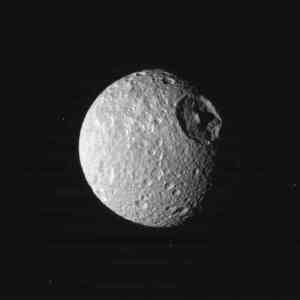
Image credit: NASA/JPL/SSI

But it still wasn’t enough. Happily, the title of the story – it was originally only a working title – provided the answer: revenge. Theseus’s mission to Mimas would be partly to retrieve the bodies of the dead heroes, but would also be driven by revenge. My Theseus analogue I named Spiro Maris – the Spiro, I suppose, from his adventures in the Labyrinth on Crete. I don’t recall why I gave him the family name Maris. The other characters in ‘A Cold Dish’ also bear names derived from their Greek counterparts. The Seven of Euripides play were Amphiaraus, Capaneus, Hippomedon, Parthenopeus, Polynices, Eteocles and Tydeus. Not all are named in ‘A Cold Dish’, but of those that are… Capaneus was known for his immense strength, so I called him Armstrong. Amphiarus means “twice-cursed”, which became Bimalison. Hippomedon… well, “hippo” is horse, so I named him Steed. The two Foote brothers are so named because their father was Oedipus, or “swollen-footed”.

As an example of “just enough information”: in ‘Thicker Than Water’, I’d named the settlement Torus for its carousel living-quarters. This phonetically aped Tauris, the name of the city where the Euripides’ play I’d based the story on had taken place. I felt I needed something similar for ‘A Cold Dish’. The Suppliants takes place in Thebes, but I couldn’t find any reference to the name’s meaning. So I decided to use the name as is for the Mimantean settlement. But I called it The BES, without actually bothering to work out what the acronym meant. The Built Environment System? It didn’t really matter.

As for “too much information”. I realised I didn’t know how large Saturn would appear in the Mimantean sky. The moon orbits at a mean distance of 185,520 kilometres, so I suppose I could work it out. Or I could finesse it, of course, and simply not mention it. But it felt like a useful detail. Instead, I went hunting on the internet, and on the JPL-NASA website found this:

Courtesy NASA/JPL-Caltech

The webpage here contains a number of artist’s impressions of the surfaces of the moons of Saturn and Jupiter.

I had a plot, a cast and a location. Now I needed an opening. I had this image in my head of figures in spacesuits encrusted with ice, so that’s what I used. Maris is inspecting the frozen bodies of the Seven, and then returns to the BES to negotiate with the Mimanteans. The rest of the story more or less wrote itself. I needed a Greek chorus. In ‘Thicker Than Water’, I’d used Saturn’s radio noise, but I wanted something different. So I decided to have all voice communication in the BES broadcast throughout the settlement. That allowed me to insert the grieving mothers, who provide the chorus in Euripides’ play, into the story and, as a bonus, gave me some pointers to the character of the Mimanteans. I also managed to include a reference to Theseus’s boat (also known as Granny’s broom).

The more I read up on the Ancient Greek characters on whom I was basing my cast, the more information I could insert into the story regarding their backgrounds. For each of the Greek city-states, I picked a moon: Athens became Rhea, Troy is Iapetus, Sparta is Hyperion, for example. Likewise with the personalities from the myths: Oedipus I renamed Rex Foote, Agamemnon is Stanovsky, Helen of Troy is, er, Helen Bright, Paris is Alexander Lek… Some of these may well make appearances in other Euripidean Space stories.

Some might say I’ve put far too much into ‘A Cold Dish’. All the references to Euripides’ play and Greek myths, which most readers won’t actually spot, some might consider those irrelevant in “a fun pure SF piece” (as Rich Horton described it on sfsite.com). But I believe stories should be more than just “fun”. I’d like to think there’s plenty to unpack in my stories, not just what appears on the surface. I feel that enriches the reading experience.