It Doesn't Have To Be Right…

… it just has to sound plausible


8 Comments

His master’s voice

So, a couple of days ago I tweeted a short quote from the book I was reading, one of this year’s Clarke Award finalists, and remarked that I was surprised to find the position expressed in the quote in a genre novel published in 2017. Most people who saw my tweet were as dismayed as I was – although, to be fair, they saw only my quote.

Which changes things. Apparently.

The book in question is Sea of Rust by C Robert Cargill, and the exact quote was “Gender is defined by genitalia”, which is spoken by the book’s narrator, Brittle, a robot, in a paragraph in which “she” admits that robots have no gender, it is not something “she” has ever thought about, but she henceforth chooses to define herself as female.

Two people I consider friends – very smart people both, and genre critics whose opinions I respect* – decided to insult my intelligence by questioning by understanding of how narrative works. Because the offending phrase – and it is offensive – was spoken by a character, they stated, that does not mean it reflects the author’s sensibilities. As another friend pointed out, I have myself written fiction featuring Nazis – and I have: ‘Wunderwaffe’ – but that obviously does not make me a Nazi. This is indeed true. Cargill has written a novel about robots, in which the first person narrator is a robot… but obviously he is not a robot himself. I never claimed this.

But the people arguing against my comment were themselves making the same assumption about me they were accusing myself of making against Cargill. Except, I think my position is backed up by the narrative.

When an attitude or sensibility exists in a narrative with no basis in the narrative for it, then it is reasonable to assume it is an attitude or sensibility of the writer. Because of course there’s a distinction between what a character professes to believe and what the writer might believe. But that also assumes the writer has removed every last vestige of their worldview or sensibilities from a text. And that’s frankly impossible. There will be attitudes they have never questioned, and they will likely colour what they write. So when Cargill writes about gendering robots – and, let’s face it, why would the concept even occur to a robot character? – and while there are no dates mentioned in the novel, let’s assume the robots began to appear in the second half of the twenty-first century… True, gender identity could have gone backwards since then, and we’ve certainly seen a lot of backwards social movement since Trump and Cameron/May took power, since the rise of the right… But there’s no evidence in the narrative for the position on gender advanced by the robot narrator. What’s inside the narrative does not apply.

You all know how much I hate Asimov’s fiction. I’ve labelled it “men in fucking hats sf”, because no matter how far in the future it is set, all the men wear hats. And men did indeed routinely wear hats when Asimov wrote his stories in the 1940s and 1950s. It’s a real-world sensibility he unthinkingly imported into his world-building. It is not an attitude of the characters that hat-wearing is normal, it is an attitude of the writer. It is men in fucking hats.

And so back to Sea of Rust. What is in a narrative has to have a foundation in the narrative. Otherwise its foundation is external. In fiction, when a character holds a specific plot-oriented worldview which dictates their actions, that worldview is documented within the text – and, in many cases, the cause of that worldview is also documented… and occasionally actually forms a narrative thread itself. Robots are machines and have no gender. Fine. Robots, for reasons the narrative of Sea of Rust chooses not to explore, adopt gender. Fine. But when a robot character says, “Gender is defined by genitalia”, they’re not parroting a robot position on gender, nor is there evidence in the text they’re parroting a position in the text’s invented world… Ergo, it’s a sensibility of the writer that has leaked through into the narrative. It is a fucking hat, in other words.

So yes, I do understand how narrative works. I also understand how writing works. And while I may not be as accomplished at writing as others… and I may place a higher value on narrative rigour than most people… I stand my original position:

Unless the narrative evidences a foundation for a sensibility or attitude, then it’s reasonable to assume it is a sensibility or attitude of the author that has leaked through into the narrative.

And given that, it is indeed fair to comment on said attitude or sensibility. I stand by the tweet that kicked this all off. I happen to think Sea of Rust is a bad book for a number of reasons – and I’m baffled it made the shortlist – but I absolutely think it’s fair to accuse the author of believing “gender is defined by genitalia” on the strength of the words in the book.

Oh, and for the record, genitals are not gender. And any novel, genre or otherwise, published at this time, needs to justify in its narrative any position opposite to this or risk being called out.

* And whom I still consider friends, of course.


4 Comments

The con in the north

I think Harrogate is the furthest north in England the Eastercon has ever been. Certainly, it’s the most northerly Eastercon I’ve attended. Blackpool, Manchester and Bradford are in the North, but still south of Harrogate. York and Leeds, also south of Harrogate, were before my time. And Glasgow, of course, is in Scotland.

More recently, I’ve been attending conventions much further north – in Sweden, Denmark, Finland and Iceland. But that’s by the by. Follycon 2, this year’s Eastercon, took place at the Majestic Hotel, which is a huge Victorian hotel that has seen better days, in Harrogate. And now that it’s all over… I’m not entirely sure if it was a good Eastercon or a bad one.

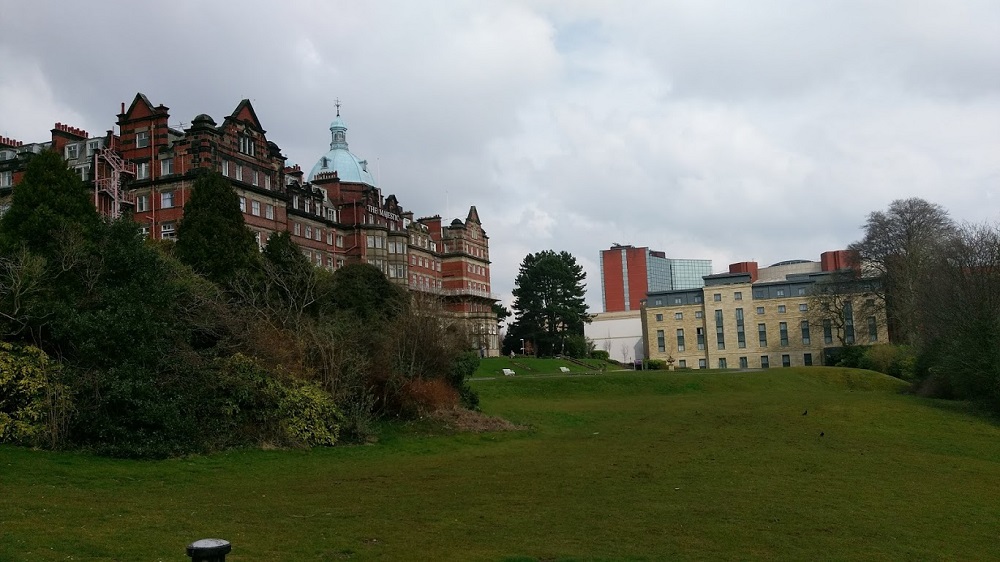
Majestic Hotel to the left, Premier Inn straight ahead

The venue was large, with plenty of room to sit down and chat and have a drink. The layout had been knocked about in the past, resulting in odd staircases that appeared to go nowhere, and a poky reception that actually had the main entrance on hotel’s rear, and an original entrance hall which boasted a nice mural above the dado but felt more like a space without a purpose – at least, normally; during the con, it was the main social area. And since there were programme rooms on either side, you’d get a throng crossing it whenever programme items ended. Having said that, the service was occasionally appalling, and I heard a few stories about delayed meals.

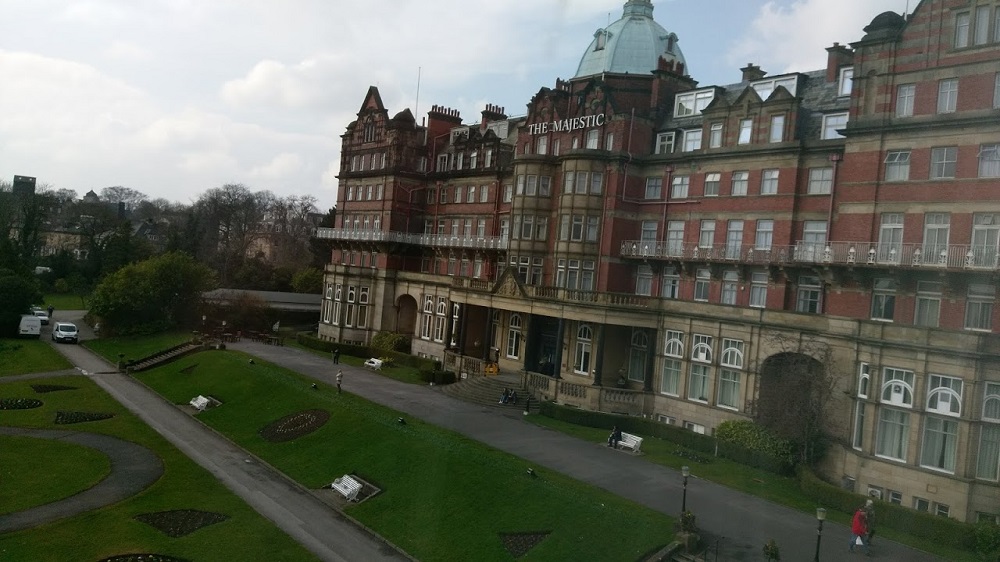
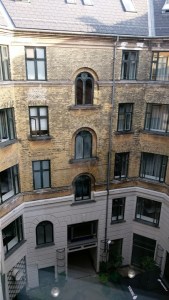
View of the Majestic from my hotel room

However, the Majestic is literally a stone’s throw from Harrogate town centre, so it was a quick walk to plenty of good places to eat. So I ate well during the con. Which is unusual for me. I can recommend Major Tom’s Social on the Ginnel, off Parliament Street, which serves pizza – including two vegan ones – and craft ale. There’s also a good all-you-can-eat Chinese restaurant on Cheltenham Crescent, although it’s not a buffet – and the concept of all-you-can-eat from a menu did confuse a couple of members of our dinner party…

(I wasn’t actually staying in the Majestic, but in the Premier Inn, which was pretty much next-door. My room was large and comfortable – it had a chaise longue! – and the staff, sorry, “team”, were helpful and attentive. The breakfast was also pretty good.)

Then there was the con’s programme. It pretty much had something for everyone, not that I attended any items. Well, other than the one I was on, about AI, which went quite well. There were a couple of other panels I’d liked to have seen, but they seemed to fall at times when I had other plans, like lunch. I heard mixed reports from those who did attend panels, although most people seemed to have enjoyed them.

I no longer attend conventions for the programme – I haven’t done for years – even if I always promise myself I’ll see more of the programme, make more of what’s offered over the weekend. Instead of just sitting in the bar and chatting to friends. Which is pretty much what I did. There was a good real ale bar, which helped. And one of the two bars – the Regency Lounge – was more like a gentleman’s club, with panelled walls and leather(-ette?) armchairs (and peeling plaster above the dado). It was a good place to socialise.

The dealers’ room – I remember when they used be called book rooms – was poor. The usual small presses, a few self-published authors, jewellery and T-shirts… but no secondhand books. I can understand why dealers no longer bother – if they’re not making a profit, or even covering their expenses, then it’s not worth it. But it is disappointing.

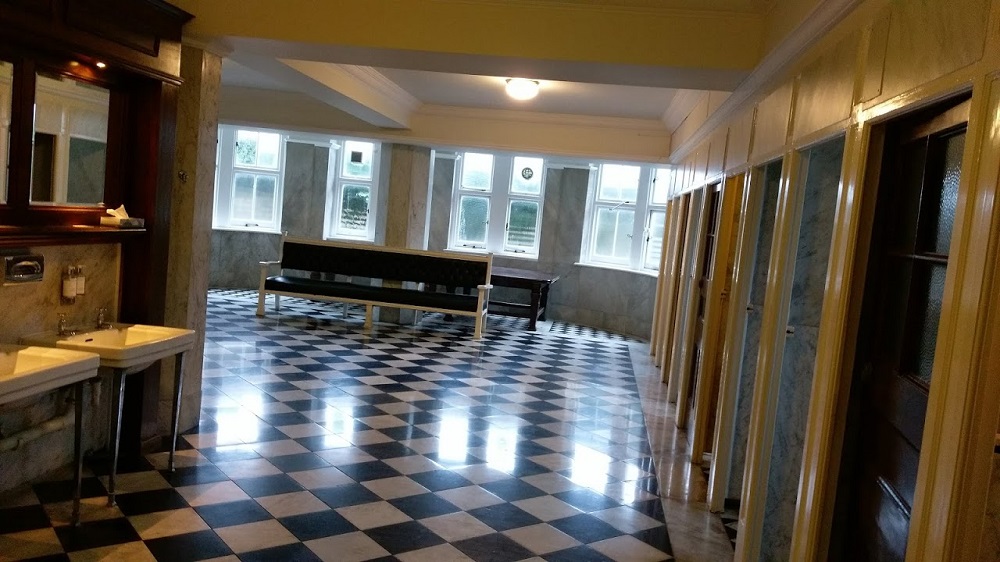
No description of the hotel would be complete without a mention of the gents’ toilet near the dealers’ room. It was enormous. There was even a bench at one end for people to, er, sit down. It had seen better days, but was still pretty impressive.

The infamous gents’ toilets

The BSFA Award ceremony took place during Follycon. I usually attend this, but didn’t bother this year. It was pretty much a done deal. I’d expected Nina Allan’s The Rift to win – it’s a very good book and a worthy winner – although I thought Anne Charnock’s Dreams Before the Start of Time slightly better. But Charnock took the short fiction award for her novella, The Enclave. Which is also very good. Although I think the category was reasonably open. Best artwork went to Jim Burns, who must have a garden shed full of BSFA Awards by now, for the cover of a novel published by NewCon Press (who also published The Enclave), jointly with Victo Ngai for illustrations for a JY Yang story on Tor.com. The non-fiction award was won by Paul Kincaid’s book Iain M. Banks, which was the most likely winner of a strong shortlist… and has also been shortlisted for the Hugo. During recent years, books, novellas and artwork published by NewCon Press have regularly appeared in the BSFA Award shortlists. True, the BSFA is a small organisation, and it takes only a handful of votes for a work to be nominated… and probably not many more for it to be shortlisted. I suppose, the same might be said of PS Publishing and the BFS Awards.

But then I think popular vote awards – and the term “popular vote” is a total misnomer – are neither popular nor useful. Like the Hugo Awards, the shortlists for which were announced over the weekend. And, ho hum, the same old faces. It’s good the puppies appear to be a spent force, but all that means is we’re back to the old way of doing things, ie, a small group of writers dominating the shortlists. It’s telling the Hugo Award shortlists (voted for by fans) and the Nebula Award shortlists (voted for by pros) often have considerable overlap. Authors, especially popular authors, bend awards out of shape. I’ve said it before, and each year it proves my point.

But the Hugo shortlists… Jemisin is the new Card, the new Bujold, the new Willis… The Broken Earth trilogy is good, but not so good it contains the best genre books published three years in a row.  I’ll read the third book, The Stone Sky, as I’ve read the first two books of the trilogy. And I’ll read Kim Stanley Robinson’s New York 2140 too, as I’ve been a fan of his books for many years. But I’ve zero interest in the rest of the shortlist. I suspect Jemisin will win, which will be  disappointment, as it’s a safe choice, but neither do I want any of the others to win. And, to be honest, I could say the same for the short fiction categories. Once upon a time, they were dominated by the Big Three print magazines – Asimov’s, Analog and F&SF – but a new Big Three of online magazines now rules the roost – Tor.com, Clarkesworld and Uncanny. But then, at a time when the short fiction is notoriously vast, it only takes a few extra votes to get a story onto the shortlist. I guess we’ll find out later in the year exactly how few votes it takes to be on the short story shortlist.

Oh well. It’s not that I can’t get excited about the Hugo Awards, because I haven’t been for years. Even back in the day, the tastes of its voters never really aligned with mine.

Anyway, I left Harrogate on Monday morning, once the trains to Leeds were running – as the British weather had managed to  bollix the service. Now our railways are privatised, they are so much better, honest guv. (When will it be okay to punch a Tory? Their entire ideology is built on dangerous lies which have a habit of doing the exact opposite to their claimed benefits: trickle-down, home ownership, privatisation, low taxes, Austerity, Brexit… One Tory even went on record saying he doesn’t think rented accommodation needs to be “fit for human habitation”! There’s a Tory who deserves a fucking good kicking.)

Anyway, I left Harrogate on Monday morning, once the trains to Leeds were running. I had a fun weekend. I ate well – always a surprise at cons, for me – and I saw some friends I don’t usually get to see (except, perhaps, at Eastercons). I had some good conversations with various people. But, as I remarked to Mike Cobley on the Sunday, we’d made the tactical mistake all those years ago of making friends with people who no longer attend cons. And from what I’ve seen over the past couple of years, young writers, ones that weren’t previously fans who attended cons, prefer to hang out with each other and their publishers. It’s not like UK cons have never been cliquey, but it does seem more marked these days. I don’t see that happening at Nordic cons – although that may well be because Nordic fandom is smaller and they all know each other. Having said that, UK fandom these days – or rather, that subset of it comprising writers and editors and critics – is entirely London-based, and us up here in the provinces can’t generate enough critical mass to get another scene going and sustaining itself.

The fact the Eastercon often takes place in the North means nothing.


Leave a comment

The BSFA Award

I’ve been a member of the British Science Fiction Association since the late 1980s, and attending Eastercons, on and off, since 1990. So the BSFA Award is the one genre award I’ve been most involved with as a voter. They’ve changed its workings over the years and, to be honest, I’ve yet to be convinced the current system works all that well. But then I’m not convinced popular vote awards are especially useful. I think the British Fantasy Society has it almost right – a popular vote to pick the shortlists, and then a jury to decide on the winner (and they can pull in an extra nominee if they feel a work deserves it). On the other hand, The BFS Awards have way too many categories. At least the BSFA Award keeps it nice and simple: best novel (published in the UK), best “shorter fiction” (novellas to flash fiction, published anywhere), best non-fiction (from blog posts to academic tomes, published anywhere) and best artwork (no geographic restriction either). This year, the shortlists look as follows:

Best Novel

I’ve read the first two, and in fact nominated them for the longlist. The Charnock was initially ruled ineligible as 47North is Amazon’s publishing imprint, but I argued the point on Twitter and the committee decided 47North was actually transatlantic and so the book qualified after all. I’m pleased about that. I’m in no rush to read the Leckie, as it’s apparently more of the same. The Hamid is a surprise. It’s also been shortlisted for the Man Booker, and I’ve not heard anyone in sf circles talking about it on social media. I guesss I’ll have to get me a copy.

Best Shorter Fiction

I’ve read the Charnock, and I thought it very good. There’s nothing from Interzone here, which is a surprise… Or maybe not. The most active voters these days seem to be those who use social media, and both Strange Horizons and tor.com are popular among them – but not Interzone, which is old school tech, ie paper. The Thompson I’ve seen praised a lot. The others I’ve heard nothing about.

Best Non-Fiction

I like the grab-bag nature of this category, but it can end up a bit of a dog’s breakfast at times. Here we have a book of criticism, two series of blog posts, a critical article in a book and a review in an online magazine. I’ve read the Banks book, and it’s very good (I might well have nominated it for the long list; I don’t remember). Adam Roberts is a frighteningly intelligent and witty critic (and writer), but to be honest I really couldn’t give a shit about HG Wells and all the books he wrote. I followed the Shadow Clarke (and was much amused at US fans’ mystification at the concept of a shadow jury), and I plan to follow it again this year. The final nominee… well, the only article published by Strange Horizons that I’ve seen mentioned several times is ‘Freshly Remember’d: Kirk Drift’ by Erin Horáková, so I’d have thought that more likely to have been chosen. I’ve not read the Ghosh book reviewed by Singh – my mother is a big fan of Ghosh’s fiction, but the only novel by him I’ve read is his 1996 Clarke Award winner The Calcutta Chromosome – but Singh’s review does look like an excellent piece of criticism.

Best Artwork

  • Geneva Benton: Sundown Towns (cover for Fiyah Magazine #3)
  • Jim Burns: cover for The Ion Raider by Ian Whates (NewCon Press)
  • Galen Dara: illustration for ‘These Constellations Will Be Yours’ by Elaine Cuyegkeng (Strange Horizons)
  • Chris Moore: cover for The Memoirist by Neil Williamson (NewCon Press)
  • Victo Ngai: illustration for ‘Waiting on a Bright Moon’ by JY Yang (Tor.com)
  • Marcin Wolski: cover for 2084 edited by George Sandison (Unsung Stories)

There’s not much you can say about Best Artwork – you either like the nominated piece, or you don’t. But another Jim Burns cover for an Ian Whates novel? Really? Burns does great work, he’s one of the best genre cover artists this country has produced, but I’d sooner see more adventurous art in this category. We also have a short story, and the art illustrating it, on two shortlists. It’s a lovely piece of art, but… I have a lot of trouble myself thinking of candidates to nominate for this category, so I guess it’s unsurprising the people who voted for a story would also vote for its accompanying art. And voting on the long list requires hunting down each piece in order to decide whether or not it’s worth a vote… Perhaps in future, the BSFA can provide a page with thumbnails of all the longlisted art?

So there you have it… Four shortlists, the winners to be decided at Follycon in Harrogate at the beginning of April. I’m going to have a go at calling the winners. I think The Rift will take best novel, Greg Egan best short fiction, the Shadow Clarke jury best non-fiction, and… okay, I’ve no idea who’ll win Best Artwork. Probably Jim Burns. Again.


7 Comments

A reading guide for grown-ups

There’s a common misperception that as you get older, so your tastes in reading drift toward non-fiction. No more fanciful story-telling, from here on in it’s facts and figures. And I’ve certainly found that as I impinge on my sixth decade on this planet – that makes me fifty – so I find myself wanting the certainty of non-fiction and a world I can relate to. They say the Golden Age of science fiction is thirteen, which is, perhaps, a comment on the ability of the thirteen-year-old to read uncritically, given that the vast bulk of sf novels fail even the most cursory critical read… But I think it’s more generally accepted that at thirteen we as readers are more willing to be wowed, we are not so cynical, we can surf the tide of ideas generated by a science fiction text. As we age, so we need more scaffolding to those ideas – possibly because we know more about the world and so are less willing to accept unsupported the premises upon which most science fiction stories rely.

Personally, I continue to read the same sort of novels I read ten or twenty years ago. But I do find them less satisfactory– No, that’s not quite right. There are ways of telling science fiction stories, and I can now discern how they are constructed, and if that’s lacking then I see it is lacking. I can think of a number of sf novels whose flaunting of the so-called “rules” actually makes them stronger fiction, and I doubt I would have seen it that way two or three decades ago.

One of the things I have certainly noticed in my response to my reading as I get older is that I’m no longer willing to put up with world-building which creates abhorrent universes in order to either create drama or, worse, make a point about our own world. The world right now is shit and getting worse on a daily basis, so writing a novel in which human beings can sell themselves into indentured labour to pay off their debts is… so fucking mindlessly right-wing it beggars belief. Why are sf authors writing the playbook for our right-wing future, when they should be telling tales to prevent it?

Remember “cli-fi”? A horrible neologism, but the point was that writing about climate collapse – which is still going to happen, by the way – would persuade the public it was a cause worth pursuing. Except no one gave a shit. Because one mid-list novel is not equal to the PR budget of an oil company. So when science fiction sets stories in futures in which human rights have been removed, all they’re doing is normalising the political thought behind the removal of human rights. Look at how many science fiction television series show torture – in 2018! – despite the fact it is morally abhorrent and globally illegal.

Science fiction has spent the last five to ten years fighting for diversity. And it has partly won that battle. Women, and women of colour, have dominated genre awards for the past couple of years. This is a step in the right direction. However, while we’ve been celebrating those successes, science fiction has been normalising the sort of right-wing shit even the Nazis had to soft-soap the German public before they would accept it. So we have a Star Trek series in which a villain repeatedly kills the crew of the Enterprise over and over again… but that’s okay because it’s a time-loop. I’m sorry, but his way out is death for everyone? How is that right? And then there’s The Expanse, in which the nominal government of Earth, the UN, uses torture, and in which a corporation murders millions of people in the cause of research. How is this right? How is this even moral? We have been so busy celebrating our own victories in the cause of  inclusivity that we’ve allowed fascist stories to take over our genre.

I don’t want to see stories of the future in which humans are treated as slaves, in which millions are murdered to disguise the kidnap of a plot token, in which torture is treated seriously as an intelligence-gathering technique, in which violence against women is used as “character development”, in which the othering of non-white people is considered “world-building”…

I want a socially responsible science fiction, that is self-aware, that knows it is a powerful tool for affecting public opinion – and not just at the behest of corporate paymasters. I want a science fiction that scorns shit right-wing concepts like evo psych and alpha males and eugenics. I want a science fiction that tells good stories and does so responsibly. I want a science fiction that doesn’t abandon its ethics or its artistic integrity in pursuit of the bottom-line. And I want a science fiction readership that accepts partial responsibility for the shit content that is produced, that demands more reponsible content and rewards it by consuming it in sufficient numbers to make it profitable. Cli-fi, after all, had its heart in the right place. But a tendency to be too preachy, an inability to match the oil companies and their anti-global-warming lies, and an inability to find a story that resonated… told against them. Science fiction has a much wider remit, and somewhere in its countless worlds and stories, there must be something we can use to tell stories of the futures we want to see, not futures we’re afraid to see.


Leave a comment

All the new year feels

I think on the whole 2017 is best forgotten. I did have some good times – conventions in Sweden, Finland and Denmark, for example – but on the whole the year was a bit of a dead loss. I had plans, I had modest plans. I failed them all. Well, I didn’t manage to get much done during the year outside the day job. I’m hoping 2018 will be much better in that regard.

Having said that, it’s hard to be optimistic when your country has decided it would sooner be racist and poor instead of prosperous and a member of the planet’s largest trading bloc. And then the US elected a posturing baboon to the White House, and the GOP seems determined to roll back every piece of legislation that had begrudgingly dragged the US into the 21st century… So, the world went to shit and it sort of killed my motivation to do much other than lose myself in movies.

I’m not expecting 2018 to be any better politically or geopolitically. I’d like to move to a more civilised country. But it’s hard to change a situation that isn’t personally broken – I work four days a week at a job I enjoy, for money that more than pays for the stupid number of books and films I buy. And my current situation certainly doesn’t prevent me from writing, or reviewing. I’ve done both in previous years.

So in 2018, I want to start writing again. I want to finish the third book of my space opera trilogy, A Want of Reason. Which is all plotted out and about a third written, and will likely turn out to be the most un-space-opera space opera that ever space opera’d. I’m basing an entire chapter on Le grand meaulnes, FFS. It opens with a terrorist attack. By one of the good guys. And wait until you see the Space Communists from Space… I also have several ideas for novellas I’ve been mulling over for a few years. I could have a bash at the Poseidon Quartet (as mentioned in Apollo Quartet 5: Coda – A Visit to the National Air and Space Museum). Or maybe the Jupiter Quartet, which I’ve been thinking of doing for a while… I’d like to write some short fiction too, although I am notoriously crap at it, well, at finishing it. I envy people who can sit down and bang out a first draft in one sitting.

I also intend to drag SF Mistressworks out of mothballs. I read several books that qualify for it during 2017, so I just need to write the reviews. And I’d like to start reviewing again for the venues I reviewed for previously. It’s all very well banging out a couple of hundred words on books I’ve read, and films I’ve seen, on my blog, but most of those “reviews” sort of turned into rants and I really need to be a bit more disciplined in my criticism. In fact, I’d like to write more about science fiction in 2018. At one point, I was going to write a whole series of posts, Fables of the Deconstruction, on individual sf tropes. I did space travel (see here) and robots (see here), but never got any further. And then there’s the spoof how to write space opera guide myself and another award-winning sf writer drunkenly hacked out one night… We really should finish it.

Of course, I’d like to read more books too. I managed to reduce my four-figure TBR pile by exactly one book in 2017. That’s excessively rubbish. I didn’t make my target of 140 in the Goodreads Reading Challenge (I finished the year on 128), so I plan to beat that for 2018. I’m an inveterate list-maker, so I’ve already started putting together a list of the books I want to read this coming year. I think I should buy less books too – I mean, buying eleven per month on average is not good for, well, for the fabric of the building I live in. I should probably have a clear-out at some point, but some authors I’ve been collecting for so long I’m reluctant to get rid of their books, even if I no longer read them…

So, resolutions… They should be in a handy list (see above). Twelve is a good number; there are twelve months in a year, twelve days of Christmas, twelve eggs in a dozen, er, eggs… So how about twelve resolutions for 2018?

  1. Read more books than last year – I have to beat 128 books but would prefer to beat 140 books
  2. Speaking of which… only start reading a new book when I’ve finished the last one
  3. Read at least six books from countries whose literature I’ve never read before
  4. Watch less films than last year – I mean, 602 is a bit fucking excessive; anyway, now LoveFilm has packed in I’ve only got one DVD rental service
  5. Finish the damn space opera novel – it’s all there in my head, and has been for a two years; I just need to get it down on paper
  6. Complete at least one novella – they’re probably going to take a shit-ton of research; why do I do this to myself?
  7. Complete at least four short stories – bonus points if I can actually sell the bloody things
  8. Get SF Mistressworks back up and running, start reviewing books again
  9. Write more about science fiction on this blog, so it’s not all films I’ve watched and books I’ve read
  10. Drink less wine
  11. Exercise – I’ve made half-hearted attempts at developing a running habit several times in the past; it usually lasts a month or so
  12. I plan to attend two Nordic cons in 2018, but maybe I can squeeze a third one in?

There, they look achievable. All I need is a bit of motivation. And self-discipline. I don’t expect to complete all twelve, but they’re mostly about getting me back to where I was before 2016 landed on my head at the day job. And then, in 2019, I can start building on them…

Happy New Year.


1 Comment

Wonderful wonderful– er, fantastic fantastic Copenhagen

So the big project at work that was supposed to end on September 1st… didn’t. A month before, they realised they weren’t going to hit the deadline, and so rebased all their plans. Which meant I was now free for the first weekend in September, the date of Fantasticon, an annual science fiction convention in Copenhagen. I mentioned it in passing to my boss, told her it was doable, if expensive, and she said go for it, I needed to use up some holidays anyway. Which is why, on pretty much a week’s notice, I booked a flight and a hotel room, and flew to Denmark to attend Fantasticon 2017.

I flew out on the Thursday night, as it was easier and cheaper than a Friday flight, although it meant an extra night in the hotel (which, er, wasn’t cheaper…). Usually, when I fly to Denmark, I go EasyJet, but this time I flew SAS, and it was a much better experience. I landed just after 9 pm, topped up my Copenhagen travel card, and caught the train from the airport to the city’s main railway station. My hotel was on Vesterbrogade, about 800 metres from the station. There are a lot of hotels on Vesterbrogade, which meant a lot of tourists, dragging their suitcases along the pavements, which were restricted because of roadworks. When I landed in Denmark, I’d switched my mobile back on and learnt I had two voicemails. Once I was in my hotel room, I listened to them. The first was from work; the second was from my bank… asking me to ring them on their fraud prevention line. I called them, demanding to know what was going on – they’d wanted to cancel my debit card two days before I flew to Helsinki for Worldcon75, but I’d persuaded them to hold off, and on my return they’d cancelled my card and sent me a new one… and now this new one had been compromised, even though I’d had it less than a week. I got a bit shouty. The bloke on the other end of the phone said, we haven’t left you a voicemail today, that one was from 16 August. Oops. It was an old message about my old card, and had got stuck in Vodafone’s voicemail system. I apologised for my outburst.

The view from my hotel window

Fantasticon 2017 didn’t start until 4 pm, so I had most of Friday free. I rang my sister, Kay, who lives just north of Copenhagen, and we agreed to meet up for lunch. I went for a wander in the Indre By, and managed to navigate my way to Faraos Cigarer, with a bit of help from my phone. I’d last visited there at Christmas, but the shop had greatly expanded. Downstairs had been English-language and upstairs Danish-language. Now, it was all English (there was a new Danish-language shop across the road), with novels and manga downstairs, and graphic novels upstairs. I met up with my sister outside the Rådhus, and we went looking for somewhere to eat. The first place, the waitress gave us a blank look when I asked what was dairy-free on the menu. She checked with the chef. I could have the salad. It seemed Copenhagen was going through a brioche phase and all sandwiches were made with bread that contained milk. We left. The second place we tried, the menu was just as unwelcoming, but the guy behind the bar (he appeared to be the only person serving) made an effort and produced two club sandwiches without dairy for us. Danish club sandwiches are not like club sandwiches in the rest of the world. They’re not triple-decker sandwiches with egg, bacon, chicken, salad, etc; they’re hot sandwiches containing chicken breast in curry mayonnaise, often with pesto. But then the Danish don’t call danishes danishes either. (They call them Viennese pastries.)

The Rådhus

After lunch I returned to my hotel to wait for the con to begin. At 3 pm, someone from the con posted on Facebook that the doors were open, so I made my way to Frederiksberg, 800 metres from my hotel in the opposite direction to the railway station, and the Serapion Order, the venue for Fantasticon. I was a bit early. I walked in and the only three people there were Sanna, Bende and Flemming, all of whom were involved in organising the con. (I’d met both Sanna and Flemming at Swecons previously.) So I checked out the venue until the opening ceremony started. More people began to arrive, including a few Swedish fans, Carolina, Thomas and Johan. There was also a Finnish fan at the con, Linn, who was a NOFF candidate. The opening ceremony consisted of Flemming welcoming everyone to the con, apologising that the GoHs – Nina Allan and Christopher Priest – had not yet arrived (their plane was landing as he spoke, he told us), and then mentioning several upcoming cons (including Icecon 2 next year and the worldcon in Dublin in 2019). Later that night, I sat through Jesper Stage’s entertaining, and very dry, talk on the economics of colonisation in fantasy and science fiction. The venue closed at ten. I left with Jesper Rugård, and as I hadn’t eaten since breakfast, we stopped at a posh burger place on Vesterbrogade. They actually had an allergy sheet for their menu.

The Serapion Order

The next morning, after a big breakfast (sadly, no gherkins), I headed to the Serapion Order about 11 am. I spent most of the day talking with friends, and attended two programme items – a GoH interview with Nina Allan, and a panel on the New Wave. The con was much busier than the day before – not just with day members, but half a dozen invited guests had also turned up to give talks or sit on panels. That evening the con laid on a buffet – they’d assured me there’d be some lactose-free food available, so I’d bought a ticket for it. In the event, the chef turned out to have a daughter who was lactose-intolerant, so he made everything using lactose-free ingredients. The dinner was excellent. Again, the venue closed at ten. Most people went home, but half a dozen of us – Jesper R, Lars, Linn, Sanna, Fia and myself – headed for a bar called the Mikkeller. It turned out to be just around the corner from my hotel. Fia, Sanna and me carried on until 1 am, before calling it a night.

Nina Allan interview

I didn’t bother with breakfast on the Sunday, and had a lie-in until 9 am instead. On my way to the con, I stopped in Irma, a supermarket, and bought a sandwich and a small bottle of orange juice with chilli, which proved to be horrible. I nipped to another supermarket, Fotex, to buy a sandwich and a drink at lunchtime. (It was the same sandwich both times, chicken and bacon, which was the only dairy-free one I could find.) I attended a panel on “Will the real science fiction please stand up?”, with both GoHs, which mostly discussed the Clarke Award and the Sharkes. At 4 pm was my only panel of the con, added at the last minute when I bought an attending membership, on “Manned space flight in the past and in the future”, moderated by Flemming, with Asmus Koefoed, Klaus Æ Mogensen, and myself. It was a bit of a free-form discussion – perhaps too free, I noticed Chris Priest nodding off in the front row at times, although apparently something we said has given Nina “the key inspiration for my next novel” (according to her blog).

The end of the con

Fantasticon 2017 ended after the closing ceremony. There was a dead dog party planned, but not in Frederiksberg near the venue. Instead, they’d booked tables at the bar used in previous Fantasticons in Valby, a ten-minute bus ride away. I’d planned to head straight for my sister’s, bus since I had a travel card, I decided I might as well have a couple of beers first. So I caught the bus with the rest of the fans. I also had some food while I was there (fish and chips! I go all the way to Denmark and I have fish and chips!). I left to catch the 19:44 train but, in a weird repeat of Worldcon75, I arrived on the platform just as the train was pulling away. Fortunately, it wasn’t the last one of the night, and I only had to wait ten minutes before another came along. If I’d caught the train I missed, I’d have changed at Østerport and arrived at Skodsborg at 20:39. But the train I actually caught meant I had to change at Copenhagen main railway station, and I got lucky with my connections, and actually arrived at Skodsborg 20 minutes earlier than the earlier train would have got me. Danish trains are good – covered in graffiti, bizarrely – but the timetable is a bit variable.

I spent the night at my sister’s, saw my brother-in-law and my nephews. I’d originally intended to stay a couple of days in Denmark after the con, but in the end booked a flight on the Monday night. And unfortunately, museums are closed in Copenhagen on Mondays. Plenty of people had told me the best coffee in Copenhagen is in Arnold Busck, a book shop, which I already knew, since I go there at least once every Christmas. People had also mentioned Fantask, Copenhagen’s first comics/sf shop, to me, so I dragged Kay there after we’d finished our coffees. I walked into the shop… and there was Sanna. I didn’t buy anything, however. Me and Kay ate lunch in Palæo, which sells grain-free food (most of which is also  dairy-free).

Fantask

After a couple of hours back at Kay’s, I caught the train to the airport. I got a bite to eat in the airport – these days airports are all about the shops, with far too few places to just sit down and relax. And it’s ridiculous shops too – Gucci watches, £50 pairs of tights, Victoria’s Secret… Yes, food, toiletries, books and magazines, these are all useful… but you have to wonder if some of the shops take in enough to cover their rent. And I’d much sooner have somewhere to sit. The flight back to the UK on a tiny aircraft, an 88-seater Bombardier CRJ900, was uneventful. Instead of relying on the vagaries of the British railway network at 9 pm at night, I’d pre-ordered a taxi from an online website. They’d emailed me the driver’s telephone number, and I rang him once I was through the e-passport gates. Manchester was, bizarrely, extremely humid. The minicab turned up 5 minutes later, and drove me home. I think in future, when I travel to Nordic cons, I might fly later in the day and take a taxi home. It was a lot less stressful.

It was all a bit sudden, but I’m glad I made it to Fantasticon. Jesper reckoned they’d had about 65 paying members over the weekend, and certainly the two rooms used for the programme were often only a quarter full. The venue, the Serapion Order – it’s some sort of Masonic order, with lodges throughout Denmark – was surprisingly good. A bottle of beer for only 25 Kr! (That’s £3.) I didn’t try any of the sandwiches they had for sale, but the buffet on the Saturday night was very good indeed. I met a bunch of Danish fans, not just the ones already mentioned, but also Knud, Jan, Klaus, and several others whose name I didn’t catch. It was also good to chat with Nina and Chris, although the con kept them busy over the weekend. The programme items I went to could have done with a little more preparation – and I include myself and the one I was on – but none were boring. A date hasn’t been set for Fantasticon next year, although it’s likely to be the first weekend in September. Nor have they decided on GoHs. But if I’m free that weekend, I’ll probably go again (but I’ll book everything well in advance so it’s not so expensive).

I’ve now been to conventions in four of the five Nordic countries, only Norway is left. True, the cons I went to in Finland were a Nordic con and a worldcon, so neither were actually Finnish conventions. But there’s always Åcon or Finncon. Swecon next year is back in Stockholm, at the Dieselverkstaden in Sickla. Assuming work doesn’t get in the way, I plan to be there – it’ll be my third Fantastika there. And, as previously mentioned, there’s going to be a second Icecon in Reykjavik in October next year. The first one was excellent, so I’m definitely up for that.


3 Comments

Kiitos, Helsinki

This year’s Worldcon took place in Helsinki, from Wednesday 9 August to Sunday 13 August. It was called Worldcon75 (not the most original name, it has to be said), and the guests of honour were John-Henri Holmberg, Nalo Hopkinson, Johanna Sinisalo, Claire Wendling (although she bowed out due to illness and did not attend) and Walter Jon Williams. It was my second Worldcon – my first was Interaction, in 2005 in Glasgow. I didn’t go to Loncon 3, in, er, London in 2014, because reasons.

The trip did not start well. A couple of days before my flight, my bank rang to inform me my debit card had been copied and they were going to cancel it and send me a new one. “Oh no you’re fucking not”, I told them. I explained I was about to visit Finland and would need my card. We reached a compromise, and my card remained valid throughout my stay in Helsinki. Yes, I want my bank to protect me from fraud, I want them to make sure no one steals my money, but… this is the same bank that had previously cancelled my card because they sent a marketing letter to the wrong address and it had been returned with “not known at this address”. So, you know, precautions.

I had planned to take some copies of my books to Finland, so if anyone wanted copies I’d have some on hand to sell. And perhaps I’d buy lots of books at the con. So I decided to take a suitcase to go in the hold (I normally travel only with cabin baggage). I’d already started packing it…
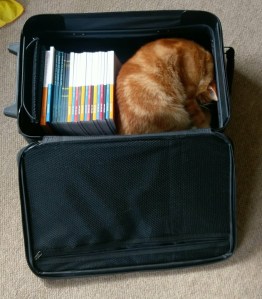
… when I thought to check my ticket. And discovered I had check-in baggage for the flight to Helsinki, but not for the flight from Helsinki. Oops. I suppose I could have contacted Finnair and asked them to add check-in baggage to my flight home, but I suspect they’d have charged for the privilege. And no, I wasn’t intending to smuggle Oscar into Finland. Anyway, I put the suitcase away, and took my usual cabin baggage. And it’s just as well – I saw someone tweet the day after Worldcon75 that they’d not had check-in baggage on a ticket to Copenhagen and had been charged €200 for their suitcases.

The trip to Helsinki was uneventful: train to Manchester Airport, a ninety-minute wait until I boarded the aircraft, a Finnair 100-seater Embraer 190. There was no one I knew on the flight, although two female passengers were clearly heading to Worldcon75 as one of them was wearing a T-shirt advertising the con. After two and a half hours in the air, I landed at Helsinki-Vantaa Airport, passed quickly through the electronic passport control gates – I must look a lot like my passport photo as the gate took less than a second to admit me – and then walked what felt like kilometres to find the railway station.

The train which runs from Helsinki-Vantaa to Helsinki päärautatieasema (central railway station) runs on a loop, so it’s impossible to catch the wrong train. And the train is a lovely modern one, with plenty of space, and very quiet. There are flat screens which announce each station, and display the route, in Finnish, Swedish and English. My hotel for the duration of the convention was the Sokos Vaakuna, which is sited just across the road from the central railway station. I’d picked it because of its location and because the website described it as having a “functional design”. This latter proved to be something that looked like it belonged in 1970s Soviet Russia. I loved it.

After checking in, and having a quick shower, I caught the train – the same one which ran to the airport and back – to Pasila, the first stop on the line. It took five minutes (and cost 5 euros). From the station, it was a short walk, across a dual carriageway and halfway down a block to the entrance to Messukeskus, the convention centre where Worldcon75 was taking place. Even though I had landed at 3 pm, I was at the convention for 5 pm.

After registering, I decided to look for the dealers room, but went downstairs instead of up the ramp… and immediately spotted Tony Ballantyne and Chris Beckett enjoying a coffee at the café on the downstairs concourse. So I joined them…

And that was sort of how it went for the entire con: bumping into people I knew, in between arranging to meet up with people I knew. I remember saying that if there were 6,000 people at Worldcon75, and I could lay claim to knowing perhaps ten percent of them… I’d probably still keep on bumping into the same thirty or so people.

I later met up with Tobias Bodlund, who had his young son in tow, and the three of us headed into Helsinki for food. The convention pack included a restaurant guide, and from it we picked Zetor, which served Russian/Finnish agrarian food (or so said the guide). It was also apparently owned by a member of the Leningrad Cowboys. That no doubt explained the tractors and the stuffed cow. I recognised about a quarter of the people in the restaurant, which was a bit odd. I ordered the Karelian stew, which came with gherkins. It was very good. I also love gherkins. Afterward, I went straight back to my hotel and had an early night.

Members of Worldcon75 were given a travelcard for Helsinki, which meant the 5-minute train ride from the central station to Pasila cost me nothing. I don’t know if this is standard practice at worldcons, but it should be. I had one programme item on Thursday: Secrets in science fiction and fantasy. To be honest, I’ve no idea why I was picked for it. And after meeting my fellow panellists – Jane Anne McLachlan, Jennifer Udden, Kim ten Tusscher and J Sharp – I suspect the topic was someone’s suggestion and they put together a random selection of authors and agents. Jane Anne had prepared several questions, and we spent the panel answering them. I’m not overly keen on doing panels like that as it prevents a free-flowing discussion and can seem stilted. It seemed to go okay. Although someone did fall asleep in the front row. I bumped into Adrian Tchaikovsky, who had been in the audience, and he said he enjoyed it.

I spent the rest of the day sitting outside the Terra Nova Brasserie, which was the bar attached to the Holiday Inn, which was the hotel attached to the Messukeskus. I went for lunch to a nearby Nepalese restaurant, with Barbara, Tobias and his son, and we ran into Lennart there. The food was okay. That evening I headed into Helsinki with Will, Jen and a Finnish friend of theirs, and the Mexican restaurant we had planned to eat in was closed so we ended up in an Australian burger bar, which wasn’t bad. Eating in Helsinki was really good for me – I didn’t have to worry about menus, as they all featured lactose-free dishes. In fact, most menus featured meals that clearly had dairy in them, but were made with lactose-free versions of the dairy products. I’ve found you either eat well at conventions or eat badly. I usually eat badly. At Worldcon75, I ate well.

I returned to the con and stayed until 1:30 am, chatting to friends outside the Terra Nova or hanging out in the Winter Garden, where I met Shaun Duke and Paul Weimer in person for the first time. I ‘d been reliably informed trains to the central railway station ran all night. They don’t. During the week, that is. I got to Pasila station at 1:31 am. The last train left just as I walked up the ramp to the platform. The next train wasn’t until 4:18 am. So I walked back to Messukeskus, and jumped in a taxi. It cost me €18, which was less than I’d been expecting.

On the Friday, I met up with Berit Ellingsen, and we had a coffee in the Fazer Café on the Messukeskus concourse (it was the best of the food/drink venues in the centre). We’ve known each other for several years, but it was the first time we’d met up in person. There was another person at Worldcon75 who’d I only known online and never met IRL – but Michael Martineck and I have been friends for more than 20 years. We first met in an online writing workshop back in the 1990s. I’d gone for a sandwich in Fazer Café with Will Ellwood, while I tried to figure out how get Michael and myself both in the same place at the same time… when I turned round, and saw he was two places behind me in the queue. We spent most of the afternoon sitting outside the Terra Nova.

I’d arrange to go for dinner that evening with Gillian Polack. Tobias was up for it too, so I went off to find Gillian. She was sitting outside Fazer Café, talking to… Michael. “I didn’t know you two knew each other,” I said. They’d apparently met at a programme item, my name had come up in conversation, and they realised they both knew me. So the four of us took the tram into the centre of Helsinki, for dinner at Stone’s Gastro Pub. Which was very good. At one point during the tram ride, a guy came up to us and asked if he could sit with us and listen to our conversation. We said sure. I assumed he was just some random nutter on the bus. Later, I saw him at Worldcon75 – he was an attending member of the con.
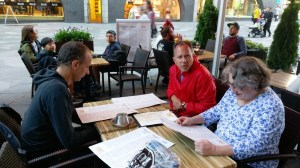
Back at Messukeskus, I stayed until 3 am, caught the train back to the central railway station (they run throughout the night on Friday and Saturday night), and crossed the road to my hotel.

My second panel of the con was at noon on the Saturday, Mighty space fleets of war. When I’d registered at the con, I’d discovered I was moderating the panel, which I hadn’t known. I checked back over the emails I’d been sent by the con’s programming team. Oops. I was the moderator. The other two panellists were Jack Campbell and Chris Gerrib. As we took our seats on the stage, Mary Robinette Kowal was gathering her stuff from the previous panel. I jokingly asked if she wanted to join our panel. And then asked if she’d moderate it. She said she was happy to moderate if we wanted her to, but we decided to muddle through ourselves. The panel went quite well, I thought. We got a bit of disagreement going – well, me versus the other two, both of whom admitted to having been USN in the past. I got a wave of applause for a crack about Brexit, and we managed to stay on topic – realistic space combat – for the entire time. I’d prepared a bunch of notes, but by fifteen minutes in, I’d used up all my points. In future, I’ll take in paper and pencil so I can jot stuff down as other members of the panel speak. After the panel, I met up with Eric Choi, a Canadian sf writer who contributed to Rocket Science back in 2012, and we had a quick chat.

Last year, when I bought my membership to Worldcon75, a friend who lived in Helsinki suggested we meet up for drinks or food. I used to work with Melody Jane about ten years ago. I left the company, she left the country. On the Saturday evening, I returned to my hotel, to meet Melody Jane. No sooner did she arrive, then the heavens opened. Thunder, lightning, the lot. Even strong winds, which caused enough damage to close one of the train lines. We waited inside the hotel for about twenty minutes, but it obviously wasn’t going to stop. So we borrowed umbrellas from the hotel reception, and walked to Farang, an Asian fusion restaurant located in the Kunsthalle Helsinki. The food was excellent, and I had a really good time. After the meal, I headed back to the Messukeskus, and stayed until 3 am. After a thirty minute wait at the station, I returned to my hotel.

I’d been getting into breakfast around 8 am each morning, at the restaurant on the Sokos Vaakuna’s top floor. But for the Sunday, I decided to miss breakfast and have a lie-in. Around lunch-time, I went looking for some modern art museums. Happily, the Kiasma Museum of Contemporary Art was just around the corner from my hotel. Also happily, its collection features lots of video installations. I like video installations. Not all of them worked for me – one or two, the CGI was a bit crude, and they felt no better than Youtube videos. But the ones by Ed Atkins and Cécile B Evans were impressive. I also thought the one by Tuomas A Laitinen was very good. Coincidentally, it was all very science-fictional, with most of the pieces actually either based on science-fictional ideas or set in the future.

For lunch, I popped into the 24-hour supermarket in the basement of my hotel and bought myself a sandwich. After spending ten minutes puzzling out the ingredients in Swedish, I spotted it said lactose-free in both Finnish and Swedish on the front label. And then it was back to the con for last day…

… which ended with the Dead Dog Party. This is a tradition at cons: those staying for another night gather in the hotel bar and have an informal party. Because so many attendees had flown into Helsinki for Worldcon75, a lot of them – myself included – weren’t flying out until the following day. A group of us had planned to head into town for food, but that plan didn’t come together. Then we heard the Dead Dog Party was laying on a tex-mex buffet. We also heard it was packed and people were being turned away. We decided to give it a try, but unfortunately took a wrong turning and it took us three times as long to get the Sokos Pasila, where the party was taking place. So I was not in the best of moods when we arrived. And saw the queue for the bar. And the queue for food. But we joined the line for the buffet anyway. Tobias and I had just reached it – tortillas and taco meat – when it finished. We waited. The chef brought out something that looked a bit like chicken fajita. It was the “vegetarian option”. Quorn or tofu or something. It was vile. I went and asked for my money back. I also persuaded the others – Tobias, Michael and Ian McDonald – to try the bar we’d spotted opposite the hotel, the Ravintola Windsor. Ian bowed out, but we were joined by Stephen Vessels. We went there, it was quiet, we got beer, and we got food (I had kebab and chips, it was very nice).

After we’d finished our food, Michael and Stephen left. Then Tobias left, so I headed back to the Dead Dog Party. I chatted to Liam Proven for a bit, and the people he was with – one told me they’d overheard an American complain during the Closing Ceremony that the con had been “too Eurocentric”. By midnight, I was ready to head back to my hotel – the last train was at 12:30. But then I bumped into Sanna Bo Claumarch, a Danish fan, and joined her and Fia Karlsson and some young Swedish and Finnish fans, and ended up staying until 2 am. To get back to my hotel, I shared a taxi with Liam and a Finnish fan.

Will and Jenny were on the same flight as me back to Manchester, so we agreed to catch the train to the airport together. But by the time I’d checked out of my hotel, I couldn’t be bothered to hang around for another couple of hours, so I caught the train on my own, checked in, and waited in the airport for them. And for Tobias, whose flight to Stockholm was around the same time as our flight to the UK. And then, when I boarded the plane – another Finnair Embraer 190 – I discovered I was sitting next to Fran and John Dowd.

The trip to Finland finished in a nicely surreal fashion on the train from Manchester Airport, when the PA first insisted the train was heading to Manchester Airport, where it would terminate, and then repeatedly told us the next stop was Batley, despite the train going nowhere near Batley.

I had a great time at Worldcon75, met some really nice interesting people – not all of which I’ve named here, but also includes John-Henri, Daniel, Bellis, Edward, Jo Lindsay, Hal (Al), Ian W (there was a plan on the Sunday to get the four Ian writers together for a photo, but it never happened – perhaps it’s just as well as it may have caused a singularity or something), Hanna, (the) Anders, Johan, Brian, Jukka, Luke, Emil, Thomas, Christina, Jeremy, Kristin and Erik, and apologies if I’ve forgotten anyone – from a variety of countries (mostly Sweden, the UK and Finland, but also the US, Canada, France, Austria, Ireland, Australia, Poland…). True, I spent most of the four and a bit days sitting outside the Terra Nova, drinking beer and socialising with friends (in fact, the con drank the bar dry of beer several times.) As is usual for me, I went to no programme items – not even the Hugo Awards, and I couldn’t get into the Closing Ceremony – but I did wander around the dealers room a number of times. In the end, I bought a single book – a first edition of John Varley’s Titan for 10 euros (bargain!) – so I wouldn’t have needed my suitcase, after all.

Jukke Halme and his team can definitely be proud of the convention they put together. There were a few problems initially, as twice as many people had turned up as had been originally planned for, but the issues were quickly resolved. I’d certainly put Worldcon75 in my top five cons I’ve attended – and I’ve been going to science fiction conventions since 1989. And I loved Helsinki, it’s a great city. I wish I’d seen more of it, but I’d had to limit my time in Finland because dayjob. I want to go back.

And that was my worldcon.

Leave a comment

Hello Helsinki

Next week, I’ll be attending the 75th Worldcon, taking place in Helsinki, Finland. It’ll be my first visit to Helsinki, but my second to Finland – I was at Archipelacon in Mariehamn, in 2015 – see here. I’m looking forward to it. Not just visiting the city, or attending the convention, but also meeting up with friends, some of whom I’ve never actually met in IRL. I’ll be on two panels at Worldcon75:

Thursday 10 Aug @ 15:00 (101d)
The Role of Secrets in Speculative Fiction, with JA MacLachlan, Jennifer Udden, Kim ten Usscher and J Sharpe
Obviously, I can’t tell you what this one is about…

Saturday 12 Aug @ 12:00 (101a&b)
Mighty Space Fleets of War, with Jack Campbell and Chris Gerrib
The title says it all.

Other than that, I’ll be knocking about the venue, the Messukeskus, or in one of the con bars (which I think are in the Holiday Inn, the on-site hotel). Or maybe off wandering somewhere.

The last – and only – Worldcon I attended was in 2005 in Glasgow. It used a “voodoo board”, where people could pin up messages arranging meet-ups. It was not especially effective. Happily, these days we have smartphones, free wifi and social media. So I’ll be extremely disappointed if I don’t manage to catch up with the people I know who are also going.


8 Comments

Onwards to Uppsala

The weekend of 26 to 28 May saw me in Uppsala, Sweden, for Kontur 2017, this year’s Swecon. The Guests of Honour were Ann Leckie, Kameron Hurley and Siri Pettersen. It was my third Swecon and my fourth Nordic con. And, I fervently hope, not my last of either. I’d previously attended two Swecons in Stockholm, but since Uppsala is pretty close to Arlanda Airport, closer than Stockholm in fact, and it sounded like a really nice town, I signed up for Kontur.

In Manchester Airport, I bumped into Luke Smith, who was also on his way to Uppsala. It turned out we were on the same flight to Sweden. And the same flight back. We hung out together until our flight was called, and then met up once we’d landed in Sweden. After making our way through immigration and customs, we headed for Sky City and the airport’s main train station. Neither of us had travelled on the Swedish railways before (I’d used the Arlanda Express on my previous visits), which proved our undoing. I bought a ticket from a machine, Luke bought his from the counter. We went down to the platform. A SJ train pulled in. Luke’s ticket, it transpired, wasn’t valid on it, but mine was. But mine wouldn’t be valid on the next train, which Luke could catch as he had a UL ticket. So we ended up travelling to Uppsala on separate trains…

Kontur 2017 took place in the Clarion Hotel Gillet on Dragarbrunnsgatan, right in the centre of town and about a ten-minute walk from the railway station. We arrived there just after two pm, which made it about ten hours (taking into account the hour’s time difference) of travelling door-to-door. Not too bad. It takes about six hours from Sheffield to Glasgow. After checking in, I showered and changed, and then headed down to the first floor, where the convention was due to take place. The conference facilities at the Clarion Hotel Gillet are laid out in an L-shape, with a large bar area occupying the angle. Unfortunately, it had no comfy chairs for chilling out, only stools and chest-high tables. Programme items took place in rooms along both arms of the L. There was also a dealers’ room, containing some Swedish small presses and a woman who made fancy dragons out of paper; a room for the Alvarfonden, which sells secondhand UK and US books; and a games room.

At previous Swecons, I’d attended far more programme items than I typically do at conventions. In part, I think that was because of the venue, the Dieselverkstaden, which didn’t really have an area where you can just hang out (Swecon 2018 is back there, by the way). The bar at Kontur, however, because everyone had to pass through it from one wing to the other, was good for socialising. So I actually only made two programme items… and those were the ones I was moderating. Oh, and I went to the closing ceremony as well.

Both of my panels were on the Saturday. The first was “Make Art not War: Sentience and Narrative in science fiction”, with Ann Leckie, Karolina Fedyk and Markku Soikkeli. I thought the panel went quite well, even if it was my first go at moderating. Ann talked about Ancillary Justice, of course, Karolina is a neuroscientist and spoke about neuroaesthetics , and Markku mentioned the AI in Gibson’s Sprawl trilogy which makes art out of found objects. My second panel was “Environmentalism and science fiction”, with, once again, Markku, plus Christin Ljungvist and Saara Henriksson. (Markku, incidentally, moderated the one panel I was on at Swecon 2016.) This panel didn’t go as well as the other one. I’d done my research, so I knew what the other panellists had written, even if it was only available in Swedish or Finnish… But environmentalism is a subject I know little about – enough to be dangerous, I suppose… We asked the audience for examples of environmentalist sf, and ended up writing twenty or so titles up on the whiteboard, but the discussion jumped about a bit without reaching any sort of point. I asked a member of the audience afterwards if he’d thought it was any good. “No,” he said. So much for my second attempt at moderating a panel…

I like city centre conventions because you don’t have to be confined to the hotel. And Kontur was slap bang in the middle of Uppsala. On the Friday night, a group of us went to a Lebanese restaurant beside the river for dinner. Anders also took me to a nearby Irish pub to try one of their beers. And on the Saturday night, Steve Savile dropped into the con as he lives in a nearby town, as did George Berger, who lives in Uppsala, so half a dozen of us went to Bastard Burger (yes, really) for dinner, which was just down the street from the hotel. There was also a supermarket in a shopping centre next to the hotel, where I could buy dairy-free sandwiches (as the hotel bar didn’t have any).

Later that night, Jukke Halme staged his famous quiz, although this time the format was slightly different. Three contestants were volunteered, and each had to answer a number of questions in three rounds: Call My Bluff, a fan version of Jeopardy, and Charades. The questions were, of course, fiendishly difficult, especially the “Fanopardy” round on a past Swecon (only three people knew the answers to the questions: one of them was Jukka, the other two were in the audience). After the quiz, I joined people downstairs in the hotel’s main bar, and stayed there until closing time.

On the Sunday, Tobias, with his son in tow, showed me around Uppsala. We drove out to Gamla Uppsala, which is pretty much just a small museum, five huge barrows, a small cafe and a church. We’d planned to eat in the cafe, but they had nothing I could eat. So we walked up to the top of one of the barrows, where we had a good view of the surrounding countryside. We popped into the gift shop in the museum, where I saw some bottles of mead – but it was alcohol-free, disappointingly. Tobias suggested getting some food from a supermarket and then having a picnic at Uppsala castle. So that’s what we did. We sat in the gardens, looking over the Botanical Garden.

Back at the hotel, we made the closing ceremony, and then people began drifting across to the Bishop’s Arms, where the dead dog party was being held. The Bishop’s Arms is an “English pub”, although more like the sort of English pub you’d find in Dubai than Durham. It was so committed to the theme, it even played Manic Street Preachers over the PA in the toilets. The beers on offer were very good, although most were considerably stronger than I’m used to. As the evening progressed, people drifted away to catch their trains, but there were still quite a few of us left when the bar closed around eleven o’clock. We headed into the town centre, but couldn’t find anywhere still open. Fortunately, it turns out Swedish hotels sell bottles of beer (and wine) at the reception desk after the bars have closed. So we hung around in the hotel lobby, drinking, for another hour or so.

After our lack of success with the trains on the Friday, Luke and I were determined to get it right for the trip from Uppsala to Arlanda Airport. We failed. We bought our tickets from the same machine, so we were definitely going to be on the same train… but we should have looked which train was departing for the airport first and bought tickets for it. We had to wait over an hour for a SJ train…

The trip home was uneventful – other than me leaving the book I was reading on the plane by accident, although, to be honest, I was more annoyed about losing the 100 Yugoslavian Dinar banknote I was using as a bookmark than the book itself. My plane was supposed to land five minutes before the hourly train from Manchester Airport to Sheffield, which obviously I could never have caught, but the landing was delayed by twenty minutes, and then there was a massive queue in Immigration, and I missed the next one, so had to wait an hour for the one after that. The worst part of every journey abroad is the final leg home from the airport by rail. There is only one train an hour from the UK’s third busiest airport (and the busiest outside London) to the country’s sixth largest city, and they’re only seventy kilometres apart! British railways are shit, and it’s all due to privatisation. In virtually every case in this country where nationalised industries have been privatised, the privatised service or utility has proven much worse. Privatisation doesn’t work. But the Tories push it because it’s a way for them, and those who own the Conservative Party and its MPs, to make more money. It’s a form of theft.

Anyway, Kontur… was an excellent convention. My first tries at moderating panels weren’t entirely successful, but never mind. Hopefully, I’ll have further opportunities to improve. I had a great time chatting with friends, and making new ones. I met up with some people I’d known only online in person for the first time – hi, George. If I name everyone I spoke to or hung round with over the weekend, I’d probably miss someone out. But certainly Sunday night and Monday morning were spent saying, “See you in Helsinki!” to a lot of people. Swedish fandom reminds me of why I joined fandom in the first place – there’s a similar atmosphere to the UK cons I remember from the early 1990s. Okay, so people don’t actually talk about genre all the time, at least not in the bar, but there’s a genuine sense of community, and an international community, which British cons no longer seem to have. I don’t think that’s due to the fact Swecon is typical three to four times smaller than a UK Eastercon, so perhaps it’s simply because of the way Swedish fandom works – and how it integrates with Nordic fandom.

I only bought three books, and they were from the Alvarfonden – Her Pilgrim Soul, The Birth of the People’s Republic of Antarctica and The Final Circle of Paradise. I didn’t want to buy too many, not just because I’d have to carry them back in cabin baggage (memo to self: remember to take a suitcase to go in the hold for Worldcon75, so I don’t have to worry about buying too many books), but also because I’d bought too many books in May already.

Finally, I leave you with a photo I took in the abovementioned supermarket. It shows an entire aisle filled with varieties of crispbread. Välkommen till sverige!


Leave a comment

The con with no name

Actually, it did have a name, Innominate, but since that means “not named or classified”… The con in question was, of course, 2017’s annual Eastercon, which took place at the Hilton Metropole Hotel at the National Exhibition Centre near Birmingham International Airport over the Easter weekend. Hence, er, the Eastercon. Innominate was the sixty-eighth such to take place, and was actually a rescue bid – the Eastercon was originally supposed to be in Cardiff. The Guests of Honour were Pat Cadigan, Judith Clute and Colin Harris, two of which were at least names known to me.

My first Eastercon was way back in 1990, although I missed several during the mid-1990s, and actually dropped out of fandom when I returned to the UK in 2002 until I was persuaded to attend the Worldcon in Glasgow in 2005. Innominate was my fifteenth Eastercon, and my sixty-first convention; it was also my second visit to the Hilton Metropole Hotel, since the 2011 Eastercon also took place there.

In the past, I’ve tended to turn up to Eastercons around 4 pm on the Friday, but they seem to start earlier these days, and I was actually supposed to be on a panel at 4 pm on the Friday, so I bought a train ticket to get me to Birmingham International by about 1 pm. As it was, the panel was cancelled several days earlier after three of its members pulled out for various reasons. It was on the short fiction categories for this year’s Hugo Awards – not a subject you’d think I’d be a natural fit for, but never mind. Unfortunately, it was cancelled after I’d made an effort to read the nominated short stories. Which I did not like (and I didn’t even bother reading the JCW, as its shiteness was a given). I’d still like to read a couple of novelettes, as there are at least two authors on the shortlist whose fiction I admire, but I can’t say any of the nominated novellas appeal (the irony, from the man who thinks the novelette category should be napalmed).

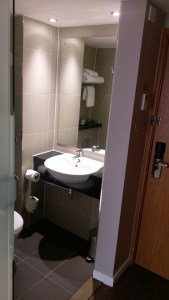
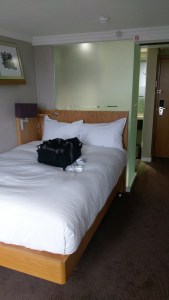
The Hilton Metropole is a deeply weird hotel. I am pretty sure I had to pass through a mirror to reach my hotel room, which was located some ten minutes’ walk away from the reception and main con bar. It was a very nice room, although the en suite had no door and the shower cubicle resembled a telephone box. The television also had only a dozen or so channels, and I found myself somewhat freaked out on the Saturday morning after watching five minutes of Made in Chelsea as I hadn’t realised such vacuous human beings actually existed.

Anyway, after a typically bad train journey on a CrossCountry train to Birmingham, and then a march through the NEC – which has improved considerably since 2011 – from the station to the hotel, I checked in. And was told I’d reserved four nights. This will prove important later. Since Birmingham is only an hour and bit by train from where I live, I’d planned to travel home on the Monday evening. So, no need to book Monday night. And I’m not sure why I did. But cancelling it was easy – at least, it was a lot easier than accidentally booking a night too few, as I did in Mariehamn at Archipelacon…

In the bar, I met up with Will and Jen… And that’s pretty much how the con went: time spent in the bar, chatting with friends, interspersed with expeditions to the dealers’ room, or trips up to my room. The food was generally good, if expensive. There was a real ale bar serving four ales from Purity, at £5 a pint, which I mostly drank, to the extent I think I’d over-hopped myself by Sunday night.

I spent most of my time with the aforementioned Will and Jen, but also Karen and Ewan, and Andy Knighton. Karen is perhaps better known as KT Davies, the author of, among other titles, the very good Breed, and her mention of a sequel led to a series of suggested titles, from Breed 2: The Breedening to the somewhat dubious Breed 2: Breed Harder to the downright nasty Breed 2: A Good Day to Breed. (Only two of those were mine.)

I also spoke to a number of other people, friends and strangers, many for shorter periods than I’d have liked. I was introduced to Pat Cadigan, who I don’t think I’d ever met before, by Dave Hutchinson, and she immediately started calling me “Sales”, which I think is good. I called Dave’s BSFA Award win for Europe in Winter correct, and it was well-deserved. It was, in fact, a good set of winners all-round.

I spoke to Swedish and Finnish fans, most of whom I knew, and even introduced myself to someone I thought was a new fan (from the UK), only for her to admit she followed me on Twitter. (So it’s not all bots, then. Phew.)

On the Sunday evening, I was on a second panel, Optimism in SF. I mentioned this to Kari Sperring that morning at breakfast and she actually choked on her coffee. In the event, I thought the panel went quite well and I only managed one “… I had a point to make but now I can’t remember what it is”. And if at least one person reads Dhalgren or Jenny Erpenbeck’s The End of Days as a consequence of the panel then job done.

The hotel continued to be weird throughout the weekend. If its mind-bending layout were not enough, one morning I stepped into the lift and there was someone already there despite my room being on the top floor. The lift also start giving me electric shocks whenever I pressed the call button. Which was not fun. On the Saturday night, the most desperate survivors of two boybands, Westlife and Boyzone, apparently performed in the hotel ballroom as Boyzlife… so the hotel was filled thirtysomething women trying desperately hard to recapture their teen salad days. It was a little surreal – even more so than the OAPs who filled the Grand Hotel in Scarborough during last year’s Fantasycon.

I bought a dozen books, which is slightly more than in recent years – the dealers’ room was much better than last year’s – although not all of them were by female sf authors, or indeed on the wants list. In fact, I don’t think any were from the wants list. Ah well.

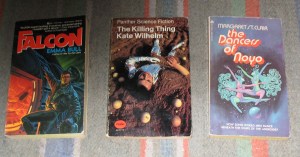
Three for SF Mistressworks. I’ve been after Falcon for a while. I think it’s Bull’s only sf novel. The Killing Thing I bought more for the cover, and because it’s a Kate Wilhelm novel, than because of the story. And I definitely bought The Dancers of Noyo because of the cover, although I’ve read St Clair before.

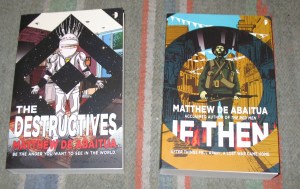
I’ve seen If Then and The Destructives recommended several times by Nina Allan, so I thought I’d give them a go. The author was apparently at the con, but I never bumped into him – not that I know what he looks like…

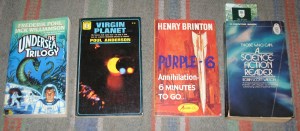
Some random old sf. The Undersea Trilogy – an omnibus of three 1950s juveniles, Undersea Quest, Undersea Fleet and Undersea City – is on my list of sf set at the bottom of the ocean. I bought Virgin Planet because I have the Beacon edition of the book (ie, the “spiced up” edition) and I want to compare it to the original. I just liked the cover of Purple-6. And Those Who Can: A Science Fiction Reader looked interesting: it contains stories by a bunch of well-known names, followed by an essay by them on an aspect of writing as it relates to the story. And it’s a surprisingly good bunch of names: not just the usual ones like Silverberg, Pohl, Ellison, Knight, but also Delany, Russ, Wilhelm and Le Guin. I’m currently reading it, as can be seen from the bookmark.

I left the con on Monday morning, after giving breakfast a miss. I’d been up late the night before with some Gollancz authors, and when asked if I was a writer, got to use the line, “Yes, an award-winning one in fact.” All three nights were pretty late, but only the first one was bad as I’d eaten little during the day. Although the food and drink was expensive in the hotel, I still managed to spend roughly as much as I usually do at Eastercons. The journey home was surprisingly good – the train from Birmingham was a CrossCountry one, and the platform was very busy, but I actually managed to get a seat on it. Yes, really. In fact, the carriage I was in didn’t look at all busy, even though CrossCountry had done their usual and only made up the train from four carriages. I was home by lunch-time, and as soon as Oscar saw me he ran into his room and stared pointedly at his empty food bowl. I didn’t get a telling-off this time, however.

Innominate felt more like a relaxacon than other Eastercons I’ve attended. Which was a good thing. There were people I wanted to speak to, but never managed to. There were people I know that I saw across the room but never managed to say hello to. But I enjoyed myself, and I came away from Birmingham with the feeling that UK fandom is still in good health.