It Doesn't Have To Be Right…

… it just has to sound plausible


2 Comments

Jupiter Rising

Issue 33: Euanthe of Jupiter has now been published. If you have a Kindle, you can buy it right this very second from here. If you’d prefer hard copy, then buy it from here. And the reason you should buy a copy? Because it contains my death metal science fiction story, ‘Words Beyond the Veil’.

Alastair Reynolds claims his ‘At Budokan’, published in Jetse de Vries’ Shine anthology, is the first ever death metal science fiction story. But does it quote the lyrics from a real death metal album, eh? Mine does – in fact, it quotes extensively from Worlds Beyond the Veil by Mithras. So I think that makes mine the first true death metal science fiction story.


1 Comment

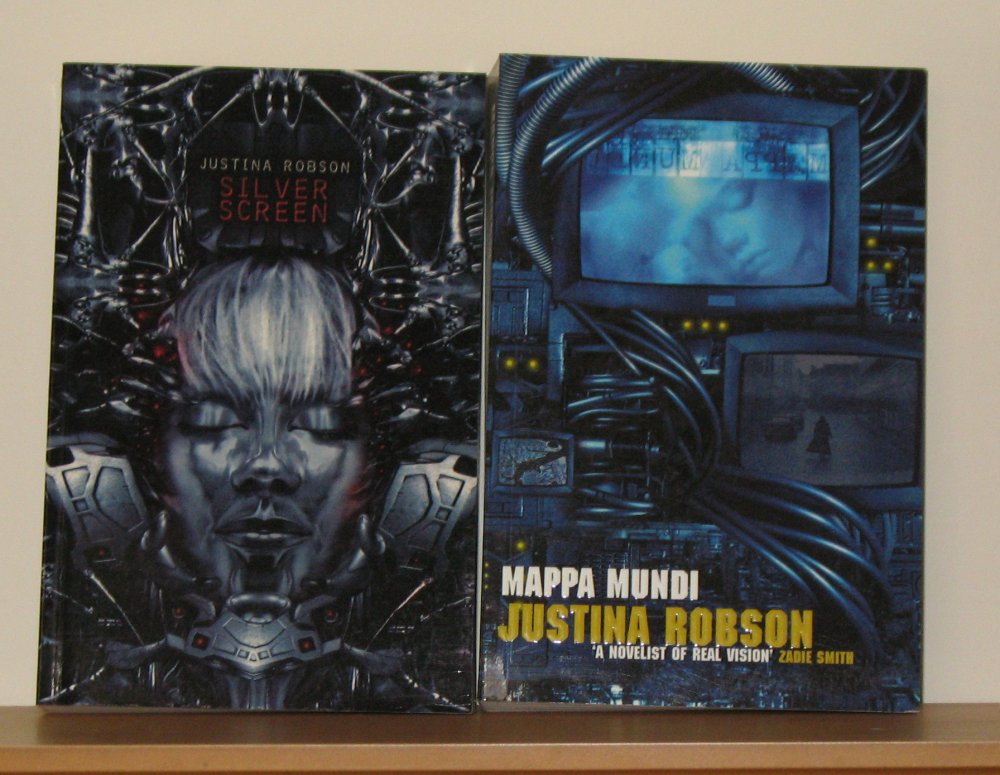
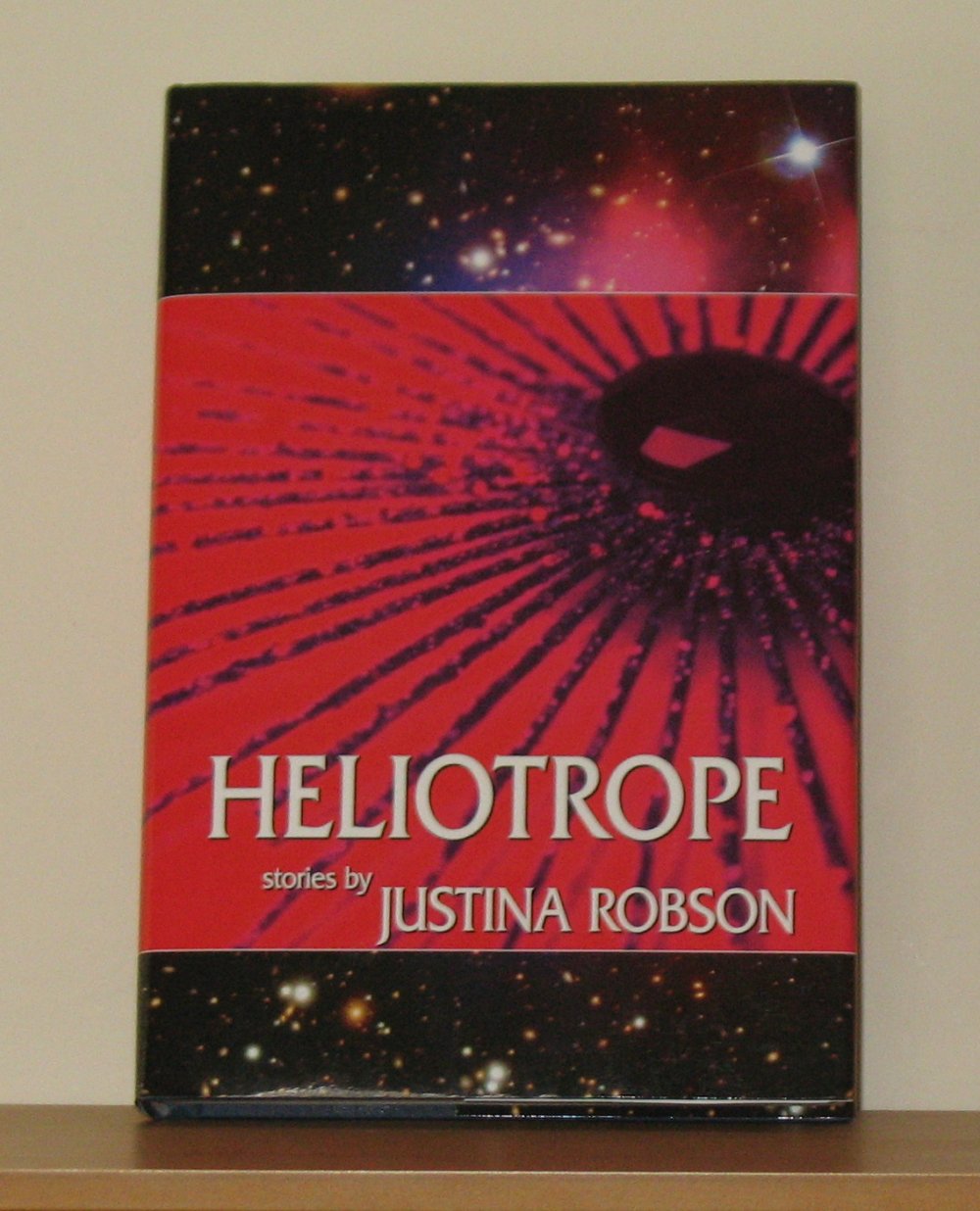
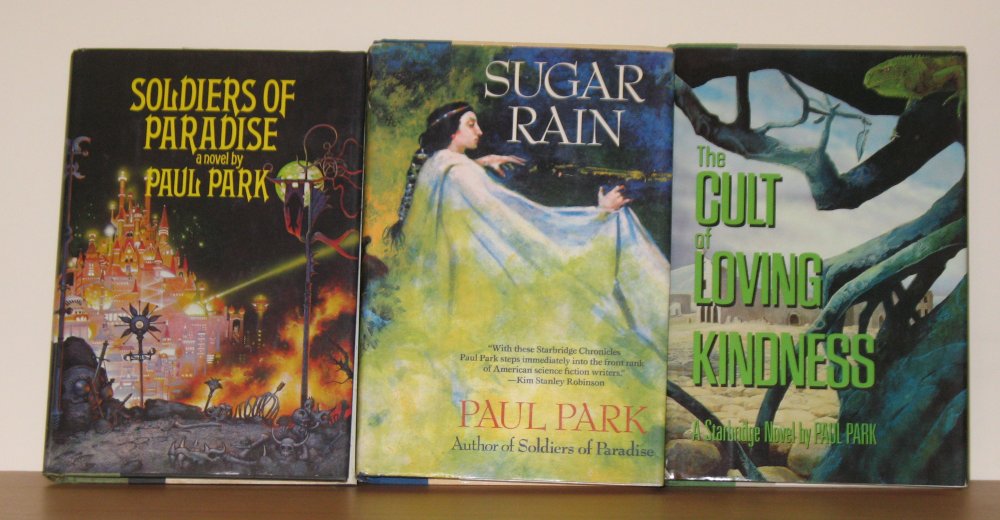
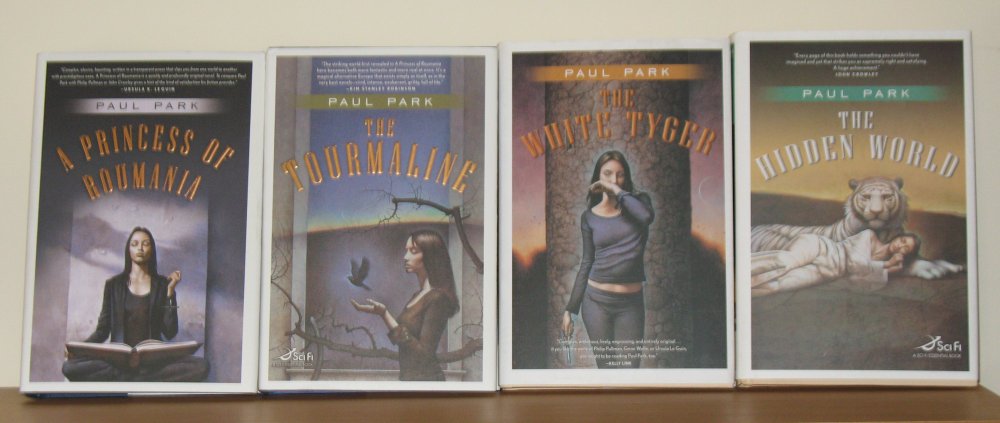
Books from my collection: Park and Robson

Back in the 1990s I was in a BSFA Orbiter with Justina Robson, so when her first novel was published I bought it. I’d already seen some of its chapters, so I knew it was good. I continued to buy Justina’s novels because I know she’s an excellent writer and she rarely disappoints.

Paul Park became one of my favourite authors after I read Coelestis – which remains a favourite sf novel to this day (see here). I subsequently tracked down copies of his debut trilogy, The Starbridge Chronicles, and then his small press novels. When the Princess of Roumania quartet was announced, I was a little disappointed that he had turned to fantasy, and what appeared to be YA fantasy at that. But I bought the books, read them – and they’re not YA, they’re actually one of the best fantasy series of this century.

Silver Screen and Mappa Mundi. Both were shortlisted for the Arthur C Clarke Award, which is a pretty damn impressive achievement.

Natural History and its loose sequel Living Next Door to the God of Love. Though I’d have said Natural History was a better novel than Silver Screen or Mappa Mundi, it wasn’t shortlisted for the Clarke. It did make the shortlist for the BSFA Award, however; as did Living Next Door to the God of Love.

The Quantum Gravity, or Lila Black, quintet – Keeping It Real, Selling Out, Down to the Bone, Going Under and Chasing the Dragon. I plan to read all five some time this summer as a reading project. Watch this space.

Justina’s only collection to date, Heliotrope, was published by Australian small press Ticonderoga to celebrate her appearance as GoH at the Australian National SF Convention in Perth this year. It’s a shame that one of the UK’s best sf writer’s only collection has to be published on the other side of the planet. My edition is the signed and numbered edition. Adam Roberts wrote the introduction.

The Starbridge Chronicles: Soldiers of Paradise, Sugar Rain and The Cult of Loving Kindness. There is a SFBC omnibus edition of the first two books, The Sugar Festival, which I’ve not seen. The trilogy is set on a world which, like Aldiss’ Helliconia, has seasons which are generations long.

The US and UK editions of Coelestis. The UK edition predates the US one by two years. Not sure why I have both. As I recall, the only first edition I could initially find was the US one, so I bought it. But at the 2005 Worldcon I found a copy of the UK edition, which I bought so Paul Park could sign for me. Which he did.

No Traveller Returns is a novella from PS Publishing. Park has another due late this year, Ghost Doing the Orange Dance (originally published in F&SF in February last year). If Lions Could Speak is a short story collection. The Gospel of Corax describes the life of an alternate theosophical Jesus. Three Marys is also set in Biblical Palestine. Perversely, copies of these three small press books appear to be more readily available than those of the Starbridge Chronicles.

A Princess of Roumania, The Tourmaline, The White Tyger and The Hidden World are one of the best fantasy series I’ve read in recent years.


16 Comments

Is a lack of realism good for science fiction?

At the back of mainstream novels, you will sometimes find a list of “sources”, i.e., the books the author used as research for the novel. This has never been common practice in science fiction, though you’ld think the genre requires so much more research than mainstream fiction. It’s not just the science, but also that the real world the readers know and understand is rarely used as a setting. So there’s a wealth of additional information the writer needs to get across. And few sf authors are working scientists, astronauts or, well, aliens.

In fact, the only astronauts to write sf set in space were Edward Gibson (Reach, 1989; In the Wrong Hands, 1992) and Buzz Aldrin (Encounter with Tiber, 1996; The Return, 2000; both with John Barnes). Scott Carpenter’s two novels (Steel Albatross, 1991; Deep Flight, 1994) are underwater techno-thrillers, and are based upon Carpenter’s post-NASA oceanographic career. Also relevant is Robert Zubrin, founder of the Mars Society, who wrote a sf novel (First Landing, 2001) about the first colony on Mars.

This doesn’t mean there are no sf authors who research, or no sf authors who list sources at the backs of their novels. However, I suspect the general aversion to info-dumping in sf also extends to authors demonstrating – or proving – that they have performed any research. Perhaps they consider the presence of its “fruits” in the story evidence enough – certainly, there’s a level of authority and realism evident in prose that contains proper research. Kim Stanley Robinson considers “exposition just another form of narrative” – and is one of the few sf authors to list sources, or give a bibliography, at the end of his novels. He also writes very realistic science fiction. His Mars trilogy is considered one of the best hard sf series of all time, and notable for its realistic depiction of the initial colonisation of Mars. In his words,

And in science fiction, you need some science sometimes; and science is expository; and so science fiction without exposition is like science fiction without science, and we have a lot of that, but it’s not good. So the word “infodump” is like a red flag to me, it’s a Thought Police command saying “Dumb it down, quit talking about the world, people don’t have attention spans, blah blah blah.” No. I say, go read Moby Dick, Dostoevsky Garcia Marquez, Jameson, Bakhtin, Joyce, Sterne — learn a little bit about what fiction can do and come back to me when you’re done. (From Outspoken Authors: The Lucky Strike)

While it’s true that some subgenres of sf demand more research than others that doesn’t mean some get a free pass. Space opera is a very unrealistic form of science fiction. It could be argued it doesn’t need to be, but I disagree. The Milky Way is not the Wild West, and any story which treats it as such is doing itself, and its readers, a disservice. Having said that, space opera is a very popular subgenre and, to many non-fans, it is emblematic of all science fiction. As a result, they see sf as an unrealistic mode of fiction, one which fails to address realistic concerns.

I sometimes wonder if sf’s frequent lack of realism is a result of writers during the early decades of the genre failing to recognise – or deliberately rejecting – their own amateurism. They would dream up neat ideas, and write stories about them, without actually bothering to build anything like a realistic or plausible world in which to explore their idea. The central conceit was all; it was the only thing which needed to be phrased plausibly. The writers may have been experts in the real world – or as much as any of us are experts  – but the setting of their story was invented so that knowledge was of little use.

Of course, it’s also true that on those days sf writers could blithely make something up and the chances of them being called on it were remote. Perhaps there might be an irate letter in the magazine a month or two later. These days, any reader can look something up online, and make their opinion known on Twitter, Facebook, blogs, forums, etc. There’s no excuse for getting it wrong now – those tools are just as available to the writer as they are the reader (though you would hope the writer would go the extra mile).

Looking at much sf written today, it seems to me it is turning more fantastical. No effort is made to explain the ideas used in a story, no effort is made to make them appear feasible or plausible. Why then are they sf and not fantasy? They may be stories written in a science fiction mode, but they are entirely unrealistic. That may be one way to offset criticism. If everything in a story is entirely made-up – in the purest sense of the term – then readers can’t object to any inaccuracy. But is that tactic necessarily a good thing?

To me, sf is about ordinary people doing extraordinary things in extraordinary settings. Yet the genre has featured a lot of extraordinary people doing extraordinary things in extraordinary settings. You can understand why the latter would appeal to adolescents – they all want to be special snowflake heroes and succeed in changing the world. (High fantasy is also full of protagonists such as these.) But the real world, and most invented worlds, are populated chiefly by ordinary people. Not by super-brainy scientists or manly bullet-chewing marines or super-competent alpha males. Ordinary people, of all genders, races, cultures, religions, sexual identities, etc, etc. When you have the whole universe to play with, why limit diversity? It makes no sense.

But then, sf has never been an observational genre, and has never really known how to meld the quotidian with the fantastic. The opposite, in fact: it deliberately eschews the quotidian, it revels in the fantastic. It lacks realism. I can understand the desire to exclude realism in some subgenres, I can even see how many readers would prefer non-realistic – escapist, immersive – stories. But I don’t think that’s the only way to do it, and I suspect it does little good to the genre’s reputation to produce only those.


16 Comments

Boxing, bugs, bounty hunters and bismillah: God’s War

When Kameron Hurley’s God’s War was published earlier this year, I took note of it, as I generally do of sf novels which feature Arabs or Arab-inspired backgrounds. I checked out the book’s website, and even read the first chapter, which was posted online. But I didn’t see anything there that made me want to buy and read the book immediately. At some point, yes, I’d probably pick up a copy, but nothing I saw encouraged me to do so there and then.

A few weeks later, Niall Harrison tweeted that God’s War was one of the best books published this year he’d read so far. He described it as “Gwyneth Jones meets Richard Morgan” – or words to that effect. And so, after a bit more conversation on Twitter, a group of people all bought copies at his urging. I was one of them.

I have now read God’s War.

Nyxnissa is a “bel dame” on the world of Umayma, which means she is a government assassin charged with killing deserters from the army. Because Nasheen has been at war with neighbouring state Chenja for generations – so long, in fact, that no one is really sure what they are fighting over. All Nasheenian men must fight at the front, and many women also volunteer. The end result of this is a female-dominated society at home, much like Britain during World War II.

But Nasheen is also an Islamic state – or rather, its state religion is one which appears to be descended from Islam. The Nasheenians have mosques and a holy book called the Kitab (which is Arabic for “book”; and, in Islam, members of the Abrahamic religions are known as “People of the Book”). There are further clues in the names of people and places – although a reference to the Kitab being written in a “the ancient language of prayer” (p 91) suggests that the Nasheenian language is not true Arabic. This may explain why some of the female characters have male names, such as Bashir, Husayn or Zubair. Or indeed why some of the place-names don’t entirely convince as Arabic – Chenja, for example: Arabic has no “ch” phoneme. And also Ras Tieg, another nation on Umayma: Arabic has a “j”, though it is pronounced as “g” in Egypt. (None of the nations’ name are entirely parsable either – ﻧﺶﺀ (nash) means “youth”, and -een could be the dual ending; Ras Tieg – ﺭﺍﺱ (ras) is “head” or “headland” but I can’t find anything close to “tieg”. But perhaps the names are not intended to mean anything.)

As muslims, the Nasheenians are moderates – possibly unsurprising, given that the society is matriarchal. Many of the teachings seem to be ignored, if not flouted – such as those prohibiting the consumption alcohol (Nyx drinks a lot of whisky during the story). Chenja, however, is far more orthodox. It practices polygamy, and its women wear the veil. One of the other characters, Rhys, is Chenjan, and while Nyx may be lapsed he certainly is not. He speaks a translation of bismillah ar-rahman ar-raheem (p 91), and also recites the ninety-nine names of God (p 80). Nyx further mocks him for “pounding [his] head on the pavement six times a day” (p 78). It is also implied that the Chenjans venerate saints, suggesting perhaps they are Shi’ites to the Nasheenian Sunni muslims. Though, according to Rhys, this cannot be the case as the two nations comprise “… believers from different moons, united in their belief of God and the Prophet and the promise of Umayma. For a thousand years, they had carved out some kind of tentative peace, maneuvered around a hundred holy wars … Chenjans would submit only to God, not his Prophet, let alone any monarch who wanted to sever God and government.” (p 78)

There are other nations on Umayma. The Mhorians, for example, are racially different to the Nasheenians, and are descended from refugees who were given permission to settle on the world hundreds of years earlier. Clues in the text – a reference to Saint Mhari, for example – suggest they may be Christian.

Hurley does an excellent job with her society-building, painting a picture of two nations with different approaches to a shared religion. The way she integrates the religion and its practice into the daily lives of the characters certainly resembles Islam in a way that Christianity does not. It is not, happily, just the mention of mullahs, burqas or the other trappings of Islam or the Arabic world. Having said that, the easy prevalence of acts and attitudes considered haram does render the end result a little less convincing.

Then there’s the technology in God’s War, which is almost entirely insect-based. Vehicles, called bakkies, are powered by a fuel generated by a sealed hive of cockroaches. People called magicians have some sort of unexplainable power over these insects – pheromonal, perhaps? – which allows them to control them. They even use them as, er, bugs – i.e., surveillance devices. Magicians are masters of biotechnology (I think they are all male), and so of advanced medicine too. Not everyone returns from the front in one piece – but the magicians patch them up, often using body parts from those who didn’t make it. Umayma’s sun is also stronger than ours – or the world’s atmosphere is thinner – and skin cancers are prevalent. Biological and chemical weaponry is used extensively in the war between Chenja and Nasheen, which in turn has its effect on the world’s population.

But perhaps the strangest element of God’s War‘s world, and the least convincing to me, is the presence of “shifters”. These are people who can “shift” into other forms – an animal, and each person is, I think, limited to one other form. One character can transform into a dog, another into a dove, and yet another into a raven. How? Where does all that mass go? There’s a hand-wavey mention of “quantum effects”, and it is stated that shifters didn’t start to appear until the various peoples had colonised Umaymi… But. It just feels a bit unnecessary, a bit over-the-top.

Likewise the magicians’ gyms. For reasons not entirely clear, the magicians are fans of boxing. The sport may be a signifier for emancipation in God’s War, given that it is acceptable in Nasheen but underground in Chenja, and popular in both. The gyms are all interconnected, irrespective of the distance between them – as if the magicians had a secret, and instantaneous, travel network. I couldn’t quite work out the reason for this – it only seemed to impact the story peripherally.

The plot of God’s War is complex but also relatively straightforward. Nyx does something she shouldn’t have done, is booted out of the Sisterhood of bel dames and sentenced to prison. When she is released seven years later, she becomes a licenced bounty hunter. She hires a team – magician Rhys (who is a Chenjan deserter), Mhorian shifter Khos, gun-nut Anneke and comms expert Taite. When Queen Zainab hires Nyx and her team to recover an offworlder, Nikodem, who has gone missing, things get complicated very fast. The Sisterhood don’t want her to succeed. She tracks Nikodem to Chenja, which means infiltrating an enemy country. Meanwhile, Nyx’s sister, a biotech scientist, is murdered, and her work somehow seems linked to Nikodem’s disappearance…

God’s War is a brutal book. Nyx is a brutal protagonist. A lot of people are killed or maimed in the story. A lot of people who have been maimed appear in the story. The magicians’ medicine is sufficiently advanced that even the most severe injuries are survivable, although why this should result in such a low value being put on life is beyond me. There is a lot of violence, and it is graphically described. Umayma is dirty, primitive in many respects, and populated by physically and psychologically broken people. God’s War is a bleak novel, with a cast that are not far from being monsters. I think it was this, more than anything else, that made it hard for me to love God’s War. The world-building is superb, Nyx is a well-drawn protagonist, and the plot is pleasingly complex, but I still found it a little too bloodthirsty for my tastes.

I couldn’t quite see the Gwyneth Jones in God’s War, although there are some small similarities with Richard Morgan’s Black Man. I don’t think it’s the best book I’ve read so far this year, though it may prove to be the best book published in 2011 I read this year. I would not be unhappy if it appeared on a few shortlists next year. I will certainly be buying the sequel, Infidel, due to be published in October.

EDIT: I forgot to mention the mention of Deep Blue Something – is Hurley a fan of the group, perhaps? “Nyx pulled her burnous up and followed the dimly lit signs to room tres-bleu-chose.” (p 224)


Leave a comment

Results: Best Science Fiction/Fantasy Books by Women Writers

Back in 21 June, I asked people to nominate their five favourite fantasy or science fiction novels by women writers. And yes, I’m doing what everyone else does in these sorts of polls and conflating “favourite” and “best”. Well, it is a sort of popularity contest type poll…

Anyway, some twenty-nine people left comments. And I have now counted up the results…

Best/Favourite Novel
1 The Left Hand of Darkness, Ursula K Le Guin (7 votes)
2 The Dispossessed, Ursula K Le Guin (4 votes)
3= Ash: A Secret History, Mary Gentle; Howl’s Moving Castle, Diana Wynne Jones; The Handmaid’s Tale, Margaret Atwood; The Many-Coloured Land, Julian May; To Say Nothing of the Dog, Connie Willis; Woman on the Edge of Time, Marge Piercy (3 votes each)

A broad selection tying for third place there, though the first and second positions don’t really come as much of a surprise.

Best/Favourite Writer
1 Ursula K Le Guin (14 votes)
2 CJ Cherryh (7 votes)
3= Diana Wynne Jones, Gwyneth Jones, Joanna Russ, Margaret Atwood, Tricia Sullivan (4 votes each)

Le Guin’s success is not really a surprise. Most of her books are still in print, she consistently appears on best of the genre lists, and she has written highly-regarded sf and fantasy. Cherryh’s books seemed almost ubiquitous during the 1980s and much of the 1990s, but are less visible these days – which is a shame. In total, 58 authors were named.

Books by year

  1810s 2
  1920s 1
  1960s 8
  1970s 21
  1980s 33
  1990s 29
  2000s 21
  2010s 3

This probably says more about the age of those who voted than it does the success of women writers during those particular decades.

Given a wider pool of voters, the results might have looked different. But even so, this poll is as valid as any other genre list you might find on the internet.


4 Comments

Don’t Look Back In Wonder

Andrew Wheeler gives a run-down on the Hugo fiction shortlists here, but it’s some of the comments he makes in passing that I find interesting. He first complains that Peter Watts ‘The Things’ is a “backwards-looking story … which retells a famous old story in a new way” and that “there have been far too many backwards-looking SF stories over the last two decades”. I don’t know about the “far too many” – I suspect Wheeler reads a great deal more sf short fiction than I do (and my reading will be skewed toward UK-produced sf short fiction anyway) – but I don’t recall all that many similar types of stories off the top of my head. Theodora Goss riffed off HG Wells a couple of years ago, I seem to recall. Even so, what’s wrong with approaching old stories in new ways? Science fiction is, after all, a genre in conversation with itself. Doing it too often, yes, can be bad, and I bow to Wheeler’s greater knowledge on whether that point has been reached. But in moderation I think it’s good and perhaps necessary.

Wheeler than goes on to say that Allen Steele’s ‘The Emperor of Mars’ “is the first really egregiously ‘gosh, wasn’t yesterday’s future so much better than ours’ story this year, flattering all of those aging Boomer SF readers who didn’t become the space-station jockeys and planet-hopping businessmen they all thought they’d be when they were twelve”. As far as I can determine, the story is not set in an alternate future – it mentions NASA missions to Mars during the 1990s, and the 2008 Phonenix mission – so if it is playing on a nostalgia for the space programme of the 1960s and 1970s, then it’s only doing so in imagining a renewed interest in crewed space exploration and colonisation in the next few decades. But how does that make it “yesterday’s future”? I can understand that baby boomers (I’m not one myself), who remember the excitement of Apollo, might look for something which harkens back to that in their science fiction. But why is that necessarily a bad thing? Wheeler goes further when discussing James Patrick Kelly’s ‘Plus or Minus’ and says, “monkeys in cans is so 1970”.

Er, what?

Magical spaceships are apparently twenty-first century? A complete absence of technological realism in sf is twenty-first century? Hardly – Edmond Hamilton and EE ‘Doc’ Smith were making up magical sf shit nearly 100 years ago. So what should modern sf be? Why should stories which attempt to treat space exploration and colonisation realistically – which doesn’t automatically mean they’re looking back to Apollo, of course – be bad?

Obviously, I enjoy stories which feature space travel and exploration. And I like stories which treat the topic realistically. Hence Rocket Science. And in my own fiction I’ve done both sorts of “looking back” that Wheeler identifies above: ‘Barker’, for example, re-imagines the first flight of an American into space. It’s retro in as much as it’s a re-examination of the historic flights of Alan B Shepard and Laika. But it’s not riffing off past science fiction, it’s riffing off history. I believe this is a perfectly valid approach to writing science fiction.

Yet any sf argument on the subject of “retro” or “looking back” is going look a bit foolish in the face of one of the genre’s most popular past-times: holding up sixty-year old works as the best sf has to offer. If that’s not “looking back”, then what is? Idolising old and not very good books simply because they’re are what introduced individuals to the genre makes no sense to me. It also seems an odd definition of “good”. Surely re-working those alleged “classics” is a valid artistic response to them? Likewise for reworking old tropes, or even old inspirations.

They say there is nothing new in science fiction anyway – there are no new ideas, only new spins on old ideas. And why limit the tools you can use when writing science fiction? Looking backwards is not always driven by a need for comfort. Sometimes, it can do the exact opposite.


9 Comments

Free Fiction: The Contributors

I’ve never been entirely sure what to do with this story. It’s been bounced by half a dozen magazines, and I’m not really sure what sort of market it best suits. It’s a bit Ballardian, and very much about the current economic situation – yes, it’s science fiction about the real world. Some may find parts of this story uncomfortably familiar. I dedicate it to all the human resource managers of the world.

THE CONTRIBUTORS

During the night, someone had removed the wall opposite Webb’s apartment. He stepped outside his front door to find himself looking out over a black void. Warning tape had been strung the length of the gap, but it was no protection. Webb paused, and squeezed the door handle he still held in an attempt to hold vertigo at bay. The corridor was some ten feet wide, but the lip of that enormous gulf seemed only inches from his feet. Once he felt steady, Webb stepped away from his door. The opening stretched the entire half-mile of the corridor. He looked out into the space, first up and then down. The far end of the void was out of sight, the roof appeared to be about a mile above him, and he could see nothing below except vague shapes in the blackness.

Nothing about this had been mentioned to him. There’d been no warning on the news. Webb had never known what was behind the wall opposite his front door; he’d always assumed it was apartments much like his own. This was, after all, a residential district.

Not wanting to be late for work, Webb walked away from the mystery. He strode faster than his usual pace, and managed to make it in time for his normal train. As the monorail zipped along the track embedded in the tunnel’s ceiling, Webb pulled a ream of printout from his briefcase and prepared for the day ahead. But his thoughts kept on circling back to that vast empty volume which had appeared on his doorstep.

He couldn’t concentrate. He put the printout away and settled back in his seat. About him he heard the rustle and scratches of the other commuters busy with their own paperwork. Webb scanned the swaying carriage, but saw only familiar faces. He did not know these people, though he had seen them every day for years. If anyone was missing, he could not tell. If there’d been apartments on the other side of the wall, their residents might well have travelled each day on this monorail.

He looked out of the window beside him, something he could not recall ever doing before. Possibly because there was nothing to see: only a blank concrete wall speeding past. If he looked down, he could just see the tunnel floor, fifteen feet below the monorail carriage. It was as featureless as the wall.

The monorail tunnel resembled a great drainpipe, square in cross-section. Every day for the past twenty years, Webb had been flushed from home to work, from apartment to office; and back again. He had sat hunched over his printouts, oblivious to his surroundings, ignoring his fellow passengers. He preferred to commute by monorail. The thought of sitting in a car, stuck in traffic in a tunnel, did not appeal to him. The tunnel’s air would be thick with fumes. Also, of course, he could not work while he was driving–and he needed these thirty minutes before he arrived at the office. Not, he reflected, that he was making good use of the half-hour today.

On arrival at the station, the door in the floor of the carriage let down, forming a stair, and Webb disembarked with the rest of the passengers. Together, they filed out of the tunnel, and into another square passage. Yet more corridors led from this, each one smaller than the last, like a giant lung cast in concrete. Webb traced his usual route along passageways through the business district until he arrived at the entrance to British Small Parts Limited. He pushed through the swing doors into the firm’s reception area, nodded companionably at the security guard behind his sliding window, and continued into the company’s facility, soon reaching his office. He opened the door and entered the small room in which he spent his working days. He slipped off his jacket and hung it on the hook on the back of the door, then sidled around the desk and seated himself. He took the printout from his briefcase and placed it neatly beside a sheaf of requisitions he needed to send to Data Processing. Lifting the first sheet of the printout, he gazed at the columns of figures, but he could not think what they were for, what they signified. He could no longer remember what he actually did, why he sat in this office for forty hours each week. Everything seemed supremely unimportant. There were no clues on the blank walls—he had never put up calendars or posters or work schedules.

The tele-printer in the corner set up a loud clatter, startling Webb. He turned to see a sheet of paper being extruded from the device. A message. He ripped the paper from the feed once the printing had completed. It was a request for an update on one of his schedules. It was enough to goad him into work.

Two hours later, Webb was disturbed by a knock at his door. He told whoever it was to enter and the door swung open. It was Chapman from Human Resources. “Important meeting at twelve,” he told Webb. “Everyone in the department. In the big conference room.”

“What about?” asked Webb.

But the door had already shut.

#

At the instructed time, Webb made his way to the big conference room. They called it that, although it was the only conference room to which they had access. There was a smaller one, deeper inside British Small Parts’ offices, but it was for the use of senior management only. Webb had heard it contained leather chairs, a wallscreen, even wood-panelling.

As Chapman had said, the entire department was there. Additionally, two members of senior management sat at the head of the long table. There weren’t enough chairs, so most of the people present stood against the wall. Webb could not decide which worried him most: the scared looks on the faces of some of his colleagues, or the grim expressions of the two managers. He wondered if he’d missed a message or a memo; or perhaps some gossip had avoided him entirely. It would not be the first time.

Chapman asked for everyone’s attention. At a nod from one of the senior managers, he continued:

“I’m sure you’ve all heard the rumours. I’m afraid they’re true. The department is down-sizing. Resource allocation is down, so we’re having to scale back on Manufacturing.” He gave a weak smile. “I don’t pretend to understand the technicalities. This is something that’s come down from on high. It’s across the board, so don’t think it’s just you… er, us. Anyway, the focus for the foreseeable future is on Maintenance, so I’m afraid there’s less work for Production Planning. Sacrifices will have to be made. We’ll do this as fairly as we can, of course. Mr Smith and Mr Jones here –” He indicated the two senior managers; not that Webb recalled ever seeing them in the department offices– “Well, Mr Smith and Mr Jones have volunteered their time to go through everyone’s personnel record and make recommendations.”

One of the senior managers raised a finger. Chapman gave him the floor: “Mr Jones would like to say a few words.”

“We’re all adults here, you know the situation,” Jones said, remaining seated. His voice was as bland as his appearance. “When HMS Great Britain began her historic voyage fifty years ago, we accepted that production was paramount. When we broke away from the Continent, we knew we couldn’t afford waste, we couldn’t afford idleness. But the economy is currently in recession, and everyone has to tighten their belts. These things happen. We’ll sail to a new market soon, demand will rise, and all hands will be needed once again. There’s fifty million of us aboard this great ship, and everyone has to pull their weight.”

A doom-laden silence followed Mr Jones’ speech, and Webb wondered whether it had been intended to lay their fears to rest, or to prepare them for their inevitable lay-off. It had not been confidence-boosting.

Someone put up their hand: Compton, one of the quantity surveyors. “What happens if our services are no longer required?”

“I’m sure there are plenty of other opportunities out there,” Chapman replied. “I’m sure you’ll find something.”

As they filed out of the big conference room, Webb was jostled by a colleague. He looked up and saw it was Roberts, one of the inventory schedulers. “‘Plenty of opportunities’, my arse,” Roberts hissed in disgust. “Everywhere’s feeling the pinch.”

“You think we’re for the chop?” Webb asked.

“We wouldn’t have been in that room if we weren’t, mate,” Roberts replied. “Best start getting your files in order.”

He stalked off down the corridor.

#

It came as no surprise to Webb to discover he was one of the “casualties”. Chapman broke the news to him in the HR man’s office. There was no sign of Smith or Jones. “I am sorry,” Chapman assured Webb, “but you know how it is.”

Webb didn’t. He’d been in employment for twenty-three years, ever since leaving university, twenty of those years at British Small Parts. He didn’t know anyone who had been unemployed.

“What am I supposed to do?” he asked Chapman. “Who’s going to give me a job? Without a salary, I can’t pay my rent, or buy food, or anything.”

“There’ll be something, of course there will. There’s plenty of work available.”

“I was good at my job,” Webb protested.

“It’s not a matter of good or bad.”

“Of course it bloody is, you damn fool,” snapped Webb. “By getting rid of me you’re implying I was no good at my job. Or were the selections made completely randomly?”

“Well, of course they weren’t random. We have to do what’s best for the company. You had excellent reports, and we’ll be happy to pass them on as references.”

“But not excellent enough,” said Webb bitterly.

He wondered if Roberts or Compton had also been let go. Roberts had seemed to think the entire department would be. Webb asked Chapman if this were the case.

“I’m afraid I can’t say.”

“You don’t know?”

“Of course I know. But that information’s confidential. Could be bad for morale, you know.”

“My morale is already bad, you stupid idiot.”

Webb rose to his feet and marched out of Chapman’s office. He halted, briefly at a loss, as the door shut behind him. Which way was his own office? All these grey concrete corridors looked the same. Left or right? Not that it would be “his” office for much longer.

Remembering the way, he marched along the deserted corridor. After collecting his coat, he went home. His briefcase he left on his desk. It belonged to the department; he had only ever used it to carry printouts to and from his flat.

The monorail carriage was two-thirds empty. Webb recognised none of those present. Some had carrier-bags on the seats beside them. He tried to remember if he had enough food in the apartment. He had visited the shopping precinct, he seemed to remember, three evenings ago, so he should be fine for another four or five days…

And then what?

It was halfway through the month. Most of last month’s wages had already been spent on bills and such. He had enough money to feed himself for another couple of weeks, perhaps longer if he economised. But all his bills–rent, utilities, entertainment, etc.; when they came due, he wouldn’t be able to pay them.

The monorail reached Webb’s station. He trotted down the stairs from the carriage and turned absently towards the tunnel leading to his residential district. His mind a blank, he traced the route home, taking the necessary turns without conscious thought. It was only when he stood before his front door that he realised where he was. He slotted his key into the lock and turned the handle. Before opening the door, however, he looked at the other side of the corridor.

The void had gone–or rather, it had been concealed. A temporary wall of wooden sheeting, which looked thin and insubstantial, now covered the full length of the gap. Whoever had fitted it had not even bothered to paint it. Webb stepped across to it and tapped the wood gently, producing a hollow knock. The void was still there on the other side. The wood felt flimsy and Webb suspected it would prove no barrier should someone fall against it. He shuddered at the thought of plumetting down into that black emptiness.

Turning back to his apartment, he pushed open the door and stepped inside. Tonight he would celebrate his misery—finish that bottle of wine in the fridge and watch something on the wallscreen–and relish his self-pity. There was plenty of time to look for another job.

#

There was no work. Not for anyone with Webb’s experience and skills. His age also told against him. He wandered the precinct, furious at the blatant insincerity of the man in the recruitment agency. Webb had sat before the agent’s desk, a smile fixed on his face, knowing the agent’s glib assurances and mealy-mouthed apologies meant as much to him as the tea he’d spilt when he picked up his cup at the start of the interview. No one, apparently, was recruiting. The manufacturing sector was undergoing shrinkage. Even opportunities for cross-training were limited.

Webb stood on the mezzanine and gazed down at the lower level of the precinct, a wide grey pedestrianised street. The only dabs of colour were the shoppers, shuttling from store to store, resting occasionally at concrete benches. From his vantage point, Webb could see that several of the shops were closed, their plate-glass frontages boarded over with wooden sheeting. He shoved his hand in his pocket and fingered the few coins there. He was down to his last pennies. The bank account was empty, the bills were due any day. He had no money, and no means of earning any. He had no future.

He yanked his tie from about his neck and shoved it angrily into his jacket pocket. Stepping back from the concrete balustrade, he turned and headed towards the nearest monorail station. There was nothing for him here. The grey ceiling with its huge banks of fluorescent lights oppressed him. The blank angular faces of the buildings lining the precinct mocked him with their disregard. Even the brightly-coloured coats of the shoppers were a direct affront to his black mood.

During the trip home in the swaying monorail carriage, Webb brooded. He pulled his monthly travel ticket from his pocket and gazed mournfully at it. Two more days and it would expire. If he wanted to go anywhere after that, he’d have to walk. And it was at least five miles from his apartment to the shopping precinct–not, of course, that he could afford to purchase anything in the shops.

At his stop, he descended the stair from the carriage and walked with a heavy tread to his home. He shut the door carefully behind him and scanned his living-room as if seeing it for the first time. The three-piece suite, with its wood-veneer finish and wool upholstery. The wallscreen, glowing nacreously. The striped wallpaper in muted shades of brown and orange. The bookshelves, lined with the colourful spines of paperbacks…

He crossed to the settee and dropped into it. He considered switching on the wallscreen, perhaps setting it to display a view of the countryside on a summer’s day, a snapshot of England’s lost green and pleasant land. But it would mean bending forward and scooping up the remote control from the coffee-table before him. He rose to his feet, wandered desultorily about his apartment for ten minutes, and then went to lie on his bed.

Someone hammering on his door dragged him from sleep. He glanced at the glowing red digits of the alarm clock on the bedside cabinet and saw that it was nine o’clock the following morning. He’d slept the entire evening and night. He was still fully dressed. Feeling groggy from too much sleep, Webb clambered from the bed and padded through the living-room to the front door. He unlatched it and swung it open.

Standing outside, fist raised to hammer the door once again, was Webb’s landlord. Behind him, a muscular man in a polo-neck jumper loomed menacingly.

“Got next month’s rent?” the landlord demanded.

Webb blinked. He rubbed his eyes and yawned. “What’s this for?” he asked. Normally, Webb paid his rent directly, bank account to bank account.

“Heard you got the chop. If you’re going to stay here, I need to know you’ve the money for the rent.”

Bad news, Webb reflected ruefully, travelled fast. He shrugged. “I’ll have it for you,” he lied.

“When?”

“I don’t know; a week or so.”

“Not good enough. Pay up by the end of the week or get out.” The landlord jerked a thumb at the brute at his shoulder. “Or Mike here will chuck you out.”

Webb had never liked his landlord, but now he found himself hating him. The man’s reaction to Webb’s unemployment was not unexpected–in truth, everyone had reacted in the same way. No means of payment equals no services. And nothing was free.

“I’ll be out by then,” Webb said. “I need to figure out what to do with my stuff.”

“As long as you’re out.” The landlord turned away. Mike gave Webb a long, hard stare, and then followed his master.

Webb watched the two of them stride off, and knew there was no way back up. He had yet to reach bottom, but there was no escaping his inexorable slide downwards. There was no charity here, and the only fellow feeling offered was that which cost nothing. He closed the door slowly, and turned back to regard his living-room. His “stuff”: he could do nothing with it. He had no money to pay to store it; he did not have enough time to arrange to sell it. Even then, it was unlikely to raise enough money to pay for a month’s rent.

#

It was moot, anyway. As Webb discovered a few days later. He heard his front door splintering, and rushed out of the kitchen to see two uniformed men with axes chopping their way into his apartment. He recognised the uniforms–there was nothing he could do. Except:

“You could have just bloody knocked,” he said. But his heart wasn’t in the admonition.

“Sorry, mate,” said the first bailiff, shouldering his way through the hole he had made. “Standard procedure.”

The second bailiff squeezed through and explained, “We’re here to possess goods to the value of four hundred and twenty-seven pounds sterling and sixteen pence. In lieu of payment for one month’s subscription to Independent Syndicated Entertainment.”

“I don’t owe them any money,” Webb protested. “I paid for last month.”

“This is for next month.” The bailiff was big, with a battered face and hair shorn close to his scalp. His eyes, a curiously light blue, appeared more sympathetic than the set of his mouth. “Standard procedure, mate,” he said. “ISE always take money in advance. You got to give them one month’s notice if you want to cancel your subscription.”

They took away the bookcase, but not the books on it. The settee and matching armchair. And the colourful rug laid before the electric fire, which Webb had bought ten years ago in a curio shop.

The day worsened. While Webb was cobbling together lunch from what was left in the pantry, someone sneaked into the apartment through the ruined front door and stole his coffee-table. Later, he looked up from his jam sandwich and he saw a pair of faces at the door peering in. They shrugged guiltily and disappeared.

The landlord returned, with Mike in tow, and in a matter of minutes Webb found himself outside his apartment, a suitcase at his feet, while a carpenter repaired his front door and a locksmith fitted a new lock. Webb saw the flimsy wooden sheeting which formed the opposite wall of the corridor, and he thought about crashing through it, diving out into that great black space, and the long fall to oblivion. He thought about flying through darkness, downwards, ever downwards. He thought about the abrupt end–to his problems, to everything.

And he knew he could not do it.

Footsteps along the corridor drew his attention. Webb turned and watched a pair of policemen approach. They halted before him. “Move along,” one said.

“Where to?” asked Webb.

“You’ve nowhere to go?” asked the copper.

Webb shrugged.

“A vagrant, then,” said the second policeman; and reached forward and clamped a hand about Webb’s upper arm. “This way, sir.” He stepped back, hauling Webb with him.

“What about my suitcase?” Webb demanded. He glanced back over his shoulder as he was dragged way.

“You won’t need a suitcase where you’re going, sir,” said the policeman.

The whole incident had unfolded with such practiced ease, with such inevitability, that Webb had fallen into the role of felon without thought.

#

After a night in jail, Webb was arraigned before a magistrate, who found him guilty of vagrancy and remanded him to a debtors’ camp. He was taken to the camp in a police bus with covered windows—not that there was anything to see, only the blank concrete walls of road tunnels. Webb was one of a dozen being transported to the camp. Each of the transportees deliberately avoided making eye contact, but they all wore the same expression of bewilderment. They were not violent criminals, so they were unchained; they were merely people without the means to support themselves.

The trip took two hours, during which Webb tried not to think about what lay ahead. For more than twenty years, he had been in employment, he had paid his taxes and his bills. He had been an average law-abiding citizen of HMS Great Britain, a vast ship six hundred miles long, one hundred and fifty miles wide. How quickly that had changed!

At length, the bus drew to a halt, a prison guard boarded, and the prisoners were herded off the vehicle. Webb found himself in a large and typically featureless chamber with grey concrete walls, ceiling and floor. A tunnel for vehicles led into it from one side. On the opposite wall was a large metal gate. As he watched, the gate slowly swung open. More prison guards appeared and began shooing the prisoners towards the gate.

Webb had not expected this. A prison, perhaps, not this hangar-like space, not this shanty town made from tin and cardboard and corrugated iron, made from rubbish. And all the people milling about between the shacks and hovels. There must have been over a thousand of them, perhaps more, dressed in a variety of styles, chiefly hand-me-downs and homemade. While he stood there, unsure what to do, the gate closed behind him with a terminal clang.

The group of new prisoners were immediately approached by a welcoming committee. The leader was a short woman wrapped in many layers of clothing, with long thick grey hair in braids. She was accompanied by four men who had plainly been chosen for their size and menacing aspects.

“Are you perms or temps?” the woman demanded.

Webb didn’t understand. He was not the only new prisoner to look puzzled.

“Your debts: do you have someone outside who can pay them off, or not?”

In short order, Webb’s group was organised into two sections. The “perms” was the smaller of the two, only three including Webb himself. Someone led away the “temps”. The woman turned to the remaining three. “There’s food and shelter, and plenty of work that needs doing to keep the camp liveable. If you don’t work, you get nothing.”

“This is it?” demanded Webb. He was expected to spend the rest of his life in here? The woman, who looked to be in her sixties, had plainly been here for many years.

“What did you expect? You know how the economy works–if you’re not a contributor, you’re a drain on resources.”

#

There was a way out, but few took it. It was a last resort. They showed it to Webb after he’d been in the debtors’ camp for a month. At the back of the great chamber was a small metal hatch. Sellings, who had lived in the camp for over six years, spun the wheel on the hatch, and hauled it open. Webb followed the man through it and found himself in a small metal room, no more than ten feet by ten feet by ten feet. There was another hatch on the opposite wall. A strange smell filled the room, and it was a moment before Webb identified it. The sea. A clang sounded behind Webb. He glanced back to see Sellings had shut the first hatch.

In the yellow light of a single lamp, Sellings undogged and opened the second hatch. Bright light spilled into the room. Webb put his arm across his eyes. He could hear a strange rippling noise. The air was still and flat, but strangely invigorating, His eyes had adjusted, so he stepped forward and peered out of the open hatch.

He saw a vast expanse of blue. The dark blue, almost grey, of the sea below, and the clear azure of the sky above. Ripples in the water lapped gently against the concrete some two or three feet below the hatch coaming.

“We’re not moving,” Webb said.

Why was HMS Great Britain not sailing the seven seas?

“This is an island, mate,” said Sellings. “It can’t bloody move, can it.”

“But…” Webb didn’t understand.

“Think about it: a ship six hundred miles long and one hundred and fifty miles wide? How’s that going to sail anywhere?”

“So we’re still– Where are we?”

Sellings pointed out to sea. “That’s the Continent over there. Europe. France. You can’t see it, it’s over the horizon. About twenty miles away. That’s your only way out.”

“‘Way out’?”

“Swim it. You have to swim across to France.”

But it was twenty miles. No one could swim that far, could they? Webb said as much.

“Of course they can. People have been doing it for nearly a century. You need to be careful, and take your time, but it can be done.”

It seemed to Webb a somewhat drastic exit, but then he thought back to life in the debtors’ camp, the makeshift nature of it all. He’d learned the camp was only one of many, all sited along the south coast, where the great engines of HMS Great Britain were allegedly located. The forgotten, and discarded, of British society. Europe, Sellings assured Webb, was a free society. Better still, the Europeans looked after their citizens, provided for them when they were no longer fit or able to work. The French and the Dutch and the Germans and the Belgians… all of them, they provided free healthcare, education, subsidised transport, unemployment benefit…

Or Webb could stay in Britain, eking out an existence in the debtor’s camp, surviving on what he could scrounge, or beg, or earn keeping the camp tidy and safe.

“Twenty miles, you said?” he asked Sellings.

#

I have no one to write to, no family or friends, but I’m going to write this letter anyway. Perhaps I’ll put it in a bottle and throw it into the sea. I can’t see Great Britain from here, it is over the horizon, the great concrete “ship”, still anchored to Europe, despite the lies told the British population. I can see the water of the Channel through the chainlink fence surrounding this refugee camp. Above me is the open sky. No more concrete ceilings, no more fluorescent lighting. I’ve become used to the open air, in fact I find I now prefer the sky above me. I never really felt free in Britain, and perhaps that was as much because of the roof permanently over my head as it was the ceaseless drive to contribute to the economy.

We’re not allowed out of the refugee camp, but we want for nothing. The French authorities provide food, shelter and medical care. It’s basic, but it’s free. There are perhaps fifty or sixty of us here. Some swam across the Channel, as I did, although many apparently perish making the attempt. Others constructed floats or boats and came that way. We’re welcomed when we reach the French shore, and temporarily housed in these camps.

Yes, “temporarily”. The French are finding homes for us throughout Europe. They even give us a choice. I’m expected to find a job once I settle down—wherever I settle down—but it’s not a crime to be unemployed. I’ve been learning Spanish as I fancy living somewhere warm and sunny. In fact, there’s an area on the south coast of Spain which is untouched and apparently very lovely. I think it was the name which drew me to it—the “Sun Coast”. Costa del Sol. Yes, I think I like that name very much.

I think I shall be happy there.

3 Comments

A month of mistressworks

SF Mistressworks has now been up for a month. During that time, 38 reviews of 35 books have been posted. Some authors have received more reviews than others – Ursula K Le Guin has had four separate titles reviewed, and both Joanna Russ and Doris Piserchia two apiece. Maureen F McHugh’s China Mountain Zhang has received two reviews, as have Sheri S Tepper’s Grass and Elizabeth Hand’s Winterlong. Otherwise, there’s been a wide mix of books covered, with 19 of them from the sf mistressworks meme list.

In terms of visits, SF Mistressworks had a good first week, but traffic subsequently dropped by about 60% after that – although those figures may be wrong as I’m not sure the WordPress statistics include RSS or Google Reader feeds. Visits have remained steady ever since. I’d like to see them rise, obviously; but it’ll take time for word to spread further and wider.

The most popular reviews by visits have been: 1) The Handmaid’s Tale, Margaret Atwood; 2) China Mountain Zhang, Maureen F McHugh; 3) Grass, Sheri S Tepper; 4) Ammonite, Nicola Griffith; and 5) The Dispossessed, Ursula K Le Guin. The most popular search term bringing people to the blog has been “the handmaid’s tale”, which explains the review’s popularity. The Handmaid’s Tale is clearly a very popular book, perhaps an order of magnitude more so than the rest – which were published as science fiction. The biggest referrer to SF Mistressworks has been, er, me – i.e., this blog. Second is Twitter – so, many thanks to everyone who has tweeted or retweeted about SF Mistressworks.

I’d like to thank Cheryl Morgan, Martin Wisse, Joachim Boaz, Cara Murphy, Shannon Turlington, Kev McVeigh, Richard Palmer, Larry Nolan, Paul Graham Raven, Sandy M, Sam Kelly, Paul Charles Smith, Michaela Staton, Kathryn Allen and Ian J Simpson for providing the blog with reviews, or allowing me to republish their reviews. I hope they will continue to contribute, and that more people will become involved.

I doubt I’ll be able to maintain my current rate of posting a review a day (except for Sundays) for much longer. I have a week or so of reviews in hand, but I may have to go to a less-frequent schedule. Unless, that is, people start sending me lots more reviews…


29 Comments

Best Science Fiction/Fantasy Books by Women Writers

After all the arguments over the results of the Guardian poll of best/favourite sf novels, it seems the US’s NPR has decided to have a bash here: “Best Science Fiction, Fantasy Books? You Tell Us”. Sigh. I’m not going to bother trawling through the 1700+ comments (as of the time of writing of this post) to see what the gender ratio is. I fully expect it to work out to about 5 – 10% female.

Instead, what I am going to do is suggest an alternative poll: your favourite five novels by women sf/fantasy writers. Leave a comment listing them. Let’s see how we do.

To start with, here are mine:

Kairos, Gwyneth Jones
Ash: A Secret History, Mary Gentle
Angel with the Sword, CJ Cherryh
The Left Hand of Darkness, Ursula K Le Guin
The Grail of Hearts, Susan Shwartz

This proved harder than I expected. There are a lot of genre novels by women writers I like a great deal, and many I have have read several times. And quite a few I’ve read recently which I expect I will return to one day. But actually picking the best of that long list? To make it a little easier, I’ve limited myself to one book per author, though there’s no reason anyone else need do so.

EDIT: and if you’re stuck for suggestions, check out the SF Mistressworks blog.


7 Comments

Apology, explanation and – oh well, it didn’t work…

Yesterday’s post, Home truths, was something of an experiment. As one commenter pointed out, my opinion of Asimov and Foundation are well-documented, and there’s little need to repeat it. But that fact, and the responses to Fabio Fernandes’ Mind Meld on the Russ Pledge on SF Signal yesterday and Cheryl Morgan’s post on the SFWA website on gender balance on 13 June, suggested a small test…

On two previous occasions on this blog I’ve made my thoughts on Asimov’s fiction plain, and both times I received around a month’s worth of hits in a single day. I was also on the receiving end of a number of threats and insults. One person even called me a “retarded nazi pedophile”. And all this for suggesting that Asimov is a rubbish writer and Foundation not a very good sf novel…

Then there’s the “mansplaining” on the Mind Meld and on Cheryl’s piece on the SFWA site. I covered some of the choicer ones here. A lot of male sf readers, it seems, turn combative when accused of sexism in their reading choices – despite an unwillingness to question those same choices.

So, it occurred to me, which of the above two would upset sf readers the most? After all, it takes a hell of an emotional investment in a book to call someone a “retarded nazi pedophile” for daring to slag it off. Would sf readers respond with such passion to being called sexist?

Sadly not. Most of the comments on my Home truths post are about Asimov.

But then, as someone pointed out, most readers of my blog already accept that most male sf readers are sexist. And my thoughts on the contribution of women in sf is also well-documented. For my experiment to have worked, it really needed a bigger pool of test subjects, ones that were ignorant of the women in sf debate – but unfortunately no one linked to it from reddit or fark.

So, sorry for the trollbait. It seemed like a good idea at the time. And it didn’t exactly prove what I wanted it to prove. It sort of did, but not really; and the results are probably tainted anyway. Ah well.